THE HISTORY OF FREEMASONRY;
FROM THE BUILDING OF THE HOUSE OF THE LORD, AND ITS PROGRESS THROUGHOUT THE CIVILIZED WORLD, DOWN TO THE PRESENT TIME.
THE ONLY HISTORY OF ANCIENT CRAFT MASONRY EVER PUBLISHED, EXCEPT A SKETCH OF FORTY-EIGHT PAGES BY DOCTOR ANDERSON IN 1723. TO WHICH IS ADDED THE HISTORY OF THE CRAFT IN THE UNITED STATES AND A WELL AUTHENTICATED ACCOUNT OF THE INITIATION AND PASSING OF THE HON. MRS. ALDWORTH, THE DISTINGUISHED AND ONLY LADY FREEMASON.
BY
J. W. S. MITCHELL, M. D.,
P. GRAND MASTER, P. G. HIGH PRIEST, AND P. E. COMMANDER OF MISSOURI.
VOLUME I.
PHILADELPHIA, PA.:
AMERICAN PUBLISHING HOUSE.
1858
PREFACE
TO
THE ELECTRONIC VERSION
The “Mitchell” history precedes both Robert Gould’s 6-volume History (1885) and Albert Mackey’s 7-volume history (1898). Prior to 1858, there was nearly a void of Masonic history, save for such as “Anderson’s Constitutions” (1723) and the “Monitorial” work of those such as Preston and Webb.
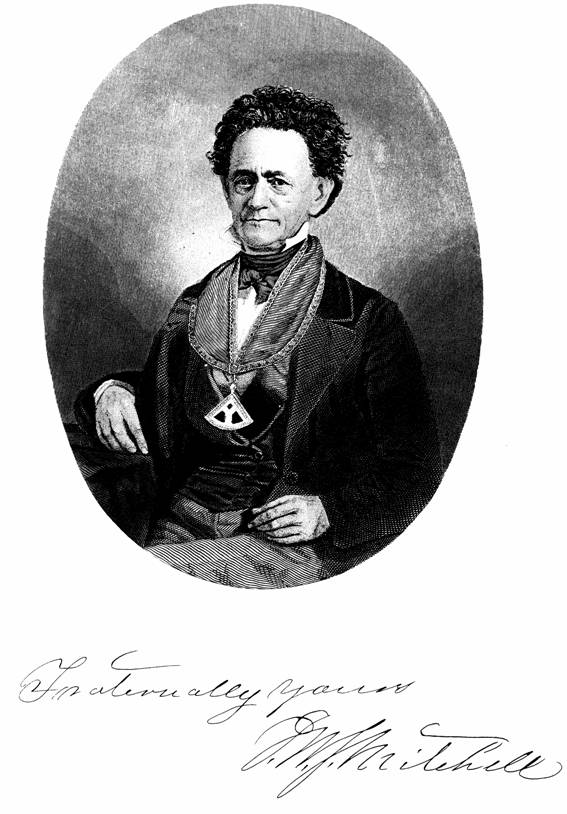
Dr. James W.S. Mitchell (PGM of Missouri) was the first to venture a major history, with a distinct bias toward the Antients. In the end, between the quality of the actual books (two volumes, bearing few graphics and published with small print), they are little known, today. It is perhaps validly said that Mitchell’s chief contribution was intellectual stimulation and contrast.
In 1858 Mitchell published “The History of Freemasonry and Masonic Digest.” By 1869 it was in its seventh edition, ranking second only to the works of Preston and Oliver; it was the most widely-read Masonic book in America. Vol. I of that edition contains 720 pages; Vol. II contains another 719 pages. Together, they covered the histories of Operative Masonry, Speculative Masonry, the High Grades, the Egyptian Mysteries, and included much material about Solomon; given that Mitchell followed Oliver in believing that Solomon was the first Grand Master.
Mitchell began his composition of Masonic history in 1855; ten years after Mackey published his “Lexicon;” containing a collection of brief articles and certain of Mackey's early Masonic theories. Both Mitchell and Mackey suffered from the void of reliable Masonic literature; there were no Masonic libraries. The authority up until that time was Oliver. Thus, Mitchell is entitled to credit for a massive undertaking, regardless of modern agreement with his views. Certainly, it took the best efforts of men such as Mitchell, Gould and Mackey to provide the foundation for modern Masonic history.
It should be noted that Mackey’s history was only half completed at the time of his death (1881); his work was completed and amended posthumously.
Mitchell’s work illustrates what was known, believed and practiced in Masonry in the United States, in the 1860s time frame – also the period of the American Civil War. Lacking a better foundation, Mitchell was obligated to reason and speculate, based on what little material was available; augmented by his best judgment and intuition. Certainly, Mitchell’s presented facts are both sincere and valuable, as are the facts presented in Oliver's books. Mitchell’s chapters on jurisprudence present an interesting set of positions on what was believed and practiced in the 1850's; that work being invaluable for comparison with modern jurisprudence.
Mitchell’s work was preceded by the "Baltimore Convention of 1843", held May 8th through the 17th, in an attempt to agree upon a standardized "mode of work" to be recommend to the various Grand Lodges. The intent being to create a Masonic ritual which could become the uniform standard in America.
The background to this convention came from the catechism form of the lectures of the day, which came to this country with Freemasonry. That system evolved from Anderson and Desaguliers; revised and "improved" by those such as Martin Clare, Thomas Dunkerly, William Hutchinson and William Preston.
The spread of the Prestonian work was largely credited to Thomas Smith Webb, who published his "Freemason's Monitor" in 1797. Webb supposedly received the Prestonian work from a pupil of Preston's, one John Hanmer. Webbs work was popularly received in almost every jurisdiction (Pennsylvania excepted). In general, the radical majority of the U.S. jurisdictions adopted some or all of Webb's modifications of Preston’s work. In turn, Webb's labors were greatly enhanced by Jeremy Cross, in his "True Masonic Chart," illustrated by the Connecticut engraver, Amos Doolittle. That work was the foundation of the art seen today on the various Masonic charts and lecture slides.
In the early days of Masonry in America, there was no standardized work. As described by Rob Morris: "The catechism being committed to memory the learner was supposed to possess the method of work, that is, the drill and drama, or ceremony of Masonry, which was made literally to conform to the lectures."
In the end, the Baltimore Convention adopted the lectures as taught by Thomas Smith Webb, making only three major changes of importance; recommending their adoption by the Grand Lodges, then in existence.
The matter of ‘ritual’ having been decided, the assembly of a viable history was mandated.
It is undisputable that Dr. Albert Mackey’s later illustrated encyclopedia and history prevailed in terms of both content and quality. While out of print by nearly a hundred years, the Mackey Encyclopedia (three volumes in its final format) and seven-volume History is also available in CD format.
Know James W.S. Mitchell:
PREFACE
IT has been said that the business of a historian is to detail facts unaccompanied by his opinions in favor of, or against particular theories. Others go further, and say that a theory in history is preposterous." Now all this sounds very well; as all men would be likely to agree in saying that the collation and proper arrangement of facts does indeed constitute history. But it is a question of grave importance, whether, under certain circumstances, it does not become the duty of the historian to do something more than this. How should we, at the present day, be able to arrive at a knowledge of some of the most important events of the middle ages, had not historians, after having detailed the known facts, reasoned tom cause to effect, in order to prove the existence of other facts, not self-evident ? One class of historians give us a very interesting and somewhat detailed account of the reign of Queen Semiramis, while another class, equally honest and intelligent, tell us that no such Queen ever lived, though both agree in stating the important facts of the supposed reign. Here is a palpable contradiction; and yet is it possible, by the use of other facts and reasonable deductions, drawn from thence, to determine which is right. Even at the present day, witnesses are being exhumed from the bowels of the earth, which, of themselves, speak no language now understood, but, when submitted to the antiquarian tests and compared with other and known developments, are made to testify of important truths which have been buried from the knowledge of men for ages past. It is a historical fact, that Cortes found a stone at the city of Mexico, so large that no man of his, or the present age, has been able to say by what power it had been elevated to its then situation. And must this mystery forever remain necessarily unsolved, because nothing can be found on record to explain it? On the contrary, should the means be discovered for raising similar bodies, would it not be the business of the historian, after detailing this fact, to reason upon the probability of the use of a similar power by the aborigines of Mexico? It is a historical fact, that the said stone contained a great number of devices and hieroglyphics, which could not be explained, even by the natives. And should this, or any future age, discover a key capable of clearly unraveling a part of these mystic symbols, may not the historian, after detailing this fact and its developments, proceed to explain the relative position of the remainder, and deduce from thence the probable reading of the whole?
In, like manner, where truth has been covered up, or mystified by fiction, it would seem to be the writer's duty to hunt up and bring to bear all accredited testimony within his reach. in order to lift the veil and expose the deception.
We have reason to believe that Masonry was, originally, a secret Society, and was, governed by laws known only to the members. We read of old manuscripts being in the hands of private members, at an early day, but we have evidence tending to show that those manuscripts bad reference alone to the fundamental laws, so far as they could be written, together with, such usages, as, at an early day, were not considered to belong exclusively to the Lodge room; and yet, even these were held to be exclusively the property of the initiated, and with which the world had no right to become acquainted.
Such, it is thought, was the condition of things until the seventeenth century, when some publications were made, but so meagre and unsatisfactory to the world, as to serve only to whet the curiosity of the lovers of ancient lore. Soon after the reorganization of Masonry in London; and the establishment of the present Grand Lodge system, a spirit of inquiry was set on foot by Grand Master Payne, for all reliable evidences of the true laws, usages, and, if possible, evidences of the history of the Society. As early as 1719, the Grand Lodge made a request to all private Masons, to bring, or send forward all manuscripts in their hands; which request was generally complied with, though a few, who still adhered to the old teaching, that no publications were allowable, committed to the flames some Masonic papers, rather than risk them in the bands of their descendants. It is believed, however, that no, material loss was sustained by the burning of said manuscripts, as those that were preserved contained all the important facts which had ever been written. And yet, after they were all carefully examined, it was found that they furnished but little more than an index, pointing to the rituals and traditions of the Order. Doctor Anderson was appointed a committee to collate the old laws, and, as far as practicable, write a history of English Masonry; and, while we have reason to believe that he faithfully collated and digested the laws, we are at a loss to account for the position he assumed in fixing the origin of Masonry. The Doctor did not claim that the manuscripts collected furnished his data; on the contrary, it was then generally believed that no such manuscripts had ever existed. We further know that he did not rely upon the legends or traditions of Masonry, for these all go to disprove his theory, viz.; that the Institution was as old as the world. It is hardly fair to suppose the Doctor did not know that, down to that period, the Fraternity believed that the origin of Masonry was known only from the teachings of the Lodge room; and yet be seemed to attach more importance to the supposed examination of a brother by Henry VI., in which the witness is made to say that "Masonry was known to the man in the West, before the man in the East," and, in assuming the hypothesis that Masonry was about as old as the world, very properly avoided any reference to those traditions which point to the man who was the instrument in bringing it into being, and perfecting its teachings.
When Doctor Anderson wrote, Masonry was but just emerging from the dark gloom of threatened annihilation, and it is not unfair to suppose that its first historian was more or less influenced by a desire to win for it, popularity: and if the great body of men were then, as now, more readily won by marvelous tales, than by simple and plain truths, we may conclude it was a master-stroke of the pen to deal in fiction; and this the more readily, because, admitting that he knew the Lodge room alone could furnish reliable testimony; be knew that Masons would not then have tolerated a publication of the facts. Certain it is, that the position be assumed carried with it the privilege of entering the broad field of conjecture, and afforded him an opportunity to feed the fancy of his readers with both facts and fiction: and the latter is equally as safe from criticism, for nowhere upon record could be found anything which would disprove either his hypothesis or his conclusions; in short, as the facts had never been published, the world was not prepared to gainsay his (the most extravagant) claims of its antiquity, nor to pronounce his theory “the baseless fabric of a dream!"
Since the publication of Anderson's Constitutions, containing a very faithful account of English Masonry, and a fancy sketch of its origin,
Page VIII PREFACE.
many sketches have been written, claiming to be historical, no two of which, it is believed, agree as to the time when the Order was inst> toted. These writers may be classed under four heads, and may be designated as follows: First, those who, in the main, agree with Anderson as to the origin of Masonry, but who undertake to fix the precise date‑some at the Garden of Eden, some in the days of Enoch, some in the days of Noah, and last, though not least, a celebrated divine of the present day fixes its existence in "the great empyrean of space, before this world was created." The second class, conceiving that something very like Freemasonry was absolutely necessary to relieve the descendants of Noah from the curse which God entailed upon them, by confounding their language, assume the hypothesis that Masonry was instituted at the Tower of Babel, before the dispersion, thus affording the tribes a universal language. The third class charge that the preceding classes are dependent upon mere theory, unsupported by any known facts for their conclusions, and, therefore, resolved to have, themselves, authentic testimony of the existence of the very oldest secret society, and, in their success in proving, from authentic records, the early existence of the Egyptian Mysteries, very wisely conclude that it is worse than useless to go further in their antiquarian researches, and jump to the conclusion that either Freemasonry is the mother of the Egyptian Mysteries, or vice versa. Thus, by some of this class, Masonry is the mother, and by others she is the daughter. The fourth class take exceptions to all the doctrines of the foregoing ‑deny the antiquity claimed for the Society, and undertake to show, from recorded testimony, that Masonry originated with the Orders of Knighthood, during the Crusades to the Holy Land. And now another adventurer enters the field, and, though " solitary and alone," he has the temerity to venture the opinion, that his predecessors were all wrong‑that the origin of, Masonry is not a matter of doubt, or should not be, to any well informed Mason. whose special attention has been called to a few well known facts; on the contrary, that its origin is so clearly and minutely detailed in the Lodge room, that all Masons must be brought to see that there alone can the whole truth be learned. This being the hypothesis of the Author of this work, it will
Page IX PREFACE.
be seen, from the facts before stated, that it would be impossible for him to write what he believes to be a true history of the Order, and throughout confine himself to a detail of recorded facts. And, aside from the consideration of the origin of Masonry, by what means may he proceed to detail its rise and progress throughout the civilized world, relying alone on recorded testimony, while only detached parcels of the whole truth have ever been published? Doctor Anderson has given us more historical detail than any other writer, and yet his investigations were confined mainly to England, Scotland, and Ireland; and, indeed, strictly speaking, his history is only complete, so far as it relates to the South of England, or, more properly, the city of London. Preston copied from Anderson, and brought down the history of the Grand Lodge of England, and its dependencies, to his own time. Doctor Oliver extended Preston's history through a period of ten years, but confined himself almost exclusively to his own Grand Lodge. Laurie's history is almost a literal copy of Anderson's, except of the Order in Scotland, which is much more minutely given. There are many volumes in the German and French languages, written with great ability, but, as far as the Author can judge, they all have reference to the various modern degrees, called Masonry. From what has been said, it will be seen that the Author relies upon the traditions for much, very much of the material upon which to found his history, and, therefore, he must reeds do all in his power to clear away the rubbish, and bring to light those sacred truths which have been thrown over by careless and unskillful workmen, and which, for more than a century, have been covered up, deeper and deeper, by fancy sketches of imaginary theory. If the traditions of Masonry are not reliable as authority for the foundation of a historical detail, then are they the merest phantoms of a distempered imagination, and we should blush to use them in the Lodge room, as the foundation of all our instructions. On the contrary, if they merit the high place they now occupy, as teachers of those great truths which, for ages past, have served to unite the discordant materials incident to man's nature, and link together a mighty Brother. hood, then are they entitled to all credit, and, by their aid, may the origin of Masonry be clearly pointed out, and a true history of the Order may be written and published to the world, with outlines sufficiently broad, and details sufficiently clear, to answer the just demands of the
Page X PREFACE.
uninitiated, and with still more precision to the understanding of the Craft; and all this, without doing violence to the laws of secrecy. With these convictions, the Author has undertaken to prove that Masonry took Its origin just where, and in the precise manner pointed out by our rituals and traditions; and whenever and wherever authenticated fact were to be found, he has endeavored to detail them impartially, without pausing to inquire whether they tended to prove or disprove his peculiar opinions. And where facts were not available, he has endeavored to glean the truth by analogy and sound deductions. In his history and review of the great batch of modern degrees, called, by their inventors, Masonic degrees, the Author has endeavored to have but one great end in view, viz., to show what is, and what is not Free masonry, and to warn the true Fraternity against amalgamations or entangling alliances with all outside institutions, however praiseworthy their objects and ends may be.
Page XIII
CONTENTS
CHAPTER I
Death of Solomon....................... 1
Freemasonry a Secret Society.............. 17
Division of Solomon's Kingdom........... To the Traditions are we indebted for the Influence of Solomon's Masons............ 96
Early History.......................... 17
Death of Josiah, King of Judah......... 97
The origin of Masonry Investigated......., 18
Destruction of Jerusalem.................. 98
Preston's Views...................... 18
The Early History of the World............ 20
CHAPTER VI.
Dr. Oliver's Opinions Reviewed............ 23
Liberation of the Jews from Captivity...... 101
The Cabiri........................ 38
Reign of Cyrus......................... 102
Dr. Oliver's Initiation of Moses by Jehovah.. 39
Artaxerxes, Reign of................. 103
Laws by Moses to Lodges and Chapters,‑ Darius, Reign of...................... 103 Oliver................................ 40
Zerubbabel.......................... 104
Masonry the True Religion................. 46
Second Temple.................... 104
Masonry Aids to Spread the Gospel to Heathens............................... 47
Pythagoras.......................... 106
CHAPTER I. CHAPTER VII
The Author's Opinion of the Origin of Masonry........................... 60
Death of Alexander the Great......... 113
Masonry is of Divine Origin.............. 53
Euclid.......................... 113
Solomon the instrument in establishing Masonry............................... 54
Alexandrian Libry.............. The Three Degrees of Masonry, History of... 61
Tower of Pharaoh........................ 11
Entered Prentice.................... 63
CHAPTER VIII.
Asdrubal's Wife Curses Her Husband....... 121
The Fellow Craft, History of.............. 66
City of Rhodes.......................... 7
Lodges allowed to confer only the Apprentice Degree............................ 68
Colossal Statue........................... 118
Wall of China........................... 12
Second Section of the Fellow Craft's Degree.. 71
Lord Amherst's Visit to China.... 123
Distinction between Fellow and Fellow Craft. 74
The City of David................. 76
CHAPTER IX
King Solomon to King Hiram.............. 77
Fall of Carthage.................. 12
Hiram Abiff...................... 78
The Tuscan Order of Architecture......... 127
Classification of the Workmen on the Temple 80
Pompey the Great........................128
CHAPTER IV.
Masonry in Rome............ 128
Masonry in Judea................12
Solomon's Temple..............83
Reign of Herod 3 ............. 1
Celebration of the Cape‑Stone.............. 86
Dr. Oliver's Traditions of the Curious Stones. 88
CHAPTER X
Solomon the First Master.................. 89
ThBuildings Erected oy Solomon......... 90
Before Christ Forty Years................. 13)
Flight of Herod....................... 136
CHAPTER V. Judea in the Hands of a Stranger.......... 13
Lodges Established‑Grand Lodge at Jeru‑ Masonry Neglected........................ a.esm................................ 92 Charlemagne, Reign of............... 141
Page XIV
ziv CONTENTS. PAGE. AOIL The First Treatise on Architecture......... 143 CHAPTER XVI. Architecture of the Sixteenth Century Cor‑ Union of Scotland and England....... 204 pared......................... 145 Reign of James I................... 204 Inigo Jones,.............~............... 206 CHAPTER XI. Nicholas Stone........................... 207 Masonry in England, Introduction of..... 146 The Massacre of Four Thousand Protestants Introduction of the Saxons into England.... 151 in Ireland............................. 208 london Inclosed with a Stone Wall....... 151 Charles I. and Cromwell.................. 209 Origin of the Name England.............. 153 Cromwell, Washington, and Bonaparte..... 209 Masonic Records Lost in the Wars with the Restoration of Charles II.......... 210 Druids............................ 154 The'Kings call for a Masonic Assembly.....210 Prince Edwin................,.,... 154 General Assembly of Masons, 1663.......210 Grand Lodge at York.................... 155 Regulations of 1663.................... 213 King Athelstan.......................... CHAPTR I. First Prince of Wales.................... 161 Oxford College Built..................... 161 Operative Masonry Abandoned.... 2.... 214 The Templars Erect their Dormus De....... 161 Sir Christopher Wren................. 21 Celebration of the Cape‑Stone of Westminster Great Fire in London, 1666.............. 216 Abbey............... 161 Roofing for Houses in the Seventeenth CenOld Records of Masonry in the Reign of Ed‑ tury............................. 218 ward III.................... 162 Rebuilding St. Paul's Church........... 219 Sir Christopher Wren's Deputy............ 223 CHAPTER XII. Walbrook Church....................... 223 Edict of Henry VI. against Masons......... 164 Death of Charles II........................ 224 Tne Bat Parliament....................... 166 Reign of William and Mary............ 225 Winchester's Hostility to Masonry........ 166 Masonry Neglected................. 225 A Regular Lodge at Canterbury in 1400.... 171 CHAPrYf XVm. C~HAtI'i xAli. Masons Should Again Take Charge of Archi‑'The White and Red Rose.................. 173 tecture............................... 227 JLtter from John Locke.................. 173 Grand Master Wren's Letter of Instructions The Old Bodleian Manuscript.............. 174 to Builders........................... 229 Abrac............................. 181 G. Master Wren's great Age compels him to CHAPTER XIV Neglect Masonry....................... 234 The Churches of St. Paul and St. Peter..... 234 Reign of Henry VII................. 183 Apprentices Members of G. Lodge......... 235 A Lodge of Masions in 1502.it....... 184 Re‑organization of Masonry m the South of ons of Masons Initiated at Eighteen Years of England............................... 236 Age................................. 185 Grand Ma ter Payne's Administration...... 239 Henry VIII. and his Parliament deny the Occasional Lodge for the Duke of Lorraine.. 249 Right Divine of the Pope.............. 186 The Old Gothic Constitutions ordered to be Reign of Elizabeth..................... 187 Revised by Dr. Anderson, 1721.........241 Districting England‑Provincial G. Masters. 190 Committee cf Fourteen............. 241 The Character of Queen Elizabeth,........ 191 Masonry Popular in England....... 243 CHAPTER XV. CHAPTER XIX. Masonry in Scotland................... 194 Masonry at York.................... 260 Origin of the Scots.................... 195 Masonry Neglected in London............. 250 Macbeth's Descendants................ 197 Grand Lodge of England sends a Charter to Robert Bruce........................ 199 York............................. 251 Masons Lived in Camps or Huts............ 200 Committee of Charity..................... 253 Kilwinning and York the Nurseries of Ma‑ Stewards Admitted to Seats in G. Lodge... 255 sonry.................................. 200 Novelties in Grand Lodge.................. 255 Ordered by the King that the Masons Pay Frederick, Prince of Wales, Initiated... 256 the G. Master.......................... 201 Attempt to remove a Landmark....... 257 William Sinclair, G. Master............... 202 Second Edi:ion of the Book of Constitutons.. 257 diary Queen of Scots................ 202'
Clandestine Makings................ 261
Page XV
CONTENTS. XT PAGE. rAC6. Only Members of Lodges Ertitled to Charity. 259 Anti‑Masonry ir Holland and France....... 8. Rupture between G. Lodge of England and Bull of Pope Engenius against Masonry...... 81A that of York...................... 260 Imprisonment of Masons by the Inquisition. 329 Seceders and Ahiman Rezon.............. 260 Masonry in Switzerland................ The First Form for a Procession............ 262 The Council of Berne against Masonry.....30 Action Against the Ancient Masons........ 265 Synod of Scotland against Masonry....... 831 CHA'PTER XX. CHAPTER XXV. Reign of Georgem.................. 268 Masonry in Ireland...l.............. 332 Initiation of the Dukes of Gloucester and Address of the Grand Lodge of Ireland to the umbtlation of the Duk.es of G.loucester and. Cumberland.......................... 269 Duke of Sussex........................ 339 Taxing Grand Officers to Build a Hall....... 279 The Duke's Reply................. 3 Past G. Officers May Wear Gold JewelsCelebration in Dublin in 1838............. 341 Past G. Officers May'Wear Gold Jewels..... 270 Difficulty between G. Lodge and the Lodge of France, Germany, and America made the Antiquity............................. 274 CHAPTER XM. CHAPTER XXVI. History of Lodge of Antiquity‑Continued... 276 Masonry in Scotland.....................34 Initiation of Omdit‑ul‑Omran Bauhader.... 279 Monument to Bro. Robert Burns...... 349 Grand Officers with Robes................. 280 The Throne of a Grand Lodge..... 362 Regulations against Non‑affiliated Masons... 281 Monument to the Memory of Sir Walter Scott 366 New Regulations Adopted.............. 281 Laying a Corner‑Stone in Scotland..... 367 Fines for Non‑attendance................ 282 CHAPTER XXVII. CHAPTER XXII. Masonry in England.............. 361 Foundation Laid for the Female Orphan Charges against Brethren for Visiting Ancient School..~ S ‑Lodges. 361 i~,ules fSchoolo................................. 361 Rules for the School........... 287 Portraits of Grand Masters......... 862 Address of the G. Lodge to the King....... 290 Resolutions of Grand Lodge....... 363 Address of the Grand Lodge of Massachusetts Revoking Innovations........ 364 to Brother George Washington........... 293 Great Dinner, January, 183.......... 366 Washington's Reply..................... 294 CHAPTER XXVIII. Washington as a Mason.............. 294 fWashino as on.g294 The Dukes of Sussex and Kent Grand Masters Death of Washington‑Funeral...........295 of the two Grand Lodges.. 373 of the two Grand Lodges................ 378 CHAPTER XXIII. Union of the two Grand Lodges........ 373 Articles of Union.................... 374 The Jesuits and Masonry.................. 298 Consequences of the Unio. 382 Consequences oftheUnto.,............ 382 Expulsion of the Jesuits from all Countries W o o What is Spurious Freemasonry............ 384 except the United States............... 299 eete id t.29...... A Clandestine Mason Contending at law for Expose of the Articles of Union of the Jesuits 300. 301‑a Fee for Making a Mason............... 386 Weishaupt's Society....................... 301.................. Insubordination of Masons at Liverpool..... 386 Baruel and Robinson's Opposition to Masonry 302 Prince of ales Lo Prince of Wales Lodge.................. S8 Revolution in France..................... 305 Influence of Masonry on a Pirate........... 389 Inhuman Treatment of American Prisoners. 307 Beautiful Ceremony of Laying a Corner‑Stone 390 Robinson's Proofs of Conspiracy........u... 308 Extract from Dewitt Clinton's Address...... 315 CHAPTER XXIX. Expulsion of the Jesuits in 1847............ 3'8 Initiation of King William IV.‑The Offices Masonry Meddles not with Politics or Re‑ He Filled.............................. 393 ligion............................. 319 An Asylum for Decayed Freemasons........ 393 Address to the Duke of Sussex............. 396 CHAPTER XXIV. Masonry in the Nineteenth Century........ 401 Masonry in France....................... 320 The Duke of Wellington's Initiation......... 408 New Degrees..................... 324 Badges of Mourning.................... 410 Masonry n the East Indies................ 325 Belgian Proscription of Masonry..... 4.... 410 Organization of the G. Lodge of Ireland..... 325 Anti‑Masons Differ in Different Countries... 413 The Order of Knights Templar instituted.... 335 Lodges in the Army Opposed.......... 417 Warrants sent into Russia and Spain....... 326 Hindoo Opinions of Masonry............,. 421
Page XVI
Xvi CONTENTS. PAGE. Pi CHAPTER XX. The Compact of 1827................, 12 Masonry in the United States.............. 423 Rupture and New Grand Lodge............ 4 Was Masonry Among the Indians Before the CHAPTER XXxV. Times of Columbus..................... 427 The Greek Language among the Indians.... 427 Rupture of Union of St. John's Grand Lodge with the Indian Medicine Lodge.................... 431 Indian Medicine Lodge................ Grand Lodge of New York............... 530 No Evidence of Masonry among the Indians. 434 Lodges Established by a Council of Thirty Welsh Language among the Indians........ 435 third Degree....................... 553 third Degree.......................: CHAPTER XXXI. Union of 1858...................... 554 Was Freemasonry Known to the Aborigines Masonry in Pennsylvania.............. 555 of the South?.......................... 441 Smiths Aliman Re........... 55 he Ancient Mysteries of Mexico.......... 442 General Grand Lodge Recommended........ 6 The Great Temple of Mexico............. 444 Establishment of an Independent Grand Initiation Ceremony..................... 445 Lodge CHAPTER XXII. CHAPTER XXXVI. the Early Setflers in the United States..... 453 Masonry in Georgia....... 56 Discovery of this Country by Icelanders iever was any Athol Masnny in Mas 1003 of ta chusetts.................................. 53 6 1003..sachusetts............................ 56 Voyage ofColumbus.................. 454 Masonry in South Carolina............. 571 Voyage of John Cabot.................. 455 Masonry in North Carolina......... 576 Voyage of Sebastian Cabot................ 456 Masonry in Virginia..................... 578 Voyage from France................... 456 GGrand and Deputy Grand Masters of Virg;‑ia 586 Ponce de Leon's Vovage.............. 467 Grand Lodge of New Jersey............... 587 De Soto's Voyag...................... 458 GrandodgeofMaryland.587 Indians Carried into Slavery..... 458 MasonryinConnecticut............. 58 French Colony..462 Hiram Lodge, No....................... 589 Colony of Hugenots....................... 463 Grand Lodge of Rhode Island.............. 597 Malendez, the Spanish Assassin.......... 464 Grand Lodge of Vermont................. 5 Sir Walter Raleigh's Colony 4........... 466 History of Masonry in Kentucky........... 59 Manteo, an Indian Chief................... 467 Masory in Delaware......... 603 What Became of Raleigh's Colony......... 469 Masonry in Ohio........................ 60 Settlement at Jamestown............. 470 MasonryinteDistrictofColumbia. 09 Pocahontas and Smith................... 472 Masonry in Tennessee................... 610 The First Warrant sent to America......... 477 Masonry in Missiippi................. 60 Masonry in Louisiana.................... 611 CHAPTER XXXIII. Old Records of G. Lodge of Louisiana....... 612 Masonry in Massachusetts................ Masonry in Missouri................... 622 St. John's Provincial Grand Lodge Estab‑ Masonry in Alabama...................... 629 lished................................ 482 Masonry in Illinois........................ 638 St. Andrew's Grand Lodge Established..... 484 Masony in Florida....................... 638 Joseph Warren appointed Provincial Grand Organization of the G. L. and G. Chap. of Fla. 640 Master............................... 486 Masonry in ioi,........................ 642 Both Grand Lodges Suspended in 1775..... 487 Masonry in Texas........................ 645 Battle of Bunker Hill.................... 487 Grand Lodge formed................. 649 Re‑organization of St. Andrew's G. Lodge... 487 Grand Chapter........................ 653 St. John's Grand Lodge Resumes Labor..... 488 Masonry in California.................... 656 Union of the Two Grand Lodges............ 489 Masonry in Kansas Territory............... 661 CHAPTER XXXIV. Masonry in Nebraska Territory........... 662 History of Masonry in New York........... 498 Masonry in Oregon Territory..........6.... St. John's Lodge, No. 1................... 00 Masonry in Minnesota Territory.......... 664 A Thrilling Story of an Escaped Prisoner.... 501 CHAPTER XXXVII. The Athol Warrant for a Grand Lodge in New Royal Arch Masonry.............6.... 660 York........................... 503 Doctor Folger's Letter.................... 1 Establishment of the Present Grand Lodge.. 505 Council of Royal and Select Masters..... 700 Origin of Difficulties in New York......... 508 History of the Council Degrees in Alabama.. 710
Page 17
CHAPTER 1.
FREEMASONRY was strictly a secret Society for more than two thousand, years; its members were forbidden to publish any thing, either in relation to its origin or teaching; and yet, throughout all that period, its history was transmitted from generation to generation, unspotted by time, and unadulterated by the sacrilegious hand of the innovator. Nor is this difficult to be accounted for, when it is remembered that the legends ‑ the traditions of the Order, have ever constituted a portion of the teaching, intimately connected with, and inseparable from, the ritual of the Lodge room. And these instructions have not only been communicated to all initiates, but they have been required so to impress them on their minds as to be able to teach in turn. Thus, while the middle or dark ages enveloped in oblivion the very footprints of the world's history, leaving us but the merest fables of Heathen Mythology to tell of Time's onward course, our Order, having been transmitted from society to society, from man to man, in the same unmistakable and unalterable symbolism, preserved its identity, and perpetuated its existence in the upward and onward mission it was instituted and sent forth to accomplish. We believe it is susceptible of the clearest proof that to the universal language of Masonry, and its unerring method of transmission, is the world indebted for a knowledge of the most remarkable events of seven hundred years of the world's history; and, to well informed Masons, it satisfactorily appears that by divine permission, it was made the instrument, not only for the preservation, but the discovery of the five books of Moses, after a lapse of four hundred and seventy years of lawless disorder. And, if there were no other interesting features in the general aspect of Masonry, these, it would seem, are abundantly sufficient to rivet the attention and excite the
Page 18
careful investigation of every inquiring mind, in relation to its true history and principles. But before we attempt to fix the point of time at which our Society was instituted, it becomes our unpleasant task to clear away the rubbish which has been thrown over it by unskillful and unfaithful workmen. The distinguished Preston says: "From the commencement of the world we may trace the foundation of Masonry; ever since symmetry began and harmony displayed her charms, our Order has had a being." If the author had stopped with the first part of the paragraph here quoted, we could readily have reconciled it with the facts, as we believe they exist, that the foundation was then laid. That some one or more of the great principles taught by Freemasonry were known from the foundation of the world, no well informed Mason is likely to question; but the existence of that principle, or even a knowledge of all the principles at that period, which are inculcated now by the Craft, does not prove that the system or art of teaching those principles was then known or practiced; and hence the objectionable part of the paragraph is that which declares "the existence of our Order ever since harmony displayed her charms." Now, this is a declaration that Masonry, as a Society, has existed ever since the creation of the world, for we must regard it as something more than the knowledge of certain principles, separate and distinct, or in chaotic confusion. Masonry is an Order, a Society of individuals, having a systematic art of teaching certain principles, and linking its recipients together by certain indissoluble ties which enable them to distinguish each other, and place them under obligations to befriend and relieve each other from the withering blight of misfortune; and it is as impossible to conceive of the existence of the Order without a community of individuals to constitute that Order, as to suppose the existence of a government without subjects to be governed. We desire the reader to satisfy himself in relation to the correctness of this position, for upon it depends the fitness of much about to be said; and we desire to use no terms which do not convey our meaning, nor assume grounds which are not sustained by facts. Preston, we believe, was a good man, and a devoted
Page 19
Mason; loved its principles and practiced them; but it is matter of extreme regret that he has done little more than to copy Anderson, and enlarge upon his wild theory. Had he traced Masonry to that period to which the written records point, or where Masonic tradition places it, his labors would have been rewarded by the plaudits of those who are seeking after true Masonic light. But his work would, in this particular, have possessed none of those charms of miraculous mystery after which the world is running with almost frantic rage. That this declaration is true, we have only to refer to the light literature of France, the very trash of which is read with more avidity and eager delight at the present day, than the ablest productions in the investigation of the means which conduce to man's true and lasting happiness; nor is this the only example of man's love of the wonderful. Science is being perverted and thrown into ridicule to suit the vitiated taste of the age. A gentleman, whose character for ability and learning in the literary world places him high as an instructor, may propose to deliver a lecture in any of the departments of science, and he can not, in any town in the United States, obtain half the number of hearers as can be had by the most illiterate vagabond who professes to close his eyes by an impenetrable hoodwink, and look with the eye of the mind through his own skull and distinctly see any object placed before him. Alas! how true it is, that while posterity will accord to this generation a rapid march in the onward course of improvements, they will also set us down as a race of men taking pleasure in being deceived; a people who are best pleased when most deceived, and the more ridiculous the manner used, the more fascinating the deception; and thus it is with Masonry, we delight to call our Institution" ancient and honorable;" ancient as having existed from time immemorial' and to confirm the belief of this oft repeated sentence, the historian is encouraged to date its origin back to a period anterior to that which affords any proofs for or against it; which leaves the writer at liberty to manufacture a tale of its origin and rise, as senseless and miraculous as the tuste of the age demands. Ia order that we may the better exhibit the ground we
Page 20
occupy, it will be necessary to inquire into the early history of man; this we shall do only so far as is absolutely necessary to the elucidation of the subject before us. If we were in possession of a clear and well defined history of the world, from its creation to the present day, we might arrive at correct conclusions with much less difficulty; but, unfortunately, the first eighteen hundred years are almost buried in impenetrable oblivion; for down to the time of the Flood, we know very little more than the genealogy of the Patriarchs, together with their vices and ultimate destruction by the Deluge. If we take civil history, we find its first dawn is to be traced only as far back as the foundation of the ancient kingdom of Babylon, or the Assyrian Empire; and even there its light is shrouded by many mists, penetrated by dubious rays. This period is about a century and a half after the Flood. Nimrod, the founder of Babel, was the great grandson of Noah, and even of his reign and government we know nothing, save from the writings of Moses, which are confined to a few particulars. That Ham and his sons rebelled against the authority of Noah seems probable, if we rely on the opinion of most chronologers; whereupon, Noah and his followers crossed into Persia, or India and China, and as Shem, whom he considered in the line of the Messiah, was doubtless a favorite with his sire, it follows as probable that they settled in the same country. That, while Elam, the eldest son of Shem, settled in Persia, Noah went still further East; and, though we are not well informed of the history of the Chinese Empire, its antiquity, the language of the people, their numerous traditions of the flood, render it probable that Noah was the first to give it being as a nation; it was certainly founded by the wisest men. To which may be added the somewhat singular fact, that Moses is silent in relation to Noah's history after the Flood; which is accounted for by writers on the ground that Noah had left Western Asia before the time to which Moses alludes, and his history is mainly confined to that scene. If Masonry existed and was operative in those days, then might we expect to find it in a higher state of perfection than at any subsequent period; for of all the cities, ancient or modern, of
Page 21
which we have an account, none, perhaps, will be found to surpass ancient Babylon, either in extent or grandeur. It was built on a fertile plain, watered by the river Euphrates, which ran through it, and was encompassed by a wall three hundred and sixty feet high, eighty‑seven feet thick, and inclosed a square of ground, each side of which was fifteen miles in length, so that a circuit of sixty miles was made in passing around the wall. There were fifty great streets, one hundred and fifty feet wide, crossing at right angles, and terminating in four other streets of two hundred feet in width at each side of the wall. The entire space within was improved with splendid edifices and beautiful gardens; the buildings were three and four stories high, and of superior workmanship; there was also, around, a square building of four hundred feet on each side, carried up to the height of the wall, and a platform of immense stone laid thereon, upon which earth was placed, which not only served to produce splendid hanging gardens, but supported large trees; these gardens were watered by an engine from the river. These people also erected the Tower of Babel, the height of which is variously estimated. We are inclined to fix it at something over six hundred feet; its base was forty rods square. Whether this was built by Nimrod, Ninus, or Semiramis, is not clearly shown. Ninus was much occupied in building and beautifying the city of Nineveh. Semiramis has also the reputation of giving to the world a reign of more splendor for her great works in architecture, as well as achievements in arms, than any other sovereign for many generations; but it is difficult to form any well grounded opinion of those who succeeded her; for although we are told she abdicated the throne in favor of her son Ninyas, it is not stated in what year of the world, nor do we know any more of the history of the Assyrian Empire for more than one thousand years. Tradition has scarcely given us the names of the monarchs; it is probable, however, that a knowledge of the arts and sciences was lost, and that the people became corrupt, dissolute, and idle; that the monarchy was totally destroyed. One thing is certain, we can not rely upon any of the details of civil history, until the reign of Nabonassar, which was about seven hundred and
Page 22
fifty years B.C. Nabonassar was cotemporary with Jotham, King of Judah, and his reign was within five or six years of the founding of Rome: to this period only, can we trace civil history with any certainty. About six hundred years B.C.. Nebuchadnezzar, King of Babylon, invaded the Assyrian Empire, and destroyed the city of Nineveh; two years after he laid siege to Jerusalem, and after two years of untiring efforts he took and destroyed it, burnt Solomon's Temple, and carried the Jews captive to Babylon. This brings us down to a period after the introduction of Masonry, as we believe; and although the sketch is imperfect, it is sufficient to enable the reader fairly and clearly to estimate our own views, as also those from whose writings we shall make extracts. We say the reader must be prepared to judge with what accuracy the history of Masonry could be traced back to the anti-deluvian world, even if it then existed, by any thing which we find in profane history, when we remember that the link is more than once broken, and for a period of time which renders it impossible ever to be united by any power of the human mind. This being true, we are left only two other sources of information:‑1. The Bible; 2. Tradition; and we give full credit to each; but we are not to be understood as saying If such a revelation can be found in a Mormon Bible, we are prepared to admit its truth; nor are we willing to admit the bare declaration of any man that a tradition exists establishing the fact that Adam was a Mason. But if the Holy Bible, or that only true and holy tradition which has been regularly transmitted from age to age, through the degrees of Ancient Craft Masonry, places the Society in the antideluvian world, we will admit that we have learned Masonry in vain, and promise to commence de novo. If we could conscientiously believe that Freemasonry is Lux; that Lux is the true religion; that the true religion was revealed to Adam, then would we admit that Adam, Shem, Ham, Japheth, Enoch, and Noah were Masons ùthat Masonry dates its birth at the creation of the world‑and we could bring to our aid the testimony of nearly all the able writers who have figured as Masonic historians for the last one hundred years. Yea, we could reap the advantage of the testimony of
Page 23
one of the most learned writers of the present day, were we to take the ground that Masonry was instituted by a man who lived in the East, before Adam was created. Should we assume that Masonry is the uncontaminated worship of the only living and true God, we should be sustained by the same celebrated divine; and it would follow that, inasmuch as God had direct communications with Adam, and Noah having been pronounced a just man, these, at least, were "Ancient Free and Accepted Masons;" and as there is no evidence that Noah or his descendants departed from the true principles of religion, for at least one hundred years after the Flood, it would seem all were Masons until they rebelled against the authority of Noah, and assembled themselves together in the plains of Shinar, and attempted to build a tower, whose top should reach the starry heavens. If Masonry is Geometry, then were all the Antediluvians members of the Order; for Adam and Eve, especially the latter, gave evidence of a knowledge of this science. But we will more methodically accomplish the object in view, by taking up the works of Dr. Oliver, an eminent divine of England, who has written more on the subject of Masonry, in the form of books, we believe, than any other man. To say we are anxious for the result of an effort on our part to point out some of the inconsistencies and false positions assumed by so distinguished a historian, but poorly expresses our feelings; for the high position he justly occupies would deter us from the attempt, did we not believe his works are likely to do much mischief. As a Mason, we should not, in any case, tolerate a misrepresentation, but especially are we under obligation to expose spurious theories, when they tend to excite the ridicule and contempt of those who are not Masons, thereby bringing reproach upon the Craft. The first extract we shall make, is that to which we have already alluded, namely: "But Ancient Masonic traditions say, and I think justly, that our science existed before the creation of this world, and was diffused amidst the numerous systems with which the grand empyrean of universal space is furnished." * To this singular * Oliver's Antiquities of Freemasonri, page 26.
Page 24
if not Quixotic declaration, we deem it scarcely necessary to say more than simply deny its truth. We here assert that there is no such tradition; and in making this declaration, we feel called upon to state that we have taken all the degrees of Ancient Craft Masonry, together with the Christian and appendant degrees; in short, all the degrees recognized in the United States as Masonic. With the traditions of Ancient Craft Masonry we profess to be familiar, and we assert here that there is no such tradition; but we do not regard the traditions of any degrees of so called Masonry, above or aside from those of Ancient Craft Masonry, as entitled to implicit confidence these we hold in such veneration, that we feel bound to speak plainly when an effort is made to misrepresent them. Had Dr. Oliver given it as his opinion that Masonry, in all its simple beauty, existed in millions of worlds, and from all eternity, we should not have complained; for, although it might have produced the impression on our mind that it displayed the recklessness of a fanatic, or hired advocate of a bad cause, still, as we could neither show that the position is incorrect, nor satisfy any one else that he did not honestly entertain the opinion, we would be justified in remaining silent. But we regard Masonic tradition as the very highest order of testimony which can be found, to establish any event which happened anterior to that period to which clearly defined written history leads us, and, therefore, can not permit spurious traditions to be substituted to establish every chimera of the brain, emanating from those who may cater to the public taste. We will not say that the principles of the science were not diffused throughout the empyrean of space from all eternity, for the simple reason that we do not know it to be untrue; we only say, there is no such Masonic tradition. The Doctor says that "Masonry is Lux ‑ that Lux is the true religion." Then it follows that none can be saved but Masons, for we do not suppose false religion will save any one. If he had said that true religion and true Masonry consist simply in the belief of the existence of one Supreme Being‑the enlightenment of the soul, showing a self‑existent and eternal first cause, then all men are, and ever have been, Masons; for every
Page 25
nation, kindred, and tongue, from the Anglo‑Saxon down to the wild savage of our own forests, have a law written on their hearts, pointing to the Father of Spirits. But Dr. Oliver tells us what Masonry is, and, therefore, we know what he conceives true religion to be:' Speculative Masonry is nothing else but a system of ethics, founded on the belief of a God, the Creator, Preserver, and Redeemer; which inculcates a strict, obedience of the duties we owe to each other; inspires in the soul a veneration for the author of its being, and incites to a pure worship of the Creator." * That this is true to the letter, all well informed Masons will testify. Freemasonry is a system of ethics; it cultivates and enforces the most sublime truths in relation to man's present and eternal being, and it incites and encourages its votaries to look to God, and ask His blessings and instructions; it points to the Bible as the great book of God's revelations; but it does no more. It seeks not to renovate the soul and make sacrifice for sin, by pointing to the Lamb of God, who taketh away the sins of the world. It points neither to circumcision nor baptism for the remission of sins. It is a system of morals only. It is not religion; it is not in reality any part of religion. It is, as the Doctor here declares it to be, a system of ethics; and yet, next to the Christian religion, it is the most perfect system ever known to man; but does it follow that God gave to man, at his creation, a system by which an association of men were to be formed into a secret society, for the cultivation and preservation of our sacred rites? The fact that Masons, in all ages, since the introduction of our Order, have taught one or more of the principles of the true worship and knowledge of God, is no more evidence of its coexistence with the creation, than is the fact that every religious society in Christendom, teaching, at this day, one or more of the same principles, proves their respective existence, as such, in the garden of Eden, or even in the days of our Saviour's sojourn on earth. Oliver's Antiquies, p. 28
Page 26
We fraternally ask the reader to remember the extract above, made with a view to compare it with others which we shall make in the course of this investigation; for, notwithstanding the Doctor takes the ground that Masonry is the true religion, it seems to us that the next, to which attention is here called, tends to prove that Masonry is no part of religion: "Placed in the Garden of Eden, Adam was made acquainted with the nature of his tenure, and taught, with the worship of his Maker, that science which is now termed Masonry., This constituted his chief happiness in Paradise, and was his only consolation after, his unhappy fall."* Now, if this science was communicated to Adam with a knowledge of the true worship, then it could not have been more than an appendage to, and not even a constituent part of, the true worship; but as this constituted Adam's chief happiness in Paradise, then are we left to infer that God revealed to Adam the plan of salvation for fallen men, viz., repentance and faith in Jesus Christ, before he fell, because, the Doctor says, this transpired in the Garden of Eden; but we must suppose that Adam did not repent until after his disobedience, for this would be to suppose an impossibility; on the contrary, if we take the ground that Adam was a Mason before his fall, then must we believe that Masonry is something more than religion, as we understand it; for we suppose the true religion embraces an acknowledgment of guilt on the part of the creature, and an outpouring of sorrow for sin to the Creator; but man's primeval purity in Paradise, before the worm of corruption polluted his soul, needed no repentance, as without sin there could be no sorrow, or pain, or guilt. In short, Adam was created holy, upright, and pure, and needed not a knowledge of the true religion to add to his felicity. Again, if it constituted his chief happiness before his fall‑when he could not have felt the want of a plan of salvation‑and was his only consolation after his fall, it could not have been mere religion. The Doctor is not content with showing that Adam was a Mason, but evidently endeavors to produce the impression that his partner was also a Mason: * Antiquities, p. 41.
Page 27
"Seduced by these specious declarations, the mother of all Masons violated the sacred injunctions of God, and, through her entreaties, Adam followed the pernicious example, and both miserably fell from a state of innocence and purity, to experience all the bitter fruits of sin, toil and labor, misery and death." * If the author had said that Eve was the mother of all men, then would we have understood him as not differing from other historians; but to assert that Eve was the mother of all Mormons, or all Odd Fellows, or all Masons, presupposes her acquaintance with, and practice of, all the peculiarities of the particular sect of which she was the mother. Abraham was the father of the faithful, because he practiced that faith so perfectly, that God was pleased to declare that through him should all the nations of the earth be blessed; and if Eve was the mother of all Masons, a question of somewhat serious import might arise. There is an opinion among the vulgar that Masons have dealings with the devil, and it is sustained by quite as well authenticated a tradition as some of those mentioned by the Doctor. Now, if Eve was a Mason before she partook of the forbidden fruit, may it not be said that the devil communicated to her the secrets of Masonry,in order that she should fall, and thereby become the mother of all Masons? This opinion is quite as tenable as that Masonry is the true worship; that the true worship was understood and practiced by her, and yet failed to arrest her disobedience, and thereby save the world from sin and death. The Doctor says that when Cain slew his brother, he fell from the true principles of Masonry; that the earth was cursed; that a mark was placed upon the fratricide, and evil pronounced against his posterity: "His race forsook every good and laudable pursuit, along with Masonry, and degenerated into every species of impurity and wickedness." t Yet to these people he traces the origin of operative Masonry ‑another evidence that Masonry was the work of the wicked * Antiquities, p. 47. t Ibid p. 46.
Page 28
one. Jabal invented the use of tents; Jubal, his brother, invented music; and Tubal‑Cain, his half‑brother, invented the art of forging metals: who, together with their great grand sire and his descendants, erected the first city, which they named lanoch, after Cain's eldest son. Now, that the descendants of Cain were the inventors of the arts above named is asserted by Moses; but, when we remember that they were under the curse of God, were wicked and rebellious, how are we justified in attributing to them the practice of Masonry, if it is the true religion, and especially when the Doctor tells us that they had lost all their Masonry? But, anon, the Doctor turns with holy horror from this wicked and rebellious people to the family of Seth, the son of Adam: "Who was educated by his father in the strictest principles of piety and devotion, and, when he arrived at years of maturity, was admitted to a participation in the mysteries of Masonry, to which study he applied himself with the most diligent assiduity. The progress he made in this study is fully demonstrated by the purity of his life. Associating with himself the most virtuous men of his age, they formed Lodges, and discussed the first principles of Masonry with freedom, fervency, and zeal." * Reader, strange as it may seem, the above extract comes from the pen of one of the most learned divines of the age‑one to whom it would seem we had a right to look for light and instruction; to whose moral guidance the novitiate, at least, might safely confide the direction of his footsteps in the pathway of moral purity and true piety, which alone lead to unfading glory. Were it an extract from that quarter where the marvelous is known to predominate, where the pens of the ablest writers are prostituted to the corrupted morals of an infidel people, and true piety is driven into exile, we might hope its effect would be as evanescent and harmless as the dreams of infidelity; but the works of Dr. Oliver are intended for preservation, to be placed in the archives of the Lodges, and handed down as a rich legacy to future ages, and we are responsible to Antdque, p. 48.
Page 29
HISTORY OF FREEMASONRY.
2' posterity, should the humblest among us permit the coinage of fiction, the mere invention of a tale, though emanating from the highest source, and that, too, in the enlightened nineteenth century, to go down to future ages as the first and only true history of Masonic events happening more than five thousand years ago, and not raise our warning voice. We will not deny the fascination which this new theory throws around the study of Masonry. With what pride would we reecho the glad tidings to the zealous and devoted Mason, that the long sleep of oblivion which has shrouded our history has passed away; that the mist of ages has been dispersed by the brilliant rays of Lux; that the vail has been rent by this celebrated divine, and we permitted to behold the standard of our Order, planted by Seth, the son of Adam, who, together with his brethren, actually" met in Lodges, and discussed Masonry with freedom, fervency, and zeal." We repeat, this would be news worthy to be chronicled abroad, were it only sustained by well authenticated history, either written or traditional; but, alas, so far from this being the case, we are constrained to regard even the theory of our author as leading the mind to disbelieve his own declaration; for if Masonry is the true religion and worship of God, and if Seth was educated by his father in the strictest principles of piety and devotion, what are we to understand the Doctor as teaching, when he uses the following language: "When Seth was arrived at the age of maturity, he was admitted into the mysteries of Masonry?" Could Adam have taught Seth, anterior to his maturity, the principles of true piety and devotion to God, without a knowledge of the true religion? Could he have been taught the principles of religion, without a knowledge of Masonry? In short, if the true religion and Masonry are one and the same thing, was not Seth, by the Doctor's own showing, taught the secrets of Masonry before he arrived to years of maturity? But, above all, we might ask What proof is there that Seth was a Mason? Give us the proof, and then, and not till then, are we prepared to‑believe that Seth and his brethren actually met in Lodges, and discussed the' great principles of Masonry with freedom, fervency, and zeal.
Page 30
"The seven liberal sciences, originally invented by Masona, were transmitted almost solely through their indefatigable zeal before the invention of printing." Here we are in the same lamentable dilemma as before. How much we regret that some known facts are not produced in support of this declaration. If a sufficient reason could be found to satisfy the inquirer after truth that Masonry existed in any form at this period, and that then, as now, it recommended the study of the sciences, the declaration of the author might be received as probable; but, can we flatter ourselves that well informed men will be prepared to admit, that because Masonry has been known for several past centuries to teach the arts and sciences, together with all the moral and social virtues, and points to the necessity of a knowledge of the one only living and true God, and a strict obedience to the divine law, that therefore Masonry was instituted in the Garden of Eden, or at any time during the antediluvian age? If history, sacred or profane, recorded the fact, or if the traditions of Ancient Craft Masonry could be brought to its support, then would we gladly give our adhesion; but it can not be thus traced. We will not deny that there are degrees called Masonic, and a great number of them, from which we may glean a tradition, leading back to the remotest period, and pretending to elucidate almost all the religions ever known or professed in the world; but where is the well informed Mason who does not spurn them as the production of modern times ùthe invention of men whose Masonic peddling propensities make them a scoff and a by‑word to the good and true everywhere? We boldly assert, and hold ourselves prepared to vindicate its truth, that there is no Masonic tradition emanating from Ancient Craft Masonryand we acknowledge no other as being true Masonry‑proving the existence of such an order of men anterior to the building of the Temple at Jerusalem; and even to that period, we shall have some difficulty to trace it,to the satisfaction of those who are not Masons, for the reason, that the most reliable traditions are hid from the world by the established usages of the * Oliver's Antiquities, p. 54.
Page 31
Institution, still we do believe that the candid reader, who will summon the moral courage to wade through our somewhat tedious investigation, will be constrained to admit that our conclusions are drawn from a reasonable supposition of their truth. Dr. Oliver seems to be aware that there might be some who would not be willing to regard his simple declaration as sufficient proof that Masons invented the sciences, and, therefore, uses the following most singular argument: "To trace these sciences back to their original, may be counted an adventurous task; but if, amidst the doubtful evidence which remains of these times, we find strong presumptive proof that they were in the exclusive possession of Masons in the most early ages of the world, it will show that Masonry is not a negative Institution, but that it is of some actual benefit to mankind."* Now, his conclusions would be, in the main, correct, if his premises were not false. He might find presumptive proof, perhaps, that the sciences were in the exclusive possession of Masons at the time to which he alludes, provided he could find presumptive proof that Masonry then existed; but the total absence of any proof, save the naked declaration of modern writers, leaves the author's deductions worthless. The science of numbers is said to have its origin with God, because Hecomputed time at the creation. Enoch invented an alphabet, to perpetuate sounds, which is called the first rudiments of grammar. Some are of opinion that Enoch communicated this knowledge to Methuselah; by the latter it was given to Noah, and by Noah to his sons, and thence to the world, after the Flood. The descendants of Shem have the honor of so improving on the original, as to produce the Hebrew tongue, while Ham and his sons conveyed the same alphabet to Egypt, whose priests, some hundred years after, dispensed with its use by introducing hieroglyphical characters, in order that their superior attainments might be kept secret from the masses. That astronomy and geometry were cultivated by the Antediluvians * Oliver's Antiquities, p. 81.
Page 32
is equally true. Josephus says that God found it necessary to give man long life, so that he might cultivate virtue and a knowledge of the sciences. That, as all heavenly bodies returned to their original places every six hundred years, a life of at least six centuries was required to obtain a knowledge of their relative motion, etc. The Pythagorean Society taught the sciences; but it does not follow, a priori, that the Pythagorean Society existed in the days of Adam, when it is known that the founder of that Society was born more than two thousand years after Adam's death? We think not; and yet there is quite as much reason for this belief as that, because Masonry has been known to exist several centuries, and inculcated a virtue or recommended the study of a science, a knowledge of which was possessed by Adam and his immediate descendants, therefore, Adam and his immediate descendants were Masons. The laws of Great Britain are founded upon, and inculcate many of the moral precepts of the laws of God; which principles were known to the Antediluvians, and yet it will not be contended that the British Government existed in the days of Adam; in like manner, Masonry teaches and enforces many of the injunctions giving to Adam, Enoch, Noah, Abraham, Isaac, Jacob, and Moses, but it does not follow that Masonry was practiced by all these men. "Enoch practiced Masonry, of which he was now elected Grand Master, with such effect, that God vouchsafed, by immediate revelation, to communicate to him some peculiar mysteries in token of His approbation." Here again the Doctor fails to produce any proof that Masonry existed in the days of Enoch, nor does he say by whom, or for what purpose, Enoch was elected Grand Master. Had the Antediluvans a Grand Lodge? Where did it hold its Grand communications, and who were its other officers? But, if the Doctor was at our elbow, he would doubtless readily answer al1 these questions, for it is not more difficult to have all the stations and places occupied, in this case, than it would seem to be in the days of Moses, and there he points out the very individuals who were in all the principal offices, even that of Deputy Grand
Page 33
Master, an officer not heard of, we think, before the eighteenth century, and certainly not before nine hundred and twenty‑six. To make the Doctor consistent, we must ask to draw some deductions which naturally follow. Masonry is Lux‑Lux is the true religion. God pronounced Enoch a just man, therefore, Enoch was a Mason, hence all good men having the knowledge and fear of God before their eyes, and living in obedience to His known commands, are also Masons, and either the Society of Christians or Masons is wholly unnecessary at this day; and we contend that there are especial reasons for the total abolition of Masonry, for we must not be so illiberal as to claim that we, as Masons, are in the possession of the only true mystic light of God's unsearchable riches and goodness, which can lead the world to worship at the footstool of His sovereign mercy, where alone the signet of truth is to be found, by the use of which we may enter the Grand Lodge of saints and angels, and be crowned with the royal crown of never fading glory, and yet withhold acknowledge of these ineffable gifts and graces from one‑half of the world. Surely our mothers, wives, and sisters should be permitted to enter within the veil of our holy sanctuary, and become partakers with us in our righteousness and redemption from sin. The following extract will astonish the enlightened American Mason, who has occupied a certain station and become well acquainted with the means which qualify him for it, as it exhibits one of two things equally remarkable, either that the same history of the degrees of Ancient Craft Masonry is not given alike in England and the United States, or that the author is seeking to engraft Scotch Rite Masonry, so called, upon the ancient stock, as this pretended history is taken from the thirteenth degree of said rite. In speaking of Enoch, he says "Being inspired by his Maker, and in commemoration of a wonderful vision on the holy mountain, in which these sublime secrets were revealed to him, he built a temple in the bowels of the earth, the entrance of which was through nine several porches, each supported by a pair of pillars and curiously concealed from human observation. The perpendicular depth 3
Page 34
of this temple was eighty‑one feet from the surface, ieoch, Jared, and Methuselah were the three architects who constructed this subterranean edifice; but the two latter were not acquainted with the sacred motives which influenced Enoch in causing this cavern to be dug. The arches were formed in the bowels of the mountain which was afterward denominated Calvary, in the land of Canaan; and the temple was dedicated to the living God. He then made a plate of gold in the form of an equilateral triangle, each of whose sides was eighteen inches, which he enriched with precious stones, and incrusted it on a triangular agate of the same dimensions. On this plate he engraved the ineffable characters he had seen in his vision, and alone, in silence and solitude he descended through the nine portals into the temple, and placed this invaluable treasure upon a cubical pedestal of white marble. When the temple was completed, Enoch made nine secret doors of stone, and placed them at the entrance of the portals, with an iron ring inserted in each, for the facility of raising, in case any wise and good man of future ages should be led to explore the secret recesses of this sepulchral vault. He then closed up the whole, that the secrets there deposited might remain in perfect security amid the anticipated destruction of mankind, for the contents of this temple were not intrusted to any human being. Enoch paid occasional visits to the temple, for the purpose of offering up his prayers and thanksgiving, in a peculiar manner, to God, who vouchsafed to him alone such distinguished favors." * If the Doctor is correct in supposing that God communicated to Enoch,in his visions on the mountain, the secrets of Freemasonry, then we must believe that Adam was not a Mason. If the author had said, that God communicated new secrets in Masonry, then might we still grant that Adam was a Mason, made so by God, in the Garden of Eden, but he only received instructions in the lower degrees; perhaps he was only an Entered Apprentice: true, we should find some difficulty in believing that God ever communicated as freely of holy things to any man after the fall, as he did to Adam while he was *Oliver's Antiquities, p. 83
Page 35
HISTORY OF FREEMASONRY.
35
permitted to converse with God face to face; but, be this as it may, if Masonry is the true religion which God communicated to Enoch, is it reasonable to suppose that he would have buried the secret in the bowels of the earth, without even making those who assisted him in the erection of his work acquainted with the only means by which they could escape eternal banishment from the presence of God? Would he have straightway buried the true religion from the eyes of men, until some good and wise men of future ages should discover and bring it to light? We hope never to call in question the mandates of Jehovah, though our finite mind may not be able to comprehend the reason which dictated them, and if it were recorded in the Bible, that God communicated to Enoch the secrets of Freemasonry, and directed him to bury them in the bowels of the earth, we would be the last to call in question its truth, but the same high veneration for His holy law, impels us to protest against that doctrine which tends to pervert His known will, in order to establish, as true, that which in reality, can be nothing more than mere conjecture, founded on premises originating only in the imagination. But in addition to the fact that there is no tradition in Masonry, as we understand it, which points to Enoch as the builder of a secret vault, there is a little defect in the manner of finishing this noble temple, which seems to place this ingeniously invented story at the door of some writer not quite so, learned as we know Dr. Oliver to be; had he devised the plan of the work, the rings which were placed in the several portals would have been made of gold or some other metal not liable to decompose, for as the design was evidently to conceal the secret for the use of future generations, after the flood, the Doctor never would have used iron rings, with the expectation that they would continue to exist as such, so long a time. The authorship of this invented tale is probably due to Debonville, Chevalier Ramsey's successor. Before we leave the subject, so often referred to, viz.:‑that Masonry is true religion, we feel called upon to notice one other fact, which seems to be inconsistent with this theory. In all the works of Dr. Oliver, he attributes to Masonry the discovery of the arts and sciences, and the practice of piety,
Page 36
36 HISTORY OF FREEMASONRY.
while the fact,is staring him in the face that the very people known to be destitute of the true religion discovered and brought to light nearly all the sciences; for, in addition to what we have said in relation to the posterity of Cain, and much as we may boast of the influence of Masonry and the true worship of God, we marvel that our philosophers so little excel a Socrates, a Plato, or an Aristotle; we wonder that our mathematicians are so little superior to Euclid or Archimedes; would think it strange that our better writers are but a step ahead of a Demosthenes and a Cicero, or that in history so few stand above Herodotus. We say it is wonderful that, after the lapse of ages, each claiming to be wiser than the past, when Christianity and Masonry have, arm in arm, or, as the Doctor will have it, "united in one," been enlightening and improving mankind, developing the rich resources of the human mind, that even now we are so little superior to the heathen, for the above named men were all so. We wish to be distinctly understood as reviewing Dr. Oliver's opinions of Masonry, with no vain hope of measuring arms, as a historian, with him. We frankly acknowledge his infinite superiority in learning and research, but the true and well authenticated history of Masonry is attainable by all who have entered within the vail; and when we find errors and false doctrines inculcated, the higher the authority the more injurious the consequences which are likely to result; and the more necessary is it that all, who can wield a pen or talk upon the subject, should boldly stand up to the work, respectfully, but firmly contending for the doctrine once delivered to us by our fathers, and thus, in the might and majesty of truth, put to shame those who may so far forget their duty to the Craft and to posterity as to set up a theory having no foundation in fact. More especially is it our duty to enter our solemn protest against such a theory, if it shall manifestly tend to bring ridicule and disgrace upon our beloved Institution. We fraternally ask whether the course pursued by Dr. Oliver is not calculated to produce that effect? To illustrate some portions of his theory, we will relate a dialogue between Mr. Wilkins, an intelligent gentleman, entertaining a favorable opinion of
Page 37
HISTORY OF FREEMASONRY.
37
Masonry, and really desirous of information; and Bro. Jones, who has taken all the degrees of Ancient Craft Masonry: Mr. Wilkins.‑Where do you date the origin of Masonry? Brother Jones.‑In the Garden of Eden. Wilkins. ùMay I not ask you for proof that Adam was a Mason, as I find no account of it in profane or sacred history? If any exists, it must be traditional, and from my knowledge of the antiquity of your Society, I am inclined to think favorably of any Masonic tradition coming in a regular and well authenticated manner. Jones.‑Well, sir, we have no tradition to that effect, but Dr. Oliver, a celebrated divine, a learned historian, says, that Adam was a Mason, because Masonry, being the true religion, Adam evidently received it from God, who freely communicated with him in the Garden of Eden in reference to holy things. Wilkins.‑Whether God communicated to Adam, before his fall, the plan of salvation denominated the true religion, is by no means apparent from any thing we find in the Bible; but, aside from this, have you any tradition that Masonry ever was regarded as the true religion? Jones.‑We have not; but Dr. Oliver says, that inasmuch as Masonry, as now practiced, inculcates some of the principles of the true religion, and as God communicated freely with Adam, face to face, Adam must have been acquainted with, and in the practice of, the true religion, and therefore Adam was a Mason; and, beyond all doubt, Enoch was a Mason, because God revealed a secret to him in a vision on the holy mountain. Wilkins.‑My dear sir, if this be the best evidence of the antiquity and original principles of Masonry, you must excuse me for saying that I shall be compelled to regard the Institution as having claimed a standing and importance in society which it by no means merits, and the arguments of Dr. Oliver as too visionary to merit a serious answer. We appeal to the candor and good sense of the fraternity to say whether the conclusions of Mr. Wilkins are not such as every intelligent man would arrive at. "The Patriarch Shem continued, until the time of his death,
Page 38
38 HISTORY OF FREEMASONRY.
to practice those principles of the Masonic science which he had learned from Lamech, Methuselah, and Noah, before the Flood. He communicated to his immediate descendants the mysteries of Enoch's pillar, and hence his sons, the Cabiri, became fraught with that knowledge, which rendered them so celebrated throughout the world." * We are aware that several historians entertain the opinion that the Cabiri were the sons of Shem, and among the number is the learned Bishop of Cumberland; but to show how uncertain this opinion is, it is only necessary to say that these authors are not agreed whether there were three or six of them, whether they were Axieras, Axiakersa, and Axiakersos, corresponding with Ceres, Proserpine, and Pluto; or whether Jove, Dionysius, and some others, not remembered, were of the number. Nor is it at all clear, that the Cabiri were in any way connected with Shem, or that they lived at the same time, much less is it settled that Shem or the Cabiri knew anything of Masonry. To us it is by no means satisfactory to say that because a secret society existed at that day, whether Dionysian, Elusinian, or Cabiric, that, therefore, Masonry was understood and practiced; nor is it plain to us that, because the Cabiri, in conjunction with Thoth and a host of other heathen, had succeeded in substituting their mysteries for the truth, thereby leading the descendants of Shem, Ham, and Japheth from the true worship, that, therefore, they were Masons; nor yet because Abraham was called of God to restore the true worship, he was necessarily a Mason. We would, however, confess, that there is more reason for supposing that the Cabiric mysteries were Masonic, than that Abraham was a Mason, because both the Cabiric and Masonic,were secret Associations, while Abraham was called of God to do a work of faith and obedience to his Divine Master, which God intended should be an example to all men. for, through him the children of the promise were to arise, and there is no reason to suppose that God made Abraham anexample of perfect obedience through any secret confederates or associations with men. We are *Oliver's Antiquities, p. 141.
Page 39
HISTORY OF FREEMASONRY.
39
aware that there is a tradition attached to one of the degrees of Masonry, as now given, that leads us to suppose, upon a superficial view, that Abraham was a Mason when he returned from Egypt and settled in Mamre; that his nephew, Lot, was a Mason: aye, and the sametradition, so called, makes Melchizedeck, the priest of the Most High God, who had neither beginning of days nor end of years, a Mason! But who does not regard the degree as of modern introduction, got up with a long line of antiquity attached to it, in order to make it acceptable to those who may be placed in a situation to receive it? The traditions of Ancient Craft Masonry teach nothing which is inconsistent with reason, and which can not be reconciled with the known events of the age; but the trumpery which has been appended, by the introduction of new ceremonies, within the last one hundred years, and the calling them Masonic degrees, enables the writer who desires to embellish, and amuse the curious, to indulge his propensity to the full, but the consequences must be great loss to the cause of truth, and a tendency to subject the Fraternity to ridicule and contempt. Moses was ordained of God to deliver the children of Israel from bondage, and long before he escaped into Midian, he received manifest tokens of God's favor, by receiving instructions in the true worship; and yet, Dr. Oliver says, that Moses had been instructed in the mysteries of spurious Masonry in Egypt. "But when he fled to Jethro, he made him acquainted with the mysteries of true Masonry." Now, the reader will bear in mind that Jethro was a priest of Midian, an open and acknowledged worshiper of idols, and therefore could not have been well informed in the true worship; and if Masonry was the true religion we should certainly be inclined to suppose that Moses was better prepared to instruct Jethro, than Jethro him, for although there is some evidence that this idolator was favored of God, still, we are not at liberty to believe that he was qualified to give holy instructions to one whom God had inspired and taught. When Moses had erected the twelve pillars, Dr. Oliver says: "After solemn sacrifice, Moses disposed the people according
Page 40
40 HISTORY OF FREEMASONRY.
to their tribes, and opened the first Lodge of which we have any certain tradition since the time of Joseph." It is scarcely necessary to say to the well informed Mason. that there is no tradition of any sort, from the degree of Entered Apprentice to the Select Master‑and no one contends that Ancient Craft Masonry embraces any degrees above‑that either Joseph or Moses were Masons, and certainly there is not the shadow of testimony to be found that Moses was ever Grand Master, and yet listen to the learned divine: Here he (Moses) held a solemn convocation to the Lord, and the people returned thanks for their miraculous deliverance, and entered into those indissoluble vows which implied unlimited and united obedience to the commandments of God. Over this Lodge presided Moses as Grand Master, Joshua as his Deputy, and Aholiab and Bezaleel as Grand Wardens." We feel called on to apologize to the reader for extracting so much from the writings of Dr. Oliver, tending as the above does to show his total want of knowledge of Masonic traditions, or his recklessness as a writer, but, as before intimated, the author's elevation of character gives him the power to do much good or harm, and, as many of our readers have not access to his works, we prefer the method here adopted of making full extracts, that it may be seen whether we do him injustice or not. We continue to make a further exhibit of the Doctor's views of the Masonic life of Moses, after he descended from the mountain, his face being covered with the glory of God. The Doctor says: "As a means of securing the practice of Masonry, and with it true religion, among the children of Israel, until a prophet like himself should appear among them to expand its blessings and convey them to all the nations of the earth, Moses convened a general grand assembly of all the Lodges, whether speculative or operative Masonry, to consult about erecting a tabernacle for divine worship, as no place,since the creation of the world had been exclusively appropriated to religion and dedicated to the true God, which He had condescended to honor with His
* Oliver's Antiquities, p. 258.
Page 41
HISTORY OF FREEMASONRY.
41
immediate presence. In obedience to the mandate of Moses, the Masters of all the newly formed Lodges, the principals of the Chapter, the Princes of the tribes, with other Masons, assembled to receive instructions of their Grand Master. To this Grand Lodge Moses gave wise charges."* Now, reader, in all candor, what think you of this as coming from a learned and reverend gentleman, and brother Mason, who is engaged in writing for posterity? Moses, Grand Master I Joshua, Deputy Grand Master I etc. An assembly of all the newly formed Lodges I And if it be possible to conceive of one thing as being more ridiculous than another in this extract, it is that the principals of the Chapter were present at this Grand Lodge! If the author had intended in the use of the term Chapter to refer to an assembly of the clergy, as this term is sometimes used, he would not have connected it with Masonry, as he has done; but all doubt is removed when he says " the principals of the Chapter, the Princes of the tribes, and other Masons, asselmbled to receive instruction from their Grand Master;" so that he evidently means a Masonic Chapter. To this we have only to ask, whether Dr. Oliver, or any other Mason, will undertake to trace the existence of a Masonic Chapter to a period earlier than nine hundred and thirty‑four years before the coming of our Saviour? Can one jot or tittle of testimony, written or traditional, be found which will point to a period beyond the reign of Cyrus, King of Persia? We answer, positively, that there is not. Nay, is there any proof that a Royal Arch Chapter was known before the days of Chevalier Ramsey? We heard an Odd Fellow say that the Order of Odd Fellowship dated its origin to the Garden of Eden, declaring that Adam was an Odd Fellow; and, certainly,there is more truth in this than in many of the positions assumed by Dr. Oliver, for,we suppose,Adam was odd before he had afellow, while for many of the Doctor's opinions there is not even such a pretext. But that we regard some things connected with our beloved institution too sacredly to write about them as the Doctor * Antiquities, p. 266.
Page 42
42 HISTORY OF FREEMASONRY.
has donl, we could make extracts, and not a few, that would astound the reader, who has not seen his works, and which clearly show that he is culpably ignorant of true Masonic traditions, as well as Masonic secrets; or,he is recreant to the cause he professes to espouse. We repeat, that if we have studied Masonry to any purpose, if we have received the degrees in due form, with the correct traditions belonging to the same, then has Dr. Oliver written what we could not. He has misplaced and transposed the degrees, and last,though not least, has antedated the origin of the Institution, without any sort of testimony which is entitled to credit. While Preston, Hutchinson, and others, have asserted that the principles of Masonry are coeval with the creation, no one, whose writings we have read, has been reckless enough to declare that Adam and all his prominent descendants, down to the Flood, were Masons. But it is reserved for Dr. Oliver unblushingly to publish to the world who were the distinguished officers of Grand Lodges, Chapters, and other Masonic Assemblies. If the author had said the same things in a different manner, if he had given it as merely his opinion, that Masonry was practiced in those days, and given a list of the Grand officers which he supposed existed, the Institution could not have suffered much; but when he gives these opinions as founded on Masonic tradition, the matter at issue assumes altogether a different aspect. We recollect but one instance in his Initiations or.Antiquities, where the reader is left to the choice of believing or not, by reason of his declaration depending on mere opinion. In speaking of the celebrated paper said to have been found in the Bodlyan Library, in which the witness on behalf of Masonry is made to say, that Masonry originated with the first man in the East, before the first man in the West, the celebrated Mr. Locke remarks, that " Masons believe there were men in the East before Adam." Dr. Oliver pronounces this opinion a mere conjecture, and this not being a conjecture of his, but of Mr. Locke's, the reader would be left to suppose that the Doctor writes alone by the authority of Masonic tradition, were it not for the fact, that, by turning to page 26 of his.ntiquities, we find this language has been already
Page 43
HISTORY OF FREEMASONRY.
43
extracted, viz.: "But Ancient Masonic traditions say, and, I think, justly, that our science existed before the creation of this globe," etc. We can not but be struck with the difference which the Doctor makes between tweedle‑dum and tweedle‑dee. While the declaration of Dr. Locke goes to show that Masons believe Masonry existed before Adam was created is mere conjecture, the Doctor asserts, as by authority of Masonic tradition, that Masonry did exist before this world was created. We ask, whence comes the Doctor's traditions? We have learned, what has ever been esteemed the only true Masonry, viz., that which has been handed down to us by England. We attach no value to any French or modern rites. We profess to know and practice " Ancient York " Masonry, or Ancient Free and Accepted Masonry as coming to us through the Grand Lodge at York, in England. There is no other Masonry taught in the United States, except in Louisiana, which is not acknowledged elsewhere, and we assert, and challenge contradiction, that there are no traditions regarded as well‑founded or coming through any truly Masonic channel, either in the United States or England, which traces Masonry beyond the Temple of Jerusalem. But, after some two years labor and reflection, the Doctor has had a change come over the spirit of his dreams.. Since writing the works already referred to, he has produced a large work, entitled the Historical Landmarks, and in volume 1st, page 270, he says: "When Jacob fled to his uncle Laban, at Mesopotamia, to avoid the resentment of Esau, the servants were directed by his mother to carry the Masonic stone of foundation along with him, in the hope that its virtues might prove a talisman of protection in that long and perilous journey." To this the Doctor adds a note, and says: "The authority on which this tradition rests, is exceedingly doubtful," and closes by saying: "I shall, therefore, introduce the traditions of Masonry as they occur, without imposing on myself the trouble of vouching for their truth. The brethren may estimate them according to their apparent value." Now, is this what we had a right to expect? Corild we
Page 44
44 HISTORY OF FREEMASONRY.
have supposed that Dr. Oliver would write some five or six volumes on the antiquity and traditions of Masonry, giving us line upon line in tracing it back to Adam by tradition, asserting in positive language that Enoch, Noah, Shem, Ham, Japheth, Abraham, Isaac, Jacob, Joshua, Moses, Aholiab, and Bezaleel were all Masons, and several of them Grand Masters, and never give us reason to believe his traditions came in a questionable shape? Yet, after the lapse of two years, he lets us know that he is only writing the romance of Masonry; that it is his business to give all the idle traditions and superstitious tales of by‑gone ages, without being at the trouble to vouch for their truth, and giving the reader the glorious privilege of adopting whatever he may think proper! We hold that there are no false traditions in Masonry; all the traditions which we receive with the degrees of Ancient Craft Masonry are true; they have ever been in substance the same; they must ever continue the same,if Masonry is permitted to remain,where it ever has been, unconnected with, and untrammeled by, any creeds, confessions, or associations of men; and that tradition which comes in any other way is not truly Masonic, and should not be introduced and used as such. We might bring together a thousand tales of ancient and modern times, representing Masonry to be any and every thing that the ingenuity or wickedness of man is capable of inventing, and, as a book of notions, we might sell our labor;but, we repeat, we were not prepared to expect this from Dr. Oliver. Thousands are likely to be misled by his works, from the fact that there are no records showing the origin of the Institution; and Masonic traditions stopping short at the Temple, those who are fond of the marvelous, and would fain persuade themselves that Masonry is religion enough for man's present and eternal happiness, will be too likely to adopt his opinions; there is the more danger of this, because he is an authorized teacher of religion. That he is deeply learned in ancient lore, no one.will doubt, and we only dare suppose that he is in the same situation where thousands of other learned men (who are Masons) are, viz., unlearned in the true Masonic traditions. If this be his situation, and he writes at all upon the subject, he
Page 45
HISTORY OF FREEMASONRY.
4
must collect his testimony from the writings of others, and in the multiplicity of stuff to be found in.the world in reference to Masonry, it is impossible to separate the true from the counterfeit, unless the workman is acquainted with the signet. But even though we take this horn of the dilemma, the effects of Dr. Oliver's labor is not the less pernicious on the minds of those who prefer the romance of fiction to the plain and unadorned truth, which can only be acquired by receiving from the few who are qualified to teach the unwritten history of our Order. We may be asked if any high‑minded', honorable Mason would attempt to give to the world a history of Masonry, without a thorough acquaintance with all its mysteries and secret traditions? We answver unhesitatingly, Yes; and for confirmation of this opinion, appeal to the observation of the Craft everywhere. We ask them to institute an inquiry, and answer the following questions:‑How many Masonic orations have you heard? Who delivered them? What portion of these expounders of our doctrine and traditions were qualified to take the Chair, confer the degrees, and give the Masonic lectures which teach the traditionary history of the Institution? Alas, brethren, is it not true that, nine times out of ten, men are selected to give to the world the history and principles of Masonry, who are little more than able to pass themselves as Masons? How often is the inquiry made as to the brother's Masonic learning? If he is talented, acquainted with profane and biblical history, and of sufficient notoriety to command an audience, he is considered just the man, and such an one will collect from other writings such as he thinks calculated to please, without being able to determine how much of it is Masonic tradition. We know a worthy brother who has published a book on all the degrees of Ancient Craft Masonry, and several modern ones, which was designed as a standard work (and by the way, it is somewhat widely circulated), who, to our knowledge, declined being examined as to his qualifications to sit in a Lodge of a certain degree, about which he had written learnedly, giving as the reason that he could not pass himself. This iame author, in social Masonic talk, frequently said things
Page 46
46 HISTORY OF FREEMASONRY.
which those present had no right to hear, not really knowing to which particular place they of right belonged. We have no means of knowing what position in this particular Dr. Oliver occupies, but the most charitable construction we can at present place upon his course is, to suppose he is very defective in Masonic learning; we can not believe there is so much difference between true Masonic traditions of England and the United States. We frankly acknowledge that Ancient Craft Masonry has been shamefully subdivided, and that our English brethren are less'to blame for this than we are, of which we may speak hereafter; still, the truth is not to be lost sight of that the same traditional history is afforded by each. Say that in England Ancient Craft Masonry is all taught In three or four degrees, while in the United States nine are necessary. When one has taken them all, he is entitled to all the Masonic traditions; we believe we have them, and therefore believe Dr. Oliver has not. We fear the reader is growing weary of this somewhat lengthy notice of the productions of one author, to the neglect of those who have claimed to occupy somewhat similar ground. To this we beg to say that, but for the appearance of Dr. Oliver's works, it is not probable that we should have written a single page as preparatory to our contemplated history. We had supposed the opinions advanced by those who wrote from 1720 to 1808, had become almost obsolete, so far as they tended to antedate the existence of Masonry. We had thought that Anderson's History and Constitutions of Freemasonry was written at a period when the Institution was but just rising into newness of life, from a long sleep of feeble, if not sickly, existence, and that the man who was best qualified did not write its history. So we thought of Smith's Use and J.buse of Freemasonry. So we believed of Preston's Illustrations, and Hutchinson's Spirit of Masonry. But, above all, we had been so long in the habit of teaching and hearing taught, in the Lodges, the Masonic traditions blended with, and making part of, the degrees, that we were not prepared to encounter a dozen volumes, written or commented upon and enlarged, near the middle of the nineteenth century, by an eminent brother living in
Page 47
HISTORY OF FREEMASONRY.
47
the home of our fathers, near the very halls in which our honored sires received the mystic light, and where they received authority and instructions to plant the glorious standard of our Order in the New World. We repeat,that we were not prepared to hear from that quarter, much less from such a brother, that Masonry was practiced by Adam, that Masonry is the true religion, when, by our laws, no such doctrine is or ever was taught. Masonry never knew but one religious test to give admittance within the walls of her holy sanctuary. A belief in the true religion or a false religion was never required by the traditions or rules of the Craft. A firm belief in the existence of the one living and true God is, and,we believe,has ever been, the only religious test. We are aware that efforts have been made to exclude that very people who, in the days of their glory and renown, established our time‑honored Institution. A race of men degraded and humbled down by the tyrannical laws of bigotry and oppression. A people who, though once the chosen of God, are now taught to feel the scourge of a malignant and inhuman power, crushing their energies and blighting their hopes of equal rights with other men. And why? Is it because they have no religion? No, but because they have not the particular religion of the powers that be. The heathen oppress them, because they are not heathen; the Catholics oppress them, because they are not Catholics; the Protestants oppress them,because they are not Protestants. Every religion is true or false, as men adopt or repudiate it. Masonry furnishes a refuge from all sectarian persecutions and distinctions. Its doors are ever open to those who believe in a Supreme Being, and whose character for morality and good deportment make them fit associates for gentlemen. We will not deny that invidious distinctions have been attempted by some Lodges in the United States; they have passed edicts requiring candidates for Masonry to subscribe to sectarian dogmas in the Christian religion. But such are the materials of which our Fraternity is composed, such the veneration for the Ancient Landmarks, that when departures of this sort have been kindly reproved, the offending brothers have cheerfully retraced their steps. If Masonry is the true religion, then should its ~privileges and
Page 48
48 HISTORY OF FREEMASONRY.
benefits be restricted to the truly pious; and as we firmly believe in the truth of the Christian religion, we should confine Masonry to Christendom, and to a small number even here. Then would Masonry cease to be universal; then would we travel from land to land and from sea to sea, and rarely meet with the footprints of Masonry; then would it become sectarian in all its features; and so long as the Christian Church is not swallowed up by the"Masonic Church,"so long would our Lodges be filled with bigots, fanatics, and hypocrites‑just such materials as constituted nearly all the secret societies of the heathen. God save us from such an alternative. No. my brethren, let us go on in the even tenor of our way, teaching Brotherly Love, Relief, and Tru with the motto of "Faith, Hope, and Charity;" let us send it forth into the uttermost parts of the earth; let us make it what God designed it should be‑a moral preparation for holier things‑a stepping‑stone from virtue to grace‑a handmaid to lead us on, by gentle pursuasion, to higher and nobler deeds; and God, who never yet withheld the protection of his outstretched arm, will continue to shield and defend it through all ills. It may be, and we are tempted to believe it will become, one of the means employed by Jehovah to run through heathen lands and bring every knee to bow and every tongue to confess that Jesus is the Christ, not because it is the true religion, but because it inculcates all the moral precepts of the Holy Bible, and persuades all men to search that record. Yea, they can not be accomplished Masons in any other way. And how often has it happened, how often may it happen again, that, while its votaries are searching for Masonic truths, the Spirit of the Most High God will illumine their understandings, and light them on to ineffable glory. If the sacred truths which our Institution teaches may but make us better men, better citizens, better moralists, then it is worthy to receive the hearty welcome of all good and virtuous men, whether they be Christians or Pagans. But if it shall be able to accomplish more; if its tendency is to lead its votaries from the contemplation of sublunary things to the enduring blessings of another and a better world if it point to the great book of nature and revelations.
Page 49
HISTORY OF FREEMASONRY.
49
a3 the source from which we may learn to escape impending ruii, and "lay hold of the hope set before us," then should it command the prayers of the virtuous, for then will it have. aj we believe it ever has had, the strong arm of Jehovah to succor and sustain it through all time. Should we ask more? Does justice demand more? Dare we claim more? Does Dr. Oliver, as aChristian, believe the plan of salvation revealed in the Scriptures at fault, that we need Masonry to perfect it? We answer, No, no; even he can not believe it! As educated Christians,we may believe that Masonry is calculated to lead men from the evil of their ways, and point to the glorious plan of redemption; it may go forth,like John the Baptist; proclaiming its heavenly mission to prepare the way for a mightier than it. It may point to the cross of a risen Saviour; it may tell of the wonderful works of Him who spake as never man spake; it may even lead the weary and fainting invalid to the Pool of Siloam, and tell of'the miraculous virtues of the water of life; bat its holy mission stops here; it can not wash the polluted soul from the disease of sin; it can not, because God has not so appointed. We claim for Freemasonry very much. We claim for it some powers which will be denied by those who do not. believe it points to the Christian religion; and while we respect their feelings, and question not their motives, we claim the same freedom from censure. We confidently look forward to the day when the great system of missionary labor, which has been so nobly begun in this land of ours, will be cheered on and powerfully aided by the mild and genial influence of Masonry. When the missionary shall go forth with the Holy tfible in one hand, and our Book of Constitutions in the other; when he shall plant the standard of our holy religion, and open a Lodge and preach the principles of Masonry in the imposing and solemn forms peculiar to our ceremonies, we venture to predict that the heathen Mason will be the first to embrace the Christian religion. Nor can it be otherwise, because to a proper understanding of Masonry, he must search the Bible. We now close our remarks as introductory to our history, only remarking that we shall doubtless have occasion frequently to refer to them in the progress of our history. I
Page 50
CHAPTER II.
HAVING, as we humbly conceive, clearly shown that Dr. Oliver has claimed for Freemasonry a degree of antiquity not sastained by any reliable testimony, and some principles which its votaries never practiced, we have only to add that our arguments will apply with equal force to all others who, in like manner, have attempted to throw a romance around its origin and early history. It now remains for us to show, as near as may be, when Masonry was instituted, and what were the principles taught in its primeval purity. We have said it was not known in the Garden of Eden; we have said it was not known to the Antediluvians; we have said that the fancy sketch which clothes Enoch, Abraham, Isaac, Jacob, Joseph, Moses, and a host of ‑thers, with the royal robe of Grand Master, is too deeply covered with fiction to stand the mirror of truth; and we have further said, that there is no testimony upon which a prudent man would risk his character, as an author, going to show that it had abeing until the building of the Temple at Jerusalem. There, we believe, it was introduced and perfected. With every Mason who has become acquainted with the third degree, we shall have no difficulty to establish this truth. But how difficult does it become to satisfy those who are not Masons, that our venerated Institution has even this antiquity? For when we have given a true and faithful account of the excellent tenets of the Order, and traced it back to the most remote period of which there is the slightest recorded evidence, still is there a mighty interregnum to be filled by other means than sacred or profane history. We have stated that we rely more implicitly on a well defined tradition, transmitted from age to age, from one organized association to another, in support of any supposed event happening anterior to the dark ages, than upon any profane
Page 51
HISTORY OF FREEMASONRY.
51
history, and we apprehend this is the opinion of most well informed men. The Mason, therefore, who has the tradition upon which we shall rely, will be constrained to admit our position to be correct, while those who know nothing of that tradition, are called upon to exercise a liberal faith in our declaration of what is, and what is not, clearly defined tradition; and we ask this the more earnestly, not because we care so much whether it has this or that much antiquity, but because Masonry has no history aside from, and independent of, its traditions. Strip it of its sacred lineage, as handed down from generation to generation, through the medium of oral communications, from father to son, from brother to brother, from society to society, and you reduce it to a level with the lowest schemes that were ever invented to delude a credulous or superstitious people. All our talk about "Ancient Land. marks," "Ancient Usages," becomes an idle tale, if Masonry originated before or since the building of the Temple. The entire fabric becomes a flimsy tissue of misrepresentations, worthy only of the ridicule of all. On the other hand, admit its origin as stated, the great good which it was designed to accomplish, and it stands forth in all the moral grandeur and magnificence of the first, the greatest, the most powerful auxiliary to our holy religion‑the only Association that, through weal or woe, through sunshine or storm, through evil as well as through good report, has never failed to inculcate and propagate the inimitable truths of God's holy law. All other associations have come and gone, because they were conceived in sin, or brought forth in iniquity. God's withering blight has been laid upon them, because corruption was in their midst. We say we must fix its origin at the erection of the Temple, because all Masonic traditions go to, and not beyond, that period of time. There is not an Ancient Craft Degree that does not point to the Temple, there is not a lecture that does not go back to the Temple, there is not a ceremony that does not lead the mind to that beloved spot. King Solomon was our first great teacher, he it was who conceived the plan and,‑'ght the beautiful system into being; and, while the excellent lessons taught by Masonry would remain just the same. we
Page 52
52 HISTORY OF FREEMASONRY.
repeat, that if the Institution took its origin anywhere else, all the forms, ceremonies, and reasons for their use are false, and should be indignantly rejected. And with a view that our readers, who are not Masons, may the better understand and appreciate our views, we voluntarily give the most sacred pledge that we will not put forth and claim as Masonic history, that which we do not sincerely believe to be sustained by the tradition of the degrees; nor will it be difficult to confine ourself to the truth. The Ancient Craft Degrees are the same everywhere; their history is the same, and though the simple truth may strip the lectures of some gewgaws and trappings of modern innovators, and though they be deprived of some of the fascinations of modern refinement, the fault is not ours. As a faithful historian, we do not feel at liberty to write for those who expect us to tickle the fancy, and captivate the imagination, by dealing in the miraculous. We intend to have no interest in misleading any one. We expect our work to stand upon its merits for truth, believing, as we do, that much harm has already been done to a great and good cause, by claiming for it more than is warranted by the facts. Truth assumes many of the appearances, if not attributes, of falsehood, when it is overdrawn or clothed in fiction. There lived, in the early ages of the world, men whose excellent qualities and noble conduct rendered them, doubtless, ornaments to society, as the benefactors of mankind; but instances are numerous, where a just appreciation of their worth was merged into a blind deification and worship of their names, until so much fable attaches to their history, that, at this day, the most saga. cious are at a loss to determine whether such men ever lived, except in the imagination of an idolatrous world. We are not ashamed to say, that we tremble for the history and con. tinuance of Masonry, if it is to be enveloped in the mists of mere conjecture. We tremble at the judgment of an enlighten. ed community, if you prove that Masonry existed at a period when no traces of its good works can be shown, or at a period when every secret association, of which we have an account, was strictly idolatrous, and, as we believe, in every essential particular, save the account of the Flood, directly at war with
Page 53
HISTORY OF FREEMASONRY.
53
our holy religion, and the laws of God. Prove to the well informed historian, that Masonry existed before the days of Solomon, and afterthe Flood, and he will be bound to declare, that it was a heathen Institution in all its original designs. Tell him that it existed beforetheFlood,and he will ask you, What for? What was it designed to perform? Was it to build the Ark? Was it to cause Adam to partake of the forbidden fruit, in order that he might learn the mystic art of making an apron? Or, was it to bring Adam to repentance after his fall? We believe Masonry has been made, by different writers, to do all these things; and yet is the history plain and simple when once understood. But when men have not given themselves the trouble to become acquainted with the well defined traditions of the Order (and great labor and time is required to do so), if they write its history, they must necessarily be groping in the dark. We here state, as our opinion, that God is the author of Masonry. Start not, reader; we do not mean to say that the Great Jehovah condescended to form Lodges, and preside in their midst, but we do mean to say that it was the result of a divine gift, as we shall presently attempt to show. We believe one of the objects designed to be accomplished by its introduction, was the overthrow of those secret societies that tended so powerfully to enslave the minds of the great masses, and subject them to the whims and caprices of the few, who governed and controlled the world through the machinations of priestly superstitions. Age on age had rolled away, since the great body of the people worshiped the one only living and true God. Here and there only was His name to be found engraven upon the hearts of men. Sodom and Gomorrah could not furnish ten who knew and acknowledged His divine law. The city of Jericho could furnish but one famnily, while many others were destitute of a soul to acknowledge His immaculate power. Even the children of Israel, that chosen people, selected for the purpose of receiving the manifestations of His mighty power and great glory, who were the daily recipients of His miraculous mercy and unceasing goodness, too often spurned the hand that fed them, and defied
Page 54
54 HISTORY OF FREEMASONRY.
the power that preserved them from impending ruin. To us it seems strange, that when God made Himeelf known as the avenger of their wrongs, snatched them from the galling yoke of slavery, commanded an East wind to open them a way through the Red Sea, and when their mighty and relentless foe, like blood‑hounds, were at their heels, caused the river to give back its mighty torrent, and engulph Pharaoh and his host beneath its flood; we say, it seems strange that these people should ever cease to feel grateful, and fail to worship at His footstool. But, alas I how melancholy a picture does their after history present. The truth is, as we suppose, that the world had long been engrossed in the thick darkness of idolatrous worship, and the remembrance of Egypt's abominations was rolled under their tongues as a sweet morsel, for they longed for the flesh‑pots of their task‑masters, rather than the glory of their Heavenly Father. When Solomon was called to the throne of Israel, there were a number of secret societies in successful operation, all professing to teach the wonderful mysteries of nature, the miraculous power of certain gods, and teaching all initiates how to escape all evils in this,and the world to come. When we shall come to speak of these societies, the caverns, incantations, and ceremonies, every Mason will see that there is no shadow of resemblance between them and Masonry; but such was the regard entertained by the Egyptians for them, and such the estimate placed upon the admission to their honors, that few men lived without the hope of being permitted to enter the sacred Society, pass through the secret cavern, and be crowned with a knowledge which would serve as a talisman against all evil to which man is heir. And he who failed to perform the inhuman penance necessary to initiation, was ever after regarded as an outcast, unworthy the society of men, dead to the world, and cursed to all eternity. To counteract the direful effects of all this, could a better method have been devised than the establishment of a new secret Society, clothed with all the paraphernalia of secret ceremonies, signs, and symbols which Masonry has ever used? We wish not to be misunderstood: we do not believe that this was all that was to be effected by
Page 55
HISTORY OF FREEMASONRY.
Masonry. Nor do we say that tradition tells us that it was created for this purpose at all. But we do say that the teachings of Masonry, instead of inculcating a belief in the power and miraculous influence of heathen gods, laid the foundation of a knowledge of that God and that religion which could alone enlighten the mind, and point to a glorious immortality. While we are constrained to admit that this opinion, as to one great end of the Institution, is probably expressed for the first time, and may, at first view, appear altogether visionary, we ask whether it is not in accordance with the general plans of the great Jehovah? Has He not, in all ages, adapted His instructions to the habits of His people? Has He not given numerous instances, clearly showing that He requires the use of means on the part of His created intelligences, to the accomplishment of the great end to be attained? Noah was required to build an Ark, in which he was to be saved; when, if it had been in accordance with the divine plan, Noah could have been saved without the use of any such means. In like manner, Moses was commanded to cast his rod upon the ground, and take it again; to thrust his hand in his bosom and take it out; to thrust it in a second time and take it out; to take water from the river, and pour it upon the dry ground; all these things were commanded to be done, as a prelude to the miracles intended to be exhibited to an unbelieving and gazing multitude;and yet, no one attributes the performance of these miracles to any power in Moses, except so far as God had bestowed. No one supposes that, by striking the rock, Moses possessed the power to make that act bring forth water. God used Moses as a means, through which infinite power was manifested. So with our Saviour, when He spat upon the clay, and with that clay opened the eyes of the blind. When He commanded the invalid to go to the Pool of Siloam, and wait for the troubling of the waters, in order to be healed, no one doubts the power of God to have effected these events by a simple act of will; indeed, the whole plan of salvation, the coming, death, and ascension of Jesus Christ, clearly exhibit the general plan of using means, and those means were always suited to the capacity, and, in many instances, agreeable to the
Page 56
‑56 HISTORY OF FREEMASONRY.
preconceived habits of receiving and communicating instruction; and as John the Baptist was sent to prepare the way, wean the people from wickedness, and turn them to the Redeemer of the world, is it far‑fetched to suppose that Masonry was instituted to prepare the way, wean men from their secret, as well as open abominations, turn them from a blind worship of idols, and the machinations of a corrupt Society, to the great truths of God's holy law? The world has ever run after the marvelous and hidden mysteries of life; and while Masonry presented to the uninitiated all the charms of other secret societies, and surged him, by the same superstitious views, to seek admission, no man ever entered within the vail of its holy sanctuary without being taught to tremble beneath the strong arm of the mighty Jehovah, venerate His holy name, love and adore Him, as the chief among ten thousand and altogether lovely. It is not likely that any who were initiated into Masonry were ever after blind idolaters, for the very name which Masonry bore indicated to the world around, and reminded the initiated, that theirs was a knowledge above all the trappings of heathen mysteries. They were called the "Sons of Light," and truly were they a lamp to light the footsteps of a dark and benighted people, from the worship of a thousand immaginary gods, to a rational homage of Him " Who sits upon the whirlwind, and rides upon the storm." From the days of Abraham to the reign of Solomon, a period of more than fourteen generations, the Jewish nation continued to rise in power and influence among the nations of the earth; and yet it can not be supposed that this was owing to their superior attainments in knowledge, for, in the arts and sciences, they were greatly behind their neighbors. It must, therefore, have been the result of God's special care over them, and this protection of divine Providence continued about the same number of generations. We now proceed to notice some of the prominent events attendant upon the erection of the Temple. Those who are conversant with the Bible will remember that David desired to erect a house to the Lord, in which to. deposit the Ark of the Covenant, and afford a fit resting place for the
Page 57
HISTORY OF FREEMASONRY.
57
great Shekinah, made every preparation in his power, amassing and laying up money for that purpose, and sought to learn the spot of ground upon which it had been decreed the house should stand, but God had determined that he, whose hands were stained with blood, should never build the Holy Temple. Yet, David being a man after God's own heart in all the outpourings of a benevolent spirit, God was pleased to promise him that the great and glorious work should be executed by his seed. When Solomon was called to the throne of Israel, out of the fullness of his soul to promote the happiness of his people, and cause them to live to the honor and glory of their Lord and Master, he devoutly prayed that his Heavenly Father would endow him with wisdom, adequate to the proper government of the great nation over which he had been called to preside. God, being pleased with the motive which prompted this thirst after knowledge, answered his prayer by granting him greater wisdom than had ever been bestowed on any king, and added thereto such riches as would enable him to perform the mighty work without let or hindrance. From the earliest period of his reign, Solomon commenced preparations and contemplated the speedy completion of the Temple; and, as he received superior wisdom as a divine gift, and as God set apart this work to be performed by him, is it not fair to suppose that this superior wisdom was given for the purpose of enabling him to perform the task assigned him in a manner which no other man was qualified to do? Solomon, as our traditions inform us, and as is recorded in the Bible, sent to Hiram, King of Tyre, to purchase timbers for the Temple. Hiram, being ardently desirous to assist in the glorious undertaking, cheerfully agreed to comply with the request; and, moreover, offered to have the timbers felled, hewed, marked, squared, and numbered, and delivered at whatever place might be designated by Solomon, without charge. Solomon desired to pay for them, and Hiram agreed to receive what would feed his workmen. " I will do all thy desire, concerning timber of cedar and timber of fir. My servants shall bring thom down from Lebanon unto the sea; and I will con
Page 58
58 HISTORY OF FREEMASONRY.
vey them by sea in floats, unto the place thou shalt appoint me, and will cause them to be discharged there, and thou shalt receive them; and thou shalt accomplish my desire in giving food for my brotherhood."‑1 Kings v. 8, 9. Upon this contract, Solomon sent to Hiram, annually, corn, wine, and oil. (See 1 Kings v. 11.) All the workmen were under the supervision and control of Solomon, as to the plan of the work and style of execution. He also sent into Tyre,and procured the services of Hiram Abif, generally known as the "Widow's Son," in contra‑distinction to Hiram, the King. The mother of Hiram Abif was of the tribe of Naphthali; and consequently, an Israelite, but his father was a man of Tyre. Hiram Abif, therefore, was only a Tyrian by courtesy, and not by the strict laws of the land. It is said, by some historians, that early in life he attracted the favorable notice of Abibalus, the father of Hiram, King of Tyre, who, foreseeing the preeminent talents of the young man, gave his powerful influence in advancing the young artist, and this kindness was rewarded by young Hiram's devotion to the advancement of his country's glory, and the happiness of the people; and though cut down in the bloom of years, he had acquired the well earned reputation of being the ablest artificer on the earth. Our traditions inform us that, in the mere form of the building, Solomon took for his model the Tabernacle which Moses erected in the wilderness. But we candidly confess our belief that too much latitude has been given to this history, as it seems to us the Tabernacle of Moses only served as a model for the Sanctum Sanctorum, and not for the entire edifice. We have said that Solomon instituted and established Masonry, and we now proceed to give some of the reasons which present themselves to our mind, in addition to those which we are not at liberty to publish. And first, as already stated, all our traditions point to him, as its first great founder. Second, he was the first Most Excellent Grand Master, of which we have any account. Third, Hiram, King of Tyre, and Hiram Abif, were King Solomon's confidential friends and counselors; and during the building of the Temple, and until it was neally completed, these three constituted the only Master Masons in the
Page 59
HISTORY OF FREEMASONRY.
59
world; from them emanated all the instructions in the degrees ‑nor were any conferred but by their authority, and the third degree, as now in use, was instituted by King Solomon, as well to perpetuate an important event, and transmit to future ages a striking example of unprecedented integrity and moral firmness, as to serve the invaluable purposes contemplated by the great founder of a Society, whose very elements would be calculated to bind together, in one common union, a band of brothers in every age, cemented by those sacred and indissoluble ties which an association of benevolent spirits always engender. Fourth, Solomon foresaw that if the children of Israel continued in their rebellion against the holy laws of God to do them, their enemies would be let loose upon them, that their city and Temple would be sacked and destroyed, and the remnant of the Jews be carried away into captivity, and this, too, by barbarian force, the delight of whom would be to destroy every vestige of the arts and sciences, and especially the Holy Law and all the holy vessels. To guard, as far as God permitted against this impending evil, Solomon instituted a plan, by which a knowledge of the degree which was lost at the building of the Temple, a copy of all the holy vessels, a knowledge of the arts and sciences, together with a true copy of the Book of the Law given by Moses, were all safely deposited, preserved, and transmitted to after generations. Other reasons crowd themselves upon our mind, but, for the present, we pause to inquire the probable weight which should be given to these. We here repeat, that the clearly defined traditions of the Craft unequivocally teach all we have stated above. Then, is it not remarkable, that if Masonry existed before the days of Solomon, some of its traditions do not point to the time, place, or persons engaged in its practice? Is it notstrange, that Solomon is reputed as the first Grand Master, if Masonry existed in the antediluvian age, or in the days of Noah, Enoch, etc.? For if, down to the time of Solomon, Masonry had been in practice, how comes it that, at the time of the building of the Temple, Solomon and the two Hirams were for several years the only Master Masons in the world? Can it be believed that
Page 60
60 HISTBORY OF FREEMASONRY.
Masonry existed for ages before, and yet at the period of which we speak,but three could be found, even admitting our traditions to be silent as to their being the first? Will not the well informed Mason, who adopts the opinion that Masonry has existed in all ages, marvel that when the degree of Master Mason was lost, because of the peculiar condition in which Solomon and Hiram, of Tyre, had voluntarily placed themselves, that none others could be found upon the broad spread earth who were not so situated, but that it was necessary it should remain buried to the world for the space of four hundred and seventy years? But, say these lovers of extreme antiquity, Masonry was remodeled by King Solomon, and assumed a new form at the building of the Temple. To this we have only to answer that, while we can not absolutely prove that Masonry did not previously exist, we are driven to the conclusion, that if Masonry was remodeled by King Solomon, it was so done as to leave no traces of its previous existence in any form whatever‑for no man ever has, nor is it likely ever will, furnish one jot or tittle of testimony that Masonry at the Temple owed its existence to, or had any connection with, any secret association of previous existence. We, therefore, marvel that the man has ever been found to hazard his reputation by saying that Masonry, as a Society, is coeval with man, when this opinion is sustained alone by the supposition that its principles are such as must have been more or less in use in all ages. Nor have we ever been able to appreciate the desire of these men so tenaciously to adhere to this flimsy doctrine of extreme antiquity. We admit Masonry is endeared to our hearts by having a head made venerable by long ages; and we glory in the remembrance that it triumphantly marched through countless revolutions, and nobly withstood the crush and ruin of kingdom after kingdom, empire after empire, and still lives and shines on earth, as a star does in bright glory. We say, we rejoice in this, because it furnishes evidence, not easily rejected, that an all‑wise and over‑ruling Providence has shielded and protected it from the pelting of the pitiless storms that have been hurled against its bulwarks. But what need we more? Need we break through the barriers of truth, and trace
Page 61
HISTORY OF FREEMASONRY.
61
its genealogy through the dark vista of time, until the very imagination is lost in the flitting clouds of other times and other worlds? Must the gray hairs, which have adorned its noble brow for more than twenty‑eight hundred years, be silvered over with a few hundred generations more, in order to gratify our propensity for the marvelous, and thus attach us to the Order? For ourself, we see not the necessity nor an apology for such a course. We now proceed to give what we believe to be the clearly defined history of the three first degrees. There were employed at the building of the Temple one hundred and fifty‑three thousand three hundred workmen. Whether these were all selected from the true descendants of the twelve tribes of Israel, or indiscriminately from all parts of the world, is not of vital importance to the proper understanding of our subject; but we hope always to give a preference to the Holy Bible, especially when it is conflicted with by men who undertake, without any superior light, to set it at naught by mere declamation. Some such as these have stated, as historians, that, inasmuch as some Greek artists settled in Asia Minor about fifty years before the reign of Solomon, and as the Greeks were the best workmen in architecture then in the world, therefore, Hiram, King of Tyre, must have sent some of these to Solomon. We regard this as worse than mere conjecture, because it amounts to an effort to account for the unparalleled splendor of the Temple, when completed, on other grounds than those plainly taught in the Bible: "And King Solomon raised a levy out of all Israel, and the levy was thirty thousand men. And he sent them to Lebanon, ten thousand a month, by courses; a month they were at Lebanon, and two months at home, and Adoniram was over the levy." "And Solomon had three score and ten thousand that bare burdens, and four score thousand hewers in the mountains. Besides the chief of Solomon's officers, which were over the work, three thousand and three hundred, which ruled over the people that wrought in the work."‑1 Kings v. 13‑16.'The difficulty arising in the minds of some, in admitting the selection to be made from the Jews is, that this people were
Page 62
62 HISTORY OF FREEMASONRTY.
not accomplished workmen in architecture.' But of how little importance is this obstacle, if we admit the truth of the Bible, in stating that God gave Solomon superior wisdom; while, on the contrary, if we set out with the calculation that none worked on the Temple but the very best Greek artists, the superior style and finish of the building can not be thus accounted for; for whether we take, the statements of the Bible,or of Josephus, it is represented as so far transcending all others made by human hands, as to stand forth the wonder and admiration of the world‑and it will not do to say that it was remarkable only because of the rich and costly ornaments, for we are told in so many words, that " when the building was completed, its several parts fitted with that exact nicety, that it had more the appearance of the handy work of the Supreme Architect of the Universe than of human hands.' And it seems to us, idle to attribute the honor to any other than God Himself,operating through Solomon. It was erected by divine command‑and is it unreasonable to suppose that God would take care of His own house, and give wisdom to man for its completion in such a manner as to surpass all others? To us, there is nothing inconsistent or difficult to be understood in all the plan and execution of the work, if we will but consider that the Supreme Architect drew the plan, and if our brethren would read the Bible more, and mere speculators less, we should have much less difficulty to contend with in the history of our Order, and much more clearly understand our duty to God, our neighbor, and ourselves. The workmen were' divided into classes or Lodges, according to their skill and ability to perform higher or lower orders of work, and their advancement in knowledge and virtue. We will not stop to give in detail, our reasons, but we must be permitted to say, that we believe Masonry wasSpeculative as well as Operative in its original plan, and at a proper time we shall attempt to show that since the days of Sir Christopher Wren (the last Operative Grand Master), we have thrown off Operative, and retained, not substituted, Speculative Masonry; and that, whenever the Ancient Landmarks are well defined and clearly set forth, the valuable lectures of Brothers Webb, Cross,
Page 63
HISTORY OF FREEMASONRY.
6'
and others, must be shorn of much of their fanciful ornaments, which have been introduced to adapt the Institution to the times and circumstances under which we live. We believe that Entered Apprentices at the Temple were those who came forward and had their names recorded to serve till the work was completed‑that, thereupon, Solomon gave them a lesson, or set of instructions adapted to their capacities, calculated as well to promote their own interests and happiness, as to forward the great work; and as soon as they had proved themselves worthy, by having acquired an intimate acquaintance with said instructions, he gave them privileges and benefits which were enjoyed by none who were not engaged upon the Temple. Our traditions clearly teach that he gave them certain secret signs and tokens, by which they would be able to make themselves known as SONS OF LIGHT, whithersoever they might be dispersed. And we would ask, What advantage could result to them from this ability to recognize and be recognized by the Fraternity, if they were strictly operatives, and in possession of no skill as workmen, superior to thousands of the Greeks? We are inclined to the belief that Entered Apprentices,then,were qualified to do better work, and were better instructed in the arts and sciences, and a knowledge of God and his holy law, than were many of the most accomplished Greeks, and hence were they prepared, should any event prevent their further advancement in Masonic degrees, to go forth and reap the benefit of instructions received at the hands of one sent of God. This degree is justly esteemed of greatly less value than the third or even second; and yet, when we properly appreciate the moral lessons here taught, we are struck with the conviction that a God‑like wisdom must have instituted it. The very first lesson teaches the candidate that humility is necessary to the acquisition of all true knowledge, and here is shown a striking likeness between this great system of ethics and that sublime system of Christianity taught in the Holy Bible. To whom does Masonry promise its benefits and blessings? To those only who humble themselves to a proper condition to receive‑to those who come forward as deperdent creatures.
Page 64
64 HISTORY OF FREEMASONRY.
To whom does God promise the benefits and blessings of Chria tianity? To those only who humble themselves as suppliants at the footstool of his sovereign mercy. To whom does Masonry promise those invaluable secrets by which the Mason is permitted to enter the company and enjoy the advantages of the Sons of Light? He who voluntarily enters into a covenant to keep sacred and inviolable the mysteries of the Order, and obey its ancient and established laws. To whom does God promise those inestimable secrets of His holy council, which enables the recipient to exclaim, "I know that my Redeemer liveth?" To him only who will enter into a solemn covenant to walk in His statues and keep His commandments. To whom does the Entered Apprentice's degree promise a recompense of reward? To him only who shall divest himself of all the vices and superfluities of life, stand upon the Square of Virtue, live by the Plumb‑line of Truth, and thus form the corner‑stone upon which he may safely build his spiritual and eternal edifice. To whom does God promise a recompense of reward? To him only who will deny himself all ungodliness and worldly lusts, and live soberly and righteously in this present evil world. Thus we think may be traced even in this, the preparatory and least important degree, a striking likeness between the divine teachings of our Heavenly Father and the Institution of Masonry. Nor are these salutary lessons the invention of modern times. They were taught at the building of the Temple ùthey have been taught ever since, and palsied be the arm that shall be raised to oppose or withhold them. Who then will say that Masonry was Operative only in former times? Who shall say it was anti‑Christian in its formation? And, above all, who shall say that the finger of God does not point to its origin, and Hisright arm guard it in its onward march to the accomplishmaent of its divine mission of " peace on earth and good will to man." The Entered Apprentice is presented with a white garment, as an emblem of that purity of life and rectitude of conduct, so necessary to his gaining admission into the celestial Lodge
Page 65
HISTORY OF FREEMASONRY.
65
above, where presides our Supreme Grand Master. He is taught so to divide his time, that he may devote eight hours to the service of God and a distressed worthy brother, eight to the common avocations of life, and eight to refreshment and sleep. He is further taught to use the " common Gavel " to divest his mind and conscience of all the vices and superfluities of life, thereby the better fitting his body, as a living stone, for tha. spiritual building, that house not made with hands, eternal i.. the heavens. He is taught to look with wonder and adrnira tion at yonder "cloudy canopy, and starry‑decked heavens, whither every good Mason hopes to arrive by the aid of th6 theological ladder which Jacob, in his vision, saw ascending from earth to heaven, the three principal rounds of which are denominated Faith, Hope, and Charity, and admonish us to have Faith in God, Hope in immortality, and Charity toward all mankind; but the greatest of these is Charity, because Faith may be lost in sight,Hope ends in fruition, but Charity extends beyond the grave, through the boundless realms of eternity." The Entered Apprentice is pointed to the Mosaic pavement, the indented tassel, and the blazing star, to remind him that this life is checkered with good and evil, that around it hangs a beautiful tesselated border of comforts and blessings, which we may enjoy by a faithful reliance on divine Providence, the hieroglyphic star of the Entered Apprentice Mason. He is taught that the Mason's Lodge, in which our brethren formerly ceased from their labor and sunk to sweet repose, conscious of a well spent day in toil, and labor, and brotherly kindness, and charity, is typical of that Grand Lodge where saints and angels assemble around the throne of God to welcome the returning prodigal with songs of rejoicing and hallelujahs to the Lamb for ever and ever. This, this is Apprentice Masonry, and who does not discover the finger of God in all this? Oh! how must theChristian Mason's heart bleed at hearing this glorious Tnstitution wantonly assailed I
Page 66
CHAPTER III.
As THE second, or Fellow Craft's degree, as now conferred, is infinitely less important than it was at the building of the Temple, and, as a faithful historian, it will devolve on us to show why this is so, we shall not shrink from the task when the appropriate time shall arrive; but, as we are now considering the earliest history of our Order, we think it proper to lay before our readers Masonry as it then was, and in tracing its somewhat obscure advancement through several ages, arrive at, and account for, the changes alluded to, as best we may. That the Fellow Craft's degree embraced a much larger amount of valuable instruction, both in reference toSpeculative andOperative Masonry than is now to be found in the degree, we think the well informed Mason can not rationally doubt. Who and what were the eighty thousand Craftsmen employed at the building of the Temple? We hesitate not to say that they were accomplished workmen; that,while it was the business of the Entered Apprentice to prepare the Rough Ashler, it was the business of the Fellow Craft to polish and perfect the stone for the builder's use, to accomplish which great skill and experience were necessary; that these workmen were inferior only to the three thousand and three hundred whom Solomon had qualified by still superior instructions to take charge of and oversee the work, must be apparent to all; that the most vigilant watch was kept over them, in order that no imperfect work might be assigned to, or find a place in, the edifice; and that,to insure this result,the most perfect system of checks and balances were instituted. If we understand the degree, as then in use, the work of those men was regularly brought up to the Temple for inspection and careful examination by such as were fully competent; and the system of examination was so
Page 67
HISTORY OF FREEMASONRY.
67
perfect as to admit of no infractions, nor was it possible that the Craftsmen could be imposed upon, should a corrupt overseer be placed to examine the work, for every Craftsman was furnished with means by which he was safely protected from having it appropriated to the use of another. So in reference to thi wages, which we are traditionally informed were paid regularly on the evening of every sixth day. No mistake or injustice could be done. Every man who had, in obedience to the established rules of the Order, accomplished a piece of work, had a right to demand, and always received, the wages justly due. And here we are struck with the simplicity and perfection of the system, as adding another evidence of the divine hand that directed; for, so infinitely perfect was the system, as noticed, that while the workmen were guarded and protected in all their rights, in like manner did it safely and completely protect King Solomon from any imposition, even to the smallest sum demanded by that vast multitude of Craftsmen. It is worthy of remark, that after the lapse of so many ages, and all the powers and inventions of man have, from time to time, been brought to bear, in order to facilitate easy and correct settlements of accounts and the speedy liquidation of just demands, no system has ever been discovered or brought into use that will at all compare with that to which we now allude, but which the Mark Master Mason of the present day can alone understand. We are aware that we lay ourselves liable to ridicule by those who are unacquainted with Masonry, in stating the fact that one man paid off regularly, justly, and satisfactorily, every Craftsman; and, when the number is considered, we are aware how natural it is for those who have not become acquainted with the simple plan, to declare the thing utterly impossible, and yet he who has witnessed an exhibition of the work has probably wondered more that he had not thought of so simple a method, than that the thing was impracticable. It will be seen, therefore, that we believe the Mark Master's degree, as now given, is part and parcel of the Fellow Craft's degree; that this is true, is manifested by a variety of reasons, few of which, however! can be written, but which must suggest themselves.
Page 68
68 HISTORY OF FREEMASONRY.
To the intelligent Mark Master, indeed, the history of our Order shows that, in England, as late as the middle of the last century, subordinate Lodges had no power to confer higher degrees than the Entered Apprentice. The right to confer the Fellow Craft and Master's degree was reserved alone to the Grand Lodge, or to a Lodge summoned by the Grand Master. Again, the history of the degrees, as detailed in the Fellow Craft and the Mark Master's, embraces much of the history of the Temple, as also of the Institution of Freemasonry; and here we learn, most conclusively, that Masonry at the building of the Temple was Speculative, as well as Operative, in its character. The recipient of this degree is taught, not only the operative use of the Plumb‑line and Square, but the moral application of these important symbols to the life and conduct of man,as an intelligent and responsible being; he is forcibly impressed with the two‑fold representation that, while King Solomon decreed that all good and true men, who wrought their regular hours, and produced such work as the overseers were authorized to receive, should reap the reward of their labor in temporal things, so should he, whose life and conduct passed the Square of the Grand Overseer, in the final day of accounts, be entitled to receive and feed on "the corn of nourishment, the wine of refreshment, and the oil of joy." He is forcibly taught, that as man was created a rational and intelligent creature, capable of the highest enjoyments in this life, so should he be constantly employed, not only in the industrious exercise of his physical powers, in producing and promoting man's comfort and convenience, by providing shelter from the inclemency of the seasons, but he is required to bring into active exercise all those higher and ennobling attributes of the mind, which render him only a little lower than the angels. The study of the arts and sciences, and their proper application to the melioration of the condition of man,is not only recommended, but, we apprehend, was formerly made to constitute a pre requisite to admission to this degree. We are prepared to admit that much of the lecture, as now given in the FellowCraft's degree, is of modern introduction‑still do we believe that the principle is retained. That the five orders of
Page 69
HISTORY OF FREEMASONRY.
69
architecture were presented to the attention of the Masons in the order they are now used, or that the seven liberal arts and sciences were all classified, and given for the study of the candidate, in the manner we now use them, we do not believe; but we do believe that the history of theBrazen Pillars, the manner and end for which they were erected, and a close application to the study of astronomy, geometry, etc., were not only advised, but enforced, as a qualification for advancement to this degree. Nor is this a far‑fetched conclusion, when we remember the mission that Solomon was called to perform. Can any one suppose that God gave Solomon superior wisdom for no other purpose than the erection of the Temple? We think not. We can not conceive of an extraordinary exercise of infinite power for the accomplishment of a finite end onlynor does the moral condition of the world, at the period of which we write, authorize such a belief; but we are forcibly driven to the conclusion that the great end to be attained by that King, called of God, was to elevate the standard of moral excellence, by all means calculated to impress the mind of man with the belief of his immortality and dependence upon his great Creator. Tle working man was lifted from his low and degraded condition, to a level with the most favored of his species. The accomplished mechanic stood proudly preeminent among the most honorable and praiseworthy of men. Nor was this effect temporary in its character; for many centuries after, yea, down to the time of Sir Christopher Wren, princes and rulers sought for, and labored to obtain, a place among the architects of the land. But this elevated platform, upon which mechanics formerly stood, was not attained by mere machines, or by simply imitative beings;but the genius, the energy, the power of intellect was called into requisition. The recipients of the mystic tie were taught to throw off the worship of pagan gods, and the mummeries of debasing superstition; they were instructed to regard the law of Moses as emanating from the divine will of the only living and true God; they were taught to look upon vice as tending to mar the happiness of man on earth, and endanger his happiness to all eternity. They were persuaded and entreated, by all the beauty of
Page 70
10 HISTORY OF FREEMASONRY.
holiness, to cultivate and practice every virtue, as a means of contentment on earth, and a final passport to another and a better world, where the righteous Judge will reward every man according to his merits‑when the good and true shall inheri the kingdom prepared for them, from the foundation of the world; and,as a powerful means of impressing the mind with the unlimited power of the great Jehovah, the student of Masonry, the humble but faithful Fellow Craft, was pointed to the starry heavens, hung with the rich drapery of God's handiwork; he was taught to look to the bending arch which overspreads this vast universe, and contemplate the illimitable power and great glory of that God, whoby His fiat spoke into being and harmonious action another and another, yea, worlds on worlds, until our own is lost, or stands as but a speck in the constellation of countless worlds, all ruled by the same unerring law of the Divine Architect of the Universe. How contracted and unsatisfying to the reflecting mind must be the doctrine that Solomon taught Operative Masonry alone. How false and ridiculous must our ceremonies appear, if they are, or ever were, intended only to minister to the temporal wants of man. How ridiculous to teach the novitiate the sublime truths contained in our lectures, as handed down from time immemorial, if these are all but a tale of modern invention? But how beautifully sublime, how ennobling to the soul, are all these lessons of instructions, if we feel assured they emanated from that man, called of God to teach mankind the secret of happiness, and furnish a password that shall gain us an entrance into the supreme Grand Council of Heaven. Masonry was evidently designed to lift the soul of man from its fallen and degraded condition, superinduced by a blind worship of a plurality of gods, to a knowledge of that system which can alone supply the wants and save from endless ruin; and he who is brought to study the heavenly bodies, and the arts and sciences, must have a mind strangely perverted, that does not behold the wonder‑working hand of our supreme Grand Master, and who will not acknowledge the rational homage due to the Creator and Preserver of all things. We do not believe that Masonry and geometry were ever
Page 71
HISTORY OF FREEMASONRY* 71
synonymous terms, but we do believe that a study of geometry was made incumbent upon all who sought to obtain advancerent in Masonry. A knowledge of geometry, and an acquaintance with the liberal arts and sciences, was necessary to a proper understanding and appreciation of the divine attributes and powers of Jehovah; and, as intimated before, Solomon had a two‑fold mission to perform; it was his business, as well as pleasure, to erect a building to the honor and glory of God, and to teach mankind, through the medium of Masonry, how to fill that aching void in the soul,and satiate that longing after immortality. We have thought much upon the subject of this degree, and have come to the conclusion that, in the subdivision, the end has been made the beginning, and vice versa. We think the entire degree of Mark Master constituted the major part of the work of the degree of Fellow Craft, and the second section of the Fellow Craft's degree, as now given, is a modern invention. If the Fellow Craft's degree, as used at the Temple, was not founded upon a certain stone spoken of in the Bible, we would ask upon what event or transaction it was founded? And this inquiry is the more apparently proper, as all other degrees are founded upon some great transaction, either alluded to in the Bible, or handed down through our sacred and unerring traditions. The degree, as now conferred, is not sufficiently marked to characterize it as so important as the degree was at the building of the Temple; but,take it in connection with the Mark Master, and it at once presents a well defined history of the causes which led to its introduction, the great end to be accomplished by it, both in reference to the benefits it bestowed on the working class of the community, as mechanics, and the moral bearing and influence it was destined to exercise on all who were permitted to come within its pale and claim its benefits; yea, we doubt whether anything has ever been presented to the mind of man, so well calculated to restrain the wild passions of the human heart, draw the cords of love and reciprocal friendship so closely around the affections, and incite to noble and benevolent action. Where is the true Craftsman that would not feel drawn by the sacred ties of Brotherhood, when hailed
Page 72
72‑ HISTORY OF FREEMASONRY.
by the sign of distress or suffering? Who would not feel it a privilege to administer to the wants of that) brother whom misfortune has assailed, or disease prostrated? Who would fail to recognize the stone spoken of in the Revelations of St. John: "To him that overcometh will I give to eat of the hidden manna; and I will give him a white stone, and in the stone a new name written, which no man knoweth, saving him that receiveth it."‑Rev. iii. 13. " He that hath an ear to hear, let him hear." Psalms:‑" The stone which the builders refused is become the head‑stone of the corner." Chronicles ii.:‑"And we will cut wood out of Lebanon, as much as thou shalt need; and we will bring it to thee in boats by sea to Joppa, and thou shalt convey it up to Jerusalem." Ezekiel xliv., 1 and 5:‑" Then he brought me back the way of the gate of the outward sanctuary, which looketh toward the East, and it was shut. And the Lord said unto me:'Son of man, mark well, and behold with thine eyes, and hear with thine ears, all that I say unto thee concerning all the ordinances of the house of the Lord, and all the laws thereof; and mark well the entering in of the house, with every going forth of the sanctuary." How beautifully illustrative of the important truths inculcated by this degree, is a proper understanding and application of the Scripture here quoted! How infallible are the means here unfolded, of securing secret relief for suffering humanity I How simple, and yet how perfect, the plan here taught, of protecting all men from falling a prey to the cravings of hunger I We marvel, not so much that this degree was instituted for mutual protection of all its recipients, but that the means adopted are so simple and easy of execution, that all may understand‑ and practice them. That the secrets of this degree, which enabled the brother to recognize and claim the friendship and protection of the brethren everywhere, were given by King Solomon to all those who proved themselves worthy, we believe the traditions of the Order sufficiently show. That the eighty thousand Craftsmen were accomplished workmen and scientific
Page 73
HISTORY OF FREEMASONRY.
73
men, we appeal to the perfection of the work as proof. That they were under the influence of the most perfect system of moral government, superinduced by the most sacred ties of that holiest of all the holy principles of Christianity‑love‑love to God and love to man, we may safely refer, not only to our traditions, but to the history of the building of the Temple, as given in the Bible. That so many men could be restrained from a violation of the law, by any other means short of divine influence, or the teaching of our holy religion, we think can not be seriously claimed, even by the skeptic, and that a mistaken view of the claims of justice, on the part of the Craft, and a corresponding dissatisfaction growing out of such an error, was readily determined and satisfactorily adjusted by a proper understanding of the true meaning and intent of the law (such as occurred on one occasion), can only be accounted for by the supposition that a power divine, a religious influence, was operating and harmonizing the whole. We dare not believe that men, in those days, were exempt from vicious desires, and uninfluenced by mercenary motives; we can not rationally suppose that so vast a concourse of men wrought together in perfect harmony, patiently submitting to the government of one man, influenced alone by the wages received, or the advancement they made in a knowledge of mere Operative Masonry. No, no; the omnipotent power of an omnipotent God was working in them to do of His own good pleasure. They had learned, not only valuable secrets, to render them efficient and accomplished workmen, but their judgments were convinced of the rational homage due to the Great Source of all good, and hence the exercise of moral principle upon their lives and conduct; hence their obedience, cheerfully and heartily given, to the Moral Law; and, while we boast of the rapid strides in intellect and moral culture, and the still onward march of mind, we could wish the evidence was before us that Masons of the present day stood shoulder to shoulder, an harmonious band, prepared to do as well as did these primitive Masons. How mortifying to the philanthropist, how heartrending to the Christian Mason, must be a comparison of the present with the past! Where is the spirit, the genius of
Page 74
7'4 ‑ HISTORY OF FREEMASONRY.
Masonry, that once united the Brotherhood in the bonds of love, made holy by the mystic tie? Where is the plastic hand that once spread the cement of affection, and united the Fraternity into one common mass of pure and disinterested friendship? Has the spirit departed, or does it sleep, only to arise in might, and majesty, and great glory, to shed around its benign and vivifying influence over this broad land? Brethren, are you prepared to answer? God is waiting to be gracious. and it is with us to say whether our light shall be made so to shine, that others, seeing our good works, may glorify our supreme Grand Master. Let us, then, awake from the lethargy of our slumbers, put on the armor of our fathers, and go forth, resolved to do and dare all things for the glorious cause. The field is larger, and we have, perhaps, more discordant materials to amalgamate than had the primitive Masons, and, therefore, the greater the necessity for a more vigorous and powerful effort to subdue our passions, and improve ourselves in Masonry. Could we all live in strict obedience to the rules of our Order, could we show forth, in our lives and conversation, the spirit of the lessons we are all taught within the Lodge, how beautiful‑how incomparably beautiful would be the spectacle to a gazing and admiring world I We confess ourself involved in some difficulty in treating of the Fellow Craft and. Master's degree, because, in the first place, if we turn to the writings of Bro. Anderson, the author, or rather the compiler, of the Ancient Constitutions, in 1722, or Bro. Entick, who wrote in 1756, we are instructed that on some, indeed, on all occasions, it was then common to call Master Masons, Fellows; and, unless we are careful, a misconstruction of the author's views will be the result. It, however, appears plain to us that at that day it was common to speak of all Master Masons, not in authority, as Fellow Crafts, that is, Brother Craftsmen; while lie who had charge of the immediate work of erecting a building was called the Master Mason. This is manifest as late as the time of Sir Christopher Wren. who was the Grand Master of Masons, and superintended the erection of so many buildings in the city of London, after the great fire. Bro. Wren could not have been more than
Page 75
HISTORY OF FREEMASONRY.
75 the designer, the great architect, while the Craftsmen were divided into Lodges, with a Master at the head of each, who was careful to see that the designs of the Grand Master were carried out while it is quite probable that very many of the Craftsmen or members of the Lodges were Master Masons. Second, because if the Master's degree had not been given, up to the time at which our traditions place it (iz., sear the completion of the Temple), we are at a loss to determine what was the degree of advancement of those three thousand three hundred overseers. But as the Master's degree, referred to in our traditions, intended to be given to the Craft after the Temple was completed, evidently embraced a set of instructions altogether superior to those in possession of the overseers, and, as these were never given by King Solomon, Hiram, King of Tyre, and Hiram Abif, is it not probable that the overseers received most of the instructions contained in the present Master's degree, and, after the completion of the Temple, these, and all other worthy Craftsmen, received the remainder of the degree, which enabled them to become undertakers, by having the power of drawing designs upon the Trestle Board, and that the instructions were given through the medium of the degree, then introduced and now in use? We can not believe that the overseers were no better instructed than the Fellow Crafts; and the beautiful system, introduced by King Solomon, for rewarding merit, and yet holding out inducements for all the workmen to remain engaged upon the Temple until its completion, may be seen and appreciated if we take this view of the subject, for while all were advanced in knowledge and an increase of wages, in strict conformity to their industry and skill, none were allowed to receive the crowning degree, embracing those instructions which qualified them to become undertakers or master builders, until after the completion of the Temple, for it must be manifest that if this instruction had been received at an early period, most, if not all, the workmen thus instructed would have left the Temple unfinished, and gone forth in the world as undertakers, as by this course they would have amassed great fortunes, and established themselves a name as superior workmen and architects, while the Temple could
Page 76
76 IISTORY OF FREEMASONRY.
not have been completed at the time it was. We, therefore, suppose that King Solomon gave to three thousand and three hundred of the most accomplished Fellow Crafts,an additional set of instructions in architecture and the arts and sciences, thereby qualifying them to oversee the execution of the work assigned to the Craft; and this is the more probable, when we remember that these overseers were not qualified to inspect or superintend all the work. It is known to the well informed Mason, that our traditions inform us that some portion of the work was not intrusted to any but the three Grand Masters. Now, it is not likely that this would have been necessary, or that the time of these distinguished men would have been occupied in manual labor, had not some great reason operated to withhold a knowledge of the art of accomplishing the finest and most secret work from those engaged on the Temple. As the degree of Master Mason includes many of the most important rules for the well being and happiness of man, and the moral influence of its teachings are forcibly impressed upon the mind by appropriate symbols, we propose to return and give the reader a more minute account of the events that led to the introduction of the Order, and trace its history down to the present time. We have said that David desired to build the house of the Lord. to afford a resting place for the Ark of God, but not until near the close of his reign do we find him engaged in any important work of architecture. When he had taken the city of Jebus from his enemies, and fixed his residence at Zion we are informed that he employed workmen in repairing and beautifying the walls and public edifices, and so much was Zion improved, that this, in connection with his residence there, gave it the name of the city of David, and he gave to the old city of Jebus the name of Jerusalem. But while David was aware that God would not permit him to build the house of the Lord, we have evidence that he did all in his power to prepare for the work, for, a short time before his death, he assembled all the chiefs of his people, and informed them that he had gathered together an immense treasure, laid up large quantities of rich materials, and plans and models for the different parts of the building, acquainting them with the will of God,
Page 77
HISTORY OF FREEMASONRY.
77 that the house was to be executed by his son Solomon, and he urged them to give their assistance and cooperation when the time should come. Shortly after, the King died, in the seventieth year of his age, having reigned seven years in Hebron, over the house of Judah, and near thirty‑three over all the tribes. The fraternal letters which passed between Solomon and Hiram, King of Tyre, although familiar to many of our readers, seem, nevertheless, necessary here, as a connecting link in this history. We, therefore, give the one most important and interesting to Masons: "King Solomon to King Hiram, greeting:‑Be it known unto thee, O King, that my father David had it a long time in his mind to erect a Temple to the Lord, but, being perpetually in war, and under a necessity of clearing his hands df his enemies, and make them all his tributaries, before he could attend to his great and holy work, he hath left it to me, in time of peace, both to begin and finish it, according to direction, as well as the prediction of ALMIGHTY GOD. Blessed be His great name for the present tranquility of my dominions; and by His gracious assistance, I shall now dedicate the best improvements of this liberty and leisure to His honor and worship. Therefore, I make it my request that you will let some of your people go along with some servants of mine to Mount Lebanon,to assist them in cutting down materials toward this building, for the Sidonians understand it much better than we do. As for the workmen's reward or wages, whatever you think reasonable shall be punctually paid them." King Hiram returned the following answer: "King Hiram to King Solomon:‑Nothing could have been more welcome to me than to understand that the government of your blessed father is devolved, by God's providence, into the hands of so excellent, so wise, and so virtuous a successor. His holy name be praised for it. That which you write for shall be done, with all care and good will; for I will give order to cut down and export such quantities of the fairest cedars and cypress trees as you will have occasion for. My people shall bring them to the sea‑side for you, and thence
Page 78
78 HISTORY OF FREEMASONRY,
ship them away to: what port you please, where they may lie ready for your own men to transport them to Jerusalem. It would be a great obligation, after all this, to allow us such a provision in corn in exchange as may stand in your convenience, for that is the commodity we islanders want most." Solomon, thankfully accepting of this generous offer, ordered a yearly present to be sent to Hiram of twenty thousand measures of corn, twenty thousand measures of wine, twenty thousand measures of oil, twenty thousand measures of fine oil for his household, and twenty thousand of barley, and it was agreed that the timbers were to be delivered at Joppa. Hiram, the King, also sent Solomon a man of his own name, a Tyrian by birth, but of Israelitish descent, who was more than a second Bezaleel. In 2. Chronicles ii. 13, he is called Hiram Abif, the most accomplished and skillful workman on earth. Anderson, in his Ancient Constitutions, makes the assertion that, in Solomon's absence, Hiram Abif filled the office of Deputy Grand Master, and in his presence was Senior Grand Warden, or principal surveyor and master of the work. We make the following extract from the same work, pages 18 and 19:‑" In 2 Chronicles ii. 13, Hiram, King qf Tyre (called here Huram), in his letter to King Solomon, says,'I have sent a cunning man, El Hiram Abif,' which is not to be translated like the vulgate Greek and Latin, Hiram, myfather, for his description, v. 14, refutes it, and the words import only Hiram, of myfather, or the chief Master Mason of my father Abibalus. Yet, some think that King Hiram might call the architect Hiram his father, as learned and wise men were wont to be called by royal patrons in old times. Thus, Joseph was called.Tbuch, or the King's father, and this same Hiram, the architect, is called Solomon's father, 2 Chronicles iv. 6." But the difficulty is over at once by allowing the word Abif to be the surname of Hiram, the artist, called in the Scriptures Hiram Abbi, and again Hiram Abif, as in the Lodge he is called Hiram Abif, to distinguish him from Hiram, the King, for this reading makes the sense plain and complete, viz.:‑that Hiram, King of Tyre, sent to King Solomon the cunning workman called Hiram Abif. He is described in two places in the Bible,
Page 79
HISTORY OF FREEMASONRY.
79 viz.:‑1 Kings and 2 Chronicles. In the first, he is called the Widow's Son, of the tribe of Napltali; and in the other, he is called the son of a woman of the daughters of Dan‑but in both that his father was a man of Tyre, that is, she was of the city of Dan, in the tribe of Naphtali, and is called a widow of Naphtali, as her husband was a Naphtalite, for he is not called a Tyrian by descent, but a man of Tyre by habitation, as Abed Edom, the Levite, is called a Gittite, and the Apostle Paul a man of Tarsus. But though Hiram Abif had been a Tyrian by olood, that derogates not from his vast capacity, for the Tyrians were now the best artificers, by the encouragement of King Hiram, and those texts testify that God had endowed this Hiram Abif with wisdom, understanding, and mechanical cunning to perform everything that Solomon required, not only in building the Temple, with all its costly magnificence, but also in founding, fashioning, and framing all the holy utensils thereof according to geometry, and to find out every device that might be put to him; and the Scriptures assure us that he fully maintained his character in far larger works than those of Aholiab and Bezaleel, for which he will be honored in Lodges till the end of time. In confirmation of the above,it may be proper to state that Hiram Abif was not only celebrated for his skill in building, but his superior knowledge extended to all kinds of work, whether in gold, silver, brass, or iron, as also in linen tapestry, or embroidery. Dires, the historian, is of the opinion that the love of wisdom was the chief inducement to that tender and devoted friendship which so long existed between Solomon and Hiram‑that they proposed to each other difficult and deep hidden problems, and Entick states that " Menander, of Ephesus, who translated the Tyrian annals out of the Philistine tongue into Greek, also relates, that whenever any of these propositions proved too hard for those wise and learned princes, Abdymonus or Abdomenus, the Tyrian, called in the old Constitutions, Amon, or Hiram Abif, answered every device that was put to him, and even challenged Solomon, though the wisest Prince in the world, with the subtility of the question he proposed." Now, that Hiram Abif solved all the difficu14
Page 80
80 HISTORY OF FREEMASONRY.
problems put to him by Solomon, or Hiram, King of Tyre, is true, because the Scriptures declare as much. But we proceed to notice an important discrepancy between the statements of Anderson and nearly all the writers of the present day, in the subdivision of the Craft at the building of the Temple. Dr. Oliver, we believe, is the only one who agrees with Anderson, and he quotes the language and uses the figures of the latter, without exercising the magnanimity to give the credit. The following is an extract from Anderson's Constitutions " To carry on this stupendous work with greater ease and speed, Solomon caused all the Craftsmen, as well natives as foreigners, to be numbered and classed as follows: " 1. Harodim, Princes, Rulers, or Provosts, in number three hundred. " 2. Overseersand comforters of the people in working, that ‑were expert Master Masons, three thousand three hundred. "3. Stone squarers, polishers, and sculptors, and men of newing. and setters, layers,or builders, being able and ingenious Fellow Crafts, eighty thousand. "4. The levy out of Israel, appointed to work in Lebanon one month in three, ten thousand every month, under the direction of noble Adoniram, who was the Junior Grand Warden, thirty thousand. " All the Freemasons employed in the work of the Temple, exclusive of the two Grand Wardens, were one hundred and thirteen thousand six hundred, besides the Ish, ormen of burden, the remains of the old Canaanites, amounting to seventy thousand, who are not numbered among Masons." It will be seen, by the foregoing extract, that the three thousand three hundred overseers were, in the opinion of Bro. Anderson, not only Master Masons, but expert ones. But while we are gratified at being able to bring such high testimony in support of a theory we have been teaching for many years, viz., that the overseers were advanced above Fellow Crafts, much like the first section of the Master's degree advances at the present day, still we are not satisfied; for, as before remarked, if the tradition handed down to us is true, the Master's degree was not given until the completion of the Temple, that is, the degree
Page 81
HISTORY OF FREEMASONRY.
81 which we now have, and overseers could not have had the one that was lost, for the same tradition informs us that, up to that period, none were in possession of it but the three Grand Masters. We also learn from Bro. Anderson another evidence in support of a theory in reference to Entered Apprentices, which we have taught for many years, and, until now, sustained only by the fact that Solomon was endowed with superior wisdom, and, therefore, was capable of giving to Entered Apprentices instructions in architecture and the arts and sciences, which would make them superior to any others in the world who were not under his control. If the opinion of Webb, Cross, and others, were true, that Entered Apprentices were bearers of burden only, of course our conclusion as to their superior knowledge was erroneous, but we never could bring our mind to believe that Solomon would admit seventy thousand men to the degree of Entered Apprentice Mason, or in any way unite them in fraternal bonds, and make them bearers of burden. Again, Anderson says that, while the Fellow Crafts were parceled off into Lodges, with Wardens over them, for the purpose of receiving the commands of King Solomon in a regular way, and the better to take care of their tools and jewels, they took Entered Apprentices, and educated them, with the noble purpose of perpetuating their succession, and handing down those valuable secrets from generation to generation. Nor is there any other opinion well sustained, for it is idle to suppose that Solomon instructed each, in person, daily; and, on the other hand, how much instruction could these Entered Apprentices have received, directly from the Fellow Crafts, or indirectly from King Solomon, if they were daily engaged in carrying the hod? On the contrary, take the ground assumed by Bro. Anderson, and a beautiful system is presented, by which the strong bonds of union and love, created by mutual friendships, are cemented by the holy ties of affection, never to be broken; for each ministered to the other's wants, comfort, and happiness, and the advancement of each, in knowledge and virtue, served but to heighten the enjoyment of all. How beautifully sublime appears this great plan of benevolence, when we are able to harmonize its several parts, and trace its 6
Page 82
82 HISTORY OF FREEMASONRY.
foundation to Him only who could speak it into being! TWe marvel, not that all men do not study the benign principles of Masonry, and spread more widely the cement of Brotherly Love, but we do marvel that Masons, who are Christians, do not all study its beautiful proportions, and discover its intimate connection with our holy religion, and the strong arm of its power in bringing men nearer, and yet still nearer, the throne of grace. Can any man be a good Mason, and not remember that God is gracious? Can any man understand Masonry, and not feel that he has no right to violate His holy law? We answer, No, no; and every Christian Mason should use its principles as a means of reforming others.
Page 83
CHAPTER IV.
THE traditions of our Order, and the old records which were brought together by order of the Grand Lodge of England, in 1718, and carefully examined by Bro. Anderson and a Committee of the Grand Lodge, agree in fixing the time of laying the foot‑stone, or corner‑stone, of Solomon's Temple on the second day of the month Zif, which answers to the 21st of April, in the fourth year of the reign of King Solomon, the third after the death of David, and four hundred and eighty years after the passage of the Children of Israel through the Red Sea, in the year of the world two thousand nine hundred and ninety‑two, after the Flood one thousand three hundred and thirty‑six, and before Christ one thousand and twelve. This mighty structure was finished on the eighth day of the month Bul, which answers to the 21st of October, being the seventh month of the sacred year, and the eleventh of the reign of King Solomon. We presume a minute description of the Temple will not be necessary here, as we hope our readers are all familiar with the Bible; but we have made some estimates, which are not generally found in Masonic works, of interest to the reader of Masonic history. The length of the Holy Place, or Temple proper, from wall to wall, was sixty cubits, sacred measure. the breadth twenty cubits, and the heighth to the upper ceiling, thirty cubits, being every way just double the size of the Tabernacle. The Oracle, or Most Holy Place, was a perfect cube of twenty cubits. The wall of the outer court, or Court of the Gentiles, was seven thousand seven hundred feet in circumference, and all the apartments would contain three hundred thousand people. The Oracle and Sanctuary were
Page 84
84 HISTORY OF FREEMASONRY.
lined with massive gold, beautified, embellished, and adorned with sculpture and numerous gorgeous and dazzling decorations of diamonds and all kinds of costly stones. It has been conceded, on all hands, that no edifice has ever been constructed that will at all compare with this in exact proportions and beautiful decorations, from the splendid portico in the East, to the glorious and revered Sanctum Sanctorum in the West. Men, in extreme vanity, have attempted to surpass this masterpiece of Masonry, but it has never been equaled, nor ever will, unless God shall again condescend to plan and oversee. We would venture an opinion upon the subject of religion with great diffidence, but we can not but think the construction of this Temple was intended to prepare the world for the religion of our Saviour; for, while the Jews would not worship with the Gentiles, and despised them as being unworthy the favor 2f Heaven, God put it into the heart of Solomon to provide a place for the worship of all nations, thereby preparing the minds of the Jews for that doctrine which offers salvation freely to all, placing all men on a level, and pointing all to the one only living and true God, as the source of every good and perfect gift. To those who deny that Solomon erected the Temple under the influence of supernatural power, we beg to propound a question, viz.: Why is it, that in the lapse of so many ages, with the onward march of mind, with all the improvements in the arts and sciences, no specimen of architecture has ever been produced to equal the Temple, either in exact proportions or beauty of finish? Why is it that no near approximation to it has ever been made? Anderson, in his ancient Constitutions, states that a short time before the consecration of the Temple, Hiram, King of Tyre, came to take a view of that mighty edifice, and inspect the different parts thereof, that he was accompanied by King Solomon and the Deputy Grand Master, Hiram Abif, and that after a thorough examination he pronounced it to be the utmost stretch of human art. Thathere it was that Solomon renewed the league with Hiram, the King, and made him a present of the Sacred Scriptures, translated into the Syriac tongue, which is
Page 85
HISTORY OF FREEMASONRY.
85
said still to be extant among the Maronites and other eastern Christians, under the name of the Old Syriac Version. This,he states, took place in the year of the Flood 1356, before Christ 992. Now, the above statement that Hiram, the King, left at that particular time to visit the Temple, is all true, but the manner in which the author makes the representation, carries the idea to our mind that he intends to say that this was the only time Hiram ever visited the Temple, and our Masonic readers will perceive that this opinion conflicts with our traditions; for we are not only taught that Hiram, the King. spenlt much of his time at the Temple, but that in the erection of a certain piece of work he was an operative; hence, it becomes a grave questior with us, whether our traditions in relation to the Temple have not, by inattention and ignorant teachers, confounded the two Hirams, for we candidly confess our inclination to believe Anderson more nearly correct, as it does not seem reasonable to suppose that the King would leave his own people and kingdom, and devote a great portion of his time to(the erection of the Temple of Solomon. But Anderson is mistaken in stating the date of King Hiram's visit; he says:" It was a short time before the consecration, and in the year of the Flood 1356." Whereas, if this building was commenced in the year 1336, one thousand and twelve years before Christ,and was finished in little more than seven years, it must have been dedicated about one thousand and five years before Christ, instead of nine hundred and ninety‑two. We know there is a difference in the calculation of some chronologers of four years between the era of Christianity and the birth of Christ, but there is nowhere a difference of thirteen years. We are hence driven to the necessity of supposing the calculation incorrect, unless we adopt the opinion (not sustained by proof, that we know of), that the Temple was not dedicated until thirteen years after the laying of the cape‑stone. Again, Anderson states that the celebration of the cape‑stone was interrupted by the death of Hiram Abif, which every Master Mason will see is at variance with our traditions as given at the present day, but we will give the author's language. He says: "The Temple of Jehovah being finished under the auspices of
Page 86
86 HISTORY OF FREEMASONRY.
the wise and glorious King of Israel. Solomon, the Prince of Architecture, and the Grand Master Mason of his day, the Fra ternity celebrated the cape‑stone with great joy; but their jo] was soon interrupted by the sudden death of their dear an( worthy Master Hiram Abif; nor less was the concern of Kin~ Solomon, who, after some time allowed the Craft to vent thei] sorrow, ordered his obsequies to be performed with grea solemnity and decency, and buried him in the Lodge near the Temple, according to the Ancient Usages among Masons; anc long mourned for his loss.' After Hiram Abif was mourned for, the Tabernacle of Moses,and its holy relics,being lodged in the Temple, Solomon in a general assembly, dedicated or consecrated it by solemi prayer and costly sacrifices past number, with the finest music vocal and instrumental, praising Jehovah, upon fixing the hol3 Ark in its proper place between the cherubims; when Jehoval filled His own Temple with a cloud of glory." The Master Mason will perceive that we can not enter intc an argument here to sustain or disprove Bro. Andersonu' views, but we may be permitted to venture the opinion thal they are the deductions of his own mind, drawn from some other source than old manuscripts. First, because we do not believe there is a particle of tradition to sustain him; and second, we do not believe a manuscript was then in existence detailing that portion of Masonic history; for we must all believe that much greater care and caution was used in committing to writing anything in reference to Masonry, than at the present day‑and his opinions go to show that the traditions of nearly all the degrees, as given at the present day, are incorrect, and for this we are not prepared. Dr. Oliver also states that Hiram Abif's death occurred during the dedication of the Temple, and that the dedication services continued twice seven days. Now, if Anderson is correct in saying that Hiram Abifs death interrupted the ceremonies, and a reasonable time was given to the Craft to mourn the loss of their beloved Master, how could the ceremonies have continued, as stated by Dr. Oliver, twice fourteen days? For we suppose he means successive days.
Page 87
HISTORY OF FREEMASONRY.
87 We will make another extract from Anderson's Constitution* in reference to the splendor and magnificence of the Temple, and refer the curious reader to Josephus and the Bible for a more extended and minute account. " The Same of this grand edifice soon prompted the inquisitive of all nations to travel, and spend some time at Jerusalem, and survey its excellences, as far as was allowed to the Gentiles; and they soon found that the joint skill of all the world came infinitely short of the Israelites in the wisdom, strength, and beauty of their architecture, when the wise King Solomon was Grand Master of all Masons at Jerusalem, and the learned King'Hiram was Grand Master at Tyre, and the inspired Hiram Abif had been Master of the work; when true, complete Masonry was under the immediate care and direction of Heaven; when the noble and the wise thought it their honor to be the associates of the ingenious Craftsmen in their well formed Lodges; and so the Temple of Jehovah, the one true God, became the just wonder of all travelers, by which, as by the most perfect pattern, they resolved to correct the architecture of their own countries on their return." The fame which the Temple acquired was not based upon the size or extent of the edifice, for if we bear in mind that it was only one hundred and fifty feet long, by one hundred broad, it will be seen that, at that day, there were many buildings much larger. The Egyptian Temples, which could not be compared with Solomon's in proportion, style of execution, or beauty of finish, were, many of them, vastly more extensive in outline, and massive in form. The palace at Carnac, from West to East, is about twelve hundred feet, and this measurement does not include any of the appendages or apartments beyond the main building. The breadth is more than three hundred and thirty feet. The Temple of Jupiter, at Agrigentum, in Sicily, is three hundred and forty‑two feet long, one hundred and sixty‑one feet wide, and one hundred and nineteen high. The dimensions of St. Paul's, in London, as we learn from Sir Christopher Wren, is,from East to West, five hundred and twenty feet, and from North to South, exclusive of the portico doors, is two hundred and eighty‑one feet. The Temple of Solomon astonished and
Page 88
88 HISTORY OF FREEMASONRY.
confounded the world, because of the perfection of all its parts, and by its evidences of the wonder‑working hand of God, the Ark of the Covenant and the Mercy Seat, overshadowed by the Shekinah, the Urim and Thummim, the Holy Fire, and the OracularVoice of Jehovah. In reference to the costly stones used in beautifying the Temple, we insert, as a matter of curiosity, an extract from Dr. Oliver: "An old Masonic tradition relates that, about four years before the Temple at Jerusalem was commenced, Hiram Abif purchased from some Arabian merchants several curious stones and shells, which they informed him were discovered on the shores of the Red Sea by some persons who had been shipwrecked. Hiram, the King, hearing of this circumstance, deputed Hiram Abif, with certain vessels, to examine the place, for the purpose of making further discoveries. After some experiments, he succeeded in finding the Topaz in great abundance, intermixed with other stones of inferior value." Whether the Doctor intends to be understood that these formed a portion of the precious stones that David had laid up to ornament the Temple‑for this would answer to the same year that he abdicated the throne to Solomon ùwe can not surmise, nor can we say through what channel he acquires a knowledge of this "old Masonic tradition;" but, if we credit the story, and this was the first discovery‑of the Topaz, then it proves that the breast‑plate of the High Priest, spoken of in the Bible and by Josephus, was not used until after the building of the Temple, or within four years of its commencement, for the second stone in the breast‑plate was a Topaz, which was said to refer to Simeon. There is one remarkable feature iL the writings of Dr. Oliver, viz., a propensity or habit of taking the surmises of his predecessors, and adopting them as the result of his judgment, formed from investigation; and very often he uses almost the precise language of another historian, without giving that author the credit. For example, the following extract from Anderson's Constitutions, in a note, will.be found, in substance,stated on page 339 of Oliver's.tnti, quilies, not as an idle tradition, but as historically true:
Page 89
HISTORY OF FREEMASONRY.
89 "The tradition is, that King Hiram had been Grand Master of all Masons; but when the Temple was finished, Hiram came to survey it, before its consecration and to commune with Solomon about wisdom and art; and finding the Great Architect of the Universe had inspired Solomon above all mortal men, Hiram very readily yielded the preeminence to Solomon Jedidiah, the beloved of God." The reader will at once see, we mean the Mason, the fallacy of this so called tradition, when he remembers that all our traditions taught in the Lodges represent King Solomon as the first Grand Master. Indeed, any other view of this subject would produce the most perfect confusion in the Craft, by making the entire traditions an absurdity, or a tissue of nonsense. The doctrine of the divine origin of Masonry would be thrown to the winds, unless, indeed, we should be so credulous as to fall into the views of Dr. Oliver, and say, that God taught Freemasonry to Adam in the Garden of Eden. Dr. Anderson, though he styles the story a tradition, evidently does not regard it as coming through an authenticated channel, or he would have recorded it as true; but Dr. Oliver, who,we suppose, gets it from some one of the editions of Anderson, gives it as Masonically or historically true. When Doctors differ, how are the unlearned to learn? The truth is, we do not wonder that some of the oldest and best informed Masons of the present day, entertain doubts about the good resulting from writing so much about Masonry, for it is a melancholy fact that most of the authors tend to lead us deeper and deeper into the mazes of conjecture, doubt, and difficulty. For the cure of this evil we know of but one plan, and the day may come when it will be adopted, viz., require every man who writes a book for sale, purporting to give the history of Masonry, to exhibit the work and lectures, and prove, thereby, that his history agrees with the well‑defined traditions, as taught in them; then, and not till then, will the young Mason be able to lay hold of a work upon which he may safely rely for correct information. For the present, we can only recommend him to acquire a knowledge of the lectures, and, in reading history, to reject all which does not conform to the
Page 90
90 HISTORY OF FREEMASONRY.
traditions taughtin the Lodges; for it will be found that they, when properly understood, are inconsistent with no principle of common sense, but constitute, as a whole, a beautiful illustration of the Catholic, or universal religion, as taught in the lives of the Apostles and Prophets. King Solomon did not send his workmen away after the completion of the Temple, but employed the Craft in carrying on his other works. He built two palaces at Jerusalem for himself and Queen; the hall of judicature, with an ivory throne and golden lions; and Millo, or the Royal Exchange. This was constructed by filling up the gulf between Mount Moriah and Mount Zion; strong arches were thrown over, upon which many beautiful piazzas were erected, with lofty colonnading on either side, and between the columns was a spacious walk from Zion Castle to the Temple. He also built the House of the Forest of Lebanon, upon four rows of cedar pillars. This was his summer‑house, or place of retreat from the cares and toils of his administration. It was furnished with a watch‑tower, overlooking the road to Damascus. Solomon built several cities between Jerusalem and Lebanon, many store‑housesWest of the Jordan, and several towns or citiesEast of that river, to furnish a safe deposit and carry on commercial trade; and,last of all, he erected that famous city, called by him Tadmor. This was situated in the desert toward Syria, in the direction to Babylon. It was one day's journey from the river Euphrates and six from Babylon; this city had a lofty palace in it. In after times, this city was called by the Greeks, Palmyra of the Desert. We are informed by travelers, that the ruins of this once mighty city are yet to be seen. How the heart of the good and true Mason‑the lover of ancient lore‑must beat on beholding the mighty pillars, the royal arches, and other specimens of the greatness and grandeur of the reign of Solomon, fallen, broken, and dilapidated by the withering blasts of time, and the ruthless hand of hostile invaders! How must his soul sink within him, when he reflects upon the ever fading glory of man, and the perishableness of all earthly things! And yet; if the spirit of Freemasonry, the principles of our holy religion, animate his
Page 91
HISTORY OF FREEMASONRY.
91 bosom, with what joy may he look from nature up to nature's God, and behold, in the perspective, a mighty city, a glorious habitation, spoke into being by the fiat of Him who builds for eternity I Aye, though we grope in thick darkness through this world of change, and mourn over the wreck of matter and the crash of worlds, the fall of kingdoms, principalities, and powers, the long sleep of our ancestors, and then, in the bitterness of heart, turn away to the new made grave of a father, a mother, a sister, a brother, a child, or companion, and give evidence of the poignancy of our sorrow, by dropping a tear upon the green sod of the cold earth; oh I how must that bosom's pang be alleviated, how must his sorrow fade away, or mingle in sweet melody with those. life‑giving words, " Come ye blessed of My Father, inherit the kingdom prepared for you from the foundation of the world." Brethren, we read in vain, we go through the forms of initiation in vain, we lecture in vain, if we fail to apply the great moral principles of our Order to out walk in life. In vain we preserve the Ancient Landmarks of the Craft, if we make no effort to live up to their teachings.
Page 92
CHAPTER V. IMMEDIATELY after the completion of the Temple, Lodges were formed in various parts of the kingdom. Anderson says tlat old Constitutions relate the fact that Solomon annually assembled all the Masons in a Grand Lodge at Jerusalem, " to preserve the cement of fraternity,and transmit their affairs to the latest posterity." Just here we are met with a difficulty which we do not remember to have seen satisfactorily explained. Solomon seems to have been the Father of Masonry, or the instrument in God's hands to establish it. We believe Masonry always taught all the morals, all the virtues, that are inculcated in the Holy Bible. We have said,elsewhere, that Masonry was originally Speculative, as well as Operative; and though we do not believe, with Dr. Oliver, that it ever was the true religion, we most sincerely think all its teachings were in strict conformity to the principles which that religion teaches. It is nothing without the Bible; our traditions are false if the ground‑work of Masonry is not laid in the Bible; and though we may be compelled to admit that it has since been made subservient to other religions, and dance attendance to other gods, its tenets ever have, and ever will, point to the God of Moses, and to that religion which was pointed out, or promised to the seed of Abraham‑and hence we find it difficult to reconcile the early life of Solomon with the great principles and tenets of the Order. It does seem strange, that one endowed with superior wisdom should, by means of that wiscom, bring a set of principles into practice, bring all its recipients under obligations to live in conformity thereto, and yet be the first to depart from them; yea, it would seem that, at the very period when he was most engaged in disseminating the truths of Masonry, he was setting at naught the very
Page 93
HISTORY OF FREEMASONRY.
93 doctrine which gave it power over all other institutions to do good; for while it taught the power,and might,and majesty,of the one only living and true God, Solomon was worshiping the various gods of his concubines. But this is not more remarkable than that God should choose him as the instrument to build His holy Temple, who so soon departed from the true worship; but how beautifully is the immaculate wisdom of our heavenly Father displayed in the life and character of Solomon, endowed, as he was,with wisdom such as man never had, and with riches, and honors, and pleasures, to the overflowing, and permitted to enjoy them all to the full extent, yet at last be constrained to cry out:" All is vanity without the fear of God and the keeping of Hiscommands, which is the whole duty of man." How strikingly illustrative of the phantoms after which man continues to run, through this short but eventful life; and how, like Solomon, do we all fail to find the haven of rest, and peace, and happiness, here below. Three years only was Solomon truly wise, and these were his last. He died A.M. 3029, in the fifty‑eighth year of his age. Even before the death of Solomon, many of those who received their instructions from him, and were, therefore, called Solomon's workmen; traveled into foreign countries in search of employment, delighted with an opportunity to disseminate the benign and holy principles of Masonry. We hear of them in Syria, Asia, Mesopotamia, and Scythia. We read of them in Assyria, Chaldea, Media, Bactria, India, Persia, Arabia, and Egypt, and also in many parts of Europe. It may seem singular that we have no historical account of their traveling into Greece or Italy, which can only be accounted for by supposing that the Greeks considered themselves sufficiently advanced in a knowledge of architecture, to do without the assistance of Solomon's builders, or the loss of an account of their work in this country has been the result of oversight. But the tradition is, that they traveled to Hercules' pillars on theWest, and China on theEast; and the old Constitutions affirm that one called Ninus, who had been at the building of Solomon's Temple, brought the refined knowledge of the science and the art into Germany and Gaul.
Page 94
94 HISTORY OF FREEMASONRY.
If this tradition be true, it seems to us probable that Greece generally was supplied with Solomon's Masons, and especially when we remember the great, the unlimited fame of the Temple, and the accomplishments of the workmen, we can not suppose the Greeks would suffer the surrounding nations to surpass them in architectural embellishments. We ask the reader to bear in mind the opinion which we have given in relation to the manner of accepting an Entered Apprentice, as we shall soon see that the character which was given by Solomon to the workmen, continued to operate advantageously to them and their successors. Thus, we see that soon after the Masons commenced traveling, so highly were they esteemed that, in many places, they acquired privileges and immunities granted to no other people; they were called Freemasons, because they taught the art only to the freeborn. They built Lodges or rooms, in which they lived. in the vicinity of any building they undertook to erect: and by their proxnlity to the great and wealthy, who employed them. the moral principles taught, and so rigidly lived up to, attracted general notice. which, together with their superior knowledge of the arts and sciences, soon influenced men of the greaters wroa.th and of the highest order of talents to solicit and obtain association with them; and,if we are to believe the man‑;(clipt:s brought forward in 1718, kings, princes, and potentates sonn after became Grand Masters, each in his own dominion; and this is the more likely, as Solomon, the wisest King, had set the example. It is probable that Solomon endeavored to unite the world in the strong bonds of love. and encourage the study of the sciences, by a. tmitting arl those sages and learned persons who visited him,to see t.r T''emple and learn of his wisdom, into the mysteries of MaoL' i, and in this manner was a knowledge of the art so soon;arried to all parts of the world, and hence kings and princes becamo Grand Masters, or patrons of Freemasons in t\eij respective countries. In the year A.M. 3034, Solomon's dominions were divided into Israei and Judah. but such was the influence of moral worth, that Solomon's Masons, or, as they were called after his death, Solomon's travelers, found favor in the eyes of all good
Page 95
HISTORY OF FREEMASONRY.
95 men, and; moreover, their skill in architecture and the arts and sciences were acknowledged to be superior to all others, and hence the division of empires and the wars of nations did not seriously affect them. About the period mentioned above, Jeroboam employed them to build him two palaces, one at Sichem, and the other at Penuel. They also erected for him two curious statues of the golden calf, with Temples for its worship; one was erected in Bethel, and the other in Dan, and to these the Israelites repaired to worship until they were carried away by Salmanesar. Soon after, King Baasha employed Solomon's travelers to build Tirzah, and King Omri built Samaria for his capital, at which place his son, King Ahab, afterward erected a large and sumptuous Temple for his idol Baal. He also built a palace of ivory, besides many castles and cities. The Temple of Baal stood, a monument of the skill of the builders and the folly of the founder, until it was destroyed by Jehu. The royal descendants of King Solomon continued to fill the throne and patronize the noble art of Freemasonry, either directly or through the High Priest, until the reign of Josiah, the last good King of Judah. Wit‑h io people did Solomon's Masons seem to exercise a greater and more beneficial influence than the Gentiles. The Syrians built a lofty Temple, and a royal palace at Damascus. Many beautiful structures were reared at Sardis, in Lydia, at Ephesus, and other cities on the coast. About thirty‑five years after the death of Solomon, the Temple of Diana, built by some Japhetites, in the days of Moses, was burned down, and the kings of Lesser Asia rebuilt and ornamented it with one hundred and twenty‑six columns of the best marble. each sixty feet high; but this mighty edifice was not finished until the seventh year of the reign of Hezekiah. King of Judah, about two hundred and twenty years after its commencement, and in the year, A.M. 3283. This Temple was four hundred and twenty‑four feet long, two hundred and twenty feet wide, and constructed by the Ionic order. It was regarded by all as preeminently magnificent, and hence became the third of the seven wonders of the world. Even Xerxes.
Page 96
96 HISTORY OF FREEMASONRY.
who waged war against image worship, and destroyed nearly everything connected with it, spared this Temple in his passage to Egypt, and it remained a monument to the Mason's art, until it was burned down by an obscure and infamous individual, for the sole purpose of notoriety. It was afterward rebuilt by Democrates, the architect, at the expense of the neighboring princes. In the twelfth year of Jotham, King of Judah, A.M. 3256, Sardanapalus was besieged by his brother Tiglath Pul Eser and Nabonassar, until, in despair, he burned himself and concubines, and all his treasure in the old Palace of Nimrod, when the Assyrian Empire was divided between Tiglath Pul Eser and Nabonassar. This Nabonassar, we are told, erected a city near the old Tower of Babel, in the year A.M. 3257, and called it Babylon. In the days of this Prince, who ruled over Chaldea, much attention was given to the study of astronomy, and so great was the advancement made in the science, that after generations styled this the astronomical era. In one of the degrees of Masonry, we have a tradition that after Noah safely landed on Mount Ararat, and offered up sacrifice to God on an altar which he erected, that he turned his attention to the cultivation of the earth, for one hundred years; when, his posterity becoming numerous, he ordered them to disperse themselves and take possession of the earth, according to the partition which he made; that they traveled a westwardly course, until they came to the plains of Shinar, when they counseled together, and, fearing the consequences of a separation, and being desirous to establish for themselves a name, gathered themselves together in great multitudes, and built the city of Babylon and the Tower of Babel. Now, if this be true, there must have been a city there before the time of Nimrod. In short, Babylon is the first city of wlich our traditions give an account aftertheFlood;but the reader will bear in mind that this tradition is not attached to either of the Ancient Craft Degrees, and, therefore, is not entitled to implicit belief, and the less so, because the city of Babylon is not spoken of by any author, if we are not mistaken, until the days of Isaiah, the prophet. By a reference
Page 97
HISTORY, OF FREEMASONRY. 9V' to Isaiah xiii; 39, and chapter xlvii., it‑ will be seen tlhat he described the.inhabitants of the city, and foretold its destruction. It is true, he does not, we think, inform us when it was built, but, from the language used, we should infer it had been the pride of the Chaldeans for at least a century; and yet, if this Nabonassar was the Baladan spoken of in the Bible‑and some authors think so‑ he could not have built the city, for Baladan is spoken of by Isaiah as being King of Babylon at the time he foretold its destruction. We will not undertake to trace Masonry into every country, and point out the various cities that were built or adorned by Solomon's travelers, but will be content to look at some of the more prominent places. Masonry not only flourished in Eastern Asia, but it took a western direction also. Boristhenes, in Pontus, was bu.it about the period of which we are writing. Prusias and Cnalcedon, in Bithynia, Constantinople (then called Bizantium), and Lampsacus, in the Hellespont. The travelers also penetrated into Rome, Ravenna, Florence, and many others in Italy; Granada, and Malaga, and others in Spain; and also on the coast of Gaul. While these banded brethren were engaged in improving and ornamenting Damascus, they erected a public altar of such curious outlines and richness of finish as to completely captivate Ahaz, King of Judah, who ordered a pattern to be taken and sent to Uriah, the High Priest of Jerusalem, who had one built in imitation, and set it up in the Temple, in lieu of the old one. In A.M. 3394, Josial, King of Judah, was slain in battle by Pharaoh Necho, from which may be dated the commencement of heavy misfortunes to Jerusalem, and, indeed, all Judah; for, soon after the fall of Josiah, Nebuchadnezzar made Jehoiakim (who succeeded his father Josiah) his vassal, and, for his revolting, was ruined. Nor did the ambitious views of Nebuchadnezzar stop here. He captured all the royal family, and the flower of the nobles of Judah, making prisoners of the best Craftsmen, laid waste Israel, overrun and destroyed every festige of the arts and sciences, demolished or burned every thing that appertained to the one only living and true God,
Page 98
98 HISTORY OF FREEMASONRY.
and at last glutted his vengeance in beholding the ruins of the masterpiece of architecture‑the inimitable, the glorious Temple of Solomon. Nebuzaradan, Nebuchadnezzar's Captain of the Guards, entered Jerusalem on the seventh day of the fifth month, four hundred and sixteen years after the completion of the Temple, took out all the sacred vessels, removed the two famous pillars, robbed the city and the King's Palace of all the riches they contained, and then, by order of his master, on the tenth day of the month, set fire to the Temple and city, overthrew the walls of the Towers, in short, made the whole a scene of desolation. This occurred, according to our computation, 588 years B.C., or A.M. 3416, though we believe it is generally recorded four years earlier. The remnant of the, Jews, whom Nebuchadnezzar carried away captive into Baby. lon, included very many of those noble‑hearted Giblemites, who descended from the builders of Solomon's Temple; and Masonic tradition informs us that they continued to hold secretly their Lodge meetings, and, in this way, taught their children the secrets of Freemasonry and the principles of the revealed religion of their fathers; for it will be remembered that, previous to the fall of Jerusalem, the power and authority to transcribe the law was confined to the Scribes, and hence but a small portion of the people were in possession of a copy, every copy found being destroyed by the infidel invader. The captive Jews, therefore, could only perpetuate their religion by teaching it to their children from memory, as they did Masonry. All the captive Masons were compelled, for the space of fiftytwo years, to devote their time, labor, and skill in finishing and ornamenting the buildings which the King of Babylon and his predecessor had commenced, as also the erection of new ones. In this way, the Chaldean masons, who wrought with the captive Jews, perfected themselves in architecture, for the specimens of their joint labor made Babylon the fourth of the seven wonders of art, and the boasted mistress of the world. The most remarkable structures were the walls of the city, the Temple of Belus, the King's Palace, and the hanging gardens. The Temple of Belus was ornamented with those famous pillars, taken from the Temple at Jerusalem, and also the Brazen Sea.
Page 99
HISTORY OF FREEMASONRY.
99 Jf what we read of the wonders of Babylon be true, the magnificence and extent of the works surpassed all others; and yet, for beauty of proportions and elegance of finish, nothing compared with the Temple of Solomon; nor did the wall which surrounded the city equal in extent the famous Wall of China. Nebuchadnezzar also erected, in the plains of Dura, a golden image of his idol god, Baal. This immense work of folly was sixty cubits high and six broad, and, according to Diodorus, contained upward of seven thousand drachms of pure gold, amounting in value to upward of fifteen millions of dollars. Thus labored and toiled the true: descendants of the twelve tribes of Israel, borne down with oppression and slavery, and denied the privilege (dear to the heart of every Jew) of wor shiping the God of their fathers; but their long sufferings were destined to result in good; for the very opposite effect to that sought by Nebuchadnezzar was the result of their long and painful captivity, for when the proclamation of Cyrus was issued for the liberation of the Israelites, according to the word of God, these architects were the better prepared to return to the land they so much loved, and lay the foundation for the rebuilding of the Temple and the city of Salem. Cyrus ascended the throne immediately after Belshazzar was slain, A.M. 3468, and removed his imperial residence to Persia, and thus put an end to the Babylonish Empire, which had stood more than two hundred years. About one hundred and seventy years before the period just mentioned, the tribes became famous for their skill in architecture; for, under the reign of Dioces, they enlarged, beautified, and adorned Echbatana so wonderfully, as to command the admiration of all Greece, and although neither this city nor Persepolis were to be compared with the Temple, and other works of Solomon, the Greeks contended that Dioces was the founder of theFraternity of Freemasons. Dr. Anderson contends that Cyrus appointed Zerubbabel, the son of Shealtiel, his Provincial Grand Master in Judah, with the High Priest Jeshuah, his Deputy. That Cyrus was Grand Master of Masons, even in his own country, our tradition does not inform us; but whether he was or not is of little
Page 100
100 HISTORY OF FREEMASONRY.
consequence to this history, for the Bible and Josephus inform us that he was a friend to the Jews, and commissioned Zerubbabel to take charge of those who were liberated, and ordered the King's treasurer, Mithredath, to deliver into his hands all the silver and gold vessels that Nebuchadnezzar had brought from Jerusalem, amounting to fifty‑four thousand; these Zerubbabel carried to Jerusalem, and the remainder were afterward, viz., in the reign of Artaxerxes Sangimanus, carried back by Ezra. Dr. Anderson does not mention Haggai as having any thing to do with the rebuilding of the Temple, and yet our traditions attribute to him the important part of constituting one of the Grand Council, that met and deliberated upon the best method of commencing and carrying on the work. We have stated elsewhere,* that it was determined in this Grand Council, for reasons known only to Masons, that none but the true descendants of the twelve tribes of Israel, should participate in this glorious undertaking. One reason of this decree, aside from that to which we allude is, in our estimation, of the highest importance, viz., if God had erected the first Temple, through the instrumentality of that people whom he had chosen to be peculiarly His‑if Masonry were instituted by divine command, as the handmaid and co‑worker with the true religion, it is but reasonable to suppose He would not suffer Idolaters to take part in the second, though He did not intend the great Shekinah should dwell therein.t But, as we shall have occasion to consider this branch of our subject more at large when we come to treat of the higher degrees, we proceed now to continue our chain of Masonic events. * Masonic Address, delivered in Fayette, Mo., June 24, 1843. t Yet, now, be strong, O Zerubbabel, saith the Lord; and be strong, 0 Joshua, son of Josedeck, the High Priest; and be strong all ye people of the land, saith the Lord, and work, for I am with you, saith the Lord of Host.Haggai ii. 4.
Page 101
CHAPTER VI. THE Jews were liberated from Babylonish captivity, B.C. 636. See Ezra i. 2., Isaiah xliv. 28., from which it will be seen, that if the seventy years of captivity foretold by Jeremiah were completed in the first year of the reign of Cyrus, King of Persia, that captivity must have commenced twenty‑eight years before the destruction of Solomon's Temple and the city of Jerusalem, as from this period to the reign of Cyrus was only fifty‑two years. If we examine carefully the history of events, we shall find no diffiulty in supposing that the captivity of the Jews commenced at that period, when Nebuchadnezzar, the Great reigned in conjunction with his father; for the Bible informs us that he reigned forty‑three years alone, and onhe year and ten months with his father. In the first year of the reign of Cyrus, he issued the following proclamation: "Thus sayeth Cyrus, King of Persia, the Lord God of heaven hath given me all the kingdoms of the earth, and hath charged me to build him an house at Jerusalem, which is in Judah," etc., etc. This proclamation was issued twenty‑six years after the death of Nebuchadnezzar. By reference to the thirty‑second chapter of Jeremiah, we are authorized to believe that the captivity of the Jews commenced before the destruction of Jerusalem. Jeremiah was himself made a captive two years before, viz., B.C. 590. Furthermore, we know that Jehoiakim, who was placed on the throne by Pharaoh, was dethroned, bound in fetters and imprisoned by Nebuchadnezzar. This Jehoiakim was placed on the throne B.C. 601 years, and reigned eleven years; so that his captivity was eleven years before the destruction of Jerusalem, which, if added to the fifty‑two, accounts for sixty‑three of the seventy years of prophecy! And
Page 102
102 HISTORY OF FREEMASONRY.
that these years may be computed is to be inferred from the fact. that at the same time Jehoiakim was dethroned, vessels of the house of the Lord were taken and carried to Babylon; and we have every reason to believe, that many of the Jews were made captives at the same time. See Chron. xxxvi. 6, 7. We have been thus particular in giving our views of this subject, because in one of the degrees of Masonry, this portion of Biblical history is, as we think, generally given improperly, and is calculated to produce an injurious effect. We allude to the number of years these Masons were in captivity, who, under the proclamation of Cyrus, returned to rebuild the Temple. The history, generally given by Masons is, that they were seventy years servants to Nebuchadnezzar and his successors, after the destruction of the Temple, and the intelligent inquirer after truth will likely ask if Masons, in these days, were not made until they were twenty‑one years old; then, the three distinguished individuals, spoken of in the Royal Arch Degree, must have been at least ninety‑one years old when they returned, which, when taken in connection with the active and important part performed by them after their return, does not seem reasonable. Now, we think they were in captivity only fiftytwo years, and may have been Masons before they left Jerusalem, and be only seventy‑three years old when they returned. But it is not necessary to the consistency of the tradition that they should have been Masons before their captivity; for our traditions represent that the captive Jews continued secretly to hold Lodges in Babylon, and the worthy individuals to whom we refer may have been present, in their youth, at the destruction of the Temple, and afterward became Masons in Babylon; but, as we before intimated, there are no good reasons to doubt their having taken the degrees before they left their native land. As long as Cyrus reigned, the Jews were protected in their much loved efforts to rebuild the Temple, but his successor Cambyses, being engaged in an effort to conquir Egypt, for this people had revolted, neglected or disregarded the workmen on the Temple. Some writers regard Amasys, the last ot Mitzraim's race, as acting Grand Master, in Egypt,when this
Page 103
HISTORY OF FREEMASONRY.
108 revolt took place; certain it is, that he was held in high estimation by the Craft; for, as a manifestation of their high regard, they cut from a solid stone, a house twenty‑one cubits long, twelve broad, and eight deep, and brought it to Memphis a present to him. More than two thousand Masons were engaged upon this work for three years. Amasys had done much for the science of Masonry, he contributed largely to the building of the Temple of Apollo, at Delphi, in Greece, but at the very moment when this good man was building up and beautifying various cities, Cambyses was preparing to pull them down, by marching an army into Egypt, and destroying temples, palaces, and other monuments of Masonic art. Amasys did not live to witness this havoc, he died about the time Cambyses reached Egypt, and Cambyses died on his return, A.M. 3482. Upon the death of Cambyses, Smerdis, the Magian, assumed the name of Artaxerxes, and usurped the throne, who, being a wicked and corrupt man, was soon made the instrument, in the hands of the infidel and barbarous nations, to arrest the building of the Temple. They sent to him a memorial, charg‑ing that the Jews had ever been a rebellious people, against the authority of kings, and warning him that if they were suffered to rebuild the Temple and city, and congregate as formerly in large numbers, no king would be safe on his throne. To which he sent back a reply that he had had the old records examined, and found truly that the Jews had ever been enemies to kings, and, therefore, ordered that they be required to desist, from building the Temple and city. This edict was not conveyed to them in the usual way, but, it being in possession of their enemies, they hastily assembled an armed force, marched against the workmen and compelled them to disperse. The false Smerdis was, however, soon dethroned, and succeeded by Darius, B.C. 520. Although this Prince is represented by Masonic tradition as knowing nothing of the mysteries of Masonry, the memory of no man of his day is held in higher estimation by the Fraternity. Our traditions inform us that Zerubbabel made heavy personal sacrifices, and traversed the Persian dominions for no other purpose than to procure
Page 104
104 HISTORY OF FREEMASONRY.
an interview with Darius, and, by reminding him of his early vows in favor of the Jews, endeavor to win his favor and protection in the great work of rebuilding the Temple and city. The King having heard of the fame of Zerubbabel, as a wise and accomplished Freemason, and being favorably impressed with the value of the Institution, demanded to know what the secrets were, and promised in return to raise Zerubbabel to one of the highest offices in his gift. The reply which Zerubbabel made was of such a character as to convince the King, not only of the great worth and importance of Freemasonry, but of the manifest impropriety of his request; whereupon, the King declared his determination, not only to protect the workmen until the Temple and city were completed, but made proclamation encouraging his loyal subjects to give gifts, and do all in their power to assist the Jews in their much loved enterprise. He also made large contributions from his own treasury to aid in carrying on the work; and in the sixth year of his reign, Zerubbabel finished the Temple, and celebrated the cape‑stone twenty years after he had laid the foundation thereof. Thus was that scripture fulfilled which declared that Zerubbabel should lay the foundation, and his hands should finish it. The consecration or dedication took place the next year, viz., B.C. 515. The Sidonians were equally as liberal in furnishing timbers for this as they had been in the days of Hiram, for the first Temple. We are informed that they prepared timbers in the forests of Lebanon, and, as formerly, conveyed them on floats to Joppa. An order to this effect had been issued by Cyrus, which they cheerfully obeyed, as also when it was renewed by Darius. During the reign of Darius, a new sect of religionists sprung up, under their great leader, Zoroaster. This sect were called Magians, and Zoroaster was styled their Grand Master, and hence they have been regarded by some as a Society of Freemasons, with how much truth we can not say. We suppose, however, that Masonry then, as now, was anti‑sectarian, and that Masons were to be found in all religious societies. Zoroaster was certainly a learned man, and encouraged teio
Page 105
HISTORY OF FREEMASONRY.
1 05 study of the liberal arts and sciences, for his followers became celebrated everywhere, for their learning and knowledge, especially of geometry. The Greeks styled Zoroaster the teacher of all human and divine knowledge. This sect worshiped the sun, and were engaged in building fire temples, mostly in Eastern Asia, where they flourished until the drays of Mahomet. About 460 years B.C., Ahasueras married Queen Esther, who was regarded the greatest beauty of the day, and an accomplished Jewess. Under this reign Ezra was chosen head of the Craft. He built many synagogues in Judea. Nehemiah succeeded him, B.C. 455, who built the strong walls of Jerusalem. This work was prosecuted while the workmen were compelled to stand guard against their enemies. The history of the Craft in that portion of the world of which we have been speaking, presents nothing of striking interest for a long period of time. We call attention to Lesser Asia, B.C. 368, in order to show the state of Masonry and a remarkable evidence of the customs regulating marriages. In this year Mausolus, King of Cana, died; and though his reign was not marked by any notable deeds, his death was rendered famous by Artemisia, who was his sister and wife, who deeply bewailed his loss, and erected to his memory that famous monument at Halicarnassus, which was regarded as the fifth of the seven wonders of the world. This monument presented an exception to the general rule of building Masonic edifices, its length being from North to South. It was four hundred and ten feet in circumference, one hundred and forty‑one feet high, and sixty‑three cubits long. It was surrounded by one hundred and thirty‑six columns of the most beautiful sculpture. The East and West fronts had mammoth arches, seventy‑three feet wide, and on the side wall was erected a pyramid, terminating in a triangle, upon the top of which was constructed a coach and four horses, full size, admirably chiseled out of one immense block of pure marble. The Masons who had the superintendence of the work were Timotheus, Briax. Scopas, and Leocleares. We new turn our attention to Greece, where, as before
Page 106
].06 HISTORY OF FREEMASONRY.
intimated, we are involved in doubt and difficulty as to the time the royal art commenced flourishing. Some authors contend that it flourished there, as in other countries,shortly after the building of the first Temple, while others equally entitled to credit, fix the time at, or near, the completion of the second. We adopt the former opinion, for the reason that the evidences of a highly cultivated architecture is to be found in the ruins at Lemnos, Athens, Sicyon, and Candia, and they afford evidence of having been built before the Trojan war. But weare, nevertheless, constrained to admit that the history is so dark as to assume the character of fable, until the days of the Olympiads, which was B.C. 775, about twenty‑nine years before the founding of Rome. Whether the Temples of Minerva and Apollo, and their gymnasiums, were erected at an earlier period or not, they did not become famous until after the building of the second'Temple, at Jerusalem. If any of them were built before the Trojan war, they must have been greatly enlarged, beautified, and adorned after the time of Zerubbabel. The first of whom we have any authentic account, as a philosopher or architect, was Milesius, who acquired his knowledge in Egypt,and flourished in Greece B.C. 540, only some eight or ten years before the proclamation of Cyrus. About this time,Pythagoras, who had been a pupil of Milesius, traveled into Egypt. Our Masonic tradition represents Pythagoras as traveling through Asia, Africa, and Europe, and being initiated into several orders of High Priesthood, and raised to the sublime degree of Master Mason. We think this tradition is not sustained by any respectable history, nor by the life of the man. We deem it proper to state here, that our views may possibly, be somewhat influenced by our preconceived and expressed opinions. We have frequently said, in delivering the lecture on the Master's degree, that we did not believe Pythagoras was a Mason, and we now proceed to an examination of the subject from the best lights we have. We have no evidence that the travels of Pythagoras were so extensive as the traditions represent. He went directly to Egypt in A.M. 3457, during the reign of Pisistratus, the
Page 107
IlSTORY OF FREEMASONRY. 107 tyrant of Athens. He lived twenty‑two years in Egypt, when Cambyses sent him to Babylon and Persia, in 3480, where he remained, learning legerdemain, for aught we know, of the Chaldean Magians, and picked up scraps of religion from the Babylonish Jews, and returned to Greece in 3489. Here he became the head of a sect or society, not of Masons, but religious fanatics, made up of all other religions, and resembling Masonry less,perhaps,than any, except that his followers were initiated into his Society with secret forms and ceremonies, but so different in their character, as at once to furnish strong presumptive testimony that he knew nothing of Masonry. He taught that God is a soul, everywhere in nature; that the souls of men are derived from this supreme soul, which is immortal: and the principle of all things being unity, he believed that between God and man there is an infinite number of spiritual agents, ministering from one to another to the great supreme soul. He taught the doctrine of metempsychosis, or transmigration of souls, that even the desires of one animal passed,at its death, into another. Pythagoras was the first that assumed the name of philosopher, or lover of knowledge, and so extensive and profound was his knowledge, that he soon became celebrated, and thousands sought to be connected with his Society; and the more anxious were they, because he required five years severe and inhuman penance before they were permitted even to behold the great philosopher,thus producing the impression that the discoveries would be not only wonderful at initiation, but that temporal and eternal happiness would be their inevitable portion. The Pythagoreans lived abstemiously, eating no flesh, shunning all pleasures, so called, and held all property in common. They forbade the use of oaths, although every initiate was hound by the most solemn oath not to reveal any of the secrets which he instituted; and yet, if we take the opinion of some authors as authority, he only taught one secret, viz., the forty‑seventh problem of Euclid. He ascribed all things to fate or destiny, required his followers to live without the use of any drink but water; but the most remarkable, as well as the most ridiculous, was the injunction of five years silence before admission into the mysteries.
Page 108
,%08:HISTORY OF FREEMASONRY.
That Pythagoras was the greatest man of his day can not well be questioned; indeed, such was the estimation in which he. was held by those who first wrote his biography, that they entertained the belief that he was, like Solomon, endowed with superhuman knowledge. He was a devoted student for thirtyfive years before he undertook to teach his followers in Greece; indeed, before he left for Egypt, his inordinate love of knowledge was apparent to his friends. His knowledge of the arts and sciences was so thorough, compared with any others of his day, that he must needs leave behind him the character of a learned and great man; but with all we must regard him as a religious fanatic; his doctrines were made up of the shreds and patches of all others, and differing from all in the singular combination of wisdom and superstition‑for while it was wise to teach his followers to bridle the tongue, how ridiculous to require five years total silence. While his code of morals, which taught that true wisdom tended to elevate man to a near resemblance to God, seemed the result of a most profound knowledge of the divine economy, how weak and groveling was that doctrine which taught that, after all the probation and penance endured, the soul, though purified, should enter again into a struggle with temporal life and earthly corruption, either in the bosom of another human being or an inferior animal. And so, in reference to all his doctrines; they were a system (if we may be allowed the term) of contradictions and inconsistencies. And now we ask our Masonic Brethren, in what does any or all the doctrines and teachings of Pythagoras resemble Masonry? Is it in his teaching morality? Some, men in all ages, have taught morality, who were not Masons. Is it in his teaching a knowledge of the arts and sciences? These, though ever encouraged by Masons, have never been confined to them. Is it in his requiring the applicants for admission into his Society to do penance five years? Masons never required a penance of any sort, nor a longer probation than was deemed necessary to know the applicant was worthy. Is it his sectarian doctrines of religion? Masonry has ever been opposed to sectarian religion, other than that which was delivered to the twelve tribes of Israel, upon
Page 109
HISTORY OF FREEMASONRY.
109 which grand level all good men might meet‑a willing obedience to God's revealed will and benevolence to all mankind, has ever been the groundwork upon which is erected the noble structure of Freemasonry; and in what does this resemble the teachings of Pythagoras? For aught we know, he may have been a Mason, but we do know he was not a good one. Masonry has ever been opposed to superstition, fanaticism, and bigotry, and if the doctrines of Pythagoras did not abound in these, then have we learned them imperfectly. We are aware that the views we have here advanced are at war with the opinions of all, so far as we know, who have written of Masonry; and we have not the vanity to suppose they will be lightly adopted, if at all, nor do we care, only so far as the truth is concerned. We promised to give,what we believed to be a true history of Masonry, and this we shall do,if God shall give the ability, without stopping to inquire whether it is likely to be popular or unpopular. We think idle tales of modern invention have been dignified with the name of Masonic tradition long enough, and if we do no more than to awaken inquiry, and stimulate abler hands to separate the true from the counterfeit, we shall have accomplished much, very much, for the Fraternity of after time, and though our opinions be cast before the winds, if they are superseded by those that shall restore our beloved Order to, its primitive purity, divested of all the gewgaws and tinseled trappings of modern innovators, we shall have done more than if we had established anew doctrine or a new sect. To this end we labor, for this object we shall continue to labor, if our brethren will stand by and sustain us, until our Supreme Grand Master shall close our earthly career, and call us to render an account of our stewardship.
Page 110
CHAPTER VII. WHILE the doctrines of Pythagoras laid the foundation for t plausible system of infidelity, the influence of which may be traced through every age down to the present day, his thorough knowledge of the arts and sciences, or, we should say, his superior knowledge of them, wrought a mighty revolution in Greece. Geometry and architecture became the passion of the age, and, taking man as the model of architecture, the fine arts were cultivated with great energy. No man was esteemed an accomplished sculptor or painter, unless he was master of geometry and architecture. The academies of Athens and Sicyon were filled with the sons of the wealthy and best born of the land, and a knowledge of the arts and sciences became the stepping‑stone to power and influence. Masonry had ever taken the lead in cultivating and storing the mind with useful knowledge, and disseminating the principles of morality and virtue; and noW, more than ever, did it flourish in Greece, and very soon this nation of people, who had long been borrowing a knowledge of architecture from Egypt, became the teachers, not only of Egyptians, but the whole world. No country on the face of the earth can now boast c.fhaving had half the number of learned and great men. Greece had her Perseus, Philostratus, Appolodorus, Eupompus, Pamphilus, Artamones, Socrates, and Methrodorus. At this age lived Theodorus Cyreneus, the master and teacher of Plato, Xenocrates, and Aristotle, who became the teacher of Alexander the Great. At no age of the world did Freemasonry exercise a greater influence on the public mind. The sacred principles of the Institution found their way into every department of government. The laws were framed for its protection and support.
Page 111
HISTORY OF FREEMASONRY.
Ill It was decreed that no slave should be permitted to study the arts and sciences; only the free‑born could become geometricians or architects; none but the free‑born could gain admission into a Lodge of Masons; and hence some believe this was the period when Solomon's travelers acquired the name of Freemasons, and that because the noble, the learned, and wise of Greece sought admission into, and were said to be accepted by the Maisons, that here it was they obtained the name of Accepted Masons. B.C. 335, Alexander, the Macedonian, gathered together an army, and gave Darius Codomanus battle at the Granicus, in which Darius was defeated. Alexander was equally successful at Issus and Arbela, and, taking possession of Tyre and Gaza, soon overrun and conquered all Egypt. Darius fled into Bactria, and was there assassinated by one of his own generals. The Persian Empire had existed two hundred and seven years, and terminated with the death of Darius; and in Alexander began the Grecian Empire, B.C. 334. To recapitulate the wanton and unprovoked outrages perpetrated by Alexander, would only go to show what an isolated case abundantly proves‑that he was one of those rare monsters of human nature, who was prompted by a sordid selfishness, and a reckless disregard of the means necessary to be used in ministering to his base passions. We read of monarchs, in former times, who were murderers either for the gratification of mere per. sonal revenge, or for the supposed perpetuity of their crowns, and we try to regard these events, or deeds of wickedness, as only taking place in the dark ages of the world; but is this true? No age in British history is so renowned for the wisdom cf the ministry and the intellectual equanimity of the sovereign, as the close of the seventeenth century, and yet Elizabeth became a heartless assassin. The truth is, as we think, that unlimited power in the hands of the few ever has, and ever will beget a spirit of tyranny, and whenever and wherever that power is concentrated in a single head, untrammeled by checks and balances of power, that head will likely show forth only the baser passions of the human heart. We doubt whether the aggregate amount of knowledge and virtue of the present day'
Page 112
112 HISTORY OF FREEMASONRY.
is much greater than in the days of Alexander the Great; bul the spirit of freedom which begets a knowledge of personal rights is abroad in the land; and fear, not wisdom or virtue, restrains the wicked passions of crowned heads. Especially since the days of the lucky blunderer, Cromwell, have the people been learning that they were not created to be made foot‑pads for kings; and as a knowledge of personal rights is spread and communicated, a corresponding dimination of the principles of the one man power has been the result, until, as by a miracle, the model Government of the world sprang into being; and though the present movements in the old world may not, and most likely will not, immediately disenthral the nations of the earth from the chains of oppression, the good seed has been sown broadcast over the land, and the day is rapidly rolling on when the Goddess of Liberty will stand upon every hill, and wave the proud banner of freedom over the valleys of the earth. We have no evidence that Elizabeth was either a tyrant or a wicked woman, until power corrupted her heart. We have no reason to believe that Alexander was an unprincipled despoiler, until unlimited power, aided by the wine cup, brought forth the beastly passions of poor, corrupt human nature. At what period of Alexander's early life could he have been induced to set fire to the city of palaces, the beautiful Persepolis? But when corrupted by a knowledge of his unlimited sway, and maddened by the inebriating cup, he could, in a mere frolic, will to destroy the most splendid specimens of human art and ingenuity. And such were the debasing influences of tyranny, that willing tools were at hand to execute his behests. Even the renowned Democrates,who stood proudly preeminent, as the most learned and accomplished Mason of the day, could so far forget his own dignity as a man,as to pamper the vanity of his vicious Emperor. He it was who proposed to Alexander to convert Mount Athos into a statue of himself, with a lake in one hand, and a city in the other; which advice was approved, and woujd have been executed, but‑ for his desire first to build a city, to be his seat of power. He commenced building the city of Alexandria about the year B.C. 332, which became the
Page 113
HISTORY OF FREEMASONRY.
13 capital of the kingdom. It is stated in Pliny's NJatural History, that Democrates first discovered the use of the papyrus. It is described as a species of bulrush, growing in the marshes of Egypt, especially ia the vicinity of the Nile. It grows about fifteen feet high; the stalk is about six inches in diameter, the bark of which, or, as some authors say, the leaves were converted into paper, upon which Democrates drew his designs of the city. Alexander died, drink,at Babylon, B.C. 323, and soon after his empire was divided between his generals. During the reign of Ptolemy Soter, B.C. 304, Euclid, the accomplished geometrician of Tyre, visited the Court of Ptolemy, who encouraged him to teach the noble science, especially to the sons of the lords of the land. We find in Anderson's Constitutions, extracts from the regulations of Euclid, which we believe to be the oldest record of Masonry now extant, and which, if true (and we have no reason to doubt it), should entitle Euclid to the high station in the estimation of the Fraternity which Pythagoras has occupied. When Ptolemy granted Euclid a commission to open a school, or Fraternity, for teaching the arts and sciences, Anderson states that an old Masonic record contains the following: "Euclid having received commission, he taught such as were committed to his charge the science of geometry, in practice. to work in stone all manner of worthy work that belongeth to building of altars, temples, towers, and castles, and all manner of buildings, and gave them a charge in this form: "First, That they should be true to their King and the lord they serve, and to the fellowship whereof they are admitted; and that they should be true to, and love one another; and that they should call each other, Fellow or Brother; not servant, nor knave, nor any other foul name; and that they should truly deserve their pay of their lord, or the master of the work, that they serve. "Secondly, That they should ordain the wisest of them to be the master of the work, and neither for love nor lineage, riches‑nor favor, to set another that hath but little cunning, to be master of the work, whereby the lord shall be evil served, 8
Page 114
114 HISTORY OF i'EhEMASONRY'. and they ashamed; and,also, that they should call the governor of the work, Master, in the time that they work with him. And many other charges lhe gave them, that are too long to relate; and to all these charges, says my author, he made them swear a great oath, that men used at that time. "And he ordained for them a reasonable pay, whereby they might live honestly; and, also, that they should come and assemble together every year once, to consult how they might work best, to serve the lord for his profit, and to their own credit; and to correct, within themselves, him that had tres passed against the Craft. "And thus was the Craft grounded there; and that worthy clerk, Euclid, gave it the name geometry, which now is called Masonry." Some of our friends will remember having heard us question the theory of Bro. Cross, and others, who have taught that geometry and Masonry were originally synonymous terms, will here see proof to the contrary. We are not surprised that Masonry has been called by other names in several ages of the world. Had the late efforts of the anti‑Masons in the United States, succeeded in rendering the Institution odious to the people, we do not hesitate to say that it would have lived, in all its simplicity and purity, under some other name; but, in all its attributes and ends, Freemasonry. So, perhaps, in the days of Euclid, Masonry.may have been called geometry by this eminent scholar; but the charges just quoted will satisfy any well informed Mason that they bear upon their face the very impress of our venerated Order, and it is to be deeply regretted that the other charges to which the old manuscript alludes were not preserved. It is matter of surprise to us that Dr. Anderson, when he was compiling or collating tile Ancient Charges and Constitutions, did not also give us the evidences of their antiquity, as presented on the face of the old manuscripts. For example, he gives us the Ancient Charges, as said to exist from the foundation of the Order, and, asit is not pretended that any alterations were ever made in them, they are satisfactorily handed down to'usi; bilt not so with the Ancient Constitutions. We are simply told;that this is an old Regulation',
Page 115
HISTORY OF FREEMASONRY.
115 and that is a new Regulation; and although the date of the new Regulations can generally be traced, the old ones can not; and whether by the old Regulations. the author means those which were adopted by the Grand Convocation which assembled at York, in A.D. 926 or simply refers to an indefinite period anterior to the collation, we are not informed. "According to the old Constitutions," says Anderson, "Ptolemy, Grand Master., with his Wardens, Euclid and Straton, the Philosopher, built his palace at Alexandria, and the curious museum or college of the learned, with the library of Bruchiam, near the palace, that was filled with four hundred thousand manuscripts or valuable volumes." This immense library was the depository of the greatest minds of the day, from the surrounding country, and was much the largest collection of literary and scientific matter the world had ever seen; and no event, from the days of Noah, tended so powerfully to bury in the rubbish of oblivion the true history of the world, and a knowledge of the arts and sciences, as its destruction. It was burnt during the wars of Julius Cesar. Ptolemy Soter founded the tower of Pharo, or, as some authors call it, the ‑obelisk of Queen Semira mis. It was a tower twenty‑five feet square, and, when completed, was one hundred and fifty feet high. This pyramid was completed by Ptolemy Philadelphus, who succeeded his father. It was so constructed, we are told, as to present the image of Queen Semiramis, cut from a large stone, with smaller ones representing tributary kings. This opinion leads us into some difficulty; for it is not pretended that there was more than one Queen named Semriramis, and she, according to Aristotle, was the builder or ornamenter of Babylon and Nineveh.'This history represents her as not being so ancient, iby several centuries, and as being Queen to Nabonassar. The tower was built on an island, and was intended, as we think, mainly, if not entirely, to serve as a lighthouse for the Alexandrian harbor, and when completed, was regarded as the sixth wonder of the world, Philadelphus founded a number of cities, and rebuilt old Rahab, calling it Philadelphia. Ptolemy Philadelphus was evidently an eminent architect and encourager of the arts and sciences;
Page 116
116 HISTORY OF FREEMASONRY.
indeed, so perfect was his style of architecture regarded, that for a long period the best and most perfect specimens were called Philadelphian. In his reign, or that of his son, another library was built near or adjoining the old one. It is said that Cleopatra afterward added to this library two hundred thousand manuscripts, presented to her by Mark Antony. As there is a remarkable similarity in the force of the reasons given by the great Emperor for the destruction of this great library, and those used by the great Alexander Campbell, of the present day, for the downfall of Masonry, Odd Fellowship, and Sons of Temperance, we will here give them in full. The Belchium, or Alexandrian Library, had often been subjected to the depredations of barbarian invaders during the revolutions and commotions of the Roman Empire, but it was as often repaired and replenished, until Alexandria was taken by the Saracens. At the period of the destruction of the library, there lived at Alexandria the famous Aristotelian philosopher, Johanes Grammaticus, who was a great favorite of the Saracen General, Amrus Ebnol. And he, being a great lover of the arts and sciences, requested, as a great favor, to be presented with this library, to which the General replied that the Caliph alone possessed the power to dispose of it, but that he would write to the Emperor and urge his request, which being done, the Emperorreturned for answer:‑" That if those books contained what was agreeing with the J.lcoran, there was no need of them, for the Alcoran was amply sufficient of itselffor all truths; but if they contained anything that disagreed with the.Jlcoran, they were not to be tolerated or endured; and, therefore, ordered that, whatsoever they contained, the whole must be destroyed without delay." Where. upon, they were distributed among the public baths, and served as fuel to heat all the baths of Alexandria for six months.
Page 117
CHAPTER VIII. B. 0. 304. When Antigonus was near eighty years old, and during his wars with Cyprus,'he demanded succor of the Rhodeans, to which they sent back for answer a request that he.could not compel them to take up arms against their friend and ally, Ptolemy. This reply so offended Antigonus, that he sent against them his son Demetrius, with a fleet of two hundred ships of war, one hundred transports, with forty thousand men, accompanied with about one thousand small vessels with provisions, etc. Rhodes was known to be a city of great wealth, and the soldiers under Demetrius expected rich booty. Demetrius was one of the most learned and scientific men of his day, as well as a brave and accomplished officer, and carried with him great numbers of those vast machines, then in use, for throwing arrows and battering down walls. The Rhodeans had, after sending away useless citizens, but about six thousand Rhodeans and one thousand strangers, together with a few slaves, to defend the city; but, at that period, the city held many eminent architects, and all were called upon to exert their best skill, and fight for their homes; and, notwithstanding the many scientific plans of assault resorted to by Demetrius, the Rhodeans were successful in counteracting them, till, after a siege of twelve months, Demetrius was willing to make an amicable adjustment and compromise of their difficulties; and, in order to leave behind an evidence of his high regard for their science and bravery, he made them a present of all the machines of war which he had employed against them. As an evidence of the high estimation in which the arts and sciences were held by this distinguished chief, we will here relate, upon the authority of Pliny and Vitruvius, that at that time there was living in Rhodes a celebrated painter, named Protogenes. The rooms he occupied
Page 118
118 HISTORY OF FREEMASONRY.
were situated outside of the city, and,consequently,exposed to the violence of the soldiers of Demetrius; but, as though noth ing could disturb his mind, or draw it from the pursuit of his profession, he continued his labors, unmoved by the noise of war; and on being asked by Demetrius for an explanation of his conduct, replied: "Because I am sensible you have declared war against the Rhodeans, and not against the sciences." Whereupon, Demetrius ordered a guard to preserve him unharmed. This artist's masterpiece was the Inlysees, a historical picture of a heathen god, or hero, said by the Rhodeans to be the founder of that city. Pliny thinks that this painting was the cause of Demetrius' raising the siege, as he states it hung in that quarter of the city where alone it was possible for a successful assault to be made, and that sooner than expose so fine a specimen of art to destruction, Demetrius abandoned his enterprise; but this historian is not sustained in this opinion by those who wrote about the same time, and the idea is ridiculed by Rollin and others. We have said thus much about Rhodes, at the period referred to, for the purpose of showing somewhat of the history of the last of the seven wonders of art. The Rhodeans sold the machines which had been given to them by Demetrius, for three hundred talents, upward of three hundred thousand dollars, with which, together with a sufficient sum raised from other sources, they built the great Colossus across the mouth of the harbor. Charles of Lindus, a celebrated Mason and architect, was employed by the city to‑perform this stupendous work, which occupied him and all his craftsmen twelve years. It was built of brass; and when we remember its hightseventy cubits, or one hundred and five feet‑and that its form‑that of a man‑was perfect in all its parts, we may form some estimate of this vast human statue. Contemplate a human figure, with one foot on either shore, and a natural stride sufficiently wide to allow the largest ships, under sail, to pass between its legs. This mighty Colossus stood only sixtysix years, when it was thrown down by an earthquake, B.C. 236. We have no accurate account of the amount of materials
Page 119
HISTORY OF FREEMASONRY.
19 employed in its building; but a tolerably correct estimate may be drawn, when we consider that it remained prostrate until A.D, C72. about eight hundred and ninety‑four years, subject to the waste of time and the purloining of men, and then weighed over eight hundred thousand pounds. The sixth Caliph of the Saracens, having taken Rhodes in the year above named, sold the brass to a Jew merchant, who loaded nine hundred camels with it, and it is fair to suppose each camel carried nine hun dred pounds. We are at a loss to determine what great purpose this great statue, much the largest in the world, was designed to answer. We know this people worshiped the sun, and that the statue was dedicated accordingly; but we can find nothing in their religion which would suggest the idea of such a statue, and it was certainly not so constructed as to afford a place of'worship. If left to our conjecture, we should be inclined to say that it was intended for the two‑fold purpose of serving as a fit place for a beacon‑light to approaching vessels, and to excite the wonder and admiration of the world; though, at the present day, we should be inclined to regard it as a specimen of their folly. Certain it is, whatever may have been the design of th9 Rhodeans, it did not long answer the end for which it was designed; for, like the Tower of Babel, the vengeance of Heaven was poured out against it. The city of Carthage, so renowned in ancient history, and to which we have already barely referred, was founded byElisa, or Dido, who married a near relative named Ascerbas, who, for his wealth, was murdered by Dido's brother, Pygmalion, King of Tyre. She, however, eluded his avarice, by secretly withdrawing from the country, carrying with her all her late husband's wealth, and after long wandering, landed on the coast of the Mediterranean, near Tunis, and purchasing some lands from the inhabitants, settled, with her few followers, about fifteen miles from that town, and afterward commenced building Carthage‑signifying new city. Dido was afterward courted by Jarbas, King of Getulia, and threatened with a war in case of her refusal to marry him. This Princess having made a solemn vow to her husband never to consent to a second marriage,
Page 120
120 HISTORY OF FREEMASONRY.
and not being capable of violating that vow, desired time to return an answer, when she ordered a pile to be raised, and ascending to its top, drew a concealed dagger and plunged it to her own heart, thus setting an example of integrity and virtue which tended no little to stamp the character of Carthagenians for many ages. How many monarchs or presidents of the present day would sacrifice their own lives sooner than involve their nation in a war? When we contemplate the growth and prosperity of Carthage‑the vast power and influence which it long exercised, not only over Africa, but her conquests were extended into Europe, invaded Sardinia, took nearly all of Sicily and Spain, and for six hundred years was mistress of the seas‑and by her great wealth, intelligence, and bravery, was prepared to dispute preeminence with the empires of the world ‑we are struck with the wonderful ways of Providence. Here was a mighty nation of people, brought into being and power by a single act of a mercenary assassin. For a long period before the Romans acquired any fame for architecture, or the science of government, the Carthagenians had established wise laws, built several thousand cities, ornamented with stately castles, etc. Their skill in masonry was of that kind which tends to show them to have been an intelligent and warlike people. Their marble temples, gold statues, splendid palaces, good ships, and well constructed forts, point out this people as occupying the most prominent position of any in the world; and when we consider that their ships sailed on every known sea, carrying on a trade with all the known world, we are not surprised that they so long disputed with the Romans the right of universal empire. But the envy and ambition of the Romans never slept or slumbered; they had a pretended prophecy‑' Delenda est Carthago "*‑Carthage must be demolished‑which after several long and bloody wars was accomplished by Scipio, B.C. 150. This was the constantly reiterated expression of Roman Senators, and served to keop alive the hostile feelings of the people to the envied fame of Carthage, but it is very questionable whether there was even a pretended prophecy in those words
Page 121
HISTORY OF FREEMASONRY.
121 It is not a little curious that a lady, also,figured somewhat conspicuously at the fall of Carthage. After the main city was given up, Asdrubal, his wife and two children, with nine hundred soldiers who had deserted from Scipio, retired to, and fortified themselves in, the Temple of Esculapius, and,owing to its favorable position, might have held out a long time; but the cowardly Asdrubal came out, and,with an olive branch in his hand, threw himself at Scipio's feet, begging for his life. The Temple was then set on fire, when Asdrubal's wife presented herself and two children in view of the army, and addressed Scipio in a loud voice: ù" I call not down curses upon thy head, O Roman, because thou only takest the privilege allowed by the rules of war; but may the gods of Carthage, and those in concert with them, punish, according to his deserts, the false wretch who has betrayed his country, his gods, his wife, and children!" Then turning to Asdrubal she said:‑" Perfidious wretchl! thou basest of men, this fire will presently consume both me and my children; but as to the unworthy General of Carthage, go, adorn the gay triumph of thy conqueror; suffer in the sight of all Rome the tortures thou so justly deservest." She then seized her children, cut their throats, and threw them into the flames, and, with a bound, followed after them. The Sicilians, who had descended from the Greeks, early practiced geometry and architecture at various places, but especially at Syracuse; for when Marcellus brought his Roman army against that city, it was twenty‑two miles around it, and could not, therefore, be subdued by a siege. Nor was Mar. cellus more successful in storming it, because of the able devices of the learned Archimedes, the Master of the Masons of Syracuse, whose plans were so skillfully laid, that he was able to counteract every movement of the Roman army, and it is probable that Marcellus would have utterly failed, but for the love the people of the city had for their festive day; for it was while they were occupied with one of these, that a single tower was permitted to be imperfectly manned, which the Roman general took advantage of, and, making himself master of it, the city soon fell into his hands. Marcellus gave strict orders to save Archimedes, but this great architect was so. deeply
Page 122
122 HISTORY OF FREEMASONRY.
engaged in devising means to repel the Romans, that he was not aware of the city being in the hands of the enemy, and was murdered by a common soldier. Marcellus was a lover of the arts and sciences, and deeply mourned the loss the world had sustained in the death of Archimedes, and gave him honorable burial. This occurred B.C. 212. We have every reason to believe that Greece, Carthage, and Sicily sent out architects and builders into many parts of Europe, particularly Italy and Spain, and also on the coast of Gaul; but we know very little of Masonry in these countries until after they were overrun by the Romans. We do not recollect how many works of art have been claimed as constituting the seven wonders of the world, but there is no specimen of Operative Masonry which, to our mind, presents so much mystery as the celebrated Wall of China, which, though it has long occupied a place on the map, we do not, to this day, know when or by whom it was built. Our knowledge of the Chinese Empire is of modern date. We think it was near the close of the sixteenth century that some Jesuit priests entered, by some stratagem, within the wall, and after remaining some time brought away, or professed to do so, the secret of making their ware. The Chinese believe that they have occupied the same spot of ground from the creation of the world, which they make some two thousand years older than it appears fiom the accounts of Moses. They have an account of several floods, but deny that even the great deluge reached China. This people have a few learned men who are somewhat acquainted with astronomy; for they record all remarkable eclipses and conjunctions of the planets, and but for the modern improvements and discoveries in astronomy, we should be driven to the Bible alone, to set aside their chronological calendar; but the celebrated Cassini, observing their account of a remarkable conjunction of sun, moon, and some of the planets, which took place, according to their showing, shortly after the creation, or about six thousand years ago‑calculated back, and proves that such a. conjunction actually took place in China one thousand eight hundred and twelve years before Christ, or in the time of Abraham, ibout
Page 123
HISTORY OF FREEMASONRY.
123 four hundred years after the Flood; which, if true, shows the government to be very ancient, and that their account of the creation is incorrect. One thing seems to be very certain, viz., that this people possessed a knowledge of architecture in an eminent degree, before they built their GreatWall. That they have retained that knowledge or improved upon it, without any assistance from other nations, furnishes another evidence that architecture was better understood by the ancients than it is at the present day; for,in point of magnitude, the world never saw anything to equal the Wall of China. We state from memory, that it is fifteen hundred miles long, and sufficiently thick for carriages to be drawn and pass each other on its top. Different opinions are entertained in reference to the style of the work; but we think the length of time it has stood, underwrites the quality of the work. We think it probable that this people had been surrounded by warlike tribes, and being themselves lovers of science, and averse to war, inclosed themselves in a wall; and so rigid and complete became their seclusion, that they lost even a knowledge of‑other nations. We read, some twenty‑eight years since, Lord Amheist's account of the manner and customs of the Chinese, ffom a personal intercourse with them, inside the Great Wall. We are not positive as to the particular stratagem used on this occasion to gain his admission, but, if our memory is correct, he bore a present of a fine carriage from George III., of England, with the condition that it was to be delivered to the Emperor in person, and Lord Amherst states that, after great precautions and blindfolding, he was admitted. He informs us that the policy of the government is, in many respects, the very reverse of any Anglo‑Saxon nation. For example, while we are using every power of mind to do away with manual labor, the canals are so built that all goods are landed at the most distant point of the empire, from the place of final destination; and that no means of conveyance is then allowed but that of manual labor; nor is this so very'remarkable, when we remember that they forbid emigration, and must needs seek to give employment to all citizens; for it will be remembered that the business houses,
Page 124
124 HISTORY OF FREEMASONRY.
which are situated outside of the wall, in order to carry on commerce with other nations, furnish employment to a very small portion of the citizens. Since, in these latter days, the Chinese have permitted a more liberal intercourse with other and Christian nations, we have some prospect that the effect will be a conversion to Christianity, a cessation of infanticide and idolatrous worship, and a turning to the true worship,aand a general system of slaughtering adults under the sanction of Chinese laws abandoned. England has already given them a foretaste of coming events. Lord Amherst represents the common people as being a faithless, lying set of ignorant beings; but,in giving credit to the man. ner of his reception, we are left at liberty to infer that they may have been instructed to deceive him, with the intention that he should know as little as possible of their true character and condition. We think this author states that when the carriage was presented to the Emperor, he ordered his best workmen to make one just like it, and conceal or destroy the original, showing a determination not to let the people know that he would use any article of foreign manufacture. In relation to the ignorance of the people, we should be surprised to hear any other account than that given by Lord Amherst; for the nature of their language, and character of government, must ever confine any very extensive knowledge of the arts and sciences to the few who are privileged by birth or wealth. It matters not to which of the sons of Ncah we trace this people. It is very evident that they understood‑Operative Masonry at an early period; but, as far as we know, there is no account, either historical or traditional, ofan organized Society of Freemasons in the empire, even to the present day. Yet, it is not impossible that it does there exist; and, if so, its traditions might tend to remove much of the obscurity which shrouds a portion of Masonic history. But we have strong reasons for supposing that no such Society ever (xisted there until introduced by Englishmen,within a short period. All the traditions and teachings of Masonry, as iar as we understand them, are founded on, and corroborative of, the Bible; and the traditions of the Chinese are at open and direct variance
Page 125
HISTORY OF FREEMASONRY.
125 with that holy volume. But, if the opinions of Dr. Oliver are correct, that geometry is Masonry, and that Masonry is the true religion, then have that people been long Masons, and the true religion is not to be found in the Bible. The great works of the Chinese leave no room to doubt their early knowledge of geometry and architecture; and,of course, as their religion and traditions ante‑date the accounts of the Bible, and give altogether a different history, their religion can have no connection with the Christian religion. So that, if they have the true, we have the false religion. We have read and heard, again and again, that Masonry is universal; that we have brethren of the mystic tie in every inhabited part of the globe, and, for aught we know, it may be so; but we are not prepared to believe, as true, mere declamation, unaccompanied by proof of any kind. Masonry is universal in its principles, upon one important condition, viz., the belief in one Supreme Being; but we have nowhere any authority for making Masons of those who believe in a plurality of gods. We have heard that we have brethren among the various tribes of Indians; but, while there is nothing in their faith to disqualify them (they all believe in a Supreme Being), we ask if we have any account of Masonry among the Indians prior to their intercourse with the whites? A few have been made, as Brant was, by the whites, who knew them to be worthy from an intimate acquaintance; and a few others have been made also by the whites, as was recently done in Ohio, with6ut any knowledge of the moral fitness or qualifications of the candidates. In the case alluded to in Ohio, our brethren seek to find an excuse in the fact that an Indian interpreter, a half‑breed, had with him a precious relic, on which was painted some mysterious characters, the tradition of which, from what we can learn, was about as much like "ancientDruidism," or the "Society of Red Men," as Masonry. But as the half‑breed was, from his own account, somehow connected with some Indian mystery, ergo, it was spurious Masonry, and he deserved to be healed. If Masons are thus carelessly and recklessly made at this day, when the Institution is so gloriously in the ascendant, is it
Page 126
126 HISTORY OF FREEMASONRY.
remarkable that Chinese Masons are to be found in the persons of those who have visited Christendom? Point us to the Lodge, among the Indians or Chinese, that can trace its origin to a period anterior to their intercourse with a Christian or civilized people, and we may be prepared to credit the story of universal Masonry. To us it does seem strange that so many able writers labor to make Masonry so much more than common sense will bear them'out in; when, if its well known history and character is given without exaggeration, it will appear proudly above all other human associations, as a system of ethics, capable of being understood by all; and it is the more remarkable, when we reflect that these extraordinary claims are calculated to excite the ridicule and animadversions of the thinking historian. Tell an intelligent man that Masonry is the true religion, and that its members are to be found in every tribe, kindred, and tongue ‑one portion acknowledging the Bible as the rule for the government of their faith, another the Koran, another without any written law, but worshiping the sun. moon, stars, animals, sticks, or stones and what must he think of you, orof Masonry? We can find a reason for believing animal magnetism, clairvoyance, Millerism, Mormonism, enchantment, or even witchcraft, or any other imposition of the day; but we are at a loss to conceive of a single reason going to show that Masonry is the wonderful system of palpable contradictions,which makes it the true religion and spurious religion, Christian andanti‑Christian, and, withal, as old as the world, and as wide‑spread as the universe of man. The Chinese evidently understood architecture at a period long anterior to our knowledge of their internal government; the immense wall alone proves this. And if we take the account of Moses, as much may be said of the Antediluvians; but does it, therefore, follow that the Antediluvians, Chinese, and Christians have ever practiced the same system of ethics, through the medium of the same organized Society, Freemasonry? We find the task a difficult one, to trace, satisfactorily, the Association from the days of Solomon to the great Convocation of York, in England, in 928.
Page 127
CHAPTER IX. THE Hetrurians used the Tuscan order of architecture at a very early period of their history, but from the Greeks, who never used this order, they learned the Doric, Ionic, and Corinthian orders; and when Turrenus, the last King of the Tuscans, bequeathed his government to the Romans, B.C. 279, they had built many splendid specimens of their art. The Romans, seeing these, invited their workmen to Rome, where they taught their knowledge of architecture. When Marcellus took possession of the rich spoils of Syracuse, he imitated the great Archimedes, by becoming the Grand Master, or patron of Masonry, and employed all the most accomplished Fellow Crafts to build the celebrated theatre at Rome; also a Temple to Virtue, and one to Honor. But the Romans still remained greatly in the rear of the Greeks, until the time of Scipio Asiaticus, B.C. 190, who led the Romans against the King of Syria, and took, by force, the country West of Tarsus. Here they beheld the magnificent specimens of Grecian architecture with wonder and admiration, and they sought carefully to imitate them. Soon after this event, there followed a series of conquests, which tended powerfully to foster and build up a love of the arts and sciences. In the time of Scipio Africanus, who was an encourager of the arts and sciences, Carthage, the great rival of Rome, was taken, and by order of the Senate destroyed, B.C. 146, but not until Scipio, who mourned to see such specimens of magnificence destroyed, had learned much of Carthagenian architecture. Nor is this all that tended to establish the glory of the Roman Republic. About, the same period,lumnmius entered and sacked Corinth, the queen city of Greece, from which were taken, not only the finest specimens of art, but the learned in science and
Page 128
128 HISTORY OF FREEMASONRY architecture were invited'to Rome, from which period Rome assumed a proud stand among the nations of the earth. The noble palace of Paulus Emilius, the triumphal arch of Marius, in Gaul, and the three theatres at Rome, rose in their splendor One of these theatres was so remarkable in size and style of finish, that we are induced to give a brief description of it here. This building was capable of holding eighty thousand persons. The interior was divided into three separate divisions or lofts of scenery, one above another, supported by three hundred and sixty columns; the first row of marble, the second of crystal, and the third of wood. Between these columns were three thousand human statues,beautifully formed of brass. In the days of Tarquinus Superbus, the Temple of Jupiter Capitolinus was built, and their god, Jupiter, was made of clay; but this Temple being destroyed, the great Sylla had the columns taken from Jupiter Olympus in Greece, and used them in building the new Temple in Rome, and made Jupiter of pure gold. Pompey the Great built a splendid theatre near his palace, that held forty thousand persons. At this period, no people were so fond of shows of all kinds as the Romans; and though in all ages theatrical amusements have seemed to lead to the toleration of more or less obscenity and immorality, it is nevertheless true that to this species of public amusement are we much indebted for the advancement of this people in literary taste, and a love of knowledge and virtue. We have been speaking of the proudest days of Rome, all things considered, but now a mighty struggle commenced between two great men‑Pompey and Julius Caesar contending for supremacy. The struggle was between two great Generals, of giant intellects, and long was the effort of doubtful result; but finally, Pompey was routed at Pharsalia, and murdered in his attempt to escape, and thus the Republic of Rome, which had existed for more than one hundred years, fell to rise no more. Caesar was proclaimed perpetual Dictator and Imperator. The High Priest reformed the Roman calendar, B.C. 48. It is stated by Pliny that Julius Caesar built the great Circus, three furlongs in length and one in breadth, which was capable of holding, at the shows, two hundred and jai4ty thousand
Page 129
HISTORY OF FREEMASON RY. 129 people. He built Caesar's Palace, the beautiful Temple of Venus, and ordered Corinth and Carthage to be rebuilt about one hundred years after they were destroyed. But how shall we reconcile this statement with the short period which elapsed between his ascension to power and his death? We do not say that he did not accomplish all the great works assigned to him, but we believe that,if he did so, they must have been commenced long before he was declared Dictator, for he was murdered at Pompey's statue, by his ungrateful friend Brutus, B.C. 44. It must ever remain a matter of opinion and doubt, whether the fall of Caesar was, or not, a national calamity. On the one hand, the lovers of liberty and republican government will contend that as a tyrant he deserved to die, that Rome might return to her republican form of government; while on the other, it may with truth be said that the Roman people had lost their capacity to govern themselves; but all agree that the consequences which followed resulted in the glory of the Roman Empire, for the conquest of Egypt, the death of Cleopatra, the fall of the Grecian monarchy immediately followed, and ushered in the magnificent Augustan age, which was destined to throw a halo of glory around the Roman Empire, making it not only the seat of imperial power, but the nursery of the arts and sciences; and though eighteen hundred years have now rolled away, the magnificence and glory of that age furnishes a fruitful theme for the pen of the scholar, statesman, and orator. Augustus was not only a lover of science, and a great encourager of the arts, but some of the greatest men of any age then lived, and were co‑workers with him to give imperishable fame to the RomanEmpire. We doubt whether, since the days of Solomon, a man has lived who, as Grand Master, or overseer of the Craft, has done more to advance the interest and prosperity of Operative Masonry than did Vitruvius, who wrote learnedly on the subject of geometry and architecture; and under the patronage of Augustus, assisted by Agrippa, commenced building B.C. 29. He first employed the Craft in repairing the public works which had been torn down or injured during the wars. He then built the bridge at Arminium, and at Rome he erected the Temple of Apollo, the Temple of 9
Page 130
130 HISTORY OF FREEMASONRY.
Mars, the great Rotunda, the splendid Forum, the Palace of Augustus, the beautiful statue in the capitol, and many other statues in the palaces, the library, the portico, the park, and the splendid Mausoleum; and placed in the Temple of Venus a gold statue of Cleopatra,which had been brought from Egypt. But we shall look with wonder and admiration at this golden age of Operative Masonry, when we contemplate the effect which the erection of these public edifices had upon the private citizens of Rome, who, becoming disgusted with their old brick mansions, and enamored with the Augustan style, tore them down and rebuilt of pure marble, so that, in the death hour of Augustus,he could with truth say, "I found Rome built of brick, but I leave it built of marble." The remains of the very buildings of which we have been writing have been found and faithfully described by travelers in the nineteenth century, from which we may fairly raise the question whether architecture has marched forward or receded for the last nineteen hundred years. We believe it has receded, ind will continue to do so until a revolution in the classifica‑:ion of employment is produced. So long as it shallbe regard3d more honorable recklessly to advocate a bad cause, or shield and defend villainy in a court of justice, or ignorantly tamper with human life by every species of deception and fraud, or stand behind the counter and live by misrepresentations, or even to spin street yarn and live a drone in the hive of nature. ‑we say, so long as the world shall regard all these occupations more honorable than to be master of a noble science, men of, the best minds and ample means will not become master builders or accomplished architects. Men are not now, as formerly,: educated for architects. The European crowned heads and best born make only the learned professions honorable; while. Americans, grateful for foreign crumbs of fashion, not only trucklingly ape foreigners in this, but seek to excel them by placing a well dressed scientific gambler greatly above a pennyless scientific mechanic. That this is all wrong, few if any will question; every intelligent, thinking man, who desires the honor and prosperity of his country, must admit that the present state of society is not likely to promote the progress
Page 131
HISTORY OF FREEMASONRY.
131 of the mechanic arts. There was a time when architecture was practiced by the most learned and wise men of the day; then architecture flourished, and that people who excelled in this became the great people of the age. There was a time when the science of medicine was in the hands of barbers, and it dwindled into insignificance. If the day shall ever come when men will be esteemed in proportion to their merit, skill, and knowledge of their business ùwhen the learned and accomplished mechanic shall stand as high in the community as the learned lawyer or doctor‑then, and not till then, will the art of building be cultivated, and the science of geometry once more engage the attention of the learned and wise. But to whom shall we appeal with the hope of even beginning this reformation? Our attention was forcibly called to this subject by our learned and able correspondent " G." whose article may be seen in the first and second numbers of the Signet. He calls upon Freemasons to go back and redeem the noble science of architecture from its fallen condition, and place it before the world in its former grandeur. He boldly makes the charge (and no mechanic has offered to refute it) that there is not a brick mason in the city of St. Louis who is capable of ascertaining what amount of pressure a brick,made of the ordinary clay, is capable of sustaining. He instances the shot tower that fell in this city a few years since; he states that the neighbors became alarmed, thinking there was danger of its falling,; that some scientific mechanics were called upon to examine it, and they pronounced it safe, and the next day it fell. He calls upon the Masons to educate the orphan children, and make accomplished builders of them. In short, he calls upon us to assume control of the science, and so encourage its study, that once more the world may know that the Society of Freemasons could at any time furnish competent builders. We know there is no probability that these suggestions will lead to any immediate practical good; but there is hope "if the tree be cut down, the tender branches thereof will not cease." There is hope that these remarks may, at some future day, awaken the mind of some lo er of the noble, but decaying science, and stimulate him to lay the foundation of a glorious revolution.
Page 132
132 HISTORY OF FREEMASONRY.
Should the day come when a Grand Lodge would offer premiums for the best specimens of architecture, that Grand Lodge will have begun the good work. We return to our history, by carrying our readers into Judea, B.C. 180. At this period, the High Priests of Jerusalem had charge of Masonry under the Kings of Egypt, and hence they are styled by Anderson and others Provincial Grand Masters, until Seleucus Philopater, King of Syria, seized upon Palestine. His son, Antiochus Epiphanes, persecuted the Jews with great cruelty, until they were rescued by the Asmonean Priest, Judas Maccaboeus. This High Priest was not the regular descendant of Joshua,the High Priest, but came of the line of Joarib, the great grandfather of Mattathias, the Priest of Madin. The lineal successor of Joshua was Onias, who, being deprived of his right by the Syrian Kings, traveled into Egypt, and built a Temple at Heliopolis; and being greatly assisted by the Jews then in Cyrene, he endeavored to make this Temple resemble the one at Jerusalem. He commenced it B.C. 149, and being speedily completed, stood until A.D. 73, a period of two hundred and twenty‑two years, when it was destroyed by Vespasian the Emperor. Mark Antony induced the Senate of Rome to create Herod, the Edomite, Khig of Judea, B.C. 33. Herod, by the help of the Romans, conquered Antigonus and mounted the throne at Jerusalem. He got rid of all the Asmonean Priests, and by his fiat made and set up High Priests according to his own will and pleasure. Herod became the greatest builder of his day‑he was regarded as the patron or Grand Master of all the Lodges in Judea, and greatly added to the knowledge of Masonry,by sending to Greece for the most expert Craftsmen, whose superior knowledge of architecture was of great service to the Jews. After the battle ofActium, B.C. 30, Herod being reconciled to Augustus, began to show his great powers of mind, and exemplify his knowledge and taste in architecture. He erected a splendid theatre at Jerusalem, after the Grecian order; he next built the city of Sebaste, or Augustus, in which he built a small Temple after the model of the great one at Jerusalem. He built a Temple of pure white marble at Paneas; also the cities
Page 133
HISTORY OF FREEMASONRY.
133 of Antipa tris, Phasaelis, and Cypron, and the tower of Phasael at Jerusaiem. But that which added most to his fame throughout the world, was his rebuilding the Temple of Zerubbabel. Herod seems to have had two great objects in view in this great undertaking‑first, to win the attachment of the Jews; and, second, to establish his name among the nations of the earth as a wealthy and scientific Prince. The Temple at Jerusalem had been standing about five hundred years, and was much decayed and injured by the many wars to which it had been exposed; but the attachment of the Jews to this venerable edifice may be seen when Herod gathered them together,and informed them that he designed throwing down the old Temple for the purpose of rebuilding it anew, for the alarm which this intelligence produced was such that Herod was compelled to promise that the Temple should not be pulled down until everything was in readiness to rebuild; and accordingly he set about preparing materials, employing great numbers of masons and one thousand wagons, in collecting the stones and timbers. Herod acting as Grand Master, divided the masons‑ten thousand in number‑into Lodges, and selected two learned Rabbins ‑Hillel and Shammai‑his assistants, or Wardens. Within two years he had got all things in readiness for the new Temple, when he pulled down the old one, and laid the corner‑stone, or foot‑stone as it was then called, just forty‑six years before the first Passover of Christ's personal ministry. The reader will remember to have read in John ii. 20, that the Jews said to Christ, " forty and six years hath this Temple been in building." Now, this may seem inconsistent with the historical facts handed down to us, if we are not careful to interpret the meaning of these Jews correctly. We learn that the Temple proper, or the most holy place in theEast, and the porch in theWest, and passage leading to both, were finished at an immense cost in the short space of one year and six months from the laying of the corner‑stone; and all the balance of the building as planned by Herod, and constituting the original design as drawn by him on the trestle board, in eight years more, when the capestone was celebrated by the Fraternity with great pomp aid splendor; and the more so,because the day was the same in the
Page 134
134 HISTORY OF FREEMASONRY.
year that Herod received the crown. But a great number of masons were retained in adding outer buildings, so that if the Jews intended to refer to these as part and parcel of the Temple, it was in building forty‑six years at the Passover, and was continued all the time our Saviour sojourned on earth, and several years after, and up to the time when Gesius Florus, who was made Governor of Judea, discharged eighteen thousand masons, which gave great offense to all the Jews; for they were constrained to regard this as a stroke, not only at their Temple, but also at their worship. Josephus describes this Temple as a magnificent marble edifice, set off with a great profusion of costly decorations, and as being the finest building upon earth since the days of Solomon. It was much larger than the Temple of Zerubbabel, and was modernized with the Grecian order of architecture. This Temple was not finished, in all its parts, until about six months before its destruction, A.D. 64. And now we approach that wonderful and interesting period when peace and tranquility was to cover the face of the earth. When all wars and rumors of wars were to be swallowed up in glad tidings of great joy. When the new Star of Bethlehem should decorate the heavens,and guide the wise men of theEast to the manger. The Temple of Venus was closed, as if ashamed of the superior light which was soon to burst upon a gazing and admiring world. Augustus had reigned twenty‑six years after the conquest of Egypt; his reign was made glorious by his many works of art, and his liberal encouragement of the sciences, but now become still more famous by his having lived and reigned at that period, when the Word was made flesh; when Christ, the Saviour, the mighty Prince of Peace, was born into this world,to be a propitiation for our sins and a lamp to our feet, to lead us from the errors of our way and point us to the glorious morn of the resurrection, when our bodies shall rise and become as incorruptible as our souls; when, if we have walked in newness of life and kept the faith as once delivered to the saints, we may all hope to arise and ascend higher, and yet still higher, through the countless realms of never ending bliss, and live with Him in eternal glory.
Page 135
CHAPTER X. WE do not feel it to be our duty to enter into a biblical research in order to show all the striking evidences furnished by God.to man, when and how the Messiah would makeHia advent into the world‑this task appropriately belongs to doctors of divinity‑but as being intimately connected with the authentic history of mankind, and especially with the Jewish nation, the birth‑place of Masonry, we think it not out of place to quote the following prediction of the Patriarch Jacob. When his spirit was about to leave its tabernacle of clay, and appear before the awful Judge of quick and dead, he assembled his twelve sons, who were the chiefs of the twelve tribes, and foretold many things which would befall that people, and among them the following stands conspicuous: "The sceptre shall not depart from Judah, nor a lawgiver from between his feet, until Shiloh come, and unto Him shall the gathering of the people be." We will now trace some of the prominent events which transpired shortly before the coming of our Saviour, from which we may learn how far the above prophecy was fulfilled. About 40 years B.C., Phcorus, son, of the King of Parthia, entered Syria with a powerful army, and from thence sent a strong detachment into Judea, with instructions to place Antigonus, the son of Aristobulus, upon the throne. Several prominent Jews, among whom was a brother of Herod's, were enticed to the army of the enemy, under a pretext of compromise, when they were placed in irons. Herod, at this critical period, escaped from Jerusalem. When the Parthians entered the city, not finding Herod, they placed Antigonus on the throne, and delivered the prisoners into his hands. Phasael, knowing that an ignominious death awaited him, dashed out his brains against the wall of his prison. Hyrcanus had his
Page 136
136 TISTORY OF FREEMASONRY. life granted, but, in order that he might never be able to enter the priesthood, Antigonus caused his ears to be cut off, knowing that the Levitical law required that the High Priest should be perfect in all his parts or members. In the life of Hyrcanus may be seen a striking exemplification of the devoted attachment of the Jews to the Holy City. After he was mutilated as above, the Parthians took him to Silencia, in Babylonia, where he remained a prisoner until Phraates received the crown, who caused his liberty to be restored and allowed him to have free intercourse with his countrymen, who regarded him as their King and High Priest, and raised him a revenue to keep him in splendor; yet the love he bore to his native country caused him to disregard these advantages and comforts. He returned to Jerusalem, whither Herod had invited him, and who afterward had him put to death. When Herod escaped from the city, he went to Egypt and thence to Rome. Antony was then enjoying the high power conferred upon him by the triumvirate. Herod desired Antony to procure the crown for Aristobulus, to whose sister he was betrothed; but Antony caused the crown to be conferred upon him, in violation of all Roman usage; for until now they had not ventured to interfere with the rights of royal houses in behalf of a stranger. But in this case, even the Senate bowed obedience to the will of Antony, by declaring Herod King of Judea, and caused the consuls to conduct him to the capitol, where he received the usual honors; but it was by no means certain,for some time,that he would be4able to keep his position. Antigonus refused to resign a throne which he had acquired at so much cost, and for two years maintained his defense. In the winter, B.C. 38, Herod made vigorous preparations for a suetessful campaign in the spring, and opened it with the sieze of Jerusalem. Antony had given orders to Sosius, Governor of Syria, to use his utmost to reduce Antigonus, and give Herod full possession of tie throne, and the two armies, being united, amounted to sixty thousand, and after a siege of six months, took the city. This army, contrary to the orders and will of Herod, put thousands of the Jews to the sword, and flooded the land with blood. Antigonus, being thus defeated, threw
Page 137
HISTORY OF FREEMASONRY.
137 himself at the feet of his conqueror, who sent him in chains f Antonv. Herod, not feeling secure while Antigonus lived, induced Antony to have him put to death. He was tried, condemned, and executed as a common criminal. This was a violation of Roman usage, his being a crowned head. Thus this unexampled event, by which the sovereign authority of the Jews was given into the hands of a stranger, and the reign of the Asmoneans, which had continued one hundred and thirty years, substituted by an Idumenian, was the prophecy being fulfilled‑thus was the sceptre about to depart from Judah, and the prediction of Jacob about to be fulfilled:‑Judah should reign over all other tribes until Shiloh come; the Jews should exist as a nation, and be governed by Judah until the coming of the Messiah. The tribe of Judah has no longer the right to rule‑the magistrates are no longer taken from thence, for Shiloh has come, "and untoHim shall the gathering of the people be." Herod had been made King contrary to all law; but the decree of Heaven had gone forth ‑the sceptre had departed from Judah, and King Emanuel was to commence his peaceful reign on earth. In the twentysixth year of Augustus, the Temple of Janus was closed up, because the whole world was at peace; the WORD was made FLESH; Jesus Christ was born‑after Solomon's reign nine hundred and seventy‑one years, in the year of Rome seven hundred and forty‑five, in the year of Herod thirty‑four, and in the year of the world four thousand. Four years after the birth of Christ, A.M. 4004, or Anno Domini 1, the Christian era begins. Augustus was a great friend and patron of Masonry, giving employment and respectability to all worthy Craftsmen; he reigned with great splendor forty‑four years, and was succeeded by his colleague, Tiberius, under whose reign the Lord Jesus Christ was crucified by Pontius Pilate, the Roman Governor of Judea. Tiberius afterward banished Pilate for this deed of injustice. Under this reign the Augustan style of architecture continued to be cultivated, and the Crafts men met with great encouragement. Nero built a splendid palace about this time, and erected a brass statue of himself, one hundred and ten feet high.
Page 138
138 HISTORY OF FREEMASONRY.
In the year A.D. 64, Vespasian sent his son Titus to subdue the Jews. and take possession of Jerusalem. When his soldiers were sacking the city, one of them, contrary to orders, set fire to the Temple, and soon after the whole city was leveled with the earth, so that not one stone was left upon another; and that the prophecies might be fulfilled, the conqueror caused a plow to be run over the ruin thereof, as a testimonial of its total and final desolation. Vespasian has the honor of introducing the Composite order of architecture, when he erected his splendid amphitheatre. This Prince ordered the Jewish Temple in Egypt to be demolished, A.D. 73, and died A.D. 77. When Titus had overrun the country' of the Jews, he returned and caused a triumphal arch to be raised, and adorned it with splendid engravings and rich sculptures; also his noble palace and other public buildings. Domitian rebuilt the Temple of Capitolinus, which he overlaid with plates of pure gold. He also built the Temple of Minerva,and a palace,more splendid than that of Augustus, containing stately galleries, halls, baths, and beautiful apartments for his women. He died A.D. 83, and was succeeded by Nerva, who died A.D. 95, having adopted Trojan, who, by aid of the renowned architect and geometrician, Apolodorus, constructed a splendid bridge over the Danube, built two triumphal arches, a palace, circus, and his famous column, one hundred and twenty‑eight feet high, with one hundred and twenty‑three stairs. In those days no public buildings were erected without having mystical inscriptions, evidently designed to hand down to the Masons of future ages the mysteries of the Order. This noble column was ornamented with mystical figures, ascending in spiral lines, from the base to the capital. In A.D. 130, Adrian, who was a Mason of great learning, built the Roman Wall, in England, the remains of which are probably yet to be seen in Northumberland. He also built a bridge at Rome, his Mausoleum, etc., etc. We are now approaching a period when Masonry was neglected. We read of Antoninus, Marcus, Aurelius, Comnmodus, and others, as having built some edifices, and, more or less, patronizing Masonry; but nothing remarkable is recorded
Page 139
HISTORY OF FREEMASONRY.
139 until the reign of Constantine the Great, who reared at Rome the last triumphal arch after the Augustan style. In A.D. 306, this great Prince removed to Byzantium, which he called Constantinople. He took with him many monuments of Italian art, and the best artists, that he might ornament Constantinople, where he expended large sums in the employment of the Craft, to erect many magnificent structures, including his own equestrian statue; and died A.D. 336. Architecture, and, indeed, all the arts and sciences, now dwindled at Rome, and as an evidence of the liability of man to pass to extremes, we are constrained to notice that this state of things was much owing to the mistaken zeal of the Christians; for such was their hatred of idolatry, that they injudiciously destroyed many of the noble monuments of art, until the Roman Empire was divided between Valentinian and Valens. The former died A.D. 374, the latter A.D. 378. The northern nations of Europe, the Goths, Vandals, Huns, Allemans, Dacians, Franks, Saxons, Angles, Longobards, and many others, had grown in power and boldness in proportion as Rome became weak. They invaded Greece, Asia, Spain, Africa, and Gaul, and even Italy itself, overrunning, like a mighty avalanche, the civilized world, trampling under foot every specimen of polite learning, and waging open war against the arts and sciences. How wonderful will appear the ways of Providence, when we remember what the Anglo‑Saxon race once was, and what it is now! Verily, "the first shall be last, and the last shall be first." Amid the gloom of Masonic desolation, of which we have been speaking, one bright spot appeared and tended to preserve our noble art. Theodosius the Great ascended the throne in the East A.D. 378. who arrested the onward march of' tile barbarians; and so devoted was he to our Order, that he enacted a law exempting all the Craft from taxation. Soon after he became sole Emperor of the East andWest, and then partitioned the Government between his two sons, Honorius and Arcadius. They both expended much of the rich spoils ot war, from Greece, Egypt, and Asia, in building, etc. When Justinian the First came into power, he determined,
Page 140
140 HISTORY OF FREEMASONRY.
at all hazards, to support and sustain the noble Craft, and suto ceeded in restoring the Roman Empire almost to its former grandeur. In A.D. 526, finding the arts and sciences in great peril of being for ever lost, he dispatched his brave General Belisarius, with a powerful army against Totila, the Goth. who. at the head of an army of savages, took old Rome, and set fire to it, which, after burning thirteen days, left poor remains to be rescued by Belisarius. From this period may be dated the downfall of the arts and sciences in Italy. The Augustan style of architecture was here lost‑the harmony of Lodges was broken Masonry was overthrown and well nigh destroyed by Gothic ignorance. Justinian succeeded in arresting from savage vengeance the substance of the civil law, and by the assistance of his wise councilmen, digested a code which bears his name. He rebuilt the church of St. Sophia, at a cost of three hundred and forty thousand talents in gold, which he vainly attempted to make equal to the Temple of Solomon. The world is indebted to Justinian for great achievements, and his name is venerated for many accomplishments and virtues; but there is one dark spot upon his fame that centuries more will not efface. He caused the eyes of Belisarius to be put out, and left him in abject poverty, and only able to preserve life by begging alms at the gates of St. Sophia. As if to hold up to derision and scorn the dastardly conduct of Justinian, the faithful historian has recorded the words of the royal beggar: "Give a halfpenny to Belisarius, whom virtue had raised and envy depressed." From the period of which we have been speaking, the arts and sciences declined for several ages. Persecutions and bloody wars succeeded in quick succession. Emperor after emperor was murdered by his successor; cruelty and rapine covered the land and disgraced the very name of Christian, and led to still more disastrous results. In the beginning of the seventh century, the Mohammedans had become numerous, and stimulated by the vindictive spirit of their opponents‑goaded on by the wild and merciless bigotry of their faith‑they came forth, as an avenging host, carrying fire and sword over the land, laying waste every vestige of elegance or refinement. The e...~~~~~~~~~~~~~~~~~~~~~~~~~~~~~~~~~~~~~~~~~~~~~~~~~~~~~~~~~
Page 141
HISTORY OF FREEMASONRY.
141 noble specimens of art were torn down or consumed, and even the gigantic tree of Masonry was shorn of its beautiful foliage, and drooped beneath a cloudy sky for many ages. The Augustan style was here lost, and if not dug up amid the ancient ruins, in the nineteenth century, is lost for ever. When, after the lapse of years, the Goths began to assume some pride and taste for building, it was but too manifest that the very principles were unknown; for with all their wealth and ambition, and the unceasing study of their ablest.designers, aided, too, by the secrets of the Order, which had been transmittcd from father to son, and from Lodge to Lodge, they succeeded only in bringing forth that uncomely order, ever since called the Gothic, which to this day is sometimes used in massy structures‑occasionally in a church or convent; but the taste that admires this order more than the Grecian or Roman style, must, we think, prefer disorder and disproportion to form and symmetry. Yet the laudable efforts of the Goths to supply the loss of the old style of architecture tended, finally, as we shall see, to restore, in some measure, the earlier and mlre perfect orders. Toward the close of the eighth century, Charlemag e endeavored, by every means in his power, to reestabli h Lodges, and resuscitate the ancient orders of architecture. A taste for fine building was thus engendered, and the French kept up unceasing efforts for the cultivation of architecture, geometry, and the sciences, in the days of Hugh Capet; and the result was, that, before the close of the tenth century, the Fraternity had so improved on the Gothic style that they ran into the other extreme, making their work as much too slender and delicate, as the Gothic had been too massy and cumbersome. The church of St. John, at Pisa, in Tuscany, under the direction of a Greek undertaker, Buschatto, presented somewhat the appearance of the ancient style of building, which was improved upon by others down to the sixteenth century; but the first prince who publicly took steps to produce a revival of the ancient style was Charles of Anjou, King of Naples. He employed Nicholas and John Pisan, father and son, to build an abbey in the plain of Taglia Cotzo, where
Page 142
142 HISTORY OF FREEMASONRY.
Charges had met and overthrown the pretender Couradin. They built the King's new castle at Naples, and other edifices, that did credit to the age. They, together with Cimaboius, took apprentices, and educated in their Lodge many young men, who became master builders; but the most distinguished was Giotto, who became an eminent architect, and established an academy, as Lodges were then properly called, and from this Lodge proceeded a fund of knowledge in geometry and architecture, that sent forth an undying influence over all Italy, A.D. 1300. Nor did the community, as now, fail to appreciate their learning and skill; their being mechanics was no bar to public favor or public honors. Many of them took part in the important offices and affairs of the government. One of the pupils educated in the Lodge above named,Laurentio Ghiberto, framed the two brazen gates of St. Johns, which, after standing long years, were seen by Michael Angelo, who in rapture exclaimed, "they are fit to be the gates of Paradise." We pass over several who became distinguished as undertakers and as men of science, and call attention to Dominigo Ghirlandais, who was the master of Michael Angelo, and several other distinguished men. But, up to this time, much of the Gothic style of building was used at Florence, when‑Bruneleschi ‑who served an apprenticeship, and studied at Rome the beautiful and just proportions of the old Roman buildings, then lying in ruins‑returned and introduced the pure Doric, Ionic, Corinthian, and Composite orders. In this noble effort, he and his successors were aided and encouraged by the Princes of the house of Medicis‑for John de Medicis, and his son, Cosmo 1., were educated in the Lodge at Florence, and each became Grand Master; and the Society or Lodge was called the revivers, because they were mainly instrumental in reviving the Augustan style. Cosmo erected a large library building, and filled it with manuscripts from Greece and Asia. To this library was attached a cabinet, containing everything which he could collect that was either rare or curious. He established an extensive commerce by sea and land, and acquired the title of the father of his country. He died lamented by all and mourned for by the Masons, A.D. 1464.
Page 143
HISTORY OF FREEMASONRY.
148 Peter de Medicis succeeded him, and was a friend to the Craft; he died A.D. 1472, and was succeeded by his son, John Julian de Medicis, who was said to be the most remarkable youth of his day. He was the most beautiful, the most accom0lished, and withal the best operative mechanic in Florence. He did much to restore and reestablish the ancient style of architecture. He died A.D. 1498. His grandson, Laurenzo, built a great gallery in his garden, for the education of the most promising youths of the country. His second son, John, afterward elected Pope Leo X., was Grand Master of Mi sons In erecting the cathedral of St. Peter, at Rorne. His (c: usin, Julius, afterward Pope Clement VII., was also Grand Master, and continued the building of St. Peter's; thus it will be seen that the whole family were devoted to arts and sciences, lovers and encouragers of Masonry, until Cosmo II. was created Grand Duke of Tuscany, A.D. 1561, who became so'eminent in his knowledge of architecture and his devotion to Masonry, that Pope Pius V. and the Emperor Ferdinand styled him the great Duke of Tuscany. He was the Grand Master of all the Masons of Italy. He established the famous Academy or Lodge at Pisa, for the education and improvement of Entered Apprentices. He died in his fifty‑sixth year, A.D. 1574. At the beginning of the fifteenth century, the Augustan style of building revived in Italy. Leon Baptista Alberti was the first author in modern times who wrote on architecture; so says Anauetel, Anderson, Reece, and others. If this be true, it is not wonderful that Masonry remained so long at a low ebb. This author, it seems, gave an impetus to science, and ere another century passed away, a greater number of distinguished architects lived than in any other age of the world. The Popes, Princes, and the States of Italy, all united to encourage and give character to the learned Masons, and thus promote its cultivation in the higher classes of society. The celebrated Bramante studied Masonry at Milan, examined the sleeping remains through all Italy, and became so proficient in the art as to be employed, by three successive Popes, to build at Rome the cloister of the church of Peace, the paiace at Chancery, and many other splendid and tastefully decorated
Page 144
144 HISTORY OF FREEMASONRY.
edifices, including a beautiful little church at Mount Orio. Under Pope Julian II., Bramante was ordered to draw the design of St. Peter's, at Rome, and at the head of a large assembiage of Cardinals, Clergymen, and Craftsmen, he leveled the corner stone, A.D. 1507. This mighty structure now stands the proudest specimen of human art upon the earth, but Bramante only lived to conduct the work seven years. He died A.D. 1514, and, by order of Pope Leo X., was buried in the church. Raphael, a celebrated painter, had studied Masonry under Lramante, and succeeded him as superintendent of St. Peter's, until he died A.D. 1520. Had he lived, he was to have been made a Cardinal. Next came Jocunde and Antony San Gallo into the office of superintendents or overseers of the work, until they died A.D. 1535, when Pope Paul III. appointed Michael Angelo, now the most celebrated draughtsman, and, afterward, the most distinguished architect of that, or, perhaps, any other age. He found fault with the draughts of his predecessors, hence made a new model, by which that lofty and magnificent Temple was carried on to completion. It would be tedious to mention all the buildings, the designs of which were drawn by Michael Angelo; suffice it to say, that his long life was spent in the glorious cause of both Operative and Speculative Masonry, and at the advanced age of ninety years, he left behind him a fame as imperishable as the world's history. It will not be uninteresting to illustrate the high estimation in which accomplished Masons were then held by kings and princes, by stating that Cosmo the great Duke of Tuscany, stole the corpse of Michael Angelo and solemnly followed him at the head of an immense procession of Masons to St. Cross, at Florence, where he was interred with Masonic honors, and a tomb erected to his memory, which was beautifuiiy adorned with three marble statues, representing Architecture, Painting, and Sculpture. Vignola, aided by Ligorio, as his Warden, succeeded Michael Angelo, the latter was discharged from his office by Pope Gregory XIII., for altering the model of Michael Angelo. Vignola acquired a high reputation as a draughtsman, and died A.D. 1573, and was succeeded by Maderni, who built the
Page 145
HISTORY OF FREEMASONRY.
145 frontispiece of the Temple. During this age, as intimated, many distinguished men lived and astonished the world with their learning and devotion to Masonry; but we shall mention only one more, and hasten to close thij part of our history, that we may commence considering the history of our Order in England, about which all American Masons feel the deepest in ter2st. About the period of which we have been writing, Andrea Palladio, of Venice, became distinguished by the publication of his opinions of the old orders of architecture, giving accurate descriptions of the most magnificent Temples of the ancients. This work is spoken of in such terms, as to cause us to regret our inability to lay hands on it. We now leave Italy, at the close of the sixteenth century, having been once the mistress of the world, by the strong arm of power, and twice the great cradle of learning, and the homre of the arts. In this golden age of Masonry, Lodges were truly what they should be‑academies of learning. Convocations were held, not alone for the practice of Masonic ceremonies. but also to foster, protect, and encourage the cultivation of true knowledge and virtue. Masons were educated and rendered scientific architects, learned draughtsmen, and practical builders. The world knew to whom application might be safely made for a competent and honest workman, to design and superintend the erection of substantial and beautiful buildings. How strikingly would a minute description of the house in which we are now writing, illustrate the falling off in architecture since the sixteenth century! Why, reader, several of our friends have warled us of the imminent danger we are supposed to be in of being buried in the ruins of this our land lord's new four story house. The front wall is supported by wood pillars, said to be a little larger than poke‑stalks, and made to present a tolerable appearance by being boxed up in one‑inch plank; and as for our office, the wind is now coming in so freely, above, beneath, and at each side of the doors, that our light, a good old fashioned tallow candle, is blown hither and yon. a,
Page 146
C HAPTER XI. BY those who are well acquainted with the history of Eingland, as found on record, we shall not be expected to fix the date when Masonry was introduced into that country, with any reliable accuracy. There is intermingled so much fable with all the early accounts of the settlement of that Island, that go one at this day can distinguish between the romance of Heathen Mythology and sober truth. Whether Bladud, who lived about 900 years B.C., was educated in Athens, and coming here, built Bath, and produced the waters there, and pifterward, in an attempt to fly with artificial wings,fell from the Temple of Apollo or that the entire story is a fiction, can lnot now be determined. Whether the Druids of Britain prac ticed many of the customs and usages of Masons near 1100 bears B.C., or whether fheir story is not something like the surmises of the present day, that because one of the red men of the forest is found in possession of a piece of bark, or bone, with some unintelligible characters engraven thereon, ergo, he is a Mason‑we shall not undertake to decide; but we venture the opinion that there is about as much reason in the one as the other. The Druids are supposed to have been Masons, because they had their secret societies, and refused to publish what transpired therein. Now, if it could be shown that this was the only secret Society in existence at the time, then we should be constrained to conclude that it was a Masonic Society; or that no Society of Masons then existed; but it is easy to show the existence of quite a number of secret societies, all teaching and practicing the doctrines of false gods, about the period alluded to: and, if we rely upon our traditions,/it must be manifest that Masonry was not then instituted, and though it came into beipg very soon after, it never did teach the doctrine of a plurality oi gods; so that the authors who make the ancient Druids a
Page 147
HISTORY OF FREEMASONRY.
147 Masonic Society must oe reckless of truth, or know but little of the traditions of our Order, for the Druids were infidels, or believers in a plurality of gods. In the history of England we have another proof that geometry and Masonry never were one and the same thing; for there is abundant proof that, while the Island was inhabited by bands of savages (and long before the visit of the Romans), they erected dwellings, and even built towns, the remains of which are yet to be seen. In applying the term savage to the first settlers of Britain, we do not use the term to be understood in the ordinary acceptation of the present day. We do not mean to say that they knew nothing of the arts‑far from it‑for they must have not only understood much about architecture, but also the science of navigation; while they were, nevertheless, savages in their manners and customs. The cities of York an4 Edinburgh were built before Masonry was instituted, and the only way in which writers can succeed in ante‑dating Masonry is by making it exclusively Operative; and hence it will be found in the writings of all these lovers of the marvelous, that every monarch who caused any building to beerected is set down as, not only a Freemason, but the Grand Master of Masons; and, indeed, we must use some caution in the examination of this subject, or we are liable to be deceived, because until the eighteenth century, a very large proportion of the members of our Order were operatives; but it must not be inferred that they were not also Speculative. On the contrary, our traditions clearly show that, at the building of Solomon's Temple, the principles of morality.and the doctrines of Moses were clearly taught. We have before stated, that for many centuries no employment or occupation was regarded more honorable than that of architecture‑the best men and the best minds were employed or occupied in the cultivation of a practical knowledge of the art of building; and, hence, when we now read an account of the building of cities in former times, we are bound to infer that Masons were employed therein; but it is a great mistake to suppose that all workmen employed on every building were Masons, or members of the Society. A mistake very much like this has been the
Page 148
148 HISTORY OP FREEMASONRY. cause of a very incorrect account of the number of Masons employed at the building of Solomon's Temple, a large propor tion of writers having regarded all that workedontheTemple or in the forests, as Fellow Crafts, or Entered Apprentice Masons, when it would seem to us as ridiculous to suppose King Solomon would make a levy of thirty thousand men, and unconditionally introduce them into the Society, a leading characteristic of which has ever been that no one could be admitted but by a voluntary request, leaving it very certain that drafted men were not likely to obtain its benefits. On the other hand, we know of no period since the building of the Temple, when architecture flourished, that it was not mainly in the hands of Freemasons, either under this name, or that of " Solomon's Builders;" and, hence, in writing the history of the Order through the middle, or dark ages, we are authorized to infer that Masonry was prosperous or depressed much in pro portion as architecture advanced or declined. But there is the more difficulty in fixing the period at which our Order was introduced into England, because of the perpetual wars and changes which were so long kept up. The first account upon which we can rely for information, in relation to the inhabitants, is to be found in Caesar's Commentaries, about 50 years B.C. Dr. Anderson gives a singular reason to account for Caesar's not pursuing his conquest‑viz., that he wished to be Grand Master of Rome‑unless the Doctor regarded every king or ruler as holding that office. Agricola is, probably, the first Roman that undertook any buildings of magnitude; nor have we any evidence that he did much more than to throw up a wall of earth, to protect the Romans from the incursions of the Picts, whom he had defeated, or rather, for a time, driven before him, until they were reinforced: for they soon broke over the wall, and continued their barbarous warfare upon the South, rendering the Roman possessions a scene of continual bloodshed. Adrian came in person, A.D. 120, and W'ilt Adrian's Wall, which also failed to protect the Romans. About ten years after this, King Lud is spoken of as being the first Christian who ruled on the Island; out during his reign the Romans suffered so many and heavy
Page 149
HISTORY OF FREEMASONRY.
149 losses at the hands of the Northerners, that they were compelled to purchase peace at a heavy sacrifice of money. Then came Severus, A.D. 207, who, in his efforts to subdue the barbarians, lost over fifty thousand men, and was glad to retire within Adrian'sWall, and rebuild it with stone. The first edifice of any note, of which we have an account, was a temple built by Chrispiness, the altar‑stone of which was found in the beginning of the eighteenth century. We read of one, called the Worthy Knight Albanus, who, A.D. 303, was converted to the Christian faith, and became a great encourager of the Craft; and as he was the first who suffered martyrdom for Christianity, it may not be difficult to account for his name having come down to us as "St. Alban." Dr. Anderson says, that " the old Constitutions affirm, and the old English Masons as firmly believe it, that Carausius employed St. Alban to environ the city of Verulam with a stone wall, and to build therein a fine palace; for which that British King made St. Alban steward of his household, and chief ruler of the realm. St. Alban also loved Masons well, and cherished them much, and he made their pay right good, viz., two shillings per week, and three pence to their cheer; whereas, before that time, through all the land, a Mason had but a penny a day and his meat. He also obtained of the King a. charter for the Freemasons, for to hold a General Council, and gave it the name of Assembly, and was thereat himself as Grand Master, and helped to make Masons, and gave them good charges and regulations." It is a curious fact, and well worthy of notice, that several writers who contend that Masonry originated in the Garden of Eden, or, at least, in the days of Enoch, and continued to be practiced in all countries, but especially in Greece and Rome, yet contend that Masonry was not introduced into Britain until the twelfth century, when it was sent there by a Lodge then recently established in Kilwinning, Scotland. Now, if Masonry was flourishing in Rome, A.D. 55, when Caesar visited Britain and laid the foundation of a colony, it is by no means unreasonable to suppose Masonry was soon after introduced, and we have no evidence of its introduction before the time of St. Alban, viz.,near the close of the third century after
Page 150
150 HISTORY OF FREEMASONRY.
Christ, can only be accounted for on the ground that the Roman settlers were almost unceasingly harassed by the Picts, Saxons, and other northern tribes, for more than two hundred years, and it may be that no attempt had been made to establish a Lodge until the days of St. Alban, and yet it is not unlikely that traveling Lodges existed in the Roman army, from the time of the first invasion, a record of which may have been lost. At any rate, we can not think it unreasonable to believe that St. Alban was a Mason, and that the Institution flourished in Britain during his day; for it will be remembered that,long before this period, the natives in theSouth part of tie Island had adopted the manners and customs of the Romans, and imitated them in the erection of buildings, and the cultivation of some of the sciences; indeed, historians inform us that many of the more wealthy sent their sons to Rome, where they received a knowledge of the polite arts and the sciences, as taught in the best schools. Leland informs us that St. Alban was thus educated, and soon after his return home he was converted to the Christian faith by his fellow traveler, Amphibalus. Being a man of unblemished integrity, and unwavering in the honest discharge of all his duties, it may easily be seen that from his conversion he left no fit occasion unemployed to promulgate the doctrines of Christianity‑thus rendering himself obnoxious to the hatred and unrelenting persecutions of the infidels, in A.D. 303, when, in honor of his high birth and eminent learning, they condescended to behead him. Guthrie, in his History of England, tells us that the Emperor Carausius, who governed the Island at this period, was not only an accomplished architect, but gave great encouragement to learning and learned men, and he induced many distinguished architects to remove from Rome, so that at the close of his reign he had gathered around him a large body of accomplished workmen, many of whom were doubtless Masons; for about this period the city of Autun is spoken of as having suddenly grown into a beautiful town by the rebuilding of the ancient houses, and erecting splendid temples,and other public edifices, which attracted attention to the "Roman Brotherhood," by which title the Masons were then best known in Britain.
Page 151
HISTORY OF FREEMASONRY.
151 The British Empress Helena, wife of Constantius Chlorus, enclosed London with a stone wall A.D. 306. After the death of Constantius, Constantine the Great, his son, ruled with great wisdom, encouraging learning and the Christian religion, and during his reign the Emperor enjoyed the blessings of peace and prosperity. But soon after his death, A.D. 336, the Northerns joined with the Saxon pirates,and renewed hostilities with the South, which was continued, from time to time,with opposite results,until A.D. 410, when Honorius was forced to renounce the Roman sovereignty over Britain; but, being reinforced, changed again the fortunes of war, until A.D. 426, when the Roman Legion was withdrawn, leaving the Southrons at the mercy of the northern barbarians, who overran the country, and destroyed many fine specimens of Roman art and Masonic skill. Masonry noW dwindled into ruin on the Island, for the few Romans that remained became identified with the Southrons, and lost their influence with the natives. But many specimens of their Masonic art are still to be seen, among which is "Arthur's Oven," a temple erected by the Romans to their god Terminus. About A.D. 450, the Southrons invited the Saxons of Lower Germany to come over and assist them, which invitation was accepted by Prince Hengist, who brought over a small army, consigting of only two thousand men, and here commenced laying the foundation upon which was destined to be raised the great Saxon race. For more than three hundred years the Romans had tried in vain to maintain their foothold: they had lost in a single campaign fifty thousand men, and suffered innumerable defeats and disasters, until finally they were forced to withdraw their forces and abandon their claim; but now two thousand Saxons joined the Southrons, drove before them the Scots and Picts; and, being from time to time reinforced, they succeeded in establishing seven kingdoms, when the Anglo‑Saxons rapidly increased in numbers and power until King Arthur died, leaving the Britons with only a few petty Kings, whose powers were soon surrendered or taken from them. The Anglo‑Saxons were a blood‑thirsty, savage people, unacquainted with any science, unless a skill in butchering
Page 152
152 HISTORY OF FREEMASONRY, human beings be dignified with that appellation‑then, indeed, would they have high claims, for they deliberately murdered three hundred nobles at one time. But, nevertheless, the material for a great and chivalrous people lurked in their composition; for very soon after they were converted to the Christian religion, the fruits of great and energetic minds were manifested. A.D. 597, about forty monks, sent by Pope Gregory, converted,all the Kings of the Heptarchy, when the Island commenced changing its appearance as by a magic wand ‑churches, monasteries, and towns sprung up, and the arts and sciences were industriously cultivated‑but they knew nothing of any but the Gothic order of architecture. The Cathedral of Canterbury was built A.D. 600; Rochester, A.D. 602; St. Paul's, London, A.D. 604; St. Peter's, Westminster, A.D. 603; but they were greatly deficient in the art of building until A.D. 710, when Kenred, King of England, sent to Charles Martel, then Grand Master of Masons in France, with a request that he would send some of his most skillful Masons to instruct the Anglo‑Saxons, not only in geometry and architecture, but also in the ancient customs and usages of the Order. Martel cheerfully complied with this request; and while we have reason to admire the rapid strides that were soon after made in the cultivation of the arts and sciences, and the great moral influence exerted by the introduction of the Christian religion, we are, nevertheless, furnished with a striking instance, tending to show the proneness of man to pass suddenly from one extreme to another. This people had but recently emerged from barbarism and irreligion; they had but recently held in contempt the people and doctrines of Christianity; and yet, as soon as they embraced the doctrines of the Bible, no act was too rigorous, no taxes too high, to enforce the consummation of any and every plan devised by their priests to promote the interests of the Church. Masons were in high favor, and were courted by kings and princes; for they alone could be relied on to erect churches and build splendid monasteries in every nook and corner of the earth. The common people were taxed until the Church owned nearly half the real estate in Britain and Scotland, and were lorded over until they
Page 153
HISTORY OF FREEMASONRY.
153 became, in effect, slaves to the Church,instead of worshipers of God. Nor did religious fanaticism stop here; piety was not estimated by a godly walk and conversation, and an effort to reform the world by the mild teachings of our Saviour; but a spirit of bigotry and intolerance crept into the Church, until practical religion assumed the appearance of a scourge, rather than a blessing to mankind. Thousands, both male and female, secluded themselves in cloisters, and ‑thus hid themselves from the face of men, spending the remnant of their days in moping from cell to cell, with a woebegone and ghastly countenance, as if God had created and filled this world with the rich bounties of His munificent hand, to be appreciated and enjoyed by the beasts of the field and fowls of the air, while man was doomed to pass his pilgrimage on earth in a living grave I But this inordinate religious zeal effected much good in the cultivation of the arts and sciences. Kings and queens, princes and nobles, priests and laymen, vied with each other in cultivating a knowledge of geometry and architecture, in order that costly churches, gorgeously ornamented, might spring up all over the land. Masons were courted and caressed by the heads of the Church, and although down to the close of the Heptarchy nothing was known about the use of brick, architecture continued to advance, though confined to the clumsy Gothic order. The Anglo‑Saxons had always called the Britons Gualish or Walishmen, until after the days of King Arthur, when they denominated the settlement beyond the Severn, Walishland, or Wales. All the old French writers call this people Galles, from their ancestors, the Gauls. During the barbarous wars on the Island, for more than one hundred and sixty years, Operative Masonry was almost entirely neglected; but that Lodges continued to meet and practice their speculative, or moral rites, in Wales, we have reason to believe; indeed, Operative Masonry did not lay dormant long, for, before the days of Martel,we find in that country numerous churches and other public buildings, erected by the Brotherhood. When Egbert succeeded to the sovereignty of the Six Kingdoms, A.D. 830, the Angles were more numerous than any ither tribe, and hence he called the country England, and the
Page 154
154 HISTORY OF FREEMASONRY.
people Englishmen. Masonry continued to flourish under his reign, as also under those of Ethelwolf and Edward, Sen., who was succeeded by Ethred, deputy King of Mercia, the husband of Edward's sister; she who became renowned as the great heroine of Mercia, because by her daring bravery she drove out the Danes. The next who had charge of the Craft was Ethelward, who founded the University of Cambridge, A.D. 918. The King died A.D. 924, and was succeeded by his son, Ethelstan, whose mother was a concubine. This King made his brother Edwin overseer of the Craft. Historians are divided in opinion as to whether Edwin was the brother or son of the King, and long, as well as contradictory, articles have been written to prove the one and the other, and to show that the Kingdid, and did not, murder his son or brother. Dr. Anderson makes the following extract from the old Masonic records, which, in our opinion, settles the question that Edward was brother to the King: "That though the ancient records of the Brotherhood, in England were most of them destroyed,or lost in the wars with the Danes, who burnt the monasteries where the records were kept, yet King Athelstan (the grandson of King Alfred), the first annointed King of England, who translated the Holy Bible *nto the Saxon language,when he had brought the land into rest and peace, built many great works, and encouraged many Masons from France and elsewhere, whom he appointed overseers thereof. They brought with them the charges and regulations of the foreign Lodges, and prevailed with the King to increase the wages. "That Prince Edwin, the King's brother, being taught geometry and Masonry, for the love he had to the said Craft, and to the honorable principles whereon it is grounded, purchased a free charter of King Athelstan, his brother, for the Freemasons, having among themselves a CORRECTION, or a power and freedom to regulate themselves, to amend what might happen amiss, and to hold a yearly communication in a General Assembly. "That, accordingly, Prince Edwin summoned all the Free and Accepted Masons in the realm to meet him in a congress
Page 155
HISTORY OF FREEMASONRY.
155 at York, who came and formed the Grand Lodge under him as their Grand M/aster, A.D. 926. "That they brought with them many old writings and records of the Craft‑some in Greek, some in Latin, some in French, and other languages; and from the contents thereof they framed the CONSTITUTIONS of the English Lodges, and made a law for themselves,to preserve and observe the same in all time coming." Preston makes, in substance, the same extract, but prefaces them with the following rather singular remarks, viz.: " A record of the Society, written in the reign of Edward IV., said to have been in the possession of the famous Elias Ashmole, founder of the Museum at Oxford, and which was unfortunately destroyed, with other papers on the subject of Masonry, at the Revolution, gives the following account of the state of Masonry at that period." * We regard these extracts as furnishing conclusive proof that the opinion that Masonry was first introduced into England through Kilwinning Lodge,of Scotland, in the twelfth century, is without foundation; for the standing of Dr. Anderson, as an honorable and impartial historian, was too elevated to leave grounds to suppose he would give the foregoing, as extracts from the old records,if they were not to be found there; and, moreover, it will be remembered that his history was, by order of the Grand Lodge of England, submitted to the severe scrutiny of a learned Committee, before it was sanctioned by that Grand body; but, above all this, we have a tradition which not only clearly points to the Convocation at York, in 926, but sets forth the more important and unpublished reasons for the holding of said Convocation at that particular time. Indeed, the tradition referred to satisfactorily accounts for the addition of the word York to those of Ancient Free and Accepted Mason. The intelligent and accomplished Mason will readily understand to what we allude, and agree with us that, although a change was not made in the body of Masonry, an important change was made in a portion of our ritual, which * Preston's Illustrations, p. 141.
Page 156
156 HISTORY OF FREEMASONRY.
change has ever been approved, and sacredly regarded by all good and true Lodges of Ancient Craft Masons. The addition of the word York has ever been used to show that the Masons approve of, and are governed by, the edicts of the said communication. If the change here alluded to had operated only in England, it might not now be regarded as a principle engrafted into our rules, but as it became a fixed law throughout the world in conferring the two first degrees, we hold that no Grand Lodge is at liberty to drop the word York from the body of her charters‑not that the name is essential to any principle or practice of our rites, but because it is commemorative of the event which made such action necessary, and points to a prominent evidence of the recuperative power of our time‑honored and heaven‑protected Institution, when assailed by traitors from within, or malevolence from without. Bro. Preston makes no allusion to the tradition of which we have been speaking; he thinks the term York has grown into use because the first Grand Lodge in England, of which we have an account, was established at York. He says: "From this era we date the reestablishment of Freemasonry in England. There is, at present, a Grand Lodge of Masons in the city of York, who trace their existence from this period. By virtue of Edwin's charter, it is said, all the Masons in the realm were convened ata General Assembly in that city, where they established a GENERAL or GRAND Lodge for their future government. Under the patronage and jurisdiction of this Grand Lodge, it is alleged, the Fraternity considerably increased, and kings, princes, and other eminent persons, who" had been initiated into Masonry, paid due allegiance to that Grand Assembly. But, as the events of the times were various and fluctuating, that Assembly was more or less respectable; and ia proportion as Masonry obtained encouragement, its influence was more or less extensive. The appellation of ANCIENT YO:‑. MASONS, is well known in Ireland and Scotland; and the universal tradition is, that the brethren of that appellation originated at Auldby, near York. This carries with it some marks of confirmation, for Auldby was the seat of Edwin. There is every reason to believe that York was deemed the
Page 157
HISTORY OF FREEMASONRY.
157 original seat of Masonic government in that country; as no other place has pretended to claim it, and as the whole Fraternity have, at various times, universally acknowledged allegiance to the authority established there; but whether the Association in that city was always entitled to that allegiance, is a subject of inquiry which it is not in our province to investigate. To thatAssembly recourse must be had for information. Thus much, however, is certain, that if a General Assembly, or Grand Lodge,was held there (of which there is little doubt, if we can rely on our records and Constitutions, as it is said to have existed there in Queen Elizabeth's time), there is no evidence of its regular removal to any other place in the kingdom; and upon that ground, the brethren at York may probably have claimed the privilege of associating in that character. A number of respectable meetings of the Fraternity appear to have been convened, at sundry times, in different parts of England; but we can not find an instance on record, till a very late period, of a GENERAL meeting (so called) being held in any other place than York. To understand the matter more clearly, it may be necessary to advert to the original institution of that Assembly, called a GENERAL or GRAND LODGE. It was not then restricted, as it is now understood to be, to the Masters and Wardens of private Lodges, with the Grand Master and his Wardens at their head; it consisted of as many of the Fraternity AT LARGE as, being within a convenient distance, could attend once or twice in a year, under the auspices of one general head, elected and installed at one of these meetings, and who, for the time being, received homage as the sole Governor of the whole body. The idea of confining the privileges of Masonry, by a warrant of constitution, to certain individuals, convened on certain days, at certain places, had no existence. There was but one family among Masons, and every Mason was a branch of that family. It is true, the privileges of the different degrees of the Crder always centered in certain numbers of the Fraternity, who, according to their advancement in the Art, were authorized by the Ancient Charges to assemble in, hold, and rule Lodges, at their will and discretion, in such places as best suited their
Page 158
158 HISTORY OF FREEMASONRY.
convenience, and, when so assembled, to receive pupils and deliver instructions in Masonry; but all the tribute from these individuals, separately and collectively, rested ultimately in the General Assembly, to which all the Fraternity might repair, and to whose award all were bound to pay submission. As the Constitutions of the English Lodges are derived from this GENERAL Assembly at York; as all Masons are bound to observe and preserve those in all time coming; and as there is no satisfactory proof that such anAssembly was ever regularl) removed by the resolution of its members, but that, on the contrary, the Fraternity continued to meet in that city under this appellation, it may remain a doubt, whether, while these Constitutions exist, as the standard of Masonic conduct, that Assembly might not justly claim the allegiance to which their original authority entitled them; and whether any other convention of Masons, however great their consequence might be, could consistently with those Constitutions withdraw their allegiance from that Assembly, or set aside an authority to which, not only antiquity, but the concurrent approbation of Masons for ages,and the most solemn engagements, have repeatedly given a sanction. It is to be regretted that the idea of superiority and a wish to acquire absolute dominion should occasion a contest among Masons. Were the principles of the Order better understood, and more generally practiced, the intention of the Institution would be more fully answered. Every Mason would consider his brother as his fellow, and he, who by generous and virtuous actions could best promote the happiness of society, would always be most likely to receive homage and respect. King Athelstan encouraged the Craft by paying them marked attention, and employed them in building many castles to keep in subjection the Danes. He also built the Abbey of St. John, in Yorkshire; Milton Abbey, in Dorsetshire; rebuilt the city of Exeter, and made some improvements at York. He died A.D. 940. From this period, during the reign of several kings, we read of nothing interesting, only so far as it relates to English history; indeed, there is nothing of much interest to Masons
Page 159
HISTORY OF FREEMASONRY.
159 for about one hundred years. In the reign of Edward the Confessor, who came to the throne A.D. 1041, a collection and compilation of the Saxon laws was made by order of the King. He was a lover of the arts and sciences, gave countenance to men of learning, and encouraged the Earl of Coventry, who was remarkable for his wealth, as well as learning, to become the overseer of the Craft, and at their head he erected the Abbey of Coventry. The King rebuilt Westminster Abbey, and a number of other houses of worship. He died A.D. 1065. Harold IIe succeeded, and reigned less than a year, when he was slain in the battle of Hastings by William, Duke of Normandy, afterward, and to this day, known as William the Conqueror. This battle was fought A.D. 1066, about six hundred and seventeen years after the Anglo‑Saxons entered Britain, under Hengist. William the Conqueror, reigned twenty‑one years. He gave to Freemasons a powerful influence throughout the kingdom, for this proud Norman, having subdued the English, improved every opportunity to make his conquest secure, and hand down the government in safety to his Norman successors. He strengthened all his military posts; to effect which he placed the Earls of Rochester and Shrewsbury at the head of the Craft; who, in turn, appointed their deputies, or overseers, and all the Masons being organized into Lodges, they built the Tower of London, and the Castles of Hereford, Warwick, Winchester, Exeter, Durham, Dover, Stafford, York, Rochester, and New Castle; thus, in a single reign he accomplished more to render permanent the crown and perpetuate the monarchy than had been done by all previous kings. Nor was he unmindful of sacred architecture, for he built a splendid abbey near Hastings, and in honor of the great victory he won there, he called it Battle Abbey. He also built a number of other abbeys, and during his reign there were erected monasteries and other religious houses, amounting to about sixty in number. Both Operative and Speculative Masonry were much benefited by the introduction of many accomplished Masons from France. The King died A.D. 1087. William II., succeeded his father, and employed the Craft in rebuilding London Bridge and a wall around the Tower. He
Page 160
160 HISTORY OF FREEMASONRYo called all the master builders together, who, after due consul tation, advised the King to build the Castle of Westminster connected with which was the largest room in the world. Westminster Hall, as this large room is called, is two hundred and seventy feet long and seventy‑four feet wide. The King died A.D. 1100. Henry I. succeeded, who granted to the Barons the first Magna Charta. During the reign of this King, more than one hundred churches were built. He died A.D. 1135, and was succeeded by Stephen, who was perpetually occupied in civil wars, urged on by himself and the Empress Maud. But, notwithstanding all the confusion and misrule consequent on civil commotions, in no reign of England's Kings were so many castles built. The nobles and gentry were equally courted by the King and the Princess, and, taking advantage of this state of things, they erected over eleven hundred castles. The Masons were constantly employed, as well as the soldiers. The Masons were under the government of Gilbert de Clare, as Grand Master. The King died A.D. 1154, and in him terminated the Norman line of Kings, after a reign, including William, the Conqueror, of eighty‑eight years. Here commenced the reign of the Plantagenets. Henry II., of Anjou, now ascended the throne. We find nothing in this reign of interest to Masons, except that the Knights Templar built their temple in Fleet Street, London. We do not remember that we have any account of the existence of this Society in England prior to this period. It is proper to observe, that Masonry continued to flourish; they built a number of castles, and about one hundred churches in this reign. The King died A.D. 1189. Richard I., reigned ten years, and died A.D. 1199. King John now ascended the throne. His chaplain, Peter, was chosen Grand Master, and under his superintendence London Bridge was rebuilt with stone, or rather it was commenced by Peter and finished while William Almain was Grand Master, A.D. 1209. After Almain, Peter de Rupibus was chosen Grand Master, and Fitz Peter was principal overseer of work, or, as modern writers would style him, Dcputy
Page 161
lISTORY OF FREEiMSONRY. 161 Grand Master. The King died A.D. 1216, and was succeeded by Henrv III., a minor of nine years old, when Peter de Rupibus was chosen his guardian, who laid the corner‑stone of Soiomnivi's Porch, in Westminster Abbey, A.D. 1218. The King died A.D. 1272. During this reign the famous College at Oxford was built, and the Templars erected their temple at Dover, which waa called Domus Dei. Edward I. now reigned, and soon became involved in wars, but the interests,of the Craft were not neglected, for the excellent Gilbert de Clare, Earl of Gloucester, was chosen Grand Master, and Ralph, of Mount Hermer, principal overseer. The King's son, Edward, who was the first Prince of Walesthe Welsh having submitted to his father‑was born A.D. 1284. The cape‑stone of Westminster Abbey was celebrated by a great concourse of Masons, with great pomp, A.D. 128o. The King died in camp at Solway, after a short illness, on July 7, A.D. 1307, and was succeeded by Edward II., under whose reign Walter Stapleton was chosen Grand Master, and wisely governed the Craft. The King died A.D. 1327. Edward III. was the next King, who not only encouraged the cultivation cf the arts and sciences, but used every fit occasion to do honor to Masonry. He it was who erected, at Windsor, a table, in a circular form, six hundred feet in circumference, for the purpose alone of feasting the Craft. This Prince, by general consent, assumed the government of tle Fraternity as Grand Master, and appointed the most skillful and accomplished workmen overseers, among whom was John de Spoulee, who was styled Master of the Giblim,* and who rebuilt St. George's Chapel, in which place the King instituted the Order of the Gater, A.D. 1350. William Wickham was overseer of four hundred Masons, and Robert Barnham of two hundred and fifty.,About this time Henry Yeuele, who is spoken of as the King's Freemason, superintended the building of the London Charter House, Queensborough Castle, and rebuilt St. Stephen's Chapel, afterward the House of Commons in Parliament. But this * Master of the Etone squaera l1
Page 162
1]6..2 HISTORY OF FREEM kSONRY. reign is most interesting to Masons on account of some additional regulations for the government of the Craft, adopted by a Convention of Masons and approved by the King.* It may he observed in this as well as all other instances, where any amendments have been made to the ancient rules, great care was taken to make no change in the Landmarks of the Order;'but the custom,in all ages,leaves no doubt on our mind that Masons are, at all times,at liberty so to modify and ciange the rules, having reference to the moral government of the members, as to adapt them to the political and religious condition of a God‑fearing people; and hence it is that Masonry, more than any moral Association of men, may be admirably suited to all * An old record of the Society runs thus: "In the glorious reign of King Edward III., when Lodges were more frequent, the Right Worshipful the Master and Fellows, with consent of the lords of the realm (for most great men were then Masons), ordained, "That,for the future, at the making or admission of a brother. the Constitution and the Ancient Charges should be read by the Master or Warden. "That such as were to be admitted Master Masons, or Master of work, should be examined whether they be able of cunning to serve their respective lords; as well the lowest as the highest, to the honor and worship of the aforesaid Art, and to the profit of the lords; for they be their lords that employ and pay them for their service and travel." The following particulars are also contained in a very old MS., of which a copy is said to have been in the possession of the late George Payne, Esq., Grand Master in 1728: " That when the Master and Wardens meet in a Lodge, if need be, the sheriff of the county, or the mayor of the city, or alderman of the town, in which the eongregation is held, should be made Fellow and Sociate to the Master, in help of him against rebels, and for the upbearing the rights of the realm. ".That Entered Prentices, at their making, were charged not to be thieves or thieves' maintainers; that they should travel honestly for their pay, and love their fellows as themselves, and be true to the King of England, and to the realm, and to the Lodge. "That at such congregaeions, it shall be inquired, whether any Master or Fellow bas broke any of the articles agreed to; and if the offender, being duly cited to appear, prove rebel, and will not attend, then the Lodge shall determine against him, that he shall forswear (or renounce) his Masonry, and shall no more use this Craft; the which, if he presume for to do, the sheriff of the county shall prison him, and take all his goods into the King's hand till his grace be granted himn and issued. For this cause principally have these congregations been ordained, that as well the lowest as the highest should be well and truly served In ihis Art aforesaid, throughout all the Kingdom of England, Amen, so mote t be."
Page 163
HISTORY OF FREEMASONRY.
163 religions where a belief in one God is held. But we can not too forcibly impress upon the minds of our readers the fallacy of that theory which represents Masonry as being practiced in every land and by every people. If it is the same everywhere ‑and it must be so‑how can that people, who deny the supremacy of God, or sub‑divide His attributes among a variety of finite beings and even inanimate things, practice Masonry, when the most imperative and unalterable rule demands, as a prerequisite to admission, an unconditional and unwavering belief in one God? If a Lodge exists in any part of the world where its members are Atheists, or hold to the existence of a plurality of gods, it has been introduced there by some Godforsaken wretch, and can never be recognized as one in our midst. To us, it seems passing strange that the Quixotic notion that Freemasonry is everywhere to be found is tolerated by those who assume to have studied its principles and undertake to teach its doctrines to the Craft and to the world. It is not remarkable that men, stimulated by a love of gold, should collect together a bundle of novelties, and prate about the timeless antiquity and unlimited existence of Masonry, if, when they have published the jumble, it is to be lauded and praised, quoted from and republished by teachers of Masonic principles and Masonic law. Men who are governed by no higher views than to "put money in their purse," will print and publish that which will sell best. Whatever may be the course of others, ours shall be the task of lending whatever of moral aid we can command, to throw over among the rubbish every stone that is not fit for the builder's use, and do honor to those whose work will pass inspection.
Page 164
CHAPTER XII. KING Edward's son Edward, commonly styled the Black Prince, died A.D. 1376, the King died the next year, and was succeeded by Richard II. Under his reign, the Bishop of Winchester was chosen Grand Master, who rebuilt Westminster Hall, and, at his own expense, built New College, at Oxford. He also founded Winchester College. While the King was on a visit to Ireland, his cousin Henry, Duke of Lancaster, who was intriguing for the crown, raised a large army, met and seized the King, and overawed the Parliament to depose him, and was thus enabled to mount the throne as Henry IV., A.D. 1399. Fitz Allen, Earl of Surrey, was now Grand Master, who founded Guild Hall, and superintended the building of several other public edifices. The King died A.D. 1413, and was succeeded by his son, Henry V., whose reign presents nothing of much interest to Masons. He died A.D. 1422, and was succeeded by Henry VI., a minor nine months old. In the third year of this reign, a Parliament, composed of men admirably portraying the gross ignorance and superstition of the age, attempted to put down Masonry by the passage of the following act: "3 Hen. VI. cap. 1. A.D. 1425. " MASONS shall not confederate in chapters and congregations. " v'hereas, by the yearly congregations and confederacies made by the Masons in their General Assemblies, the good course and effect of the statutes of laborers be openly violated and broken, in subversion of the law, and to the great damage of all the commons; our sovereign lord, the King, willing, in this case, to provide a remedy, by the advice and consent aforesaid, and at the special request of the commons, hath ordained and
Page 165
HISTORY OF FREEMASONRY.
165 established that such chapters and congregations shall not be hereafter holden; and if any such be made, they that cause such chapters and congregations to be assembled and holden, if they thereof be convicted, shall be judged for felons: and that the other Masons, that come to such chapters or congregations, be punished by imprisonment of their bodies, and make fine and ransome at the King's will." But the Masons so far disregarded it as to laugh at the founders and officers of the unjust law, and this stupid act of Parliament was never enforced. At this period, Archbishop Chicheley was at the head of the Craft, as Grand Master, by whose authority new Lodges were formed at various places, great harmony prevailed in them, and, if we make proper allowance for the depressed condition of learning, we must believe that the principles of Masonry were practiced as generally after the passage of the prohibitory act, as before. But as the Masons of the present day may feel interested in knowing the causes which led to this action on the part of Parliament, we give the most accurate detail we have anywhere met with, in the language of Mr. Preston: The Duke of Bedford, at that time regent of the kingdom, being in France, the regal power was vested in his brother Humphrey, Duke of Gloucester,* who was styled Protector and Guardian of the Kingdom. The care of the young King's person and education was entrusted to Henry Beaufert, Bishop of Winchester, the Duke's uncle. The Bishop was a prelate of great capacity and experience, but of an intriguing and dangerous character. As he aspired to the sole government of affairs, he had continual disputes with his nephew,the Protector, and gained frequent advantages over the vehement and impolitic temper of that Prince. Invested with power, he soon began to * This Prince is said to have received a more learned education than was usual in his age: to have founded one of the first public libraries in England. and to have been a great patron of learned men. If the records of the Society may be relied on, we have reason to believe, that he was particularly attached to the Masons, having been admitted into their Order, and assisted at the initiation of King Henry,in 1442.
Page 166
166 HISTORY OF FREEMASONRY.
show his pride and haughtiness, and wanted not followers and agents to augment his influence."* The animosity between the uncle and nephew daily increased, and the authority of Parliament was obliged to interpose. On the last day of April, 1425, the Parliament met at Westminster. The servants and followers of the peers coming thither armed with clubs and staves, occasioned its being named the BATT PARLIAMENT. Several laws were made; and, among the rest, the act for abolishing the Society of Masons.t The Masonic * In a Parliament held at Westminster on November 17, 1443, to answer a particular end, it was ordained, "That if any person committed for grand or petty treason, should wilfully break out of prison, and, escape from the same, it should be deemed petty treason, and his goods be forfeited." About this time one William King, of Womolion, in Yorkshire, servant of Sir Robert Scott, Lieutenant of the Tower, pretended that he had been offered by Sir John Mortimer (cousin to the lately deceased Edward Mortimer, Earl of March, the nearest in blood to the English crown, and then a prisoner in the Tower), ten pounds to buy him clothes, with forty pounds a year, and to be made an Earl, if he would assist Mortimer in making his escape; that Mortimer said he would raise forty thousand men on his enlargement, and would strike off the heads of the rich Bishop of Winchester, the Duke of Gloucester, and others. This fellow undertook to prove upon oath the truth of his assertion. A short time after, a scheme was formed to cut off Mortimer, and an opportunity soon offered to carry it into execution. Mortimer, being permitted one day to walk to the Tower wharf, was suddenly pursued, seized, brought back, accused of breaking out of prison and of attempting his escape. He was tried, and the evidence of King being admitted, was convicted, agreeably to the late statute, and afterward beheaded. The death of Mortimer occasioned great murmuring and discontent among the people, and threatened a speedy subversion of those in power. Many hints were thrown outboth in public and private assemblies, of the fatal consequences which were expected to succeed this commotion. The amazing progress it made, justly alarmed the suspicions of the ambitious prelate, who spared no pains to exert his power on the occasion. t Dr. Anderson, in the first edition of the Book of Gbnstitutions, in a note makes the following observation on this act: This act was made in ignorant times, when true learning was a crime and geometry condemned for eonjuration; but it can not derogate from the honor of the ancient Fraternity, who, to be sure, would never encourage any such confederacy of their working brethren. By tradition it is believed that the Parliament were then too much influenced by the illiterate clergy, who were not Accepted Masons, nor understood architecture (as the clergy of some former ages), and were generally thought unworthy of this Brotherhood. Thinking
Page 167
HISTORY OF FREEMASONRY.
167 meetings being secret, attracted the attention of the aspiring prelate, who determined to suppress them.* thev had an indefeasible right to know all secrets, by virtue of auricular con‑'ession, and the Masons never confessing any thing thereof, the said clergy were highly offended, and at first suspecting them of wickedness, represented them as dangerous to the State during that minority, and soon influenced the Parliament to lay hold of such supposed arguments of the working Masons, for making an act that might seem to reflect dishonor upon even the whole Fraternity, in whose favor several acts had been before and after that period made." * The Bishop was diverted from his persecution of the Masons by an affair in which he was more nearly concerned. On the morning of St. Simon and St. Jude's Day, after the Lord Mayor of London had returned to the city from Westminster, where he had been taking the usual charges of his high office, he received a special message, while seated at dinner, from the Duke of Gloucester, requiring his immediate attendance. He immediately repaired to the palace, and being introduced into the presence, the Duke commanded his Lordship to see that the city was properly watched the following night, as he expected his uncle would endeavor to make himself master of it by force, unless some effectual means were adopted to stop his progress. This command was strictly obeyed and at nine o'clock the next morning the Bishop of Winchester, with his servants and followers, attempting to enter the city by the bridge, were prevented by the vigilance of the citizens, who repelled them by force. This unexpected repulse enraged the haughty prelate, who immediately collected a numerous body of archers and other men at‑arms, and commanded them to assault the gate with shot. The citizens immediately shut up their shops and crowded to the bridge in great numbers, when a general massacre would certainly have ensued, had it not been for the timely interposition and prudent administration of the Mayor and Aldermen, who happily stopped all violent measures, and prevented a great effusion of blood. The Archbishop of Canterbury and Peter, Duke of Coimbra, eldest son of the King of Portugal, with several others, endeavored to appease the fury of the two contending parties, and, if possible, to bring about a reconciliation between them, but to no purpose, as neither party would yield. They rode eight or ten times backward and forward, using every scheme they could devise to prevent further extremities; at last they succeeded in their mediation, and brought the parties to a conformity; when it was agreed that all hostile proceedings should drop on both sides, and the matter be referred to the award of the Duke of Bedford; on which peace was restored, and the city remained in quiet. The Bishop lost no time in transmitting his case to the Duke of Bedford; and in order to gloss it over with the best colors, wrote the following letter: "Right high and mighty Prince, and my right noble, and after one leinest [earthly] lord; I recommend me unto your grace with all my heart. And as you desire the welfare of the King, our sovereign lord, and of his realms of England and France, your own weal [health] with all yours, haste you hither. For, by my troth, if you tarry long,we shall put this land in jeopardy [adventure
Page 168
163 BISTORY OF FREEMASONRY. The sovereign authority being vested in the Duke of Gloucester, as protector of the realm, the execution of the laws, and all that related to the civil magistrate, centered in him; a with a field, such a brother as you have here; God make him a good man. For your wisdom well knoweth that the profit of France standeth in the welfare of England, etc. The blessed Trinity keep you. Written in great haste at London, on All‑hallowen‑even, the 31st of October, 1425. "By your servant, to my lives ends, "HENRY, WINCHESTER." This letter had the desired effect, and hastened the return of the Duke of Bedford to London, where he arrived on January 10, 1425‑6. On February 21, he held a great council at St. Albans; adjourned it to March 15 at Northampton, and to June 25 at Leicester. Bats and staves being now prohibited, the followers of the members of Parliament attended with stones in a sling and plummets of lead. The Duke of Bedford employed the authority of Parliament to reconcile the differences which had broken out between his brother and the Bishop of Winchester; and obligated these rivals to promise before that assembly that they would bury all quarrels in oblivion. Thus the long wished for peace between these two great personages was. to all appearances, accomplished. During the discussion of this matter before Parliament, the Duke of Gloucester exhibited the following charges, among five others, against the Bishop of Winchester: "That he had, in his letter to the Duke of Bedford, at France, plainly declared his malicious purpose of assembling the people, and stirring up a rebellion in the nation, contrary to the King's peace." The Bishop's answer to this accusation was: " That he had never had any intention to disturb the peace of the nation, or raise a rebellion; but that he sent to the Duke of Bedford to solicit his speedy return to England, to settle all those differences which were so prejudicial to the peace of the kingdom; that though he had indeed written in the letter THAT IF HE TARRIED WE SHOULD PUT THE LAND IN ADVENTURE BY A FIELD, SUCH A BROTHER YOU HAVE HERE, he did not mean it of any design of his own, but concerning the seditious assemblies of masons, carpenters, tylers, and plasterers; who. being distasted by the late act of Parliament against the excessive wages of those trades, had given out many seditious speeches and menaces against certain great men, which tended much to rebellion; * that the Duke of Gloucester did not use his endeavor, as he ought to have done in his place, to suppress such unlawful assemblies; so that he feared the King and his good subjects must have made a field to withstand them; to prevent which he chiefly desired the Duke of‑Bedford to come over." As the Masons are unjustly suspected of having given rise to the above civil commotions. I thought it necessary to insert the foregoing particulars, in order to clear them from this false charge. Most of the circumstances here mentioned are extracted from Wolfe's Chronicle, published by Stowe. *The above particulars are extracted from one of Elias Ashmole's MSS. on the subject of Fra _",u
Page 169
HISTORY OF FREEMASONRY.
1I9 fortunate circumstance for the Masons at this critical time. The Duke, knowing them to be innocent of the accusations which the Bishop of Winchester had laid against them, took them under his protection, and transferred the charge of rebellion, sedition, and treason from them to the Bishop and his followers; who, he asserted, were the first violators of the public peace, and the most rigorous promoters of civil discord. The Bishop, sensible that his conduct could not be justified by the laws of the land, prevailed on the King, through the intercession of the Parliament, whose favor his riches had obtained, to grant letters of pardon for all offenses committed by him, contrary to the statute of provisors, and other acts of praemunire; and five years afterward, procured another pardon, under the great seal, for all crimes whatever, from the creation of the world to the 26th of July, 1437. Notwithstanding these precautions of theCardinal, theDuke of Gloucester drew up, in 1442, fresh articles of impeachment against him, and presented them in person to the King; earnestly entreating that judgment might be passed upon him according to his crimes. The King referred the matter to his council, which was at that time composed principally of ecclesiastics, who extended their favor to the Cardinal, and made such a slow progress in the business, that the Duke, wearied out with their tedious delays and fraudulent evasions, dropped the prosecution, and theCardinal escaped. Nothing could now remove the inveteracy of the Cardinal against theDuke; he resolved to destroy the man whose popularity might become dangerous, and whose resentment he had reason to dread. The Duke having always proved a strenuous friend to the public, and, by the authority of his birth and station, having hitherto prevented absolute power from being vested in the King's person, Winchester was enabled to gain many partisans, who were easily brought to concur in the ruin of the prince.* * The Bishop planned the following scheme at this time to irritate the Duke of Gloucester:‑HisDuchess, the daughter of Reginald Lord Cobham. had been ac. cused of the crime of witchcraft, and it was pretended that a waxen figure of the
Page 170
170 HISTORY OF FREEMASONRY.
To accomplish this purpose, the Bishop and his party concert. ed a plan to murder the Duke. A Parliament was summoned to meet at St. Edmondsbury, in 1447, where they expected he would lie entirely at their mercy. Having appeared on the second day of the sessions, he was accused of treason, and thrown into prison, where he was found, the next day, cruelly murdered. It was pretended that his death was natural; but though his body, which was exposed to public view, bore no marks of outward injury, there was little doubt of his having fallen a sacrifice to the vengeance of his enemies. After this dreadful catastrophe, five of his servants were tried for aiding him in his treasons, and condemned to be hanged, drawn, and quartered. They were hanged accordingly, cut down alive, stripped naked, and marked with a knife to be quartered; when the Marquis of Suffolk, through a mean and pitiful affectation of popularity, produced their pardon, and saved their lives; the most barbarous kind of mercy that can possibly be imagined! The Duke of Gloucester's death was universally lamented throughout the kingdom. He had long obtained, and deserved the surname of GooD. He was a lover of his country, the friend of good men, the protector of Masons, the patron of the learned, and the encourager of every useful art. His inveterate persecutor, the hypocritical Bishop, stung with remorse, scarcely survived him two months; when, after a long life spent in falsehood and politics, he sunk into oblivion, and ended his days in misery. * King was found in her possession; which she, and her associates, Sir Roger Bolingbroke, a priest, and one Margery Jordan, of Eye, melted in a magical manner before a slow fire, with an intention of making Henry's force and vigor waste away by like insensible degrees. The accusation was well calculated to affect the weak and credulous mind of the King, and gain belief in an ignorant age. The Duchess was brought to trial, with her confederates, and the prisoners ‑ were pronounced guilty; the Duchess was condemned to do public penance in London for three days, and to suffer perpetual imprisonment; the others were executed. The Protector, provoked at such repeated insults offered to his uchess, made a noble and stout resistance to these most abominable and shameful proceedings, but it unfortunately ended in his own destruction. The wickedness of the Cardinal's life, and his mean, base, and unmanly
Page 171
HISTORY OF FREEMASONRY.
1Il After the death of the Cardinal, the Masons continued to hold their Lodges without danger of interruption. Henry established various seats of erudition, which he enriched with ample endowments, and distinguished by peculiar immunities; thus inviting his subjects to rise above ignorance and barbarism, and reform their turbulent and licentious manners. In 1442, he was initiated into Masonry, and, from that time, spared no pains to obtain a complete knowledge of the art. He perused the Ancient Charges, revised the constitutions, and with the consent of his council, honored them with his sanction. The ancient records show that, during this King's minority, a Lodge was in successful operation at Canterbury, and the name of Thomas Stapylton is recorded as Master, John Morris Custos as Warden; also, fifteen Fellow Crafts, and three Entered Apprentices are named in the same record. It may also be seen in a record,made in the reign of Edward IV., the following language is used:‑" The company of Masons, being. otherwise known or termed Freemasons, of auntient staunding and good reckoning, by Means of affable and kind Meetings dyverse tymes, and as a loving brotherhood use to do, did frequent this mutual Assembly in the tyme of Henry VI., in the Twelfth yeare of his most gracious reign, viz., A.D. 1434, when Henry was aged thirteen years." The same record says further:‑"That the charges and laws of the Freemasons have been seen and perused by our late sovereign king, Henry VI., and by the lords of his most honorable council, who have death, will ever be a bar against any vindication of his memory, for the good which he did while alive, or which the money he had amassed could do after his death. When in his last moments, he was heard to utter these mean expressions: " Why should I die, who am possessed of so much wealth? If the whole kingdom could save my life, I am able, by my policy, to preserve it. or, by my money to purchase it. Will not death be bribed, and money do every thing? The inimitable Shakespeare, after giving a most horrible picture of despair, and a tortured conscience, in the person of the cardinal, introduces King Henry to him with these sharp and piercing words: Lord Cardinal, if thou think'st on heaven's bliss, Lift up thy hand make signal of that hope." ù He dies, and makes no sign.‑HEN. VI., Acr 3. "The memory of the wicked shall rot, but the unjustly persecuted shall be had In everlasting remembrance."
Page 172
172 HISTORY OF FREEMASONRY.
allowed them, and declared that they be right good and reasonable to be holden, as they have been drawn out and collected from the records of auntient tymes," etc., etc. From this it appears that, before the troubles which happened in the reign of this unfortunate prince, Freemasons were held in high estimation. The Grand Master, Chicheley, died 1443, after having governed the Craft with great skill, and superintended the building of All Souls, Bernard, and other colleges and public buildings. Indeed, the reign of Henry VI. is remarkable for the number of colleges founded and built. After the death of Chicheley, Wanefleet was chosen Grand Master, who superintended the building of Eton College, Cambridge, and Queen's College, and a number of churches at various places. This Grand Master erected, at his own cost, Magdalen College, at Oxford. But Masonry, as also the arts and sciences, were destined to be greatly interrupted in this reign, which for a time promised so much for the cause of learning. The King had done all that a wise and prudent Prince could do to raise his subjects from the low and degraded condition in which he found them, to an' elevated station among the nations of the earth; but the bloody civil wars, the inhuman butcheries of seventeen years, between the white and red roses, or the royal houses of York and Lancaster, struck a death blow to learning, and Masonry languished. m1
Page 173
CHAPTER XIII. RICHARD, Duke of York, son of Richard, Earl of Cambridge, and Ann Mortimer, claimed the crown in right of his mother. The house of Lancaster were the descendants of John a Gaunt, and adopted the red rose as an insignia by which its followers were krown. The house of York, for similar reasons adopted the white rose. The civil wars which arose and were carried on by these two houses, were not induced by a desire of either party to establish any new principle in government, nor in any way to benefit the masses, but simply to determine which of the families should have the honor of furnishing England with her kings; and after deluging the country with blood, the red rose was defeated. Nor were the dominant party satisfied with victory and a ruling prince of their party, but Henry VI. was murdered, and the males of every branch of his family were cut off by assassination. As it seems to be pretty well authenticated that Henry VI. was a Mason, and did much to advance the interests of the craft, we feel it to be our duty to give the celebrated paper, said to have been found in the Bodleian Library, in the handwriting of Henry. We give the paper in the same language it was said to have been originally written in, together with the letter and comments of the learned John Locke:.J Letter from the learned Mr. John Locke, to the Right Honorable, Thomas, Earl of Pembroke, with an old JManuscript on the subject of Freemasonry: MAY 6th, 1696. MY LORD:‑I have at length, by the help of Mr. Collins, procured a copy of that MS. in the Bodleian library, which you were so curious to see; and in obedience to your Lordship's commands, I herewith send it to you. Most of the notes annexed
Page 174
174 HISTORY OF FREEMASONRY.
to it are what I made yesterday for the reading of my Lady Masham, who is become so fond of Masonry, as to say, that she now more than ever wishes herself a man, that she might be capable of admission into the Fraternity. The MS.,of which this is a copy, appears to be about one hundred and sixty years old; yet (as your Lordship will observe by the title), it is itself a copy of one yet more ancient by about one hundred years; for the original is said to be the handwriting of King Henry VI. Where that Prince had it, is at present an uncertainty, but it seems to me to be an examination (taken perhaps before theKing) of some one of the brotherhood of Masons; among whom he entered himself, as it is said, when he came out of his minority, and thenceforth put a stop to a persecution that had been raised against them. But I must not detain your Lordship longer by my preface, from the thing itself. I know not what effect the sight of this old paper may have upon your Lordship; but, for my own part, I can not deny that it has so much raised my curiosity, as to induce meto enter myself into theFraternity, which I am determined to do (if I may be admitted) the next time I go to London, and that will be shortly. I am, My Lord, your Lordship's most ob't and most humble servant, JOHN LOCKE. Certayne Questyons, with.insweres to the same, concerning the Mystery of MACONRYE; writtene by the hand of kynge IHENRYE, the sixthe of the name, and faithfully copyed by me * JOHNA LEYLANDE, dntiquarius, by the commande of his Highnesse.t They be as followethe, Q.‑What mote ytt be?: * JOHN LEYLANDE was appointed by Henry VIII., at the dissolution of Monasteries, to search for and save such books and records as were valuable among them. He was a man of great labor and industry. t His Highness, meaning the said King Henry VIII. Our kings had not then the title of Majesty. t What mote ytt be? That is, What may this mystery of Masonry be? The answer imports that it consists in natural, mathematical, and mechanical knowledge. Some part of which (as it appears by what follows), the Masons pretend to have taught the rest of mankind, and some part they still conceal.
Page 175
HISTORY OF FREEMASONRY.
175 A.‑Ytt beeth the skylle of nature, the understondynge of the nuyghte that ys hereynne, and its sondrye werkynges; sonderlyche, the skylle of reckenyngs, of waights and metygnes, and the true manere of faconnynge al thyngs for mannes use; head lye, dwellings, and buyldyngs of alle kindes, and all odher thynges that make gudde to manne. Q.‑Where dyd it begynne i A.‑Ytt dydd begynne with the * fyrste manne yn the este, whych were before the * fiyrste manne of the weste, and comyinge westlye, ytt hath broughte herwyth alle comfortes to the wylde and comfortlesse. Q.‑Who dyd brynge ytt westlye? A.‑The * Venetians, whoo beynge grate merchaundes, comed ffyrste ffromme the este ynn Venetia, for the commodyte of marchaundysynge beithe este and weste bey the redde and myddlonde sees. Q.‑How comede ytt yn Engelonde? A.‑Peter Gower,t a Grecian, journeyedde ffor kunnynge yn * Fyrste menne yn the este, etc. It should seem by this, that Masons believe there were men in the East before Adam, who is called the' fiyrste manne of the weste;' and that arts and sciences began in the East. Some authors of great note for learning, have been of the same opinion; and it is certain that Europe and Africa (which, in respect to Asia, may be called western countries), were wild and savage, long after arts and politeness of manners were in great perfection in China and the Indies. * The Venetians, etc. In the times of monkish ignorance, it is no wonder that the Phenicians should be mistaken for the Venetians. Or, perhaps, if the people were not taken one for the other, similitude of sound might deceive the clerk who first took down the examination. The Phenicians were the greatest voyagers among the ancients, and were in Europe thought to be the inventors of letters, which, perhaps, they brought from theEast with other arts. t Peter Gower. This must be another mistake of the writer. I was puzzled at first to guess who Peter Gower should be, the name being perfectly English; or how a Greek should come by such a name; but as soon as I thought of Pythagoras, I could scarce forbear smiling, to find that philosopher had undergone a metempsychosis he never dreamed of. We need only consider the French pronunciation of his name, Pythagore, that is, Petagore, to conceive how easily such a mistake may be made by an unlearned clerk. That Pythagoras traveled for knowledge into Egypt, etc., is known to all the learned; and that he was initiated into several different orders of priests, who, in those days, kept all their learning secret from the vulgar, is as well known. Pythagoras also made
Page 176
1?68 HISTORY OF FREEMASONRY.
Egypte, and in Syria, and yn everyche londe whereas the Venetians hadde plaunted maconrye, and wynnynge entraunce yn al Lodges of Maconnes, he lerned muche, and retournedde, and woned yn Grecia Magna,* wacksynge, and becommynge a myghtye wyseacre, t and gratelyche renowned, and her he framed a grate Lodge at Groton, T and maked manye Maconnes, some whereoffe dyde journeye yn Fraunce, and maked manye Maconnes. wherefromme, yn processe of tyme, the arte passed yn Engelonde. Q.‑Dothe Maconnes descouer her artes unto odhers? A.‑Peter Gower, whenne he journeyede to lerne, was fiyrste ~ made, and annone techedde; evenne soe shude all odhers beyn recht. Natheless Maconnes 1 hauethe alweys yn everyche tyme, from tyme to tyme, communycatedde to mannkynde soche of her secrettes as generallyche myghte be usefulle; they haueth keped backe soche allein as shulde be liarmfalle yff they every geometrical theorem a secret, and admitted only such to the knowledge of them as had first undergone a five years' silence. He is supposed to be the discoverer of the forty‑seventh proposition of the First Book of Euclid; for which, in the joy of his heart, it is said he sacrificed a hecatomb. He also knew the true system of the world, lately revived by Copernicus; and was certainly a most wonderful man. See his life by DION. HAL. * GRECIA MAGNA. A part of Italy formerly so called, in which the Greeks had settled a large colony. t " Wyseacre." This word at present signifies simpleton, but formerly had a quite contrary meaning. Wiseacre in the old Saxon is philosopher, wiseman, or wizard; and having been frequently used ironically, at length came to have a direct meaning in the ironical sense. Thus Duns Scotus, a man famed for the subtlety and acuteness of his understanding, has, by the same method of irony, given a general name to modern dunces. t " Groton." Grotou ig the name of a place in England. The place here meant is Crotona, a city of Grecia Magna, which, in the time of Pythagoras, was very populous. ~ " Fyrste made." The word MADE I suppose, has a peculiar meaning among the Masons. Perhaps it signifies initiated. 11 "Maconnes haueth communicatedde," etc. This paragraph has something emarkable in it. It contains a justification of the secrecy so much boasted of by Masons and so much blamed by others; asserting that they have, in all ages, discovered such things as might be useful, and that they conceal such only as would be hurtful either to the world or themselves. What these secrets are we see afterward.
Page 177
HISTORY OF FREEMASONRY.
177 comend yn euylle haundes, oder soche as ne myghte be holpynge wytllouten the techynges to bejoynedde herwythe in the Lodge, oder soche as do bynde the freres more stronglyche togeder ey. tlhe proffytte and commodytye comynge to the confrerie her fromnle. Q. ùWhatte artes haueth the Maconnes techedde mankynde? A.‑The artes, * agicultura, architectura, astronomia, geomteria, numeres, musica, poesie, kymistrye, governmente, and relygonne. Q. ùIowe commethe Maconnes more teachers than odet menne? A.‑The hemselfe haueth allein in t arte of ffyndynge neue artes, whyche arte the ffyrste Maconnes receaued from Godde; by the whyche they fyndethe what artes hem plesethe, and the treu way of techynge the same. Whatt odher menne doethe ffynde out, ys onelyche bey chaunce, and herfore but lytel I tro. Q.‑What dothe the maconnes concele and hyde? A.‑Thay concelethe the arte of ffyndynge neue artes, and thatt ys for here own proffytte, and preise: $ Thay concelethe the arte of kepynge ~ secrettes, that soe the worlde mayeth *' The artes, agricultural etc. It seems a bold pretense, this of the Masons,.that they have taught mankind all these arts. They have their own authority for it; and I know not how we shall disprove them. But what appears most odd is that they reckon religion among the arts. t " Arte of ffyndynge neue artes." The art of inventing arts must certainly be a most useful art. My Lord Bacon's Novum Organum is an attempt toward somewhat of the same kind. But I much doubt that, if ever the Masons had it, they have now lost it; since so few new arts have been lately invented and so many are wanted. The idea I have of such an art is, that it must be something proper to be employed in all the sciences generally, as algebra is in numbers, by the help of which new rules of arithmetic are and may be found. " Preise." It seems the Masons have great regard to the reputation, as well as the profit of their Order; since they make it one reason for not divulging an art in common, that it may do honor to the possessors of it. I think, in this particular, they show too much regard for their ownSociety, and too little for the rest o" mankind. ~ " Arte of kepynge secrettes." What kind of an art this is, I can by no means imagine. But certainly such an art the Masons must have; for though, a some people suppose, they should have no secret at all, even that must be a secret which being discovered would expose them to the highest ridicule; and, therefore, it requires the utmost caution to conceal it, 12
Page 178
178 HISTORY OF FREEMASONRY.
nothinge concele from them. Thay conceletl e the arte of wunr derwerckynge, and of foresayinge thynges to come, that so thlv samne artes may not be usedde of the wyckedde to an euvcll ende. Thay also concelethe the arts * of chaunges, the wey of wynnynge the fa.ultye t of Abrac, the skylle of bccommyUng gude and parfyghte wythouten the holpynges of fere and hope; ind the universclle t longage of maconnes. Q.‑Wylle he teche me thay same artes? A.‑Ye shalle be techedde yff ye be werthye, and able to lerne. Q.‑Dothe all maconnes kunne more then odher menne? A. ùNot so. Thay onlyche haueth recht and occasyonne more then odher menne to kunne, but manye doeth fale yn capacity, and manye more doth want industrye, that ys pernecessarye for the gaynynge all kuinynge. Q. ùAre maconnes gudder men than odllrs? A.‑Some maconnes are not so virtuous as some odher mcnne; but, yn the moste parte, thay be more gude then thay woulde be yf thay war not maconnes. Q.‑Doth maconnes love eidher odher myghtylye as beeth sayde A.‑Yea, verylyche, and yt may not odherwise be: for gude * " Arte of chaunges." I know not what this means, unles it be the trasniutation of metals. t "Facultye of Abrac." Here I am utterly in the dark. t " Universelle longage of maconnes." An universal language has been much desired by the learned of many ages. It is a‑thing rather to be wished than hoped for. Butit seems the Masons pretend to have such a thing among them. If it be true, I guess it must be something like the language of the Pantomimes among the ancient Romans, who are said to be able, by signs only, to express and deliver any (ration intelligibly to men of all nations and languages. A man who has all these arts and advantages, is certainly in a condition to be envied. But we are told that this is not the case with all Masons; for though these arts are among them, and ail have a right and an opportunity to know them yet some want oapacity, and others industry, to acquire them. However, of all their arts and secrets, that which I most desire to know, is " The skylle of becommynge gude and palrfyhte, " and I wish it were communicated to all mankind. since there is nothing more true than the beautiful sentence contained in the last answer, " That the better men are, the more they love one another." Virtue having in txelf something so aniable as to charm the hearts of all that behold it.
Page 179
HISTORY OF FREEMASONRY.
179 menne and treu, kennynge eidher odher to be soche, doeth always love the more as thay be more gude. [Here endethe the questyonnes and awnsweres.] A GLOSSARY OF ANTIQUATED WORDS IN THE FOREGOING MANUSCRIPT. AUtein, only. Middlelonde, Mediterranean. Alweys, always. Myghte, power. Beithe, both. Occassyonne, opportunity. Cowimodytye, conveniency. Odher, other..Confrerie, fraternity. Onelyche, only. Faconnyinge, forming. Pernecessarye, necessary, absolutely Foresayeinge, prophesying. Preise, honor. Feres; brethren. Recht, right. Ileadlye, chiefly. Reckenyngs. numbers. Hernpleseth, they please. Sonderlyche, particularly. HIwsetfe, themselves. Skylle, knowledge. Ier, there, their. Whereas, where. Hereynne, therein. Woned, dwelt. lfeiwyth, with it. Wunderwerckynge, working miracle. Ilolynge, beneficial. Waksynge, growing. hKuEne, know. Werck, operation. Kunnynge, knowledge. Wey, way. Jlke gudde, are beneficial. Wylde, savage. Mctynges, measures. Wynnynge, gaining Mote, may. IYnn, into. We have no good reason to question the statement that this paper was'found in the Bodleian Library, and it is not improbable that it was in the handwriting of Henry VI.; but we are not prepared to regard the answers given to the questions propounded, as evidencing a thorough knowledge of the subject, and the honesty of the witness. And yet the answers are not much more ridiculous than many of the popular theories of the present day. Now, we can not feel prepared to adopt the opinion of Mr. Locke, that, even in the benighted days of Henry VI., Masons believed that the Society was instituted by a man in the East, who lived befole Adam. Nor, on the other hand, are we inclined to coincide with Preston, in supposing the words, "man in the Elast" were used by the witness to convey any hidden or Masonic meaning. We believe that the answers were gien in such a manner, as to throw around the sutject as much mystery as would be most likely to operaio
Page 180
8‑0 aHISTORY OF FREEMASONRY.
favorably on the mind of the King; any other view will prove that the witness was grossly ignorant of the traditions of the Order, as they clearly point to the building of Solomon's Temple. Again: the declaration that Pythagoras, who (according to Pliny, Livy, and some others) lived in the reign of Servius Tullius, in the year of the world 3472, communicated the secrets of Freemasonry to the members of his Society at Crotona in Italy; that thence they were spread over France, and found their way into England‑we can give no sort of credit to. We have heretofore shown‑conclusively, we think‑that Pythagoras never was a Mason, or at all acquainted with the principles of Masonry, only so far as they are, and ever have been, connected with science. At any rate, the principles of Masonry, as we understand them, never were taunght by him. With a view to the just appreciation of this Bodlcian paper, it is proper to consider the time and the circumstances by which the Masons were surrounded when this witness testifies. The Bishop of Winchester, whose power and influence were second only to the King's, was then engaged in persecuting, by every possible means, the Society of Freemasons. The deep‑seated hatred and deadly hostility manifested by him to the Masons. was in strict keeping with his character. His object was power, and he sought to obtain it by low cunning, bribery, or any other means within his reach; and that society, or set of men, whom he could not suborn to subserve his purposes, would, of course, come under his condemnation. Under this state of things, it was very important that the Masons should be able to enlist the King in their behalf. It was an age of superstition and gross ignorance; and when questioned as to the origin of the Society, he who said it originated with the manl ill the East, before the man in the West, went only a step further than Dr. Oliver, who traces it to the Garden of Eden, and even adds another envelope to the bundle of mystery, by giving it as his opinion, that Masonry existed in other worlds, before this of ours was created. Now. as the Doctor has many admirers, we infer they love this sort of extravagant method of mystifying mystery; and it is quite as reasonable to believe:
Page 181
HISTORY OF FREEMASONRY.
181 that King Henry's witness understood how to please his royal listener. But, with the exception of the manifest effort to give a long and undefinable antiquity to the Order, the paper is to be regarded as highly interesting; for our principles are, certainly, very correctly set forth. That part of the answers relating to " Facultye of Abrac " which to Mr. Locke was unintelligible, conveys to our mind a clear apprehension of one of the most important features in Masonry. The use of the word "Abrac" is universally traced * Mr. Hutchinson, in his ingenious treatise, entitled, Ihe Spirit of Masonry, gives the following explanation of the word ABRAC, which, as it is curious, we shall here insert in that gentleman's own words:. "A1RAC, or ABRACAR, was a name which Basilides, a religious writer of the second century, gave to God; who, he said, was the author of three hundred and sixty‑five. " The author of this superstition is said to have lived in the time of Adrian, and that it had its name after ABRASAN, or ABRAXAS, the denomination which Basilides gave to the Deity. He called Him the Supreme God, and ascribed to Him seven subordinate powers, or angels, who presided over the heavens; and also, according to the number of the days in the year, held that three hundred and sixty‑five virtues, powers, or intelligences, existed as the emanations of God; the value, or numerical distinctions of the letters in the word, according to the ancient Greek numerals, made 365: A B P A X A Z. 1 2 100 1 60 1 200. "Among antiquaries, ABRAXAS is an antique gem, or stone, with the word AimAXAS engraved on it. There are a great many kinds of them, of various figures and sizes, mostly as old as the third century. Persons professing the religious principles of Basilides, wore this gem with great veneration, as an amulet, from whose virtues, and the protection of the Deity‑to whom it was consecrated, and with whose name it was inscribed‑the wearer derived health, prosperity, and safety. "There is deposited in the British Museum such a gem, which is a beryl stone, of the form of an egg. The head is in cameo, the reverse in taglio. "In church history, ABRAX is noted as a mystical term, expressing the Supreme God, under whom the Basilidians supposed three hundred and sixty‑five dependent deities. It was the principle of the Gnostic hierarchy, whence sprang their multitude of thrones. From ABRAXAS proceeded their PRIMOGENIAL MIrND from the primogenial mind, the LOGOS, or word; from the logos, the PiIRONXASIS, or prudence; from the Phronesis, SOPHIA and DYNAMIS, or wisdom and strength; from these two proceeded PRINCIPALITIES, POWERS, and ANGELS;. and from these, other angels, to the number of three hundred and sixty‑five, who were supposed to have the government of so many celestial orbs committed to their care."
Page 182
182 BISTORY OF FREEMASONRY. back to the second or third century when it was understood to convey the idea of a great First Cause ùeither the only God, or He who ruled over and controlled all other gods. Now, that the secret traditions of Masonry furnish evidence of God's will to man, in the preservation and' transmission of His holy law to future generations, through the Society of Freemasons at the building of the Temple, is a fact known to} every well‑instructed Mason, who has taken all the degrees appertaining to Ancient Craft Masonry. In short, Masonic traditions furnish proof of the power and wisdom of God, in addition to those handed down by the writings of Moses. We therefore incline to the belief that the witness meant to be understood as saying that Masons, more than others, were enabled to comprehend the will of God to man. We certainly prefer this construction to the one put upon his language by Mr. Preston, viz., that he meant to say that Masons understood the art of working miracles.
Page 183
CHAPTER XIV. WHEN the blood) struggle between Richard III. and Henry Tudor, then Earl of Richmond, terminated in the death of the former, the army proclaimed the victor Henry VII., King of England, 1485. His wife, Elizabeth Plantagenet, daughter of King Edward IV., being the true heir of all the Plantagenets, conveyed hereditary right of royalty to all her offspring. In this reign the Cape of Good Hope and America were discovered; the former in 1487, and the latter in 1493. We find by a reference to the History of Italy, that at this period the Gothic style of architecture was totally abandoned in that country, and the Augustan style revived; while in England the Gothic arrived at its greatest perfection, and continued to be used, as we shall hereafter see, down to, and more or less during, the reign of Elizabeth. Without stopping here to enter into a defense of the principles of Masonry, or inquire into the causes which led to the denunciations of the Pope of Rome against the Order, we call attention to the fact that so long as architecture was in the hands of Masons, the Roman Catholic Church was their zealous and steadfast friend. We can not affirm that this was caused by a devotion to the principles which Masonry inculcates, or the restrictions which its ritual places upon its members, whereby they may not become slaves to the confessional, so far as to reveal the secrets of the Society. But we rather infer that tho great moving cause was the necessity which the Church was then under to obtain the services of competent workmen for the erection of fine churches, monasteries, etc. However this may be, it is certainly true that down to the time of Henry VIII. most of the Catholic Priests were Masons, and generally officers of the Society. Indeed, such was to some extent the case in the days of Sir Christopher Wren.
Page 184
184 fISTORY OF FREEMASONRY. In the reign of Henry VII., the repairs of Westminster Abbey which had been long before commenced, were completed, in 1493, from which period it stood untouched, and finally neglected. This work was finished under the superintendence of John Tslip, Abbot of Westminster. This magnificent structure was il a dilapidated condition in the middle of the seventeenth century; when, at the expense of government, Sir Christopher Wren restored it to its former grandeur. In 1500, the Grand Master of the Order of St. John's, then at Rhodes and afterward at Malta, issued his order and assembled all the Sir Knights in grand convocation, and chose Henry VII. their protector. This royal Grand Master appointed John Islip, the Abbot of'Westminster, and Sir Richard Bray, Knight of the Garter, his Wardens, through whom his summons was issued, calling a Lodge of Master Masons at his palace on June 24, 1502; and when so assembled a grand procession was formed, and under charge of the King in person walked to the place appointed. East of Westminster Abbey, and laid the corner‑stone of the King's Chapel,in manner according to the usages of the Order. This fine edifice was completed and the cape‑stone duly celebrated in 1507; and soon became famous as the most perfect specimen of Gothic architecture:in the world. Some idea may be formed of the estimation in which this splendid edifice.wa. ‑1 1,:" +1 fact that Leland, the distinuiished antiquarian, regarded it as constituting the eighth wonder ot the world. By order of the King, Grand Warden Bray rebuilt the‑ Palace of Sheen, on the Thames, and called it Richmond. Bray also superintended the enlargement of Old Greenwich Castle, which the Kingcalled Placentia, near which was erected a somewhat singular building called the King's Box, or the Queen's House. Bray also raised the Middle Chapel of Windsor. The King built a number of religious houses, two colleges‑Jesus and St. John's, at Cambridge, and Brazen Nose at Oxford rebuilt Bayard Castle, and converted the old Castle of Savoy into a hospital. The King died in 1509, leaving his crown to his son, Henry VIII., aged eighteen years. Here is another exemplification of the unalterable principles of our Order It will be recollected that in all former times theKing
Page 185
HISTORY OF FREEMASONRY.
185 was regarded as Grand Master by hereditary right, provided he was or should become a Mason, and not otherwise. In every age it has ever been the interest and desire of the Fraternity to have the favorable opinion and patronage of the ruling sovereign Yet, so sacred and inviolable have ever been the rituals of the Order, that even when persecutions were most bitter and vindictive, never was a prince permitted to take charge of, or be considered Grand Master, unless he had first become a Mason. Nor have we an account of a single instance where the rule has been departed from, in order to initiate even a king before he was of mature and discreet age. It has been (we shame to say it) reserved to the nineteenth century, to the land of America, to the old Grand Lodge of Louisiana, and to the Grand Orient of France, influenced by the Scotch Rite, to attempt an innovation in the body of Masonry, by declaring that the sons of Masons might be initiated at the age of eighteen; but we would not leave our readers of after time unadvised of the fact that so far from any other Grand Lodge in the United States imitating or approving of this attempt to trample under foot and set at defiance the ancient usages of the Order, every Grand Lodge has put her seal of disapprobation upon the action of that Grand body in this particular. Every good and true Mason loves to be enrolled. among those who aim to adhere strictly to that immemorial usage which requires a man to be of lawful age beifore H6 dan hoe made a Mason; ard should any Grand Lodge go behind this rule, under the flimsy pretext that " mature age" conveys a meaning subject to a latitudinarian construction, and presume to make Masons of men not twenty‑one years old, they must expect that all such will be regarded as clandestine, and unfit to be acknowledged as Fellows and Brothers. In the case of Henry VIII., though a King, and eighteen years of age, not even a proposition was entertained for his initiation, and because of this, Cardinal Woolsey was chosen Grand Master. He built the College of Christ's church, Oxford, Hampton Court, and White Hall, and several other edifices, which, upon his disgrace. were forfeited to the Crown in 1530. After the Cardinal incurred the displeasure of the King and the Fraternity, he was removed, and Thomas Cromwell, Earl of
Page 186
186 HISTORY OF FREEMASONRY.
Essex, was appointed Grand Master, who, by order of th King,built St. James' Palace, Greenwich Castle, and Christ' Hospital. This King and his Parliament disowned and denounced th( right divine of the Pope of Rome, and Henry was openly declared the Supreme Head of the Church in 1534. This ecclesiastical revolution was productive of some momentous events, destined to be felt throughout long ages; for, though it was not to be expected that the heretofore acknowledged supreme power of the Pope would be abandoned without a struggle, yet did this movement of Henry VIII. lay the foundation for the freedom of English subjects. We would not, however, be misunderstood: we do not mean to say that in throwing off the yoke of Rome, the protesting party were governed by a iust conception of their religious duties alone; far from it. It is the nature of nen to pass from one extreme to the other, as well in religious as political matters; and in this case, the dominant party were as unjust, bigoted, and unyielding in all their dogmas, as had been the Church of Rome. Near a thousand religious houses were suppressed, and the landed estates connected therewith forfeited to the Crown. Cromwell, the Grand Master, was falsely charged, unjustly condemned, and fell upon the scaffold a sacrifice to party bigotry and religious intolerance. After his death, Lord Audley was chosen Grand Master, and notwithstanding the suppression of so many churches, and the panic which ensued, consequent upon this religious revolution, Masonry did not languish, even its Operative department continued in requisition, and the style of architecture greatly improved. The religious houses and the landed estates connected with them, which, as before stated, were confiscated to the Crown by the King's order, were sold to the nobility and gentry on such liberal terms, that they readily converted many of them into stately mansions, furnishing employment for the Masons. Grand Master Audley erected Magdalen College, and the great house of Audley End. The Kingdied 1547, and was succeeded by his son, Edward VI., who was the son of Queen Jane Seymour. He was but nine years old when he came to the throne, and reigned under the
Page 187
HISTORY OF FREEMASONRY.
187 regency of Edward, Duke of Somerset, who exerted all his power and influence in favor of the Protestant religion and as Grand Master of the Masons, built Somerset House, which was forfeited to the Crown when the regent was beheaded in 1552. John Poynet was then chosen Grand Master; but the next year the King died, and Mary Tudor, daughter of Queen Catharine of Aragon, succeeded her brother as Queen Sovereign, who restored the Catholic religion; and maddened by a recollection of the wrongs which she thought her favorite Church and people had endured, she became more vindictive and blood‑thirsty in her unholy zeal against the Protestants, than had either of the preceding sovereigns been against the Catholics. She mar. ried Philip II., king of Spain, fought several battles, lost Calais, and died without issue, 1558. Although this queen reigned but about five years, and left few if any monuments of her wisdom and virtue, still will her name live in the Protestant Church history, through all time, as the "Bloody Mary." During her reign we know but little of the condition of Masonry, as from the death of Henry VIII. until the reign of Elizabeth, we have no account of the assembling of the Craft, or of their having a Grand Master; and yet we must believe that Lodges continued to meet and practice their rites. Elizabeth next ascended the throne, A.D. 1558. She wa, the daughter of Queen Ann Boleyn. As the arts and sciences and general literature were greatly encouraged and cultivated during this reign, and as there transpired many events of deep interest to the Craft, we may be expected to devote somewhat more time to it than either of the reigns which immediately preceded it. Elizabeth was evidently a woman of a strong and masculine mind. We are aware that the fame which this administration so justly acquired has been very generally attributed to the wisdom of her ministry, and that this is partly correct can not be successfully dsnied; for we doubt whether any reign in English history, from the days of the Heptarchy down to the present period, has been blessed with such an accumulation of towering intellect and plodding sagac ity as was brought to bear in the reign of Elizabeth. But can we overlook the fact that in order to concentrate and keep
Page 188
188 HISTORY OF FREEMASONRY.
together this galaxy of genius and learning, the effortQ of a wise head, keen perception, sound judgment, and unyielding firmness was absolutely necessary? And these qualifications were admirably blended in this queen. When we remember that England had only just emerged from an age of almost gross darkness, we can the more readily accord to Elizabeth powers of discrimination rarely met with in either sex. If her administration be carefully examined, it will be seen that almost all her movements were the result of preconceived schemes, of deep and far‑seeing policy. Even her acts of benevolence and kindness were prompted, not by impulse, but by a subtle calculation of cause and effect, Her love affairs, where the dearest affections of her heart were at stake, were made to yield to a cold political calculation. So, also, do we look upon her reestablishment of the Protestant religion, for it has never seemed at all clear to our mind that the feelings of her heart did not lean to the Catholic Church. All things, with her, seem to have been made subservient to a craving ambition, which we suppose to have been her ruling passion. True, it does not appear that she courted that fame which monarchs acquire by the sound of the clarion and gaudy trappings of war. She sought not to live in the annals of the world's history as the heroine of great battlefields, but she longed for the more enviable and imperishable name of being the wisest among her equals; and pity it is that she did not more earnestly strive to be thought good as, well as wise. At the period of which we are now speaking, no one but initiates knew anything of Freemasonry; no publication of its principles had ever been made. For the most part, it had been governed or influenced by the priesthood, whose policy was to keep a knowledge of the arts and sciences from the masses; mnd hence, not even the true objects of the association were known with any accuracy beyond the halls of the Lodge. Masons had their public processions and public ceremonies it is true; but this dumb show of a portion of their rites remained unexplained, as also the greater, and purer, and holier principles of the Order. Masons were known to hold their meetings in secrecy, andia
Page 189
HISTORY OF FREEMASONRY.
189 their intercourse with the world studiously avoided conversations in relation to the principles of the Association; and, strange though it may seem, the very secrecy thus observed created a degree of awe and reverence for the Institution in the minds of some; others were very naturally led to entertain doubts and suspicions of its purity, and we marvel that through so many ages of bigotry and superstition‑through so many reigns of tyranny and oppression‑so few instances are recorded of organized opposition to the Society. Were a secret society of the present day to refuse to make an expose of the leading objects sought to be attained, they would most likely enlist the opposition of the community; more especially if that society was becoming numerous. We are not then surprised that Queen Elizabeth, who held the sceptre by a doubtful tenure. and whose ambition could brook no opposition, should entertain fears that, perchance, something might be concocted where her secret emissaries dare not go, which might lead te an investigation of the hereditary rights of Mary, Queen of Scots, whose claims to the very crown which Elizabeth wore were, to say the least, quite plausible; and hence, as a stroke of policy, the more securely to guard against secret conclaves. she sent an armed force to York on the 27th of December, 1561, with orders to break up the Grand Lodge, and forbid the Masons to assemble together or hold their Lodges. When th leaders and most trustworthy of the Queens officers presente4 their instructions to Sir Thomas Sackville, who was theio Grand Master, he initiated some of them, and expounded the principles of the Institution, whereby they became convinced of the utility and purity of Masonry, and lost no time in repre senting to the Queen that she had misconceived the character of the Institution and the practices of theSociety. They testified that the Institution was one of pure benevolence, inculcating a love of virtue and the practice of charity; that it did nol tolerate or permit a meddling with affairs of State or Church, etc. These representations were made in the form of a petition, signed by the members of the Grand Lodge, and subscribed to by the Queen's officers above alluded to; and whether at heart she entertained doubts of their truths, or secretly harbored
Page 190
190 HISTORY OF FREEMASONRY.
enmity against the Order, it is quite clear that after these representations.were made public, a hostile demonstration against the Society would have proved unpopular; and while it may be that we do the character of the Queen injustice, in withholding the meed of praise generally awarded to her for abstaining from further molestation, we attribute her forbearance to other causes, for the reason, as before stated, that a shrewd, selfish policy marked her course throughout. It is fair to suppose that the same reasons which prompted her fear of their enmity, operated in causing her to use suitable means to make them her friends, when assured they had not been her enemies. Certain it. is, that this event tended more to render Masonry popular than anything which had previously occurred, for the reason that it was the first public testimony ever made in its behalf. In this reign the arts and sciences were encouraged and cultivated. The Augustan style of architecture, which had been so long neglected, was brought into use and favor by means of travelers into Italy, where they not only acquired a knowledge of the superior architecture of that country, but brought with them copious drawings, which enabled the architects of England to appreciate tneir excellence and imitate their improvements. The Gothic style was, therefore, neglected; and it is quite probable that in no age would England have been more beautified and adorned with splendid edifices, had the Queen been disposed to patronize the work. In 1557, Sir Thomas Sackville resigned his office of Grand Master, and as Masons had now become numerous in the South of England, it was deemed proper to district the kingdom and appoint a Grand Master for each. Accordingly, Sir Francis Russell, Earl of Bedford, was chosen to take charge of the Masons in the northern division, and Sir Thomas Gresliam of the southern. The General Assembly, or Grand Lodge, continued to meet at York, where all the records were kept. Sir Thomas Gresham superintended the building of the first Royal Exchange. At his suggestion the more wealthy citizens of Londoir purchased a Diece of ground, upon which he erected a house for the benefit of commerce. The corner‑stone was laid
Page 191
HISTORY OF FREEMASONRY.
191 on the 7th of June, 1566, just one hundred years before the great fire, and such was the expedition with which the work was carried on, that it was finished in November of the next year, 1567, and was called the Bourse until 1570, when the Queen, laving dined with Sir Thomas, and being accompanied by him in a thorough examination of the building‑being particularly pleased with the plan of a gallery, which surrounded the entire structure, and being divided into shops, then filled with the most fashionable merchandise‑she caused the edifice to be proclaimed, by herald and trumpet, the Royal Exchange. Under the superintendence of Sir Thomas Gresham, many fine buildings were erected, and the Craft flourished in the South under his administration. Charles Howard, Earl of Effingham, was next chosen Grand Master, and presided in the South until 1588, when George Hastings, Earl of Hlintingdon, was chosen Grand Master, and served in that office until the death of the Queen, 1603, when the crowns of England and Scotland were united by the ascension to the throne of James VI. (Stewart), King of Scotland, who was proclaimed at London James I., King of England, France, and Ireland‑ ‑Scotland not yet being added to the kingdom, though governed by England's crown. Tile life and character of Queen Elizabeth is not such as wins upon the better feelings of thle heart. We may admire her lofty and independent spirit in many tilings; we may be fascinated with her powers of mind, but a knowledge of the fact that the whole was made subservient to an unholy ambition, not even curbed by the moral suasion of a pure heart, we turn from her praise with a feeling akin to disgust. She that could refuse to marry a man for whom she felt a warn and abiding attachment, for no otlier reason than that a husband might, perchance, clog or divide her fame, was capable of perpetrating even crime, did her interests demand it. Her cousin Mary, Queen of Scots, being defeated in battle. fled from Scotland. thlrew herself at the feet of England's queen, and appealed to tile affections of a relative for safety and protection. Could any but a wretch, lost to every sense of feeling, save that of selfishness, betray the trust thus reposed? Elizabeth imprisoned her, not for a day, nor a month, not for a year only. but, if
Page 192
192 HISTORY OF REEMASONRY. we remember correctly, for seventeen years. Some writers have thought that this act of cruelty was prompted by a jealousy felt on account of Mary's superior beauty‑that being herself vain of personal admiration, she dreaded the appearance of her cousin at court; but we think this a short‑sighted view of the subject, when we consider the true character of the Queen. We know that she was a slave to ambition, and while we must declare our want of opportunity now to look up authorities, we may be permitted to say that, in our reading the history of England in early life, we became satisfied‑and that from English authors, Robinson and others‑that had justice been done, Mary, the beautiful Queen of Scots, would have swayed the sceptre of England in place of Elizabeth. We think, therefore, that jealousy, not of personal charms, but of hereditary right to reign, was at the foundation of this fiendlike cruelty. Some of the English writers attempt to account for Elizabeth's conduct on the ground that the popularity of Mivary with the people rendered it almost certain that if she had been liberated; the country would have been involved in civil wars‑to prevent which they justify the Queen in the murder of Mary. But be this true or false in reference to the early period of Mary's imprisonment, she had ceased to be remembered by the people‑all excitement had died away, and no excuse or apology can be offered for the cold‑blooded, heartless conduct of Elizabeth in having her beheaded in prison, denying her even the comforts of her confessor. Had the reign of this Queen been thrice illustrious, this single act of brutal barbarity would snatch from her brow the last bright gem in her wreath of glory.
Page 193
CHAPTER XV. IT may be thought by some a little singular that, in writing the history of Freemasonry, we have so nearly confined our investi;gations to England for reliable testimony since the Christian era; but we think it will not be so regarded by those who hlave examined the subject for themselves, and who are not disposed to receive and adopt legendary tales in lien of fI(cts. Dr. Robertson, the able historian and ready writer,:ays, " History which ought to record truth and teach wisdom, often sets out with retailing fiction and absurdities." If this was tlhe case in his day, how much more so now, and especially in relation to Masonry? When Anderson, Preston, Smith, Hutchinson, and others of the eighteenth century wrote, how little did they think that the idle tales which they detailed in order to show how ridiculous had been the superstition of some, would in the middle of the nineteenth century be rewritten, embellished, and sent forth as solemn truths! The truth is, that if some master hand is not found to expose the gross absurdities of the present day, and snatch the pure history of the Order from the rubbish with which it is being covered up, the day will indeed come, when our brethren will not be able to distinguish between the pure system of Ancient Craft Masonry, and the new degrees of Scotch and Modern Masonry. But why is it that he who writes the history of Masonry can more easily impose nc the reader by deceptive tales? We think the reason is to be found in the fact that before 1722, so little had ever been published. All things connected with the Order were either transmitted from age to age by oral tradition, or a iew rare parchments sacredly withheld from the public gaze. Asido from tradition, the history of Masonry is so difficult to trace, that the writer may impose on his readers without the fear
Page 194
194 HISTORY OF FREEMASONRY.
of being exposed. Judging by what we have seen, we do not hesitate to believe that Macauley, or any other distinguished writer, could send forth to the world a work purporting to be a history of Masonry, and it would become popular, though its only merit should consist in an effort to show that the Order tt only existed in its primitive purity with the aborigines of.America, but was practiced in its highest perfection when Columbus landed on this continent. Nor could he be wanting in admirers should he claim that the ceremonies of the Indian medicine dance is Masonry, only a little adulterated by savage peculiarities. We set out in this history with a determination that though we might enlighten our readers but little, and amuse their fancy less, we would state nothing to be true which we did not believe to be so; and herein is to be found the reason of our confining our investigations mainly to England. If we were writing the romance and poetry of Masonry in modern times, we should go to France for the gewgaw and tinsel wherewith to deck our work. We should find there, and without turning back to musty documents two centuries old, that Masonry is not a pure system of morals, inculcating the sacred truths of the Bible; but a splendid pageant to captivate the eye and feed the vanity of man. Nor should we be wholly wanting in material for novelty were we to go only to the old Lodges of Loi~isil)a. where the old iron‑sided genius of Masonry has been bfrced into an unholy matrimonial alliance with the flippant jade of'France. But in our search after the substance rather than the shadow we have been forced to rely mainly on Engla‑d. Masonry has been clogged with novelties and has greatly deteriorated almost everywhere but in England and Scotland; and by those who do not know that Scotch Rite Masonry is not, nor ever was, recognized as the Masonry of Scotland, it may be supposed that the purity of the Institution has been lost even there. As we have arrived at that period in our history where the crowns of England and Scotland were united, it seems to be proper to turn our attention for a time to the latter kingdom. In entering upon this task we are met with difficulties at the very threshold. We are not able to fix, with any certainty, upon the
Page 195
HISTORY OF FREEMASONRY.
195 period at which Masonry was introduced into Scotland. This may be accounted for by the incessant wars in which that country was involved. When the Romans invaded England, thay found the country occupied or alternately overrun by the Gauls, Picts, Welsh, Danes, Scots, and other barbarous tribes. Tacitus is of opinion that the Scots are descended from the Britons of the South, others think they are of Caledonian origin, and hence they were called a wandering people; but whether they descended from the one or the other, they are of Celtic origin. The Roman General Agricola, found, A.D. 81, the northern part of Great Britain occupied by the Caledonians, a fierce and warlike people; and, having repulsed them, erected strong walls, or forts, between the Friths of Forth and Clyde, which was regarded as the northern boundary line. In A.D. 121, Adrian erected a stronger wall, and much further South, extending from New Castle to Carlisle; but at no period did the Romans enjoy peaceable possession of the country claimed; and a part of the time the Caledonians had possession at least as far as the old wall. After Agricola was recalled, the Scots passed the walls, and put to the sword all the Romans coming in their reach. In return, they were repulsed by Marcellus, a Roman General, who succeeded Agricola. A predatory warfare was kept up with alternate success, until Rome sent an immense army who reconquered the Scots at a cost of fiftythousand men. The Emperor, who in this invasion commanded in person, had not m(re than left the island when the Scots became disgusted and incensed against his son, who had been left as regent, and took up arms; but a treaty of peace was soon after entered into, under Donald I., who is regarded as the first Christian King of the Scots. He died A.D. 216. From the reign of Donald I. to Eugene I., a period of one hundred and thirty years, no interesting events are handed down to us in an authentic way. In the reign of Eugene I., tie Romans and Picts united against the Scots, and the latter were defeated in a battle in Gallaway county; but Maximus, the Roman General, being called away to quell some disturbances in the South, the Scots defeated the Picts. The following year, Maximus marched again against the Scots, and defeated them.
Page 196
196 HISTORY OF FREEMASONRY.
The King and many of his nobles fell in battle, and the Scots were driven out of the country. Some took refuge in Scandinavia; but most of them went to Ireland, from whence they made frequent flying attacks on their enemy. The Picts were, for a. time, pleased with the part they had taken against the Scots; but when they found that the Romans required them to submit to Roman laws, and look for no other than a Roman ruler, they repented of their course, and invited the Scots to join them against the Romans. In 421 the Picts, Goths, and Scots united against their common enemy, and together with other northern tribes, compelled the Romans to withdraw their forces, which left the Britons at the mercy of all the barbarians; and being harassed and hunted down on all sides, they dispatched to Rome that celebrated petition, called the "Groans of the Britons.".But this failed to bring relief, and they called in the aid of the Saxons, which, through a series of events, finally led to the overthrow of all Britain's foes, and the permanent establishment of the British government. Three hundred years now pass without affording anything of interest in Scottish history, except what is embraced in the history of England. In 787, the Kings of France and the Scots entered into a treaty which was observed down to the union of the crowns of England and Scotland. After this treaty, the King of the Scots, Dugall, claimed the right also to the Pictish crown, which being disputed, a resort to arms was the result. King Alpin, who succeeded Dugald, was defeated, taken prisoner and beheaded. Kenneth II., son of Alpin, succeeded to the throne, and seeking revenge for the death of his father; collected his forces, gave battle, and so signally defeated his enemy, that he got possession of all Scotland; and may, therefore, be justly regarded as the founder of the Scottish Monarchy. He removed the seat of his government from Argyleshire to Scone, by transferring the celebrated black stone, held so sacred by the Scots. This stone was afterward taken to Westminster, England. After Kenneth's death, his brother, Donald, reigned; when the Picts called on the Saxons to join them against the Scots promising that all the benefits arising from the war should inure to the Saxons. By this confederation the Scots
Page 197
HISTORY OF FREEMASONRY.
197 were defeated, and the Saxons gained possession of all the country South of the Forth and, Clyde‑the Forth being considered the boundary line. The Picts, as in the cave of the Romans, received the most cruel treatment from their allies. Most of them fled to Norway. Donald, having been dethroned, put an end to his own life, and was succeeded by his nephew, Constantine. son of Kenneth MacAlpin. It was during this reign that the Danes, who had long been the enemies of the Britois, first invaded Scotland. They were at first victorious; but afterward defeated, and driven out of the country. In this war Constantine was taken prisoner and beheaded by the Danes, A.D. 874. For the next hundred years Eth, Gregory, Donald III., Constantine III., Malcolm. Iudulfus, and Cullen, severally reigned. They were perpetually at war with one tribe or another‑sometimes with the Picts, sometimes with the Danes, Irish, and British. Kenneth III., who succeeded Cullen, A.D. 970, was a strong friend to the poor. He caused them to be relieved from the unreasonable exactions of the nobility. During this reign the Danes again invaded Scotland. Kenneth gave them battle. His army were being defeated, and were flying, when they were stopped by a yeoman named Hay, who induced them to turn and renew the fight, which soon resulted in the defeat of the Danes. Kenneth was murdered, A.D. 994, at the instance of a lady whose son he had caused to be put to death. The throne was then usurped by one Constantine, who reigned eighteen months, and was succeeded by Grime, who was killed by Malcolm, son of Kenneth, who was the true heir to the throne. Malcolm II. reigned about thirty years. He was engaged in war most of the period, and it is said he was the first to compile the laws of Scotland in a book, called the Regiurr JMajestatum. He partitioned the land into baronies, and founded the bishopric of Aberdeen, in honor of his defeat of the Norwegians at that place. He was a lover of the arts and sciences; encouraged architecture by fortifying his castles and towns, and at last. at the advanced age of eighty years, fell by the hand of an assassin, A.D. 1034. He was succeeded by his grandson, Duncan I.
Page 198
198 HISTORY OF FREEMASONRY.
Another grandson, the celebrated Macbeth, whose character Shakespeare has so graphically portrayed, signalized himself against the Danes; and becoming ambitious, murdered Duncan and usurped the throne, to the exclusion of the rightful heir, Malcolm, son of Duncan. Macbeth commenced removing all who seemed to be at all in his way; he caused one of the most powerful Thanes to be murdered, and sought the life of his son, who only escaped by flying to Wales. Macbeth plotted against the life of Macduff, the Thane of Fife, who fled to England; whereupon, Macbeth murdered his wife and children, and confiscated his estate. Macduff took an oath to have revenge. To this end, he encouraged Malcolm to set up his rightful claim to the crown, and by their united forces, Macbeth was defeated in battle, and fled to the most secure retreats in the highlands, where he successfully defended himself against all enemies for two years; but his day of retribution came at last. Macduff finally met him in personal conflict, and slew him, 1057. Malcolm III. being now seated on the throne, was, like his predecessors, engaged in almost incessant warfare. He espoused the cause of the Saxons against William of Norway, who, on conquering England, subjected Malcolm to many humiliating terms. On the death of William the Conqueror, Malcolm again espoused the cause of Edgar Atheling; but William II., surnaraed Rufus, ascended the throne of England, and Malcolm and his son fell in battle, at Alnwick, A.D. 1093. The throne of Scotland was then usurped, first by Donald Bane, and then by Donald; but by the influence of Henry I. of England, Edgar, the rightful heir, was placed on the throne. He died A.D. 1107, and was succeeded by his brother Alexander. This prince assisted the English in a war against the Welch, and died A.D. 1124. David, his younger brother, succeeded him. Owing to the great piety of this king, and his liberality to the church and clergy, he was called St. David. He was engaged in war by espousing the cause of Maud against Stephen, the rival aspirants to the English throne. He died A.D. 1153. Malcolm IV. succeeded him‑a prince of a feeble mind. He died in 1165, and left the crown to his brother William, who waged war against England, was defeated and taken prisorer.
Page 199
HISTORY OF FREEMASONRY.
199 ID order to gain his freedom he entered into an engagement with Henry to become his vassal, and do homage for his whole kingdom., with which terms he complied until Coeur de Lion, who succeeded Henry, declared Scotland an independent kingdom. William died 1224. This King built a palace at Aberdeen, and rebuilt the town of Perth, after it had been destroyed by fire. Doctor Anderson tells us that this King was an excellent Grand Master, but by what authority does not appear. Alexander II. succeeded his father and died A.D. 1249. His son, Alexander, a child eight years old, was crowned Alexander III. He was betrothed to the Princess Margaret of England, and married her 1251. This prince had a fierce.contest with the Pope, who sought to destroy the freedom of the Scottish Church. He was engaged in a bloody war with the Norwegians. He was thrown from his horse and killed, A.D. 1286. Here commences a series of events highly interesting in Scotland's history. Alexander, at his death, left no children. His daughter Margaret had married Eric, King of Norway, and died before her father; leaving a daughter, Margaret, known in history as the "Maiden of Norway;" she was the undoubted heiress to the crown. Edward, King of England, was scheming for the purpose of uniting Scotland to his dominions, and with that view agreed to marry his eldest son, Edward, to the Queen,but she died before reaching Scotland; thus was Scotland left without an heir to the throne except through the descendants of the Earl of Huntingdon, son of David I. Among these were Robert Bruce and John Baliol. Bruce was the son of Isabel, Earl David's second daughter. Baliol was the grandson of Margaret, the eldest daughter. Each of these aspirants were supported by large factions, and, to prevent an appeal to arms, they mutually agreed to refer their claims to Edward, King of England, and abide his decision. Edward meanly sought, and nearly succeeded, in destroying the independence of Scotland. He first obtained an oath from the contending parties, and nearly all the nobles, to regard Scotland as a fief of the English crown, and then gave the crown to Baliol, as the least formidable person. Edward soon forced Baliol to resign the crown that he might seize it under a pretext that his
Page 200
200 HISTORY OF FREEMASONRY.:subjects in Scotland had rebelled. Sir William Wallace now appeared upon the stage of action, and by his achievements in arms acquired the fame of a great patriot and hero. His history and unexampled exploits are too well known to require a further notice here. He at length fell into Edward's hands, was tried and condemned as a traitor, and suffered an ignominious death. Robert Bruce, the grandson of Baliol, next came forward to vindicate the honor of his country. The nobles crowded to his standard, and, by the many hard fought battles with their English oppressors, Scotland's well earned fame has been securely recorded in the world's history; and the names of her heroes are being sung in every land. We have thus far given a skeleton of Scotland's history, not because it has directly any necessary connection with the history of Masonry, but that our readers may see the reason of so much uncertainty in dating its introduction and continuation in that kingdom. No one can reasonably expect any connected and authentic account of a benevolent institution from a people who were perpetually engaged in warfare. But that Masonry was early introduced into Scotland we do not doubt; and we now proceed to give the most reliable testimony within our reach. We make the following extract from the Edinburgh Encyclopedia, as the most concise and impartial view of the subject we have any where met with; and though it appears the writer was not a Mason, we do not question but that his information was derived from‑the old records of the Society, and, therefore, give full credit to the statements as follows: "The earliest appearance of Freemasonry in modern times was under the, form of a traveling Association of Italian, Greek, German, and French artists, who were denominated Freemasons, and went about erecting churches and cathedrals. The members lived in a camp of huts.* They were under a surveyor who directed the establishment, and every tenth man was called a Warden, and overlooked those under his charge. By means of this traveling Association the mysteries of Masonry seem to * Solomon's builders so traveled and lived, and it is believed that their tue of tog huts gave rise to the term Lodge.
Page 201
HISTORY OF FREEMASONRY.
201 have been introduced into Kilwinning, in Scotland, and York, in England, at a very early day." About the same views here expressed are entertained by Wren in his Parentalia; but we are still left to conjecture the precise time of its introduction into Scotland. That it existed there during the Roman invasions, we believe; but, aside from the romance of some side degrees called Masonic, we know but little of it until the twelfth century. We have a very accurate account of Masonry in Scotland from the union of the crowns, and many of these accounts show that the brethren of that period had both written and traditional accounts of its existence there long anterior to the twelfth century. Under the reign of James I., Henry Wardlaw, Bishop of Andrews, was Grand Master until the young King was ransomed and crowned, A.D. 1424. This King proved to be a wise and prudent ruler. He was a friend and encourager of the arts and sciences, and finally acted as Grand Master. This fact, which is authenticated by the traditions of Scottish Masons, goes far to prove that Masonry not only existed in Scotland at that day, but that it was so well organized as to leave no doubt of its previous existence. King James instituted a law requiring each Master Mason to pay four pounds Scots annually to a Grand Master, to be chosen by the Grand Lodge and approved by the crown. He also ordained that every candidate at initiation should pay a fee to the Grand Master. The Grand Master had not only the superintendence of the Craft, but to him was given the power to regulate and determine all matters of controversy, and settle claims arising. between the members, thereby preventing law suits among Masons. In the absence of the Grand Master, appeals were authorized to be made to the nearest Warden. This wholesome regulation remained in full force until the civil wars of 1640. King James turned his attention to architecture, repaired and fortified all his castles and seaports, which greatly influenced the nobility to follow his example in giving employment to the Craft. This King reigned thirteen years, much beloved by all his subjects, and especially by the Masons. He was basely murderel by his uncle, Walter Stewart, Earl of
Page 202
202 HISTORY OF rREEMASONRY. Athrall, A.D. 1437. His son, James II., succeeded to the throne, but, being only seven years old, reigned under the regency of Lord Callender. William Sinclair was Grand Master in this reign, and built Roslin Chapel, near Edinburgh, which was regarded as a masterpiece of Gothic architecture. Bishop Turnbull, of Glasgow, was chosen Grand Master in 1450; and four years after founded the University of Edinburgh. The King encouraged and gave employment to the Craft. He died A.D. 1460, leaving his son, James III., to ascend the throne at seven years old. This King early acquired a love of architecture, and employed the Craft in the finest work. He erected a spacious hall at' Stirling; and, under the direction o' Robert Cochran, then Grand Master, built the Chapel Royal in the Castle. Soon after Lord Forbes was Grand Master, and held the office until the King's death, A.D. 1488. James IV., aged sixteen years, succeeded his father, Bishop Aberdeen, now Grand Master. The King employed him tc build the University of Aberdeen, A.D. 1494. Elphinston was the next Grand Master and founded at his own cost the bridge at Dee, which was finished by his successor, Bishop Gavin Dunbar. The King turned his attention to ship building and greatly increased his navy. He died in battle on Flodden Field, A.D. 1513. From the issue of this King proceeded the right to the British throne after the death of Elizabeth. His wife was Margaret Tudor, eldest daughter of Henry VII., of England, by whom he had James V., a minor of seventeen months. This King, when of age, encouraged the cultivation of the sciences and held in high estimation all learned men. During this reign, Gavin Douglass, Bishop of Dunkel, was Grand Master, and after him, George Crighton, Abbot of Holy Rood House, Patrick, Earl of Lindsay, and Sir David Lindsay, were. in turn, Grand Masters. The King died, A.D. 1542. By his wife, Mary, daughter of Claud of Lorain, Duke of Guise, he left Mary Stuart, Queen Sovereign of Scotland. only seven days old. She became Queen consort of France, and. after the death of her husband, King Francis JI., she returned to Scotland A.D. 1561, and brought with her some fine. architects. She married a second time, Henry Stewart,
Page 203
HISTORY OF FREEMASONRY.
203 Lord Darnley, A.D. 1565. The Queen was doubtless fond of admiration, and so far indulged in a gratification of this propensity as to lead to the most unhappy consequences. Darnley it would seem never shared largely in her affections, for she very soon showed a decided preference for an Italian musician, who, through jealousy, Darnley murdered. Soon after she contracted an intimacy with Bothwell, a man of loose morals; and most historians tell us that the general impression prevailed at the time, not only in Scotland, but throughout Europe, that she and Bothwell caused the house in which Darnley was sick to be blown up, thereby causing his death; and in confirmation of this opinion, she married Bothwell so soon after the death of her husband as to excite the indignation of her subjects, upon which her nobles forced her to resign in favor of her infant son James VI. Pending the investigation of the charges brought against her of participation in the murder of Darnley, she managed to escape, raised an army, and gave battle to her opponents, was defeated, fled for protection to her cousin Elizabeth, who confined her in prison for many years, and then caused her to be beheaded, as already mentioned. When James VI. succeeded to the throne of England as James I., he omitted to appoint, as was his right, a Grand Master for Scotland, but the Scottish Masons (in Grand Lodge we suppose) granted two Charters to the Saint Clairs of Roslin. These old Charters are said to be still in existence in Hays',collection of MSS. in the Advocate Library. King James was a warm supporter of the Protestant religion, and as had been done in England, the property of the Catholic churches was divided between the nobility and gentry, and they built many stately edifices from the ruins, which gave active employment to the Masons. At this period the Augustan style of architecture was cultivated in Scotland. The King was made a Mason by Lord Patesley, who was Grand Master before the union of the crowns. Previous to this period, the King, the nobility, and chiefs of clans lived in fortified castles. The clergy also erected monastries and churches which would favorably compare with any Gothic buildings in Europe.
Page 204
CHAPTER XVI. WE have already intimated that with Queen Elizabeth the royal family of Tudors lost all claim to the crown of England. Soon after Mary, Queen of Scots, was beheaded, a question arose as to whom Elizabeth's successor would be. The Infanta of Spain had a party ready to urge her claims, as had Arabella Stuart, but the nobility, with but few exceptions, turned their eye to King James VI., of Scotland. Nor is it remarkable that the far‑seeing Britons should quietly acquiesce in the reign of the Stuarts, when we remember that it had long been a favorite project with the Kings and Parliaments of England, to bring Wales, Scotland, and Ireland under the government of England; and thus far having failed to consummate their wishes by means of the sword, recourse was had to diplomatic policy. While we do not question the right which James derived by royal descent, we very much doubt whether the English would have submitted quietly to be governed by a Scotchman, had it not been for the grasping propensity of the Saxon race to extend their dominion. James had not been idle; on the contrary, he instructed his ambassador at the English Court, Edward Bruce, to use all his efforts to obtain from the Queen, a promise to name him as her successor. This, however, at the time, she declined doing; when Bruce was instructed to sound the nobility, which he did, with so much effect as to gain the promise of nearly all the prominent men that James should have their preference against all pretenders, which may have had some effect upon the mind of the Queen, as she did, shortly Defore her death, and when she was most probably deranged, name her cousin as her successor. His claims being thus settled, immediately on the death of the Queen, 1604, the lords of
Page 205
HISTORY OF FREEMASONRY.
20b the council declared James King of England and Scotland, and Sir Charles Perry and Thomas Somerset, were dispatched to bear the tidings to him, having a letter of congratulation, etc., signed by all the peers and privy councilmen then in London, which had the effect to suppress all further efforts in behalf of the Infanta, Arabella Stuart, and the Earl of Hertford. Thus did James I. commence his reign, without serious opposition Here we date the beginning of Scotland's downfall. That noble love of independence and martial spirit, which so eminently characterized that people, was swallowed up in a spirit of rejoicing at having the opportunity of furnishing their ancient enemies with a king; and along with this, the opinion prevailed that the effect would be to enlarge the commerce and greatly increase the prosperity of Scotland; but, instead of reaping the advantages expected, a depression succeeded, and Scotland was soon regarded as only an appendage of England. We will, however, better instruct our readers, by making the following extract from Dr. Robertson, the able historian. He says: " The Scots, dazzled with the glory of giving a sovereign to their powerful enemy, relying on the partiality of their native prince, and in full expectation of sharing in the wealth and honors which he would now be able to bestow, attended little to the most obvious consequences of that great event, and rejoiced at his accession to the throne of England, as if it had been no less beneficial to the kingdom than honorable to the King." By his accession, James acquired such an immense increase of wealth, power, and splendor, that the nobles, astonished and intimidated, thought it vain to struggle for privileges which they were now unable to defend. Nor was it from fear alone they submitted to the yoke; James, partial to his countrymen, and willing that they should partake in his good fortune, loaded them with riches and honors; and the hope of his favor, concurred with the dread of his power in taming their fierce and independent spirits. The will of the Prince became the supreme law in Scotland, and the nobles strove with emulation who should most implicitly obey commands which they had formerly been accustomed to contemn. The extensive rights, vested in
Page 206
206 HISTORY OF FREEMASONRY.
a feudal chief, became, in their hands, dreadful instruments, and the military ideas on which these rights were founded, being gradually lost or disregarded, nothing remained to correct or mitigate the rigor with which they were exercised; for the King, satisfied with‑ having subjected the nobles to the crown, left them in full possession of their ancient jurisdiction over their own vassals. The nobles, exhausting their fortunes by the expense of frequent attendance upon the English court, and by attempts to imitate the manners and luxury of their more wealthy neighbors, multiplied exactions upon the people, who durst hardly utter complaints which they knew would never reach the ear of their sovereign, nor move him to grant them redress. "From the union of the crowns, to the revolution of 1688, Scotland was placed in a political situation, of all others the most singular and unhappy; subjected at once to the absolute will of a monarch, and to the oppressive jurisdiction of an aristocracy, it suffered all the miseries peculiar to both these forms of government. Its kings were despotic, its nobles were slaves and tyrants, and the people governed under the rigorous domination of both." We have said that James omitted to appoint a Grand Master in Scotland, which may have been owing to the fact that, by his elevation to the throne of England, he became, by prerogative, Grand Master of England, and therefore left to the Grand Lodge of Scotland to choose a Grand Master; for we find him yielding the same right to the Grand Lodge of England, and approved of their choice of Inigo Jones. The King ordered him to draw a plan of a palace at Whitehall, whereupon the old banqueting house was pulled down, and the King, with Grand Master Jones, his Warden, William Herbert, Earl of Pembroke, and Nicholas Stone (Master Mason to His Majesty), together with many of the Fraternity, proceeded in ample form to lay the corner‑stone of a new banqueting house. The ceremony of laying the corner‑stone was the same then that it is now, except that it was then customary to hear the sound of trumpets and the huzzas of the spectators when the Grand Master used his gavel upon the stone. It was also customary to find on the stone a large purse of gold, either presented
Page 207
HISTORY OF FREEMASONRY.
201 by the King, or contributed by the people, for the benefit of the Masons. Now, we are not disposed to quarrel with oui brethren of the present day for dispensing with much of the noise and parade formerly used, but we much regret that the good old custom of taking up a collection on such occasions for the benefit of infirm brothers, or the widows and orphans, has been done away with. Almost all other benevolent societies appeal frequently to those who are not members to contribute to their associations, and we can see no good reason why Masons should not do the same. While we may not so far violate the venerated custom of our Order as to furnish any statistics of benefits bestowed or relief afforded, nor publish to the world the manner or the amount of alms annually given, we do feel at liberty to say that the Masons expend more in benevolence, in proportion to their numbers, than any other society in the world; and the only reason why this fact is not generally known is, that the rules of our Order require us to act, in this particular, under the instructions of the Bible‑giving all alms in secret. But to return. The new banqueting hall was supposed to be the finest specimen of pure architecture in the world; since the days of Augustus. The room set apart as the banqueting hall was thought to be the largest in the world. In a manuscript of Nicholas Stone, which was burned in 1720, it is said that " the best Craftsmen from all parts resorted to Grand Master Jones, who always allowed good wages, and seasonable times for instructions in the Lodges, which he constituted with excellent By‑Laws, and made them like the schools and academies of the designers of Italy. He also held the quarterly communications of the Grand Lodge of Masters and Wardens, and the annual general assembly and feast on St. John's day, when he was annually rechosen until A.D. 1618, in which year William, Earl of Pembroke, was chosen Grand Master, and being approved by the King, he appointed Inigo Jones his Deputy Grand Master." Historians tell us that Masonry flourished in this reign. The King, being a Mason, was qualified to judge of the great merit
Page 208
208 HISTORI OF FREEMASONRY. of patronizing the Society, and he did do all he could, under the circumstances, but his extravagant manner of living, and the mean and niggardly supplies voted him by Parliament, prevented him from carrying on any extensive improvements. Indeed, such was the jealousy of the English Parliament to anything Scottish, they even withheld a decent supply for feai the King would lavish a portion of it upon some of his brothel Scotchmen. The King died A.D. 1625, and was succeeded by his son, Charles I., aged twenty‑five years, who had been previously made a Mason, and waiving his right to Solomon's chair, the Earl of Pembroke continued to fill that office until he resigned in 1630. The King was well skilled in the arts, and a lover and encourager of the sciences. He encouraged foreign painters, sculptors, and statuaries; but, justly regarding Inigo Jones the ablest and best architect in the world, he permitted no foreign er to furnish a design for any public building. Upon the resignation of the Earl of Pembroke, the Grand Lodge made choice of Henry Danvers, Earl of Danby, which selection was approved by the King. This Grand Master made Inigo Jones his deputy, who drew the plans of all public buildings. In A.D. 1633, Thomas Howard was chosen Grand Master, and was succeeded in A.D. 1635, by Francis Russell, Earl of Bedford, who soon after resigned, and Inigo Jones was again chosen to fill Solomon's chair. During the government of this distinguished architect and able Grand Master, civil war broke out which almost set at naught all statutory laws, and introduced a destructive anarchy. The Puritans had, within a few years, become so numerous as to furnish Parlia ment with scores of fanatics, and, as is generally the case, that party which clamored loudest for tolerance, no sooner possessed the power than it became far more intollerant than the party it opposed. The Roundheads, or Puritans, so far succeeded as to get the control of all the measures of state policy. About this time the Roman Catholics of Ireland rose en masse, and massacred forty thousand Protestants without regard to sex or age. This inhuman and fiendish butchery, perpetrated in the name of the holy religion, caused the King
Page 209
HISTORY OF' FREEMASONRY. 209 who wasa warm cllurclman, to convene the Parliament, and again ask for supplies; but the Puritans, being in the majority, and feeling almost as much hatred for churchmen as Catlolics, refused to furnish the money necessary to preserve peace in the kingdom, and even insinuated that the King was at the bottom of the massacre. Charles pursued a vacillating course toward his enemies, sometimes threatening the severest and most summary punishment, and next conceding all that was asked, until, emboldened by this advantage, Parliament threw off all disguise, and raised an army for the avowed purpose of protecting the liberties of the people, but in reality with no other design than to establish their fanaticisms and jargonl, as the religion of the kingdom. In repeated battles, the Royalists and Roundheads were alternately victorious, until the gambling brewer, Oliver Cromwell, made his appearance, and became the great leader of the rebellion. This illiterate street brawler soon acquired more unlimited power than had been exercised by any king of England for centuries before; nor did he fail to exercise that power in such manner as tended most certainly to his own elevation. Cromwell was not only brave and daring, but if nature ever designed men to lead armies to bloodshed and slaughter, Cromwell and Napoleon were of the number. The immortal Washington was not better fitted to lead a little band of patriots in defense of their liberties than was Cromwell to direct the wild enthusiasm of a bigoted, besotted, and ignorant multitude. Who, for example, but Cromwell could have sent five hundred men under the command of a journeyman tailor, remarkable only for his ignorance and (brutality, to take the person of theKing from his palace, and convey him as a prisoner to the camp, and thus lay the foundation of his overthrow and death. After retaining the King as long as he thought good policy required, Cromwell instituted a mock tribunal, and giving him a mock trial, had him condemned and beheaded, A.D. 1649. in no country has Masonry flourished while that country was cursed with civil commotions. The genius and spirit of the Institution, covet the shades of retirement and the gentle smilesa 14
Page 210
210 HISTORY OF FREEMASONRY.
of peace and quietness; love‑the strong bond of union‑can not bloom in its wonted freshness and vigor while civil wars are turning neighbor against neighbor, and father against son; but now, as ever, though its light burned but dimly, still did it continue to burn. Its altars were much neglected, but not forsaken. Masons occasionally held their meetings and practiced their sacred rites. Partly to prove this fact, and partly to indulge our fondness for the preservation of old documents, we here insert an extract from the manuscripts of Elias Ashmole. He says: "I was made a Freemason at Warrington, Lancashire, with Colonel Henry Mainwaring, of Kenthingham, in Cheshire, by Mr. Richard Penkle, the Warden, and the Fellow Crafts (whose names he gives), on the 16th of October, A.D. 1646." From the best light we have, this was about five years before the death of Inigo Jones, though Preston says lie died in this year; but as Hume, Anderson, and others agree in stating this event as happening in A.D. 1651, we infer that Preston is mistaken. Indeed, we are tempted to believe that Preston's statement of the time is an error in print, for we can not believe that historians should differ about the time of the decease of the most distinguished architect the world probably ever produced. He it was, that introduced the Augustan style of architecture into England, and,if we may believe some of the most judicious and unprejudiced writers, there are specimens of his skill still to be seen, that amply prove the merit of his great fame. On the restoration of Charles II., in 1660, who had suffered much in exile, and knew the value of Masonry, he now embraced the earliest opportunity to restore the ancient Order to its wonted prosperity. On the 27th of December, 1663, a general assembly of Masons was held under the following authority of the King: " Whereas, amongst our regal hereditary titles (to which, by Divine Providence, and the loyalty of our good subjects we are now happily restored), nothing appears to us more august, or more suitable to our pious disposition, than that of Fathe‑r of our Country, a name of indulgence as well as dominion, wherein we would imitate the benignity of Heaven,
Page 211
HISTORY OF FREEMASONRY.
211 which, in the same shower, yields thunder and violets, and no sooner shakes the cedars, but, dissolving the clouds, drops fatness. We, therefore, out of a paternal care of our people, resolve, together with those laws which tend to the well administration of government, and the people's allegiance to us, inseparably to join the supreme law of salus populi, that obedience may be manifestly, not only to the public, but private felicity of every subject, and the great concern of his satisfactions and enjoyments in this life. The way to so happy a government, we are sensible, is in no manner more facilitated than by the promoting of the useful arts and sciences, which, upon mature inspection, are found to be the basis of civil communities and free governments, and which gather multitudes by an orphean charm, into cities, and connect them in companies; that so, by laying in a stock; as it were, of several arts and methods of industry, the whole body may be supplied by a mutual convenience of each other's peculiar faculties, and, consequently, that the various miseries and toils of this frail life may, by as many various expedients ready at hand, be remedied or alleviated, and wealth and plenty diffused in just proportion to one's industry; that is, to every one's deserts. And there is no question, but the same policy that founds a city, doth nourish and increase it; since these mentioned allurements to a desire of cohabitation do not only occasion populosity of a country, but render it more potent and wealthy than a more populous, but more barbarous nation; it being the same thing to add more hands, or by the assistance of art to facilitate labor and bring it within the power of the few. "Wherefore, our reason has suggested to us, and our own experience in our travels in foreign kingdoms and states, hath abundantly confirmed that we prosecute effectually the advancement of natural experimental philosophy, especially those parts of it which concern the increase of commerce, by the addition of useful inventions tending to the ease, profit, or health of our subjects; which will best be accomplished by a company of ingenious and learned persons, well qualified for this sort of knowledge, to make it their principal care and study, and to be constituted a regular Society for this purpose,
Page 212
212 HISTORY OF FREEMASONRY.
endowed with all proper privileges and immunities. Not that herein we would withdraw the least ray of our influence from the present established nurseries of good literature and edu. cation, founded by the piety of our royal ancestors and others,, to be perpetual fountains of religion and laws ùthat religion and those laws, which, as we are obliged to defenrd, so the holy blood of our martyred father hath inseparably endeared to us; but that we purpose to make further provision for this branch of knowledge, likewise, natural experimental philosophywhich comprehends all that is required towards those intentions we have recited; taking care in the first place for religion, so next for the riches and ornament of our kingdoms: as we wear an imperial crown in which flowers are alternately intermixed with the ensigns of Christianity. "And whereas, we are well informed that a competent number of persons of eminent learning, ingenuity, and honor, concording in their inclinations and studies towards this employment, have for some time accustomed themselves to meet weekly, and orderly to confer about the hidden causes of things, with a design to establish certain, and correct uncertain, theories in philosophy; and by their labors in the disquisition of nature to approve themselves real benefactors of mankind: and that they have already made considerable progress by divers useful and remarkable discoveries, inventions, and experiments in the improvement of mathematics, mechanics, astronomy, navigation, physic, and chemistry‑wo have determined to grant our royal favor, patronage, and all due encouragement to this illustrious assembly, and so beneficial and laudable an enterprise." How many of our readers will be able to discover in this singularly worded document, a warrant authorizing the Masons to hold an assembly, we can not divine; for we confess, if we had found it disconnected with the subject of Masonry, we never should have suspected its connection with the Society. But we find it recorded by Dr. Anderson" who says it was drawn by Dr. Christopher Wren, father of the celebrated Sir Christopher Wren. Of one thing we feel satisfied, that if this charier is to be regarded as a fair specimen of the legal instro.
Page 213
HISTORY OF FREEMASONRY.
213 ments of that day, men must have possessed a much keener penetration then than now; for it is to be presumed that no document of the kind would emanate from the King which did not admit of being understood by others than the writer. At the assembly held under and by the authority of this, charter, Henry Jermyn, Earl of St. Albans, was chosen Grand Master, who appointed Sir John Denham Surveyor General of the Royal Marks. Mr. Christopher Wren and Mr. John Webb were appointed Grand Wardens. On December 27, 1663, this Grand Master held a general assembly and feast, when the following regulations were adopted: " 1. That no person of what degree soever. be made or accepted a Freemason, unless in a regular Lodge, whereof one to be a Mason or Warden in that limit or division where such Lodge is kept, and another to be a Craftsman in the trade of Freemasonry. " 2. That no person hereafter shall be accepted a Freemason but such as are of able body, honest parentage, good reputation, and an observer of the laws of the land. "3. That no person hereafter who shall be accepted a Freemason shall be admitted into a Lodge or assembly until he has brought a certificate of the time and place of his acceptation from the Lodge that accepted him unto the Master of that. limit or division where such Lodge is kept, and the said Master shall enroll the same in a roll of parchment, to be kept for that purpose, and shall give an account of all such acceptations at every General Assembly. "4. That every person who is now a Freemason shall bring to the Master a note of the time of his acceptation, to the end that the same may be enrolled in such priority of place as the brother deserves; and that the whole Company and Fellows may the better know each other. " 5. For the future the said Fraternity of Freemasons shall be regulated and governed by one Grand Master, and as many Wardens as the said Society shall think fit to appoint at every annual General Assembly. " 6. That no person shall be accepted unless he be twenty‑one years oid, or more.'
Page 214
CHAPTER XVI1. WE now approach that memorable period in the history of Freemasonry when it was about to assume a different position in society. We have seen that in the original formation of the Institution a beautiful and harmonious combination of operative and speculative principles cemented the Fraternity into a scientific, moral, and mechanical community, alike useful to the world and beneficial to themselves. In every age of the world the great mass of mankind has been influenced and swayed by the few, whether in religion, politics, or ethics. From the days of Solomon to near the close of the seventeenth century, we have no reason to doubt that the wisest and best men held in veneration the sciences of geometry and architecture; indeed, so universal was this sentiment, that by common consent the standing of a nation or people was commensurate with their skill in architecture; and hence, it is not strange that the sons of kings and nobles sought to become operative workmen and scientific architects, and hence was the science better understood then than now. So soon as the learned and wealthy came to regard labor as discreditable, the scientific laborer was reduced to a level with the most illiterate hireling, and it was to be expected that a society having within its body a large number of the higher classes of the community, would so far yield to the influence of public opinion, as to remodel the system in accordance with the views of its members. Thus, while the rituals of the Order were retained, our Institution ceased to require its initiates to become either accomplished workmen, or even cultivate a knowledge of the sciences. It is true, the lectures continued to recommend the study of the arts and sciences, but Masonry ceased to be an academy of learning; and it was not long ere it was regarded as altogether proper to initiate men who possessed nothing
Page 215
HISTORY OF FREEMASONRY.
215 better than a negative character for honesty, though they knew not a hatchet from a hand‑saw, and though they were not expected to devote any time to mental culture. To preserve Freemasonry from total ruin and disgrace, however, the same‑ moral lessons were preserved and kept in use; and now, while one‑half of the noble tree has been suffered to wither and die, the other half blooms in immortal green, and points the beholder, through faith, to the immortality of the soul in another and eternal world. Yes, though Masonry stands forth shorn of one of its beautiful proportions, still does it present the most sublime reality (the Christian religion alone excepted) that the mind of man ever conceived of. The period we are now about to review is, therefore, one of great interest, and it becomes our duty to deal somewhat more in detail in relation to those important events, as also of the individuals who distinguished themselves as prominent actors. The city of London had been built mainly of wood, which, together with the narrowr and crooked streets, rendered it, not only unsightly, inconvenient, and unhealthy, but very liable to be consumed by fire. The city had long been a fruitful generator of contagious diseases. The year 1665 was unusually one of scourge, from the plague, and it continued its ravages up to that period when the greatest of all fires occurred in London in 1666. This fire burned over three hundred and seventy‑three acres of ground, consumed thirteen thousand houses, eighty‑nine parish churches, and a number of chapels. It also destroyed the Royal Exchange, Custom House, Guild Hall, Blackwell Hall, St. Paul's Cathedral, and some fifty‑odd halls belonging to companies and societies. The direct loss is estimated at ten millions of pounds sterling‑nearly fifty millions of dollars; in short, the great city was left in almost total ruin. At this trying period the King displayed in a wonderful degree his keen penetration in the selection of competent men to devise plans, and tako charge of the rebuilding of the city, in such a manner as would render it more beautiful and less liable to a similar catastrophe. The King appointed Sir Christopher Wren Surveyor General. and principal grand architect. At this period he was acting as Deputy to the Grand Master:; but as he was long in the
Page 216
216 HISTORY OF FREEMASONRY.
service of his country and the Fraternity, as Grand Master, and became prominent for the skill and ability with wlich he presided over the Craft, and for his learning in architecturs, we feel called upon to transmit through our pages something of his early history, and this will be read with the more interest because he was the last Grand Master of Operative Masonry. Sir Christopher Wren, the only son of Dr. Christopher Wren. Dean of Windsor, was born in 1632. If we may rely on his biographers and the Fraternity of his day, the great genius and love of science which were so fully developed in after life, were to be seen in Sir Christopher Wren when he was but thirteen years old, as at this age it is recorded that he invented a new astronomical instrument‑the Pan‑Organum‑and wrote treatises on rivers, which attracted the notice and wonder of the learned. He invented a new pneumatic engine, and a curious instrument to solve this problem, viz.; On a known plane, in a known elevation, to describe such lines with the turning of rundles, to certain divisions, as by the shadow the style may show the equal hours of the day. At the early age of fourteen he was admitted into Windham College, where he enjoyed the advantages of the learned instructions and warm friendship of Drs. Wilkens and Ward. He assisted Dr. Scarborough in anatomical preparations and experiments on the muscles of the human body, from which experiments, it is said, originated the geometrical and mechanical speculations in anatomy. He wrote an able paper on the variations of the magnetic needle, by which to find the velocity of a ship under sail; one on the improvement of galleys; one on using artillery on shipboard; how to build on deep water; how to build a mole into the sea, without cisterns; and one upon the improvement of navigation by connecting rivers, which, in our opinion, embraces the outlines of that system of constructing canals by means of feeders, which is now so generally in use, and the nvention of which, we believe, is generally attributed to DeWitt Clinton. We regard the life and achievements of Sir Christopher Wren as displaying, in a striking point of view, the great powers of the mind; for when we remember that ho
Page 217
HISTORY OF FREEMASONRY.
217 was early employed in public and active business, and so continued to near the close of his long life, we can scarcely conceive of an opportunity for him to use his pen otherwise than in connection with his daily vocations; and yet, this remarkable man wrote so much as to draw from Preston the following language: "In short, the works of this excellent genius appear to be rather the united efforts of a whole century, than the production of a single man." It will be seen in the course of this history, that Sir Christopher Wren devoted his time and preeminent talents both to Operative and Speculative Masonry. His services in the former capacity are better known to the general reader, for the reason that the great fire of 1666 called forth his talents as an Operative Mason, and everything connected with the rebuilding of London was carefully chronicled in history while his services in Speculative Masonry are known only through the traditions of our Order, nothing having then been published in relation to the moral teachings and principles of Speculative Masonry. It is not more singular than true. that while every one is ready to ridicule or censure those who, in laying oft towns, make the streets so narrow as to be inconvenient, unsightly, and unhealthy; yet, when by means of fire, the same men are afforded an opportunity of so widening them that most, if not all, the inconveniences would be avoided in the rebuilding, there are generally a sufficient number of contrary or meanly contracted landholders to thwart the praiseworthy efforts of the balance. This difficulty was clearly seen in the burnt district of St. Louis, Mo., after the great fire of May, 1849. The plan drawn up by Sir Christopher Wren for the rebuilding of London was a masterly effort, and presented the singular merit of so widening and straightening the streets as to have made it one of the handsomest cities in the world, and do little or no injury to any one of the landholders; and yet, because some of them by that plan would not have received the precise spot of ground once occupied by them, they refused their assent, and thus defeated the accomplishment of an object that would have benefited the inhabitants for ages to come. But even this obstacle did not paralyze the efforts of the great architect; for he so remodeled his plan as to give satisfaction to all, and
Page 218
218 HISTORY OF FREEMASONRY.
though all could not be accomplished that was desirable, he rebuilt the city, greatly surpassing in beauty and convenielce the old one. One of the first houses of magnitude rebuilt was tht Custom House for the port of London. This was erected in A.D. 1668, built so as to contain both the Tuscan and Ionic orders of architecture. The length of this building is one hundred and eighty‑nine feet; the breadth varies from twenty‑five to sixty feet. In A.D. 1669 the Royal Exchange was opened, supposed to be the finest in Europe. In this building was placed a statue of each of the kings of England. The first house built exclusively by the taste, and under the direction of Deputy Wren, was the great Theatre at Oxford, which was erected by the private means of Gilbert Shelden. This edifice was modeled, in many respects, after the Theatre of Marcellus, at Rome, and with a view to do justice to the great architect, we make the following extract from Dr. Plat's notice of this building, from which our readers may judge whether improvements are still being made in the art of covering houses. The Doctor says: " It was an excellent device, whoever first contrived it, of making flat floors or roofs of short pieces of timber, continued to a great breadth. without either arch or pillar to support them, but sustained only by the side walls and their own texture; for by this means many times the defect of long timber, or the mistakes of workmen, are supplied or rectified, without any prejudice to the building. Of this sort of work we have an example in the schools in the floor of the uppermost room of the Tower. There is also a diagram of such work in the architecture of Sebastian Serlio. But Dr. Wallis was the first that demonstrated the reason of this work, and has given divers forms for it, besides the aforementioned, in his book De Motu. But of all the flat floors having no pillars to support them, and whose main beams are made of divers pieces ot timbers, the most admirable is that of the Theatre of Oxford, from side wall to side wall eighty feet over one way, and seventy the other; whose lockages are so quite different from any before mentioned, and in many other particulars, as perhaps not to be paralleled in the world.
Page 219
HISTORY OF FREEMASONRY.
219 In 1671, Sir Christopher Wren commenced the monument of London, built in memory of the great fire. This work was completed A.D. 1677. It exceeded in hight the pillars of Trajan and Antoninus at Rome, as also that of Theodosius at Constantinople. Its altitude is two hundred and two feet; the diameter of the shaft of the column is fifteen feet; the ground bounded by the plinth, or base of the pedestal, is twentyeight feet square, and the pedestal is forty feet high. On the inside is a stoneway of three hundred and forty‑five steps of black marble, ten and a half inches broad, and six high. Over the capital is an iron balcony, encompassing a meta thirty‑two feet high, supporting a blazing urn of brass. It is said to contain near thirty thousand feet of solid Portland stone. The shaft contains four thousand eight hundred superficial feet. TheKing, having adopted one of the many plans furnished for rebuilding St. Paul's Cathedral, and having appointed comnlissioners, consisting of lords, spiritual and temporal, and noblemen, together with Sir Christopher Wren, Doctor of Laws, proceeded, on the 12th day of November, 1673, to issue the following remarkable proclamation: " WHEREAS, since the issuing out of our commission (viz., Anno 1663), the late dreadful fire in London hath destroyed and consumed the Cathedral church of St. Paul, to such a degree that no part of the ancient walls or structures can, with any safety, be relied upon, or left standing; in so much that it is now become absolutely necessary totally to demolish and raze to the ground all relics of the former building; and in the same place, but upon new foundations, to erect a new church; (which, that it may be done to the glory of God, and for the promotion of His divine worship and service therein to be celebrated; and to the end the same may equal, if not exceed, the splendor and magnificence of the former Cathedral church when it was in its best estate, and so become, much more than formerly, the principal ornament of our royal city to the honor of our government and of this our realm, we lha caused several designs for that purpose to be prepared by Dr Christopher Wren. surveyor general of all our works and buildings, which we have seen, and one of which we do more
Page 220
220 HISTORY OF FREEMASONRY.
especially approve; and have commanded a model thereof be made after so large and exact a manner, that it may remain a perpetual, unchangeable rule and direction for the conduct of the whole work.) And whereas, our former commission, in which the upholding and repairing the ancient Cathedral church is only designed and mentioned, doth not sufficiently authorize and empower our said commissioners therein named, to begin and complete a new fabric upon new foundations‑KNOW YE, etc. " The Royal Warrant, under the Sign Mlanual and Privy Seal, for beginning the works of the new Cathedral of St. Paul, transcribed from the original, annexed to the Surveyor's drawing: " Charles R. WHEREAS, we have been informed that a portion of the imposition laid on coals, which by act of Parliament is appointed and set apart for the rebuilding of the Cathedral church of St. Paul, in our capital city of London, doth at present amount to a considerable sum, which, though not pro portionable to the greatness of the work, is, notwithstanding, sufficient to begin the same; and with all the materials and other assistances which may probably be expected, will put a new quire in great forwardness; and whereas, among divers designs which have been presented to us, we have particularly pitched upon one, as well because we found it very artificial, proper, and useful, as because it was so ordered that it might be built and finished by parts. We do, therefore, by these presents, signify our royal approbation of the said design hereunto annexed; and do will and require you forthwith to proceed according to the said design, beginning with the Eastend or quire, and accomplishing the same with the present stock of money, and such supplies as may probably accrue according to the tenor of the commission to you directed, and for so doing, this shall be your warrant. Given at our court at Whitehall, the 14th day of May, 1675, in the 27thl year of our reign. By His Majesty's command, " HENRY COVENTRY. "To our Commissioners for rebuilding the Cathedral of St. Paul, London." In connection with the commencement of this great building, there is some evidence that tends to throw a doubt over one of
Page 221
HISTOlY OF FREEMASONRY. 221 our Masonic traditions; and this is entitled to the more attention because of Bro. Wren's familiarity with, and love of all, our rituals. Every Mason,at the present day, will remember where, according to our traditions, the first or corner‑stone should be laid, and it would seem remarkable that the rule, if then considered an established one, should have been disregarded at laying the foundations of St. Paul's; but as there may be a difference with builders between laying the foundation and that of the corner‑stone, with which, technically, we are not acquainted, we make the followixg extlact from Anderson's Constitutions: "In the progress of the works of the foundations, Deputy Wren met with one unexpected difficulty. IHe began to lay the foundations from the West end, anld had progressed successfully through the dome to the last end, where the brick earth bottom was very good; but as he went on to the northeast corner, which was the last, and where nothing was expected to interrupt, he fell, in prosecuting his design, upon a pit, where all the potearth had been robbed by the potters of old times. Here were discovered quantities of urns, broken vessels, and pottery ware of divers sorts and shapes. How far this pit extended northward, there was no occasion to examine. No ox skulls, horns of stags, and tusks of boars were found, to corroborate the account of Stow, Cambden, and others; nor any foundations more eastward. If there was formerly any temple to Diana, he supposed it might have been within the walls of the colony, and more to theSouth. It was no little perplexity to fall into this pit at last. He wanted but six or seven feet to complete the design, and this fell into the very angle northeast. He knew very well that under the layer of pot‑earth there was no other good ground to be found, till he came to the low‑water mark of the Thames, at least forty feet lower. His artificers proposed to him to pile, which he refused, for the piles may last for ever when always in water (otherwise London Bridge would fall), yet, if they are driven through dry sand, though sometimes moist, they will rot. His endeavors were to build for eternity. He therefore sunk a pit of about eighteen feet square, wharfing up the sand with timber, till he came forty feet lower into
Page 222
222 HISTORY OF FREEMASONRY.
the watr and sea shells, where there was a firm sea beach which confirmed the opinion of many that the sea had been, in ages past, where now St. Paul's church is. He bored through this beach till he came to the original clay; being then satisfied, he began, from the beach, a square pier of solid, good masonry, ten feet square, till he came within fifteen feet of the present ground; then he turned a short arch, under ground, to the former foundation, which was broken off by the untoward accident of the pit." When Deputy Wren was surveying the ground to begin this mighty fabric, an occurrence happened that was regarded by many as an omen of great good. Having determined the outward lines for the foundation of the building, he found the centre, and sent a common laborer for a stone to mark the spot, who, seizing upon the first that presented among the rubbish, happened to bring a part of an old grave‑stone, having on it but a single word of the original engraving, viz., Resurgam. Although this church is not so large as St. Peter's, it is regarded by many as affording evidence of a higher order of scientific skill, and a more refined taste in the architect. We should not subserve the purposes of this history by entering into a minute detail of each, or any one of the many public buildings erected in London by the Freemasons, under the supervision of Sir Christopher Wren. Those who may desire this sort of information may have their desires fully met by a reference to any of the historians of that day. Suffice it to say, that it is probable no man has ever lived who superintended so much work, or so justly acquired high fame as an architect and Mason, as did Sir Christopher Wren. He seems, from the commencement, to have risen above the restraints of settled rules in architecture, and conceived the bold design of following either or all the orders of architecture only so far as they were adapted to the location and design or use 6f the building. Many of his edifices would be condemned if judged by the rules laid down in the books; but he, as we apprehend all able de. signers would do, was, as before remarked, governed by surrounding circumstances, and to meet the end in view, boldly exercised a discriminating judgment and sound taste, whether a
Page 223
HISTORY OF FREEMASONRY.
223 rule was laid down in accordance therewith or not. This is so strikingly manifested in the steeple of Bow church. that we extract Dr. Plat's notice of it. He says: "The steeple of Bow church is another masterpiece of Sir Christopher Wren's, in a peculiar kind of building, which has no fixed rule to direct it, nor is it to be reduced to any settled laws of beauty. Without doubt, if we consider it only a part of some building, it can be esteemed no other than a delightful absurdity; but if either considered in itself, or as a decoration of a whole city in prospect, not only to be justified, but admired. That which we have now mentioned is, beyond question, as perfect as human imagination can conceive or execute, and till we see it outdone, we shall hardly think it to be equaled." Of the fifty‑four churches, however, erected by Deputy Wren. the one which most wins upon the taste of foreigners is St. Stephen's Wallbrook church; and an English writer, whose name we omitted to take when we made the following extract on our memorandum book, speaks of it in the same light. He says: "Wallbrook church, so little known among us, is famous all over Europe, and is justly reputed the masterpiece of the celebrated Sir Christopher Wren. Perhaps Italy itself can produce no modern building that can vie with this in taste or proportion. There is not a beauty which the plan would admit of, that is not to be found here in its greatest perfection; and foreigners very justly call our judgment in question for understanding its graces no better, and allowing it no higher degree of fame." Dr. Wren early called to his aid Mr. Robert Hook, Professor of Geometry in Gresham College, who was engaged in measuring and laying off private streets, lanes, and sites for private buildings. During the rebuilding of London, theKing failed not to remember the interests of his people elsewhere. He commanded Sir William Bruce, then Grand Master of Scotland, to rebuild the palace of Holy Rood House, at Edinburgh, which was executed by that architect in superior style. Thus it will be seen, that only accomplished and scientific architects were deemed qualified to take charge of the Craft. True, it often happened that by prerogative the reigning 7 0 inrV‑U 1~~V r L
Page 224
224 HISTORY OF FREEMASONUY. King was Grand Master, who, if ever so well quaifired, sH['lim took the superintendence of the Craft in Operative Masonry. but the high reputation which the Society had obtained as a school of learning, was never lost sight of‑for the King appointed aDeputy from among the most learned of the profession. George Villiers, Duke of Bucks, was chosen Grand MtLaster in 1674; but he had neither the industry nor skill necessary for the times, and the responsibility mainly devolved on Deputy Wren. Henry Bennett, Earl of Arlington, was the next Grand Master, but he was so deeply engaged in politics that he attended to Lodge duties but imperfectly, and in Speculative as well as Operative Masonry, Dr. Wren was universally looked to as the great leader. Our knowledge of the action of Lodges in this reign are imperfect, for the reason that many of the records were destroyed in the revolution of James III., and Dr. Anderson says that many of these records were destroyed in his day, when the Grand Lodge was endeavoring to procure them in order to preserve and transmit a true history of the Order It seems that such was the prejudice against publishing anything in relation to Masonry, or the action of Lodges, that some of the old Masons, disapproving the edict of the Grand Lodge, burned the records in their possession, rather than run the risk of them getting into print in after ages. King Charles II. died in 1685, and was succeeded by James II., Stuart. ThisKing was not a Mason, and the Institution was much neglected in his reign. But on the death of Grand Master Arlington, the Fraternity assembled and elected Sir Christopher Wren, 1685. He appointed Mr. Gabriel Gribben and Edward Strong, Grand Wardens. It does not appear that this Grand Master appointed a Deputy, indeed we are well satisfied that a Deputy was formerly appointed only when thle Grand Master was incapable of superintending the Craft. Grand Master Wren was an active member of the Lodge of Antiquity, and usually met the brethren to observe and preserve the old usages of the Craft until the revolution of 1688, when the Prince of Orange landed, and King James sailed to France, and died, 1701.
Page 225
HISTORY OF FREEMASONRY.
225 After James left, a convocation of states was held, and the crown of England was entailed upon James' two daughters, Mary, Princess of Orange, and Ann, Princess of Denmark, and their issue; and in the event of a failure of issue, then on William, Prince of Orange‑his mother, Mary Stuart, was King James' eldest sister; but he was to reign only during life. Accordingly, in 1689, King William III., and his wife Queen Mary II., were proclaimed king and queen, joint sovereigns of England and Scotland. Masonry began to decline about this period; indeed, we do not learn of more than half a dozen Lodges in the South of England that held regular meetings, nor are we fully prepared to account for this sudden falling off. The King was made a Freemason, and expressed his approval of the choice of Wren as Grand Master, and extended his encouragement in the rebuilding of St. Paul's Cathedral, and the great addition to Hampton Court. The King also built his palace at Kensington. Sir Christopher drew up a petition to the King and Queen, praying them to convert the site and buildings of their royal palace to the noble purpose of & hospital for old seamen, etc. To this petition he procured the names of many of the lords, and their prayer was granted. To the speedy erection of this extensive and magnificent building, Grand Master Wren devoted his unremitted attention, without compensation or reward in any way; indeed, this was only characteristic of his whole life ùhe ever preferred the good of the public to any private interests, and never sought to enrich himself. About this time, Charles Lennos, Duke of Lennox and Richmond, was chosen Grand Master. Wren was again appointed deputy, and Edward Strong, Sen., and Edward Strong, Jr., Grand Wardens. As heretofore, Dr. Wren was the efficient head of the Craft, and in 1698 he was again elected Grand Master. Queen Mary died 1694, and King William 1702. Ann Stuart. wife of George, Prince of Denmark, now ascended the throne as Queen sovereign. The Queen united the kingdoms of England and Scotland into one kingdom, Great Britain, May, 1707. Sir Christopher Wren had now become so old that he could is
Page 226
226 HISTORY OF FREEMASONRY.
not attend to the active duties of Masonry, and Lodges were shamefully neglected, insomuch that the few who attended the annual assembly, being willing to do all in their power to revive it, enacted a law abrogating the ancient rule which required the initiates to be either architects or students of the arts and sciences. The doors being thus thrown open as well to the illiterate as the learned, the members rapidly increased. Masonry revived at the cost of the downfall of the noble science of architecture. We have elsewhere said, that even yet, after the innovations and miserable blunders of the eighteenth century, though architecture has been declining for one hundred and fifty years, still may it be revived and brought back to its wonted grandeur. Yea, more; would Masons make their Lodges, as of old, academies of learning, a brighter day would dawn upon our Craft ùfor with the improvements of the age, and the onward march of mind, architecture would rise far above its former glory.
Page 227
CHAPTER XVIII. WE feel, as we have intimated before, that if we could do or say anything to induce the brethren of our Order to institute an inquiry into the propriety of again taking charge of architecture, we should become a public benefactor. We know that in the days of Sir Christopher Wren, the science was not as much understood as it had been by the ancients. In every age, from the building of Solomon's Temple down to the abolition of Operative Masonry, the science of geometry and the art of building languished or flourished in proportion as Masonry was cultivated or neglected. For several centuries anterior to the time of our last operative Grand Master, Masonry and sound morals were so little attended to as almost to leave covered up, in the rubbish of ignorance and superstition, every vestige of the noble science. As Masons had the entire charge and control of architecture, it must needs have suffered almost a total overthrow; and as the wisdom of the people and their national greatness had been commensurate with their knowledge of the arts and sciences, and more especially architecture, it is not to be wondered at that literature became unpopular, and ignorance the standard of worth. After the reign of Henry VI., Masonry several times revived and again languishcd, until the beginning of the eighteenth century. One of these revivals was under Sir Christopher Wren; and we are not left to tradition only to learn that as Masonry flourished architecture advanced and the nation prospered. No man, perhaps, ever did so much to reestablish the fallen glory of our venerated Order; no man did more to render it honorable, in the eyes of wise and good men, to be an accomplished and scientific mechanic. In his day, kings, princes, and nobles esteemed it a high privilege to become Masons and accomplished artisans
Page 228
228 HISTORY OF FREEMASONRY.
and it is a matter of astonishment and regret that, so soon after his noble example, Sir Christopher's successors should have taken down the great pillars of the edifice, by admitting street loungers, ladies' dolls, and illiterate drones, into the Order, to take charge of its concerns. From that day commenced the fall of Masonry from the proud stand of giving tone and influence to mechanism, engendering a love of the sciences, and shedding lustre and glory over the government that patronized it. From that time, while science and art generally have advanced with the progressive age, architecture has stood still, if, indeed, it has not receded. Masons, more than any, have the power to correct that vitiated taste which makes it more honorable to be ignorant, with money, than learned, without it. Mechanics themselves have it in their power to elevate their standing above those who sneer at them. Let Lodges become what they once were‑schools of learning; let mechanics learn to be more than mere imitative beings; let them become scientific workmen; and the day is not distant when even the purseproud ignoramus will be ashamed to say, " That is a very clever man, for a mechanic." We wish not to be misunderstood. We would not have our Lodges to be less devoted to the inculcation of a high standard of moral principle; we would not have them lose one jot or tittle of Speculative Masonry; but we only desire, once more, to see them take charge of architecture as a science, and, not only bring it back to its once elevated position, but push it forward, step by step, with the other noble sciences. This is not a fit place to suggest the details of a plan, nor do we feel qualified to do so, if it were; but we again call attention to the subject, and with a view to furnish some data, and call attention to architecture of the seventeenth century, we will here extract entire, from Anderson's Constitutions, a letter written by Sir Christopher Wren, in his old age, which was designed as a letter of instruction to those who might succeed him: Since Providence, in great mercy, has protracted my age to the finishing the Cathedral church of St. Paul, and the parochial churches of London, in lieu of those demolished by the fire (all
Page 229
HISTORY OF FREEMASONRY.
229 which were executed during the fatigues of my employment in the service of the Crown, from that time to the present happy reign); and lbing now constituted one of the commissioners fbr building, pursuant to the late act, fifty more churches in London and Westminster, I shall presume to communicate, briefly, my sentiments, after long experience; and, without further ceremony, exhibit to better judgment what at present occurs to me, in a transient view of the whole affair, not doubting but that the debates of the worthy commissioners may hereafter give me occasion to change, or add to these speculations. "I.‑I conceive the churches should be built, not where vacant ground may be cheapest, purchased in the extremities of the suburbs, but among tie thicker inhabitants, for convenience of the better sort, although the site of them should cost morethe better inhabitants contributing most to the future repairs, and the ministers and officers of the church, and cllarges of the parish. " I.‑I could wish that all burials in churches might be disallowed, which is not only unwholesome, but the pavements can never be kept even, nor the pews upright; and if the churchyard be close about the church, this is also inconvenient, because the ground being continually raised by the graves occasions in time a descent by steps into.the church, which renders it damp and the walls green, as appears evidently in all old churches. " III.‑It will be inquired, Where then shall be the burials? I answer, in cemeteries seated in the outskirts of the town. And since it has become the fashion of the day to solemnize funerals by a train of coaches (even where the deceased are of moderate condition), though the cemeteries should be half a mile or more distant fiom the church, the charge need be little or no more than usual; the service may be first performed in the church. But for the poor and such as must be interred at the parish charge, a public hearse, of twc wheels and one horse, may be kept at small expense, the usual bearers to lead the horse and take out the corpse at the grave. A piece of ground, of two acres, in the fields, will be purchased for much less than two rods among the buildings. This being inclosed with a
Page 230
230 HISTORY OF FREEMASONRY.
strong brick wall, and having a walk round and two cross walks decently planted with yew trees, the four quarters may serve four parishes, where the dead need not be disturbed at the pleasure of the sexton, or piled four or five upon one another, or bones thrown out to gain room. In these places beautiful monuments may be erected; but yet the dimensions should be regulated by an architect, and not left to the fancy of every Mason; for thus the rich, with large marble tombs, would shoulder out the poor, when a pyramid, a good bust on a pedestal, will take up little room in the quarters, and be more proper than figures lying on marble beds. The walls will contain escutcheons and memorials for the dead; and the area, good air and walks for the living. It may be considered, further, that if the cemeteries be thus thrown into the fields, they will bound the excessive growth of the city with a graceful border, which is now incircled with scavengers' dung stalls. IV.‑As to the situation of the churches, I should propose they be brought as forward as possible into the larger and more open streets, not in obscure lanes, nor where coaches wil be much obstructed in their passage. Nor are we, I think, to observe Easter Westin the position, unless it falls out properly Such fronts as shall happen to lie most open in view, should be adorned with porticos, both for beauty and convenience, which, together with handsome spires or lanterns, rising in good proportion above the neighboring houses (of which I have given several examples in the city, of different forms), may be of sufficient ornament to the town, without a great expense for enrichnmg the outward walls of the churches, in which plainness and duration ought principally, if not wholly, to be studied. When a parish is divided, I suppose it may be thought sufficient if the mother church has a tower large enough for a good ring of bells, and the other churches smaller towers for two or three bells, because great towers and lofty steeples are sometimes more than half the charge of the church. "V.‑I shall mention something of the materials for public fabrics. It is true the mighty demand for the hasty worl‑ of thousands of houses at once after the fire of London, and the fiauds of those who built for the great, have so debased tX*
Page 231
HISTORY OF FREEMASONRY.
231 valle of materials, that good bricks are not now to be had without greater prices than formerly, and, indeed, if rightly made, will deserve them. But brickmakers spoil the earth in the mixing and hasty burning, till the bricks will hardly bear weight, though the earth about London, rightly managed, will yield as good bricks as were the Roman bricks (which I have often found in the old ruins of the city), and will endure, in our air, beyond any stone our island affords; which, unless the quarries lie near the sea, are too dear for general use: the best is Portland or Rock‑abbey stone, but these are not without their faults. Tie next material is lime. Chalk‑lime is in constant use, which, well mixed with good sand, is not amiss, though much worse than hard stone‑lime. The vaulting of St. Paul's is rendering as hard as stone; it is composed of cockleshell lime, well beaten with sand‑the more labor in the beating the better and stronger the mortar. I shall say nothing of marble (though England, Scotland, and Ireland afford good and beautiful colors); but this will prove too costly for our purpose, unless for altar pieces. In windows and doors, Portland stone may be used, with good bricks and stone quoyns. As to roofs, good oak is certainly the best, because it will bear some negligence. The churchwarden's care may be defective in speedy mending drips; they usually whitewash the church, and set up their names, but neglect to preserve the roof over. their heads. It must be allowed that the roof, being more out of sight, is still more unminded. Next to oak is good yellow deal, which is a timber of length and light, and makes excellent work at first, but if neglected, will speedily perish, especially if gutters (which is a general fault in builders) be made to run upon the principal rafters, the ruin may be sudden. Our seaservice for oak, and the waves in the North Sea, make timber at the present of excessive price. I suppose ere long we must have recourse to the West Indies, where most excellent timber may be had for cutting and fetching. Our tiles are ill made, and our slate not good. Lead is certainly the best covering, and being of our own growth and manufacture, and lasting, if properly laid, for many hundred years, is without doubt the most preferable, though I will not deny but an excellent tile
Page 232
232 HISTORY OF FREEMASONRY.
may be made to be very durable. Our artisans are not yet instructed in it, and it is not soon done to inform them. " VI.‑The capacity and dimensions of the new churches may be determined by a calculation. It is, as I take it, pretty certain that the number of inhabitants for whom these churches are provided are five times as many as those in the city who were burnt out, and probably more than forty thousand grown persons that should come to church, for whom these fifty churches are to be provided (besides some chapels already built, though too small to be made parochial). Now, if the churches could hold, each, two thousand, it would yet be very short of tile necessary supply. The churches, therefore, must be large; but still, in our reformed religion, it should seem vain to make a parish church larger than that all present can both hear and see distinctly. The Romanists, indeed, may build larger churches. It is enough if they hear the murmur of the mass, and see the elevation of the host; but ours are to be fitted for auditories. I can hardly think it practicable to make a single room so capacious, with pews and galleries, as to hold above two thousand persons, and all to hear the service, and both to hear distinctly and see the preacher. I endeavored to effect this in building the parish church of St. James, Westminster which I presume is the most capacious, with these qualifications, that batl yet been built; and yet, at a solemn time, when the church was much crowded, I could not discern, from a gallery, that two thousand were present. In this church I mention, though very broad, and the middle nave arched up, yet as there are no walls of a second order, nor lanterns, nor buttresses, but the whole roof rests upon the pillars, as do also the galleries, I think it may be found beautiful and convenient, and, as such, the cheapest form I could invent. "VII.‑Concerning the placing of the pulpit, I shall observe‑A moderate voice may be heard fifty feet distant lefore the preacher, thirty feet on either side, and twenty behind the pulpit, and not this. unless the pronunciation b‑o distinct and equal, without losing the voice at the last word of th'e sentence, which is commonly emphatical, and if obscured, spoils the whole sense. A Frenchman is heard further than an
Page 233
HISTORY OF FREEMASONRY.
233 Ernglish preacher because lie raises his voice and never sinks his last words. I mention this as an insufferable fault in the pronunciation of some of our otherwise excellent preachers, which schoolmasters might correct in the young, as a vicious pronunciation, and not as the Roman orators spoke‑for the principal is in Latin, usually the last word, and if that be lost, what becomes of the sentence? " VIII.‑By what I have said, it may be thought reasonable that the new church should be at least sixty feet broad, and ninety feet long, besides a chancel at each end, and the belfry and portico at the other. These proportions may be varied; but to build more room than that every person may conveniently see and hear is to create noise and confusion. A church should not be so filled with pews, but that the poor may have room enough to stand and sit in the alleys, for to them equally is the Gospel preached.* It were to be wished there were to be no pews, but benches; but there is no stemming the tide of profit, and the advantage of pew keepers, especially, too, since by pews in the chapels of ease, the minister is principally supported. It is evident these fifty churches are not enough for the present inhabitants, and the town will continually grow; but it is to be hoped that hereafter more may be added, as the wisdom of the government may think fit, and therefore the parishes should be so divided as to leave room for subdivisions, or, at least, for chapels of ease." The foregoing extract, while it is replete with good sense, presents a style of writing that in some respects would not be sanctioned at the present day; nor would the opinions of tile author, in relation to some things, be more acceptable. We have heard one or two pulpit orators, Europeans, whose style was such as Sir Christopher admired, but to us it was anything but agreeable to the ear. About the period here referred to, many splendid mansions * Query? Is the Gospel preached equally to the poor, where all the seats are owned, ‑though not always occupied‑from which the preacher can be distinctly heard? Does not the preacher of the present enlightened age preach directly for the benefit of the rich. and incidentalq for the poor? Is not the house of the Lord again ccupied by money‑changers? Do not rich sinners elbow out poor saints
Page 234
234 HISTORY OF FREEMASONRY.
were erected throughout England, but the most beautiful specimens of the Augustan style of architecture, were to be seen in the new chapel of Trinity College‑Christ's church College. Sir Christopher Wren lived to see London laid in ashes‑to see it more beautifully and conveniently rebuilt. He had the honor of designing and laying the corner‑stone of St. Paul'. church, in 1673, and finished it in 1710. The highest and las stone on the top of the lantern was laid by his son, Christophel Wren, Esq., who had been deputed by his father to do so. Thi was done in the presence of the great architect, Mr. Strong and his two sons, Grand Wardens, and a large concourse of Masons. Thus was this splendid edifice, second only to the church of St. Peter at Rome, begun and finished in thirty‑five years, by one architect, and under one bishop (Dr. Henry Compton), while St. Peter was in building one hundred and forty‑five years, under twelve successive architects, assisted by the Roman See, and, as was supposed, by the best artists in the world, under the reigns of nineteen Popes, viz.: Julius II., Leo X., Hadrianus VI., Clemens VII., Paulus III., Julius IIT., Paulus IV., Pius IV., Pius V., Gregorius XIII., Sextus V., Urbanus VII., Gregorius XIV., Innocentins IX., Clemens VIII;, Paulus V., Alexander VII., Urbanus VIII., and Innocentius X. The great age of Sir Christopher Wren obliged him to discontinue his frequent visits to the Lodges, and his assistance in their internal management; and strange to say, so long had the Fraternity been looking up to him for instruction and guidance, that his retirement had the effect to produce the most culpable neglect of all their most sacred duties, until the number of Lodges in the South of England were reduced to seven or eight. Queen Anne died without issue, 1714. She was the last of the race of Charles I., who ascended the throne, because, by an act of Parliament, the crown had been settled upon the Protestant heirs of his sister, Elizabeth Stuart, whose daughter, the Princess Sophia, the rightful heir, died a short time before the Queen; and by said act of Parliament, her son George, Elector of ‑Hanover, was entitled to the crown. Accordingly, he made a magnificent entrance into London, on the 20th of September, 1714. After
Page 235
HISrORY OF FREEMASONRY. 235 the rebellion of 1716, a few zealous Masons made an effort to resuscitate the Order, and as they regarded their long apathy and inattention to the Institution as being mainly owing to the inability of their aged Grand Master to attend to the duties of his office, the following Lodges met in council, viz.: one held at the Goose and Gridiron, in St. Paul's Churchyard; one held at the Crown, in Parker's Lane; one at the Apple Tree Tavern, in Charles street, Covent Garden; and one at the Rummer and Grapes Tavern, in Chancel Row, Westminster, together with some old brethren, who were not connected with either assembled at the Apple Tree Tavern, and put into the chair the oldest Master Mason, who was at the time Master of a Lodge. They thereupon constituted themselves into a Grand Lodge pro tempore, in due form. At this convocation or assembly, they revived the quarterly communications of the Masters and Wardens of the Lodges who alone had constituted the Grand Lodge. We here call attention to an error into which many Masons in the United States have fallen, in relation to the Grand Lodge of England. The general impression seems to be, that the Grand Lodge of England proper, only met once a year, viz., on Feast Day; while, if the history of that branch of the Fra ternity is well understood, it will be seen that the Grand Lodge was made up of the Master and Wardens of the particular Lodges, whose duty it was to meet quarterly in Grand Lodge, and transact such business as the interest of Masonry and the particular Lodges seemed to demand. At these meetings none others than members were permitted, while at the great annual feast, although the Grand Lodge was convened, the doors were more widely thrown open. It was a day of rejoicing and fellowship with all. Past Masters were there, and were perritted to participate; Entered Apprentices were there, and permitted to participate; in short, the annual feast was a convention of all the Masons, and in relation to some things, Apprentices had a voice in the Grand Lodge; but at this reorganization, the doctrine is clearly set forth that none but the Masters and Wardens of the Lodges for the time being are entitled to seats in the Grand Lodge, as members, but the
Page 236
236 HISTORY OF FREEMASONRY.
Grand Lodge claimed and exercised the right to amend and alter its own Constitution, and hence held and exercised the power, at an after period, of admitting others to membership. The assembly above alluded to did not fully reestablish the Grand Lodge of England, but advised that the old custom of holding an annual feast should be revived, and that the Grand Master, according to custom, should then be chosen. Accordingly, in the third year of the reign of George the First, on St. John the Baptist's day, 1717, the assembly and feast were held at the Goose and Gridiron. Anderson informs us that "before dinner, the oldest Master Mason (being the Master of a Lodge) being in the Chair, proposed a list of proper candidates, and the brethren, by a majority of hands, elected Mr. Anthony Sayer, gentleman, Grand Master of Masons, who, being forthwith invested with the badges of office and power by the said oldest Master, and installed, was duly congratulated by the assembly, who paid him the homage." We think it may be seen by this, that at this assembly of Masons all the brethren were equally permitted to take part; but the very first act of power exercised by Grand Master Sayer was, in effect, to declare who were the members of the Grand Lodge, for he ordered the Masters and Wardens of Lodges, only, to meet him in quarterly communication. To this order, Anderson makes a note, in which he says:" It is called a quarterly communication, because it should meet quarterly, according to ancient usage." Now, if Anderson, who lived at the time, and assisted in reestallishing the Grand Lodge of England, then spoke of this order of the Grand Master, requiring the Masters and Wardens only to assemble in Grand Lodge, as an ancient usage, with what propriety can we say that Past Masters are members of the Grand Lodge by ancient usage, when, for fifty years after that period, we have no evidence that they were considered members, or ever had been at any previous period? At the assembly and feast held on June 24, 1718, George Payne, Esq., was elected Grand Master of Masons; and here we will insert the language of Dr. Anderson, who was present. in order to elicit inquiry into the true history and origin of
Page 237
HISTORY OF FREEMASONRY.
237 the Past Master's degree, which we do not believe belongs to, or has any connection with, Ancient Craft Masonry. The Doctor says:" Bro. Sayer, having gathered the votes after dinner, proclaimed aloud, our Bro. George Payne, Esq., Grand Master of Masons, who being duly invested, installed, congratulated, and homaged, recommended the strict observance of the quarterly communication." This is as full as any description given in any part of Anderson's history of the installation of the Grand Master; and we suppose the custom then was to require the Grand Master simply to promise faithfully to discharge the duties of the office, and that no other ceremony was used than to8k place in the presence of all Master Masons. The investigation of this subject will be more fully entered into in the appropriate place. At this communication, the Grand Master requested the brethren to bring to the Grand Lodge any old writings and records concerning Masons and Masonry, in order to show the usages of ancient times; and Anderson informs us that this year several old copies of the Gothic Cohstitution were produced and collated. John Cardwell, city carpenter, and Thomas Maurice, stone cutter, were chosen Grand Wardens. As Grand Master Payne's administration may be justly esteemed as marking out an era in the history of Freemasonry, we will proceed at once to the further consideration of that subject. The eminent character and peculiar fitness of Grand Master Payne for the office he held tended powerfully to render the Institution popular, and caused many applicants, from the higher walks of life, for the mysteries of Masonry; nor were his very efficient services overlooked by the Craft, for although at the annual communication in June, 1719, the Rev. Dr. Desaguliers was elected Grand Master, Bro. Payne was again elected in June, 1720. It was during his administration, and especially in 1720, that a number of valuable manuscripts concerning ancient usages, charges, and regulations, were brought forward, and at this period while the Grand Lodge was using every effort to perpetuate these things, many valuable documents were destroyed by those, who regarded it as a violation of solemn duty
Page 238
238 HISTORY OF FREEMASONRY.
to suffer anything having a direct reference to Masonry to be published; among the number so destroyed was one written by Nicholas Stone, a Warden of Inigo Jones. This paper had been seen by many of the old brethren, and by them regarded as of the very highest importance. How remarkable to the light thinker of the present day does this conduct seem, especially when he can find at every turn a modern publication in which is to be found almost everything but the mere ritual, and in some, even much of that. We sincerely think that the true course would have been between the two extremes, and that the Grand Lodge of England in 1722 adopted that course. Those brethren, who feared to publish to the world the principles, objects, and ends of Freemasonry, and who believed that such a publication would tend to the overthrow of the Order, greatly erred; for every community has a right to know the true principles upon which are based the existence of all secret associations within its borders. No set of men have a right to congregate together in secret conclave from month to month, from year to year, without giving assurances, and reliable testimony, that the end is not detrimental to the well‑being and good order of society, and for this purpose the Grand Lodge of England wisely ordered the publication of the Ancient Charges which clearly set forth the terms of cement and the principles of the Association, the result of which was, to remove the vulgar prejudices and idle tales, then in vogue in reference to Masonry; and it did much more than this, it rendered the Institution popular with all classes, except those whose moral character was so defective that they were excluded from its benefits. But, on the other hand, we are not prepared to say that this passion for publishing has not led to an evil more alarming and ruinous in its consequences than the other extreme. We ask the reader, who is a Mason, to take up the writings of Dr. Oliver, the.ncient Landmarks for example, read it carefully, and then tell us in sober seriousness if the Doctor has not printed too much. What are the secrets of Masonry, that may not be published to the world; aye, and if his history be received, what becomes of our traditions? We know we are treading on ground held sacred by some, we have been made to feel the consequences,
Page 239
HISTORY OF FREEMASONRY.
239 in a pecuniary point of view, of our temerity il presuming to call in question anything coming from that distinguished Englishman; but, nevertheless, all this and much more will not make us swerve from our course; our purpose is to reject the rubbish and imperfect work, whether presented by the Mastei or the Apprentice, offend whom it may; and though we seek not to measure arms with any one, we stand prepared to prove, whenever it shall be questioned, that if Dr. Oliver's history of the first three degrees in Masonry is true, then are our traditions an idle tale. We can not but feel deeply concerned about the reception and use that will be made of Oliver's works in the United States; already do we see evils which may be traced as having their origin there‑already are we hearing much which may be found in Webb's Monitor, as belonging to modern Masonry, given as the true lecture of the Royal Arch degree. In one instance, we asked the lecturer if he was aware that much of his lecture was in Webb's Monitor, and he assured us that he got it from Dr. Oliver as belonging to the Royal Arch. We repeat, therefore, that we are at a loss to determine wl] ther it would not have been better never to publish a line than to run wild with a desire not only to have all the truth in print, but a vast amount of iction and irrelevant matter. If we were to be governed by the fashion of the day, as a Masonic historian, we could not tell what it is we may not publish. Until since the difficulties in New York, for example, we really did not know it was right to speak of the use of the Gavel as some Grand Lodges and journals have recently done, we thought that instrument was so intimately connected with our ritual and strictly belonged within the walls of a Lodge, that its use was, or should be, known only to Masons, aye, and we thought its true and mystic use was known only to those who have been called, constitutionally, to preside. We remember a time when it was very common to hear a lecturer say," Masonry is a progressive science," and, verily, if all we read be true, and all we see published be admissible, Masonry is truly a progressive science," and if its end is not nigh, it is only because it is under the supervision and control of a kind Providence. Who are the men that tolerate and give sancticn to the
Page 240
240 HISTORY OF FREEMASONRY.
publication of so much, and such an amount of trash as belonging to Masonry? we answer, as far as we know, they are generally those who have taken the Ineffable degrees, where the same rule against writing does not exist that is to be found elsewhere. We sometimes see a brother who is an Odd Fellow and who thinks it strange that the same rules which obtains in Odd Fellowship will not apply in Masonry; in like manner those who devote most attention to ScotchRite degrees are much inclined to regard the careless manner of concealing those secrets as applicable to Ancient Craft Masonry, while, in fact, there is no connection between them. Now, we have no objection to the teachings of any of the degrees called Masonic; but we must say, strictly speaking, that most of them are only so in name, and regarding Ancient Craft Masonry, as we do, worth greatly more than all the rest, we protest against any amalgamation which would infringe upon, or violate any of, its sacred rules; but we will not further pursue this subject here, as an occasion may offer and circumstances may require a separate article on this subject. In 1721, the Duke of Montagu was elected Grand Master, which greatly rejoiced the brethren, as it inspired them with the hope that the time was again coming round when the Fraternity would be governed and patronized by the nobility. At this communication, the power was given to the Grand Master to appoijt his Deputy and Grand Wardens. A great feast was held at this meeting and the question having arisen, whether waiters, not Masons, might be employed to wait on the table, it was determined that no one could be admitted to be present who was not a Mason, when some of the most respectable and worthy brethren volunteered as waiters. It is needless to say that in America, at least, the practice is very different now. After dinner, the noble prince, Duke of Montagu, was con ducted into the oriental chair, and was installed with all the pomp and ceremony then in use, in the presence of one hundred and fifty brethren, twelve Lodges being represented. In this, as in other instances, there is not the slightest allusion made to the Past Master's degree, nor any other ceremony which did not take place in the presence of the entire company of Masons
Page 241
HISTORY OF FREEMASONRY.
241 then in attendance, including Entered Apprentices. As we embrace every opportunity to give our readers extracts fiom old records, whenever of an interesting character, we give the following from Dr. Anderson, who was an eye‑witness to this ceremony:‑" Bro. Payne, the old Grand Master, made the first procession round the hall, and when returned he proclaim ed aloud the noble prince, and our brother, John Montagu, Duke of Montagu, Grand Master of Masons; and Bro. Payne having invested his grace's worship with the ensigns and badges of hia office an(l authority, installed him in Solomon's Chair, and sat down on llis right hand, while the assembly owned the Duke's authority with due homage, and joyful congratulations upon this revival of the prosperity of Masonry." The manner of these congratulations will be given when we come to speak of the election of the Duke of Richmond. On the 29th September, 1721, the Grand Lodge assembled in ample form at the King's Arms, sixteen Lodges represented. "His grace's worship and the Lodge, finding fault with all the copies of the old Gothic Constitutions, ordered Bro. James Anderson, A.M., to digest the same in anew and better method." At a communication on the 27th of December, 1721, the Grand Master, at the request of the Grand Lodge, appointed fourteen learned brothers to examine Bro. Anderson's manuscript, and to report thereon. The meeting was made unusually interesting by lectures of some old Masons. Mr. Preston says, that Grand Master Payne appointed Dr. Desaguliers and James Anderson, A.M., to revise, arrange, and digest the Constitutions. But as Preston does not give any testimony in support of his declaration, that Dr. D. was placed on that committee, and as we can not for a moment suppose that one standing so high in the estimation of the world, as a literary man and good Mason, as Dr. Anderson, would fail to mention this fact, and especially so soon after the occurrence, we do not hesitate to receive the statement made in his history of Masonry, that Anderson alone was placed on that committee; indeed, any other conclusion would leave a stain on his good name, which his whole life contradicts; but we know that his manuscript was subjected to the most rigid scrutiny of 16
Page 242
242 HISTORY OF FREEMASONRY.
fourteen learned men and Masons, and that the Grand Lodgo authorized tle publication of the work, approved of it after 11. publication, and this it could not have done had Dr. Anderson meanly deprived another brother of the hlonor of being associated with him in this noble work. Bro. P'rcston seems to have fallen into another error, botl at war with the truth and at variance with the above statement. ‑le says in another place tllat Grand Master Payne compiled the Gcreeral Regulations, in 1721. Now, it is true tlhat to Grand Master Payne are the Fraternity indebted for setting on foot tills inestinmble uublication: for, at the period of Ills election, tlhe Craft hlad fallen into many errors because the usacges were not well understood, a‑nd no one could determine, with certainty, in what they consisted. To remedy tils evil, Bro. Payne spared neither labor nor pains to collect and compare all the old manuscripts lie could gain access to, and finally urged upon the Grand Lodge the importance of a compilation and digest; but more than this is nowhere attributed to him, save in l'reston's writings, and those who hlave taken his declaration as true, without an examination of tlhe subject. As we notice several Grand Lodges are in error as to the time at which Anderson's Constitutions were received and acknowledged as the fundamental law of the Grand Lodge of England, and deeming it a matter of importance tllat this error should not exist, we make the following extract from Anderson's History:" Grand Lodge met at the Fountain Tavern in the Strand, in AMPLE form, March 25, 1722, with formner ‑Grand Officers and those of twenty‑four Lodges. The said committee of fourteen reported that they had perused Bro. Anderson's manuscript, viz., the history, charges, regulations, and Master's song, and, after some amendments, had approved the same. Upon which the Lodge desired the Grand Master to order it to be published." We have noticed in the reports of the different Grand Lodges in the United States that tlle time of the adoption of the Constitutions and Ancient Charges hlave been variously set down at 1718‑19‑20‑21‑22 and 23. These discrel)encies, we presume, hav. grown out of the action had by the Grand Lodge of England ‑uon that subject in each yeaC; but,
Page 243
HISTORY OF FREEMASONRY.
243 ns before stated, they were adopted in 1722, and again approved of and recommended to the perusal of the brethren in 1723, at which meeting printed copies were before the Grand Lodge. Masonry had now again become popular in England, especially with the nobility and gentry; and so highly was tloffice of Grand Master esteemed, that, to wear the honors, a man, standing high in the estimation of the world, condescended to all that low truckling and trickery of electioneering whiclh have given notoriety to some little men of our day and our own country. The Duke of Montagu had administered the affairs of the Craft so wisely and well, that a large majority desired to retain him in office another year, but knowing that another brother, a mere novice in Masonry, was jealously ambitious, and who was using every means to supplant him, they delayed the grand feast, but the ambitious aspirant, Philip, Duke of Wharton, succeeded in getting a number of Masons together at Stationer's Hall, June 24, 1722, who having no Grand Officer present, put into the Chair the oldest Master Mason then present, and who was Master of a Lodge, and by the great power in him vested, proclaimed Philip Wharton, Duke of Wharton, Grand Master of Masons, and Joshua Tinson and William Hawken, Grand Wardens; but in the overjoy of his heart at his high elevation, he forgot to appoint a Deputy, and even forgot that it was necessary to open and close his Grand Lodge in AMPLE form. Our brethren over the water are hereby informed that in cases of emergency we can do things better than this in the United States; for example, at the meeting of the Grand Lodge, in the city of New York, on the 5th of June, 1849, a brother, in open Grand Lodge, proclaimed the Grand Lodge dissolved (of course by the high power in him vested), and actually went through the flummery of electing Grand Officers in open defiance of the legally installed Grand Master and his officers. And this fungus Association had the effrontery to claim to be recognized as the Grand Lodge of the State of New York. But this breach of Masonic faith and common decency has been healed. As soon as it was known that Wharton had been illegally proclaimed Grand Master, the good brethren refused to recognize his authority, and Grand
Page 244
244 HISTORY OF FREEMASONRY.
Master Montagu convened the Grand Lodge, and Wharton came forward with a suitable apology and pledged himself to submit to all the regulations of the Craft, and to be true and faithful; which humiliation moved upon the feelings of Grand Master Montagu, and he suffered himself to commit a wrong by causing Wharton to be proclaimed Grand Master. He appoint ed Dr. Desaguliers Deputy Grand Master, and Joshua Timsor and James Anderson, Grand Wardens. This communicatior was held on January 17, 1723, at which time Anderson present ed printed copies of his Constitutions, etc. The Grand Lodge again convened on the 25th of April, 1723, the Grand Officers and thirty Lodges represented. The Lodges were called by the Grand Warden, Anderson, there being no Grand Secretary yet appointed. Grand Master Wharton proposed for his successor the Earl of Dalkeith, who was duly approved and unanimously elected. The tickets for the next feast were ordered to be ten shillings. At the assembly and feast on June 24, 1723, Grand Master Wharton came, attended by eminent brethren, in their coaches; he sent for the Masters and Wardens of Lodges, who came and formed the Grand Lodge, presided over by Bro. William Cowper, now Grand Secretary. Dr. Anderson informs us that at this feast there were four hundred Masons, all dressed in their regalia, and that they dined in due form. After dinner, Francis Scott, Earl of Dalkeith, was duly installed. At a meeting April 28, 1724, Grand Master Dalkeith proposed for his successor the most noble Duke of Richmond, then Master of a Lodge, who wasi joyfully saluted Grand Master‑elect. "At the assembly and feast, June 24, 1724, Grand Master Dalkeith, his Deputy, and Wardens visited the Duke of Richmond,in the morning, at his house in Whitehall, who, with many brothers duly clothed, proceeded in coaches from the West to theEast,and were handsomely received at the hall by a vast assembly." "The Grand Lodge met and having confirmed their choice of Bro. Richmond, adjourned to dinner. Dinner being ended, Grand Master Dalkeith made the first procession round the tables, viz., Bro. Clinch to clear the way; the Stewards two and two abreast, with white rods; Secretary Cowper, with the
Page 245
HISTORY OF FREEMASONRY.
245 bag, and on his left, the Master of a Lodge, with one greatlight; two other great lights borne by two Masters of Lodges; former Grand Wardens proceeding one by one, according to juniority; former Grand Masters proceeding according to juniority; Sorrel and Senex, the two Grand Wardens; Desaguliers, Deputy Grand Master, alone; the Sword carried by the Master of the Lodge to which the Sword belonged; the Book of Constitutions on a cushion carried by the Master of the Senior Lodge present, Richmond, Grand Master elect, and Grand Master Dalkeith. During the procession round the tables three times, the brethren stood up and faced about with regular salutations; and when returned, Bro. Dalkeith stood up and, bowing to the assembly, thanked them for the honor he had of being Grand Master, and then proclaimed aloud the most noble prince and our Bro. Charles Lennox, Duke of Richmond and Lennox, Grand Master of Masons. The Duke having bowed to the assembly, Bro. Dalkeith invested him with the ensigns and badges of his office and authority, installed him in Solomon's Chair, and, wishing him all prosperity, sat down at his right had. Upon which the assembly joined in due homage, affectionate congratulations, and other signs of joy." The Grand Master appointed Martin Folkes, Deputy Grand Master, George Payne, P.G.M.; and Francis Sorrell, Grand Wardens. At a meeting of the Grand Lodge, November 21, 1724, P.G.M. Dalkeith proposed a fund of general charity for the poor brothers which was unanimously adopted. This is the first account of a charity fund we read of. We have reasons to believe that, prior to this, relief was given alone by individual contributions. At a meeting of the Grand Lodge, November 27, 1725, Grand Master Richmond proposed for his successor Lord Paisley, and at the assembly and feast on December 27, 1725, the Grand Master was proclaimed, etc. Dr. Desaguliers was appointed D. G. Master. We believe Grand Master Paisley did not attend a meeting of the Grand Lodge until December 12, 1726, when the Earl of Inchiquin was chosen Grand Master, and William Cowper, Deputy Grand Master. In June, 1727, King George I., after a reign of thirteen years, died and was succeeded by
Page 246
246 HISTORY OF FREEMASONRY.
his brother King George II. The King was forty‑four years old when he, with his Queen Caroline, was crowned October 11, 1727 In examining the history of George I., our attention has been called to a sentiment of Dr. Anderson, which is at war witl a portion of our present lecture on the E. Apprentice's degree We thought it had ever been customary to lay the first stone of a building in the north‑east corner, until we read a description of the manner in which the foundation of St. Paul's church was laid, after the great fire in London; and here again, more than sixty years after, the south‑east corner is spoken of, but for the satisfaction of the reader, and especially the Mason, we will make the following extract from Anderson: " But St. Martin's church in the Fields was, at the sole charge of the parishioners, rebuilt, strong and irregular, and it being a royal parish church, King George I. sent Richard, Bishop of Salisbury, his lord almoner, as Deputy, and Thomas Hewett Esq., his Surveyor General, attended by Bro. Gibls (the architect of that grand pile), with many Freemasons, in a solemn procession from the palace, to level the foot‑stone in the south‑east corner, by giving it three great knocks with a mallets in the King's name, and laying upon it a purse of one hundred guineas; when the trumpets sounded, all joined in joyful acclamations, and the Craftsmen went to the tavern to drink." Masonry flourished in great prosperity throughout the entire reign of George I., and the great number of fine buildings erected not only shows that the Craft, as operatives, were much employed, but that architecture was much cultivated and improved. On the 19th December, 1727, the Grand Lodge was assembled, and the Deputy Grand Master, being authorized by the Grand Master, who was absent, proposed Lord Colerane, who was saluted; and on the 27th of the same month, Henry Hare, Lord Colerane, was duly installed, who appointed Alexander Choke, Deputy Grand Master, and Nathaniel Blakesley and Joseph Highmore, Grand Wardens. On the 27th December, 1728, Lord Kingston, of Ireland, was installed Grand Master, who appointed Blakesley his Deputy. In 1729, Thomas Howard, Earl of Great Britain, Duke of Norfolk, was installed with
Page 247
HISTORY OF FREEMASONRY.
247 more pomp and ceremony than any, perhaps, who had preceded him. The very large assembly of Masons, including six Past Grand Masters, formed a procession in chariots and carriages. The annual assembly, or feast, had become a place of agreeable resort to all Masons, and we notice that in all those annual processions the most distinguished men took part, the most wealthy and the noble born were there; indeed, if we may judge from what is recorded by Anderson, Preston, Smith, and others, we conclude no Mason in good health failed to join the procession, because of the weather being too warm, or too cold, nor any other trivial reason; all good Masons then turned out, and so they do now, hut it would seem that the number of good Masons are now proportionably small; we have seen nearly as much drumming to get up a respectable procession as is sonuetimeu ecaessary to get up a respectable thanksgiving. 4'
Page 248
CHAPTER XIX. DURING the administration of the Duke of Norfolk as Grand Master, he sent from Venice, where he was on a visit, twenty pounds to be placed in the Charity Fund, and a large folio book, elegantly bound, to serve as a record book. He also sent the sword, formerly the property of Gustavus Adolphus, King of Sweden; afterward it was worn by the brave Duke of Saxe Weimar. This sword the Grand Master caused to be orna. mented and suitably engraved, and presented it to the Grand Lodge, to be worn ever after by the presiding Grand Master. It was called the Masonic Sword of State. At the communication of the Grand Lodge in 1731, Lord Lovell was chosen Grand Master. As the question has been mooted, whether it is proper to install by proxy, we make the following extract from Anderson's History of Masonry. He says: "Thomas, Duke of Norfolk, Grand Master, proposed the Right Honorable Thomas Coke, Lord Lovell, to succeed His Grace in Solomon's Chair for the year ensuing. But Lord Lovell, being ill of an ague, returned home and left Lord Colerane his proxy for the day. All things being regularly transacted as above, Deputy Grand Master Blakerby proclaimed aloud our noble Bro. Thomas Coke, Lord Lovell, Grand Master of Masons. Lord Colerane being invested in his name, appointed Thomas Batson, Esq., Deputy Grand Master, and George Douglass and James Chambers, Grand Wardens." In May, 1731, Grand Master Lovell and his officers, and the Masters and Wardens of thirty‑seven Lodges, met in Grand Lodge. At this meeting it was resolved that the Committee of Charity should be restrained from giving more than five pounds to any petitioner for charity. We notice the passage of a resolution at this meeting, which would seem to us of the present day rather singular. It was found that, inasmuch as
Page 249
HISTORY OF FREEMASONRY.
249 it was made the duty of the Grand Secretary to transmit to the subordinate Lodges a copy of the minutes of the quarterly communications, his labors had become burthensome, and by resolution the Grand Lodge authorized them to be etched. Now, if by this it is meant to engrave them on a plate so that impressions could be taken, and be thus transmitted, we cal not see why the more convenient and economical plan ot printing with type was not adopted; for in either case a publication was made, and we also know that before this time Anderson's History of JMasonry was printed, in which he had published the proceedings of the Grand Lodge from time to time, more full and complete than would likely be done by engraving. We have said elsewhere, that formerly subordinate Lodges were only authorized to confer the degree of Entered Apprentice; the Grand Lodge, or Grand Master, alone having the right to confer the degrees of Fellow Craft and Master Mason. In 1731, Grand Master Lovell issued a dispensation authorizing a special Lodge to be held at the Hague, for the purpose of initiating and passing His Royal Highness Francis, Duke of Lorain, afterward Emperor of Germany. At this making, the Rev. Dr.Desaguliers presided as W. Master. During the same year Lorain visited England, and the Grand Master formed a special Lodge, and raised the brother to the degree of Master Mason. In 1732, Lord Viscount Montagu was chosen Grand Master. In 1733, the Earl of Strathmore was chosen Grand Master, who, being absent in Scotland, was installed by proxy. In this year we find that the new colony of Georgia, in North America, was recommended by the Grand Lodge of England to the benevolence of the subordinate Lodges. We suppose the brethren of Georgia are now able and willing to return the favor, should an occasion offer. We confess our surprise that Dr. Anderson should publish to the world a history, purporting to be the history of Masonry, V id. Old Rulaios, xiii
Page 250
250 HISTORY OF FREEMASONRY.
and yet so studiously abstain from saying anything of the Grand Lodge at York. If he had been employed to write the history of the Grand Lodge in the South of England alone, lie should have so told the world; but lie who undertakes to write the. history.of Masonry will fail of his aim, if lie withholds an account of the oldest Grand Lodge then known. We are aware that an unpleasant feeling long existed between the two Grand Lodges; but this feeling was engendered mainly after Anderson wrote; but whether or not, we can conceive of no reason that could have justified his course. We regret it the inore, because the Grand Lodge of York, as far as we know, never ordered a publication of its proceedings, and our knowledge of its origin and history is very imperfect; indeed, in reference to its origin but little is known, save what may be inferred from a tradition in the Fellow Craft's degree. As we have heretofore given so much of the early history of the Grand Lodge at York, as authentic information would authorize, we will consider now that period embraced between the seventeenth century and the dissolution of that Grand body. About the close of the seventeenth century, Masonry had become very much neglected in the North as well as the South of England, but still a few Lodges continued to meet and work. In 1705, there was an assembly of Masons at York, ever which Sir George Tempest presided as Grand Master. At this conmunication many Masons were made, consisting not only of the citizens of York, but of the surrounding country. The Right Honorable Robert Benson, Lord Mayor of York, was the next Grand Master, and to his administration were the Masons in tlheNorth of England much indebted; for he was not only a lover of the Order, and well qualified to preside over the Grand Lodge, but he gaoe so much attention to the promotion of the Craft, that something like a revival took place, and the annual feast which was held under his Grand Mastership was numerously attended, and justly regarded as one of the most splendid exhibitions of the kind ever witnessed in the city of York. Sir William Robinson was next chosen Grand Master, and
Page 251
HISTORY OF FREEMASONRY.
251 under his administration the Society flourished both in numbers and respectability. Sir Walter Hawkesworth was the next Grand Master, and after his term of service expired, Sir George Terrpest was again chosen to preside over the Craft in the year 171 1. He was succeeded by Charles Fairfax in 1715. In 1716 Sir Walter Hawkesworth was again chosen Grand Master, who presided with great dignity and usefulness until 1718. when he was succeeded by Edward Bell, Esq. In 1719, Charles Bathhurst was chosen Grand Master. In 1720, Edward Thompson, M.P. In 1722, John Johnson, M.D., was Grand Master, and in 1724, John Marsden was filling Solomon's Chair at York, and during all the period above named, the Craft in the North of England continued in great prosperity. These facts are taken from the old records of the Grand Lodge, and for many years there is nothing to be found whicl goes to slhow the slightest unpleasant feeling on the part of this Grand Lodge toward the Grand Lodge held at London. Nor is it likely that any serious difficulty would ever have existed lhad the Grand Lodge of England held, at London,confined itself to a strict observance of the Ancient Landmarks, and issued charters for Lodges only within a reasonable distance of its location; but that this newly constituted Grand Lodge did introduce some innovations, the history and testimony of the three oldest Lodges in London clearly:how; and yet does it seem that the old Grand Lodge of York was, for the sake of harmony, disposed to overlook all this; but the Grand Lodge of England seemed to desire a rupture between the two bodies, for it appears that at a period when both Grand Lodges were prospering in the highest degree, a few discontented or bad Masons at York, in bitterness of spirit, applied to the Grand Lodge at London for a charter:o form a new Lodge in the city of York, and their request was granted. This bearding of the lion in his den was anything but courteous or Masonic, and the lookers on did not fail to visit such conduct with marked disapprobation; for though the Grand Lodge at London continued to grow in strength and influence, mainly because it was patronized and visited by the noblemen and those in high places, the Grand Lodges of Ireland and Scotland avoided intercourse with it: nor is this
Page 252
252 HISTORY OF FREEMASONRY.
remarkable when we remember that it had been everywhere believed that the Grand Lodge of York was the oldest organ. ized body of Masons that ever issued charters for the making of Masons. This Grand Lodge had ever held sacred the original tenets of the Order, and throughout the world Masons prided themselves as being made under that authority which directly or indirectly emanated from the Grand Lodge at York; and now that near a century and a half has passed since the organization of the Grand Lodge at London, old Masons are generally desirous to be considered York Masons. The Grand Lodge at London has time and again disregarded and trampled under foot the ancient usages of the Craft. It assumed the doubtful right of publishing its proceedings; it removed an Ancient Landmark, by throwing off all connection with Operative Masonry; it sent a charter into the very city in which the old Grand Lodge held its annual meetings; it added to the number of those who had ever constituted the Grand Lodge. No one pretends to deny that, up to the period here alluded to, the Masters and Wardens of particular Lodges alone constituted the Grand Lodge; but the Grand Lodge at London added thereto, first, the P.G. Masters, then. the P.D.G. Master, then the P.G. Wardens, and not only the Masters and Wardens of the Stewards' Lodge, but fifteen of the members also. Nor was this all. At a later period, viz., 1813, even P. Masters of particular Lodges were made members of the Grand Lodge. Who, then, will wonder that with the sober and discreet Masons the Grand Lodge at London was looked on with distrust? But such is the power and influence of money and birth, that the very Grand Lodge who committed the first and only violations of Masonic usage and Masonic law, trampled under foot the Ancient Landmarks, and introduced novelties unknown to the Fraternity, was ere long destined to triumph over all opposition, and stand forth before the world as the only Grand Lodge in England, with the assumed title of the Grand Lodge of all Masons. Our readers need not start at this declaration, for that it is true, look to their proclamation of the election of Grand Master, and it will be seen that they always declared him to be, not the Grand Master of the Grand Lodge of England, but
Page 253
HISTORY OF FREEMASONRY.
253 the Grand Master of Masons. The Grand Lodge at York styled itself the Grand Lodge of all England, while that a. London was called the Grand Lodge of England. The Grand Lodge at York continued to decline from the period first named until early in the nineteenth century, when it was dissolved, and the Grand Lodge at London, alias the Grand Lodge of England, has enjoyed since undivided authority over the entire island. As intimated, the Grand Lodge of England, as early as 1723, adopted a system of disbursing charity through a committee, similar in its character, and likewise in its component parts, to the committee now acting in St. Louis, Missouri, called the Board of Relief. Under the Grand Lodge of England, the disbursement was intrusted to seven brothers; soon afar nine more were added; and, finally, the acting Masters of twelve city Lodges and the Grand Officers constituted the Charity Committee, to whom all applications were made by those in want of assistance. The Committee met four times a year by order of the Grand Master, or Deputy. At those meetings the Committee passed upon all applications and disbursed to each from time to time, five pounds, and, if peculiar cases required more, the matter was presented to the Grand Lodge. This system, or something like it, is necessary in every large town. A brother applies for assistance, and if unknown to the Fraternity, it is the duty of the Charity Committee to make diligent inquiry to learn whether the applicant is worthy. About the period when Lord Lovell was Grand Master, the Masons of Wales voluntarily came under the control of the Grand Lodge of England, and a Provincial Grand Master was appointed for the South, and another for the North of Wales. As early as 1729 a Provincial Grand Lodge was, by Deputy, established in New Jersey, America, and a Provincial Grand Master was appointed for Lower Saxony. Indeed, as far as we can judge, the Graqd Lodge of England gave character, and, in most instances, created nearly all the Lodges beyond the island, save those established by the Grand Lodges of Scotland and Ireland. In 1734, the Earl of Crawford was installed Grand Master.
Page 254
254 HISTORY OF FREEMASONRY.
At this meeting Bro. Anderson informed the Grand Lodge that a new edition of the Book of Constitutions was needed, and that he had been preparing materials for that purpose, whereupon he was ordered to lav the said materials before the present and past Grand Officers to be examined and reported upon. He was also ordered to collect the names of all the patrons or Masonry as far back as possible, and to insert the names of the Stewards from the time of Grand Master Montagu. At this communication the following edict was passed:‑" That if any Lodge, within the bills of mortality, shall cease to meet during twelve calendar months, the said Lodge shall be crossed out of the list; and if reinstated shall lose its former rank." Another regulation, designed to encourage the brethren to serve in the Boardi of Stewards, was made, namely, That all the Grand Officers, except the Grand Master, should be elected or chosen from the Stewards' Lodge. At this meeting also a report was made, showing that there were, in the city of London. several illegal assemblies of Masons, styling themselves Lodges, in which persons were given the degrees of Masonry for a nominal sum of money. Grand Master Crawford suffered himself to commit another outrage on the rights of the Grand Lodge at York, by tonstituting two Lodges within its district, and without the approbation or consent of said Grand Lodge, granted deputations‑one for Northumberland, one for Lancashire, and one for Durham. This act of open disrespect and defiance so incensed the Grand Lodge at York, that they no longer held any communication with, or acknowledged the legal existence of, the Grand Lodge at London. A total estrangement followed, which is alluded to by Bro. Anderson rather cavalierly in his edition of the Constitutions of 1738. He uses the following language, after giving the names of the Provincial Grand Masters appointed by the Grand Lodge of England: "All these foreign Lodges are under. the parentage of our Grand Master of England; but the old Lodge at York City and the Lodges of Scotland, Ireland, France, and Italy, affecting independence, are under their own Grand Masters, though they have the same constitutions, charges, regulations, etc., for
Page 255
HISTORY OF FREEMASONRY.
*255 substance, with their brethren of England, and are equally zealous for the Augustan style, and the secrets of the ancient and honorable Fraternity." In April, 1735, Lord Weymouth was installed Grand Master and to give our readers some idea of the estimation in which the Fraternity was then held by the nobility and gentry, we mention the following individuals as being present on that occasion, viz., the Dukes of Richmond and Athol; the Earls of Crawford, Winchelsea, Balcarras, Weyms, and London; the Marquis of Beaumont; Lords Cathcart and Vene Bertre; Sir Cecil Wray and Sir Edward Mansell. Under the administration of Lord Weymouth, a deputation was granted to the Duke of Richmond to hold a Lodge at his seat at Aubigny, in France; thus wholly disregarding the powers and jurisdiction of the Grand Lodge of France. He also issued a warrant to open a Lodge at Lisbon, and another at Savannah, Georgia, in America. He further caused patents to be issued for Provincial Grand Masters in South America and West Africa. At a meeting of the Grand Lodge, December 11, 1735, the twelve Stewards, headed by their Master, Sir Robert Lawley, appeared with their badges on. Previous to this they had not been recognized as having any right to a seat in the Grand Lodge, but the scene which followed furnishes another proof of the readiness of the Grand Lodge to introduce novelties and new regulations. On this occasion, a proposition was made to allow the twelve Stewards seats and votes in the Grand Lodge, which was resisted with such earnestness that utter confusion pervaded the Grand Lodge, and, to avoid further evil, the Grand Master was compelled to order it closed; but the Stewards eventually accomplished their wishes, and ever after held seats in the Grand Lodge, although no order was ever passed, or, if passed, never entered on record to that effect until 1740, when twelve of the Stewards' Lodge were, not only declared members, but authorized to take precedence of all other Lodges in rank. The Earl of London was chosen and installed Grand Master in 1736. During his administration he granted provincial
Page 256
256 HISTORY OF FREEMASONRY.
deputations to New England, South Carolina, and one to Cape Coast Castle, Africa. The Earl of Darnly was chosen and installed Grand Master in 1737. " On November 5, 1737, an occasional Lodge was held at the Prince of Wales' palace at Kew, near Richmond, by the Rev. Dr. Desaguliers (formerly Grand Master), Master of this Lodge. Mr. William Goften and Mr. Erasmus King, Grand Wardens. The Right Honorable Charles Calvert, Lord Baltimore, the Hon. Col. James Lumsley, the Hon. Major Madden, Mr. D. Noyer, Mr. Vraden; and when formed and tyled, His Royal Highness, Frederick, late Prince of Wales, was in the usual manner introduced and made an Entered Apprentice and Fellow Craft. " Our said Royal Brother Frederick was made a Master Mason by the same Lodge, that assembled there again for that purpose." * Dr. Anderson does not say whether this particular Lodge which conferred the degree of Master Mason was convened by order of the Grand Master or not; but we are left to infer that such was not the case, as no allusion is made to the manner ol constituting it with such authority. It is true that we find a Past Grand Master present, but up to this time, as far as we know, the Grand Lodge, or Grand Master presiding, always conferred the Master's degree. The article just quoted settles another vexed question, so far as a usage no older than this can do, viz., that it is not illegal to give the two first degrees at the same meeting. But we trust the reader, who has thus far followed us with care. is prepared to question the propriety of regarding the action of the Grand Lodge of England as constituting a fundamental law for oar government. If that Grand body had strictly adhered to the Ancient Landmarks as laid down in the Ancient Charges, we would not hesitate to regard all her early enactments as furnishing a basis and guide for ours, but we have seen that again and again, the most sacred rules have been trampled under Anderson't Cmstitutions, edition 1756, p. 123.
Page 257
HISTORY OF FREEMASONRY.
257 foot whenever and wherever expediency seemed to call for it. The question may arise‑To what source, if not to the Grand Lodge of England, shall we go for correct precedent or ancient laws. While we acknowledge that to the Grand Lodge of England we are indebted more than to all other sources for authentic information in relation to the usages of the Order and while we receive as authority that which was collated and published by that body,as constituting the fundamental law for the government of Masons throughout the world, we can not consent to bow with submission to those edicts of the Grand Lodge of England, which contravene or make void the very laws which they proclaimed to the world as fundamental. We are, therefore, left with no other reliable source from which to learn what ancient usage is than the Ancient Charges found in Anderson's Constitutions. Any action of the Grand Lodge of England in the eighteenth century which does not interfere with said charges, should be looked upon with the respect due to their age and the distinguished brethren who enacted them; but to go further than this is to lose sight of the very principles which they set out to maintain. There is scarcely a year in our time that we do not learn of some Grand Lodge, being at the moment ignorant of the spirit and intent of the ancient landmarks, committing the greatest blunders, superinduced by expediency. Even the Grand Lodge of England, to whom all would willingly pay homage, and gladly look for a bright example, set at defiance, blotted out, expunged one of the very landmarks preserved and handed down by that Grand body, and regarded everywhere as being as sacred as any one in the whole code of fundamental laws. A mere matter of expediency, begot in fanaticism, has led that body to strike out " born," and insert " man," so that liberated slaves might be made Masons. At a regular communication of the Grand Lodge, January 25, 1738, Anderson's new edition of the Book of Constitutions was approved and ordered to be printed. April 27, 1738, the Marquis of Carnarvan was chosen G. Master, who appointed John Ward, Esq., Deputy G. Master, Lord George Graham and Captain Andrew Robinson G. Wardens. u
Page 258
S5b HISTORY OF FREEMASONRY.
We make the following extract from the minutes of the Grand Lodge, in order to show with what zeal the Masons of that day attended to the business of the Fraternity: "Grand Lodge held at the Devil's Tavern on Wednesday, January 31, 1739. PresentThe Marquis of Carnarvan, G. Master; William Grseme, as D. G. Master; Lord George Graham, Senior G. Warden; Andrew Robinson, Junior G. Warden; George Payne, John T. Desaguliers, LL.D., F.R.S., Earl of Loudon and Earl of Darnley, P. G. Masters; Thomas Batson, Esq., late D. Grand Master; Mr. Jacob Samball; Martin O'Conner, Esq., Martin Clare, A.M., F.R.S., late G. Wardens; Robt. Tomlinson, Esq., Provincial G. Master of New England; John Hammerton, Provincial Grand Master of Carolina; And the Masters and Wardens of ninety‑two Lodges." From this we may form some idea of the rapid growth and prosperity of Masonry in England, when we remember that little more than twenty years previous to this period only four Lodges could be found in the South of England to take part in forming a Grand Lodge. In May, 1739, Lord Raymond was chosen Grand Master, who appointed William Graeme, M.D., F.R.S., Deputy Grand Master; John Harney Thursby, S. G. Warden; Robert Fay, Esq., J. G. Warden. In June,of this year, a complaint was laid before the Grand Lodge, charging that some of the brethren had been guilty of making Masons in a clandestine manner; but the subject wa~ postponed, and was again taken up in December following, when the brethren charged came forward with suitable acknowledgments, and were pardoned. At this communication twenty pounds were appropriated for the relief of a brother, who had been inhumanely treated by the Inquisition at Florence,for no other reason than that he was a Mason, and true to his trust. We wish our readers to bear this in mind. for the reason that iome Grand Lodges in the United States have passed resolutions declaring that is i no part of the business of a Grand
Page 259
HISTORY OF FREEMASONRY.
25, Lodge to give alms. In the history of the Gra:d Lodge of England we learn that at almost every communication more or less funds were appropriated for the relief of the distressed; and, in addition, the Grand Lodge had a Charity Committee. whose business it was to afford relief when the Grand Lodge was not in session. We confess our surprise at the attempt to estab lish this new doctrine, that a Grand Lodge was only a legisla tive body. We hope never again to hear of a brother, a widow, or orphan. knocking at the door of a Grand Lodge for relief and receive for an answer, " Though we tax subordinate Lodges in order to create a charity fund, yet it is no business of ours to disburse it." In 1740, the Right Honorable John Keith, Earl of Kintore, was chosen Most Worshipful Grand Master, or, to use the language of the Grand Lodge of England, Right Worshipful Grand Master. Here we obtain the first evidence of a departure from the Ancient Regulations, which requires every Mason to be and continue affiliated with some Lodge. rWe make the following extract from the minutes of the Grand Lodge, held July 23, 1740: "This Lodge put in force the regulation which requires every petitioner for charity to have been a member of some regular Lodge within the space of five years." On a"other occasion, the Grand Lodge passed a resolution that every petitioner for charity should, at the time, be a member of some regular Lodge. About this time, a number of brethren, either from disappointed ambition, or, it may be as they professed, from a belief that. innovations had crept into the Grand Lodge of England, withdrew their connection and support from the regular Lodges, formed themselves into new Lodges, and took upon themselves the power to make Masons without authority from any Grand Lodge; and so reckless did they become, that, in order to increase their numbers and enlarge their influence, they initiated, passed, and raised for a mere nominal sum of money. The Grand Lodge took notice of this irregular conluct, and the brethrer thus censured, availing themselves of
Page 260
260 HISTORY OF FREEMASONRY.
the misunderstanding and unbrotherly feeling existing between the Grand Lodge of England and that of York, openly charged the former with introducing innovations, and themselves assumed the cognomen of York Masons. It will be remembered that the Grand Lodge of England had given just cause of offense to the Grand Lodge at York, by interfering with its acknowledged jurisdiction, and it is not to be supposed that the latter would make an effort at reconciliation; indeed, it is probable that the members of the Fraternity holding under the Grand Lodge at York rather encouraged the schism. The arrogance of the Grand Lodge of England, and the high veneration in which the Grand Lodge of York was held by the Scotch and Irish Masons, tended rather to create distrust and disaffection; and though the measures adopted by the Grand Lodge of England for the punishment of those who acted in defiance of Masonic law had the effect to check the lawless outbreak, it only had this effect for a short time. At every meeting of the Grand Lodge, or the quarterly communications, turmoil and confusion was produced by complaints against the regular Lodges on the one hand, and efforts to heal the breach and punish the leading offenders on the other. The edicts of the Grand Lodge,enforcing the penal laws against those who participated in the establishment of clandestine Lodges, caused the seceding Masons to call in question the authority of that body. There were now so many clandestine Lodges in London, that some decisive measure became necessary, and we are told that one was adopted by which all who were clandestinely made could be detected, and thus prohibit them from visiting the regular Lodges. This, more than anything, tended to exasperate the seceding party, and they openly declared their independence of the Grand Lodge of England, assembled themselves together and formed what they chose to call the Grand Lodge of Ancient Masons.* They constituted new Lodges, denounced all the Lodges held under the Grand Lodge of England as being modern Masons, and pretended to justify their course by ~ Established in 1753.
Page 261
HISTORY OF FREEMASONRY 261 declaring that the Ancient York Constitutions sustained and upheld them; and that this might the more plausibly appear to their followers and the world, they published a garbled and mangled collection of the Ancient Charges and Constitutions, styling it the.Jhiman Rezon. This book, under the authority of this clandestine and illegal Grand Lodge, found its way into the American Colonies, has been republished by Maryland, Virginia, Pennsylvania, and South Carolina; and, indeed, until recently it has been regarded generally as a true copy of Anderson's Constitutions; but any brother can readily satisfy himself that such is not the fact, by taking up either of the above named editions, and comparing them with Anderson. When we come to treat of the history of Masonry in the United States, we shall probably have occasion to refer to this spurious book again; but lest we should be misunderstood, we wish it distinctly borne in mind that we do not say the dJhiman Rezon contains no part of the Ancient Charges and Ancient Constitutions; on the contrary, it contains the greater part of these old documents; but so much is added and intermixed with the ancient law that no man living would be able to determine what was ancient and what modern, unless he had a copy of Anderson's Constitutions with which to'compare. It is truly said that a "rose will smell as sweet by any other name;" and it is equally true, that the fact of calling the clandestine Lodge of London the Grand Lodge of Ancient Masons, by no means made it what its name imported; but it is a fact, nevertheless, that the fascinating title or name thus impudently assumed did mislead quite a number of worthy, and some prominent and otherwise well‑informed men. This irregular Grand Lodge was, for a time, presided over by men of the highest standing, and when we remember that the Masons of Scotland and Ireland acknowledged it, and repudiated the regular Grand Lodge, from a false supposition that the latter was governed by modern rules, while the former was working under the York standard, or ancient law‑we say, under this state of things it is not remarkable that charters from this irregular Grand Lodge found their way into America, and became the standard of Masonic light; but this state of things can not long
Page 262
262 HISTORY OF FREEMASONRY.
exist;, for all who will make a strict and impartial examination must become satisfied that this new Grand Lodge had beer founded in error, and made bad worse by so mutilating th ancient laws, and adding new and unauthorized regulations, a. to throw the Craft into confusion and disrespect. Even thos who had with pain witnessed departures from the Ancient Landmarks by the Grand Lodge of England, were constrained to admit that the new Grand Lodge had erred in this respect, to a much greater extent; and the sober, thinking, and discreet of the brethren, were daily deserting its jurisdiction. On March 19, 1741, the Earl of Morton was chosen Grand Master. Under his administration the Grand Treasurer, Secretary, and Sword Bearer, became members of the Grand Lodge. Lord Ward was chosen Grand Master in April, 1742. This royal brother is represented as being well versed in all the rites, ceremonies, and usages of the Fraternity, as well as the government of the Craft, having filled every office, from Secretary in a private Lodge to Grand Master. The wisdom and moderation with which he presided over the Grand Lodge tended much to break down the bitter feelings which had grown up between the members of the two Grand Lodges in London. During his administration, which lasted two years, perfect harmony was restored in all the Lodges under his jurisdiction, owning allegiance to his Grand Lodge. He established several new Lodges, and appointed a Provincial Grand Master for Lancaster, three for the Island of Jamaica, and one for North America. About this time we find the first rule laid down for the order of a procession. We present the following, taken from Anderson:‑" On a motion by a late Worthy Grand Warden, it was now ordered that the procession in the Hall, at all future Grand feasts, be made by the following brethren and in the following manner, viz., Tyler to clear the way before the Musick. The Musick. The 1st LIGHT, carried by the Master of the 4th Lodge. The Wardens of the Stewards' Lodge. The Master of the Stewards' Lodge.
Page 263
HIETORY OF FREEMASONRY. 263 The Grand Secretary with the bag. The Grand Treasurer with the Staff. The Provincial Grand Masters, juniors to walk first. All Past Junior Grand Wardens, juniors to walk first. All Past Senior Grand Wardens, juniors to walk first. The 2nd LIGHT, carried by the Master of the 3rd Lodge. All former Deputy Grand Masters, juniors to walk first. All former Grand Masters, juniors to walk first. The 3rd LIGHT, carried by the Master of the 2nd Lodge. The Junior Grand Warden. The Senior Grand Warden. The Deputy Grand Master. The Master of the Senior Lodge, with the Constitution on a cushion. The Grand Master‑elect. The Sword Bearer, carrying the Sword of State. The Grand Master." The following new regulation was adopted at the same comniunication: "Bro. Fatherly Baker proposed for a law or order of the Grand Lodge, that no brother do presume to print, or cause to be printed, the proceedings of any Lodge, or any part thereof, or the names of the persons present at such Lodge, but by the direction of the Grand Master or the Deputy Grand Master, under pain of being disowned for a brother, and not to be admitted into any quarterly communication or Grand Lodge, or any Lodge whatsoever; and of being rendered incapable of having any office in the Craft. It was unanimously agreed to, and ordered to be entered as a law of the Grand Lodge." In May, 1744, Earl Strathmore was chosen Grand Master, who was absent during his whole term, and the business devolved on the other officers. He appointed a Provincial Grand Master for Bermuda. Lord Cranstoun was chosen Grand Master in 1745, and continued in office for two years. Under his administration Masonry greatly revived; several new Lodges were formed. About this period mock processions were gotten up, with a view to throw the Fraternity into ridicule. This disgraceful proceeding was traced to Masons who had become offended,
Page 264
2G4 HISTORY OF FREEMASONRY.
and professed to be disgusted with these public shows. The Grand Lodge discontinued public processions. Lord Byron was chosen Grand Master in 1747, and held the office for five years. His zeal and ability tended very powerfully to elevate the standard of Masonry, and the more so from the wisdom manifested in the selection of his assistants. Few men in the eighteenth century equaled his Deputy, Fatherly Baker, in a thorough knowledge of the laws and usages of Masonry; and whether in the absence of the Grand Master, or in his company, the confidence and respect of the Fraternity was inspired wherever he visited. Two such officers as these the Grand Lodge of England seldom had. Preston says that he issued a patent (charter) for Denmark, Norway, Pennsylvania, Minorca, and New York. This latter parchment we have no account of, as far as recollected, in the history of Masonry in New York. A charter was issued in 1737 and in 1781, to form a Provincial Grand Lodge in New York; the former by the Grand Lodge of England, and the latter by the illegal Grand Lodge of Ancient Masons, so called, but we know nothing of the charter of 1750. Lord Byron was succeeded by Lord Carysfort, 1752, who not only sustained an equally proud stand with his efficient predecessor, but in some things greatly surpassed him. He was remarkable for his judicious management of the funds of the Grand Lodge, and no Grand Master ever evinced more tact and management in the preservation of order and harmony in the Craft; and this was the more easily and effectually done because of his readiness, on all occasions, to visit the Lodges, and encourage a strict conformity to the usages. He is represented as being prompt in his decisions, affable and kind in his manners, and candid in all things. His Deputy, Dr. Manning, was also very efficient in his aid to the Grand Master. It is therefore, not remarkable that Lord Carysfort was reelected in 1753. On examination we find that Preston speaks of a patent issued by this Grand Master, also for New York. We hence infer that what are termed patents by Anderson and Preston in these cases, are to be understood only as charters for particular Lodges, and not, as we had supposed for the formation of Grand Lodges, Provincial.
Page 265
HISTORY OF FREEMASONRY.
265 The Marquis of Carnarvan was chosen Grand Master in 1754. He ordered the Book of Constitutions reprinted, under a resolution of the Grand Lodge. The following brethren composed the committee to revise, correct, and make such additions as were required, viz.: The Right Worshipful Grand Master; the other present Grand Officers; George Payne; the Earl of Loudoun; Lord Ward and Lord Carysfort, late Grand Masters; Sir Robert Lawkey; Edward Hady, M.D.; Thomas Smith; Rev. John Entick, M.A.; Arthui Beardmore; and Edward Bowman. The edition which this Committee were appointed to prepare was published in 1756, a copy of which is now in the possession of the author of this History. It is styled Entick's Edition of.Jnderson's Constitutions. From this work we make the following extract, purporting to be the minutes of the Grand Lodge, March 20, 1755: " The Grand Lodge then took into consideration a complaint against certain brethren,for forming and assembling under the denomination of a Lodge of Ancient Masons, who, as such, consider themselves as independent of this Society, and not subject to our laws, or to the authority of our Grand Master; when the Deputy Grand Master (presiding) took notice of the great necessity there was to discourage all such meetings, not only as the same were contrary to our laws, and a great insult to the Grand Master and the whole body of Free and Accepted Masons, but as they likewise tended to introduce into our Craft the novelties and conceits of opinionative persons, and to create a belief that there have been other societies of Masons more ancient than that of this ancient and honorable Society; and the question being put, that the meeting of any brethren of this Society, as or under any denomination of Masons other than as brethren of this our ancient and honorable Society of Free and Accepted Masons, is inconsistent with the honor and interest of the Craft, and a high insult on our Grand Master and the whole body of Masons, it was carried in the affirmative." On May 18, 1757, Carnarvan was succeeded by Lord Aberdour. We have now passed over a long period of time, throughout
Page 266
t66 HISTORY OF FREEMASONRY.
all of which we have seen the Fraternity, though occasionally in trouble, yet in the main flourishing to a greater extent thai during any period of time of the same length. The reign of George II. was a brilliant one for Masonry; the governmen of the Society was in the hands of the wisest and best men, not only in England, but elsewhere. The nobility were proud of their membership, and delighted in the ritual and teachings of our Order. Nor were the clergy less the encouragers and patrons of the Institution. King George II. died October 5, 1760, and on the next day George III. was proclaimed. The reign of this Prince calls up in the minds of American citizens reminiscences of the glorious struggle of the noble spirits of'6; it calls to mind that document (the Declaration of Independence) which is destined to be handed down and held in veneration whenever and wherever the stars and stripes shall wave over the sons of freemen; and it may be that the wrongs inflicted by the King and his Parliament upon our forefathers may tend to blind our judgment to a proper estimate of the King's wisdom and virtues. Indeed, we doubt whether any true American is qualified to write his history. That his popularity at home was founded on a belief of his private virtues and profound wisdom can not be denied. No king ever ascended the throne with a purer reputation, and none was more loved by his subjects. Indeed, it is very questionable whether England contained another man who could so long have kept an army quartered in the American colonies, making war upon their kindred and friends, ill violation of every principle of justice and the inalienable rights of freemen. It is a fact not as generally known as it should be, that many, very many of the most effective battles for American independence were fought in the beer‑shops, taverns, and private families in England. The great body of the people, though proud of the honoi of British arms and British valor, disapproved of the courst pursued by the ministry, in making war upon the American Colonies; and a much longer continuation of hostilities would most likely have led to a revolution in England. The reign of George III. is marked by the onward march of the sciences. Distant regions were explored, and every encouragement
Page 267
HISTORY OF FREEMASONRY.
267 was given to the dissemination of knowledge. Masonry had now become a powerful auxiliary in the cultivation of the arts and sciences, and a means by which the pure principles of morality were diffused through every ramification of society over the civilized world. Its benign influence was being felt and acknowledged where,but a short time before,its foot‑prints were never known, or had been so dimmed by time as not to be distinguished. But we must not lose sight of the fact that, while Masonry arose in might and majesty, and spread far and wide a happy influence upon the minds of men, its very increas‑.ng popularity tended most powerfully to the introduction of novelties and innovations, from which it is not known that it can ever recover. It will be seen in the course of the following pages, that, instead of the original three degrees, innumerable others have been instituted, no one knows where, or by whom; until, at the present day, no man knows when he has taken all; nor has this alarming increase yet ceased. Every year we hear of from one to a dozen side degrees never heard of before, and it requires no spirit of prophesy to foresee that many of these are likely, at no distant day, to be engrafted nto and made part of the so called regular degrees. But as the subject here alluded to will be treated of in its appropriate place, we dismiss it for the present, and return to the order of our history.
Page 268
CHAPTER XX IN the early part of the reign of George III., Masonry flourished throughout the kingdom of Great Britain, and extended its influence in other and distinct countries. The Constitutions, as preserved and transmitted by the Grand Lodge at York, were then, as now, universally acknowledged as the only written authority going to show the Ancient Landmarks and usages of the Order, and hence was the Grand Lodge of England applied to for authority to establish and constitute Lodges in various quarters of the civilized world. Lord Aberdour remained at the head of the Fraternity five years. During his administration, the public festivals and yearly communications were regularly observed. We confess our surprise at the number of Provincial Grand Masters appointed by this Grand Master, though some of them we believe were appointed to fill vacancies. He appointed one for Antigua, and the Leeward Caribbee Islands, also for the towns of Norwich and Norfolk; for the Bahama Islands; for 11amburg and Lower Saxony; for Guadaloupe; for Lancaster; for Georgia; for Canada; for Andalusia; for Bermuda; for Carolina; for Mosquito Shore; and for East India. Lord Aberdour was succeeded by the Earl Ferrers, in 1762, from which date it seems Masonry was much neglected. The nobility and gentry, in a great measure, withdrew from the Society, or ceased to attend the meetings of the Lodges, and even the annual feasts were much neglected. At this falling off, no one acquainted with the tendency of human associations, whether religious, moral, or benevolent, should be surprised. Each have their revivals and depressions. We will not stop to enter into a metaphysical disquisition in order to show the causes which ever have and ever will produce these seemingly unnatural changes in human affairs, believing it only necessary
Page 269
HISTORY OF FREEMASONRY.
269 to say here, that such events are to be looked for in almost every department of life. Gen. John Salter was Deputy Grand Master under Ferrers, and to him is the Fraternity indebted, more than to the Grand Master, for the preservation of order and the maintenance of the principles of our Institution. In 1764, Lord Blainey was chosen Grand Master. During his administration the Dukes of Gloucester and Cumberland (brothers to theKing), were made Masons. Eleven warrant were issued under this administration. Thomas Dunckerley was justly esteemed a luminary in Masonry, and to him much is due for his prominent and untiring efforts to restore the Order to its wonted dignity. The Grand Lodge, being aware of his valuable services, did him the honor to order that he should rank as a P. Senior G. Warden, and in all processions take his station next to the acting officer of that grade. In Blainey's administration we have an evidence of the undue influence which birth is sometimes made to exercise, even in Masonry, where one of the first lessons taught is that all meet upon th6 level. The following resolution will exemplify our meaning: " Resolved, That, as the Grand Lodge entertains the highest sense of the honor conferred on the Society, by the initiation of the Dukes of Gloucester and Cumberland, each of their royal highnesses be presented with an apron lined with blue silk; and that, in all future processions, they shall rank as Past Grand Masters, next to the Grand Officers for the time being." A similar resolution was passed in reference to their brother, the Duke of York, who, in his travels, had been made a Mason. The Duke of Beaufort was chosen Grand Master,in 1767. In 1768, letters were received from the Grand Lodge of France, proposing to open and keep up a regular and fraternal correspondence and interchange of Masonic courtesies between the two Grand Lodges, which was cheerfully agreed to by the Grand Lodge of England, and, forthwith a copy of the English Constitutions, together with a list of subordinate Lodges, was ordered to be forwarded to the Grand Lodge of France.
Page 270
270 HISTORY OF FREEMASON RY. Beaufort interested himself warmly for the promotion of the prosperity and harmony of the Order. He it was who first propo3ed to apply for a charter of incorporation of the Grand Lodge of England. Some of the brethren misconceiving his object, ind the effect of being incorporated, opposed the measure, and the Fraternity was soon warmly divided into parties upon the subject; but, on the final vote, the Lodges sustained the proposition, one hundred and sixty‑eight to forty. three. A bill wa3 introduced into parliament to incorporate the Society, by the Hon. Mr. Dillon; but on its being opposed by one of the members, at the request of some Masons, Mr. Dillon moved its indefinite postponement, which was carried. About this time, and during the pendency of this question, Hon. Charles Dillon, D. G. Master, introduced a proposition to raise funds for building a grand Masonic Hall, by taxing the officers of the Grand Lodge, and all who should apply for initiation into the mysteries of Masonry, also those brethren who should apply for membership in the Lodges. Some have doubted the right of the Grand Lodge of Missouri to levy a contribution upon the candidates for degrees, to be applied to the use and support of the Masonic College; but, aside from other and unanswerable arguments, it must be admitted, that if the Grand Lodge of England possessed the power to levy and collect fees from the applicants for degrees, for the purpose of building a hall, surely it is competent for a Grand Lodge to levy and collect a tax, to be applied in the education of the sons of Masons,or any others. At this period the Grand Lodge had on deposit, in the three per cent. fund bank, one thousand three hundred pounds,standing in the name of Berkley Beardmore, which the Grand Lodge ordered to be transferred to the names of their Grand Officers. This order was resisted by Beardmore; but soon after, in consequence of his death, the transfer was made without opposition. The rapid increase of foreign Lodges, holding under the Grand Lodge of England, suggested the propriety of constituting an office, the incumbent of which should have the special
Page 271
BISTORY OF FREEMASONRY. 271 auperintendence of said foreign Lodges. The Grand Lodge, therefore, appointed a Provincial Grand Master for all foreign Lodges, to whom the reports of particular Provincial Grand Masters and foreign Lodges, where there was no such officer should be made. Grand Master Beaufort also appointed an Inspector General for that district, known to be within the bills of mortality; but this measure met the decided disapprobation of the city Lodges, nd the office was soon after abolished. In 1770, a communication was received from Baron de Boetzelaer, Grand Master of the National Grand Lodge of the United Provinces of Holland and their dependencies. This communication asked to be acknowledged as an independent Grand Lodge, and proposed to the Grand Lodge of England that, if it would, for the future, refuse to give warrants for establishing Lodges within the provinces as named, the Grand Lodge of Holland agreed to yield to England the exclusive jurisdiction over all countries in which the Grand Lodge of England then had subordinate Lodges. These terms were acceded to, and articles of fraternal friendship and intercourse were freely entered into between the two Grand bodies. In 1772, Lord Petre was chosen Grand Master. At this period a considerable sum of money had accumulated in the hands of the Grand Lodge, belonging to the hall fund, and a Committee was raised for the purpose of carrying out the plan of erecting a hall. By their report in 1774, they had contracted for the purchase of a lot of ground, situated in Great Queen street, for the sum of three thousand one hundred and eighty pounds. The cost of erecting the hall was estimated, by the same Committee, at three thousand pounds, and yet, twenty years after, it appears the hall had cost about twentyfive thousand pounds, which sum was raised mainly by the sale of annuities for life, of five pounds for every share of fifty pounds. On the first of May, 1775, the foundation‑stone was laid in solemn form. This handsome structure was completed in about twelve months, and on the 20th of May, 1776, it was dedicated in Masonic form to MJasonry, Virtue, Universal Charity,, and Benevolence, in the presence of a large and brilliant
Page 272
272 HISTORY OF FREEMASONRY.
assembly. This Masonic Hall, we believe, is still standing and is occupied in part for Masonic purposes. It may be a matter of wonder to some that, in the great metropolis of England, the Masons are unable to set aside the whole building for Masonic purposes, but those who have lived in large cities and have witnessed the large and perpetual drain upon the funds of the Society, for the relief of suffering humanity, will not bt surprised. We do not hesitate to say that generally the smal country Lodges are much more apt to have surplus funds or hand than any situated in a city or commercial town. About the period here referred to, a fraternal correspondence and interchange of Masonic courtesies were opened between the Grand Lodges of England and Germany. It seems that the latter, whether as a condition or not of this arrangement of amity and brotherly intercourse, agreed to contribute annually to the Charity Fund of the former. In 1776, the Grand Lodge of England resolved that all Past Grand Officers should wear a gold jewel, the ground enameled blue ùall the jewels were worn pendent to a blue ribbon. About this period clandestine Masonry again attracted attention; in reference to which the Grand Lodge issued the following edict, in 1777: ù" That the persons who assemble in London and elsewhere in the character of Masons, calling themselves dJncient JMasons, and at present said to be under the patronage of the Duke of Athol, are not to be countenanced or acknowledged by any regular Lodge or Mason under the Constitution of England. Nor shall any regular Mason be present at any of their Conventions, to give a sanction to their proceedings, under the penalty of forfeiting the privileges of the Society. Nor shall any person initiated at any of their irregular meetings be admitted into any Lodge, without being remade.* That this censure shall not extend to any Lodge or Mason * Preston says:‑" This censure only extends to those irregular Lodges in London which seceded from the Fraternity, in 1738, and can not apply to the Grand Lodge in YorkCity, or to any Lodges under that ancient and respectable banner, whose independence and regular proceeding have been fully admitted and authenticated by the Grand Lodge in London, in the Book of onmstitdioe, printed under their sanction, in 1738.'
Page 273
HISTORY OF FREEMASONRY.
273 made in Scotland or Ireland, under the Constitution of either of these kingdoms, or to any Lodge or Mason made abroad, under the patronage of any foreign Grand Lodge in alliance with the Grand Lodge of England, but that such Lodge arc' Masons shall be deemed regular and constitutional." The foregoing furnishes a useful commentary upon the writings of some prominent Masons of the present day. How many, even in the state of New York, have written largely about the charter received from the Grand Lodge of England in 1781, Athol, Grand Master? How many more in other states, not excepting Missouri, have quoted from the.Jhiman Rezon, as the highest authority of ancient Masonic law, without taking the trouble to inform themselves that the clandestine' body of Masons in the city of London, to guard against whoim the foregoing edict was issued, not only sent a charter for the formation of a Provincial Grand Lodge in New York, but also to two or three other points in the United States; and, having reprinted a garbled extract of Anderson's Constitutions, called it the Jihiman Rezon, and not only used the same as containing all the ancient regulations, but sent it to America, where it was afterward republished in Pennsylvania, Maryland, Virginia, and South Carolina. We have examined two or three of these republications, and feel called upon to admonish the brethren everywhere that the Ancient Regulations are so mixed up with various modern regulations that, without a copy of Anderson's Constitutions, it is utterly impossible to separate them. In 1777, the Grand Lodge of England ordered an appendix to the Book of Constitutions, embracing the principal proceedings of the Grand Lodge from the date of the last edition. About the same time, the Grand Lodge ordered an annual publication, called the Freemasons' Calendar, the profits of which went to the Charity Fund. This Calendar, we suppose, was intended to answer about the same purposes that are now effected in the United States by printing the proceedings of the Grand Lodges. The Grand Lodge passed a resolution prohibiting any subordinate Lodge from initiating for a less sum than two guineas. Most of the Lodges were in the habit, and continued to charge' is
Page 274
274 HISTORY OF FREEMASONRY.
five guineas for initiation. The Grand Lodge also directed that the name, age, and occupation of every initiated and affiliated brother should be recorded in the books of the Lodge. In 1777, the Duke of Manchester was chosen Grand Master; under whose administration arose a difficulty between the Grand Lodge and the Lodge of Antiquity. It will be remembered by our readers that, in the course of this history, we have had occasion to allude to the claim set up by the Lodge of Antiquity to an immemorial charter. The difficulty originated in an open violation of one of the edicts of the Grand Lodge, by the Master and Wardens of the Lodge of Antiquity, in dressing in their regalia, and, with the Lodge, walking to and from church in procession, without permission of the Grand Master or Deputy. A charge to this effect being brought before the Grand Lodge, the subject continued to agitate that body for more than twelve months. Whether the law prohibiting processions, without the consent of the Grand Master, or his Deputy, was either necessary or proper, is, we think, extremely doubtful; but whether or not, while the law was in being, no good Mason should have disregarded it, and the Grand Lodge could do nothing less than maintain its dignity by asserting the conduct of the Lodge of Antiquity a violation of duty; and it is quite likely that the subordinate Lodge would have seen and acknowledged its error, but for another difficulty, in which, we think, the Grand Lodge transcended its powers. The Lodge of Antiquity expelled three of its members for alleged gross unMasonic conduct. The Grand Lodge, without proper course of law, and in violation of the rights of subordinate Lodges, ordered them to be reinstated. The Lodge set up its claim to the right, in all cases, of determining who should be its members, and refused to comply with the edict of the Grand Lodge. While we hold that it is the bounden duty of every Subordinate Lodge to yield obedience to the edicts of the Grand Lodge, not subversive of the ground‑work and principles of the Order, we can not conceive of a sufficient reason for denying to any Lodge the right to judge in the choice of their private society. Had the Grand Lodge restored the expelled brothers to the privileges of Masonry, and stopped there, we should hold their
Page 275
HISTORY OF FREEMASONRY.
275 action as unquestionable; but it is not only a wholesome, but necessary right, guaranteed by the very nature of things, of every Lodge to say who shall sit within its walls. No brother should be at liberty to visit without the consent of the Lodge; and surely, if a Lodge may refuse to admit a proposed visitor, it may refuse a brother membership. The Grand Lodge of South Carolina has recently taken precisely the position which the Grand Lodge of England occupied; and it may be, that it will seek justification by the precedent laid down by the Grand Lodge of England; but two wrongs can not make a right.
Page 276
CHAPTER XXI. IMMEDIATELY after the unauthorized edict of the Grand Lodge, reinstating individuals regularly expelled b) the Lodge of Antiquity, this Lodge began to set up its claims to independence, on the ground that they had not received its charter from the Grand Lodge, nor had they ever surrendered its immemorial charter, when it came under the control of the Grand Lodge. To such an extent of bitterness was this discussion carried, that both parties seem to have forgotten the original cause of difference. Stringent edicts were hastily passed by the Grand Lodge, which were answered by resolutions of defiance on the part of the Lodge of Antiquity. Memorials and remonstrances were presented to no effect. The Lodge of Antiquity appointed committees for the purpose of examining the ancient records of the Lodge from which it was found that its existence was traceable greatly beyond the establishment of the Grand Lodge of England, nor could there be found any written testimony that they had derived their authority from the Grand Lodge at York, and hence they chose to call theirs an immemorial charter. They applied to the Grand Lodge at York and the Grand Lodge of Scotland (both, as we have seen, were prepared to take grounds against the Grand Lodge of England) for advice; not only refused compliance with the resolutions and edicts of the Grand Lodge, but issued protests against its authority, discontinued attendance upon the Grand Lodge, and the Charity Committee; published a manifesto, giving notice of its separation, and acknowledged its alliance with the Grand Lodge of all England, at York. The Grand Lodge of England enforced its edicts, s6veral members were expelled, and the most bitter animosities were engendered. In vindication of the course of the Grand Lodge, the following resolution was passed by the Committee of Charity, in 1779:
Page 277
HISTORY OF FREEMASONRY.
277 "Resolved, That every private Lodge derives its authority from the Grand Lodge, and that no authority but the Grand Lodge can withdraw or take away that power. That though the majority of a Lodge may determine to quit the Society, the constitution or power of assembling remains with, and is vested in, the rest of the members who may be desirous of con tinuing their allegiance; and that if all the members withdraw themselves, the Constitution is extinct, and the authority reverts to the Grand Lodge." The Lodge of Antiquity took the ground that this resolution might properly be made applicable to all Lodges deriving their existence from the Grand Lodge; but, inasmuch as that Lodge claimed an immemorial existence, it was not, nor could it be made, applicable to them, " for," said they, " the Lodge not only claims its prior existence, but the Grand Lodge has repeatedly admitted it." Bro. Preston, in reviewing this subject, fully concurs with the Lodge of Antiquity, that, inasmuch as that Lodge did not derive its being from the Grand Lodge, nor at any time surrender its ancient authority, and take a charter under the Grand Lodge, therefore it was clearly independent of it. As we can not concur with this eminent writer upon this subject, we subjoin a reason or two upon which our judgment is formed. Those of our readers who have read carefully our history of the establishment of the Grand Lodge of England will bear in mind that there were then in London four Lodges, one of them, the Lodge of Antiquity, claiming an immemorial charter. These Lodges assisted in forming the Grand Lodge, acknowledging its authority; indeed, were its principal material of existence, and therefore did not need a charter from that Grand Lodge. Not long after, these old Lodges became jealous of the rapid growth and power of the new Lodges, complained to the Grand Lodge, and demanded an edict securing to them authority and dignity, in the Grand Lodge, against future contingencies‑and everything they asked was granted. After which, the Lodge of Antiquity submitted to the authority of the Grand Lodge from 1717 to 1778. Had the Lodge of Antiquity held itself aloof from the Grand
Page 278
278 HISTORY OF FREEMASONRY.
Lodge at its formation, and ever after, then would the conclu. sions of Bro. Preston be correct; but if, at any time, that Lodge voluntarily came under the authority of the Grand Lodge, it surrendered all its original rights, except such as were reserved, and there is proof, not only that this Lodge did come under said authority, but it was for weal or woe, in part responsible for the existence of the Grand Lodge, and, as stated, it again acknowledged its authority by demanding and receiving conditions for the continuance of that authority. We hold that a formal surrender of the charter is not at all necessary to the acknowledgment and the exercise of authority; but that the overt acknowledgment of such power is all that is necessary. It is true, as Preston asserts, that up to the beginning of the eighteenth century, the Masons, by the Ancient Charges, had a right to assemble in sufficient number at any place they chose, call a brother to the Chair, and open a Lodge, receive and act upon applications for the mysteries, and, furthermore, to make Masons. A record of such proceedings was made, and he who acted as Master of the Lodge for the time being was not necessarily Master at any other meeting. Indeed, there was no such thing as a Lodge with regular and permanent members; but all members of the Fraternity were alike at liberty to form a Lodge to make Masons, and the officers were only so for the time being. The present system of the Grand Lodge, or Grand Master constituting Lodges by the appointment of regular Masters and Wardens, was not known. The Ancient Charges were the only authority appealed to, nor were any laws or regulations made or attempted to be made in addition to the charges. There was a Grand Master of Masons, not of a Grand Lodge, properly speaking; for what we now regard or speak of as the Grand Lodge at York, was simply an assemblage of all Masons who chose to attend; that assembly adopted such regulations as they thought proper. It was presided over by the Grand Master; but beyond such meeting the Grand Master had no power delegated to him. All Masons were truly upon one common level, and amenable only to each other,under the authority of the charges,when assembled at York. When a Lodge was formed by the assemblage o.
Page 279
HISTORY OF FREEMASONRY.
279 a sufficient number of brethren, the attestation of those brethren was the highest authority of its legality, and the only written testimony offered in proof of the making a Mason. By this ancient regulation, B.ro. Preston asserts the Lodge of Antiquity was always governed. But this, we have shown, could not have been the case, for that it did come under and act by the authority of the Grand Lodge of England is matter of history, not questionable in its character. The difficulties between the Grand Lodge and the Lodge of Antiquity continued, though not with the same bitterness, about ten years. In 1790, all differences were reconciled, and the Lodge of Antiquity once more took its place as a member of the Grand Lodge. In 1779, news was received by the Grand Lodge of England. that Omndit‑ul‑Omrah Bahauder, son of the nabob of the Carnatic in India, had been made a Mason, under the authority of the English Constitution. The Grand Lodge feeling honored by the association of this distinguished man, sent him a congratulatory letter, a copy of the Constitutions, etc. On the receipt of which, he returned a letter so replete with good sense, and so tastefully written, that we are induced to copy it entire.* ~V T THE RIGHT WORSHIPFUL, flis Grace the Dulce of Manchester, Grand Master of the illustrious and benevolent Society of Free and Accepted Masons, under the Conslitution of England, and the Grand Lodge thereof: MUCH HONORED SIR AND BRETHREN:‑An early knowledge and participation of the benefits arising to our house from its intimate union of counsels and interests with the British nation, and a deep veneration for the laws, constitutions, and manners of the latter, have for many years of my life led me to seize every opportunity of drawing the tie between us still closer and closer. By the accounts which have reached me of the principles and practices of your Fraternity, nothing can be more pleasing to the Sovereign Ruler of the Universe, whom we all, though in different ways, adore, or more honorable to his creatures; for they stand upon the broad basis of indiscriminate and universal benevolence. Under this conviction, I had long wished to be admitted to your Fraternity, and now that I am initiated, I consider the title of an English Mason, as one of the most honorable that I possess. For it is at once a cement between your nation and me. the friend of mankind. I have received from the Advocate General of Bengal, Sir John Day, the very acceptable mark of attention and esteem with which you have favored me; it has been presented with every circumstance of deference and respect that the situation of things here and the temper of the times would admit of, and I do assure your grace and the brethren at large, thai
Page 280
280 HISTORY OF FREEMASONRY.
In 1777, a Grand Lodge, provincial to the Grand Lodge of England, was formed in India, and Brigadier Gen. Horne was elected first Grand Master. This Grand Lodge,as soon as organized, issued a charter for a new Lodge at Madras, under the name of Perfect Unanimity Lodge, No. 1, and the Grand Lodge performed the ceremony of consecration in the following October. About this time, the Grand Lodge of England donated one hundred pounds for the relief of brethren in America, who had suffered by the Revolution, or, as the English writers style it, rebellion. In 1778, a number of brethren, fascinated with show, introduced into the Grand Lodge a proposition, requiring the Grand Officers and P. G. Officers to provide themselves with robes in which to appear on all public occasions. This proposition was favorably received, but it being referred to a committee, it was found to be at direct variance with the usages of the Order, and therefore was abandoned. The Grand Lodge ordered that no brother should hold two offices in the Grand Lodge at the same time. The Grand Lodge of Germany applied for and obtained leave to send a representative to the Grand Lodge of England, who was given a rank next to the Past Grand Officers. In 1782, an effort was made on the part of the Grand Lodge to establish fraternal communion between that body and the Grand Lodgesof Scotland and Ireland, but the old prejudices were too deep rooted to be lightly or speedily removed. We make the following extract from Preston, to show that in times he has done ample justice to the commission you have confided to him, and has executed it in such a manner as to do honor to himself and me. I shall avail myself of a proper opportunity to convince your grace, and the rest of the brethren, that Omdit‑ul‑Omrah is not an unfeeling brother, or heedless of the precepts he has imbibed; and that while he testifies his love and esteem for his brethren,by strengthening the bonds of humanity, he means to minister to the wants of the distressed. May the common Father of all, the one Omnipotent and Merciful God take you into His holy keeping, and give you health, peace, and length of years, prays your highly honored and affectionate brother, OMDIT‑UL‑OMRAH BAHAUDSB.
Page 281
HISTORY OF FREEMASONRY.
281 past, Freemasons, as well as others, have been title‑worshipers, notwithstanding our boast of meeting on the level: "At this meeting, also, the pleasing intelligence was communicated of the Duke of Cumberland's intention to accept the government of the Society. This having been regularly stated in the Grand Lodge. His Highness was proposed Grand Masterelect, and it was resolved, in compliment to him, that he should have the privilege of nominating a peer of the realm as acting Grand Master, who should be empowered to superintend the Society in his absence, and that, at any future period, when the Fraternity might be honored with a prince of the blood at their head, the same privilege should be granted. "At the annual grand feast, on May 1, 1782, the Duke of Cumberland was unanimously elected Grand Master; and it being signified to the Society that His Highness meant to appoint the Earl of Effingham acting Grand Master, that appointment was confirmed, and His Lordship presided as proxy for His Royal Highness during the feast." The following new regulations were adopted at this meeting: 1. That no brother, initiated since October, 1768, shall be appointed to the honor of wearing a blue or red apron, unless the Grand Secretary certifies that his name has been registered, and fees paid. 2. That no brother, initiated since that time, shall be appointed Master or Warden of a Lodge, or be permitted to attend any Committee of Charity or Grand Lodge, unless his namehas been registered, and fees paid. 3. That every petitioner for charity, initiated since that time, shall set forth, in his petition, the Lodge in which, and the time when, he was made a Mason, in order that the Secretary may certify by indorsement, on the back of the petition, whether his name has been registered, and the fees paid. 4. That every Lodge shall transmit to the Grand Secretary, on or before the general feast in each year, a list of all persons initiated, or members admitted, together with the registering fees, or notice that they have not initiated or admitted any, that their silence may not be imputed to contempt.
Page 282
282 HISTORY OF FREEMASONRY.
5. That to prevent the plea of ignorance or forgetfulness, a blank form shall be printed and sent to each Lodge to be filled up and returned to the Grand Secretary. 6. That the Grand Secretary shall lay before the first quarterly communication after each Grand Feast, an account of such Lodges as have not registered their members within the preceding year, that they may be erased from the list of Lodges, or be otherwise dealt with, as the Grand Lodge may think expedient. 7. That to prevent any injury to individuals, by being excluded from the privileges of the Society, through the neglect of their Lodges, in their names not being duly registered, any brethren, on producing sufficient proofs that they have paid due registering fees to their Lodges, shall be capable of enjoying all the privileges of the Society; but the offending Lodges shall be rigorously dealt with for detaining fees that are the property of the Society. 8. That ten shillings and six pence be paid to the Grand Lodge for registering the name of every Mason, initiated in any Lodge, under the Constitution, after May 5, 1788. 9. That no Lodge shall be permitted to attend or vote in the Grand Lodge, which has not complied with this regulation. At this meeting, also, the precedent of inflicting fines for non‑attendance was set. The Grand Lodge ordered that the Deputy Grand Master and Wardens should be fined for failing to attend the communications of the Grand Lodge. It will be seen that this penalty did not include the most important Grand Officer, the Grand Master, for the reason, as we suppose, that they could not "frame" to pronounce a royal personage guilty of Masonic wrong. Now, we are far from wishing to withhold from the meritorious the meed of praise; on the contrary, we hold it to be right and proper, if for no other reason, to stimulate the rising generation to emulate the example of the good and great, that public honors should be bestowed upon all whose noble deeds or benevolent acts tend to elevate the character of man, and honor the Great Creator; but we do desire to see those honors given to the truly meritorious, and withheld from those whose only claim is the
Page 283
HISTORY OF FREEMASONRY.
283 accidental distinction of being born of a certain lineage. If royalty and virtue were known to walk hand in hand, we would not complain; but when it is not difficult to see, that of all classes of mankind, in proportion to their intelligence, the royal families are most corrupt, we do complain that Masons, professing to know no distinctions other than merit, should, spaniel‑like, cringe and fawn at the feet of certain of their brethren, only because of high‑sounding titles. Away with the square, level, and plumb, if they are to be desecrated to unholy purposes. We would see the standard of Masonry brought up to the sublime and ennobling principles it inculcates; nor is this a consummation less devoutly to be wished at this day than at the period about which we have been writing. Masons in America do not worship royalty of birth; but a sort of royalty less dignified and of baser materials has sprung up in this country, to which even Masons bow a willing knee. Money! money! no matter by what means obtained, wins upon the beholder, and cringing adulation is too often seen paid to the merely wealthy, even in the Lodge‑room; while the humble mechanic, who, though standing upon the topmost round of Masonic knowledge, may pass through life, in the faithful discharge of his Masonic duties, and, for all his toil, only hear it said, " He is a very clever fellow,for a mechanic!" No people worship titles more than Americans do wealth. This is all wrong; and whose duty is it, if not the Masons, to work out a change? Let the Masons unite in the fulfillment of that command, to give " honor to whom honor is due," and, by the principles of our Order, it will be found to be due only to the virtuous and good, the benevolent and wise.
Page 284
CHAPTER XXII. IN 1787, Chevalier Bartholomew Ruspini, a very zealous Mason, conceived the plan of establishing, under the patronage of the Fraternity, a place of refuge and school for the maintain ance and education of orphan female children of indigent Masons. Failing immediately to interest his brethren so far as to embark in the enterprise, he applied to Her Royal Highness the Duchess of Cumberland, who immediately seized the opportunity to manifest an animated interest and embark in the enterprise, by heartily giving her open and avowed patronage and influence to its accomplishment; and to her fostering hand is owing the establishment of the Institution in 1788. She warmly commended it to the patronage of the royal family, nobility, and gentry of both sexes. A house was hired for the purpose, and, on January 1, 1789, fifteen children were admitted. This, we believe, is the first Masonic school ever established ù at least, it is the first of which we have a published account. This truly benevolent design soon attracted the attention. not only of the Masons of the South of England, but the brethren of.India also contributed liberally to it. The object of the Institution was to train up orphan children in a knowledge of virtue and religion. We have often thought it strange that the governments of England and America have not long since taken measures to insure the proper training and education of destitute orphan children. Thousands of dollars are annually contributed by benevolent individuals for the immediate relief of the suffering poor; and, under existing circumstances, it is the best that can be done to mitigate the sufferings and sooth the sorrows of the distressed; but was the sum thus distributed systematically applied, under a system of laws and salutary rules, how much more efficient and extensive would be the relief afforded, and the good accomplished. Let us exemplify our meaning by supposing that fifty dollars is given to a poor family to purchase
Page 285
HISTORY OF FREEMASONRY.
285 fuel, clothing, and the necessaries of life for the winter; when spring arrives, the family are not only as destitute of means as at the commencement of winter, but no moral or religious instructions have been given to the children‑no new stimulus to exertion or habits of industry have been inculcated; and we can not but see that a large proportion of the poverty and suffering is to be found among those who live in ignorance, and necessarily become more or less degraded and indolent. Let the children of the same family be taken into a house of refuge, under the control of competent teachers, and governed by wholesome laws, and the fifty dollars will go far to support the children; and, what is of more consequence, they are so instructed that, at an early age, habits of industry will be acquired, self‑respect and a commendable pride will be engendered, and not only will they be able to maintain themselves, and, if need be, contribute to the comfort of an aged mother, but they become lifted up from degradation to a fair respectability, and form, ever after, useful members of society. There is strength and influence in concert of action and unity of purpose. Benevolent societies accomplish much more good, according to the means employed, than is or can be done by individual alms‑giving; and yet, how much more might be accomplished were the government to take the matter in hand. But we are aware that it might be thought Quixotic in us to suggest a plan, or the outlines of a system, with any hope of its attracting the attention of law‑makers, who spend their lives in legislating for the benefit of property‑holders, not caring to give even a portion of their time and talents for the benefit of that numerous but uninfluential class, the humble poor. We are aware that it might not comport with our habits of thinking, and, many would say, with the spirit and genius of our government, to become the dispenser of alms directly. And why not, pray? The government is for the good of the people; and what people are, or can be, truly great and truly good, whose government permits a large moiety of its citizens to drag out a life of degraded morals, wretchedness, anr want? No government of a civilized, much less Christian, people should suffer a pauper‑we mean a street pauper‑in the land. What must
Page 286
286 HISTORY OF FREEMASONRY.
after ages think of England, with all her boasted freedom and her inimitable laws, with all her rapid march in the knowledge of religion and virtue, with all her vast domain " on which the sun never sets,"‑we say, with all her boundless resources, what must future and more enlightened ages think of her eight millions of paupers, and the long list of deaths from absolute starvation? But we are aware that this subject more fitly belongs to another place; and yet would we fain hope that our remarks, if they do no more, will stimulate our brother Masons to adopt a system in their alms‑giving that will result in the greatest amount of permanent good. He who gives a dollar here and a dollar there to feed the poor does well; but he who throws all these dollars into a fund, to be distributed by wholesome rules, will do much better. In 1793, the funds raised through the Masons for the benefit of the Masonic school of which we have been speaking, had so far increased that they were enabled to build a spacious schoolhouse, at a cost of two thousand five hundred pounds. It was large enough to accommodate one hundred children, but we are not informed that it was ever filled.* We subjoin some of the more important and interesting rules adopted for the government of the school. Every child admitted was required to be the daughter of a Mason, who had been initiated three years, and whose name had been registered in the books of the Grand Lodge; and such child, at the time of entering, must be between the age of five and ten years; not afflicted with any disorder or contagious disease, or constitutional infirmity; must have had the small pox,t and free from any corporeal or mental defect. Children so received were retained in the Institution until they were fifteen years old, during which time they were carefully instructed in every domestic branch of female employment, and when discharged from school they were placed out as apprentices, either to a trade, or as servants, as might seem best. * This school maintains and educates seven hundred daughters of indigent Masons now. t A very unjuat and unnecessary requirement.
Page 287
HISTORY OF FREEMASONRY.
287 The Institution was controled by a Board called the Governors, who held their stated meetings quarterly. A general committee, consisting of life governors and thirty annual governors, met once a month to receive reports of the sub‑committees and give such orders as they thought proper, subject to the confirmation of the first named Board of Governors. Twelve of the last named committee constituted a Eoutse Committee, to whose especial care was given the internal arrangement. They visited the school weekly, examined the provisions, condition of the rooms, etc., and reported accordingly. A Committee of Auditors, composed of twelve of the general committee, met quarterly to examine the vouchers of the treasurer and collector, and saw that disbursements were not imade unless authorized.* * RULES AND REGULATIONS OF THE SCHOOL. 1. Every person subscribing one guinea annually is deemed a governor or governess during the time such subscription is continued. 2. Every subscriber of ten guineas or upward is deemed a governor or governess for life, and such governor is a member of the General Committee. 3. The Master, for the time being, of any Lodge subscribing ten guineas, is a member of the Committee for fifteen years, and on each Lodge paying the further sum of ten guineas within the space of ten years, such Master for the time being is a governor and member of the Committee so long as such Lodge shall exist. 4. The Master, for the time being, of any Lodge subscribing twenty guineas, is a perpetual governor, so long as such Lodge shall exist. 5. Any subscriber who has already made a benefaction of ten guineas, or the Master of a Lodge who has contributed twenty guineas, and chooses to repeat such donation, is entitled to the privilege of a second vote on all questions relative to the charity. 6. The executor of any person paying a legacy of one hundred pounds for the use of the charity, is deemed a governor foy life; and in case a legacy of two oundred pounds or upward be paid for the use of the charity, then all the executors proving the will are deemed governors for life. 7. Every govcrnor has a right to vote at all quarterly and special courts, and every nobleman, member of parliament, lady, Master of a country Lodge, and governor residing within the bills of mortality, have a right to vote by proxy at all ballots and elections; but no person being an annual governor can be permitted to vote at any election until the subscription for the current year (and arrears, if any) are paid to the Treasurer. 8. Any governor supplying this Institution with any article, wherefrom any emolument may arise, shall not vote on any question relative thereto, nor can such governor be a member of any committee during the time he serves the charity.‑PRESToON' IUlsration of Freemasonry.
Page 288
288 HISTORY OF FREEMASONRY.
At the time Preston wrote his Illustrations, he informs us that so highly had the school flourished, that the sale of the work done by the children who were inmates, amounted to as much as two hundred pounds annually. On February 10, 1790, the Grand Lodge voted an annual subscription of twenty‑five pounds to the school, and recommended it to the charity.of the subordinate Lodges, and soon after a new impetus was given to this charity by the addition of considerable sums donated by them. One remarkable donation is mentioned. Shakespeare Lodge, at Covent Garden, and the individual members thereof, paid above a thousand pounds to the fund. The Duke of Cumberland continued to be Grand Master until his death in 1790. Masonry never flourished more in England than during the Grand Mastership of Cunberland; indeed, we have been compelled to notice that our Institution has ever flourished or declined in that country very much in proportion as it was patronized by the nobility. High sounding titles seem to be necessary to the growth and prosperity of almost any association in a monarchical government, and nowhere more than in England. During Cumberland's administration, nearly all the males of the royal family became Masons, and hence at the grand feast of 1790, at which the royal Masons attended, there were over five hundred brethren in attendance. In the latter part of 1790, the Prince of Wales was chosen Grand Master. We say chosen, because such is the language of English historians; but we assert, without the fear of contradiction, that there is to be found no instance where the election of any candidate of the royal family was ever opposed by any candidate, not of royal blood. On the contrary, the most cringing adulation was perceptible in the Craft whenever one of royal blood would condescend to serve as‑Grand Master ‑and this, too, without even expecting theso called and elected Grand Master to fill or perform the duties of that office; but while sending forth to the world the name of the Prince of Wales, or any other prince, as Grand Master, he was requested to choose an acting Grand Master, who performed all the onerous duties of the office. The spirit of man‑worship is not
Page 289
HISTORY OF FREEMASONRY.
289'onfined to a monarchical government. How often do we find it the case in the United States? In choosing a Grand Master, the brethren sometimes lose sight of Masonic worth, Masonic qualifications, and faithful servitude in the glorious cause, and choose some one having no other claim than that of having occupied some prominent station in religion or politics, and who, it is to be expected, will lead the Craft into errors, if not confusion, for the want of Masonic light. At the grand feast in 1791, the members of the Lodge of Antiquity were reinstated by the Grand Lodge to all their Masonic privileges, after having been under suspension or expulsion for more than ten years. Among these was Bro. Preston, author of the Illustrations of Masonry, which, to our mind, accounts for his strange notions in regard to the rights of the Lodge of Antiquity, because of its immemorial charter, referred to in our last chapter. When the Prince of Wales consented to accept the office of Grand Master, the Grand Lodge ordered three elegant chairs and candlesticks to be provided for the use of the Grand Lodge. At the next grand feast, these chairs and candlesticks were paraded before the public, but, unfortunately for the royalblood‑loving masses, His Royal Highness was not present to occupy one of the chairs. He was, however, elected Grand Master by acclamation. It is due to the memory of the Prince of Wales, to say that he was not at all responsible for the extravngant devotion to blood manifested by the brethren; on the contrary, we have reason to believe that after he assumed the government of the Craft, he faithfully performed the duties of his office, so far as his engagements in public affairs would permit; nor did he encourage or tolerate any departures from the ancient and established usages of the Order, and for one who was heir apparent to the crown, courted and caressed by all classes, it is only remarkable that he qualified himself so well to discharge his Masonic duties. Indeed, if we may rely upon the opinions of Preston (who, by the way, was rather a cringing royalist), the Prince of Wales was one of the best presiding officers the Grand Lodge of England ever had. The lodges throughout the kingdom vied with each other in 19
Page 290
290 RHISTORY OF FREEMASONRY.
manifestations of gratitude and loyal submission to his person and office, and this seemed the more admissible, even in Masons, when we remember that about this time the French Revolution broke out and spread its influence into England. Attempts were made to sow the seeds of discord and rebellion by secret emissaries throughout the kingdom, and, therefore, in order to strengthen and give confidence to the throne, many addresses were signed and forwarded, while the Masons chose generally to speak through their illustrious Grand Master, giving assurances of their attachment to his person and family. In 1793, the Grand Lodge adopted the following address, which was delivered in person by His Royal Highness the Prince of Wales, Grand Master:" To the King's.Most Excellent Majesty, the humble address of the Grand Lodge of the lncient Fraternity of Free and J.cceptea Masons, under the Constitution of England " MOST GRACIOUS SOVEREIGN:‑At a time when nearly the whole mass of the people anxiously press forward and offer, with one heart and one voice the most animated testimonials of their attachment to Your Majesty's person and government, and of their unabated zeal, at this period of innovation and anarchy in other countries, for the unequaled constitution of their own, permit a body of men, Sire, which, though not known to the laws, has ever been obedient to them‑men who do not yield to any description of Your Majesty's subjects in the love of their country, in true allegiance to their sovereign, or in any other of the duties of a good citizen, to approach you with this public declaration of their political principles. The times, they think, demand it of them, and they wish not to be among the last, in such time, to throw their might, whatever it may be, into the scale of order, subordination, and good government. " It is written, Sire, in the Institute of our Order, that we shall not, at our meetings, go into religious or political discus sions; because, composed, as our Fraternity is, of men ot various nations, professing different rules of faith, and attached to opposite systems of government, such discussions, sharpening the mind of man against his brother, might offend and disunite.
Page 291
HISTORY OF FREEMASONRY.
291 A crisis, however. so unlooked for as the present, justifies, to our judgment, a relaxation of that rule, and our first duty as Britons, superseding all other considerations, we add, without further pause, our voice to that of our fellow subjects, in declaring our common and fervent attachment to a government by King, Lords, and Commons as established by the glorious Revolution of 1688. " The excellence of all human institutions is comparative and fleeting; positive perfection or unchanging aptitude to its object, we know, belongs not to the work of man; but when we view the principles of government which have recently obtained in other nations, and then look upon our own, we exult in possessing, at this time, the wisest and best poised system the world has ever known‑a system which affords equal protection (the only equality we look for, or that indeed is practicable) and impartial justice to all. It may be thought, perhaps, being what we are, a private society of men, connected by invisible ties, professing secrecy, mysterious in our meeting, stamped by no act of prerogative, and acknowledged by no law, we assume a part and hold a language on this occasion to which we can urge no legal or admitted right. We are the free citizens, Sire, of a free state, and number many thousands of our body; the heir apparent of the empire is our chief; we fraternize for the purpose of social intercourse, of mutual assistance, of charity to the distressed, and good will to all; and fidelity to a trust, reverence to the magistrates, and obedience to the laws, are sculptured in capitals upon the pediment of our Institution. And,. let us add that, pervading as we do every class of the community, and every walk of life, and disseminating our principles wherever we strike root, this address may be considered as speaking in epitome the sentiments of a people. "Having thus attested our principles, we have only to implore the Supreme Architect of the Universe, whose Almighty hand hath laid in the deep the firm foundation of this country's greatness, and whose protecting shield hath covered her amia the crash of nations, that HE will continue to shelter and sustain her. May her sons be contented and her daughters happy
Page 292
292 HISTORY OF FREEMASONRY.
and may Your Majesty, the immediate instrument of her present prosperity and power, to whom unbiased posterity shall thus inscribe the column: " To George, the friend of the people and patron of the artsi which brighten and embellish life, with your amiable Queen and your royal progeny, long, long continue to be the blessing and the boast of a grateful, happy, and united people. " Given unanimously in Grand Lodge, at Freemason's Hall, this 6th day of February, 1793. Signed, "RAWDON, A.G.M. Countersigned, "PETER PARKER, D.G.M. "WILLIAM WHITE, G.S." After the Grand Master had waited on the King and deliv ered the address, the Grand Lodge unanimously adopted a complimentary and fraternal address to His Royal Highness, expressive of their high sense of his services to the Craft, and the powerful influences his name had exercised in favor of the Institution. Masonry, at this period, flourished with great prosperity throughout Europe; nor were the brethren in America less alive to the interests of the Order. The struggle for independence, through which they had just passed, the heavy burdens which fell upon all classes, in order to recover, in some degree, from the evils of a protracted and unequal war, and the downtrodden credit of the national government, all did not, all could not, arrest the onward march of Freemasonry. Nay, it had flourished to a limited extent even upon the battle field, and amid the wounded and dying. Many and oft were its holy and benign principles brought into requisition to shelter the afflicted, bind up the wounds, and pour consolation into the soul of the dying soldier. The tent of Washington was often a rendezvous for the members of the Craft, who never failed to find in the breast of that great chief and good man, a safe repository of their secrets and a heartfelt sympathy for their deprivations and sufferings. No wonder, then, that the Grand Lodge of Massachusetts should remember with gratitude their brother, thb father of his country and theirs, when the struggle was ended and they were freemen:
Page 293
HISTORY OF FREEMASONRY.
293 " address of the Grand Lodge of Free and accepted Masons, of the Commonwealth of Massachusetts, in JNorth JAmerica, to their brother, George Washington: "While the historian is describing the career of your glory, and the inhabitants of an extensive empire made happy in your unexampled exertions‑while some celebrate the hero, so distinguished in liberating United America, and others the patriot who presides over her councils, a band of brothers, having always joined the acclamations of their countrymen, now testify their respect for those milder virtues which have ever graced the man. "Taught, by the precepts of our Society, that all its members stand upon a level, we venture to assume this station, and to approach you with that freedom which diminishes our diffidence without lessening our respect. Desirous of enlarging the boundaries of social happiness, and to vindicate the ceremonies' of their Institution, this Grand Lodge has published J. Book of Constitutions (and a copy for your acceptance accompanies this), which, by discovering the principles which actuate, will speak the eulogy of the Society, though they fervently wish the conduct of its members may prove its higher commendation. " Convinced of his attachment to its cause and readiness to encourage its benevolent designs, they have taken the liberty to dedicate this work to ONE, the qualities of whose heart, and the actions of whose life,have contributed to improve personal virtue, and extend throughout the world the most endearing cordialities; and they humbly hope he will pardon the freedom and accept the tribute of their esteem and homage. "May the Supreme Architect of the Universe protect and bless you, give you length of days and increase of felicity in this world, and then receive you to the harmonious and exalted Society in heaven. "JOHN CUTTER, G.M., "JOSIAH BARTLET, S.G.W., "MUNGO MACKAY, J.G.W. "Boston, Dec. 27, A.L. 5792." To the address of the Grand Lodge, General Washington replied in the following words:
Page 294
294 HISTORY OF FREEMASONRY.
"Answer to the Grand Lodge of Free and accepted Masons of Jliassachusetts: "Flattering as it may be to the human mind, and trul) honorable as it is to receive from our fellow citizens testi monials of approbation for exertions to promote the public welfare, it is not less pleasing to know that the milder virtues of the heart are highly respected by a Society whose liberal principles are founded in the immutable laws of truth and justice. "To enlarge the sphere of social happiness is worthy the benevolent design of a Masonic Institution; and it is most fervently to be wished that the conduct of every member of the Fraternity, as well as those publications that discover the principles which actuate them, may tend to convince mankind that the grand object of Masonry is to promote the happiness of the human race. " While I beg your acceptance of my thanks for the Book of Constitutions, which you have sent me, and for the honor you have done me in the dedication, permit me to assure you that I feel all those emotions of gratitude which your affectionate address and cordial wishes are calculated to inspire, and I sincerely pray that the Great Architect of the Universe may bless you heire, and receive you hereafter into His immortal temple. " GEO. WASHINGTON." We are aware that, in the world's history, a faithful record will be made of the life and character of WASHINGTON. We know that he who was " first in war, first in peace, and first in the hearts of his countrymen," needs not the aid of our pen to render sacred his illustrious name. But we write of him in this connection because it is our privilege, and we rejoice that it is so, not only to ornament our pages with the name of one who, to his other high claims to admiration, may be added that of a just and upright Mason, but because his whole life will serve as a model to others. From the period of Washington's initiation, through a long and eventful life, he sought to inculcate and practice the sublime principles of Masonry. Whether at he fireside of home or upon the tented field, he was, every
Page 295
HISTORY OF FREEMASONRY.
295 where and at all times, good and true. While, therefore, the Christian, the statesman, the warrior, and civilian, justly claim the privilege of enrolling his thrice‑honored name upon the broad scroll of their history, we, too, the SONS OF LIGHT, while in the exercise of Faith, Hope, and Charity‑while urging to the practice of Brotherly Love, Relief, and Truth, claim the right to point the Entered Apprentice, the Fellow Craft, and Master Mason to the name of Washington, as an incentive to noble exertions and glorious achievements in the cause of benevolence and virtue. We claim him as the great luminary, the Masonic beacon of the eighteenth century. All good Masons will derive a melancholy pleasure in seeing recorded in the history of our Institution, an account of his death. General George Washington died at his residence, Mount Vernon, on the 14th of December. 1799. On the 18th, a solemn and imposing procession was formed about three o'clock, at Mount Vernon. The commencement of the ceremonies was announced by the firing of minute guns from a vessel in the river. The procession moved in the following order: The Cavalry, Infantry, and Guards marched with arms reversed. Music. Clergy. The General's horse, with his saddle, holsters, and pistols. The Corpse, borne by Colonels Little, Gilpin, Payne, Ramsay, and Simms, as pall‑bearers. The Mourners. Freemasons. Citizens. The procession having arrived at the lower part of the lawn on the banks of the Potomac, where the family vault was placed, the cavalry halted, and the infantry marched toward the mount and formed their lines. The clergy, followed by the Masons and citizens, then descended into the vault, where the burial service was performed. After which, three general discharges were given by the infantry, while the cavalry and eleven pieces of artillery, which lined the banks of the river at the back of the vault, paid the last military honors to the departed hero, soldier, and civilian, the Christian and Mason, the father of his country, the immortal Washington.
Page 296
296 HISTORY OF FREEMASONRY.
It has often been truly said that his achievements are engraven upon the hearts of all true Americans; but this is not enough, for, in every country beneath the sun, where freemen dare be free, his name is known and appreciated; aye, and there is not a patriot battling for liberty and the rights of man, whose bosom does not heave with a new and nobler impulse at the sound of that venerated name. And if, for another century, the American people shall continue to rally round the bloodbought banner of their glorious Union, the day will come when the very sound of that name will rouse to arms millions of down‑trodden and fettered slaves, whose battle‑cry will be "Washington and liberty, or death!" Already may be heard the deep‑toned mutterings of a gathering storm. A little while, and the battle‑cry of all Europe shall sweep like an avalanche over the whole civilized world, dethroning kings and demolishing thrones, till not a monarch shall be left to bind again the chains of slavery. To this beloved land of ours, the home of Washington, all eyes are turned. The experiment is here being made, which, through all time, must determine whether the people are capable of self‑government. Three‑quarters of a century have passed away since the banner of the Union and liberty was unfurled by a band of veterans. The United Colonies have become United States, they have waxed old and powerful. Other States have been added to the confederacy, until the new are stronger than the old; but they are all actuated by the same glorious principles which governed the sages of'76. It is true that now and then we hear the dastardly croaking of the Pharasaic religionist of theNorth, whose soul knows no higher aim or more noble impulse than the love of self, and whose love of country is measured by the same laws. But these are not all who are becoming disturbers of the peace and harmony of society. The noble bearing of the generous South is sometimes converted into the intemperate and fiery shout of the revolutionist. But what of all these? They are but atoms floating in boundless space. They are but drops of poison cast upon the bosom of the calm and sleepy ocean; they may disturb the surface for a moment, but will soon be lost to view, and live no more in the memory of men.
Page 297
HISTORY OF FREEMASONRY.
297 The great body of the people are sound, and the Union is safe. Oh would not the withering blight of an offended Jehovah palsy the hand that would attempt to sever the cord that binds our States in one, and our people into a fraternity of friends and brothers? We envy not the notoriety of the northern abolitionist or the southern disunionist. But neither are to be feared, for impulsive as are the people of America, they are not prepared for the yoke of a monarch, or the anarchy of petty governments. The Saxon loves to breathe the air of freedom; his stalwart arm will ever be raised against an enemy from without, or a traitor from within. Yea, all true Americans will rally around the standard of their country, and they have no country but in the Union. We return from this digression.
Page 298
CHAPTER XXIII, WE have now arrived at a period in the history of Masonry when the principles of the Institution had become so generally known, that Lodges were established all over Europe; indeed, its glorious banner had been flung to the breeze in every civilized land. We are, therefore, no longer compelled to look alone to England for materials with which to fill our work. But the rapid march and growing popularity of the Order did not shield it from the foul aspersions of the bigot and the time‑serving demagogue. It is somewhat singular that, of all the persecutions practiced in the world, none is so bitter and unrelenting as that which originates with religious societies; and of all the societies the Jesuits greatly excel in a. spirit of vindictive and relentless persecution. We know some who are so exceedingly afraid of wounding the feelings of some brother who may be connected with that Church, that they would have us cover up the truth, and withhold any censure or exposure of our deadliest enemies. But to such timid, cringing Masons we beg to say, we are writing for the lovers of truth; we are writing that after ages may learn, through our pages, the true and unadorned history of Masonry; and if, in so writing, it becomes necessary to expose to public gaze the corruptions of a sect who profess the religion of our Saviour, the fault is not ours; nay, we should merit the scorn and detestation of the Brotherhood in all time to come, did we fail to record the simple truth, offend whom it may. But the writers of Masonic history are not the only class who have and will continue to call in question the purity of the motives of the Jesuits. Go to the history of nations, examine the records for the last three hundred years, and we believe it will be found that,in every country where they have assembled
Page 299
HISTORY OF FREEMASONRY.
299 in considerable numbers, the Jesuits have been expelled by national authority. But lest we be charged with promulgating slanders against a religious sect, we call attention to a few facts from the records of history. Before doing so, however it may be proper to say that we have not taken this course because of any pleasure we derive in prostrating the influence of one religious denomination and elevating another, but the Jesuits have time and again attacked Masonry; yea, wherever they had the power, they have persecuted the members of the Order even to the death, and it is a privilege we shall take, to defend our Institution from falsehood and foul slander, and we shall not withhold our knowledge of the corrupt motives which have actuated our enemies. If it could be made to appear that the Jesuits had shown hostility or opposition to no other society than Freemasonry, it might seem probable that their enmity arose from some practice or doctrines of our Order, at war with the Christian religion; but we charge that the Jesuits have never failed to use every means in their power to prostrate every association, whether religious, moral, or political, which they could not suborn to their unholy purposes. We are aware that this may seem to be mere declamation and hearsay. We ask the reader's attention to a few historical facts, viz.: the Jesuits were expelled from Saragossa in 1555; they were expelled from Valteline in 1566; from Segovia in 1578; from Portugal in 1578 and 1759; from Vienna in 1568; from ATignon in 1570; from Antwerp in 1578; from England in 1579, 1581, 1586, 1601, and 1604; from Japan in 1589 and 1613; from Hungary in 1588; from France in 1594, 1762, and 1847; from Holland in 1596; from Tournon in 1597; from Berne in 1597; from Dantzic and Thorn in 1606; from Venice in 1606 and 1612; from Bohemia in 1618; from Moravia in 1619; from Naples in 1622; from Malta in 1634 and 1768; from Russia in 1676, 1723, and 1816; from Savoy in 1729; from Spain in 1767; from the Sicilies in 1767; from Parma in 1768; from Rome and nearly all Christendom in 1773; fiom Bordeaux in 1789; from the Netherlands in 1622; from China and India in 1622; and we are not by any means certain that we have been able to find an account of all their expulsions,
Page 300
300 HISTORY OF FREEMASONRY.
But, for all the purposes of their bitterest enemies, we have certainly found enough; and now we ask our readers to draw their own deductions. We ask if there is a single reason to suppose that any society, not wholly corrupt, would have been expelled from the several communities in which they lived, fortyodd times in less than three hundred years? Nor is it the least remarkable in the history of this corrupt Society, that, in nearly all cases, they have been expelled from the midst of a people who were Catholics. We think it was during the reign of Charles of France, that their expulsion was brought about somewhat in the following manner: A Jesuit, who was engaged largely in some sort of traffic, failed for a very large amount. The creditors obtained some evidence that the Society of Jesus held all property in common, and, if so, the Society was legally responsible for the debts of any one of its members. It, therefore, became of the highest importance to get hold of their articles of association, that the principles of the confederacy might be laid before the proper tribunals. Accordingly, legal process was issued, requiring the Society to bring forward the articles of association. At this they became alarmed, and the General (who is a personage between the Pope and the people), appealed directly to the K.ing, and demanded the interposition of his authority to prevent their exposure. The King, in turn, demanded to see the articles before taking further steps, and, as he was a good Catholic, the General supposed he would be able to manage the King, and, therefore, laid before him all their secret articles of compact. But, unfortunately, the General proved too much. He notonly showed that whenever he chose, he could set at naught the bulls of the Pope, but that he was, through his secret agents, able to dethrone any prince he chose. Now the King was a good man, and, withal, not willing to have under his immediate wing a set of wire‑workers, whose principles, by their own showing, would lead them to adopt the basest schemes to dethrone the King of France, should it be to the interest of the Society so to act. It is said the King expressed astonishment and horror, at the thought that such an organized band of unprincipled men had obtained so powerful a foothold in
Page 301
HISTORY OF FREEMASONRY.
301 France, and immediately issued his order for their expulsion from the kingdom. Now, reader, these are the men, this is the secret Society (opposed to all secret societies), who have ever been ready to use any and all means against the prosperity of Masonry. It is known to every well informed Mason that, though the precepts and doctrines of Masonry have no connection directly with politics, they do tend to freedom of thought, to the cultivation of the mind, and, consequently, beget a love of free institutions of government. It is also known that the doctrines and policy of the Jesuits tend inevitably to the opposite extreme. The power and influence of their religion upon the minds of the people,are precisely in proportion to the ignorance and superstition of the masses. Will any intelligent man doubt the power of the present Pope to take the toe‑nail of some beggar, cause it to be exhibited as a relic of our Saviour, and have millions of poor deluded human beings bowing before it, even at the cost of their last farthing? Near the close of the eighteenth century, perhaps about 1775, a secret society was established at Bavaria, founded by the celebrated Dr. Weishaupt, Professor of Canon Law in the University at Ingolstadt. This philosopher and his adherents professed to have at heart (and, for aught we know, sincerely) the well being and happiness of the human race. The Abb6 Barruel, a Jesuit priest, of whom we shall speak more at length presently, informs us that this secret Society gravely contended that all the religions existing were but so many clogs in the onward path of man's happiness, and, therefore, their effort would be exerted to subvert them all,and raze their very foundations. This theory did not stop here, but,necessarily,led to a like hostility to all civil governments, and Barruel charges that they did seek to destroy all political and social relations, that the mind might be left to untrammeled thought and unrestrained action. 1. He says they sought to demolish the altar. 2. The throne. 3. All ties of social union. These, he goes on to say, were suggested first by a sect of philosophers, who aimed at the destruction or the altars of Jesus Christ, and His Gospel
Page 302
302 HISTORY OF FREEMASONRY.
The second were the Sophists of rebellion, who conspired against the thrones of kings, and the third called themselves the Illuminati, who united with the two former, and then affiliated with the Freemasons. We will here remark that, from our reading we know but little of the first two named Societies, we mean from an authentic source, but we venture to say that we have good authority for believing that the Society of the Illuminati had for their leading object to improve the condition of mankind, by cultivating the minds of the masses. They were visionary‑they were infidel in some of their religious notions, but, certainly,they had in view to encourage education among the common people‑a consummation devoutly to be wished by all except despots, and that class of religionists whose policy has ever been to keep the people in ignorance, and through their superstitions enslave them. At the close of the eighteenth century, Masonry had spread over France and Germany, and was becoming very popular; its influence was thefore feared by the Jesuits, and the first favorable opportunity was seized upon to make an unfavorable impression on the public mind in relation to its objects and ends. Few men were better qualified to‑ do the dirty work of slander, and none,. certainly, ever had less regard for the truth than this Jesuit priest, Barruel. It will be remembered that pending the Revolution in France the Assembly so far reorganized the Church, as to require all priests and ministers of the Gospel to subscribe and swear to obey certain articles, which tended in some degree to freedom of conscience. The priests, dear souls, could not do this; not, as they said, because there was anything wrong in the thing itself, but because it was a direct attack upon God's holy lawalias, the Churh;. and thus it has ever been with that class of men; if an attempt is made to enlighten the common people, that is an attack upon God's law which gives to Peter and his successors the right to expound the law. If an attempt is made to relieve the common people from the necessity of taking bread out of their children's mouths,.tol purchase luxuries for the priests and build churches for their mummeries, the whole priesthood rise as one man and cry out " profanity," and charge all philanthropists with being infidels.
Page 303
HISTORY OF FREEMASONRY.
303 The Abbd Barruel was one of those sacred personages who could not stoop to subscribe to liberal articles, and he fled to England, where he wrote and published the bitterest invectives against all who dared to gainsay the divine right of the King and the holy Catholic Church, under the title of Memoirs Illustrating the History of Jacobinism. Barruel was an ultra royalist (what Jesuit is not?) and that his writings might not give offense in England, where most of the royal family were Masons, he charges the Society in France with uniting with the before named secret Societies, all infidel in their character, and thus united caused the Revolution, while he admits that the Masons in England were not only in favor of the Christian religion, but free from any connection with the abominable doctrine of republicanism. The following extract will afford the reader a specimen of Barruel's attack upon the Masons of France: " I saw," says he, "Masons, till then the most reserved, who freely and openly declared,'Yes, at length the grand object of Freemasonry is accomplished, equality and liberty; all men are equal and brothers, all men arefree. (Monstrous!) That was the whole substance of our doctrine, the object of our wishes, the whole of our grand secret!' Such was the language I heard fall from the most zealous Masons‑from those whom I have seen decorated with all the insignia of the deepest Masonry, and who enjoyed the rights of'venerable' to preside over Lodges. I have heard them express themselves in this manner before those whom Masons could call profane (uninitiated), without requiring the smallest secrecy, either from the men or women present. They said it in a tone as if they wished all France should be acquainted with this glorious achievement of Masonry." [See Hartford edition, 1799, vol. ii, p. 149.] We once believed the foregoing to be, not only false, but maliciously so; but a thorough examination of the subject has developed the fact that Ransey's Ineffable degrees, falsely called Scotch Rite Masonry, were introduced into France about 1740, and had for their leading object, the propagation of the theory that Masonry was merely a part and parcel of the Egyptian Mysteries; and its doctrines little more than the inculcation of the philosophy of their priests and hieroplanta.
Page 304
804 HISTORY OF FREEMASONRY.
But for a time the Ineffable degrees were neglected or lost sight of until De Bonville, or a convocation of his followers, reproduced them, so remodeled, that their teachings opposed all kings, all governments, all religions, and sought to erect upon their ruins the religion of REASON, LIBERTY, and EQUALITY; and soon after Weishaupt, who claimed to have instituted the Illuminati, adopted said degrees as the foundation of his Society, requiring all initiates to have taken them before en tering his Association. Before the French Revolution, and, therefore, before Barruel wrote, this new system of so called Masonry had become popular in France, and was there spoken of and regarded to be truly Freemasonry, and not only became a part and parcel of the leveling schemes of the Illuminati, but gradually crept into the Jacobin clubs, and thus wielded an influence in bringing about the great Revolution. At a proper time we will give the history of Ineffable, or Scotch Rite Masonry (improperly so called), and it will then be seen that though Barruel's motives were purely selfish and sectarian, he had apparently good grounds for charging Masonry with being a political and disorganizing Institution. Barruel correctly states that the Masons of England had never been known to meddle with politics or religion; and had he known what Masonry truly was, truth would have demanded of him to say it had nowhere so meddled; but as he was not a Mason, he was justified in supposing that what was regarded to be Masonry in France was truly so called; and in this view of the subject, the denunciations heaped upon Barruel by Masons everywhere are uncalled for. The motto of the Illuminati was " Liberty and Equality." The motto of Scotch Rite Masonry, Ancient and Accepted, was, and is now, " Liberty, Equality, and Fraternity." That some Ancient Craft Masons, truly so called, were concerned in bringing about the French Revolution is very probable, but nowhere, throughout the world, have our Lodges permitted even the discussion of politics in any shape or form. In the American Revolution, Washington, and a host of other Masons, joined the standard of rebellion, and nobly fought for our independence, but no one dreamed of charging the Lodges with originating, or having anything to do with the revolt.
Page 305
HISTORY OF FREEMASONRY.
305 The people of France had been downtrodden under the most slavish surveilance‑they were even made to bushwhack all night, to keep the frogs from croaking, and thus disturb the slumbers of the best born. In the reign of Louis XVI., no common citizen was safe. It is a fact, not now denied, that Louis was in the habit of signing, in blalk, letters de cachet; in other words, blank warrants or orders, directing the keeper of the Bastile to take charge of, and carefu!ly lodge, the persons named. These orders could be had for a few francs; and while the King was reveling in luxuries and gluttony, the purchaser filled the blank with the names of such persons as his interest, hatred, or whim close to single out for destruction; for, be it known, that punishment, at least in prison, took place without any trial, and very often without any crime being charged. When that dismal prisonhouse was thrown open by the revolutionists, hundreds came forth wlio could not tell for what they had been imprisoned. One man, it is stated, had been a prisoner forty years, and never knew why he had been placed there. A Revolution in France was the necessary consequence of the wrongs inflicted upon the people; it was demanded by the state of things then existing, and, for a time, the struggle was a noble one; aye, and it was being crowned with that success which an oppressed and downtrodden people deserved. Nor would it have stopped short of the independence and freedom of the people, protected by free institutions of government, but that even patriots, goaded on by the drunkenness of success, lured and misled by such soulless monsters as Robespierre, commi tted crimes so black and horrible as to turn the best men of the republican party against the party, and beget an impression in the minds of the disaffected, in and out of France, that no people were capable of self‑government. The royalist party are wont to point to Robespierre as a model infidel republican, while the truth is that he was a professor of religion‑a hypocrite, of course, for he was a merciless assassin. But so far from his being a fair specimen of a true republican, it is now generally admitted that he was in the employment of the royalists; that he committed excesses and caused the most revolting 20
Page 306
B06 HISTORY OF FREEMASONRY.
murders and other crimes to be perpetrated, in order that the thinking portion of the people, whether royalists or republicans, might become disgusted with the liberty party, and render them again willing to see the return of a monarchy. No nation of people ever labored under so many difficulties in shaking off the chains of slavery as did the French. Myriads of hired emissaries of royalty were in their midst, and such confusion existed that they seemed to know no other law than to kill their own countrymen, each in self‑defense. All Europe was opposed to the principles of the Revolution; the republican party had no friends abroad, save the little handful of Americans, who, upon principle, repudiated all entangling alliances, and hence could render no service to the friends of liberty in France. Under this state of things it is not remarkable that impulsive Frenchmen, having no great and good spirit to lead them to victory, and at the same time restrain their passions, should have run pellmell into utter ruin. We do not undertake to excuse the excesses committed by the republican party, but we will not admit that those excesses were the necessary result of republican principles. On the contrary, the American Revolution stands out in bold relief, proclaiming to after generations, and to the confusion of monarchists everywhere, that a weak and almost defenseless people, a little band of veteran republicans, were able, amid their victories and defeats, to set an example of moderation, forbearance, and mercy, worthy the imitation of the wisest and most powerful nations of the earth. Where is the Englishman whose cheek does not crimson with the blush of shame, in reading an unvarnished tale of that memorable struggle? On the one hand, a nation the most powerful, a people the most polished and christianized, the model nation of civilization, was engaged in hiring savage bands, not only to make war upon a small number of half‑armed Christian people, but encouraged those savages in all the most inhuman and barbarous cruelties perpetrated in cold blood upon prisoners of war. Yes, civilized England, Christian England, savagelike, trampled upon the laws of nations, the laws of humanity, and the laws of God, by murders unprovoked, by assassinations
Page 307
HISTORY OF FREEMASONRY.
307 and butcheries the most fiend‑like that ever disgraced the most barbarous people. Nor is this all; the suffering, starvation, and death, on board their prison‑ships, were no less revolting to humanity than the tomahawk and butcher knife of the Indian.* On the other hand, the prisoners taken by the Ameri cans were treated, not only humanely, but with kindness. The truth is, the American army was led on and governed by high and noble spirits; by men who were republicans in principle, clothed with the holy armor of justice and mercy. Away, then, with the foul charge that republicanism is chargeable with the crimes of the French Revolution. The republican party of France had no WASHINGTON; they had not the moral worth and sterling virtue that composed the convention of'76; they had no such Congress as the Colonies had. The republican party of France was headed by corrupt men, and the people became corrupt; and hence the loss of nearly all the good designed to be accomplished by the Revolution. Had Barruel been an honest man‑had it been his intention to show to the world the true causes which led to the Revolution, and the reason of so much crime and bloodshed in its prosecution, he was every way disqualified to accomplish the end sought, for he was no politician or statesman; he believed no political movement to be correct, unless it tended to honor and increase the power and wealth of the clergy. With him the cause of the Catholic Church was the cause of God, and he who offended a priest offended God; and hence did he and thousands of others refuse to take the oath of allegiance to the new government, alleging such an act to be dishonoring God. The publication of Barruel was soon after followed by a similar one from Robinson; and as the Masons of England had not then learned the true character of the new system called * During the six years that Howe and Clinton commanded at New York, eleven thousand Americans died on board the prison‑ship Jersey, stationed at that point to receive prisoners, and starve them to death. The number who perished amid famine and disease, in their jails, dungeons, and prison hulks, were in proportion to the above. The immense number of cases of massacre and cruelty to indivi duals are so revolting to humanity. that we can scarcely associate them witb s civilized people.
Page 308
808 HISTORY OF FREEMASONRY.
Masonry in France, they were alarmed and deeply grieved at the appearance of these grave charges, sustained, as they were, by respectable testimony, against their beloved Order. Thus did a scheming political society, anti‑Christian in its character, bring unmerited reproach upon Ancient Craft Masonry by the name it assumed, and by selecting its members from among the Masons. Mr. Robinson was Professor of Natural Philosophy, and Secre tary of the Royal Society of Edinburgh, and, very naturally, an ultra royalist. He published a book entitled Proofs of Conspiracy against all the Religions and Governments of Europe, carried on in the Secret Meetings of the Freemasons, Illuminati, and Reading Societies. Robinson, like Barruel, wrote to promote his own aggrandizement. Mr. Burke had written what was termed an unanswerable argument against republicanism, and proving the divine right of kings, for whiah inestimable service he received a large pension from the British govern ment. Robinson, very likely, looked forward to a like renuneration; but, even in the event he failed in this end, he had. nevertheless, everything to gain and nothing to lose by the publication, for he enjoyed a very lucrative situation in the gift of the royalists, and nothing was more likely to win their confidence and beget their gratitude than an attack upon the friends of liberty; and the reckless slanderer is less likely to be exposed in essaying against secret Societies than anything else; for, inasmuch as secret Societies can not make known afl the transactions of their meetings, the malignant villifier is only known to be so to the members of those Societies. Robinson pursued the same illiberal and unmanly course that was carried out by Barruel, attributing the Revolution in France to secret Societies, but mainly to Masonry and Illuminati. And, although an investigation by the English Masons proved him to be an unprincipled slanderer, his publication had the effect to prejudice the minds,of a great many persons against the Institution. It is true that Robinson had the same proof that Barruel had, and, in like manner, charged that the Illuminati and Freemasonry united in France, and together raised the Illumination war‑whoop‑" Peace to the cottages, and war with palaces." We
Page 309
HISTORY OF FREEMASONRY.
309 find an excuse for Barruel's vindictiveness in his probable ignorance of the principles and character of Freemasonry; but no such apology can be found for Robinson; for, though he was not a Mason, he was in daily contact with those whom he knew to be Freemasons, and to be gentlemen of the highest character; and again, had he desired to know more of the true principles of the Order, he had the means at hand, and would have been furnished with unmistakable evidence that, in Scotland and England, Masonry had never been known to meddle with politics or religion, and though he had shown that those calling themselves Masons had so interfered in France, every true Mason in Scotland, England, and everywhere else, would, as they did, openly disavow and repudiate the course pursued by reputed Masons in France. But Robinson had a purpose to serve, and truth and honesty had no part or lot in it, or he never would have quoted the flimsy and coarse arguments of Louis XV. to establish the divine right of kings. Both Robinson and Barruel, like all others who have made an attack upon Masonry, obtained for their writings but a transitory influence, and for themselves a fame as unenviable as their bitterest enemies could desire. The motives which actuated Barruel may be inferred from the following language, held by Rabaut de St. Etienne, who was a member of the National Assembly‑an eye‑witness to the scenes of the Revolution, and who wrote its history; he was a clergyman of the Protestant religion, and may, like ourself, have felt some bitterness against Jesuit priests; but, as he was a man of unexceptionable character, we may fairly infer his prejudices, if he had any, were forced upon his mind by the corrupt course pursued by the priests. He says: " The oath required of the clergy was one of the pretexts used for endeavoring to create one of those quarrels which are termed schisms, and in which men separate into parties, and then fight for the sake of abstract questions which they do not understand. The National Assembly had given the title of Civil Constitution of the Clergy,to what was nothing but its organization. It would seem that the assembly would have done better in not engaging in this affair, since each profession and each professor can arrange themseivo
Page 310
810 HISTORY OF FREEMASONRY.
agreeably to their own mode of proceeding, saving the superin tending power of the government. It ran the hazard of reviving, under one form, a body which it had destroyed under another. But priests maintain such a fast hold of all temporal affairs, and attach themselves so closely to the interests of the government, that it is difficult to separate them from these affairs and these interests; and, take the matter up in what shape you may, the priesthood still meets you at every corner. This creates a degree of embarrassment in every country where the sovereign, be it what it may, has a serious inclination to be master. "The National Assembly, then, having organized the clergy according to the principles of the French Constitution, required of the priests the oath which had been taken by every citizen to support the Constitution, but it required at the same time that they should swear to maintain the civil Constitution of the clergy. Of all the military men who have taken and broken the civic oath, not one ever thought of saying that heaven was injured by the military organization; their pretext hath been, that they had already taken an oath to theKing, which rendered the latter null and of no effect; but priests are in the habit of identifying themselves with God, and whoever offends them offends Heaven. Accordingly, certain subtle minds soon discovered the means of creating a schism in asserting that this Constitution was a spiritual affair‑nay, more, that it was another religion; that to require such an oath was a restraint of the freedom of conscience; that it was putting priests to the torture and exposing them to suffer martyrdom. They even desired death, and that they might be led to execution‑well assured that the National Convention would never do any such thing. "There was found in the kingdom a considerable number of well meaning persons, who imagined that their consciences had received a material injury by this new organization of the clergy‑for what men most believe, is very often what they least understand. Meanwhile, the nonjuring priests were obliged to quit their parishes, and pensions were allotted to themn; but they endeavored to preserve their influence over their parishioners and interest them in their favor, by all those
Page 311
HISTORY OF FREEMASONRY.
311 means which continually lie within reach of those to whom men have committed the government of their reason. This division inspired the enemies of the Constitution with the hope that the French might be seduced into a civil war for the sake of the priesthood, since they would not go to war for the sake of the nobility, which, in truth, had no abstract ideas to present to the subtle minds of the discontented. The courtiers and the friends of privileges on a sudden became devout; they were devout even at court; nay, they were devout even at Worms and at Coblentz. But the citizens of Paris, even such as were least enlightened, did not become the dupes of this mummery. Now, without Paris, there can be no civil war."‑London Edition, p. 200. We are aware that it is with some difficulty any one can determine who, or whether any, have written an impartial account of the French Revolution. Not only was all France divided into parties, but all Europe partook more or less of the same feelings‑all were partisans; and whether we read after a royalist or republican, we are called upon to make allowances for the bias which the author's mind had received by his connection with the excitements of the times. On the subject of Masonry, however, or any other secret society, we think the case is different. We know that those who set themselves up as competent judges, and who undertake to pronounce judgment against Freemasonry, or any other truly benevolent institution, must needs do so from corrupt motives, and at the expense of common honesty; for, were their motives pure, they would not condemn what they did not understand; and were they honest, they would admit that, not being members, they had not the means of knowing what Masonry is. We may not be able to convince the world that Robinson and Barruel wrote from corrupt motives,and in disregard of the truth; but, no Mason can fail to believe it. But while we look with contempt upon those who have wantonly villified Freemasonry, we can not overlook the fact that, at the very period referred to, or a short time before, the foundation was laid for innovations which have spread over France and Germany; and even in this land of ours, where we so much love the Ancient Land
Page 312
312 HISTORY OF FREEMASONRY.
marks, tile innovations referred to have crept in; and though Ancient Craft Masonry has not been ousted, Modern Masonry has been added on, and so far tolerated as to endanger the identity of Ancient Masonry. Some are of opinion that although Modern or French Rite Masonry was introduced before the institution of the Society of Illuminati, still had that Society much to do in giving birth to the great flood of new degrees, yclept Masonic. Some are of opinion that the great attch of degrees, now attempted to be called Masonic, were originally practiced in the occult Lodges of the Illuminatithat a great many Masons became members of the Illuminati, as they at this day become Odd Fellows, without the one interfering with, or trampling on, the rights of the other; but the Illuminati being desirous to occupy the elevated station Ma sons had ever occupied, sought to assimilate theirs, as far as possible, to the Institution of Freemasonry, and hence soon passed a law that no one should become a member of the Illuminati without previously receiving the first three degrees in Masonry. Whether there is any truth in this suggestion we know not; but that the founder of the Illuminati sought, in the outset, to create the impression that Masonry, true Masonry, was what he proposed teaching, the following extract from a circular of his will clearly show: "I declare," says Dr. Weishaupt, " and I challenge all man kind to contradict my declaration, that no man can give any account of Freemasonry‑of its origin, of its history, of its object, nor any explanation of its mysteries and symbols, which does not leave the mind in total uncertainty on all these points. Every man, therefore, is entitled to give an explanation of the symbols, and any system of the doctrines that he can render palatable. Hence have sprung up that variety of systems which,for twenty years,have divided the Order. The simple tale of the English, and the fifty degrees. of the French, and the Knights of the Baron Hunde, are equally authentic, and have equally had the support of intelligent and zealous brethren. These systems are, in fact, but one. They have all sprung from the blue Lodge of three degrees, take these for their standard, and found on these all the improvements by which each system is
Page 313
HISTORY OF FREEMASONRY.
313 afterward suited to the particular object which it keeps in view. There is no man nor system in the world which can show, by undoubted succession, that it should stand at the head of tho Order. Our ignorance in this particular frets me. Do but consider our short history of one hundred and twenty years. Who will show me the mother Lodge? Those of London we have discovered to be self‑erected in 1716. Ask for their archives, they tell you they were burnt. They have nothing but the wretched sophistications of the Englishman, Anderson, and the Frenchman, Desaguliers. Where is the Lodge of York, which pretends to the priority, with their King Bouden, and the archives that he brought from the East? These, too, are all burnt. What is the Chapter of old Aberdeen and its holy clericate? Did we not find it unknown, and the Mason Lodges there the most ignorant of all the ignorant‑gaping for instruction from our deputies? Did we not find the same thing at London? And have not their missionaries been among us, prying into our mysteries, and eager to learn from us what is true Freemasonry? It is in vain, therefore, to appeal to judges; they are nowhere to be found; all claim for themselves the sceptre of the Order; all, indeed, are on an equal footing. They obtain followers, not fiom their authenticity, but from their conduciveness to the end which they proposed, and from the importance of that end. It is by this scale that we must measure the mad and wicked explanations of the Rosicrucians, the Exorcists, and Cabalists. These are rejected by all good Masons, because incompatible with social happiness. Only such systems as promote this are retained. But, alas, they are all sadly deficient, because they leave us under the dominion of political and religious prejudices, and they are as inefficient as the sleepy dose of an ordinary sermon. " But I have contrived an explanation which has every advantage; is inviting to Christians of every communion; gradually frees them from all religious prejudices; cultivates the social virtues, and animates them by a great, feasible, and speedy prospect of universal happiness in a state of liberty and moraL equality, freed from the obstacles which subordination, rank, and riches continually throw in our way. My explanation is
Page 314
814 HISTORY OF FREEMASONRY.
accurate and complete; my means are effectual and irresistible. Our secret Association works in a way that nothing can with stand, and man shall soon be free and happy. "This is the great object held out by this Association, and the means of obtaining it is illumination‑enlightening by the sun of reason, which will dispel the clouds of superstition and prejudice. The proficients in this Order are, therefore, justly named the Illuminated. And of all the illumination which human reason can give, none is comparable to the discovery of what we are‑our nature, our obligations, what happiness we are capable of, and what are the means of obtaining it. In comparison with this, the most brilliant sciences are but amusements for the idle and lascivious. To fit man by illumination for active virtue, to engage him to it by the strongest motives, to render the attainment of it easy and certain, by finding employment for every talent, and by placing every talent in its proper sphere of action, so that all, without feeling any extraordinary effort, and in conjunction with, and completion of, ordinary business, shall urge forward with united powers the general task. This, indeed, will be employment suited to noble natures‑grand in its views and delightful in its exercise. And what is this general object? The happiness of the human race." We leave the reader to make his own comments upon the egotistical views of the Doctor, with the simple remark that all may see the fallacy of attributing modern Masonry to the Society of Illuminati, as the founder of this Society tells us the French had been giving fifty degrees for twenty years before. We can not close our notice of the malicious slanders of Barruel and Robinson, without expressing a feeling of pity for such men. Theirs was a species of depravity, the like of which we are called upon too often to witness. Men of strong and well cultivated minds, are often led astray by an overweening desire to do or write something to perpetuate their names, without exercising a sound discrimination in the selection of a subject, and hence are they liable to leave behind that which will consign their names to the contempt and derision of good men.
Page 315
HISTORY OF FREEMASONRY.
315 We make the following extract from an address of De Witt Clinton, delivered at the installation of G. M. Van Rensselaer, of New York, in 1825, not only because of its application to Barruel and Robinson, but also because it strikes at another class of enemies to Masonry, now doing much more harm. We repeat what we have said elsewhere in this history, that Dr. Oliver is doing Masonry more injury than its bitterest enemies, by the ridiculous claims he sets up in its behalf. Had Clinton seen and read the writings of Oliver, he could not have denounced them in more forcible and appropriate terms than do his remarks in 1825: "Our Fraternity has suffered under the treatment of wellmeaning friends, who have undesignedly inflicted more injuries upon it than its most violent enemies. The absurd accounts of its origin * and history, in most of the books that treat of it, have proceeded from enthusiasm operating on credulity and the love of the marvelous. An imbecile friend often does more injury than an avowed foe. The calumnies of Barruel and Robinson, who labored to connect our Society with the Illuminati, and to represent it as inimical to social order and good government, have been consigned to everlasting contempt, while exaggerated and extravagant friendly accounts and representations continually stare us in the face, and mortify our intellectual discrimination by ridiculous claims to antiquity. Nor bught it to be forgotten that genuine Masonry is adulterated by sophistications and interpolations foreign from the simplicity and sublimity of its nature. To this magnificent Temple of the Corinthian Order there have been added Gothic erections which disfigure its beauty and derange its symmetry. The adoption, in some cases, of frivolous pageantry and fantastic mummery, equally revolting to good taste and genuine Masonry, has exposed us to much animadversion; but our Institution, clothed with celestial virtue, and armed with the panoply of truth, has defied all the storms of open violence, and resisted all the attacks of insiduous imposture, and it will equally *Dr. Oliver says it is reasonable to suppose Masonry existed before this world was created!
Page 316
316 HISTORY OF FREEMASONRY.
triumph over misguided friendship, which, like the transit of a planet over the disc of the sun, may produce a momentary obscuration, but will instantly leave it in the full radiance of its glory." We make the following extract from Robinson, that every Mason may at once see the evidence upon which he founds his opposition to Masonry:‑" In 1789, or the beginning of 1790, a manifest was sent from the Grand National Lodge of Freemasons (so it is entitled) at Paris, signed by the Duke of Orleans, as Grand Master, addressed and sent to the Lodges in all the respectable cities in Europe, exhorting them to unite for the support of the French Revolution‑to gain it friends, defenders, and dependants; and, according to opportunities and the practicability of the thing, to kindle and propagate the spirit of revolution throughout all lands. This is a most important article, and deserves a very serious attention. I got it first of.all in a work written by L. A. Hoffman, Vienna: 1795. f * *X Hoffman savs that he saw some of those manifests; that they were not all of one tenor‑some being addressed to friends of whose support they were already assured. One very important article of their contents, is earnest exhortations to establish, in every quarter, secret schools of political education, and schools for the public education of the children of the people, under the direction of well principled masters, and offers of pecuniary assistance for this purpose,and for the encouragement of writers in favor of the Revolution, and for indemnifying the patriotic booksellers who suffer by their endeavors to suppress publications of an opposite tendency." It will be seen, when we come to speak of Scotch Rite Masonry, that, at the time Robinson refers to, the National Grand Lodge of France had lost its identity with Ancient Craft Masonry, and had adopted the political Masonry, so called, of Chevalier Ramsey, modified and.anti‑christianized by De Bonville. The witness brought forward by Robinson is not of the best character; indeed, he had no other motive than that of stooping to the lowest and most scurrilous abuse of the Protestants; and had we none other than the testimony of
Page 317
HISTORY OF FREEMASONRY.
317 foffman, we should be justified in calling in question his statements; but the weight of testimony goes to show that the National Grand Lodge, having accumulated the Scotch Rite degrees, or Ineffable Masonry, trampled under foot the teachings of Ancient Craft Masonry, and, in open violation of its sacred injunctions, did take part in concocting political schemes in unison with the Illuminati; but, while even the best citizens of France might well have believed that the said Grand Lodge acted in obedience to the principles of true Masonry, we repeat that Robinson could not have so believed. His facilities for knowing better were too easy of access; indeed, the testimony was forced upon his notice by daily intercourse with Masons, remarkable for their piety and devotion to law and order. No man of observation has lived where Masonry was practiced, without being compelled to see that to the Institution belonged men of all religious and political creeds; that the Constitutions and usages forbid their interference, in any way, with religion or politics, nor could they successfully do so,were a majority so disposed, for the reason that men of all creeds belong to the Order, and, of course, there would be opposition to, and, consequently, exposure of, any effort of the majority to carry out a partisan measure. This fact was well known to Robinson and Barruel, and hence they make an effort to show that the Masons had affiliated with the Illuminati; that the members of this Society were all liberty men, and hence the Masons associated with them were in favor of universal freedom. Now, to an American, it seems strange that any private citizen, with a cultivated mind, and who is not in the pat of royalty, should be opposed to the liberation of all or any portion of the human race from the yoke of monarchy; but no dispassionate, unprejudiced man can fail to see that both Barruel and Robinson have, throughout their publications, perverted the truth in order to effect their object. We know it was the policy of every royalist to influence, if possible, the minds of the people of all Europe against the party who brought about and carried on the Revolution of France, for it is too manifest a truth that, had France succeeded in throwing off entirely the bondage under which her people had been
Page 318
818 HISTORY OF FREEMASONRY.
groaning, and established a republican form of government, the example would have been speedily followed in England and other portions of Europe. Robinson admits, rather injudiciously we think, that the example of the Americans operated powerfully in France. He says: " The French officers and soldiers, who returned from America, imported American principles, and, in every company, found fond hearers, who listened with delight to their fascinating tale of American independence. During the war, the minister was obliged to allow the Parisians to amuse themselves with theatrical entertainments, where every extravagance of the Americans was applauded as a noble struggle for native freedom. All wished for a taste of that liberty and equality which they were allowed to applaud on the stage; but, as soon as they came from the theatre into the streets, they found themselves under all their former restraints. The sweet charm had found its way into their hearts, and all the luxuries of France became as dull as common life does to a fond girl who lays down her novel. In this irritable state of mind, a spark was sufficient for kindling a flame. To import this dangerous delicacy of American growth, France had expended many millions, and was drowned in debts." We repeat, that we do not doubt that a large majority of the Masons of France were in favor of Republican principles, and we rejoice in the belief that such was the case; for, while we are constrained to admit that the revolutionists signally failed to accomplish the great end of their outbreak, still did they leave France in a much better condition than it was at the commencement of the struggles, and then it was that the seeds were sown that are now beginning to shoot forth tender branches that must sooner or later grow and overshadow the land. The expulsion of the Jesuits, in 1847, caused the people to inquire into the nature and objects of that Association, and no one can fail to see that the masses have undergone a great change in relation to the rights and powers of the priests. In France, as in America, there are thousands of good Catholics who are still clinging to the imaginary idea that the Pope is supreme and infallible in all spiritual things, but who as stoutly deny his right
Page 319
HISTORY OF FhEEMASONRY. 319 to interfere with temporal, and especially political affairs; and whenever the people of France shall become independent of the priesthood, they will no longer have any use for, nor will they tolerate, a monarchical government. But Masot:iry, as a Society, has had nothing to do with the politics of France. Masonry meddles with neither Church nor State. The members of the Order have ever taken a stand for or against political revolutions, according to their individual views and opinions of right; but no rule is older or better estanlished in the government of the Institution, than that, in the Lodge room, no discussions in relation to politics or religion can be tolerated. This rule must ever exist and be lived up to, or Masonry will cease to exist. Were it possible to make it a partisan Institution, it would cease to be Masonry. Not so with the Ineffable degrees; they were originally, and are still, political in their teaching. The Rose + was originally, not only a christian, but also a military degree, the order of Knights Templar (which is in substance the Rose +), is now both christian and military. What encampment of Knights Templar could deliberately fold their arms in the event an assault was made upon the Christian religion? All the members of this Order are Christians in principle; it is their duty to uphold and sustain it on all fit occasions, and, we believe, as valiant and magnanimous Knights, they would never prove recreant to their trust. There are some Sir Knights who, from recent developments in the General Grand Encampment of the United States, would even be willing to go further, and throw themselves into the breach, should an attempt be made to dissolve the union of the States; but, as before stated, we wish it to be distinctly understood that when we speak of the principles and government of Masonry, we mean Ancient Craft Masonry. In no association of Masons, from the Entered Apprentice to the Royal Arch, will politics or religion ever enter. These degrees are in the possession of all creeds and professions. No religious tests, other than a belief in one God, can by them be exacted; nor can the applicant be required to say whether he is a royalist or republican, a unionist or disunionist, a whig or democratbut all, all meet upon one grand level at the shrine of MASONRY
Page 320
CHAPTER XXIV AWE have to regret our inability to trace back, by an. authentic records, the existence of Masonry in France to any very remote period. We have already given an account of the early introduction into England of some French architects, and that Solomon's builders were known there, as elsewhere, is very certain; but, for a long period of time, all traces of the Society are lost in that country. To account for this satisfactorily is no easy task, but we think it capable of a probable solution. We have already shown that Masonry was formerly patronized and protected by the Catholic Church; that a large number cf the priests were members of the Order. This, it will be re& menmbered, was at a time when the art of building was exclus, ively. or nearly so, in the hands of the Masons, and when the Church of Rome was, as now, vigilant in pushing forward her claims into every country and town, by the erection of costly and attractive buildings, either cathedrals or churches. In short, so long as it was the interest of the Church to use the Society, so long was it in the enjoyment of the favor and patronage of the Church. But two prominent causes operated to release them fiom all ties of interest. First, the united efforts of Pope and priests, for a long period, had resulted in the erection of a vast number of public buildings for worship, and the demand for buildings then ceased to be so great; but the more prominent cause was, that the Society departed from the Landmarks handed down to them by their fathers, by neglecting to cultivate a thorough knowledge of their vocation, and by suffering the art to get into the hands of others than members of the Society; and, as soon as the Church was able to command the services of builders who were not Masons, it was quite natural they should avail themselves of the advantage,
Page 321
HISTORY OF FREEMASONRY.
321 for we know there are, and ever have been, some things held sacred in Masonry which are at open war with the Catholic Church. For example, Masonry teaches freedom of thought, and encourages its members to investigate from cause to effect, and sound the philosophy of all things‑receiving and cherishing that which would stand the test of the overseer's square, and casting among the rubbish all else. This did not, and never can, comport with the doctrines of a Church whose leading trait is to debase and keep in abject ignorance the great mass of its members, who may not think, or act, or speak, only as they are bid to think, act, and speak by those professing to have the key of knowledge. Again, we know that the secrets of Masonry have ever withstood the basest efforts of the confessional‑a thing abhorrent to a poor worm of the dust, who has donned a long‑tailed coat as a covering for his sacred person, and who claims homage as a right divine. From what we have said, it will not seem improbable that the influence of the Church tended to drive Masonry from France, as we know it did from Spain and other countries. That Masonry was last introduced into France from Scotland or England is beyond doubt, but, as to the precise time, we are much at a loss to show. Doctor Robinson was of opinion that, when James II. abdicated the throne of England, and took refuge in France, in 1688, his adherents introduced Masonry there as a means of making friends to his cause and the rights of royal prerogative. Thus is Masonry made to answer either extreme best suited to the wicked ends of the reviler and mischief‑maker. In 1688, it is made use of to promote the ends of royalty; and in 1796, it is used to " make peace with cottages, and war upon palaces." We think the statement of a few facts will render it at least probable that Robinson is incorrect, both as to the time of its introduction into France, and the purposes for which it was used. As early as 1645, Masonry certainly existed in France, for we learn that, at that period, a certain district was set apart for the Society or Company of JMaonnerie. In examining some 21
Page 322
82' HISTORT OF FREEMASONRY. of thl laws, by which we know the Society there was governed, we shall find abundant proof that it derived its authority and being from Scotland instead of England, and that, whatever innovations have since been made in that country, Masonry was then practiced according to the strict rules of primitive Craft Masonry. When any difference of opinion or dispute arose among the members, either in reference to the manner or the art of building, or other causes threatening to disturb the harmony of the members, the whole matter was referred, for adiudication and settlement, to judges or overseers chosen from their own body, before whom each party had the right to introduce testimony, and be supported by an advocate. Now, nothing of this sort ever existed in England, but we know that in Scotland the Masons had, for similar purposes, their Warden Courts, conducted in the same manner as the Masonic Courts in France. It is, then, very certain that the Masonry of France in 1645, was derived from Scotland. We shall now undertake to show the probable time of its introduction. It will be borne in mind that about the middle of the sixteenth century, Mary, Queen of Scots, was a minor in France. Mary of Guise, sister of the French King, was Regent of Scotland. France and Scotland were allied powers, and stood connected by strong fraternal ties, for Mary, Queen of Scots married, though an infant, the heir apparent to the throne of France. France sent to Scotland troops, to assist in prosecuting the wars of the Scots. They were residents there for a long time, and as the Lodge at Kilwinning was then in a flourishing condition, it is not likely so many Frenchmen would return home without taking a knowledge of Masonry with them. Indeed, we should be doing injustice to the French character to suppose so curious a thing as Masonry was being practiced in their midst and they not seek to share in it. We might add other reasons tending to prove our position; but, as they are all circumstantial only, we have deemed it suf ficient merely to give the above, they being satisfactory to our mind that Masonry not only existed in France before 1645, but that it must have had a place there as early as the days of Mary Queen of Scots. Had Masonry been introduced into France as
Page 323
HISrORY OF FREEMASONRY. 323 late as 1688, it would seem that we should certainly have had some authentic account of it, for, during the revival of Masonry in theSouth of England, about thirty years after, much stir and inquiry was made in relation to its history, and the eventful fact would then have been within the memory of some of the living. Upon the whole, then, we conclude that Robinson has been unfortunate in his attempt to state facts, both as to the history and the objects or ends of Freemasonry, for had Masonry been used in the Revolution of 1688, to put down the Hanoverian succession and reestablish the Stuarts upon the throne of England, we should have the important move recorded with the events of the time; for neither the policy of the French government, nor the feelings of the French people, were such for England as to create the belief that it would have been kept a profound secret. Nor is it likely that James II. would have been so short‑sighted as to make such an attempt, well knlowing, as he did, that there was in the minds of the people a decided leaning in favor of the Scottish line of succession. In short, we presume no man dreamed of such an idle tale, until it was supposed capital could be made out of it. It is our misfortune, at this day, that the early rules of Masonry deterred all, until 1717, from publishing anything in relation to it; and for the balance of the century we know but little through the press, except from England; and Masonry there partook somewhat of the character of the English government in one particular, viz., bigotry. The English writers on Masonry have been at no pains to give us any very accurate or extended account of Masonry anywhere, unless it was what they boastingly call English Masonry. In other words, whenever and wherever the English sent out a warrant, we have an account of the fact, and in such a manner as to leave the impression that that warrant carried with it the first Masonry introduced there, though it was known that warrants from Scotland had long preceded theirs. From the frequent English publications as above, English Masonry became better known in continental Europe than Scotch Masonry; and the republication of the JAncient Constitutions, improperly called the
Page 324
824 HISTORY OF FREEMASONRY.
Enghsh Constitutions, tended greatly to give notoriety to English Masonry. Of course, we do not design leaving. the impression that there was any radical difference in the principle or rites of Masonry in England and Scotland, but only in the external forms of government. It is a matter of doubt whether it would not have been better for the Fraternity of the world, if Masonry had never been introduced into France. There is something peculiar in the constitution of the mind of a Frenchman, which renders him essentially different, in some respects, from all otheis. He is ‑not only restless, but fond of gewgaws and tinsel, and a never ceasing round of changes, which latter is illy adapted to Masonry. We have not been able to show when French Masons began to introduce innovations, but we have seen that the founder of the Illuminati dates their existence to a period anterior to the time of his writing about twenty years; but these remarks must be considered as applying to the great batch of new degrees, and not to the origin of the first; for, as early as the beginning of the last century,they instituted a new degree called Chevalier JIacon Ecossais, doubtless originating in a desire to do honor to Scotland for having planted Masonry in France; and as it was accompanied with great pomp and ceremony when conferred, many were inclined to regard it as superior and more desirable than the plain and simple degrees of Ancient Craft Masonry. The barrier being thus passed, it was not difficult to find an apology for another and another new degree, more and more showy, until finally nothing was regarded Masonry that did not tolerate great display and parade. Nor was Craft Masonry permitted to escape the influence of these fungus additions. Even the Blue Lodges commenced resorting to ceremonials, resembling as nearly those of the Pythagoreans or the Egyptian Mysteries, as the true and unadorned Ancient Craft Degrees. As far as we can ascertain, just enough of the secret ceremonies are retained as to allow the brother to pass himself, and be recognized throughout the world as a Mason. Let an Englishman or an American visit a French Lodge,at the present day, and he will be astonished to find how wholly unprepared he is to assist in conferring the
Page 325
HISTORY OF FREEMASONRY.
325 degrees; but if he is familiar with the accounts given of the mystic rites of the ancient heathens, he can not fail to mark the near resemblance, except, it may be, that the French excel the ancients in fiummery and pageant. From all this, it should not be wondered at if, indeed, as charged, the Lodges in France have sometimes suffered politics and religion insidiously to creep in. We have recently seen a letter from a distinguished Mason and accomplished gentleman in France, charging that some of the Lodges of his country are now suffering these things within the sacred walls of their meeting. If this be true, we hope, as he predicts will be the case, that the Grand Orient will institute the strictest investigation, and at once put its seal of disapprobation on such an outrage, by cutting off, or otherwise punishing, every offending Lodge; for we hold that no apology or excuse can be offered for an offense. known to be so by every Masonic Lodge the world over. The Grand Orient should be open and above board. If the novelties of Scotch Rite Masonry has, indeed, superseded Ancient Craft Masonry, let the Grand Lodge declare the fact, and the true Grand Lodges throughout the world will withdraw their recognition of French Masonry. When we come to speak of the nineteenth century, we shall probably again direct our attention to Masonry in France. At present, we must turn our attention, for a short period, to the spread of our Order into various countries, not yet noticed, in the eighteenth century; and, ere we are done, we shall most likely furnish a singular commentary upon the doctrine of those who contend that Masonry is universal. ‑We do not hear of Freemasonry in the East Indies until 1729. That year a provincial charter was granted by the Grand Lodge of England, and the next year a Provincial Grand Master was appointed to overlook the Lodges. A Grand Lodge was established in Ireland,in 1730. During this year, the Grand Lodge of England appointed Monsieur Thuanus Provincial Grand Master for Lower Saxony. In 1731, a charter was issued by the Grand Lodge of England to open and constitute a Lodge at Hague. It was in this Lodge that the Duke of Lorraine, afterward Emperor of Germany. was
Page 326
826 HISTORY OF FREEMASONRY.
made a Mason. This year, the Grand Lodge of England sent Masonry into Russia and Spain, and a distinguished gentleman, residing in Andalusia, was appointed Provincial Grand Master. In 1736, we hear of the first Lodges in Upper Saxony, under the guardianship of the Grand Lodge of England. Also, at Cape Coast, in Africa, and at Geneva. In 1738, a Lodge was instituted in Brunswick, under a warrant from the Grand Lodge of Scotland. In this Lodge quite a number of the German princes were made Freemasons, several of whom, thb King among the number, were afterward raised to the Grand Master's chair. Masonry was now being spread so rapidly over the civilized world, that it necessarily attracted the attention of the vigilant Catholic Church, who, for reasons already given, looked upon it with a jealous eye. In 1735, Masonry was being extensively disseminated throughout Holland. The emissaries of the Church, finding that Lodges were growing up in almost every town, their meetings were known to be held with closed and well guarded doors, and this was made a pretext for reporting against them to the authorities of the government. We do not doubt at all the sincerity of those priests who professed to believe that doctrines were taught in the Lodges in opposition to the Catholic religion, and hostile to the government. A Society who never lets an opportunity slip to propagate any doctrine secretly that will effect their own aggrandisement, might well suspect that no body of men could be found who would monthly and weekly assemble themselves together for no more profitable object than mere benevolence,and the amelioration of the condition of men. We repeat, that we believe they were sincere when they charged that the Masons assembled for vile purposes; and they had no difficulty in inducing the government to enact laws denouncing them. It is true, the first act acknowledged that nothing had been discovered hostile to either the Church or the State, or derogatory to the conduct of gentlemen and good citizens, yet, for fear some bad consequences might result, the government thought it prudent to abolish all Masonic assemblies. It was a violation of this tyrannical law that caused the celebrated brutal persecutions
Page 327
HISTORY OF FREEMASONRY.
327 in Holland. A Lodge at Amsterdam continued to meet secretly after the passage of the above act. They were watched, and information laid before the magistrates‑whereupon, the Master, Wardens, and all the members present were arrested; and here commenced a scene of thrilling interest, not only to the Masons of the world at that day, but even now, when more than a century has rolled back into the gulf of the past. Who that loves the courts of the tabernacle can look back upon the manly and noble bearing of the Master and Wardens of that Lodge, and hot feel that, though the money‑changers must be expelled. yet will Jehovah preserve and purify the Temple from the sacrilegious pollutions of wicked men. Our brethren of the Lodge at Amsterdam, being arraigned before the criminal tribunal of their country, where but little mercy and no justice was to be expected, if the holy religion of the holy Catholic Church was a party in the trial, so far from skulking behind that protection which might have been afforded them by requiring proof to be brought that they were Masons, and if so, that they had been holding a Masonic meeting, the Master and Wardens camne boldly forward and confessed both to be true, and upon their oaths defended the Institution, by declaring its objects to be purely benevolent, and consistent with, rather than hostile to, the Christian religion and the loyalty of the subject. They declared themselves true and faithful subjects and followers of Christ. They further stated that, although they could not reveal the secrets of the Order, there was nothing in them repugnant either to the laws of God or man, and challenged the Court to select any good man, in whom they had confidence, and upon his testimony would they be willing to stand or fall. Upon this reasonable suggestion they were discharged for the time, and the town secretary was requested to be initiated, who afterward so zealously advocated the principles and practices of Masons in the Lodge, that the magistrates also became members and were advocates of Masonry. In 1637, a similar feeling to the one above detailed was gotten up in France against our Order, which resulted in an act of government abolishing their assemblies; and this, too, as in
Page 328
328 BISTORY OF FREEMASONRY. Holland, terminated in an acknowledgment that no evil was known to exist in the Institution; but, as the meetings of tihe Society were held in secret, it was feared they might harbor doctrines hostile to the Church or the government. But so inconsistent was this act with the known character and lives of its members, that public opinion frowned down the law, and in a little while no attention was paid to it. It is related that about this time the Society was thrown into much trouble in Germany by a few illiterate and mischief‑making women. Strange to say, it is recorded in history that a few German ladies, seized with an over‑portion of curiosity, had long been laboring by stratagem to learn the secrets, but without success, and becoming exasperated at their failure even to extort them from their husbands or admirers, sought revenge by attempting to poison the mind of the Empress Maria Theresa against the Lodges in Vienna; and they so far succeeded as to induce the Queen to issue an order for surprising all the Masons while in attendance upon their Lodges, and, but for the Emperor, Joseph I., it would most likely have been carried into effect; but, being a Mason himself, he voluntarily gave assurances that no fears need be entertained that the Society would ever attempt to interfere with politics or religion, and maintained openly that the charges were false and malicious. It is remarkable with what rapidity Masonry spread throughout the world after the revival in England,in 1717. Throughout all Italy Lodges had become so numerous that, as early as 1738, Pope Eugenius, becoming alarmed lest they were plotting against papal authority, issued a bull, not only against the assembling of Masons, but denouncing all who assisted, or in any way gave countenance to their meetings, or the secrets held by them. The Pope, it seems, succeeded in instituting one truthful charge against the Society, and the only one upon which he claimed to found the denunciation. He charged that Masons initiated men of all religions, and from which he chose to draw the inference that they were enemies to the Catholic religion, and the more to be detested because the Society was rapidly on the increase. No instance is shown of improper
Page 329
HISTORY OF FREEMASONIY. )29 conduct on the part of any of the members; but the charge above named (which was admitted to be true) was amply sufficient to justify this high‑handed measurein His Holiness, whose Church was composed of men whose superstition taught them that the Pope could do no wrong. This bull was attempted to be enforced everywhere. In Holland, where the persecution had given way to common sense, and even priests had become reconciled, the priesthood had attempted to enforce the will of the Pope, by propounding the question, "Are you a Mason?" before communion, and, if answered in the affirmative, the sacrament was refused. On January 14, 1739, the Pope issued an edict filled with even more of bigotry, superstition, and violence than the previous one. The galleys, a fine of a thousand crowns of gold, and even the tortures of the rack were threatened against all who would dare visit a Lodge room; and, not satisfied with fulminating his vindictive spleen against his subjects, he ordered a book, entitled An apology for Freemasonry, to be publicly burned in the streets of Rome, lest some honest and intelligent Catholic might, perchance, be led to believe that all Masons were not heretics. Soon after the Pope's denunciation had gone forth, a brother Mason was imprisoned and treated with unrelenting cruelty at Florence, by the Inquisition, because he persisted in saying Freemasonry was a good Institution, and no enemy to the Christian religion. This was the same Bro. Crudeli already mentioned in our history, to whom the Grand Lodge of England sent assistance and condolence while he was in prison. At Lisbon, in 1742, James Mouton and John Coustos were imprisoned by the bloody and heartless Inquisition. They were commanded to disclose the secrets of the Society, but, instead of doing this, they defended it against the heinous and false charges brought by the minions of the Church; whereupon they were extended upon the rack, and the horrid torture applied; but failing to move them, from an inflexible trust to their solemn engagements, they were given a respite, and then again was the torture applied. This inhuman punishment was repeated three times, and they were eventually sentenced to
Page 330
330 HISTORY OF FREEMASONRY.
walk the auto defe, and serve four years in the galleys. In 1744, upon the petition of a number of Masons in London, George II. authorized the British Minister at Lisbon to make a demand of the prisoners from the King of Portugal. Thus, after more than three years' imprisonment and brutal treatment, for no other cause than their fidelity, and daring to speak the truth, they were restored to their friends. Freemasonry was introduced into Switzerland by the establishment of a Lodge at Berne, under the authority of the Grand Lodge of England, in 1739; and it is astonishing to see with what rapidity Masonry has spread over that country. This prosperity continued until 1745, when a quarrel, between the council and some members of the Fraternity, led to the most serious consequences. Instead of settling the difficulty upon its merits, the council arrayed themselves against the whole Society of Masons, under no other pretext than that it had in its body secrets which were, by its laws, withheld from all who were not initiated. No charge of immoral or irreligious conduct was made against any of the members, and yet the council issued an edict, prohibiting the assembling of Masons under the severest penalties; but they were not satisfied with merely denouncing the Institution and suppressing the Lodges, not only at Berne, but throughout all Switzerland, but the council seemed determined to outdo in cruelty the Pope, and all members of the Catholic Church, for the law required that he who was accused of being a Mason should be put upon oath, and if proven to be a Mason, he was required to renounce and denounce the Institution; and, if any of the authorities chose to push the matter so far, he was required to develop the secrets under' oath. We have already given instances of cruelty practiced under several edicts against our Order, and we might add greatly to the number, but it is not deemed necessary. We can not, however, take leave of the Council of Berne, without making this public acknowledgment‑that, while the intolerant bigotry of the Catholic Church has, in various quarters, led to wanton and unprovoked abuse and persecutions against Freemasons, honesty and fairness require us to say that the Council of Berne, composed of a people professing the
Page 331
HISTORY 1O FREEMASONRY. 331 reformed religion, and pretending to be governed by the divine injunctions of our Saviour, proved themselves greater bigots, more intolerant tyrants, and far less merciful human beings than was Pope Eugenius, or any of his followers. But this state of things could not last long in a country where there was no ecclesiastical prince to fetter and bow down the minds of the people. The very extreme to which the Council of Berne ventured upon, produced a reaction and an inquiry into the justice of the stringent measures; and the result was that in a little time Masonry was openly practiced. But the Council of Berne was not the only Protestant tribunal who took upon themselves to legislate upon and denounce a Society about which they were totally ignorant. In 1745, a memorial was laid before the Synod at Stirling, in Scotland, drawn up and signed by a bigoted, self‑sufficient member who, according to Burns, considered himself "unco good and rigidly righteous," alleging that at the initiation of Freemasons some sacrilegious ceremonies were practiced, and, therefore, the memorialist prayed the Synod to inquire whether Freemasons were entitled to be fed from the table of the Lord. The Synod gravely deliberated upon the subject. and sent the question out to the Kirk Sessions, and thus it became a bone of contention or fire‑brand in the churches until 1755, when the Synod even surpassed Pope Eugenius and the Council of Berne in some respects, for they passed an ordinance requiring the Kirk Sessions to propound to all communicants, suspected of being Masons, a certain list of questions, supposed to cover all the ceremonies and secrets of initiation, and, being clothed with the omnipotent powers of the Inquisition, required full and explanatory answers to each. All honorable Masons, of course, spurned the effort to filch from them that which is safely deposited in faithful breasts; and, for thus indignantly refusing to act meanly and dishonorably, they were debarred all communion with the Church.
Page 332
CHAPTER XXV. IN relation to the history of our Order in Ireland, we have to regret our inability to lay hands upon anything either full or satisfactory. The meagre accounts we have are in detached parcels, and rather tend to embarrass than satisfy the inquiring mind. We have examined Anderson, Preston, Hutchinson, Oliver, and others, to no purpose. We learn, it is true, from these authors, that a Grand Lodge was established in Ireland in 1730, from which the careless reader would be led to believe that Masonry was unknown in that country prior to that period; while a careful examination will irresistibly lead to the belief that Masonry in Ireland was coeval with the Grand Assembly in York. It is true, we can not find any records which show an organization separate and apart from the York Assembly, nor is it likely that any such existed. For a very long period it is quite probable that York was the great point to which all Masons were annually attracted from a large extent of country, if not, indeed, from the whole of Europe. Provincial, or even national Masonic governments were unknown; but as many as could meet at York, each having equal rights and equal powers to advise means for the advancement of the Order, annually assembled there, and it is quite probable that this state of things would have continued much longer, but for the almost perpetual wars waged by the surrounding nations and clans. The first Assembly of which we have an account, besides that ot York, was called at Kilwinning, in Scotland, in the thirteenth century, in the days of King Robert Bruce. This monarch was in the habit of invading England so often and so rapidly, as seldom to meet a well organized opposition. In the reign of the weak minded Edward II., Bruce overran, burned, and pillaged the country almost with impunity; and even in
Page 333
HISTORY OF FREEMASONRY.
333 his last days, during the reign of Edward III. and his queen mother, though he had sent timely notice and a defiance to the English army, they could only judge of his whereabouts by the smoking ruins in his rear. Under such circumstances, it is not to be wondered at that our Fraternity in Scotland projected a separate organization, for they could not, or would not, attend the meetings at York, in the midst of their national enemies. The same thing may be said of England and France, and England and Ireland; and hence it follows that, if Masons were then made only by order of the Assembly, or the Grand Master of Masons, it is not remarkable to find, in the beginning of the eighteenth century, a knowledge of the Craft almost entirely lost, except in England and Scotland, where Masonic organization continued to exist. Yet, if we may rely upon the researches of M. Farrell, Provincial Grand Master of North Munster, who lately issued a Calendar and Directory for 1850 (some limited extracts from which have been kindly furnished us by one of our able correspondents, whose name we would gladly mention, but that we are forbid), we may infer that Masonry is as old in Ireland as in England; and this, from the very nature of things, is probably true, for Ireland was not always, as now, the weaker and less intelligent nation. We proceed, then, using the information derived as above stated, and such others as we have access to, to give some account of Masonry in Ireland. The early part of the history of Masonry in Ireland can not be separated from the history of the Order in England, from which we infer that no difference really existed. The Irish and English both claim that Masonry was introduced by the Phoenicians, A.D. 124. It is true, as stated in the early part of our history, that there are some reasons to believe the Order was introduced at the commencement of the Roman invasion, about A.D. 50. The Irish Masons contend that Heber and Hereman. sons of Milesius, were the first teachers and founders of the art in Ireland. These names, if we mistake not, are not mentioned by the English historians as having any connection with the Order; and it will be observed that many of the names referred
Page 334
334 HISTORY OF FREEMASONRY.
to by Farrell, and others, who have written of Irish Masonry, are strictly Irish names. After Heber and Ilereman, the next most prominent patron or teacher mentioned was Eachaid, styled Ollamh Fodhla, or Learned Doctor, who, in A.D. 767, ordered triennial meetings of the Fraternity to be held at Tara, in Meath. Soon after this, the Danes renewed their aggressions, carried on a constant predatory warfare against the Irish, overran the country, and destroyed all the ancient records of the Society, making war upon the arts and sciences as well as upon the people. That these events took place at about the time referred to in our traditions, Bro. Farrell refers to some towers known to be the handiwork of the Craft of that era, and also to the opinions of Strabo, of Diodorus Siculus, and the evidence furnished by Sir Robert Betham, in his second volume of Etruria Celtica, in which he assimilates the Masonic rites with the mysteries of the Gobham Saor, or " Free Smiths" of Ireland. Bro. Farrell states that, in A.D. 306, St. Albans obtained the first royal charter for Assemblies or Huttes (Lodges) of Masons to be holden in England. This corresponds with Preston's statement. In A.D. 430, during the reign of Longhaigh, St. Patrick founded the priories of St. Aoogat, Lochdery, and St. Patrick. A.D. 872, Alfred the Great was patron of the Order, and, under his kind guardianship and protection, the Society flourished in great prosperity. According to Bede, Alfred was initiated at the college of Mayo, and the letter of Eric, a celebrated philosopher of Auxerre, to Charles the Bald, about the middle of the ninth century, designates the Irish philosophers, servants of the wise Solomon. The ruins of Kilmallock (the Irish Balbec), and numerous others, are referred to by Bro. Farrell as clearly showing the great antiquity and varied fortunes of the Order in those dark and troublesome ages. A.D. 926, King Athelstane granted a charter to the Masons of England. This account also agrees with Anderson and Preston; but they do not mention it as the second charter for Lodges in England, as, from Bro. Farrell's account, it would
Page 335
HISTORY OF FREEMASONRY.
335 seem to be. We suppose it is probable that Masonry had been somewhat neglected in England, and a new organization then took place. A.D. 1014, Brian Boroihme routed the Danes; not, however, until they had destroyed, or again carried away, the records of the Order. A.D. 1118. The Knights Templar were instituted under the Grand Mastership of Hugo de Payan, or Payance. Of vourse we do not wish it understood that the organization of Knights Templar, here spoken of, was the same in rites and ceremonies as those of the present day, or that the Association was then connected at all with Masonry. Such a position, though assumed by many, can not be sustained by testimony, which we will attempt to show in the proper place. A..D. 1166. Dermond MacMurrough built the priory of All Saints, or All Hallows. A.D. 1168. In the reign of Roderick O'Connor, the wonderful castle of Tuam was built. A.D. 1177. The priory of Knights Templar, Kilmainham was erected under the Grand Mastership of Earl Strongbow, vho, it seems, was " Lord Warden," as well as Grand Master. We are not told whether he was Grand Master of the Templars or Masons, but suppose the former. A.D. 1183. The priories of Nedrumand and St. John the Baptist were founded by Alwred du Palmer. A.D. 1210. In the reign of King John, Henry de Laundres, or Launders, Archbishop of Dublin, and Grand Master, erected the Castle of Dublin, and the priory of Kilkenny was built by William, Earl of Pembroke. A.D. 1225. Subsidies were raised by the Order in Ireland, for the Holy Land. A.D. 1230. Hugh de Lacy, Earl of Ulster, and Grand Master, founded Carickfergus, the priory of Ords, and Trim Castle. A.D. 1464. Thomas, Earl of Desmond, was Grand Master, and it is said that O'Donnell MacWilliam de Burgo was Deputy Grand Master; but we apprehend that this office was unknown at that period. It was common to induce a King, or some dis'
Page 336
836 HISTORY OF FREEMASONRY.
tinguished nobleman, to accept the office of Patron or Grand Master, with the understanding that he was to have nothing to do with the active duties of the office, and then choose an acting Grand Master, who was not called Deputy. A.D. 1517. In the reign of King Henry VIII., the Earl of Kildare was Grand Master, and greatly promoted the prosperity of the Order. [See Freemason's Quarterly Review, p. 289, vol. ix., for a statement respecting Boal's Bridge, Limerick.] A.D. 1591. The Knights of Malta patronized the Masonic Craft. It will be remembered that the Knights Templar, and Hospitalers, or Knights of Malta, had, at the period we are now speaking of, become very wealthy ùowned large possessions which had been given them by the Christian kings, because of their valuable services and indomitable courage in the long continued wars with the Infidels, and it is to be understood, when we speak of their patronizing the Masons, we mean that they employed them to erect buildings. A.D. 1600. In this century, the Order greatly flourished, as the erection of many splendid edifices abundantly show, and especially in England, during the time of Inigo Jones and Sir Christopher Wren‑a full account of which we have already given. We learn but little of Masonry in Ireland during this century; it is, however, quite probable, that Masonry there, as well as elsewhere, suffered a heavy depression in the latter part of the seventeenth century ~ for we are not referred to any documentary evidence of the condition of the Craft until the beginning of the next century; and this corresponds with our knowledge of Masonry in England, for there we know that while the Order flourished with remarkable prosperity, until after the great fire in London in 1666, yet even before Sir Christopher Wren died, a great lukewarmness and falling off was perceptible. A.D. 1726. The books of the provincial Grand Lodge of Munster show that the Hon. Col. James O'Brien was Grand Master, and Springett Deputy Grand Master. It will be borne in mind that Preston says, that the Grand Lodge of Ireland was established in 1740‑clearly conveying the idea that viasonry had been sent there after the revival in the South of England
Page 337
USTORY OF FREEMASONRY. 337 Nov. ve hiave allorn some proof that the Order probably existed in lr: land as early as in England, but it may be that Bro. Preston inter‑led to be understood as alluding to the revival or resuscitation of the Order; and if it be true that the Provincial Grand Lodge of Munster emanated from the Grand Lodge of England, it may be, and likely is, true that the Provincial Grand Lodge was established four or five years before the Grand Lodge of Ireland, or rather before the revival of that Grand Lodge. We suppose Masonry was very much neglected througlhout Europe during the latter part of the seventeenth century. To the four old Lodges in London are we indebted for the revival of 1717, and to the publication of the old Charges and Constitutions are we mainly indebted for the revival throughout England, France, Germany, America, etc., and the rapid spread of the Order throughout the civilized world. A.D. 1 728. The records of the Grand Lodge of Ireland show O'Brien was still Grand'Master, and Robert Longfield Deputy Grand Master. A.D. 1729. Col. William Maynard was Grand Master, and Thomas Riggs D. G. M. In this year, under the reign of George II., the Grand Lodge of Ireland laid the corner‑stone of the Parliament House, Dublin. A.D. 1730. The Right Hon. James King, Lord Kingston, was elected and installed Grand Master of Ireland, having been Grand Master of England the preceding year. A.D. 1731. Lord Kingston was reelected Grand Master, and Lord Viscount Nitterville D. G. M. A.D. 1732. The Right Hon. Nicholas Nitterville was elected Grand Master. We do not think it necessary to give the names of the Grand Masters any further. A.D. 1738. The Grand Lodge established a Committee of Charity. A.D. 1749. In the beginning of this year (January 3rd) the Grand Masters' Lodge was established, and ordered freedom on the registry. A.D. 1751. In this year the book of the Irish Constitution was published by Edward Pratt. 22
Page 338
338 HISTORY OF FREEMASONRY.
It will be remembered, we have stated that the Emperor of Germany was initiated in 1735, and the Prince of Wales in 1737; and, if we mistake not, Frederick the Great, King of Prussia, was initiated the following year, but when and where the latter acquired a knowledge of the royal Ineffable degrees, we are not so well informed. We will here add that, at a proper time, we may institute an inquiry, to ascertain from whom Frederick the Great derived nis authority to ordera Convention of Royal Princes at Paris, in order to send that system into the new world. We may further inquire who possessed the power to proclaim Frederick the Sovereign Grand Inspector General of both hemispheres. In short, we may seek to know the origin of the Ineffable degrees; and this one thing we promise our readers‑that, whatever may be our opinions from the facts elicited, we shall, as in all other cases, speak out fearlessly and without reserve. We shall not pause to inquire whether the teachings of Webb or Morin are the most popular in this country. We know that there is a great amount of false teaching traceable to the door of one or the other, or both; and, if our researches should enable us to find the way, we shall not fail to leave a fingerboard to direct future travelers. Having been thus led out of our usual course, we return to say that we are so imperfectly informed in relation to the latter part of the history of Freemasonry in Ireland, that our best efforts would only exhibit detached parcels. We think it remarkable that all the English writers should have so totally neglected to notice the action of the Grand Lodge of Ireland. If we mistake not, Preston does little more than mention Irish Masonry‑except to say a Grand Lodge was established there in 1730‑until 1808, when we learn that a communication was received by the Grand Lodge of England from the Grand Lodge of Ireland, approving the adoption of stringent measures in reference to the Masons holding under the Grand Lodge of.Incient jMasons, or the Athol Grand Lodge, and promising to admit no one to visit. who held allegiance to that clandestine body. This communication was cordially appreciated, aLd kindly responded to by the Grand Lodge of England.
Page 339
HISTORY OF FREEMASONRY.
3,9 Tle following feeling address was voted by the Grand Lodge, in 1836, on the receipt of the intelligence that His Royal Highness, the Duke of Sussex, had been successfully operated on. and the cataracts, which had so long caused his blindness, renoved: "To IIis Royal Highness, Augustus Frederick, Duke of Sussex, Earl of Inverness, and Baron of Jrklow, Right Worshipful Grand Master of Freemasons in England: " THE ADDRESS OF THE RIGHT WORSHIPFUL GRAND LODGE OP IRELAND: "We, the Grand Master, Deputy Grand Master, Officers, and other brethren of the Grand Lodge of Ireland, approach your Royal Highness with joy and exultation at the boon granted to the Masonic Craft by the Grand Architect of the Universe, at whose creative fiat all things first were made‑who, in the glorious manifestation of His power, has again bestowed on your Royal Highness the light of this sublunary world, of which you were so long deprived. " Ever mindful of the blessings dispensed by Him who said'Let there be light,' and there was light‑who has withdrawn the vail of darkness from your sightless orbs, as if it were His will that the high decree should be kept perfect, and that your Royal IIighness might be without blemish, and continue to cultivate the divine attributes of Faith, Hope, and Charity into the hearts of the Mystic Craft, over whom you have so long presided with advantage to them and credit to your Royal Highness. "We, of the Mystic Craft, in union with our British brethren, rejoice that the Masonic Star of England has again arisen into noontide splendor, and that your Royal Highness can again behold the glorious light of day. "That your Royal Highness may long continue to enjoy that blessing, for the good of the Masonic Order and the benefit of the nation, is the fervent prayer of your Royal Highness' brethren in Ireland." The following is the answer returned by the distinguished Graaud Master of the Grand Lodge of England:
Page 340
~41 HISTORY OF FREEMASONRY.
* To the Grand Master, Deputy Grand Master, Grand Ojficers, and Members of the Grand Lodge of Ireland: "MY LORD DUKE:‑Most worshipful and highly esteemed brother ùI hasten to express to you, as Grand Master of Ireland, and, through your Grace, to the brethren who compose the Grand Lodge of Free and Accepted Masons of Ireland, my sincere acknowledgments for the congratulatory address with which you have marked and welcomed my restoration to the blessing of sight. "Every true and faithful Mason must be ready, at all times, to bend before the chastbning hand of the Almighty, as well as to adore and magnify His goodness and His mercy.' "During the progress of my disorder, my heart was cheered and my sufferings were alleviated through the divine favor, by the consoling attentions, as well as by the kind sympathy, of friends; and now that the same gracious Providence has been pleased to remove the vail of affliction, and to bring me back to the enjoyment of life's choicest treasure, the happiness I enjoy is increased in a tenfold proportion by the numerous and affecting addresses which I am proud to have received from those who were distant, as also from those who were near. "And now, my Lord Duke, while the opportunity is thus favorably afforded, as a brother of our ancient and venerable Order, I avail myself of it to communicate to your Grace my entire satisfaction at hearing of the distinguished exertions which you had made in the last session of Parliament during the progress of a bill* in which the interests of our Fraternity This bill was intended to exclude from office in the government, all who were members of secret Societies, and was superinduced by the supposed efforts of the fag end of the Illuminati, and some other newly invented secret clubs which were suspected of teaching disloyalty to the government and opposition to religion. During the pendency of this bill before Parliament, the Duke of Leinster, Grand Master of Ireland, offered an amendment, or proviso, excepting the Society of Freemasons, and in support of his measure, stated that they were not a secret Society, and in the able manner of his sustaining this, the true position, did honor to himself and country, and justice to our Order. But in carryhig his measure he was ably sustained by others, who stood ready to vouch for the principles of Masonry.
Page 341
HISTORY OF FREEMASONRY.
341 in Ireland were concerned. My unfortunate malady rendered me at that time wholly incapable of seconding, as I otherwise most certainly would have done, both by my voice and my vote, your zealous exertions‑nor did any one more sincerely rejoice than myself at their proud success. "In conclusion, I must further assure your Grace, that so long as I shall continue to preside, by the wishes of my brethren, over the Fraternity of Free and Accepted Masons in England, as their Grand Master, I shall always endeavor to promote, by every means in my power, the best understanding, as well as to cement and strengthen the bonds of affection between the respective Grand Lodges of our Fraternity, and among all our brethren in the threefold division of that mighty empire which is placed under tbh dominion of our gracious Sovereign, who is at once a brother and the patron of our Craft. "That you, my Lord Duke, the Grand Master, together with all the brethren under your rule and guidance, may long enjoy every earthly blessing which the Great Architect of the Uni. verse can bestow, is the sincere wish and fervent prayer of "Your Grace's affectionate brother and sincere friend, "AUGUSTUS FREDERICK, G.M. "Halkham, 16th Dec., 1836.' In 1838, there was a Masonic celebration, procession, etc., at Dublin, by the brethren of St. Patrick's Lodge, No. 50. As we notice some peculiarities on this occasion, and as we believe the Freemasons of the United States have, within a few years, departed from some of the old Masonic usages, in a vain effort to imitate the showy apparel of our friends the Odd Fellows, on occasions of public processions, we shall mention some particulars of this occasion. It seems the fete was gotten up in part to do honor to the Countess of Mulgrave, and more than a thousand guests, composed mainly of the most fashionable and distinguished members of Dublin society, were present. The entertainment was given at the Rotunda. Soon after the arrival of the Viceroy, and her Excellency the Countess of Mulgrave, and suite, a procession was formed to conduct the distinguished guests to the rooms where refreshments awaited them, all of
Page 342
342 HISTORY OF FREEMASONRY.
whi(ll were beautifully decorated with Masonic banners, ett.., and brilliantly illuminated. When the great throng of the elite, male and female, were collected, the effect must have been brilliant and imposing in the extreme, as we find Dr Oliver, who is a divine, and not to be presumed at all led away by tinsel and show, using the following language in describing it: "The radiant array of white and blue plumage‑the exquisitely wrought dresses of every tint and hue which varied taste could suggest‑the sparkling diamonds, and eyes still brighter, flashing from the countless beauties whose presence graced this gorgeous assembly, combined with the various military uniforms and the costly insignia of the brethren‑rich in the grandeur and glory of jeweled gold, tended to Lighten the effect, and throw a pleasing variety over a scene which looked like a fairy festival in an eastern romance." The members of the Lodge and brethren visiting, all wore black coats with velvet collars and cuffs. The breast and skirts were lined with white satin; the buttons were of silver. The members of the Lodge, as a mark of distinction, wore blue rosettes on their arms. We have italicized the words showing the Masonic colors used on the occasion, to remind our American brethren that these were formerly the only colors permitted to be used in Masonic processions. All accounts represent this festival as being the most magnificent, as well as one of the most agreeable, entertainments that ever occurred in Dublin. The decorations delighted the eye, the music the ear, and activity as well as animation was added by dancing; but above all, beauty must have borne off the palm, if we may credit the Chairman who presided on that occasion: " We have here a lovely band of ladies, culled from the garden of Irish beauty, and conducted by our fair and noble guest, the Countess of Mulgrave. To attempt a description of the leader, or of the band, were alike futile. To paint in words the bright eyes, the lips steeped in loveliness, and the golden hair in whose flowing locks love has this night spread a thousand nets, is altogether impossible, unless I were that favored fairy who spoke pearls; and to express our feelings toward the possessors
Page 343
HISTORY OF FREEMASONRY.
343 of these beauties is equally impossible, unless my lips were touched with fire. To her Excellency, and to that lovely band, we owe every sentiment of pleasure and delight which we have this night experienced. They have spread happiness on every side around them; they have poured upon our festival the rosy light of beauty, and have made our banquet hall (like the sea whence Venus sprung) to teem with all the graces. To say that her Excellency's virtues and accomplishments render her worthy to be the leader of that band of beauty, is as high a compliment as can be paid, in my opinion, to anybody, and yet not more than truth; and to declare that we desire to see her Excellency often filling that distinguished station, is only to give utterance to a sentiment which is swelling at the breast, and bursting at the lips of every brother of the Order." Before the close of the evening's festivity, the Worshipful Master proposed the health of Lord Mulgrave, in reply to which he arose and said: "I certainly must plead guilty to the charge of not being a member of the time‑honored Order of Masonry. I regret that i am obliged to admit this; my only consolation, and it is a great one, is, that I suffer under this defect in common with the entire of that part of the creation which is generally admitted to approach nearest to perfection; and no Irishman can venture to pronounce that to be a great error which is committed by all those lovely ladies around, whom it would be high treason against the laws of gallantry to deny to be faultless." A custom has long prevailed, and, we believe, is still kept up by the old Lodge at Cork, to give annually a dress ball for the benefit of the Masonic Female Orphan Asylum. These assemblies are attended by the most distinguished and fashionable families, and are generally productive of great enjoyment, and tend to contribute quite largely to the support of the Asylum. One of these balls yielded, in 1840, two hundred pounds sterling. With this brief, imperfect, and desultory notice of the Grand Lodge. of Ireland, and the state of Masonry there, we leave the subject, at least until we can acquire further information. It is proper, however, to add that Masonry in Ireland has never been thrown into confusion by an attempt to mix up modern
Page 344
S44 HISTORY OF FREEMASONRY.
degrees, called Masonic, with it. France, Germany, and America are amenable to the Fraternity at large for these spurious degrees; but, though repeated efforts have been made to lure from the old and beaten track by fascinating show, and the music of high‑sounding names, we believe our brethren in England, Scotland, and Ireland have thus far refused to amalgamate the discordant materials, and we sincerely hope they will continue to do so; for, if we are not greatly mistaken, the day will come when France, Germany, and America will be under the necessity of sending to Great Britain to learn what true Masonry is. For even now we are told, from high places, that this rite and that rite is Masonry‑that this system and that system is Masonry ‑while he who penetrates into the depths of our mysteries, and learns Masonry as it was originally taught, and which was continued to be taught until within the last hundred years, will be forced to the conclusion that Masonry has no rites. It is a perfect system of itself, and is unlike all others; it has no rites, and though men may seek out many inventions, and though, in themselves, they may be good, it by no means follows that they are part and parcel of Masonry. Truly shall we be compelled to admit that Masonry is a progressive science, if, to the simple three or four degrees, some eighty others are to be added and engrafted on the old tree. We hope not to be misunderstood; we are not opposed to any of these new associations which have for their object benevolence and good will to man. On the contrary, we know many of them to be highly useful, and eminently calculated to strengthen the bonds of union, under certain circumstances; but, they are not, therefore, any part of Masonry, any more than Odd Fellowship, or the ceremonials of the Sonm of Temperance, nor should they be so regarded.
Page 345
CHAPTER XXVI. HAVING given a sketch of the early history of Masonry in Scotland, from the most authentic sources then at our command, and being desirous to throw all the light we can upon this interesting subject, we give the following note of Dr. Oliver's, which we find in Oliver's Preston, page 384: "A communication froim my friend, James Dobie, Esq., of Leith, in Scotland, contains the following remarks on the origin and progress of Freemasonry in that part of the island: ù'It is generally admitted that Masonry was first established at Kilwinning, where a stately monastry was founded A.D. 1140. I find in the notes to a poem published at Paris in 1820, La Maponnerie, that"Jacques, Lord Stuart, recut dens sa Lodge, a Kilwin en Ecosse, en 1286, les comtes de Gloucester et Ulster, f un.Jnglais, I' autre Irelandois."' This was the year iu which Alexander III. died, and, if the authority be correct, it shows that the Stuart family were distinguished in Scotland before they came to the crown. James I. patronized Kilwimndng Lodge, and presided as Grand Master until he got one chosen by the brethren, and approved of by him. To this office an anrnal salary was paid by all the Lodges in the kingdom, and he had deputies in the different counties. In the reign of James II., the office was made hereditary in the noble family of St. Ch.ir, oi Roslyn. where it continued until 1736, when Wm. St. Clair, Esq., of Roslyn, resigned in favor of the brethren, and with the view of instituting the Grand Lodge of Scotland. The Mother Lodge of Kilwinning, long after the institution of the Grand Lodge, continued to act independently and to grant charters to other Lodges, as formerly. This gave rise to disputes which it was desirable, for the credit of the Fraternity, to avoid; and, at length, in 1507, Mother Kilwinning agreed to hold of the Grand Lodge, thereby renouncing all right to grant charters
Page 346
346 HISTORY OF FREEMASONRY.
in future. Kilwinning was placed at the head of the ioll of the Grand Lodge, under the denomination of Mother Kilwin ning, and its Master, for the time being was declared the Provincial Grand Master over the Ayrshire district. Other minor regulations were adopted, and these put an end to all disputes about Masonic precedency." In 1801, the Grand Lodge of Scotland received an invitation from the magistrates of Edinburgh, to assist in laying the foundation‑stone of the Wet Docks, at Leith. At the time the Earl of Dalkeith, Grand Master, was absent, and his powers being vested in the Deputy Grand Master, Robert Dundas, who accepted the invitation and caused notice to be given, inviting the Fraternity to assemble for that purpose on the 14th of May. On that day, Preston informs us, about twelve hundred Masons met in the Assembly rooms at Leith. This, we believe, was the largest number of Masons which had ever assembled together since the days of Solomon, and we regard it as pretty strong evidence that in no country is the same interest felt, and the same zeal manifested in the cause of our Order, as in Scotland. On the occasion referred to, the procession was formed before nine o'clock, and was accompanied by the Lord Provost, Magistrates, and Council of Edinburgh, with the Magistrates of Leith, in their robes. The Masonic procession included the most prominent and respectable men in Scotland. When the procession arrived on the ground, the usual addresses were made and responses given, and the corner, or foundationstone, was laid with all the formalities known to the Craft; and, though there were many thousand spectators, it is said the day closed without a single accident. Masonry in Scotland has ever pursued the even tenor of her way, and flourished in great prosperity, except during the conflicts and disturbances arising from wars. Hence, at the beginning of this century, when no such disturbances interfered, the Order was highly in the ascendant. It will be remembered that some years prior to this period, the clandestine or irregular Grand Lodge in London, called the Grand Lodge of "Ancient Masons," to which we have referred before, obtained the consent of the third Duke of Athol, who was then Grand
Page 347
HISTORY OF FREEMASONRY.
347 Master of the Grand Lodge of Scotland, to preside over it aF Grand Master also. Through the high standing, popularity, and influence.of the Duke of Athol, it was many years before the Grand Lodge of Scotland was informed of the true cause of difference between the Masons of England; and, as the Scots Masons were made to believe that the Grand Lodge of England had departed from the Ancient Landmarks, and made innovations into the body of Masonry, their Grand Lodge not only justified the spurious Grand Lodge of London in assuming the name " Ancient," but refused to recognize the Grand Lodge of England. In 1803, at a communication of the Grand Lodge of Scotland, at Edinburgh, on the 30th of November, the Earl of Moira, the acting Grand Master of the Grand Lodge of England, was a visitor, and, in a speech of some length, gave a history of the cause which led to the formation of the spurious Grand Lodge, and the obstinacy manifested by the seceders from time to time, when, as had several times been done, an opportunity had been offered for a fraternal adjustment of all difficulties. He further assured the Grand Lodge of Scotland that his Grand Lodge would never close its doors to those erring brethren, if they would come forward and acknowledge those errors and cease to practice them. So entirely satisfactory was his explanation of the wlole affair, that at the conclusion of his address he was loudly applauded, and the Grand Lodge of Scotland soon after opened a correspondence and solicited fraternal intercourse with the Grand Lodge of England, and immediately offered its mediation in order to bring about a reconciliation and union of the two bodies in London. We have already given an account of the causes which led to the formation of the Athol Grand Lodge in London; but, as this subject will have to do with the history of Masonry in the United States, and especially as all the editions of the.ihiman Rezon, so extensively printed and used in this country, originated with this spurious Grand Lodge, we will extract a note which we find appended by Preston in his last edition. After giving some account of the matter, he, in a note, says: "From Mr. Lawrie's valuable treatise on Masonry, lately published. the above particulars have been extracted. This
Page 348
~4.8 HISTORY OF FREEMASONRY.
gentleman has given a very satisfactory account of the mif understanding between the regular and irregular Masons of London. After stating that the schism commenced with the secession of some brethren from the Grand Lodge in 1739, he observes that the active promoters of it, calling themselves Ancient Masons, not only formed Lodges in subversion of the rules of the Order, but actually established in London a nominal Grand Lodge, in open defiance of the Ancient Grand Lodge, on whom they invidiously bestowed the appellation of Modern Masons, on account of a few trifling innovations in the ceremonial observances which had been inconsiderately sanctioned. The irregular Masons encouraged tie revolt; and having chosen as their Grand Master the Duke of Atlol, then Grand Master‑elect of Scotland, a friendly intercourse was opened between them and tie Grand Lodge in Edinburgh. From this circumstance, more than from any predilection in their favor, a correspondence has, since that time, been kept up, and the same prejudices imbibed by the brethren of Scotland against the regular Masons of England. The business, however, being now more clearly understood, it is expected that a general union will soon terminate all differences, and that a regular communication will be speedily effected among the regular Masons of both kingdoms." The Grand Lodge of Scotland further manifested its desire to approve of the course pursued by the Grand Lodge of England, by the election of the Prince of Wales as their Grand Master, while he still retained that dignity over the Grand Lodge of England. This circumstance, we think, tended powerfully to bring about a reconciliation and the union which afterward took place. Several spurious Grand Lodges have been established in the United States, at different periods, and in different States; but, such is the power of moral influence, no one of them has continued long to exist after the Fraternity at large had expressed their disapprobation; and this it was that taught the seceding Masons of London to seek a reconciliation. So long as that body was recognized by the Grand Lodges of York and Scotland, they boldly set at defiance their legal Grand Lodge; but
Page 349
HISTORY OF FREEMASONRY.
349 when the cold shoulder was given them by both these Grand bodies, they had no foreign support left them, except in the United States, where they had sent some charters and their garbled Constitutions, under the title of the.Jhiman Rezon, the spurious Grand Lodge was forced, in self‑defense, to seek a union. On the 25th of January, 1820, as, by arrangement, twentyfive Lodges met at Allaway Kirk, in Ayrshire, it being the anniversary of the birth‑day of Robert Burns, to lay the corner stone of a monument to the memory of our brother, the great Ayrshire poet. The Lodges appeared in their separate regalia, or badges, and, having walked in procession to the ground set apart for the monument, they formed a circle, and the Right Worthy Deputy Grand Master Boswell, proceeded to lay the corner‑stone, and delivered the following beautiful address: "BRETHREN:‑May corn, wine, and oil abound; may all that is useful and ornamental be cultivated among us; and may all that can invigorate the body or elevate the soul, shed their blest influence on our native land. "We have at length assembled to pay a grateful, although tardy, tribute to the genius of Robert Burns, our Ayrshire poet, and the Bard of Coila. There surely lives not the man so dull, so flinty, so phlegmatic, who could witness this event without emotion. But to those whose heartstrings have thrilled respon sive to the chords of the poet's lyre‑whose bosoms have swelled, like his, with love and friendship, with tenderness and sympathy‑have glowed with patriotism or panted for glorythis hour must be an hour of exultation. Whether we consider the time, the place, or the circumstances, there is enough to interest in each; but these combined, and at once in operation on our feelings and our fancies‑his muse, alas I is mute who alone could have dared to paint the proud breathings of such an assemblage at such a moment. "When we consider the time, we can not forget that this day is the anniversary of that which gave our poet the light of heaven. Bleak is the prospect around us; the wood, the hawthorne, and the birkenshaw are leafless; not a thrush has yet essayed to clear the furrowed brow of winter but this we
Page 350
850 HISTORY OF FREEMASONRY.
know shall pass away, give place, and be succeeded by the buds of spring and the blossoms of summer. Chill and cheerless was our poet's natal day; but soon the wild flowers of poesy sprung, as it were, beneath his boyish tread; they opened as he advanced, expanded as he matured, until he reveled in all the richness of luxuriance. Poverty and disappointment hung frowning around him, and haunted his path; but soothed and charmed by the fitful visits of his native muse, and crowned, as in a vision, with the holy wreath, he wantoned in a fairy land ‑the bright creation of his own vivid and enwrapt imagination. HIis musings have been our delight. Men of talents and of taste, the most refined, have praised them; men of strong and sterling, but of untutored intellect, have admired them; the poet of the heart is the poet of mankind. "When we consider the place, let us remember that these very scenes, which we now look upon, awakened in his youthful breast that animating spark which burst upon the world in a blaze of inspiration. In yonder cottage he first drew breath; in that depository of the lowly dead sleeps the once,humble, now immortal, model of the cottage life‑there rests his pious father‑and there it was his fond and anxious wish that his dust should have been mingled with the beloved and kindred ashes. Below us flows the Doon, the classic Doon, but made classic by his harmony; there, gliding through the woods, and laving his banks and braes, lie rolls his far‑fetched waters to the ocean. Before us stand the ruins of Kirk Alloway, shrouded in all the mystic imagery with which it is enveloped by his magic spells. Kirk Alloway! to name it is enough. "If, then, the time and place are so congenial with our fond impressions, the circumstances which have enabled us to carry into effect this commemoration of our bard, must give delight to every enthusiastic mind. In every region where our language is heard, the songs of Burns give rapture; and from every region, and from climes the most remote, the votive offerings have poured in to aid our undertaking, and the edifice which we have now begun shall stand a proud and lasting testimony of the world's admiration. Not on the banks of Doon alone, or hermit Ayr, or the romantic Lugar, echo repeats
Page 351
HISTORY OF FIbEMASONRY. 351 the songs of Burns; but amid the wild forests of Columbia, and scorching plains of Hindostan‑on the banks of the Mississippi, the St. Lawrence, and the Ganges, his heart‑touching melody floats upon the breeze. "This monument rises like the piled cairn over our warriors of old‑each man casts his stone; and in honor of him, the son of a cotter, and himself a plowman, our Prince, with the true feelings of greatness, and more illustrious by this act of generosity, pays here his tribute at the shrine of genius. May the work prosper, and when happily completed, then may it tell to future generations that the age which could produce a Burns was rich also in those who could appreciate his talents, and who, while they felt and owned the power of his muse, have honored his name." At a convivial meeting in the evening, among other entertaining addresses, the Rt. W. Deputy Grand Master took occasion to say that the monument was well nigh the work of the civilized world; that contributions had not only poured in from every part of that kingdom, but from the East Indies and America, where a higher enthusiasm for Burns' writings seemed to prevail than in his native land. Under the political excitements, and owing to other causes, Masonry languished in Scotland from 1815 to 1835. In the latter year, many evidences of its revival were observable. The Lodges recommenced work with animation, and a general desire prevailed, not only for a uniformity of work, but to assimilate as near as possible to the work in England. It will be remembered that Mother Kilwinning and the Lodge at Melrose claimed to have had their origin from that company of Solomon's builders who erected an abbey at Kiiwinning and Melrose, in the twelfth century. In December, 1835, the Lodge at Melrose renewed its ancient customs of forming a torchlight procession and marching round the ruins of "St. David's holy pile," preceded by solemn music. Dr. Oliver gives the following fanciful description of one of these processions: "Nothing could be more singular or impressive than the spectacle which here presented itself. The red glaring light
Page 352
352 HISTORY OF FREEMASONRY.
of the flambeaulx, as it flashed upon the pillars and projection. of the ancient abbey, discovering the grotesque faces and figures of grinning monks sculptured on the corbels and capitals of many a moldering arch, contrasted strikingly with the deep, mysterious gloom of the retiring aisles and cloisters, whose darkness, indeed, was ever and anon partially illuminated as the singular procession passed along. Every step whi:l the brethren trod, as they slowly advanced up the interior of the edifice, was upon hallowed dust. In the language of him whose name is linked with that of the place: "'Beneath the lettered stone were laid The ashes of their fathers dead; From many a garnished niche around Stern saints and tortured martyrs frowned " In 1836, Lord Ramsey was elected Grand Master of the Grand Lodge of Scotland. The following is the language of Dr. Oliver: " A beneficial regeneration of the Craft was effected in Scotland,under the able rule of Lord Ramsey, who was elected to the Grand Master's throne in the month of November, 1836." Now, we have the writings of Anderson, Preston, Hutchinson, Smith, Lawrie, and Lawrence Dermott‑the latter was a member of the spurious Grand Lodge of London, and all the others were subjects of a monarchy‑and yet no one of them attempted to introduce the novelty of calling the chair of the Grand Master a throne. We have long since ceased to be astonished at anything which may be found in the writings of Dr. Oliver, but we have been surprised to find those in high places, and especially conductors of Masonic periodicals, engaged in trumpeting the fame and recommending the works of a man, who seems to be as reckless of consequences as the most irresponsible tale‑writer of the age. Doubtless, the eulogists of Dr. Oliver will oe disposed to regard this attempt to change the names of things as a small matter; but, if he has the right to change one, he is equally authorized to change all the Masonic terms, and, if the whim takes him, we may look to have a Chancellor of the Exchequer, etc., etc. It is not wonderful that Lord Ramsey exercised a powerful
Page 353
HISTORY OF FREEMASONRY.
353 influence in favor of Masonry in Scotland, for, in addition to his amiable and prepossessing qualities as a gentleman, he was emphatically a working Mason. We think it doubtful whether Scotland can boast another name deservedly entitled to so much praise, or who obtained so thorough a knowledge of the work, and lectures of the degrees. Being thus prepared to work or give instruction to others, he necessarily exercised an immense influence for good. Under his administration, a spirit of laudable pride and emulation was produced‑and all Lodges prosper where the officers know and do their duty. As Lord Ramsey will ever occupy a prominent place in the history of Masonry, it will not be uninteresting to introduce an anecdote which accounts for his becoming a Mason, at least at the time he did. The Freemason's Quarterly Review, of England, says: "As his Lordship, some years ago, was walking with his clerical tutor, a wretched beggar, apparently a foreigner, entreated his charity. The clergyman turned round to question the suppliant, and in a moment grasped his hand with the most cordial kindness. Lord Ramsey was surprised. The stranger was a Freemason; he was fed, clothed, and supplied, by the generous Englishman, with the means of transit to the coast of Syria, where he stated he originally came from. The circumstance made such an impression on Lord Ramsey, that he determined to join an Association so pregnant with good works." Our readers will doubtless remember the account we gave, in the early part of this history, of St. Clair of Roslyn, who, by an act of noble generosity, made himself the instrument to break down the long existing and time honored practice of making the office of Grand Master of Scotland hereditary. In 1837, just one hundred years after this event, the Grand Lodge of Scotland determined to celebrate the centenary in honor of the man and the happy circumstance. An effort was made, and successfully, to call out Masons from all parts of Scotland. No expense was spared to make the occasion long to be remembered by the Fraternity and the community. St. Andrew's day was chosen for the celebration, and n ore than one thousand TMasons assembled on the day appointed. We find the following 21
Page 354
854 HISTORY OF FREEMASONRY.
account of the memorable proceedings of that day, given by Dr. Oliver as an extract, without saying from whence it was taken; but we suppose it to be from the records of the Grand Lodge, or from one of the journals of the day in Edinburgh: "The word march being given, and repeated along the whole line, the grand batallion of the brethren of peace moved forward as one body, preceded by the band of the Queen's Royal Lancers. Thus issuing from Jhe portals of the Royal Exchange, at Edinburgh, the head of the column was greeted with a loud huzza from the assembled multitude, which, as the rest advanced, gave place to a solemn and admiring silence. This attention and decorous conduct, on the part of the spectators, was flattering to the Craft, and is a proof of the great moral impression which the character of our glorious Institution universally creates, whatever a few prejudiced and unfortunate individuals may say or think. Respect to the ancient Free and Accepted Fraternity of Masons, was the sentiment expressed on this occasion; and no other than a moral force could, in the absence of the military, lave kept the crowd in such extraordinary order. The police employed undoubtedly did good service, particularly in repelling the tendency to pressure at the several turnings. But only look what a sight the High Street presents during the procession! Whoever has beheld Edina, with her cloud‑capped towers and lofty mansions, rising from eight to ten stories in hight, each individual stage of this Babel of buildings inhabited by whole hosts of families, of every kind and calling, may imagine the sublime effect of a multitude af torches, reflecting with reddening glare upon the mighty sides of the spacious streets, which long has formed the pride of'Auld Reekie.' Thousands of visages were visible from every tier of windows on either fank, from the lowest to the topmost habitable spot. It was a study for the lover of the picturesque ùa scene of strange grandeur, not unworthy of the magic pencil of a Martin. We have witnessed the religious processio:ns in the capitals of Catholicism, but we will ave that thiis:ranscended them all, even as a spectacle. On passing the fiAou, of the Theatre Royal, Bro. Murray, the manager, testifi 0, >vt raternal attention by the exhibition of a brilliantly
Page 355
HISTORY OF FRE^MASONRY. 355 illuminated star placed over the portico of the house. Blue lights and rockets were discharged from Calton Hill, as the procession passed up the Regent's Bridge, till, at last, arriving at the Waterloo Hotel, the music divided right and left, and the grand Masonic cortege marched into the great hall, which had been decorated and prepared for their reception." This brilliant display made a powerful and lasting impression on the bystanders, and tended, in no small degree, to excite a laudable pride in the bosom of the Masons. We wonder not that the greatest and best men delight to be found enrolled on the books of our Lodges, when not only the principles taught assist in elevating the soul to noble deeds, but whose moral influence exercises so happy an effect upon a community on public occasions. Dr. Oliver says that all Masonic processions should be got up upon the same plan as the one just described, without regard to expense, and thus prevent public processions becoming so common as to excite the ridicule of the world; and in this we heartily agree with him, supposing, of course, that he does not include funeral processions. There was a time when we were proud to be seen in a procession on a festival occasion. at least once a year; but we had not then well looked into the effect of those half got up displays. We had not then heard the opinions of good and prudent men, who were lookers on; but now, and for many years past, we have been in the habit of advising the first Lodge in each town to make, as soon as they were able to do it well, one celebration, and such an one as would command the attention and admiration of the spectators, and, throulgh some one who was fully capable, explain to the community the principles of our Order in a public address. We hold that every association, who does business with closed doors, owes it to the public to explain the objects and ends of that association; but this being once done, it is a bore to keep repeating it. It seems a matter of surprise that a body of Masons so large and respectable, and influenced by a zeal unsurpassed, should so long have neglected to provide, by a well organized system, for the destitute orphan children of brother Masons. But whatever may have been the cause of their long delay, the year
Page 356
356 HISTORY OF FREEMASONRY.
1837 will be memorable in the history of Masonry in Scotland, as the period when an Institution for the education and maintenance of orphans was established in Edinburgh by the Fraternity. And this year was destined to add another gem to the chaplet of Scottish Masonry, by presenting to the world, in a tangible form, their veneration for genius and letters. The farfamed Sir Walter Scott, who first revolutionized romance writing, and so blended truthful history with fascinating tales ot fiction, that his works became at once a source of amusement and a channel of useful instruction to all, was made a Mason at St. David's Lodge at Edinburgh; and his brethren, in 1836, laid the corner‑stone of a monument to his memory. The convocation was called by the Lord Provost (who was also Provincial Grand Master), to meet at Glasgow. The magistrates of Glasgow and of several of the surrounding towns, and a large concourse of Masons, were formed into a grand procession, protected by the military, and moved from Court Hall to St. George's Square, where the monument was to be erected. As the ceremony of laying this corner‑stone differs in some respects from that in use in this country, and, as far as we are informed, from that in England, we will insert some portions of it as it is found in Oliver's History of Freemasonry: "The Grand Master (the Lord Provost) caused the Grand Treasurer and Grand Secretary to deposit the papers and coins in the cavity of the stone, the band playing'Great lights to shine,' during which the stone was let down with three regular stops. The Grand Master, with the Sub‑Grand Master,* and Grand Wardens before them, then passed down the stone ‑the Grand Master on the East, the Grand Wardens on the West‑when the Grand Master said: "' Right Worshipful Sub‑Grand Master, you will cause the various implements to be applied to the stone, in order that it may be laid in its bed according to the rules of architecture.' * We have not seen the title " Sub‑Grand Master" usea anywhere else. It is probably a Scottish title. In law, especially among the Scotch, we have noted some strange titles of dignitaries, commrn to both England and Scotland.
Page 357
HISTORY OF FREEMASONRY.
357 "The Sub‑Grand Master having then ordered the Wardens to do their duty, the usual interrogatories were then made, as follows: "G. Master.‑' Right Worshipful Sub‑Grand Master, what is the proper jewel of your office?' "J.nswer. ù' The Square.' " G. M.‑' Have you applied the Square to those parts of the stone that should be square?' "ilns.‑'I have, Most Worshipful Grand Master, and the Craftsmen have done their duty.' " G. M.‑ Right Worshipful Senior Grand Warden, what is the proper jewel of your office?' "sins.‑' The Level.' "G. M.‑' Have you applied the Level to the stone?' "Jins.‑' I have, Most Worshipful Grand Master, and the Craftsmen have done their duty.' " G. M.‑' Right Worshipful Junior Grand Warden, what is the jewel of your office?' "Jins.‑' The Plumb.' " G. M. ù' Have you applied the Plumb to the several edges of the stone?' ":ins.~‑'I have, Most Worshipful Grand Master, and the Craftsmen have done their duty.'" No part of the remaining ceremony differs from that in use in the United States. As far as our observation has extended, the custom here is for the Deputy Grand Master and Wardens, who carry the appropriate implements, to hand them to the Grand Master, who, as the Master Workman, or Grand Overseer, applies them to the stone in regular order, and thus tries the stone, and pronounces it square, level, and plumb‑hence the above questions are not asked. After the Grand Master had poured on the stone the corn, wine, and oil, and pronounced the usual benediction, the band played the " Mason's Anthem," the Grand Master ascended the platform and delivered the following address: "Principal Macfarlane and Gentlemen. ùWe have performed an tct which, while it honors the dead, at the same time honors the living. By erecting a monument to departed genius, we
Page 358
358 HISTORY OF FREEMASONRY.
leave to our posterity a tangible proof that the generations among whom Sir Walter Scott lived were in so far worthy of him, that they could appreciate his merit. We have beet doing what, perhaps, more than any other act, helps society forward in the road of social improvement. Every monument erected to a great and good man is an ever fresh moral lesson to the public. We have been doing what tends to cement society in all that concerns men, in the matters of public and domestic life, in the certainties of this world and the hopes of the next. There are, and in our nature there must ever be, a diversity of opinions and affections. Experience seems to teach that, in the society where these are most freely expressed, where men most freely emulate each other in endeavors to promote their favorite views, the greatest discoveries are made, and the greatest actions are performed. But rivalry and emulation alienate men. and cultivate the less amiable passions. It is good, therefore, to seize on all those occasions which can reunite us in that love which is one of the best attributes of our nature; and what occasion can there be so well fitted for this purpose, as when men of every creed and every opinion which divide society, unite in common homage to the memory of some distinguished fellow‑citizen. Their common admiration teaches them that, however widely they may differ, they still have one common nature, and that their points of resemblance form exactly what is noblest about them. There could not be a mind more admirably constituted for producing this desirable effect than that of the great man whose memory we meet to honor. Those of his works which will live with his nation's language, are not controversial, stirring up strife‑they are pictures of life around which all men gather to derive enjoyment. Their distinguishing features are the power of noting and expressing the peculiarities of character, as well as the fertility of invention. We, from whose firesides, from the living inmates of whose domestic circle his charms were drawn, wan feel and attest their identity with nature. We have sat at table with‑we have shaken hands with‑we have quarreled and been friends with‑his Dandie Dinmonts, his Cuddie Headriggs, and last, though not least, his Bailie Nicol Jarvie3
Page 359
HISTORY OF FREEMASONRY.
359 There can be no testimony to the truth of his portraits so strong and credible as ours. But it is for those less familiar with his prototypes, that testimony must be borne of the power and originality of his genius. It has been left to posterity to bear this testimony. Already has his fame been echoed back to us from distant lands, in which a differently constituted society judges as impartially of his merits as the latest posteritywill be able to do.'" It must be pardoned us if we indulge in a feeling of selfgratulation, that, while every anxiety has been expressed to pay a tribute to the memory of Sir Walter Scott, Glasgow has been the first to realize the honorable intention. He has deserved it at our hands ùhis heart and imagination were wedded to the old chivalrous time‑and yet, no man has delineated with a more graphic hand the peculiarities of the founders of that state of society in which we, of this country, live‑the originators of that self‑reliance and persevering enterprise, which has changed the face of the whole country around us, and which will change it to something nobler and better still. " Gentlemen, I return my sincere acknowledgments to all who have assisted me in discharging this pleasing and important duty. To the brethren of the Grand Lodge‑to the Committee of Management‑to the members of the various public bodies, who have favored us with their company‑to the whole of my fellow‑citizens with whom solemnities like this draw closer the cords of love, first knit by more onerous, and, therefore, more anxious ties‑to all, this monument, when complete, must be an interesting object. To me it must be eminently so, from the gratifying recollections it will ever awaken in my mind." The Masons of Scotland were again called upon,in August, 1840, to lay the corner‑stone of a metropolitan monument to the memory of Sir Walter Scott. Having already given a description of the ceremony of laying the corner‑stone of another monument to do honor to the same man, we shall not enter into a detailed account of this. It is proper, however, to say, that the grand spectacle had been looked to with
Page 360
360 HISTORY OF FREEMASONRY.
anxiety for weeks before, and this anxiety pervaded every 3lass of society. On the morning of the day set apart, we are told that the streets of Edinburgh were crowded, and long oefore the hour for the procession to move, the shops were closed, and all classes, male and female, went forth to witness the ceremony which was to begin the edifice intended to do honor to one who had contributed so largely to the literature of Scotland and the world‑one who produced an era in that branch of literature designed to instruct and amuse‑who found it fallen and debased, by the hands of bunglers, to a silly display of fantastic dreams, having neither the merit of a praiseworthy design, nor the power to " hold the mirror up to nature," and, as with a magic wand, wrested the sceptre from the writers of love‑sick tales and pointless plots, and so elevated the character of light reading, that no man has since dared to give to the world a romance not designed to follow his model. In every country where the banner of the Cross waves over the national flag, and the principles of our holy religion triumphs over the shreds and patches of infidelity, the influence of the giant mind of Sir Walter Scott is felt, and so fat acknowledged by the pious followers of our Saviour, that the doctrines of regeneration are, since his time, extensively taught by tracts modeled after his style of writing. No wonder, then, that, on the occasion of laying this corner‑stone, fifteen hundred of his brother Masons, the largest assembly of the kind ever seen in Europe, should congregate to do honor to their distinguished countryman and beloved brother. No wonder that such an immense concourse of the sons and daughters of Scotland, who are a reading people, should joyfully seize upon the opportunity of showing their admiration of the genius and talents of the "Great Unknown." And we may add, no wonder so many are to be found in other and distant lands, t) whom the news of this event came like the gentle whisperings of the Genii of science, filling their souls with the benign fires of emulation.
Page 361
CHAPTER XXVII. IN 1802, the Earl of Moira, Acting Grand Master of the Grand Lodge of England, informed his Grand Lodge that the Lodges in Berlin, subordinate to the King of Prussia, had solicited the influence of the Duke of Sussex for a mutual and fraternal correspondence, to be commenced and carried on between them and the Grand Lodge of England. One of the beneficial effects designed to be accomplished by these fraternal relations, was to place the Masons, in either jurisdiction, under obligations to protect and assist any brethren hailing from the other, who might stand in need of such assistance; to which propositions the Grand Lodge of England responded in the most respectful and fraternal manner, giving assurances of a cordial cooperation in carrying out the wishes of their brethren of Berlin. The same year, four Lodges in Portugal asked for fraternal correspondence, and, on their part, appointed a resident representative to the Grand Lodge of England, and expressed a desire to be considered as acting under, or by the Masonic rules, as laid down by the English Constitution. These acts of fraternal kindness were duly appreciated, and the Grand Lodge of England appointed a Delegate to represent them in Portugal. In November, a charge was brought before the Grand Lodge against some of its members, for not only visiting, but for filling offices in the irregular Society calling themselves Jincient Masons. The charge being fully sustained, and it being an open and known violation of the laws of the Grand Lodge, it was determined to proceed in the most summary manner to punish them, unless they promised to withdraw all connection or asso ciation with the irregular Lodges. The offending parties, it would seem, had no improper design in thus overstepping the
Page 362
362 HISTORY OF FREEMASONRY.
bounds of their duty, but were sincerely desirous of doing all in their power to effect a reconciliation and a union between the two Masonic bodies; and, with the hope that this desirable end might be accomplished, they asked and obtained the consent of their Grand Lodge to withhold any further proceedings against them, and the Grand Lodge, having ever been willing to throw open its doors and invite their erring brethren to return to their duty, granted this request; but the charges were withdrawn, and a Committee, consisting of the most prominent brethren, was appointed to aid in the desired object. The Earl of Moira was at the head of this Committee, and expressed an ardent desire to effect a union. But, in 1803, a report was made to the Grand Lodge, setting forth the entire failure, on the part of the Committee, to induce the erring brethren to return. It was in evidence that the irregular members, so far from meeting the advances with a cordial desire to heal all divisions, had obstinately refused to take any steps to pave the way. Whereupon, the Grand Lodge put in force its edicts, by declaring that whenever it should appear that any Mason, under the English Constitution, should visit or hold Masonic communion with any Lodge, or meeting of persons, calling themselves.Ancient [Masons, under the sanction of any one claiming to be Grand Master, who had not been regularly elected in the Grand Lodge, should have their names stricken from the list, and the fact made known to all the Subordinate Lodges. In 1804, the Grand Lodge ordered the portrait of the Earl of Moira, Acting Grand Master, to be placed in the Masonic Hall. along with the portraits of the Past Grand Masters. We hope it will not be thought indelicate in us, because of our having filled that station, to express our regret that it is not the universal custom of the Grand Lodges in the United States to preserve a portrait of their Grand Masters. The expense would be comparatively small, and not only be gratifying to the Past Grand Masters, but a source of pleasure to all the members. We should, indeed, like to visit a Grand Masonic Hall and behold the likenesses of all who had presided over the Grand Lodge. During our life, we have received no mark of
Page 363
HISTORY OF FREEMASONRY.
363 distinction, or evidence of esteem, so highly prized as the rich and handsome jewel presented to us by the Grand Lodge of Missouri; we are, therefore, prepared to appreciate the grateful emotions which would rise up in the breast of a brother who, upon entering the hall of his Grand Lodge, beheld his portrait there suspended by order of his brethren. In February, 1806, the Earl of Moira, Acting Grand Mas ter, informed the brethren that, in a visit to the Grand Lodge of Scotland, he had fully explained the origin and progress of the difficulty existing between the Grand Lodge of England and those Masons holding under the so called Grand Lodge of Ancient Masons, who assembled under the authority of the Duke of Athol. Whereupon, the brethren of Scotland expressed themselves as having been greatly misinformed in relation to the matter, and, being now satisfied that the error existed with the seceding Masons, they took occasion to manifest their sense of approbation of the course pursued by the Grand Lodge, by electing his Royal Highness, the Prince of Wales, as Grand Master of Scotland. The Grand Lodge of Scotland immediately set on foot measures to induce, by mediation, the erring brethren to return to their duty, and unite with their legal Grand Lodge. The Grand Lodge of England ordered an expression of its fraternal appreciation of the course pursued by the Scots Masons, to be forwarded to the Grand Lodge of Scotland, and invited the interposition of that body to bring about a reconciliation and union of all the Masons in England. The Grand Lodge unanimously tendered a vote of thanks to the Acting Grand Master, the Earl of Moira, for his efforts in behalf of the restoration of peace and union. In April, 1808, the Grand Lodge resolved, " That it is absolutely necessary for the welfare of Masonry, and for the preservation of the Ancient Landmarks. that there be a superintending power competent to control the proceedings of every acknowledged Lodge; and that the Grand Lodge, representing, by regular delegation, the will of the whole Craft, is the proper and unquestionable depository of such power. "That it is contrary to the principles of Masonry for a Lodge to publish its sentiments upon political subjects, inasmuch as the
Page 364
364 HISTORY OF FREEMASONRY.
agitation of any political question, or the discussion of any public affair, is strictly forbidden among Masons; the Grand Lodge itself, though acting for the whole Craft, not being justifiable in departing from this rule, unless in some cases of obvious and extreme necessity. " That the Grand Lodge concurs entirely in the justice of the opinions which the Grand Lodge of Scotland thought itself bound to enforce, and trusts that no Lodge under the Constitution of England will, in any shape, countenance resistance to an authority exerted upon principles universally recognized by all true and faithful brethren."‑PRESTON. In November,of the same year, the Grand Lodge received a communication from the Grand Lodge of Ireland, highly applauding the course pursued by their English brethren of said Grand Lodge. On the 31st of December, of this year, his Royal Highness, the Prince of Wales, laid the corner‑stone of Covent Garden Theatre, as Grand Master of England and Scotland. On the 12th of April, 1809, it was resolved by the Grand Lodge that they " Do agree in opinion with the Committee on Charity, that it is not necessary any longer to continue in force those measures which were resorted to, in or about the year 1739, respecting irregular Masons; and do, therefore, enjoin the several Lodges to revert to the Ancient Landmarks of the Society. Here is an implied acknowledgment that the Grand Lodge had tolerated some departures from the Ancient Landmarks, and that there were some grounds for the charge made by the seceding Masons, that they had tolerated innovations‑and Lawrie confirms this charge, but says they were of a trifling character, belonging to the ceremonials of the degrees, and could not justify the term given them of " Modern Masons." The more effectually to carry out the last‑named resolution, the Grand Lodge constituted a " Lodge of Promulgation," or Committee of Instruction, to exhibit the works and lectures in Ancient Craft Masonry. Sir Peter Parker, D. G. Master, died in December, 1811, when the Prince of Wales, Grand Master, appointed. his royal brother, the Duke of Sussex, then W. Master of the Lodge of Antiquity.
Page 365
HISTORY OF FREEMASONRY.
365 The Earl of Moira had now been many years the acting Grand Master of the Grand Lodge, and it may be truly said that, since the time of Sir Christopher Wren, no man had done more to elevate the standard of Masonry, and make it honorable to live in obedience to its benign injunctions. It may be truly said that, he never shrank from any duty which his office imposed on him, and none could be more tenacious of the equal rights of all. He had ever been ready to sacrifice his own ease and. comfort to serve the Craft, and no wonder that such a man, won the confidence and love of all the brethren. In 1812, his Lordship was appointed Governor General of India, and it was determined, by the Fraternity, to testify their high estimate of his character, and their love of his person, by inviting him to a farewell banquet on the eve of his departure. "The 27th of January, 1813, was the day appointed, when a most sumptuous dinner was served up in Freemason's Hall to about five hundred brethren, including six Royal Dukes, viz., Sussex, D.G.M., York, Clarence, Kent, Cumberland, and Gloucester. The gallery was filled with ladies of the first fashion and respectability, including the Countess of Loudon and Moira. The Duke of Kent's band attended in the gallery." The Duke of Sussex, in proposing the health of the Prince of Wales, accounted for his absence, and then, in a most eloquent address, reminded the Craft and the spectators, of the many virtues and important services which the Earl of Moira had rendered his country, his brethren, and mankind, and closed by proposing " the health of the Earl of Moira‑the friend of his Prince, the friend of his country, and the friend of mankind." To this high compliment the Earl made the following most feeling and beautiful reply: " BRETHREN:‑It has been said that'out of the fullness of the heart, the tongue speaketh.' I know not upon what grounds that statement was founded; but at present, at least, I can not vouch for its accuracy. Never did I more wish for a command of words, and never was I less confident of my powers than I am upon this occasion; yet, God knows, my heart is full enough. But the overwhelming marks of regard and attachment, with which you have honored me, and, still more, the
Page 366
866 HISTORY OF FREEMASONRY.
exaggerated compliments which I have just received from the illustrious personage who presides here this day, leave me little of that spring of spirit which is necessary toward answering adequately. I thank that illustrious personage for his high encomium, though he has left me a difficult line to draw between apparent acceptance of so overcharged an eulogy, and failure in due recognition of your kindness. I thank that illustrious personage, because I know the cordiality of his soul, and triumph in the impulse which it has given to his expressions, though it has raised him to a strain of eloquence, after which any language of mine must seem tame and feeble. You, brethren, well know the medium through which our illustrious Chairman has viewed me, and will thence not be at a loss to account for his fervor; but they who can not construe those expressions by that key which all of you understand, ought to be apprised that there exists in the Society of Masons, a brotherly affection, nay, an affection far more than brotherly, which delights in slackening the crest of judgment, and even rioting in the field of fancy, when the object is to exalt the merits or to extenuate the defects of a member of the Craft. (Applause.) Such has been the practice of the illustrious personage who has just addressed you. He has allowed fraternal partiality to seduce him into all the indulgence of luxuriant imagination. He has sketched a picture with fairy tints. He has exhibited the hand of a master in the portraiture; but he has also displayed a master's license, trusting that elegance of outline and brilliancy of colors would atone for deficiency of resemblance. What the Royal Duke has been pleased to ascribe to me, has been only the emanation of the principles cultivated in this hallowed Institution‑the practical effect of those lessons which Masonry inculcates, not for purposes of mysticism, but in the hope of their influence on the interests of society. ~ His Royal Highness has been pleased to dilate upon my humble services in the army. I am sufficiently conscious of the exiguity of the scale upon which it has been my lot to act. I have no pretensions to aught beyond credit for zeal; and with that I can be satisfied. If I know myself, I have ever held it of far higher value to possess the silent esteem which attends
Page 367
HTSTORY OF FREEMASONRY. 367 a useful member of the community, than to he followed by the clamorous, but unweighed and transient, applause of the multitude. Only believe of me, that I have honestly considered myself the servant of the country, always liable to be called upon to support its interests, and always ready to obey, with fervor, the summons. That merit is all that I can be entitled to claim. The illustrious Chairmanhas praised me as the friend of the Prince.\ Can I assume merit for my attachment, when all the honor of such a connection, for a number of years, must have been bestowed upon me? If I had the happiness of being distinguished by such partiality, adherence was but a slender return, though the only one I could make. But, were it possible for me to forget every other cause for pride and gratitude in such favor, there is one obligation which the circumstances of this day would present most emphatically to my memory. It was the Prince Regent who placed me in the situation whence I have derived all the flattering testimonies of your good will. To him I owe the opportunities of endearing myself to you‑if I dare indulge myself in listening to your friendly assurances of my having done so; to him I stand indebted for the means of manifesting what I thought ought to be the tenor of his representative in the Craft. You have approved my conception of that character. You have gone further; you have rewarded it by making this the proudest day of my life; and see how much his influence contributes to that pride! When I look round me and observe so many individuals of the royal family present on the occasion, I must feel what an indication it is of his generous wish that your kind enthusiasm should have his implied concurrence; not that I can thence be less grateful to each of these illustrious personages for allowing me the boast, that their countenance on this night bore testimony to their ratifying your approbation. This, as a man, I feel deeply, but with no inferior sensibility as a Mason. Dignifying, indeed, it is to the Craft, to see those elevated personages exhibit their fellowship with us. But it is not merely a superficial honor to which your minds should be alive. No, you ought to feel the incalculable benefit which the serious objects of Maloary must derive from this public display of the
Page 368
868 HISTORY OF FREEMASONRY.
sentiment of royalty toward the Brotherhood; this avowal from so many of those immediately connected with the throne, that they make common cause with your welfare and your affections. Let us carry this thought further. Let us exult in the advantage which may ensue to every class in Britain, from the circumstance, that these elevated individuals could not have been present here, had they not previously received all those solemn inculcations with which Masonry endeavors to dispose the heart of each of the initiated, to promote the comfort of his fellow. Every one of these illustrious persons has had the important lesson whispered into his ear,'Be simple, be benignant, be man!' And the germ, planted in minds like theirs, can not be unfruitful. They comprehend their rich reward. They share with us in the glowing confidence that the beneficence of a superintending Father perpetually shields us. They participate with us in that sure hope of the future, which makes our present existence appear but a speck in the immensity of our immortal heritage. They are assimilated to us in all the generous affections of that charity, which tells us that kindness to all must be the oblation most acceptable to Him, who, in creating all, could have no motive but their happiness. When royalty cherishes such sentiments, its comnmixture with social life is a blessing. Need I remark how proud the distinction is for our own beloved country, that the presence of these illustrious persons, in meetings of convivial society, so far from being a check upon hilarity, is an encouragement, which renders enjoyment more grateful? Yes, the influence of royalty in Britain is never felt but as the genial zephyr, which cheers and invites to expansion every bud it breathes upon; while, in other realms, it is the wind from the desert, withering all over which it passes. "One word upon a point, more immediately referable to myself. I have called this the proudest day of my life. 1 ought to feel it so. For above twenty‑one years, I have had the honor and satisfaction of presiding in this Society; a Society formed to stimulate men to the practical application of doctrines, at which I have slightly glanced, but on which I should bave been happy (had it been allowable) to expatiate. The prodigious extent of this Society, in England, is little imagined
Page 369
HISTORY OF FREEMASONRY.
369 by those who are not called upon to look to the numbers. Its perfect tranquility attracts no attention. That so vast a, body should exist in such silence, and move with such invariable tranquility, while it would appear to the casual observer that no eye watches or hand directs its procedure, is the best proof of its rigid adherence to principles, in their nature unalterably advantageous to society. It is, then, a pride to hold a leading station among such men. But while I have enjoyed that distinction, I have, on the other hand, been subjected to their scrutiny. It has been, not only the right, but the duty, of Masons to keep a vigilant eye over my conduct in life, that, if censure were due, their remonstrance and rejection might prevent the credit of the Craft from being tainted by the ostensible superintendence of an unworthy individual. After that observation of me for twenty‑one years, my brethren have this day pronounced their judgment. I, therefore, ought to know how to appreciate this testimony of your approbation. I do appreciate it justly. I should believe your verdict to be partial; perhaps I must be conscious it is so; but in the eyes of the world it is the stamp of honor affixed upon me; and I thank you, brethren, with a gratitude commensurate to the magnitude of the boon." At the close of this address, the whole assembly was wrapt in that profound silence, which the eloquence of the speaker, and the occasion which called it forth, were calculated to produce. After a short pause, the Duke of Sussex asked attention to a song, written by Waller Rodwell Wright, expressly for the occasion; when Mr. Bellamy sung with great applause the lollowing verses: OCCASIONAL STANZAS. ADAPTED TO THE GERMAN AIR. "ERSCH.LL, 0 GEFUH'M. Thou. soft‑breathing lyre, for awhile be suspended The social delight which thy numbers impart; While sighs of regret with our raptures are blended, And strains of affection flow warm from the heart. Hail! hail! hail! to every bosom dear, Thou, to whose honored name We consecrate the parting tear 24
Page 370
8O HISTORY OF FREEMASONRY.
Ye realms, where the day‑star first springs from the ocean, Now welcome the dawn of Philanthropy's ray, Ye nations that tremble in abject devotion, By Ganges or Indus‑rejoice in her sway. Hail! hail! hail! etc. Go on, noble Spirit! still guerdon'd with glory, Pursue the bright track which thy fate has assigned; For thus shall thy name live ennobled in story, Of Britain the pride, and the Friend of Mankind. Hail! hail! hail! etc. Oh, deem not our hearts can e'er cease to revere thee, Or still on thy virtues with rapture to dwell, Recalling those scenes to our souls that endear thee, And the pain of that hour when we bade thee farewell Hail! hail! hail! etc. E'en then, while between us wide oceans are rolling, Whene'er we assemble these rites to renew, With magic illusion our senses controlling, Shall fancy restore thee again to our view. Hail! hail! hail! etc. And when on that breast, where bright honor, still beaming Sheds lustre, excelling what kings can bestow, The pledge of Fraternal Affection is gleaming, With kindred emotions thy bosom shall glow, Hail! hail! hail! etc. Oh, think, while glad millions their gratitude breathing, For Freedom and Justice thy name shall adore, Fond Friendship and Joy, rosy chaplets are wreathing, To greet thy return to thy loved native shore. Hail! hail! hail! etc. The spectators having retired, the Grand Lodge was opened, and the Duke of Sussex presented to their noble guest a splendid jewel, a present from the Masons, and delivered an appropriate address, which was replied to in a feeling manner by the Earl. We do not deem it necessary to insert either of the addresses entire, but will make the following extract from the reply of the Earl of Moira: "The lustre which he praises, and which his friendship misleads him to consider as essentially mine, is only the splendor
Page 371
HISTORY OF FREEMASONRY.
371 of Masonry reflected by me. The prominent station which I hold here, concentrates all the rays of the Craft upon my person, as it would upon the person of any other placed in the same elevation, and the illustrious Deputy Grand Master makes an effort to persuade himself that this lunar brilliancy is the genuine irradiation of the sun. My real relation to you may be best explained by an Asiatic apologue.* In the baths of the East, perfumed clay is used instead of soap. A poet is introduced, who breaks out into an enthusiastic flow of admiration at the odor of a lump of clay of this sort.'Alas! answers the clay,'I am only an ordinary piece of earth; but I happened to come in contact with the rose, and I have borrowed some of its fragrance. " After various toasts were drank, the Earl of Moira proposed the health of the Provincial Grand Masters, Sir John Doyle and his colleagues. Upon which, Sir John Doyle rose and made the following reply: "MOST WORSHIPFUL ACTING GRAND MASTER AND BRETHREN: Honored as I have been by the personal notice of the Chair, and deputed by my colleagues, the Provincial Grand Masters, I rise to return our joint thanks for the honor which has been conferred upon us. The value of the compliment is considerably enhanced by the kindness with which the toast has been received by all the worthy brethren present, and the gracious approbation given to it by our illustrious visitors; it is doubly gratifying to us in coming from a body, the basis of whose Institution is,'to fear God, honor the king, and to love one's neighbor as one's self;' an Institution whose principles, if universally diffused, would tend to calm those angry storms which agitate and convulse an affrighted world, and man would no longer be the bitterest enemy of his fellow‑man. Upon the interesting occasion which has brought us together this day, and which has excited the best feelings of the human breast, it is impossible to be wholly silent. I am, indeed, sensible of the difficulty, nay, the impossibility, of engaging your attention, unless 73a could do, what you never will do, forget the brilliant * The Prophecy of Sadi.
Page 372
372 HISTORY OF FREEMASONRY.
display of impressive eloquence which you have heard from the Chair,and from the distinguished person who has been the subject of its just and elegant eulogium. But, brethren, difficult as the task may be, that heart must be cold and callous,indeed, that could remain unmoved at such a scene as this, and not catch some sparks of that enthusiastic fire which seems to animate the whole‑an enthusiasm which must be as honorable to those who feel it, as gratifying to him whose virtues have called it forth. If this could be applicable to a casual observer, how must it affect the feelings of one who, from earliest youth, has been honored with the unvaried friendship of this highly‑gifted man I I know him well; and he who knows him best must love him most: I know his virtues, but I also know the refined delicacy of his manly mind; and I am fearful that, in endeavoring, however in adequately, to describe the one, I should insensibly inflict a wound upon the other. Were it not for fear of this offense, what countless instances could I state of modest merit brought forward and sustained; of rising genius fostered and protected; of human misery relieved and comforted. The helpless orphan, the wretched widow, the aged parent, the houseless stranger, the prostrate foe, all shared the bounty of his generous hand: [here ensued loud and reiterated applause and joyful approbation]‑thus embracing, in the vast scope of his comprehensive and philanthropic mind, every gradation of human woe, from childish infancy to decrepit age. He was, in heart, a true Mason,'and every child of sorrow was a brother; self was the only being that seemed by him forgot.' Happy Hindoo! how will thy sable sons have cause to bless the power that sendk them a father and protector, to diffuse happiness among count less millions I But I dare not trust my feelings further; deli cacy forbids me to say more‑truth and justice would not allow me to say less."
Page 373
CHAPTER XXVIII. WE have heretofore given an account of the causes which led to a rupture in the Craft, in 1739; but we omitted to say that the seceders did not then set up, or attempt to establish, a Grand Lodge. On the contrary, they held themselves independent of all authority ùdenied the right to erect a governing head‑but professed to be governed by the ancient law which authorized any number of Masons to assemble,when and where they pleased,to make Masons. And thus they continued, denying the authority of the Grand Lodge of England, and making Masons without a warrant, until 1753, when they formed themselves into a Grand Lodge, and made the third Duke of Athol Grand Master; which office he and his successor, the fourth Duke of Athol, held until the Prince of Wales became Regent of the United Kingdom, when the Prince resigned his office of Grand Master of the regular Masons, and the Craft unanimously elected his brother, the Duke of Sussex. The Duke immediately threw his entire influence in favor of a reconciliation between the two bodies of Masons; and so active and energetic were his efforts, that he soon laid the foundation for the success of his noble undertaking. His first care was to satisfy the Duke of Athol that a union would be productive of good; and that venerable nobleman soon after resigned his office of Grand Master, and warmly recommended the Society to elect the Duke of Kent, who had been made a Mason under Athol's jurisdiction. Accordingly, the Duke of Kent was chosen and installed Grand Master of that Society on the first of December, 1813; and His Royal Highness then declared that his object in accepting the office was that he might the more effectually cooperate with his brother, the Duke of Sussex, in burying for ever all animosity and bitterness of feeling that
Page 374
874 HISTORY OF FREEMASONRY.
might still be remaining between the two Societies, and bring about a union which could but operate for the honor and prosperity of the Craft, not only in England, but throughout the world. The two Grand Masters immediately called to their aid several able and distinguished Masons, whose joint labors resulted in the following articles of union: ARTICLES OF UNION BETWEEN THE TWO GRAND LODGES OF ENGLAND. IN THE NAME OF GOD, AMEN. The Most Worshipful, His Royal Highness Prince Edward, Duke of Kent and Strathearn, Earl of Dublin, Knight Companion of the Most Noble Order of the Garter and of the Most Illustrious Order of Saint Patrick, Field Marshal of His Majesty's Forces, Governor of Gibraltar, Colonel of the First or Royal Scots Regiment of Foot, and Grand Master of Free and Accepted Masons of England, according to the OLD INSTITUTIONS; the Right Worshipful Thomas Harper, Deputy Grand Master; the Right Worshipful James Perry, Past Deputy Grand Master; and the Right Worshipful James Agar, Past Deputy Grand Master of the same Fraternity; for themselves,and on behalf of the Grand Lodge of Freemasons of England, according to the Old Institutions; being thereto duly constituted and empowered‑on the one part; The Most Worshipful, His Royal Highness Prince Augustus Frederick, Duke of Sussex, Earl of Inverness, Baron Arklow, Knight Companion of the Most Noble Order of the Garter, and Grand Master of the Society of Free and Accepted Masons under the CONSTITUTION OF ENGLAND; the Right Worshipful Waller Rodwell Wright, Provincial Grand Master of Masons in the Ionian Isles; the Right Worshipful Arthur Tegart, Past Grand Warden; and the Right Worshipful James Deans, Past Grand Warden of the same Fraternity; for themselves, and on behalf of the Grand Lodge of the Society of Freemasons, under the Constitution of England; being thereunto duly constituted and empoweredon the other part, Have agreed as follows: I.‑There shall be, from and after the festival of Saint John the Evangelist next ensuing, a full, perfect, and perpetual union of and between the two Fraternities of Free and Accepted Masons of England, above described; so as that, in all time hereafter,they shall form and constitute but one Brotherhood; and that the said community shall be represented in one Grand Lodge, to be solemnly formed, constituted, and held, on the same day of the festival of Saint John the Evangelist next ensuing, and from thenceforward for ever. II.‑It is declared and pronounced, that pure Ancient Masonry consists of three degrees, and no more, viz., those of the Entered Apprentice, the Fellow Craft, and the Master Mason (including the Supreme Order of the Holy Royal Arch). But this article is not intended to prevent any Lodge or Chapter from
Page 375
HISTORY OF FREEMASONRY.
375 holding a meeting in any of the degrees of the Order of Chivalry, according to the Constitutions of said Orders. III.‑There shall be the most perfect unity of obligation, of discipline, of work Ing the Lodges, of making, passing and raising, instructing and clothing, brothers; so that but one pure, unsullied system, according to the genuine landmarks, laws, and traditions of the Craft, shall be maintained, upheld, and practiced, throughout the Masonic world, from the day and date of the said union until time shall be no more. IV.‑To prevent all controversy or dispute, as to the genuine and pure obligations, forms, rules, and ancient traditions, of Masonry, and further to unite and bind the whole Fraternity ot Masons in one indissoluble bond, it is agreed, that the obligations and forms that have, from time to time immemorial, been established, used, and practiced, in the Craft, shall be recognized, accepted, and taken, by the members of both Fraternities, as the pure and genuine obligations and forms by which the incorporated Grand Lodge of England, and its dependent Lodges in every part or the world, shall be bound; and for the purpose of receiving and communicating due light, and settling this uniformity of regulation and instruction (AND PARTICULARLY IN MATTERS WHICH CAN NEITHER BE EXPRESSED NOR DESCRIBED IN WRITING), it is further agreed, that brotherly application be made to the Grand Lodges of Scotland and Ireland, to authorize, delegate, and appoint, any two or more of their enlightened members to be present at the Grand Assembly on the solemn occasion of uniting the said Fraternities; and that the respective Grand Masters, Grand Officers, Masters, Past Masters, Wardens, and brothers, then and there present, shall solemnly engage to abide by the true forms and obligations (PARTICULARLY IN MATTERS WHICH CAN NEITHER BB DESCRIBED NOR WRITTEN), in the presence of the said members of the Grand Lodges of Scotland and Ireland; that it may be declared, recognized, and known, that they are all bound by the same solemn pledge, and work under the same law. V.‑For the purpose of establishing and securing the perfect uniformity in all the warranted Lodges, and also to prepare for this Grand Assembly, and to place all the members of both Fraternities on the level of equality,on the day of reinion, it is agreed, that, as soon as these presents shall have received the sanction of the respective Grand Lodges, the two Grand Masters shall appoint, each, nine worthy and expert Master Masons, or Past Masters, of their respective Fraternities, with warrants and instructions to meet together at some convenient central place in London; when. each party having opened (in a separate apartment) a just and perfect Lodge, agreeable to their peculiar regulations, they shall give and receive mutually and reciprocally the obligations of both Fraternities, deciding by lot whicn shall take priority in giving and receiving the same; and, being thus all duly and equally enlightened in both forms, they shall be empowered and directed either to hold a Lodge under the warrant ol dispensation to be intiusted to them, and to be entitled, " The Lodge of Reconciliation," or to visit the several Lodges holding unaer both the Grand Lodges, for the purpose of OBLAIATING, instructing, and perlecting, the Masters, Past Masters, Wardens, and members, in both the forms, and to make a return to the
Page 376
376 HISTORY OF FREEMASONRY.
Grand Secretaries of both the Grand Lodges of the names of those whom they shall have thus enlightened. And the said Grand Secretary shall be empowered to enrol the names of all the members, thus remade, in the register of both the Grand Lodges. without fee or reward; it being ordered, that no person shall be thus obligated and registered, whom the Master and Wardens of his Lodge shall not certify, b) writing,under their hands, that be is free on the books of his particular Lodge. Thus, on the day of the assembly of both Fraternities, the Grand Officers, Masters, Past Masters, and Wardens, who are alone to be present, shall all have taken the obligation by which each is bound, and be prepared to make their solemn engagement, that they will thereafter abide by that which shall be recognized and declared to be the true and universally accepted obliga. tion of the Master Masons. VI.‑As soon as the Grand Masters, Grand Officers, and members, of the two present Grand Lodges, shall, on the day of their reunion, have made the solemn declaration,in the presence of the deputation of Grand or Enlightened Masons from Scotland and Ireland, to abide and act by the universally recognized obligation of Master Masons, the members shall forthwith proceed to the election of a Grand Master for the year ensuing; and, to prevent delay, the brother so elected shall forthwith be obligated, pro tempore, that the Grand Lodge may be formed. The said Grand Master shall then nominate and appoint his Deputy Grand Master, together with a Senior and Junior Grand Warden, Grand Secretary or Secretaries, Grand Treasurer, Grand Chaplain, Grand Sword Bearer, Grand Pursuivant, and Grand Tyler. who shall all be duly obligated and placed; and the Grand Incorporated Lodge shall then be opened in ample form, under the style and title of " The United Grand Lodge of Ancient Freemasons, of England." The Grand Officers who held the several offices before (unless such of them as may be reappointed), shall take their places, as Past Grand Officers, in the respective degrees which they held before; and in case either or both of the Grand Secretaries, Pursuivant, and Tylers, should not be reappointed to their former situations, then annuities shall be paid to them,during their respective lives,out of the Grand Fund. VII. ù" The United Grand Lodge of Ancient Freemasons, of England," shall be composed, except on the days of festival. in the following manner, as a just and perfect representative of the whole Masonic Fraternity of England; that is to ay, of The Grand Master. Past Grand Masters. Deputy Grand Master. Past Deputy Grand Masters. Grand Wardens. Provincial Grand Wardens. Past Grand Wardens. Grand Chaplain. Grand Treasurer. Joint Grand Secretary, or Grand Secretary, if there be only one. Grand Sword Bearer.
Page 377
HISTORY OF FREEMASONRY.
377 Twelve Grand Stewards, to be delegated by the Stewards' Lodge. from among theil members existingat she Union; it being understood and agreed. that, from and after the Union, an annual appointment shall be made of the Stewards,if necessary. The actual Masters and Wardens of all Warranted Lodges. Past Masters of Lodges, who have regularly served and passed the Chair,betore the day of union, and who have continued, without cessation, regular contributing members of a warranted Lodge. It being understood, that of all Masters who, from and after the day of the said union, shall regularly pass the Chair of their respective Lodges, but one at a time, to be delegated by his Lodge, shall have a right to sit and vote in the said Grand Lodge; so that, after the decease of all the regular Past Masters of any regular Lodge, who had attained that distinction at the time of the union, the representation of such Lodge shall be by its actual Master, Wardens, and one Past Master only. And all Grand Officers in the said Grand Lodges shall retain and hold theirrank and privileges in the United Grand Lodge,as Past Grand Officers, including the present Provincial Grand Masters, the Grand Treasurer, Grand Secretaries, and Grand Chaplains, in their several degrees, according to the seniority of their respective appointments, and where such appointments shall have been cotem poraneous, the seniority shall be determined by lot. In all other respects, the above shall be the general order of precedence in all time to come; with this express provision, that no Provincial Grand Master, hereafter to be appointed, shall be entitled to a seat in the Grand Lodge, after he shall have discharged the duties thereof for full five years. VIII.‑The Representatives of the several Lodges shall sit under their respective banners, according to seniority. The first two Lodges under each Grand Lodge to draw lot, in the first place, for priority; and to which of the two the lot No. 1 shall fall, the other to rank as No. 2, and all the other Lodges shall fall in alternately; that is, the Lodge which is No. 2 of the Fraternity, whose lot it shall be to draw No. 1, shall rank as No. 3 in the United Grand Lodge, and the other, No. 2, shall rank as No. 4, and so on, alternately, through all the numbers respectively. And this shall for ever after be the order and rank of the Lodges in the Grand Lodge, and in Grand processions, for which a plan and drawing shall be prepared, previous to the union. On the renewal of any of the Lodges now dormant, they shall take rank after all the Lodges existing at the union, notwithstanding the numbers in which they may now stand on the respective rolls. IX.‑The United Grand Lodge being now constituted, the first proceeding after solemn prayer, shall be to read and proclaim the act of union, as previously executed and sealed with the great seals of the two Grand Lodges, after which the same shall be solemnly accepted by the members present. A day shall then be appointed for the installation of the Grand Master and the other Grand
Page 378
878 HISTORY OF FREEMASONRY.
Officers, with due solemnity; upon which occasion the Grand Master shall, in open Lodge, with his own hand, affix the new great seal to the said instrument, which shall be deposited in the archives of the United Grand Lodge, and to be the bond of union among the Masons of the Grand Lodge of England, and the Lodges dependent thereon, until time shall be no more. The said new great seal shall be made for the occasion, and shall be composed out of both the great seals now in use; after which the present two great seals shall be broken and defaced; and the new seal shall be alone used in all warrants, certificates, and other documents, to be used thereafter. X.‑The regalia of the Grand Officers shall be, in addition to the white gloves and apron, and the respective jewels or emblems of distinction, garter‑blue and gold; and these shall alone belong to the Grand Officers, present and past. XI.‑Four Grand Lodges, representing the Craft, shall be held for quarterly communication in each year, on the first Wednesday in the months of March, June, September, and December; on each of which occasions, the Masters and Wardens of all the warranted Lodges shall deliver into the hands of the Grand Secretary and Grand Treasurer, a faithful list of all their contributing members; and the warranted Lodges in and adjacent to London shall pay, toward the Grand Fund, one shilling per quarter for each member, over and above the sum of half a guinea for each new made member, for the registry of his name, together with the sum of one shilling to the Grand Secretary, as his fee for the same; and that this contribution of one shilling for each member shall be made quarterly, and each quarter, in all time to come. XII.‑At the Grand Lodge, to be held annually, on the first Wednesday in September, the Grand Lodge shall elect a Grand Master for the year ensuing (who shall nominate and appoint his own Deputy Grand Master, Grand Wardens, and Secretary); and they shall also nominate three fit and proper persons for each of the offices of Treasurer, Chaplain, and Sword Bearer, out of which the Grand Master shall, on the first Wednesday in the month of December. choose and appoint one for each of the said offices; and on the Festival of St. John the Evangelist, then next ensuing, or on such other day as the said Grand Master shall appoint, there shall be held a Grand Lodge for the solemn installation of all the said Grand Officers, according to ancient custom. XIII.‑After the day of the reunion, as aforesaid, and when it shall be ascertained what are the obligations, forms, regulations, working, and instruction to be universally established, speedy and effectual steps shall be taken to obligate all the members of each Lodge in all the degrees, according to the form taken and recognized by the Grandc Master, Past Grand Masters, Grand Officers, and Representatives of Lodges, on the day of reunion; and. for this purpose, the worthy and expert Master Masons, appointed as aforesaid, shall visit and attend the several Lodges, within the bills of mortality, in rotation, dividing themselves into quorums of not less than three each, for the greater expedition; and they shall assist the Master and Wardens to promulgate and enjoin the pure and
Page 379
HISTORY OF FREEMASONRY.
379 unsullied system, that perfect reconciliation, unity of obligation, law, working, language, and dress, may happily be restored to the English Craft. XIV.‑When the Master and Wardens of a warranted Lodge shall report to the Grand Master, to his satisfaction, that the members of such Lodge have taken the proper enjoined obligation, and have conformed to the uniform working, clothing, etc., then the Most Worshipful Grand Master shall direct the new great seal to be affixed to their warrant, and the Lodge shall be adjudged to be regular, and entitled to all the privileges of the Craft; a certain term shall be allowed (to be fixed by the Grand Lodge) for establishing this uniformity; and all constitutional proceedings of any regular Lodge, which shall take place between the date of the union and the term so appointed, shall be deemed valid, on condition that such Lodge shall conform to the regulations of the union within the time appointed; and means shall be taken to ascertain the regularity, and establish the uniformity, of the Provincial Grand Lodges, Military Lodges, and Lodges holding of the two present Grand Lodges, in distant parts; and it shall be in the power of the Grand Lodge to take the most effectual measures for the establishment of this unity of doctrine throughout the whole community of Masons, and to declare the warrants to be forfeited, if the measures proposed shall be resisted or neglected. XV.‑The property of the said two Fraternities, whether freehold, leasehold, funded, real, or personal, shall remain sacredly appropriate to the purposes for which it was created; it shall constitute one grand fund, by which the blessed object of Masonic benevolence may be more extensively obtained. It shall either continue under the trusts in which, whether freehold, leasehold, or funded, the separate parts thereof now stand: or it shall be in the power of the said United Grand Lodge, at any time hereafter, to add other names to the said trusts; or, in case of the death of any one Trustee, to nominate and appoint others, for perpetuating the security of the same; and in no event, and for no purpose, shall the said united property be diverted from its original purpose. It being under. stood and declared that, at any time after the union, it shall be in the power of the Grand Lodge to incorporate the whole of the said property and funds in one and the same set of Trustees, who shall give bond to hold the same in the name and on the behalf of the United Fraternity. And it is further agreed, that the Freemason's Hall be the place in which the United Lodge shall be held, with such additions made thereto as the increased numbers of the Fraternity, thus to be united, may require. XVI.‑The fund, appropriate to the objects of Masonic benevolence, shall not be infringed on for any purpose, but shall be kept strictly and solely devcted to charity; and pains shall be taken to increase the same. XVII.‑A revision shall be made of the rules and regulations now established and in force in the two Fraternities; and a code of laws for the holding of the Grand Lodge, and of private Lodges, and generally, for the whole conduct of the Craft, shall be forthwith prepared, and a new Book of Constitutions be composed and printed. under the superintendence of the Grand Officers, and with the sane tion of the Grand Lodge.
Page 380
880 HISTORY OF FREEMASONRY.
Done at the Palace of Kensington, this twenty‑fifth day of November, in thi year of our Loid 1813, and of Masonry 5813. EDWARD, G.M. THOMAS HARPER, D.G.M. JAMES PERRY, P.D.G.M. JAMES AGAR, P.D.G.M. [Lb s.] In Grand Lodge, this first day of November, A.D. 1813. Ratified and confirmed, and the seal of the Grand Lodge affixed. EDWARD, G.M. ROBERI LESLIE, G.S. AUGUSTUS FREDERICK, G.M. WALLER RODWELL WRIGHT, P.G.M., Ionian Isles ARTHUR TEGART, P.G.W. JAMES DEANS, P.G.W. [L..] In Grand Lodge, this first day of December, A.D. 1813. Ratified and confirmed, and the seal of the Grand Lodge affixed. AUGUSTUS FREDERICK, G.M. WILLUM H. WHITE, G.S. A meeting of the two Grand Lodges, in pursuance of Article V.. was held on the first of December, 1813, at the Crown and Anchor Tavern, in the Strand. The Articles of Union were laid before these Lodges, and received with Masonic acclamation; the Articles were unanimously ratified and confirmed.;' The Lodge of Reconciliation" was then constituted; the Royal Grand Masters, respectively, having nominated the following brethren to form the same: OLD INSTITUTIONS. R. F. Mestayer, of the Lodge ‑.. No. 1. Thomas Harper, Jr.,... 1. J. H. Goldsworthy,‑.. 2. W. Fox, ‑ ‑ ‑ 4. J. Ronalds, ‑. ‑ 16. William Oliver, ‑. 77. Michael Corcoran, ‑ 194. R. Bayley, ‑..‑ 240. James M'Cann,... 244. Aid Brother Edwards Harper, Secretary thereof. CONSTITUTION OF ENGLAND. Rev. Samuel Hemming, D.D., of the Lodge No. 384, R.W.M. William Meyrick, P.M., 1, S.W. William Shadbolt. G. Stewards' Lodge, ‑ J.W. Stephen Jones, P.M.,... 1. Laurence Thomson, ‑ ‑. 54. Joseph Jones, ‑. 66. Jacob Henry Sarratt, ‑ 118. Thomas Bell, ‑ ‑ 180. J. Joyce, ‑ ‑.‑ ‑ 453. And Brother William Henry White, Secretary thereof.
Page 381
HISTORY OF FREEMASONRY 381 Their Royal Highnesses, the Grand Masters, then signed the Articl is of Union. tnd each affixed the great seal thereto in Grand Lodge; and the same was countersigned by the Grand Secretary of each of the two Grand Lodges respectively. Invitations having been sent to the Grand Lodges of Scotland and Ireland, and notice given throughout the kingdom, great preparations were made for a public recognition of these Articles of Union, and, moreover, for the very desirable end of bringing all the members of the Craft together, and thereby unite them in feelings of Brotherly Love. The day set apart for this purpose was Saint John the Evangelist's Day, 27th December, A.L. 5813. On that day, the two Grand Lodges assembled in separate rooms, and, all things in readiness, united in forming a grand procession to the Assembly Hall. The Duke of Kent walked at the head of one Grand Lodge, and the Duke of Sussex at the head of the other. Being assembled, and duly seated in Masonic order, the Rev. Dr. Foghlan, Grand Chaplain under the Duke of Sussex, made proclamation, and calling attention to the Articles of Union, inquired, " How say you, brothers, Representatives of the two Fraternities‑Do you accept of, ratify, and confirm the same?" Which was responded to affirmatively by the entire assembly. Whereupon, the Rev. Dr. Barry, after the trumpet was sounded, proclaimed: "Be it known to all men, that the Act of Union between the two Grand Lodges of Free and Accepted Masons of England, is solemnly signed, sealed, ratified, and confirmed, and the two Fraternities are one, to be henceforth known and acknowledged by the style and title of THE UNITED GRAND LODGE of ANCIENT FREEMASONS OF ENGLAND: and may the Great Architect of the Universe make their union perpetual." The Articles of Union were then deposited in the Ark of the Covenant, with appropriate ceremonies. The brethren then severally approached the altar, and took upon themselves an obligation to observe and keep sacred the Articles of Union, and be true to the United Grand Lodge. Whereupon, the Duke of Kent nominated his kinsman, the Duke of Sussex, to be Grand Master of the United Grand Lodge, which was unanimously agreed to by the Craft, and proclamation was then made that the M. W. Prince Augustus Frederick, Duke of Sussex, Earl of Inverness, Baron Arklow, Knight
Page 382
882 HISTORY OF FREEMASONRY.
Companion of the Garter, was duly elected Grand Master of the United Grand Lodge of England. The Grand Master, being duly installed, nominated the other Grand Officers, which, it will be observed, was equivalent to appointing them. The officers being installed, the United Grand Lodge was opened in ample form. Due record was ordered to be made of all the proceedings, and letters were directed to be forwarded to the Grand Lodges of Scotland and Ireland, acquainting those Grand bodies of the happy consummation of the union. The consequences growing out of this fraternal settlement of Masonic difficulties,so long existing il England, was of the very highest importance. A very large proportion of the Lodges then in the world owed their existence, and most of them still acknowledged allegiance, to one or the other of these Grand Lodges. Unceasing efforts had been successfully made by the illegal Grand Lodge to produce the impression everywhere that the Grand Lodge of England was composed of modern Masons, who had made such innovations in the body of Masonry, as tended to the overthrow of all the sacred rites which, from time immemorial, had been regarded as essential to the well being of the Order; and although this charge was unfounded in fact, it was, nevertheless, true that the Grand Lodge of England had introduced slight changes in some of the ceremonies of the ritual, which were not necessary or proper; and thus the charge‑ill‑natured, exaggerated, and false‑gained belief, because the fact was known that the unimportant changes spoken of had been made. The Grand Lodge of Scotland, for more than a quarter of a century, were taughtto believe, by the Dukes of Athol, Grand Masters of the illegal body, that the Grand Lodge of England was not entitled to the fellowship and fraternal regard of Ancient Free and Accepted Masons. The Grand Lodge of Ireland held itself aloof, under an impression that the charge was well founded. Masons in America had imbibed the same ill‑founded views, and hence nearly all the charters applied for by the Colonies, from 1772 to the close of the Revolution, were demanded either of the Grand Lodge of Scotland, or the Grand Lodge of Jincient Masons of
Page 383
HISTORY OF FiEEMASONRY. 83 England. We can, perhaps, introduce no testimony more clearly going to show how deeply rooted was the prejudice of American Masons against the Grand Lodge of England, and the culpable ignorance which then and still prevails in the United States in relation to the history of Masonry, than the fact that, as late as 1849, after the notorious and disgraceful. riot in the Grand Lodge of New York, men were found claiming to be profoundly learned, but who were so profoundly ignorant as to state, over their own signatures, that Lodges holding under, or originating from, the Grand Lodge of England, might justly be regarded as modern and irregular Masons. It is truly said that a rose by any other name would smell as sweet, but we have been so long an observer of the current events of life as to know that men are too often led astray by fascinating or high‑sounding names. The false war‑cry, for "Liberty and the people's' rights" have led millions to bow their necks and receive the yoke of oppression and the chains of slavery. In like manner, thousands were won over to the illegal Grand Lodge of England, by its assumed name of the "Ancient Masons." That the time was approaching when these errors would have been eradicated, and the Grand Lodge of England assume the proud stand to which she was entitled, even had the union not been effected, can not be well doubted. Scotland had become enlightened, and had changed her ground; Ireland had also denounced the irregular Grand Lodge. The Grand Lodges in the United States were being set right upon the subject, but still was the union a glorious event, an era in the history of Masonry; for that union was the result of concession and compromise. The Grand Lodge of England receded from its slight innovations, or rather additions, to the ancient rituals, and went so far as to commit even a worse blunder, by admitting some new rules, introduced by the irregular Grand Lodge, one of which is now being productive of great evil in the United States, viz., the right, by legislative enactment, of Past Masters to a seat in, and a life membership of, the Grand Lodge. On the other hand, we know of no important yielding of the irregular Grand Lodge, except to throw away their ill‑gotten and garbled Book of
Page 384
381 HISIIORf OF FREEMAS(NRY. Constitution, having the imposing name of the sihiman Rezon, and fall back on the highest and only extant code of laws contained in Anderson's Constitutions. But this was a great triumph for Masonry throughout the world; for, since the union, no man, who has searched for the precious jewels of antiquity, need stray from the right path; no man, who would separate the gold from the dross, will go to the amalgamating and corrupting laboratory of the Jfhiman Rezon. Anderson's Constitutions and.Ancient Charges, as collated by order of the Grand Lodge of England, adopted in 1722, and published in 1723, is everywhere regarded as the highest written authority, and that the Jncient Charges, contained in that book, are to be regarded as containing all the Ancient Landmarks proper to be written, to which there can be no additions nor alterations, nor can any of them be violated with impunity. We dismiss this interest ing subject, by expressing the hope that no attempt will ever be nmade again to mutilate, alter, or amend our fundamental laws. We have examined, with great care, the writings of those tr+o have undertaken to draw a line of distinction between true and spurious Freemasonry, without beirug able to rise from our studies much enlightened. We confess that our mind is so obtuse, that we have not been able to learn what spurious Masonry is, notwithstanding we have had the advantage of the learned writings of Dr. Oliver. We can rot, for our life, see how a system so perfect, and so unlike anything else ever conceived by man, could be counterfeited; nor do we believe it has ever been, or ever will be, counterfeited. That system which is not Masonry is certainly unlike it in the most essential particulars, and can not, tnerefore, be regarded as anything more than an attempt at a counterfeit. We hold there can be no counterteit Christianity. There are spurious religions, and men may wear the externals of Christianity, and even counterfeit a Christian, but, if the religion of our Saviour is a religion of the soul, there can be no religion devised which will counter‑'bit its impress upon the soul. And Masonry, like Christianity, has never been counterfeited, though thousar ds have attempted to imitate it. The most daring attempt of which we have an account, origina+d in li, don with an obscure and illiterate
Page 385
HISTORY OF FREEMASONRY.
385 man, who established what he was pleased to call a Lodge of Freemiasons, for purposes of emolument. His ceremonies were secret and imposing, his rites were mystical and solenn in their character; he had his Entered Apprentice, Fellow Craft, and Master's degree; but, upon examination, they bore so little resemblance to Masonry, that every novitiate could at once detect the fraud, and see that it was merely an imposition. In January, 1815, an action was brought in thePalace Court, Westminster, by one Thomas Smith, a copperplate printer, against William Finch, to recover ~4 2s. for printing done for the defendant. Finch did not dispute the account, but set up as plea that the plaintiff was justly indebted to him in the sum of ~16 19s. 6d. for making him a Mason, and giving him instruc. tions in the various degrees conferred in his self‑constituted and independent Masonic Lodge, at his own house, near Westminster Bridge. It was proven by several officers of the Grand Lodge, men of known integrity, that Finch was not authorized to make Masons; on the contrary, that his whole system was an imposition on all who could, by his misrepresentations, be induced to submit to his process of initiation, and that even had Finch been competent to confer degrees in Masonry, no man had a right to do so for his own emolument. His trial, we are told, occupied considerable time, and the facts were fully elicited. From all the testimony, the Court charged the jury that it was clearly proven that Finch, not only had no authority to make Masons, but that the Fraternity disowned lim as having any knowledge whatever of the peculiar rites of the Institution; in short, the testimony left no doubt of his being an. impostor. Whereupon, the jury, without leaving their box, gave a verdict against Finch for the full amount claimed by Smith. Now, we suppose Dr. Oliver would call Finch's miserable attempt spurious Masonry. From the period above referred to, although Masonry flourished throughout the British possessions, we have no remarkable events to record until the death of King George III., in the beginning of 1820. It will be remembered, that the Prince of Wales wap long the Acting Grand Master of the Grand Lodge of England 26
Page 386
886 HISTORY OF FREEMASONRY.
and continued to fill the oriental chair until lie was called, by reason of the great age of the King, to the regency of the king dom; at which time lie was tendered, by the Grand Lodge, the office of Patron‑which he accepted, and filled until, by the death of his father, he ascended the throne‑which, it seems, by the usages of the Grand Lodge, released him from his care over the Fraternity; and, hence, it was deemed proper, by the Grand Lodge,to address him a letter of condolence on the deatl of the King, his father. This address, and the events which followed, must for ever put to shame the unblushing charges made by Barruel and Robinson‑that Masonry is the cradle of treason, insubordination, and revolution. The address fraternally requested George IV. to continue at the head of the Fraternity by holding the office of Patron, which was accepted by him, and which distinguished position he occupied until his death. About this time, some evidence of insubordination made its appearance in Liverpool‑confined for a time mostly to Lodge No. 31. It seems to have arisen from a very laudable desire on the part of said Lodge to have, through the Grand Lodge, some of the Ancient Regulations so defined, that all Lodges might act consistently and with some uniformity. Lodge No. 31 sent upa memorial, charging that some Lodges had undertaken, and did transact, Masonic business with an insufficient number present, and desiring the Grand Lodge to give definite instructions as to the constitutional number to form a Lodge. Other complaints were made, and some of them were clothed in indecorous language. This communication, it seems. was not replied to, nor is it likely that it ever reached the Grand Lodge; but, as early as December, 1818, the Provincial Grand Secretary, for the Liverpool jurisdiction, communicated to the Grand Lodge some facts in relation to the condition of Masonry in Liverpool, and suggested the propriety of the Grand Lodge fixing a rule as to the number necessary to form a working Lodge, etc. To this communication, the Board for General Purposes, prior to the meeting of the Grand Lodge, replied that the subject had long engaged the anxious attention of the Grand Lodge; that, Iaving found the Ancient Charges silent upon that point, it had been deemed most prudent, in forming a new code of laws for the
Page 387
HISTORY OF FREEMASONRY.
387 government of the Grand Lodge, to leave that instrument silent upon the subject also. This we must regard as extremely singular in the Grand Lodge of England; for it would seem that no subject called more loudly for the interposition of the Grand Lodge, for the simple reason that the Old Regulations did not settle the matter. If the Grand Lodge had undertaken to act upon no subject about which the Old Regulations were silent, then, injeed, the Grand Lodge of England could never have had a Constitution of its own making; for the Ancient Charges makes no provision for the creation of such an instrument. But the Grand Lodge, not only adopted such of the old rules as were deemed applicable, but declared that the Grand Lodge should have power to alter, amend, or add new regulations for the government of the Craft; provided, in no case, could it remove an Ancient Landmark‑in other words, violate any of the Ancient Charges; and, certainly, it would seem within the power of the Grand Lodge to make a wholesome rule designating the proper or smallest number which could legally form a Lodge for work, etc. This was the origin of the disruption in Liverpool; but the insulting circulars published and circulated by Lodge No. 31, setting at defiance the Grand Lodge and its edicts, and the repeated efforts of the Provincial Grand Master to restore subordination having failed, the Grand Lodge was left no alternative but, first to suspend, and afterward expel, twenty‑six of the brethren, and strike Lodge No. 31 from the registry. The number suspended by the Grand Lodge was about sixtyeight; but, previous to the final action, all but twenty‑six were by petition restored. These not only persisted in their open rebellion, but actually endeavored to get up a meeting of the Craft in Liverpool, for the avowed purpose of setting at defiance the Grand Lodge, and form a separate governing head for the city of Liverpool, and so much of the surrounding country as they could get to join them; but, failing in this, we hear no more of them until 1823, when, it seems, some of these expelled brethren had been admitted into the Sea Captain's Lodge, No. 140, at Liverpool, and had actually acquired control over it; for a petition was sent up from that Lodge to the Grand Lodge,
Page 388
888 HISTORY OF FREEMASONRY.
signed by the Master and Wardens, two of whom were of the twenty‑six expelled Masons, in which they stated that it was the determination of Sea Captain's Lodge to withdraw from the Grand Lodge, unless the expelled brethren were restored, and other important concessions made by that Grand body. The Grand Lodge took prompt steps, and in due time Sea Captain's Lodge was stricken from the list of Lodges, which put an end to the rebellion. With a view of showing in what estimation Freemasonry is, and has long been held by the royal family of England, we subjoin a brief sketch of Prince of Wales Lodge, London. In 1787, the Prince of Wales, Sir Samuel Hulse, Col. Stanhope, Lord Lake, and others, petitioned the Duke of Cumberland, then Grand Master, for a warrant to constitute a new Lodge, to be called Prince of Wales Lodge; which being granted, Sir Samuel Hulse was named the first Master, Col. Stanhope and Lord Lake as Wardens. But it seems the Prince of Wales was soon after made Master of the Lodge, and, in 1792, the Dukes of York and Clarence were made Wardens by election, which offices they filled until the Prince of Wales ascended the throne. Soon after this event, the Lodge addressed a memorial to George IV., their late W. Master, in which, after the usual salutations, they entreated his Majesty to continue his protection, by consenting to become the Patron of the Lodge, to which lie cheerfully gave his consent. The Lodge then addressed a letter to the Duke of York, then acting Senior Warden, setting forth the happy termination of their appeal to the King, and urging the necessity of having an acting W. Master, as it would not comport with the duties of the King to fill that chair; they, therefore, fraternally requested the Duke to give his consent to fill that office, which he cheerfully agreed to. The Lodge then made suitable preparations for the installation of his Royal Highness, which took place on the 22nd of March, 1824. The Duke of Sussex, Grand Master, attended and performed the installation service. After the officers were all appointed and installed, the company, about ninety brethren (some forty of whom were officers, or past‑officers, of the Grand Lodge), sat down to a sumptuous dinner.
Page 389
HISTORY OF FREEMASONRY.
389 About this time, the widow of the celebrated traveler and antiquarian, Belzoni, applied to the Fraternity for relief. The M. W. Grand Master brought the subject before the Grand Lodge. ie stated that Bro. Belzoni, who lost his life in Africa, was initiated at Cairo, in the Lodge of Pyramids, and, during his residence at Cambridge, had become a member of the Lodge of Plato, in that place, and as notice had been given that his widow was in distress, he moved that the United Grand Lodge of England, deeply sympathizing with Mrs. Belzoni on the irreparable loss which she, as well as the lovers of science and literature, have sustained by the premature death of the late Bro. Belzoni, do contribute the sum of fifty pounds, out of the fund of benevolence, in aid of the public subscription in her behalf. This motion was unanimously carried, and affords a significant commentary on those Grand Lodges in the United States (Ohio, for one), who have gravely decided that a Grand Lodge of Freemasons can not, consistently, be an alms‑giving body. But this instance of voting relief is by no means an isolated case; the Grand Lodge of England was ever, and now is, a dispenser of charity; and, until recently, we supposed every Masonic body, whether Grand or subordi nate, was so. Yea, if it is not so, we have learned Masonry in vain. In every land, on every sea, where Masons are to be found, the hailing sign of distress is hearkened unto. A Scottish paper, the Stirling Journal contains the following: "At a meeting of the Leith and Canongate Lodge, on Thursday evening, March 5, 1829, a visitor, who was the Captain of a ship, stated that, when sailing in the South American Seas. he was boarded by pirates, whose numbers were so overpowering as to render all resistance unavailing. The Captain and several of the crew were treated with rudeness, and were about to be placed in irons while the plunder of the ship went on. In this situation, when supplication and entreaty were disregarded, the Captain, as a dernier resort. made the mystic sign, which none but Craftsmen ever knew. The Commander of the piratical crew immediately returned the sign, and gave orders to stop proceedings. He grasped his newly discovered brother by the hand, with all the familiarity of an old acquaintance, and swore he should sustain no injury. Mutual acts of kindness then passed between them; every article that had been seized was restored to its place, and the two ships parted company with three hearty cheers." And shall it be said that, while an abandoned pirate will forget his love of gain, and fly to the relief of a distressed
Page 390
390 HISTORY OF FREEMASONRY.
brother, a Grand Lodge will be found too busily engaged in making and unmaking laws to respond to the mystic sign, or listen to the ominous cries for help? No, brethren, no! Let there be no Lazarus standing at our gates, pleading in vain for the crumbs which fall from our table. It may be, and is true, that the subordinate Lodges can best dispense alms generally; but no Grand Lodge should be without its Charity Fund, to be dealt out with a liberal hand in case of need. In 1827, Humber Lodge, No. 73, in Kingston‑upon‑Hull, laid the corner‑stone of a new Masonic Hall, and as there is something beautiful and new to us in the ceremony (as recorded by Preston) used on that occasion, we proceed to insert the questions and answers to which we allude: " I hereby, in the presence of all these Worshipful Masters, Wardens, and Deacons, and in the presence of all these Master Masons, worthy and diligent workmen of our secret Craft, do ask of you and of your company, if you know yourself at this time to have done anything contrary to the laws of Masonry, which has not been told to the provincial authorities, and whereby you should be suspended fiom your work? " W.JM.‑We are good Masons at this very time. "D.P.G.M.‑Have you among your company any brother guilty of brawlings, strife, and disobedience in open Lodge? "W..M.‑We have none, Right Worshipful Master.'D.P.G.JI ùHave you among your company any brother who, in open Lodge, is guilty of drunkenness, common swearing, or profane words? "W.MJ.‑We have none, Right Worshipful Master? "D.P.G.IM ùHave you authority to do this day's work? "W.JM.‑We have, Right Worshipful Master, and, with your permission, will here read it." The authority was then read, the procession formed, and the corner‑stone laid in ample form. Bro. Preston states, in a note, that he was present on this occasion, and, therefore, states accurately the proceedings. There were some other peculiarities in the ceremony of laying the corner‑stone, which will be interesting to many Masons in the United States. The D. P. Grand Master
Page 391
HISTORY OF FREEMASONRY.
391 anointed with oil the working tools before delivering them to th3 builders. The stone, after being lowered, received from the hands of the D. P. Grand Master not only corn, wine, and oil, but some grains of salt. The use of the latter article in the ceremony is unknown in this country, we believe, nor have we observed any account of its use on other occasions in England. The Duke of York died in 1828, when his brother, the Duke of Clarence, was chosen and installed W. Master of Prince of Wales Lodge, by the Grand Lodge, the Duke of Sussex, Grand Master, presiding. In 1828, the Grand Lodge of England, in order to raise a fund for the relief of poor brethren, their widows and orphans, required the following fees to be paid into the Grand Treasury: For registering a Mason within the London District, one guinea; for a Mason made out of the London District, ten shillings and. six pence; affiliating fee for a brother made within the London District, five shillings, and two shillings and six pence elsewhere; one shilling per quarter to be paid by every brother in London, and six pence per quarter for those out of that District; and so rigid was the Grand Lodge in requiring the Lodges to see that these fees were paid, that fifty‑nine Lodges had their charters arrested, and their names stricken from the list, at one session, for failing to comply. In 1830, King George IV. died, and was succeeded by his brother, the Duke of Clarence, as William IV. The custom of the Fraternity in England has ever been to consider the King, if a Mason, Grand Master or Patron of Masons, and, on the death of George IV., the Craft requested William IV. to fill that station, to which he cheerfully gave his assent. as follows: "WHITEHALL, July 28, 1830. " S:‑I have the honor to inform your Royal Highness that His Majesty has been graciously pleased to signify his consent to be Patron of the United Grand Lodge of Ancient Free and Accepted Masons of England." " I am, sir, your Royal Highness' dutiful and ob't serv't, ROBERT PEEL. "His Royal Highness the Duke of Sussex." In 1833, Lord Dundas, Deputy Grand Master, in behalf of his Royal Highness the Duke of Sussex, G.M., presented the Grand Lodge with a marble bust of William IV., and three
Page 392
892 HISTORY OF FREEMASONRY.
elegant gilt silver trowels, used by the Grand Master in laying the corner stones of the London University, the Licensed Victuallers' Asylum, and the Charing Cross Hospital. During the reign of King William IV., Masonry flourished in England. The noble achievements of the Grand Lodge in creating a fund for benevolence, the school it had established, and the great attachment for the Order manifested by the best and most distinguished men, did not fail to give the lie to the foul charges which had been brought against the Institution, and as, in everything else, persecution but tended to purify and enrich it. Nor was the prosperity of the Craft confined to England. Throughout Europe and America, a new impetus might be seen in its incipiency; Masons, everywhere, were beginning to awaken from their lethargy. The Jacobins in the old, and the anti‑Masons in the new world, had failed in their end. The indignation of an insulted people was aroused, and men were no longer hoodwinked by the cunningly devised fables of demagogues and hairbrained fanatics. The fire of persecution which had swept like a simoom over the land, was stayed by the hand of Him who doeth all things well. Yea, intelligent men awoke as from a dream, and wondered that they had been dragged into the whirlpool of bitter invective and insane denunciation against a Society of whose internal regulations they knew nothing, and against which they could say nothing, but at the expense of truth. Brethren, we should be clleered by the soul‑strengthening reflection that our Supreme Grand Master has said, " whom He loveth He chasteneth,' and truly lhas this been applicable in our case. Masonry now, in all its essential worth, is as gold purified seven times, and it occupies a niche in the temple of fame, more nearly allied to its primitive purity, than in any age of the world since " with shouting and praise " the great cape‑stone of the house of the Lord was celebrated before an admiring world. Aye, and if we look not back‑if we halt not in our onward march to glory and renown, the widow's tears and the orphan's cries will ascend to the most high and holy place, and once again the fire will come down from heaven and fill our iouse with the presence of the Lord.
Page 393
CHAPTER XXIX. KING WILLIAM IV. was made a Mason in Prince Geolge Lodge, No. 102, London, on the 13th March, 1786. In 1788, he affiliated with Prince of Wales Lodge. In 1790, he was chosen Patron of R. A. Masonry in England, soon after the death of his uncle, the Duke of Cumberland. In 1792, he was Junior Warden of his Lodge, the Prince of Wales W. Master, and the Duke of York Senior Warden. Before he ascended the throne lie was made W. Master. He contributed liberally to the Masonic Female School, of which his consort, Queen Adelaide, was Patroness. Thus, for more than half a century, was his Royal Highness an active and watchful Mason, until his demise in 1837. At the time of his death, his brother, the Duke of Sussex, was Grand Master, and, in an address to the Grand Lodge, spoke feelingly of the King's unwavering attachment to Masonry, attributing much of his love of virtue to the solemn impressions made on his mind at his initiation. Upon the demise of the King, numerous addresses of condolence to the Queen Dowager, and of congratulation to Queen Victoria on her accession to the throne, were forwarded, among which was one from the Grand Lodge of Ireland. This year the Grand Lodge of Ireland adopted a By‑Law, prohibiting any brother from holding the office of Master of a Lodge who had not previously given proof of his competency, and also of his punctuality in attending the meetings of his Lodge. The most flattering accounts were also received, from various parts of the world, of the prosperity of Masonry, and especially of the revival of the Order in the East and West Indies. Efforts had been made, and with great success, to establish an Asylum for Aged and Decayed Freemasons, and at the
Page 394
394 HISTORY OF FREEMASONRY.
quarterly communication this year, Dr. Crucefix, Grand Treasurer, brought forward a resolution for the purpose of pledging the faith of the Grand Lodge in support of this benevolent Institution. This proposition had been opposed by the M. W. Grand Master, but solely on. the ground that he feared the paramount obligations to the Female Orphan School would be endangered, by diverting the means and energies of the Grand Lodge to another channel, and thus, between two praiseworthy Institutions, neither would prosper. The resolution of Dr. Crucefix was modified and adopted, as follows:‑" That this Grand Lodge recommend the contemplated Asylum for Aged and Decayed Freemasons to the favorable consideration of the Craft," which had the effect to give confidence and importance to the measure, and liberal subscriptions poured in fiom various quarters. A list of the subscribers, and the following ‑egulations, were published: " That a donation of fifty guineas and upward shall render the donor eligible to be proposed as a Vice‑President. "That a donation of twenty guineas shall constitute a life governor. "That a donation of ten guineas shall constitute a life subscriber. "That two guineas, annually, shall constitute a governor. " That one guinea, annually, shall constitute a subscriber. " That fifty guineas from a Lodge shall entitle it to the privilege of a life governor so long as the Lodge shall exist. "That twenty guineas from a Lodge shall entitle it to a like privilege for twenty‑five years. " That ten guineas from a Lodge shall entitle it to the privilege of a subscribet for fourteen years." That the foregoing regulations may be well adapted to raise money for benevolent purposes, we are not disposed to question; but that it is calculated to insure a judicious use of them, we much doubt. If all wealthy men were well informed, prudent, business men, the end desired miglit be arrived at; but, we think, as a general rule, the most active, efficient, and competent brethren are to be found among the poorer classes, or those who are in moderate circumstances; and, whether rich or poor, we hold that the management of funds for benevolent purposes should be intrusted to the most competent men. A petition from the brethren of Western India was, this year sent to the Grand Lodge of England, praying for permission
Page 395
HISTORY OF FREEMASONRY.
395 to constitute a Grand Lodge with legislative powers, and asking the appointment of a District Grand Master for that portion of country. Early in 1838, Montego Bay Friendly Lodge, at Jamaica, had a public procession, moved to a church, listened to a sermon, and collected fifty pounds to be forwarded to London, for the benefit of the Asylum for Aged and Decayed Masons. Just at this point of time, Dr. Oliver informs us that the historian arrives at "an epoch in Masonry." If, from this period, a new computation of time is to commence, it is but proper that the reader should be informed of the mighty event which produced this epoch, and, hence, we must be held blameless if we seem to occupy more space than otherwise the subject would demand. In order that we may be the more clearly understood, it will be necessary to go back a few years, and bring before the reader some incidents in the history of English Masonry, to which we have not heretofore directed special attention. The reader will please to remember that, in 1813, the Duke of Sussex and the Duke of Kent were placed at tile head‑one of the Grand Lodge of England, or Prince of Wales Grand Lodge, and the other the Grand Lodge of AJncient Masons, or Athol Grand Lodge‑and that, through the commendable services of the two royal brothers, the glorious union of 1813 was effected. It will be borne in mind, also, that the Duke of Sussex was thereupon chosen M. W. Grand Master of the United Grand Lodge, and continued to fill that honorable and responsible station down to the memorable epoch of Dr. Oliver. The Fraternity, always ready to do honor to the good and great, several times expressed a desire to tender to their noble and efficient Grand Master some suitable testimonial of their high appreciation of his services, and proposed that the Grand Lodge order the preparation and presentation of a present adapted to tilis end; but the Grand Master, rightly estimating the sacred deposits for charity, refused,peremptorily, to sanction the appropriation of a dollar for any other object; but intimated that, should a free‑will offering be made by the brethren for that special purpose, lie would accept any present thus
Page 396
396 HISTORY OF FREEMASONRY.
purchased. Whereupon, a subscription was set on foot and freely circulated, not only throughout England, but also all Europe and the isles of the sea. And thus, in 1838, it was found a sufficient sum had been raised to complete the contemplated present, and, a day being set apart for the presentation, great preparations were made at Freemason's Hall, and about five hundred brethren appeared, clothed in Masonic regalia, while the galleries were filled with ladies and gentlemen, as spectators. All things being in readiness, Lord John Churchill read the following address of the Committee of the Masonic Offering:'To His Royal Highness Prince Jlugustus Frederick, Duke of Sussex, K.G., etc., etc., etc., Most Worshipful Grand Master of ancient, Free, and aqccepted Masons of England: " MOST WORSHIPFUL SIR:‑We, a Committee of the brethren, associated for the purpose of presenting a votive offering to their Grand Master, respectfully approach your Royal Highness to express the feelings, and to fulfill the wishes, of the great body of Masons whom we represent. "For them, sir, and for ourselves, we fervently acknowledge the deep debt of gratitude to your Royal Highness from the Craft of England. We do honor to ourselves in thus proclaiming the truth and the boast, that the Illustrious Prince, who, during the twenty‑five years now rolled by, has ruled the Order, by its own free choice, has rendered to Masonry services unparalleled in its history. "For the high social rank which the Fraternity now holds in this country‑for the absolute exclusion from our peaceful temple of those divisions, religious and political, by which men are elsewhere distracted; for our increased and increasing prosperity, we feel, and we glory in he recollection, how much we owe to your Royal Highness. The events of the last quarter of a century afford a bright example to other countries, and to future times, how perfectly, under a wise, benevolent, and zealous ruler, the freedom of our institutions may consist with the preservation of union and discipline, the happiness of our members, and the promotion of all those high interests which are the great objects of Freemasonry.
Page 397
HISTORY OF FREEMASONRY.
397 In testimony of the deep sense which we and our brother subscribers entertain of the obligations which we owe, in common with every member of the Order, we pray your Royal Highness to be pleased to accept the work of art which is now before us. It will, we are persuaded, derive value in your Royal Iighness' estimation, from the circumstance that. in this offering of gratitude, Masons of all ranks, and in all countries, have concurred. Toward this grateful object, contributions have spontaneously flowed from brethren far and near; in Lodges, and as individuals, firom the Provincial Grand Master to the Entered Apprentice, fron the British Isles to the farthest parts of the world. The sentiments which the brethren entertain toward your Royal Highness, have proved to be as universal as the principles which they are taughlt to profess. "To preserve some record of these sentiments, and the occasion and mode of their expression, we lhave embodied, in print, a statement of the circumstances attending this offering. And we further pray your Royal Highness to accept this copy of the little volume, from which the future historian may learn how strong and how just are the feelings by which we are animated toward our illustrious Grand Master. " Finally, and in the heartfelt consciousness that in this prayer every good Mason will unite, we supplicate the Great Architect of the Universe that the favors of Heaven may be continued to him who lhas so well deserved them, and that your Royal Highness may long rule, in health and happiness, over a grateful and united Brotherhood." To which the Grand Master made an appropriate reply. The following description of the offering was extracted by Dr. Oliver fioml the published pamphlet of the proceedings: "The Masonic offering was a candelabrum, the base being about twenty‑eight inches long, by twenty‑four inches broad; the greatest extent of the branches for the lights is threefeet, by two feet six inches, and the whole bight is three feet seven inches. The principal feature of the design is a circular temple of architecture, formed by six columns of the Corinthian order, supporting an enriched dome, crowned by the figure of Apollo. On the fr' 70 are represented the twelve signs of the Zodiac. ‑ ‑~ ù‑‑‑‑‑‑‑‑‑‑‑ù ~ ‑~..VI.,,
Page 398
398 HISTORY OF FREEMASONRY.
In the interior of the temple, resting on a tesselated pavement, is seen the altar, with the volume of the sacred law unfolded, and the square and compasses thereon. The temple is raised on a circular pedestal, which again rests on a square plinth, or step, on the projecting angles of which are seated four figures, emblematical of Astronomy, Geometry, Sculpture, and Architecture. Astronomy is contemplating the heavens, and holding in one hand a sextant, and in the other a telescope; her head crowned with stars, as with a diadem, five in number. Geometry is depicted as contemplating the globe, measuring its parts and ascertaining its proportions with the compasses; and the mystic triangle is marked on her pedestal correctly. Sculpture is represented with the mallet and chisel, having just completed the bust of Socrates, emblematical of the devotion of the fine arts to the promotion of the moral virtues. Architecture is typified by the plan of a temple, which she is unfolding to view. The whole of the temple, with its classical accompaniments, is placed on a superb base. From the angles spring four branches for ligllts, the cup to receive the lights being in the form of the lotus leaf. The whole may be used as a candelabrum, when artificial light is required, or otherwise without the branches, in its most simple form, without appearing imperfect. The base has on each of its four faces an ornamental panel. Three of these are enriched with historical tablets in low relief, and the fourth contains the inscription. The frames of these tablets are ornamented with the olive, corn, and pomegranate, emblematical of those blessings of Providence which Masonry teaches us to diffuse and employ for the welfare of our fellow creatures. The tablet, on the principal face, represents the union of the two Fraternities of English Freemasons, so happily accomplished by his Royal Highness the Duke of Sussex, in conjunction with His Royal Highness the late Duke of Kent, in the year 1813. The two illustrious Grand Masters, surrounded by their respective Grand Officers and other brethren, are represented as ratifying and completing the Act of Union; the instrument of which was forthwith deposited in the Ark cf the Covenant, the symbol of the Grand Edifice of the Union. The all‑seeing eye of Providence is represented as casting its
Page 399
HISTORY OF FREEMASONRY.
399 refulgent rays on the deed. The tablet, to the left of the above, represents Solomon receiving fiom his father, King David, the plan of the Temple to be erected at Jerusalem, according to the instructions which the Almighty had communicated to him in a vision. The third tablet represents the Temple completed, and King Solomon in the act of dedicating it to God's holy service. The fourth tablet contains the inscription, which is as follows: TO HIS ROYAL HIGHNESS, PRINCE AUGUSTUS FREDERICK, DUKE OF SUSSEX, K. G., &c., &c., &c., IN COMMEMORATION OF COMPLETING TWENTY‑FIVE YEARS GRAND MASTER OF ENGLISH FREEMASONS, FROM HIS AFFECTIONATE BRETHREN. 1838. And this august ceremony, it would seem, constituted an epoch in Masonry! But it may be that we have done the distinguished author injustice in attributing to him the design of making this interesting occasion the only event constituting an "epoch." We are aware that, in 1838, the most cheering news was received, giving assurance of the rapid spread of the principles of Masonry throughout the civilized world, and the unprecedented increase of Lodges throughout Europe and America, but this healthy revival commenced in Europe long before 1838. And though Masonry, in the United States, suffered a serious drawback between 1825 and 1830, by reason of the anti‑Masonic excitement, and though a revival commenced before 1838, yet, so far from that revival having reached its hight, it will be seen that it is still rapidly progressing at the time we are now writing, and the same remarks are applicable to Europe. But, after all, we think it would be vain‑glorious in the Fraternity to claim for Masonry all the credit for the benign influences which it has seemed to exert within the last twenty years. That a mighty rev'olution in the moral condition
Page 400
400 HISTORY OP FREEMASONRY. of the civilized world had commenced, and was rapidly pro gressing in 1838, is true; and it is also true that Mazlonry nas, and is still, playing a conspicuous part in the glorious events of the age; but, we apprelend, the close observer will find no difficulty in perceiving that all this is owing to a continuation of united influences, happily brought to bear upon tha social circles of society. Masonry has ever taught the same principles, but, alone and unaided, it never had the power to produce an epoch by revolutionizing society and moralizing the world; but, that it is a powerful auxiliary, no one acquainted with its teachings dare deny. We leave to those, whose proud prerogative it is to chronicle the achievements of the various Christian churches, to tell to posterity the appliances brought to bear, in the first half of the nineteenth century, for the amelioration of the condition of mankind; and, but for the bigot'ry which clings to the skirts of all sectarians, we might fold our arms, and rely upon the honesty and fairness of such historians for a full meed of praise upon the Masonic Institution. Those who believe that man is a mere machine, impelled by the irresistible power of the Divine hand, to travel t lhrough the elysian fields unscathed by the tempter, and unimpeded in their pilgrimage to the holy land, or, by a Divine fiat, be hurled into endless woe, may well deny that any aid may be looked for fiom the associations of men. Those, on the other hand, who believe that man has nothing to do but to have faith in the power and mercy of God, will cast asid.e the influence of benevolent and moral associations. But those who believe that man is wonderfilly made in the image of his Creator, endowed with a will and power to exercise it for weal or woe, will feel sufficiently humbled to acknowledge and appreciate all the assistance they may receive in traveling the slippery path of virtue, which leads to the fountain of pure and holy love, made accessible through the intercession of the Son of Man. When ministers of the Gospel were wine‑bibbers, all men might be so likewise, without losing caste in society. When elders and deacons could take the name of God in va.n, without serious offense to their Church, the non‑professor might well be a profane swearer, and still occupy an elevated position in
Page 401
HISTORY OF FREEMASONRY.
401 society. When Christianity was without a high standard of virtue and moral worth, practical piety was without its proper influence, even when it was found in its purity. There is fashion in religion, as in all things else, and if the Christian's mantle sits lightly, or is rent and torn with the grosser passions, the standard of morality claimed by the world will be proportionably below the standard of Christianity. When Christians are willing to sit with folded arms, and make no effort to evangelize the world, the philanthropist will feel himself excused if he withholds the hand of benevolence, and permits the suffering to suffer on. Within the nineteenth century, great achievements have been won by the truly pious. The money changers and adulterers have been turned out of the Lord's house‑the humble poor have been invited in. A spirit of humility has taken the place of ostentation, and Christians have commenced living for others, as well as themselves. Sunday schools have been established, where the twig may be bent as God would have it to grow. Bible societies have been instituted, that the influence of combination and the force of example might send the truth, and a veneration for its teachings, through all the ramifications of society. Missionary societies have been established, that the holy Bible might find its way into every cottage, and that the Gospel might be preached to every creature. Various other associations for benevolent purposes have sprung up, as the result of the enlarged views of Christian duty; and professors of religion, seeing the happy results arising from those under tnir immediate control, have been constrained to sanction and encourage all others,having for their objec.; the alleviation of distressed and suffering humanity, Odd Fellowship has been doing a good work in the elevation of the standard of morality, with its votaries, and, through them, on society around. The Sons of Temperance have effected more in the cause of temperance than the Church, unaided, was able to do in eighteen hundred years. Since the days of Solomon, Masonry has existed, teaching the doctrine of one God and obedience to His holy requirements. Originally, it pointed to the coming of a Mediator. and thui 26
Page 402
402 HISTORY OF FREEMASONRY.
everywhere were a few to be found prepared to listen to the preaching of John the Baptist. From the advent of our Saviour, it has walked hand in hand with Christianity. Its power and influence have ever been second alld subservient to the ends of true religion. It teaches not Christianity, but does teach all the preliminary steps to the most holy religion. It can not alone moralize the world, but it has powerfully aided in the glorious revolution which, for the last twenty years, has been marching on with giant strides. Masonry is indebted tc the Church, and all other benevolent associations, for the seeming epoch of 1838, and the Church,and all other benevolent associations, are indebted to it for the great increase of morality among men. The epoch of 1838 is equally an epoch in the history of the Church, in the history of a moral reformation brought about by a combination of influences, all efficient and praiseworthy, and these influences have stimulated all classes to the cultivation of the mind. Education has become an object of the first importance, and it is difficult to imagine the existence of an educated people who are vicious. Let the mind of the masses be cultivated, and vice and immorality will measurably disappear. Masonry has sought to effect this, and, aided by all the associations before alluded to, much ù‑very much has been accomplished; and hence it is that all moral and benevolent associations are now prospering beyond anything hoped for in any former age. Masonry is in the ascendant, because moral principles are in the ascendant. Masonry is popular, because Christianity is popular. A higher standard of piety is rapidly gaining ground, and, like John the Baptist, Masonry has been sent before, to prepare the way for a mightier than it, even the religion of our Saviour. Sooner or later, the mission will be accomplished; sooner or later, the tenets of our Order will overspread the earth; sooner or later will its teachings be sought for, as part and parcel of the Christian's duty. Already does the kindest feeling exist between Masonry and all Churches, except that one whose members are esteemed pious in proportion to their bigotry and superstition. Already does Infidelity stand abashed at the rapid and onward march of the mighty army of allied
Page 403
HISTORY OF FREEMASONRY.
403 powers doing battle in the glorious cause of benevolence, and fighting against those who'would enslave the mind. One division is marching under the banner of morality, with "Benevolence "for its motto; while the other displays the Cross, bearing the inscription, " IN HOC SIGNo VINcES." Aye, and we are all marching to the same land of promise. The first named division is now in the rear; but, ere the final battle is fought, we doubt not their humble submission to the discipline of the Grand Commander will enable them to conquer, under the holy banner of their superiors, and enter, with joy and rejoicing, the gates of the new Jerusalem. An annual festival of the Asylum for Aged and Decayed Freemasons was celebrated in June, 1838. An able and eloquent address was delivered by Bro. Wcod, and such was the effect of his forcible appeal, in behalf of that class of suffering brethren, that the subscriptions amounted to over eight hundred pounds. In this benevolent and praiseworthy undertaking, we have evidence of the great amount of good or harm which may be done by any one man, who has the confidence and esteem of his fellow‑laborers. The reader will remember, that the Grand Master, the Duke of Sussex, expressed his opposition to connecting the Grand Lodge, in any way, with this new scheme, of benevolence, and gave as a reason his fear that the necessary means would be diverted from the Female School already under charge of the Grand Lodge, and thus, between the two benevolent Institutions, both would fail. But the unceasing efforts of Thomas Wood and Dr. Crucefix, and a number of other distinguished men, succeeded so far as to get liberal donations, not only in England, but elsewhere, in aid of the new scheme. In the early part of 1839, the amonut of subscription being deemed sufficiently large, the General Committee resolved that, from and after July 81, of that year, the interest of the amount subscribed should be given, by way of annuities, to destitute brethren of London and the Provinces, and, for this purpose they adopted the following regulations: " That the annuities be ten pounds each; and that six only of such annuities be granted for the first twelve months. " That if a sufficient number of candidates, so located, apply for the benefit of
Page 404
404 HISTORY OF FREEMASONRY.
this Institution,at the first election, the six annuities already determined shall be thus allotted; three in the Provinces, and three in the Metropolis. " That every donor or subscriber of one guinea be entitled to one vote during the year; and so on, in proportion, for every additional guinea. " That an annual governor (or subscriber of two guineas per annum) he entitled to three votes. " That every life subscriber (or donor of ten guineas) be entitled to two votes. "That every life governor (or donor of twenty guineas) be entitled to four votes, and two votes for every additional ten guineas. " That every governor, subscriber, or donor may vote by proxy; such proxy being a subscriber; and that, for every single vote the subscriber may be entitled to, he shall have as many votes as there are vacancies, which may be given to one candidate, or distributed at pleasure. " That all proxy papers be numbered, signed by the Secretary, and forwarded by post; and that no second proxy paper be issued, without the concurrence of the Chairman,on the day of election. " That subscriptions,declared and paid on the day of election, shall entitle the parties to vote. " That no subscriber,in arrear, shall be entitled to vote at any election, until such arrear be paid. " That in cases of equality of votes, at any general meeting, the Chairman shall be entitled to a second, or casting vote." The Institution was thus brought into actual operation, notwithstanding the opposition of the Duke of Sussex. Indeed, everywhere, except in London, the Institution was popular with the Lodges and brethren, and liberal donations were pouring in from the Provinces. But, during the very tide of prosperity, when men's hearts were in the right place, and liberal hands were opened, and that, too, without injury to the Masonic Female School, an organized opposition was gotten up against the undertaking. Bitter feelings were engendered between the friends and opposers of the Asylum, mainly growing out of the opposition of the Grand Master to the plan of disbursing the benevolence. We are, however, uncharitable enough to suppose that one cause of the Duke's continued opposition grew out of the fact, that the scheme was not proposed by himself, and there was danger of its success, unless some stringent measures were taken. That the reader may draw his own inference, we insert the following communication from the Grand Master: "AUGUSTUS F., GRAND MASTER. C GENTLEMEN AND BROTHERS:‑Having received from Bro. Crucefix a note, communicating to me various resolutions, which had been passed at different
Page 405
HISTORY OF FREEMASONRY.
405 meetings, by several brethren, who have at heart the establishment of some institution calculated to relieve decayed and aged Masons. I feel it incumbent upon me to repeat the statement which I first made upon that subject, at the Grand Festival in the present year. On that occasion, I stated th:t. as to an asylum or a building. I could not, and never would, lend:ither the sanction of my name or any pecuniary assistance, inasmuch as I was convinced that it would be a useless expenditure‑a waste of money, without the slightest chance of any profitable or beneficial result therefrom; but that, if such project were given up, and then the brethren were disposed to form a plan for granting annuities, which were to be taken solely from the interest of moneys collected, and not break in upon the capital, that to such a proposition I would listen. " Since that time, a proposition was made to me to receive a deputation on the subject, which I left unanswered, in consequence of seeing a circular which the Committee had in the interim circulated, and which had misrepresented the statements I have here made, without any communication to me. " This, I have no hesitation in saying, is completely at variance with my statement.' From the whole tenor of the paper,'it is clear, the same disposition and inclination. on the part of some individuals, as to the erection of an asylum, still remains. Now, without imputing motives to any one, there can be no doubt the Craft will be misled, in supposing that I have given a silent consent to such a plan, which I am equally determined, as before, to resist; therefore, unless it is clearly understood that the intention of erecting:.n asylum is totally abandoned, I feel myself under the necessity of declining any communication on the subject. "I hope this will be deemed a fair:anwer to the apslicltion made to me; and, as such, I wish it to be communicated to those brethren who framed the resolutions upon which the request of an interview with me has been grounded, and which I consequently decline; but, to show that this determination has been taken in conformity with those opinions which have actuated the whole of my conduct in this transaction, I will further add, that, until next April, if it please God to spare my life, I will take no further steps; but, should the brethren at that time have made no advance in the matter, I shall think myself at liberty to state my own plan, when, I have no doubt, the brethren will see which is the most feasible, and when I shall call upon the Fraternity for that assistance which I have never found them unwilling to afford, when useful objects are proposed for their consideration. "Southwick Park, Fareham, August 26, 1839. u To Bros. R. T. CRCCEFIX, J. C. BELL, J. C. MCMULLEN, and Z. WArKINS." While Dr. Oliver gives His Royal Highness great credit for his hencvolence, and finds nothing remarkable in his opposition to the plan of erecting a building for the residence of poor and inrmll orithren, we can not but regard the Duke's whole course as remarkable, to say the least of it. At first, he was opposed
Page 406
IC6 HISTORY OF FREEMASONRY.
to it, because he feared it would cripple the Female School next, because it would be a waste of money; and, after two thousand pounds sterling was actually subscribed for the pur pose of erecting a building, he was then no longer opposed to the scheme of creating annuities for decayed Freemasons, bu to the plan of furnishing them a residence; and, without condescending to suggest a substitute plan, he arrogantly asks the friends of benevolence to abandon their plan, and, at a future day, he would suggest his, and call upon the Fraternity to give means to sustain it; and, in the event his plan was adopted, he would probably contribute, out of his private means, to assist in its consummation. Well, there are some men who give a great deal of relief money, who never give alms. We know a gentleman, who gave two hundred dollars for the relief of the poor of St. Louis one winter, who, the next winter, though more wealthy, could not be induced to give a suffering family half a cord of wood, and we were so uncharitable as to account for it thus: The two hundred dollars donated was done in a public manner, and was published in all the papers. The half a cord of wood was asked for privately, and, if it had been given, would, most likely, have soon been forgotten by the few who knew it. Now, no man in England had been more honored and revered by the Masons than the Duke of Sussex, and, we believe, much of his popularity was deserved; but, where his assistance or approbation could not be had to a great scheme of benevolence, upon any other terms than that he was to be the mover of it, we fail to appreciate his benevolence, or the motives which prompted his donations. Dr. Oliver tells us that this letter of the Grand Master threw the Asylum Committee into great difficulty, not because of their being satisfied that the original plan was not a good one, but because the Duke had opposed that plan; and, while it appears they were entirely willing to abandon it on his account, the difficulty was, could they do so and carry out the wishes and intentions of those who had donated two thousand pounds sterling for the erection of a building. The Committee passed a resolution, that it was expedient to postpone the erection of a
Page 407
HISTORY OF FREEMASONRY.
407 building until an additional sum of seven thousand pounds sterling was raised; which was, in effect, suspending all operations, as desired by the Grand Master. But even this did not satisfy those who had become partisans of the Grand Master; for, in November following, an anonymous paper was circulated, basely and meanly charging that Bros. Wood, Stephens, and Crucefix had used language reflecting upon the conduct of the Grand Master. These brethren, it will be remembered, were the most active and efficient men in getting up and carrying out the benevolent scheme. At a meeting of the Board for General Purposes, the charges alluded to were openly made, and then these distinguished men were suspended for three months. What appears remarkable in this affair is, that these brethren were suspended for using language which it was not proven they did use, and which they afterward proved they did not use. In noticing the great number of distinguished men, who, according to Dr. Oliver, held offices in particular Lodges, in 1839, we observe that the Earl of Aboyne held the office of Senior Warden in the Lodge of St. Peter, in the city of Peterborough, and was. at the same time, Worshipful Master of Aboyne Lodge, in Scotland. In the United States, none but a member can be an officer of a Lodge, and no one can be a member of more than one Lodge at the same time. But, since the novelties of the Grand Lodge of Jncient Masons of England. we suppose it has not been considered improper for a nobleman to hold office anywhere, as the Duke of Athol was Grand Master of the Grand Lodge of Scotland, and the above named Grand Lodge of England, for many years. We make the following extract from Dr. Oliver, to show how Masonry was esteemed in Ireland, in 1839: " At a Masonic festival held at Clones, Bro. Tenison, Barrister‑at‑law, an active and intelligent Mason, made an announcement, which shows that, in Ireland, as in our own country, the science is openly practiced by wealthy and educated men. He observed that, "The higher orders and well informed classes were coming forward to seek the honors of Masonry. Why? Because they
Page 408
408 HISTORY OF FREEMASONRY.
were convinced that it did not contain anything derogatory to a free citizen, contrary to the conscientious scruples of a believing Christian, or opposed to that allegiance which was due to our Sovereign Lady, the Queen. But, on the other hand, that its ordinances and discipline had been productive of the happy effects of cementing, in personal friendship, people of different creeds and countries, and uniting, in the sacred sympathies of social life, those, who, in their distracted land, would otherwise be divided, through the discordant materials of politics or party. Yes, sir, persons of property and intelligence are now pressing forward to assist in the resuscitation of Provincial Lodges, encouraged by the hope of doing good, regardless of the supineness of mere nominal Masons, and despising the hostility of those, who, unbound by Honor's sacred tie, the law of kings; The noble mind's distinguishing perfection; That aids and strengthens virtue where it meets her, And imitates her actions where she is not, would crumble in the dust, a fabric built for the shelter of infant destitution and aged decay; and which presents a common centre, where all can associate without being disturbed by the difference of opinion." In connection with this subject, we insert the following note from Oliver's Preston: "The Duke of Wellington, when Colonel in the 33rd Regiment of Foot, wai initiated into Freemasonry in Lodge 494, which was at that time held in the Castle of Dangan, County of Meath; the late Earl of Mornington, his Grace's father, being W. M. at the time. He was duly passed, after the usual examination; and, in the phraseology of the Lodge, entered at the southern gate, and afterward raised. The following brethren, being members, were present; manj of them, in the words of the Irish bard,' have been famous in story.' "Bro. Sir James Somervillle, Bart., "Bro. William Foster, Sir Benj. Chapman, Bart., " George Lowther, M.P., " Ham. Georges, M.P., " Marquis Wellesley,' Delvin, late Earl of Westmeath, " F. North, Earl of Guildsid, " Robert Uniacke, M.P., " Robert Perceval, ^ Richard Boyle, M.P, " Robert Waller, " John Pomeroy, " Richard Leslie, i Earl Mornington, " Arthur Wellesley."
Page 409
HISTORY OF FREEMASONRY.
409 Were it deemed necessary to prove the laudable design and purity of the Institution of Freemasonry, by an array of distinguished names, we could present a list of patriots, statesmen, philosophers, and divines in this country, who would favorably compare with even Old England. Masonry has ever walked hand in hand with literature, science, and religion, and hence, in every civilized country, the greatest and best men have been members of our Society; and, withal, it is not very remarkable that some respectable men should be everywhere found openly opposed to the Institution. There are bigots everywhere; there are men to be found in every community, who are opposed to everything that does not, in some way, put money in their purse; some, who are glad to have an excuse for not belonging to a benevolent society, are not willing to say that they are so supremely selfish as to be unwilling to administer to the wants of others, and, as they can not belong to the Freemasons without contributing something to the Charity Fund,they seek a pretext for declining a connection with them; and such men find it convenient to be opposed to Masonry. Go to a. man, who is not a Christian, and ask him to join any Church, and he can, and will, find serious objections to any Church you will name. The truth is, if a man is not inclined to do good, he will find objections to all good associations. But this class of men are by no means either as bitter, or as successful, in their opposition to Masonry as is the bigot‑the religious bigot‑who would have all men to bow to his will, and be governed by his standard of morality and virtue, when, in fact, he has no standard for either, save that which centres in self; and it is fortunate that such men hold themselves aloof from our Order. What would Masonry be worth in such hands? Who ever knew a purely selfish man to make a good Mason? His professions of religion may awe him into submission to the external rules of the Church, and he may live and die with a religious cloak on, having but few glaring rents in it; but we apprehend it will be found eaten up, with the moth of self‑pride and inward corruption, when submitted to the inspection of the Grand Overseer,in that day of final accounts. Nor do we know that such men do Masonry any harm. They keep some men from joining our Lodges, it is true, but only such as
Page 410
410 HISTORY OF FREEMASONRY.
are disinclined to do good. They keep up a buzz and outcry against the monster secret Society; and it is known tihe aro watching, not for the good which Masons do, but for their slightest departures fiom the line of rectitude, and they serve as a watch for our mouths, and a guard to our lips; we are all more careful to walk uprightly, and square our actions by the square of virtue, if we know there are a few self‑righteous Pharisees watching us at every corner. But Masonry has not, at all places, been so popular with those occupying the higher walks of life, or who wear the clerical robe. While Masonry ias ever been in the hands of the best men, in England and America, we have already seen that, wherever religion is based upon bigotry and superstition, our Order has never flourished, if in the power of the Church dignitaries to prevent it. The following article appeared in the London Times of February, 1838:'The Belgium pastors have proscribed the Institution of Freemasonry; and are so pregnant with spiritual horror, that they have desired the poor not even to receive alms froni a Freemason. Such self'denial as this, and we may regard it as such, could scarcely have been expected." The Earl of Zetland, Pro‑Grand Master, died in A. D. 1839. Upon receipt of the melancholy tidings, the Grand Lodge was convened, and an order passed, requiring all the Lodges in England to place themselves in mourning for six months. To show the difference in the mourning badges used on that occasion fiom those generally used in the United States, we give the order as we find it in Oliver's Preston: " Grand Officers, Past and Present, three rosettes of black crape on the badges; the collar suspending the jewel to be completely covered with crape; but the jewel to be uncovered. "Masters, Past Masters, Wardens, and other officers of Lodges, three crape rosettes on the badge, and one at the point of the collar, just above the jewel. " All other Master Masons, three black crape rosettes on the badge.'Fellow Crafts and Entered Apprentices, two black rosettes on the lower part of the badge." In this year, the Grand Lodge found it necessary to resort to
Page 411
HISTORY OF FREEMASONRY.
411 stringent measures, in order to secure the punctual attendance of the members. It is true, that the By‑Laws or rules of Masonry fixed the hour at which the members should meet; but it was found that this rule was so far lost sight of, as to produce great inconvenience, and it was, therefore, ordered, that the hour of meeting, mentioned in the summons, should be the time for commencing business. We do not believe that any action of the Grand Lodges, in this country, would have much effect in removing this evil, so common, especially in cities; but, if the Master of each Lodge would, invariably, open the Lodge at the appointed time‑or, if not enough present, dismiss them, we have no hesitation in saying a good effect would follow. We have frequently known the Worshipful Master wait until nine o'clock, in order to get members enough to transact business; and this was so generally the case, that brethren were in the habit of making a call after tea, and then attend the Communication of their Lodge. Where it is understood that a Lodge is not usually opened at the appointed hour, even the most punctual members will delay their attendance to a late hour. If we are correctly informed, our friends, the Odd Fellows, seldom have cause to complain in this particular, and for the simple reason that they enforce their rules.. No Institution has better rules than our Fraternity; but there is, in many instances, a fatal want of adherence to them. When speaking of the history of Masonry in Ireland, we stated that, in 1836, Parliament enacted a law prohibiting certain unlawful oaths, and that the Duke of Leinster proposed an amendment to the bill, which excepted the Masons from the operation of this law. Dr. Oliver says that this act was passed in 1839; but, while we most cheerfully admit that his means of knowing is much better than ours, we are inclined to think he is mistaken in this instance. For, it will be seen that His Royal Highness, the Duke of Sussex, alludes to this subject, and warmly compliments the Duke of Leinster for having carried that amendment, in his letter to that nobleman, dated December 16, 1836. The following are the conditions upon which the Masonic Society was exempted from the operation of the statute:
Page 412
412 HISTORY OF FREEMASONRY.
"That this exemption shall not extend to any such Society or Lodge, unless two of the members, composing the same, shall certify upon oath, which oath any Justice of the Peace, or other magistrate, is hereby empowered to administer, that such Society or Lodge has, before the passing of this act, been usually held; or, if so formed after the passing of this act, under the denomination of a Lodge of Freemasons, or Society of Friendly Brothers of the said Order, and in conformity to the rules prevailing among the Societies or Lodges of Freemasons, or of such Societies of such Friendly Brothers in this kingdom; which certificate, duly attested by the magistrates before whom the same shall be sworn, and subscribed by the persons so certlfying, shall, within the space of two calendar months after the passing of this act, or within the space of two calendar months after such formation of such Society or Lodge, as aforesaid, be deposited with the Clerk of the Peace for the County, Riding, Division, Shire, or place where such Society or Lodge hath been usually held, or shall be so formed; provided, also. that this exemption shall not extend to any such Society or Lodge, unless the name or denomination thereof, and the usual place or places, and the time or times of its meetings, and the names and descriptions of all and every the members thereof, be registered with such Clerk of the Peace, as aforesaid, within such two months, and also on or before the 25th day of March, in every succeeding year, while this act shall continue in force." This amendment to the act of Parliament may be regarded as the very strongest testimony of the high standing which Masonry then had in England, for, it will be remembered, a considerable excitement and alarm prevailed, growing out of the supposition that the several secret societies or clubs, then being formed in Ireland, had for their object revolution and political reform; and nothing, short of the most implicit confidence in the principles of Masonry, and the law‑abiding habits of its members, could have induced Parliament to make that Institution a solitary exception to the operation of that law, the intention of which was to suppress secret societies or clubs. This amendment, also, presents a very striking commentary upon the charges of Barruel and Robinson, that the downfall of kings
Page 413
HISTORY OF FREEMASONRY.
418 and the revolution of empires were concocted in Masonic Lodges. It will be observed, that the opposers of Masonry assume very different grounds, in different countries. In governments controlled by a monarchy, Masonry is charged with being in favor of liberty, and opposed to the one man power; while, in a land of freedom, where the people are governed by laws of of their own making, Masonry is charged with designing and desiring consolidation, and, finally, monarchical rule. During the wild and heartless tirade against Masonry in the United States, who ever heard an anti‑Mason charge our Institution, or its members, with being in favor of the liberties of the people? Who ever heard a brainless demagogue or a canting priest essaying against Masonry, on the ground that its members were republicans or democrats? No; no such grounds were taken, for, by that course, the sting of the malignant slanderer would have failed to poison the public mind. It is true that man is an excitable being, and liable to vacillate from one extreme to the other; but we wonder that, either in France or America, the people could be made to run wild with their fears of Freemasonry, for a moment's reflection should teach all honest men that, from the very Constitution and usages of our Order, neither of the charges could be true, for the simple reason, that the Lodge room contains men of all political creeds, and of all religions founded on the belief of God. But. sufficient for the day is the evil thereof; we shall have ample opportunity for comments upon this subject when we come to speak of the antiMasonic excitement in this country. In 1840, Dr. Crucefix, while under suspension, caused to be published in the Freemasons' Quarterly Review, some of te proceedings had by the Grand Lodge, in relation to the charges brought against him. This was in direct violation o a wellknown law of the Grand Lodge; and great as was the injustice which had been perpetrated in suspending the Doctor, no one could justify him in thus setting at naught an edict of his Grand Lodge; and it is not improbable that the influence of his friends, and a conviction of his own, that he had, in this particular, done wrong, and laid himself liable to well‑gronaded
Page 414
414 HISTORY OF FREEMASONRY.
charges, caused him to go forward to the Grand Lodge, and atone for his error, by an open and frank acknowledgment, which had the effect to reconcile all difficulties and restore harmony. There seems to be a decided difference between England and America, in relation to the homage paid to the Grand Master. Here, while the Grand Master is presiding in open Lodge, the most implicit obedience is paid to his mandates, and the most respectful observance of all the courtesies due to the officer and his exalted station. Added to this, his official orders, issued in vacation, are readily yielded to, even though their propriety or justice be questioned; but here the distinction ceases. A brother commits no higher offense in speaking disrespectfully of the private character or conduct of the incumbent of the chair than of any other, even the most humble brother. The reputation and the feelings of all are held equally sacred. In England, it seems to be a crime of the highest magnitude to impugn the motives, or even doubt the sagacity, of the Grand Master, merely because he is Grand Master. If we rely upon the testimony of Dr. Oliver and the Freemasons' Review, we must believe that the language imputed to some of the brethren, and for which they were suspended, imported but slight censure against the Grand Master, and, as it turns out to be exceedingly doubtful whether the language was ever used, it shows an overweening and sycophantic desire to shoulder the quarrels of that officer. But Dr. Crucefix was suspended because he had been so unfortunate as to preside over a meeting when other members used the objectionable language. Dr. Oliver tells us that it threw the Craft into great confusion, as they could not impugn the motives of Dr. Crucefix; they believed him to be an upright and a good man, and a zealous Mason; but, on the other hand, they felt bound to defend and sustain the dignity of the Grand Master. The truth is, that Dr. Crucefix was a warm and efficient friend to the Asylum for Aged and Decayed Freemasons, and the Grand Master, as we have seen, was not; and that the Doctor had triunlphed is easily seen, when, at a festival, this year, three thousand five hundred dollars were subscribed. and
Page 415
HISTORY OF FREEMASONRY.
415 the Queen Dowager, consort of William IV., sent forward one hundred dollars, and commended the project in handsome terms. The Earl of Durham died this year. He had been a distin. guished officer of the Grand Lodge for more than twenty years fulfilling every trust reposed in him, and at every step making friends. Throughout his whole life he had been a warm advocate of the principles of Masonry, and had done much to promote the prosperity of the Institution. His death was sincerely niourned by all. but especially by the Craft. The testimony of such men are of the highest importance, and should be preserved in the annals of our history. On one occasion, when an assembly of his brethren were giving expression to their sense of his long and efficient services, in grateful and complimentary terms, he made the following remarks: "I have ever felt it my duty to support and encourage the principles and practice of Freemasonry, because it powerfully developes all social and benevolent affections; because it mitigates without, and annihilates within, the virulence of political and theological controversy; because it affords the only lneutral ground on which all ranks and classes can meet in perfect equality, and associate without degradation and mortification, whether for the purposes of moral instruction or of social intercourse."‑OLIVER'S Hist. of Masonry. We were struck with the force and justice of these views, and have been tempted to apply them, more especially, to the condition of society in England and America. England boasts of the freedom of her subjects, while America urges, not only the freedom, but equality of her citizens. The Declaration of Independence, made by our venerated sires, asserts the doctrine that all men are born free and equal; but is there a land under the sun where this boasted equality is maintained? We affirm there is not. It is true, that every free white man in the United States has guaranteed to him certain equal and inalienable political rights, and he may, having a fair character, expect the respectful consideration of every other honest man; but, to insure the fulfillment of high expectations. either social or political, certain appliances are requisite, which all can not comimnand. Extraordinary talents, without money, if accompanied
Page 416
416 HISTORY OF FREEMASONRY.
with a large amount of "brass," is, sometimes, a successful cause of rising to, and maintaining, a respectable station in society. Prominent connections, without either talents or money, raise some to a level with the most respectable; but the only sure passport is money! money!‑and this, too, as often without, as with, merit. There is, perhaps, no place where we should look with so much confidence to find all on an equality as in the house of prayer, but even there we find distinctions‑yea, more plainly marked than in the ball room. Is there a Church in this country, where the members are on an equality during divine service? Who occupies the choice seats, the high places, in the house of the Lord? We answer, not the saints‑not the poor in spirit‑not those who are humble and of contrite heart; but those, only, who are able to pay large annual rents. The choice or fashionable pews are worth, say, one hundred dollars a year; the next most respectable, sixty or seventy dollars, and so on down; and, in some liberal congregations, a few back seats are set apart specially for the poor, so that the elite can tell, at a glance, who are going to heaven in fashionable company, and who with " tag‑rag‑andbobtail." In some parts of the country, the Methodists teach us that it is radically wrong to dedicate a house to the Lord, with the understanding that the seats are excepted; and hence their seats are all free. But poor human nature is, at last, the same in that as in all other Churches. In Cincinnati, they excommunicate a Church from the Conference connection, because the seats belong to money‑changers, while in Boston, and other cities, pews are sold and rented for the best prices to be had, and this, too. with the connivance, if not sanction, of the Bishops and Elders. It is mockery, all, to prate about piety, humility, and Christian meekness, if the poor woman is com pelled to take a back seat in the house of God, and become a mark to be pointed at by those who, it may be, have helped to make her poor. How often do we see the family of a tippling shopkeeper occupying the most costly pew, while the widow of a man, beggared and murdered in that dram‑shop, is to be seen occupying one of" the poor people's seats?" The Lodge room is, indeed, the only place where there are no
Page 417
HISTORY OF FREEMASONRY.
411 seats set apart for the poor‑where there are no high places save those obtained by merit, and these at the hands of a majority, whether rich or poor. Whatever may be the distinctions which society has established on the streets, in private mansions, or church edifices, those distinctions can not enter the Lodge room. We repeat, then, that the Earl of Durham has forcibly illustrated the true character of our Institution in its social relations. The death of the Earl of Durham threw a gloom over the Lodges throughout the kingdom, all which were required, by an edict of the Grand Lodge, to put on mourning for six months. During this year a question arose in the Grand Lodge, involving the right to send Lodges into the army. It is believed that this was the first time a doubt had ever been raised in England, or any other country where Masonry was tolerated at all, upon this important subject. And it seems the more remarkable that the question should be mooted at so late a day, when it is remembered that Masonry was introduced very early into England by the Roman army; and, from that period to the year 1840, no nation or people, nay, not even a respectable military commander, ever dreamed of its interfering with discipline. And, while we laugh at the distinction sought by the individual who threw himself into the breach, we fully agree with Dr. Oliver, in saying that our Institution had nothing to lose by the discussion of the subject, for there is nothing more certainly true than that, in every instance, Masonry has received strength, yea, new life and increased prosperity, from the free investigation of every charge alleged against its principles or tenets. We challenge contradiction,. when we say that the Freemasons' Quarterly Review, of London, has done more for Masonry, in England, than all other causes combined. And we may add, with equal truth, that the various Masonic magazines, in this country, have not only tended to put down all opposition, but to raise the proud standard of our Order above the assaults of bigots and fanatics. That the origin and nature of the question may be fairly un. derstood, we make the following extract from Dr. Oliver: 27
Page 418
418 HISTORY OF FREEMASONBY. "The 38th Regiment, stationed in Limerick, having had a Masonic warrant, No. 441 of the Registry of Ireland, in the Regiment for the last fifty years, although it being some time since the brethren met as a Lodge, through the exertions of their Colonel (Piper), who was the W. M. while in India, they revived the Lodge; and, having got the brethren of the Ancient Limerick Lodge to assist, the Master and officers were installed on the 23rd June. The circumstance, having been inserted in a Limerick paper, came under the notice of Sir Edward Blakeney, who immediately wrote to know if such a transaction occurred among the officers and men of the 38th; and, being answered that they considered, while the 47th, 79th, 4th Dragoons, and several other regiments, had Masonic Lodges attached to them, and particularly as they were under the special protection of the law, inasmuch as, when all other secret societies were prohibited, a special exception was made to Masonry, they could not see any breach of military discipline; but, notwithstanding all these and other arguments used, Sir Edward ordered them to return the warrant at once, and cease to meet as Masons." That this tyrannical order was justified, by the testimony of a single intelligent and impartial officer of any army in the world, we emphatically deny. It is scarcely necessary to say, at this late, day, that there is nothing in Masonry, or its rules, which can be made to impair the devotion or zeal of a soldier to his country, his fireside, and his home. It is certainly not necessary to quote from our Ancient Regulations to show that Masonry in no way interferes with the discipline or duty of a soldier, under any circumstances. And it would be a waste of time to introduce a single witness to show that, in every army, Masons have been as good soldiers as any class with which they can be compared. Indeed, such a cloud of witnesses could oe referred to, that we should scarcely know where to begin. But, if it be charged that Masonry tends to take away the desire for unholy revenge, harbored by the heart not free from barbarism, and causes him to remember mercy to a captive foe, even upon the battle field, we proudly admit the truth of the allegation, to the fullest extent. We assert that Masonry tends to make the soldier more obedient to the discipline of the army
Page 419
HISTORY OF FREEMASONRY.
419 and the commands of his superior. Masonry tends to make the brave more brave, until the battle is won; but, then, its irresistible tendency is, to cultivate the principles of civilization. It teaches justice, tempered with mercy and pure benevolence; it teaches the soldier to be a man, and not a blood‑thirsty fiend; it teaches the conqueror that it is not beneath his dignity, nor will it sully his honor to practice the benign principles of benevolence, and extend the hand of fellowship to a fallen or captive foe. And, if evidence were wanting to show that Masonry practically inculcates these heaven‑born principles, we might triumphantly appeal to every army of civilized men upon the face of the earth, in which a Lodge existed; yea, to every army in which Masons were to be found, though attached to no Lodge. But Masonry is productive of other and more important results, in its influence upon the soldiery. We wish that all, who entertain doubts about the policy of suffering a Lodge in the army, could have heard the thrillingly interesting accounts of its happy influence, as detailed by the lamented Colonel Boyakin, of Illinois, who commanded a portion of our army in the Mexican war. We had known the Colonel for many years, and loved him as a Mason good and true. But, on his return, he could only speak of our Order with enthusiasm. He said he had ever seen it do good, but only in the army had he witnessed its giant strength. There he had seen it arrest the downward and ruinous course of young men, and, not only restore them to their former good conduct, but raise them far above their former standard of moral worth. He had seen it make a sober and discreet man of the almost drunkard. He had seen it drive away envy, and spite, and malice; yea, he had seen it make brothers of enemies. In short, he declared to us that Masonry did more good with the volunteers under his command, than all other benevolent efforts combined. He said he had often before seen zealous brethren make the Lodge room a place of praiseworthy fraternal association, but never had he seen the whole soul poured forth in BrotherlyLove before. There he saw, night after night, every member present engaged. heart and soul, in the glorious cause.
Page 420
420 HISTORY OF FREJMACONRY. And such is its influence, always, in a land of strangers. away from the gentle allurements of home. It makes a home and a family fireside for all its members. It brings up reminiscences of the parental roof, and the endearments of early associations with beloved sisters and brothers. We do not hesitate to say that, however much good Masonry is doing everywhere, its brightest and loveliest achievements are in the army; and we should be loth to believe that any sensible man, with all the testimony before him, could oppose its introduction into the barrack or camp, unless, indeed, it were possible for him to be opposed to religion and morality. Although we do not feel seriously called upon to furnish proof of the well known fact that Masonry can not make a soldier less brave, or less obedient to military discipline, we think proper to give the following extract from Dr. Oliver, who credits it to a writer in the JNaval lMilitary Gazette: " I must confess myself unable to comprehend the object of this most arbitrary proceeding on the part of Sir Edward Blakeney, and shall feel obliged if you will throw some light on it, and state what it is, connected with Freemasonry, that has led Sir Edward thus to condemn it, as animproper Society for military men to belong to. If he can show that its introduction into the army has been in any way subversive of good order and military discipline, the question is of course settled; but I must remark that, if any such objection does exist, it is strange that it has never been stated until now; and that it altogether escaped the notice of the following general officers. who were, to the full, as anxious to maintain strict discipline in the British army, as the gallant commander of the forces in Ireland:‑His Royal Highness the Duke of York, the late Duke of Richmond, Earl of Harrilngton, Marquis of Hastings, Earl of Donoughmore, Sir John Stuart, Sir John Doyle, Lord Combermere (who was present, lately, when his son, an officer in the 7th Hussars, was initiated into the mysteries of Freemasonry), and many others, living and dead, were all members of the Masonic Brotherhood, which Sir Edward Blakeney has taken upon himself to denounce, as dangerous and hostile to the well being of the army. Did Sir Edward Blakeney ever hear that
Page 421
HISTORY OF FREEMASONRY.
421 the 46th fought less gallantly at Dominica, in 1805, because opposed to a body of French, consisting for the most part of Freemasons, although there was, at the time, a regimental Masonic Lodge in the 46th? Or, can he show, in the whole army, regiments which have uniformly maintained a higher character for strict discipline, good conduct, and bravery in the field, than the following regiments (which I name from memory):‑lst Dragoons, 28th, 29th, 38th, 42nd, 46th, 71st, 79th, and 88th, to each of which there is, or was lately, a Masonic Lodge attached?" About this time, Masonry received a new and powerful impetus in India, through the instrumentality of Provincial Grand Masters, who had been appointed by the Grand Lodge of England. Lodges rapidly sprung up, and the most intelligent and prominent men sought initiation. This prosperity was the more remarkable. because of the materiel with which the Lodges were surrounded, some idea of which may be formed from the following amusing anecdote, found in the Freemason's Quarterly Review for 1839: " The lower order of the Hindoos, being at a loss to comprehend the occasion of the Freemasons' meeting, conceived their mysteries are expounded by dancing gestures, and likening them to their own natches, they style the Freemasons' ceremonial as the'Chumera ka natch,' the leather dance, in reference to the apron. They also consider that'magic' is practiced by them, and they term the Lodge building' Jadoo Gurh,' Sorcery or Magic House. Lately, a punkahpuller, who was squatting outside the banqueting room of a Lodge, was observed to become gradually sleepy over his duty, to the manifest inconvenience of the brethren, and the punkah at length was still. One of the brethren left the room, and found the lazy fellow asleep. A sharp touch with the rope aroused the sleeper, who, suddenly awakened, and seeing the brother in his full paraphernalia, his dream was over; bewildered and alarmed, he screamed out,' Jadoo Gurh! Jadoo Gurh!' and vanished. No consideration could ever induce him to repeat his visit to the portals of the Sorcery House." Our history of European Masonry, from 1830 to 1840, i! necessarily very partial and imperfect. We have been forced to rely upon Dr. Oliver, and detached parcels found in the Free. mason's Quarterly Review, and other periodical publicationsbut mainly upon Dr. Oliver, who has written but little, save of Masonry in England. There is another, and somewhat singular reason why our
Page 422
422 HISTORY OF FREEMASONRY.
history is less fascinating in its details for the last ten years. At no period of the world's history has our Institution been so proudly in the ascendant, in every civilized nation of the earth, as it now is and has been for the last twenty years; and one would be prepared to expect the historian to be so richly furnished with material, that he would be able to captivate his readers by a detail of interesting events; but, it must be borne in mind, a relation of interesting facts in reference to any one portion of the world is now applicable to all others. The news fiom all quarters is, that Lodges are rapidly increasing, and Masonry is prospering everywhere. Everywhere are the same public demonstrations being made in its favor; and, so far from riveting attention, we should tire the reader, were we to give a separate and detailed account of each. Within the last ten years, a few local disturbances, growing out of a difference in opinion as to Masonic law, and, in some instances, temporary confusion has been produced by an overweening desire to assimilate Masonry to the Christian religion; but these form but slight and transient spots in the bright and broad firmament which overspreads our time‑honored and growing Institution. We believe that almost, if not every Grand Lodge, that ever attempted to establish any other religious test than a belief in the God of the Bible, has receded and retraced its steps. And the few jarring discords brought about by ambitious and designing men, have been smothered in their infancy; or, if not, will soon die of disappointment and chagrin. "Truth is mighty, and will prevail." Masonry is one and indivisible. Its principles are Godlike, and will triumph over all opposition. Its ancient laws and peculiar rituals are being well understood; and though there be a few who vainly suppose they could improve the system by fanatical innovations, the sound sense and unbiased judgment of the great body of the Craft will frown down every appearance of such unholy and mis. placed zeal. Masonry will continue to move on, in the even tenor of its way, until all benevolent breasts will beat respon. sive to its benign injunctions.
Page 423
CHAPTER XXX FREEMASONRY IN THE UNITED STATES. HOWEVER strange it may seem to those who have not care. fully examined the subject, it is, nevertheless,true that, at this day, it is more difficult to collate and digest a history of Freemasonry, in any one country in which it has been known to exist, than it would be to collate and digest a history of the world. Two facts, not only prove this to be true, but satisfactorily explain the reason of it. First, until the early part of the eighteenth century, the Masons permitted very little to be published, either in reference to the action of the Lodges, or of the principles of the Order. And, second, since publications have been permitted, very few men have undertaken the laborious task of writing such a history of the Society as its claims demand. In writing the history of the world, the author is only required to examine, and select from his predecessors (always at hand in great numbers); while, upon the subject of Masonic history, we have no digested work to consult, written prior to 1722; and what renders the task more difficult is, that the works which have appeared since that time are little more. than copies of the first. Dr. Anderson, of London, by order of the Grand Lodge of England, collected all the old manuscripts then available, and wrote out a brief history of the Order in 1722. But that it was necessarily imperfect, may be readily seen in the fact that such was the prejudice of some of the old Masons against any publications updn the subject, that they destroyed many valuable manuscripts, lest they should find their way to the world at that or some future period. Since Anderson wrote, Preston, Hutchinson, and a few others, have written upon the same subject; but it is lamentably true, that no one of them has done much more than copy Anderson. If we may
Page 424
424 HISTORY OF FREEMASONRY.
believe Anderson, and if we consider the time occupied, and tle circumstances under which he wrote, we must suppose lie did not present all the facts which might have been gathered, had his exclusive attention been devoted to the subject for a longer period; and it is Iimucl to be regretted that Preston and Lawrie, who wrote in the same century, gave us so little additional light. It is, therefore, a. difficult task, at this day, to compile a history of the Order down to the period when these authors wrote; but how much more difficult is it to continue that history down to the present day. Dr. Oliver, a distinguished divine of England, has recently written largely upon the subject, and has undertaken to bring the history down to 1840, and, so far as England is concerned, has probably done so correctly; but we regard it as rather remarkable that he should have acquired so little knowledge of Masonry in the United States. He does not undertake to say at what time Masonry found its way into this country, nor does he give us any details of its rise and progress, if we except a short period in our Masonic history, viz., the rage of anti‑Masonry. Upon this subject he dwells at some length, giving extracts from Allyn's Ritual, Stone's Letters, and the writings of other unprincipled scamps, whose gas we had been taught to believe was too contemptible for serious notice, much less to find an abiding place in a work entitled to the name of history. To this day, then, we have no written history of Masonry in the United States. Such a history has not been deferred because of a want of demand for it, for no work is more desired; but, we suppose, no one has undertaken to write it, simply because the difficulties attending it were too great to be encountered. Had Dr. Anderson written the history of Masonry in the American Colonies, Preston, Lawrie, Oliver, and others, would have done likewise, for then it would have ueen easily compiled. As it is, we fear it is now too late to expect that such a work will be satisfactorily performed. We may go back about one hundred and twenty years, and gather a few disconnected facts of particular localities, and draw our deductions from them, but the chain of events is by no means continuous until after the close of the Revolutionary
Page 425
HISTORY OF FREEMASONRY.
425 war; and even from that period to the present day, we are compelled to wade through an almost impenetrable mass of rubbish, alid pick up, scrap by scrap, if, indeed, by so doing, we shall be able to connect the links in such manner as may be useful to those who shall come after us. It is true, we might write volumes founded orn mere conjecture; we might assume the popular ground, that Masonry is as old as the world, and known to all the inhabitants thereof, and hence it must have been in possession of the Indians prior to the discovery of this continent, in 1492. Yea, we should be borne out in asserting that the "'lost tribes" brought it to the forests of America, and have ever since preserved it in its purity. We might find hieroglypiiics stamped upon bones and pieces of bark, and, as one of our cotemporaries has done, jump to the conclusion that, as we could not decipher them, they must be the hieroglyphics of true Masonry corrupted. But, we suppose, we would be about as well sustained by testimony, to take the ground that the Garden of Eden was situated in Central America, that some of the mountains were not submerged by the Flood, and, that Noah (being Grand Master, according to Oliver) left behind a Lodge of lethren, well skilled to teach and perpetuate Freemasonry on this continent, while he sailed to Mount Ararat, to plant it there. While we are not inclined to deal in any of these chimeras of the brain, we are constrained to admit that "a round, unva.rnished tale of truth " is scarcely to be hoped for, even though we should detail and bring to bear all the available testimony. Feeling well persuaded that we shall not be able to meet the expectation of our readers, we claim the privilege of showing that the fault is not ours, and that we are not alone in our failure to elicit material for the history of Masonry in this country. Soon after we commenced our history, more than ten years ago, we addressed letters to some of the most prominent Masons in the older States, setting forth our design, and fraternally asking their aid, by collecting such materials as they could within their respective jurisdictions. To South Carolina and Virginia we looked with great interest, and we supposed
Page 426
12G HISTORY OF FREEMASONRY.
we had addressed the very men who would have taken pride in aiding so laudable a work; but to neither of those letters have we received a reply. We did not write to any one in Massachusetts, for the reason that we had no hope of being benefited thereby, as Bro. Moore had long been publishing a Masonic journal in that State; and we took it for granted that he would, long since, have given us something more than the meagre sketches which have appeared in his Magazine, had tlhe facts been available. From New York, alone, have we received assistance. We take pride in saying that our letters to Bro. Yates, the distinguished antiquarian and enlighted Mason, were responded to in a most satisfactory manner, touching the higher orders of Masonry. We have already availed ourself of his valuable information, and though he compelled us to suppress his name in that connection, we can not permit this opportunity to pass without tendering him our acknowledg ments. Our letters to Bro. Hatch, of world‑wide fame, as the unequaled Chairman of the Correspondence Committee, was promptly responded to, and such assistance as his pressin engagements permitted, lie gave with a free good will. wWe tender him our hearty thanks. Bro. King, the editor of the Union, a journal second to none, to whom we wrote at a later period, has taken up the subjects of our letter with a lively zeal, which can not fail to result greatly to our interest, and which proves that his generous bosom is animated by a noble heart. We will not say that he has done more to forward our history than any other Masonic editor would do, under similar circumstances, but we do say he is the only one who has tendered us aid. The following extract from the Portfolio, Vol. ii., p. 229, will show how little interest is manifested by Masons, occupying high places, for the preservation of the history of the Craft in the United States: "Many years ago, the editor of this work had it in contemplation to compile and publish a history of Masonry in the United States. For the purpose of obtaining the necessary material, he addressed a circular letter to each of the Grand
Page 427
HISTORY OF FREEMASONRY.
42? Secretaries; to several of his letters he received replies, containing notes of the origin and progress of Masonry in their respective States; but by the greater number his request was unnoticed, and he, therefore, abandoned the design." It will be seen that Bro. Tannehill's failure to elicit information was not more complete than ours has been, though we selected men of literary fame. And now, what remains for us to say, by way of promise to our readers? It is very evident, that an attempt to gather interesting facts has been so long delayed, that a perfect history of the Craft, in this country, can never be given; and the longer such an effort is delayed, the more of our history will be lost to future ages. Being impressed with the importance of rescuing from oblivion all the material we can, we shall proceed to collate the few facts now available, though, in the end, we should only be able to furnish an imperfect sketch. Should we, at some future period, be able to make a tour through the older States, as we much desire to do, we hope then to be able to remodel and rewrite our History of Jmeri"an JMasonry. We do not think it important to our subject that we should enter the lists with those who, for more than two centuries, have attempted to show the origin of the American Indians. It is true, that, if we believed there was reliable testimony that Masonry was in the possession of the Indians before the discovery of this continent by Columbus, it would become a subject of deep interest to inquire whether the aborigines sprang from the lost tribes of Israel; and, this fact being ascertained, then to determine wlhether, at any period, there was a commercial intercourse carried on between them and any other portion of the world; for if, in 1492, Masonry was known to the aborigines, the conclusion is irresistible, that they received it from an intercourse with some other nation or people, as they could not have brought that knowledge with them long before Masonry was instituted. The religious ceremonies, but more especially their belief in one great spirit, one great first cause, one God, favors the idea that they were descended fiom the Jews. On the other hand,
Page 428
428 HISTORY OF FREEMASONRY.
some of the tribes are known to speak so nearly the Greek language, that a Greek scholar finds little or no difficulty in acquiring a knowledge of the Indian tongue. Some two or three years since, we had a long interview with an Indian agent, from the Missouri River, who stated to us:hat one of the tribes under his supervision was readily understood by any one familiar with Greek; that, while many of the words had evidently become corrupted by their intercourse with other tribes, still was the greater portion of their language Greek. There is, also, quite as much testimony that there are other tribes who speak the old Celtic language. Now, how can all these difficulties be reconciled to any of the theories which have been promulgated? If they are descended from the lost tribes, we should expect the Indians to speak mainly the Hebrew, and yet we have no knowledge of any tribe speaking that language. If the Indians emigrated fiom Greece, we should, certainly, not expect them to have any knowledge of the one only living and true God, but that the names of their gods would be as numerous as the stars. If their stock is Tartaric or Celtic, we should equally look for a perpetuation of the Egyptian Mysteries, and a total want of any knowledge of the God of Moses. And. besides, Wales has not been a nation long enough to render it probable that the first settlers on this continent were Welsh. Several writers tell us of tribes of Indians having fair skins, blue eyes, and light reddish hair, and this they give as evidence that they are of Welsh origin, and by some it is supposed that Madock and his followers landed on this continent, and that the tribes last spoken of were his descendants; but this is not sustained by any other than doubtful surmises. Moreover, it would not do to trace the origin of the American Indians to Madock, for even admitting he landed on this continent at all, that event could not have occurred more than about three hundred years before the landing of Columbus. But, not wishing to pursue this subject here, we will only say that we do not think it within the power of man to show, with any sort of clearness, the origin of the American Indians. To our subject, it is important that we ascertain, if possible, whether Freemasonry was known to the Indians prior to the
Page 429
HISTORY OF FREEMASONRY.
429 discovery of the continent by Columbus. If it can be shown that Masonry was, at that time, known to the aborigines, it would prove to our mind, satisfactorily, either that the Indians came here since the building of the Jewish Temple; or that, if they emigrated to this country at any time anterior to the days of Solomon, other emigrants came among them afterward, for no man can show any reliable evidence that Masonry existed in the world until it was instituted by King Solomon. No one, who does not jump to conclusions from mere chimeras of the brain, can for a moment suppose that Masonry was in possession of the lost tribes of Israel, and they, landing on this continent, perpetuated it down to the present day. As well might we suppose, as before suggested, that it had been left here by Noah, or that it was instituted at the Tower of Babel, after language was confounded, with a view that, by this universal language, men might be able to recognize and hold communion with each other the world over. Either of these fanciful suppositions would drive us to another, more serious in its consequences, viz., that God failed to accomplish his designs, for the Bible tells us, that the whole earth was srbmerged, and that only Noah and his family were saved; and that sacred volume also informs us that the language of the Babylonians was confounded, that they might not hold communion one with another, but, thereby, be compelled to separate into tribes or nations, speaking the same tongue. But granting that Masonry did exist on this continent before its discovery by Columbus, would it not be quite as rational to suppose it was brought here immediately after the completion of Solomon's Temple? The Bible informs us that the wise men of all nations visited Jerusalem, to behold the Temple, and learn wisdom of Solomon. Now, if there were at that time any wise men on this continent, they certainly visited and learned wisdom of Solomon. But we cease these wild speculations, and come to the naked proposition‑Were the aborigines in possession of Freemasonry when this continent was discovered by Columbus? We answer, unhesitatingly, they were not; and, though we can not be expected to prove a negative, we shall proceed to show
Page 430
430 HISTORY OF FREEMASONRY.
upon what shallow proofs reliance is placed by those who maintain the opposite ground. Brother Yates, in an able article to be found in Moore's Magazine, vol. iv., page 70, relates several instances where the whites were made prisoners by the Indians, and, through the intervention of a friend, miraculously made, were saved from being burned at the stake. Now, these historical facts, in the hands of almost any other writer, would have been used to prove that Masonry was the cause of saving the lives spoken of; but Brother Yates sets out to prove that a portion of the Indians are descended from Wales, and he tells us that some of the Indians spoke the same language of the prisoners, and, hence, there was a partiality created, which resulted in restoring the Welshmen to their homes. We find the following paragraph in Brother Yates' article: "Major Stoddard, in his History of Louisiana, says that travelers describe certain secret Societies among the American Indians, which are like our own Freemasons' Lodges. Their regulations are similar. No member can be admitted without the unanimous vote of the whole Society, to be determined by ballot. They have different degrees, like ourFraternity; ceremonies of initiation; and different modes of passing fiom one degree to another." As statements similar to the above have been made, and reiterated again and again, and as their truth has never been questioned, so far as we know, we now propose to examine their claims to our belief. It will be observed that Major Stoddard makes no statement in relation to the matter upon his own authority, and before giving a description of a secret Society known to exist among the Indians, we undertake to say that greater reliance may be placed upon the statements of Indian traders and Indian agents than upon the gas of flying travelers; and we have been at no little pains to obtain information from eye witnesses of the scene described. The following description of a "Medicine Lodge," and the "Medicine Dance," may be relied on as mainly correct. It was detailed to us by an eye witness:
Page 431
HISTORY OF FREEMASONRY.
431 "For some months previous to the day of meeting, it is known to the surrounding friendly nations that, on a given day, a Medicine Lodge,' or'Medicine Dance,' will be held. No one seems to know by whose authority the meeting is called, but all suppose it to be a decree from the " Great Medicine." "Previous to the meeting, a smooth piece of ground is selected, about fifteen feet by thirty. Small poles are set on end in the ground, about a foot apart; willow limbs are then interlaced closely, fiom pole to pole, until the sides or walls of the Lodge, or' Wickiup,' are sufficiently tight to prevent passers by from seeing within, save by eaves‑dropping, which, by the Indians, is considered so disgraceful that no fears are entertained of an interruption of the kind. After the walls of the Lodge are finished, the tops of the poles are bent inward, and the whole secured by means of bark strings, on the top of which skins of animals are placed, to form a roof. It is understood that the day of the meeting is the one, of all others, for making presents, and few Indians assemble without being prepared with a pony, a gun, furs, wampum, or some other articles to be given to their friends. The members of the Society are made up of men and women, but generally of the Chiefs, and descendants of Chiefs, or families in authority. The day and hour being arrived, the members assemble in the Lodge. The women have black leggings, and black strouds, or mulle‑taigon, extending from the waist to midway of their thighs; the upper parts of their dress are thickly ornamented with silver broaches and trinkets. The men have scarlet leggings, a calico skirt, and scarlet blanket. The members being assembled, and seated around on skins, a fire is built in the centre of the Lodge. Whisky is then handed around two or three times, which is sparingly partaken of; after which they rise, one after another, and commence dancing, accompanied by music, resembling, somewhat, the chanting of a hymn, the words of which have reference to the Great Spirit, or leleta. After singing and dancing for a time, they are again seated, and a sumptuous repast of meats is partaken of..Then, again, the singing and dancing is renewed, and now enters a candidate, or one who is to be inducted into this Society, and is seated at one end of the Lodge. This person i?
Page 432
432 HISTORY OF FREEMRASONRY. decoatt6d according to the ability of the family of which he is a member, but always are candidates richly supplied with ornaments and jewels, held in high estimation. On tlhe entrance of tile candidate, the members all resume their seats, except the' Gi‑at Medicine,' who continues to dance up to, and around the candidate, now and then going through the motions of shooting, with a bow and arrow, at him. At each of these imaginary discharges of the arrow, more or less of tlhe powers and endowments of the' G‑reat Medicine' are supposed to pass into the candidate. Nexo, the'Great Medicine' shoots, or slips, a bean into the mohth of the candidate, and, finally, strikes him a blow with the'Medicine Bag,' and he falls to the earth, apparently dead. He is then stripped of all his jewels and ornaments, which constitutes the fee for initiatiou. This being done, the'Great Medicine' rubs the body making mysterious signs, and repeating a batch of words, or guttural sounds, the meaning of which is unknown to any one, but supposed to be dictated by the'Great Spirit.' Immediately after this ceremony, the " Great Medicine" again strikes the candidate with the'Medicine Bag,' and, putting his hand to the mouth, the bean falls into it; the initiate is restored to life, and, with singing and dancing, he is welcomed as a member." Now, reader, what think you is the great end supposed by the Indians to be accomplished by all this parade and ceremony? Do you suppose they imagine they make Masons? Are any of the tenets of our Order perceptible? Is there any likeness in the ceremony? Is the candidate taught a system of ethics? Well, whatever may be your opinion, we will tell you that the Indians believe the " Great Medicine" is permitted to commune with the " Great Spirit," in relation to the cure of all diseases of the human race, and that any one, male or female, who may be introduced into the "Medicine Lodge," is thereby placed under the special protection and instruction of the "Great Spirit," who, if he is faithful, will ia time be taught how to cure all diseases. And this is the great secret, long since discovered (if we may believe some far‑seeing and seemingly learned Masons), to be spurious Masonry. Bul it may be said by those who imagine they can find Masonry in
Page 433
HISTORY OF FREEMASONRY.
433 verything that possesses mystery, that we have not told all that tends to establish a connection between this " Medicine Dance " and Freemasonry. We have not told about the hieroglyphics‑the symbols used by the members of the " Medicine Lodge." We grant it, and admit that it is not our privilege to withhold this irresistible evidence, that the Indians have spurious Masonry, at least. We grant that the members of the Medicine Lodge " are furnished with a boie, or piece of bark, with mysterious characters or symbols, if you please, painted upon it; and we further admit that once upon a time, the editor of a Masonic journal, on beholding one of these mysterious articles, very sagaciously arrived at the conclusion that the owner was a Mason, though no sign or word could be obtained in proof of it, and straightway, not only heaped favors and encomiums on the Indian, but highly approved the action of a Lodge, who, a few days after, made a Mason of a half‑breed in company, without requiring delay and strict investigation, as in all cases where white men are petitioners. We admit, further, that we can not explain the meaning of the symbols above alluded to, but we ask it to be remembered that the same may be said of many other symbols used by every tribe of Indians, whether belonging to a secret Society or not. The truth is, and it is known to all, that the Indians do as the ancient Egyptians did, and as all untutored and uncivilized people have ever done, represent events and things, by painting or carving certain images, the meaning of which, by long use, is well understood by them, but unknown to others. The Western pioneers obtained a knowledge of the meaning attached to some of the symbols, and we have reason to believe that a knowledge of all could be arrived at. Those who fell into the hands of the warlike tribes in the early settlement of the Mississippi valley, soon learned the particular kind of painting which represented the condemnation of the prisoner, and some other symbols were understood by them; but to one who has not had the opportunity to devote any attention to the subject, the peculiar manner of painting the face, the symbols on their blankets, etc., would not be understood. It is known that most of their symbols are representations of different kinds of animals, to each of which 28
Page 434
434 HISTORY OF FREEMASONRY.
different meanings are attached, according to the different attitudes in which they are represented; but as far as we can ascertain, thc e is not a single Masonic symbol, or one having a well‑defined resemblance to those used in Masonry, in the possession of the Indians. We do not, of course, mean to say, that Masonry can not now be found among the Indians; on the contrary, we know that a number of Lodges, with all our rituals,.re established among them, byt we also know that these are the result of their intercourse with the whites. We have often heard from public speakers that the noble conduct of Brant, in saving the life of a brother Mason, though an enemy, was proof positive, that Masonry was known among the Indians, when this continent was discovered, and yet it would not be difficult to produce testimony that he was made in an English Lodge, held under the authority of the Grand Lodge of England. And so, we presume, was Masonry introduced among the Indians. We do not believe that Masonry was known on this continent, until after it was visited by civilized men. We can not but regard it as remarkable, that learned men who have not been able to produce satisfactory testimony that a Masonic Lodge was ever opened on this continent, by the civilized, the polished, the proud descendants of the Saxon, prior to 1730, at the same time so fully satisfy themselves that Masonry existed among the Indians before the days of Columbus. And, as attempts are daily being made to convert this visionary theory of Indian Masonry into settled historical truth, we shall next proceed to examine some of the testimony relied upon. In the article referred to, Bro. Yates says: " Francis Lewis, the father of the late General Morgan Lewis, who was up to the time of his decease, Grand Master of the Grand (symbolic) Lodge of the State of New York, wan taken captive during what was termed' The French War;' and as was the custom on such occasions, he, with the thirty other cap tives, were given to the Indians that accompanied the French party, as their share of the prisoners. Mr. Lewis, being a native of Walcs, and versed in tile Welsh language, was astonished
Page 435
HISTORY OF FREEMASONRY.
435 at hearing the Indian, to whose particular care he had been assigned, called by a name which reminded him of two Welsh words, signifying'large head.' On inquiring of an interpreter, who was one of the party, the meaning of the name, he learned that its literal signification was large head. This disdiscovery induced him to make some further philological researches in the language spoken by these Indians, and, during the short period of his captivity, he discovered many other words, which bore so strong an analogy to Welsh words of the same meaning, that the conclusion that they were derived from the Welsh was irresistible. Mr. Lewis' associate prisoners were put to death, but Mr. Lewis' own life was saved by the largeheaded Indian, aforesaid, who had become his friend and patron, and conducted him in safety to Montreal, whence, on an exchange of prisoners, he reached his home in safety." Admitting the foregoing statement to be strictly true, and we have no cause to question it, it certaitly does not furnish the slightest testimony that the life of Lewis was spared because of Masonry; but, on the contrary, because the Indian had conceived a friendship for him, growing out of their supposed common origin. Bro. Yates further says: "The Rev. Morgan Jones, Chaplain in a military expedition to Port Royal, South Carolina, was, with others of his party, taken prisoner by the Tuscarora Indians, in the year 1660. Ho was condemned to death. While preparations were making for his execution, he made signs of distress, and certain exclamations in his native tongue, the Welch. These were noticed, and instantly responded to by a Sachem of the Doeg tribe, who was present. This Sachem warmly interceded with the Tuscaroras, in behalf of Mr. Jones, and saved his life. He afterward visited the Doeg tribe, and preached to them in the Welsh tongue, so as to be understood."‑OWEN'S British Remains. Here, again, we are furnished with evidence, that the languago spoken by Morgan Jones was the means of saving his life. But, says the account, he made signs of distress; but we are not told that they were Masonic signs, and, most certainly, we must believe there are signs of distress depicted upon the countenance, and evidenced by gesticulations, which may he
Page 436
436 HISTORY OF FREEMASONRY.
understood by the whole human race, and, to our mind, the fair presumption appears to be, that Masonic signs were not used; for had they been resorted to with success, the fact would most certainly have been stated. Upon the whole, we ireasonably hope that we will not be amenable to the charge of illiberality or skepticism, in expressing surprise that, upon such flimsy testimony, Brother Yates jumps to the conclusion that secret Societies, much less the Masonic Society, have existed among the Indians from time immemorial, and, by the merest surmise, that the Indians had derived their Masonry from the Druids, whom we suppose never knew anything about Masonry. Bro, Yates says: "I am not able, from the source of information now before me, to give a more circumstantial account than I have above, of these secret Associations. The accounts we have, speak of them only in connection with the Welsh Indians, and have been furnished by writers not of the Mystic Craft, who introduced the facts in relation to them, for the single purpose of showing that the ancestry of these Indians must have emigrated from Wales. Of this there can be no reasonable doubt. This emigration must have taken place several centuries before the days of Columbus, and the knowledge of Freemasonry, which these emigrants possessed, must have been derived from the Druids, of whom there were more in Wales than in any other country in Europe. These learned and pious men were, it is well known, exterminated by the sword, A.D. 1282, in the reign of Edward I., to whom they had rendered themselves obnoxious by their liberal sentiments and exertions in the cause of liberty. That English Masonry is of Druidical origin is susceptible of proof, and is a subject that has employed the talents of several distinguished writers without, as well as within, the pale of the Masonic Fraternity." Bro. Yates is not content with stating that the Welsh Indians had a knowledge of Masonry, but makes the assertion that " these mystic Associations were known also among othei nations." We are loth to believe that the distinguished brother makes this statement with so much confidence upon no better authority than the hearsay testimony furnished by Governor
Page 437
HISTORY OF FREEM4SONRY. 437 Clinton. But that we may do no one injustice, we will extract the article as given by Bro. Yates: "But these mystic Associations existed, not only among'the Welsh Indians, so called, they were known, also, among other Indian tribes, which could not, by any possibility, have had a Welsh origin. I allude to the tribes constituting the Iroquois Confederacy, who were the sovereigns of the State of New York, when Hudson first discovered the river which bears his name. De Witt Clinton, late Governor of the State of New York. relates, on the authority of a respectable native minister of the Gospel, that a Freemason Society existed among the Iroquois. The minister received the signs of the mystery from a.Menomenie chief. The Menomenies must, therefore, be in possession of the mystery also. Among the Iroquois, it was anything but common. Only three times five could be members of it at any time, viz., six of the Seneca tribe (that being the most ancient), five of the Oneida, two Cayugas, and two St. Regis. This was making their Association extremely select, and strangely contrasts with the practices of Masons of modern days, who regard less their selection of members for their inoral worth, than did these sons of the forest. They claim that their Society has existed from the foundation of the world! The periods of their meetings they keep profoundly secret. They assemble once in three years, as deputies, under pretense of other business." Now, let us see what evidence is here furnished, that Masonry was known among the Indians before the days of Columbus. The details made by De Witt Clinton are well known; they have been published again and again, and, what is very strange, they seem to have satisfied all, or nearly all, Masonic writers. of the great antiquity of Masonry among the aborigines of this country. But, suppose we grant that every word of the witness examined by De Witt Clinton be true, and grant that the mystic signs spoken of were Masonic signs, pure and unaaulterated, in the name of all the laws of evidence, what does it prove? Why, simply, that some of the Indians were Masons in the early part of the nineteenth century. Is it at all remarkable, that a native Indian minister should be able to find
Page 438
438 HISTORY OF FREEMASONRY.
another Mason among the Indians, during the days of De Witi Clinton? What a pity it is that the world happens to know that Brant, who lived long before the period here referred to was made a Mason in a legally constituted Lodge of English Masons. Had this knowledge been withheld, these modern lovers of miracles would have seized upon his noble bearing toward a brother captured in war, as proof positive, that Masonry had been known among the Indians from the days of their crossing the great waters. But the testimony of De Witt Clinton's witness proves too much. It goes to show that the Masonry of the Indians was no Masonry at all. Who ever heard of the number of Masons, in a whole tribe or nation of people, being limited to three times five? There are some modern degrees, called Masonic. which might be tortured into the teaching of a similar doctrine; but, be it remembered, that the antiquarian writers, who take similar grounds to those occupied by Bro. Yates, make no intimation that the Indians were always in possession of these degrees. Certainly not. Ancient Craft Masonry is their theme, and yet nowhere can they lay their finger upon historic or traditional facts tending to show that twice five, three times five, or any other specific number, constituted the limit, beyond which no additions could be made. We think that no such doctrine was taught at Solomon's Temple. In our inquiries in relation to the " Medicine Lodge," among the Indians, we were informed that the time and place of the meeting was not known in the vicinity until a short time before it occurred, and yet, in some mysterious way, tribes at a distance were informed, and were always represented, if any of them belonged to the " Medicine Lodge;" that but few were permitted to become members, but we did not learn that the specific number was three times five. The truth is, we know something of this " Medicine Lodge." We know it is the Indians' Medical College, where they make doctors. They believe all knowledge of the healing art comes directly from the Great Spirit, using the Indian " Great Medicine," as an instrument; and hence they believe that their " Medicine Lodge" has been in existence from the foundation of the world; for
Page 439
HISTORY OF FREEMASONRY.
439 they have no doubt about the Indians being the first race of people. Bro. Yates is fully aware of the difficulties to be encountered in sustaining the theory assumed by himself and others, and hence he frankly holds the following language: "The Menomenies and Iroquois may have learned their mysteries from the Welsh Indians; or, on the supposition that they did not, their knowledge of the mysteries might be traced to a more ancient source‑even the same from which the Druids themselves derived them. For the want of authentic materials ‑documentary, and even traditional‑we could, at best, present only plausible conjectures; and, to show how we arrive at these conjectures, would involve a tediousness of detail more suitable for a set volume, than a short essay for a periodical. Masons conversant with the ancient history of our Order, will be enabled readily to connect the historical fragments we subjoin, and will see their bearing on the question under discussion." This, upon the whole, is a very singular paragraph to come from the pen of Bro. Yates. First, he tells us, that the Menomenies and Iroquois may have learned their mysteries from the Welsh Indians; but, on the supposition that they did not, their knowledge of the mysteries might be traced to a more ancient source. We grant, that if it could be satisfactorily shown that Masonry was known to the Indians prior to their connection with civilized men, or, if you please, before the discovery of this continent, there would be some excuse for entering upon the field of conjecture, in search of the truth, but we protest against the right of jumping to conclusions, without a foundation to start from. Bro. Yates concludes his article by stating that the Camrlche Indians have a language of signs. Now, this we do not at all questiol:; but we ask whether this is evidence that these signs are Masonic? As well might it be conjectured by those who know no better, that the language of signs used in every country, and among every people, by the deaf and dumb, is the language of Masonry. But we notice the enthusiastic article of Bro. Kavanaugh, who, after quoting the cases given by Bro. Yates, to show there are Masons among the Indians, proceeds to detail the facts of
Page 440
440 HISTORY OF FREEMASONRY.
another case, where, during the late war with England, a white man's life was saved by an Indian Mason, who was a Chief of the Miami tribe, and then he breaks out with the following language: " From these facts, and hundreds of others of a like character, which could be given, it is most manifest and clear that many if not all the Indian tribes of this continent are in possession of at least the mystic signs and language of Masonry. Now, the great inquiry arises, how came they in possession of them? When, and through what channel? And how have they retained and perpetuated a knowledge of these mysteries through many generations and centuries? All agree that they must have obtained them long before the discovery of this continent by Columbus." Such extravagant, and, we must say, unweighed declarations as these, have already rendered Masonic writers the laughingstock for well‑informed and thinking men, who are not led away by mere declarations, and have tended no little to bring ridicule and reproach upon our Institution. Who are all these agreeing that Masonry was known among the Indians long before the days of Columbus? But, above all, we ask for, and the world has a right to demand the evidence upon which this agreement is made. We have no satisfactory proof that Masonry existed among the white men of this country, before the early part of the eighteenth century, and by what authority shall we all agree that it was known to the Indians from time immemorial? Bro. Kavanaugh adopts one of the popular theories of the day. He erects his standard on the Tower of Babel, unfurls his banner, and sends Masonry from thence (where it never existed) to the four corners of the earth.
Page 441
CHAPTER XXXI. WAS FREEMASONRY KNOWN TO THE ABORIGINES OF THE SOUTH? Whether we adopt the opinion that America was first peopled by the Carthagenians, or the ten tribes, or by some wandering tribes of Japheth; whether they sprang from China or Japan; or, lastly, whether, as some say, this continent was not submerged by the Flood, and that the aborigines were Antediluvians; we are, in either case, bound to suppose there was a time when a connection or intercourse existed between the inhabitants of the eastern hemisphere and those of the southern portion of this continent. Either the first settlers in Mexico and Peru emigrated from the East, or else Asia, itself, was peopled from South America. To show this, we need no other proof than the striking similarity in the religion of the two portions of the world. We have seen that, between the aborigines of North America and the ancient Jewish nation, there were many unmistakable approximations and features of sameness that could not have been accidental; and yet, still more unmistakable, is a likeness to be found between the Ancient Mysteries of Asia and those of Mexico. Indeed, the only striking difference to be observed is found in the fact, that while the Egyptian Mysteries were practiced with great cruelty, it was as nothing compared with the cold‑blooded vampirism of the Mexican Mysteries. But whether Freemasonry was known to the ancient Mexicans, is quite another question. It is asserted, that Freemasonry existed in Mexico long before the days of Cortes, and it will be seen that we are subject to some embarrassment in denying the truth of this assertion, when we remind our readers that the affirmative party have done nothing but to affirm. But, as all who do thus affirm take the ground that the Ancient Mysteries were, somehow, Freemasonry, spurious, to be
Page 442
442 HISTORY OF FREEMASONRY.
sure, but, nevertheless, Freemasonry; we may, by showing what the Ancient Mysteries of the Mexicans were, enable our readers to judge of the correctness or fallacy of the popular theory. If the Ancient Mysteries constituted Freemasonry, then, of course, we admit that Masonry was known to the aborigines o! Mexico; but, aside from this favorite theory of Dr. Oliver, we are at a loss to account for the origin of a bare surmise, that Masonry was practiced by the early inhabitants of that country, for we have not the slightest trace of any other secret Association or Society, practicing secret forms and ceremonies. On the other hand, if we admit that the Ancient Mysteries and Freemasonry were, originally, one and the same thing, we are thrown into another dilemma by the declaration of the Reverend Doctor, that Freemasonry is the true religion, as we can not bring our mind to suppose any sane man can recognize true religion in the Mexican Mysteries. One thing is very certain, viz., we have not the slightest evidence that Masonry was known to the ancient Mexicans, by that or any other name of similar import, unless, indeed, we should adopt another of the many‑horned theories of Dr. Oliver and his admirers, that Masonry was Architecture; in which event, we should be bound to admit the existence of Masonry everywhere and in all time. But we have no well‑authenticated evidence that the Architects were banded together, and practiced any secret rites. We are left, then, to suppose that, if Masonry existed there at all, it constituted the religion of the people, and to the end that all may see what sort of Masonry this religion would make, we proceed to give a brief account of the Mexican Mysteries. In Mexico, as in all other heathen countries, the priests were at the head of all religious ceremonies, incantations, and bloody sacrifices to their numerous gods. Rocky caverns, high mountains, and dark and dismal forests, were selected for their secre ceremonies. They worshiped a god in almost everything from which they derived benefit or injury, and hence, all the elements, the hills, the valleys, water‑courses, and even the stones of the mountains; and it is a remarkable fact, that whatever was terrible or productive of evil commanded more of their devoted adoration than that which was productive of good. We shall
Page 443
B1STORY OF FREEMASONRY. 443 iamne only a few of their most prominent deities. Teotl, the Supreme, was supposed to be the head or principal god, and yet, it will be seen, that they did not worship him, nor Huitzilopochtli, the god of mercy, with anything like the zeal and devotion that was paid to Texalipuca, the god of vengeance. Quetzalcoatl, the god of the air; Mictlancihautl, the goddess of hell; and many others, come in for a large share of their devotions.* The sun was supposed to be the god of mercy, and hence, all supplications for mercy were directed to that luminary. This deity was represented in their temple, by the figure of a man with black marks on his forehead, and black lines extending down to the nose. Tescalipuca, being the god of evil, was supposed to produce famine, disease, and death. He was represented as a black man with a hideous face, whose anger could only be allayed or appeased, or his vengeance averted, by human victims. Faber, in his Pagan Idol, tells us that the Mexicans had many houses set apart for, and filled with idols, great and small, made of metal, wood, potter's ware, etc., etc., and that all these had to be feasted upon human blood; not by the use of that which was drawn sparingly from the veins of the living, but by the warm and smoking heart's‑blood, tori from immolated beings; with this blood were the idols literally smeared until it would become an inch thick, and the floor of the building a foot deep in coagulated gore. At the Sacred Chapel in Mexico, victims were sacrificed under various pretenses, and for various purposes, but the most remarkable was that which occurred in the first month of the Mexican year. On this occasion, human beings were sacrificed for the purpose of getting their fresh and bleeding skins to be worn by the priests, who, with this skin stretched over their entire persons, traveled from street to street, and from house to house, demanding alms from all whom they met for forty‑eight hours, or until the skin became offensive to the smell.t But we will hasten to the consideration of the secret ceremonies consequent upon this barbarous religion, used at the initiation of candidates into their mysteries. The candidate was required to undergo a *See Humboldt's Researches in America. Ibid., vol. 1st.
Page 444
444 HISTORY OF FREEMASONRY.
probation similar to those mentioned in the Egyptian Mysteries. He was whipped with knotted cords, his flesh cut with knives, his lips and ears were pierced, and his body cruelly lacerated with thorns of the cactus; reeds were put into the wounds that they might bleed more freely, and then they were burned with red‑hot cinders. Cases were not at all rare where candidates perished under these inhuman cruelties. And yet such was the superstitious reverence for this mysterious worship, that men and women would rather die from torture than utter a complaint, well knowing that a murmur from their lips would subject them to be dismissed with contempt, and be ever after regarded as unworthy of the society of religious men, and under the curse of the gods. Faber mentions a striking evidence that a great deal more cruelty was practiced by the Mexicans, than any of which we have an account in the Eastern Mysteries. " All other nations," he said, "used water as a means of purification, while the Mex icans used human blood." Those who claim that Masonry is derived from the Eastern Mysteries have called especial attention to the white garments used in the ceremonies of initiation, as furnishing strong presumptive evidence of its identity with the Masonic use of the lambskin; but here in Mexico, even that flimsy pretext is not to be found, for their candidates were clothed in black. After the candidate had undergone his allotted probation, preparatory to initiation, he was anointed with holy ointment, prepared and blessed by the holy priesthood, which process was to furnish him with holy courage to encounter and withstand all dangers to which he was about to be exposed. The Great Temple of Mexico was dedicated to the god of mercy, and was certainly the most wonderful structure of which we have any account. It is said that a city of five hundred houses might have been built within its walls. In this wonderful pyramidal Temple, the Mexican Mysteries were celebrated, and one would think, from the scenes enacted, that their god of vengeance, and not of mercy, presided over it. Reader, we refer you to Humboldt, to Faber, Jones, and others, if you would read a detailed account of the bloody deeds of that
Page 445
HISTORY OF FREEMASONRY.
445 superstitious and blood‑thirsty people. We have neither the inclination nor the room for more than a brief allusion to those having a bearing upon our subject, and yet we doubt whether even this brief sketch can be read without a shudder: and surely we may be allowed to pity a brother who can find Masonry in this barbarous system of religion. All things prepared, the anointed candidate is led into the dark and secret courts of the Temple, from whence he emerges into an apartment where he is compelled to behold some of his fellow‑men brutishly put to death, under pretense that the religious ceremonies can not be performed, or the blessings obtained. without the immolation of human beings. The great High Priest carried in his hand a large sharp instrument made of flint, and resembling in shape a butcher's knife; another priest carried a collar of wood, made to represent a serpent; four other priests proceeded to arrange themselves around a pyramidal stone, so constructed that when the victim was thrown on it upon his back, the stomach and bowels protruded and favored the intended use of the knife. The priests and their assistants were singularly expert in giving the condemned a trip which never failed to throw him as was desired. This being done, the body being made bare, the High Priest, with wonderful dexterity, cut open the man's bowels and likewise the thorax, seized, and literally tore out his heart, and held it up smoking and streaming with blood to the sun, to whom it was thus made an offering, but as the sun did not actually take possession of it, the High Priest turned, cast the heart into the face of an idol near at hand, and took pains actually to smear its face with the blood. The candidate next descended into the dark cavern of initiation, denominated the " path of the dead;" and truly the name seemed to be appropriate, for here all the horrible sights, which in the eastern mysteries were sham representation, were but too real. The candidate heard the shrieks of despair which burst from the lips of those who had but just then been informed that they were about to be made victims, to minister to the gods. He heard the groans of the dying, while he beheld the hands of the priest reeking with the warm heart's
Page 446
446 HISTORY OF FREEMASONRY.
blood of another and another victim. Hurried on fiomn one revolting scene to another, the candidate was compelled to wade through human blood, now warm, and now partially coagulated. Anon he reaches a narrow passage, guarded by an idol, to whom another victim is offered, in order to gain permission for the candidate to pass. Thus, from one scene of butchery to another, being himself all the time exposed to the most cruel and refined bodily tortures, the candidate arrived at a narrow passage or fissure in the cavern, through which he was forced up, until reaching a point some feet above the surface of the earth, the termination of the passage, through which he was rudely thrown and headlong fell among the assembled multitude, by whom he was hailed with frantic shouts as a regenerated and new‑born soul. When these initiations occurred on festival days, we are told that many thousands of men, women, and children assembled to welcome each new‑born soul by shouting and dancing, during all which time the women were without a single article of clothing, actually dancing amid the throng in a state of nudity; nor did the ceremony stop here, but every species of obscenity, lewdness, and prostitution was indulged in, sanctioned and encouraged by the priests. One writer tells us that the young women were not considered marriageable until they had prostituted themselves about five years, and hence were they encouraged to commence at an early age. Bro. Masons‑you who are in search of truth‑you who do not blindly adopt all the chimeras of other men's brains‑you who do your own thinking, and draw your own deductions from the facts, pause and reflect. Nay, I need not ask so much, for I can not believe that any Mason, not predetermined to believe a falsehood, can read the foregoing imperfect history of the Mexican Mysteries, and not feel indignant that any sane man would dare call this Ancient Freemasonry, or anything akin to it. Well may this be called an age of imposition, when intelligent men will claim to establish a theory upon such a flimsy basis; but we must believe that this is an age of mental delusion and blind superstition, if authors are encouraged, by Masons themselves, to publish such ridiculous stuff, for
Page 447
HISTORY OF FREEMASONRY.
447 the hi,:tory of the origin and rise of Freemasonry. We marvel that one, not a Freemason, should trace the origin of Masonry to the Crusades to the Holy Land, where armies, in their phrensied zeal, were marching under an oath to redeem it from the sacrilegious hands of the Infidel, or, failing in this, to die at the tomb of Christ. But how much more do we marvel, that a Mason ùone who has learned what the principles of Masonry are‑should trace, or attempt to trace, the origin of our glorious Order, to such a source as the Ancient Mysteries; but we marvel still more, that one who sets up this worse than visionary theory, should find admirers and followers in this enlightened age. Who is he that has beheld the simplicity and beauty of our ceremonies, and listened to the holy teachings of mercy and love, of truth and justice, of kindness and forbearance, of benevolence and charity, of virtue and true holinesswe say, who that has witnessed the inculcation of these benign teachings of the Lodge room, can gulp down the wild theory which makes Freemasonry the true religion and false religiona system of ethics, and, at the same time, nothing more nor less than geometry; aye, and then again the same thing as the Ancient Mysteries, or Heathen Mythology? We have just seen that a distinguished brother, of our own day and country, declares it to be susceptible of demonstration, that the Society of Ancient Druids was an Association of Freemasons; and yet we know they were a religious sect, led astray by the darkest superstitions of a dark and idolatrous age, worshiping, not their Creator and Benefactor, but the ten thousand gods of their own imagining. If it be possible for any one to examine the subject and adopt the opinions above quoted, it is but a step to suppose that the doctrines and teachings of the Mexican Mysteries were the doctrines and teachings of Freemasonry. Indeed, those who believe that the Egyptian Mysteries were Masonic Mysteries, can not avoid an admission that the Mexican Mysteries were also, for no man can doubt the fact that the Ancient Mexican religion was the Pagan theology ‑the same religion as that of the East, differing only in this, that in their ceremonies the Mexicans used no sham representations, but actually practiced all the cruelties which in Asia
Page 448
448 HISTORY OF FREEMASONRY.
were merely represented or pretended to be practiced. Now if all this be admitted‑and the most popular and distinguished Masonic historian of England claims Masonry to be all that is above stated, and his theory is sanctioned by most of the leaders of the Masonic press in this country‑it may be interesting to institute an inquiry, with a view to learn, if possible, what are truly the leading features, the principles, of Freemasonry: First, " Lux is Masonry, Masonry is the true religion. Masonry is a system of ethics; " then a system of ethics is Lux, Lux is Masonry, and Masonry is the true religion. "'Masonry is geometry," then Lux is JMasonry, Masonry is the true religion, true religion is a system of ethics, and a system of ethics is geometry. "Masonry is architecture;" then Lux is Masonry, Masonry is a system of ethics, ethics is geometry, geometry is architecture, and architecture is the true religion. "The sAncient.Mysteries were JMasonry; " then the Jincient Mysteries (in Mexico, at least,) were a system of blood‑thirsty murders, this system was Lux, geometry. architecture, ethics, and the true religion.* "Ancient Druidism was Masonry;" t then Druidism was LIGHT, ethics, geometry, Heathen Mythology, architecture, and the true religion, and the system of Christianity taught by our Saviour, and sealed by His sacred blood, is driven to the four winds, and murder and rapine takes its place. There is one popular theory intimately connected with our subject, which, although mentioned in our catalogue of the wonders of which Masonry is composed, yet claims something more than a passing notice. It is known that some recent discoveries in Central America, tend to prove that architecture was understood and practiced in a high state of perfection at a very remote period; so remote, indeed, as to lead those who are skeptical about the truths of the Bible, though correspondingly credulous about other things, to suppose that the remains of an ancient city, lately brought to light, furnishes satisfactory evidence that the architects of that city were Antediluvians. And, inasmuch as architecture is, and always was, Masonry, Dr. Oliver. t Bro. Yates.
Page 449
BISTORY OF FREEMASONRY. 449 they conclude that Masonry flourisllcd before the Flood and most certainly, if their premlise.s he correct, their conclusions are inevital)le, for Noah's Ark was evidently the work of Architects. Yea, we go further; we say, if architecture was anciently Freemasonry, all doubt about the antiquity of our Order is for ever removed, for the disinterment of the ruins of ancient cities in Egypt, as well as in the southern portion of the American continent, clearly show that architecture was better understood by the ancients than it is at the present day. But we are told that, whether we admit or not that Masonry was anciently architecture, we are bound to admit tlat the recent discoveries among the remains of ancient cities, prove beyond a doubt that Freemasonry did then exist, because very remarkable hieroglyphics have been found, some of which bear a striking resemblance to some of the hieroglyphics in Masonry. Now, we have already shown that it would be remarkable, if the people in ancient times, who resorted to symbols and hieroglyphics to communicate their ideas, had not used some emblems, which would bear some resemblance to those used in Masonry; and, besides, we have not the most implicit confidence in the detailed accounts of all those wonderful discoveries. Not many years since, a very remarkable stone was found somewhere, bearing upon its face some very remarkable hieroglyphics. This stone was taken to London; fac similes of it were sent to the learned antiquarians throughout all Europe; thousands of pounds of rags, made into paper, were consumed in writing learned dissertations upon the wonderful discovery, and many believed that an authentic history of the dark ages was about to be revealed. Well, if we have the story correctly, a wag discovered the method of deciphering the hieroglyphics on this stone, and they read as follows, " John Bell lives here." A learned writer, Septimus, in the March number of the.Mirror and Keystone, for 1852, under the head of "Masonic Abraxas," labors to prove that those engraved stones, called abraxas, were used, in the early ages of Christianity, for the purpose of communicating certain facts, and to transmit a knowledge of our religion ~ but, not content with this view of the subject alone, he proceeds to say:29
Page 450
450 HISTORY OF FREEMASONRY.
" Among the Masonic emblems, found upon these stones, are the Lamb, Dove, Phoenix, Anclor, Lyre, Serpent on the Cross, Cross and Rose, and the Cross Keys. Some may consider them as simple individual devices, but the Masonic student will see, in their peculiar forms, their surroundings, or the accompanying words, the evidence of their origin and mystical intention. There can be no doubt that, if these relics of the past were industriously and carefilly investigated by an accomplished Mason, who hlad access to the originals, in European cabinets, much light might be thrown on the ancient history of the Craft." Now, we will not gainsay all this, but we suggest whether Septimus has furnished a clue to tlese important discoveries. First, the emblem of a Lamb claims our attention, and we respectfully ask, whctlher tlle Lamb is exclusively a Masonic emblem? We are inclined to think the ancient Christians used this emblem, to represent the Lamb that was slain on Calvary. Tlle Dove is an emblem claimed by one of the modern degrees, called Masonic; but we apprehend that tlhe Dove is not peculiarly a Masonic emblem. The Phoenix, if a Masonic emblem at all, certainly does not belong to Ancient Craft Masonry. The Anchor is a Masonic and a Christian emblem. The Lyre we know nothing about, as a Masonic emblem. The Serpent on the Cross is a modern Masonic emblem, but not exclusively so. The Cross and Rose has no connection with Ancient Craft Masonry; and the Cross Keys, we apprehend, has only been used, as a Masonic emblem, since the reorganization of Masonry, In the last century. But what Septimus means by saying, the Masonic student will find evidence of their origin and mystical intention, by " their peculiar forms and surroundings," we are at a loss to determine. We suppose the emblem of a Lamb is the same, no matter by whom, or for what purpose, represented. So, in reference to all the other emblems named. A Masonic Square is an emblem of ninety degrees, or the fourth part of a circle; and is not a square, used for any other purpose, the same? We protest against this reckless manner of claiming Masonry to be found in every emblem engraven upon the stones which have been disinterred. The celebrated mammoth stone of
Page 451
HISTORY OF FREEMASONRY.
451 Mexico, which Cortes had thrown down, but which no power known at the present day could replace, is covered over with emblems of an idolatrous and superstitious age; but, is it reasonable to claim those emblems as belonging to Masonry? There would be quite as much propriety in claiming that the ancient Mexicans were right in supposing the stone itself was a deity. We have said before, and, from present indications, it can not be too often repeated, that, if Masonry should ever be brought into ridicule, it will be done by Masonic writers themselves, who claim for it more than history, tradition, or common sense warrants. We humbly think our well authenticated traditions make Masonry old enough to satisfy even the lovers of ancient lore, and we know it to be wide spread enough for all needed purposes; but Masonry was never intended for, nor was it ever adapted to, a race of savages, or people wholly void of the lights of civilization. Masonry was instituted in wisdom, and with wisdom's ways it has kept pace. In every land beneath the sun, where the light of Revelation has dawned, or even where a well defined system of moral accountability has enlightened the understanding of men, there Freemasonry has planted its standard, and erected its altars. But its mission never tolerated, nor was it ever mixed up with, idolatrous worship. There is nothing in the religious faith of the North American Indians which would exclude them from a participation in Masonry, for they have ever believed in one Great Spirit; and, if we can find no reliable evidence that Masonry was known to them before their intercourse with the whites, how much less testimony do we find of its existence in Mexico, at a time when all the teachings of that people's religion were directly at war with every principle known to Freemasonry. Dr. Oliver has devoted thirty‑odd pages to "Initiations in America," and he has shown great learning and research in doing so. He very clearly and minutely details the ceremonies of initiation into the Ancient Mexican Mysteries; but, we believe, he nowhere mentions Freemasonry, until after he concludes his article; but immediately follows his corollary. which commences as follows: "Such were the famous Mysteries of Idolatry. I have
Page 452
452 HISTORY OF FREEMASONRY.
designedly, omitted to draw any formal comparison, for the purpose of showing what portion of true Freemasonry they retained, amid all their abominations, because the intelligent brother will not fail to discover the points of resemblance, wherever they occur." Now; we candidly confess that, in all this, the Doctor has surpassed himself. In his examination of the Egyptian, Roman, and Grecian Mysteries, lie did not fail to put up a finger‑board at every cross‑road, or dimly marked foot‑path, which led to the slightest resemblance between those Ancient Mysteries and Freemasonry; while here, in Mexico, where every usage, every principle, and every ceremony of the Ancient Mysteries, were at war with Masonry, and, hence, where no resemblance whatever can be found, he has the magnanimity to trust to the intelligence of every brother to point out the resemblance. Is not this an'.nsult to the common understanding of men? What intelligent man, who knows not what Masonry is, would not feel incl:r.rd to ridicule an Institution whose leaders connect it with all the diabolical deeds of an idolatrous people? And yet, we are asked by brother Masons, who stand forth as beaconlights, to sanction the wild and visionary theory of this learned divine‑we are asked to believe that he is the great expounder of Masonry, of the present age. "Masonry," says Dr. Dodd, " is a singularly amiable Institution, which annihilates all parties, conciliates all private opinions, and renders those who, by their Almighty Father, were made of one blood, to be also of one heart and mind; brethren bound, firmly bound together by that indissoluble tie‑thie love of their God and the love of their kind."
Page 453
CHAPTER XXXII. IN order that we may arrive at the probable time at which Masonry was introduced into this country, it becomes important to inquire into the character of the early settlers, and the country from which they emigrated; for it is not likely that a people, not having Masonry in their native country, would introduce it into a newly discovered continent; and we have seen, from the collected testimony in this history, that, at the time when this continent was discovered, Freemasonry did not exist, or, at least, we have no proof that it existed everywhere; on the contrary, the evidence is that it was confined to England, Scotland, Ireland, and a small portion of continental Europe. We shall, therefore, make a brief sketch of the discovery and colonization of the United States; but we shall avoid useless discussions as much as possible. We are not inclined to stop by the way, and undertake to call in question the generally received opinion, that the honor of the discovery of this continent is due to Columbus; but it is a fact worthy of more than a passing notice, that an Icelandic historian, of acknowledged merit,* takes the ground that, as early as 1003, America was discovered by his countrymen. He states that a vessel sailed from Iceland to Greenland at the period spoken of, and that it was driven by adverse winds to the shores of Labrador, and that, for some years thereafter, the voyage was repeated successfully to Newfoundland, where colonies were then planted. The author relies mainly upon the traditions of his countrymen, and we are not prepared to say those traditions are not as reliable evidence as much which has been offered for our belief by modern writers, in relation to the middle ages. We know that, for a long period anterior to the days of Columbus, the Italian mariners had penetrated Thorfau&
Page 454
454 HISTORY OF FREEMASONRY.
every sea known to the world, and, we think, it is not improbable that this continent was reached by some of them. What, though the descriptions of the coast and the general face of the country compare but poorly with the facts since known to exist? Some allowance may well be made when we remember the true character of the people by whom these traditions were preserved. Names of localities were liable to be confounded, and the description of the coasts may have applied to the South rather than the North; in short, the point of land discovered by the Icelanders or Italians may have been in Florida, instead of Labrador. But, suppose the Icelanders did plant colonies on this continent five hundred years before the time of Columbus, it does not authorize the belief that Masonry was by them introduced upon the shores of America, for the simple reason, that we have not the slightest evidence that Masonry was then known in Iceland. On the other hand, had we proof that the Italians planted colonies here at the period spoken of, there would be strong reasons for supposing Masonry was by them brought over. But, with this hypotllesis, we are lost in conjecture; for whether colonies were planted by Icelanders or Italians, they were either exterminated, or they became merged into the tribes of the aborigines, and all traces of their history was lost, and we have but little reason to suppose an amalgamation took place, except so far as the Greek language, known to exist with some tribes of Indians, tends to favor the idea. But, granting that a colony of Greeks was planted on this continent, and that, being deserted by their countrymen, they finally joined and intermarried with the Indians, we have still no testimony that Masonry was among them. It follows, then, that we must look to another source, and to a later period, for light upon the subject. The discovery of this continent, as before intimated, is generally attributed to Columbus, and yet there are some strange passages to be found in the writings of the ablest historians. George Bancroft, for example, vaguely admits that Columbus first landed on this continent, but immediately after writes as follows:
Page 455
HISTORY OF FREEMASONRY.
455 " In the new career of western adventure, the American continent was first discovered under the auspices of the English, and the coast of the United States by a native of England." To sustain the above declaration, the author attributes the discovery to John Cabot, a native Venetian, at the time a resident merchant at Bristol. Now, it would seem that, granting the discovery to have been made by John Cabot, his residence at Bristol did not make him an Englishman, and therefore the credit is given to the wrong country. But Sebastian Cabot, the son of the merchant, claimed to be a native of England, and he accompanied his fatller, and for aught we know may have seen land in the New World before his father; but even this would be a flimsy pretext, for we know that the enterprise was gotten up and conducted by the father, and the credit is justly due to him, however much his son afterward surpassed his father in maritime adventures. But, be this as it may, the expedition referred to was made five years after Columbus, under the patronage of Ferdinand and Isabella of Spain, discovered this continent. Immediately after the termination of the civil wars between the houses of York and Lancaster, a very general spirit of commercial enterprise was enkindled in England, and Henry VIJ. partook largely of the desire for new discoveries. It was not, therefore, difficult for John Cabot to obtain from the King, in 1497, a patent, giving to himself and three sons almost unlimited pcwers to occupy and appropriate to their own use. any newly‑ liscovered continent or islands, provided only that the banner of England should be placed on the same. Thus provided, the elder Cabot, at his own expense, fitted out five vessels, and, with his son Sebastian, set sail for the West, influenced, no doubt, by the traditions of the Icelanders, that the New World was to be found " where the lands do nearest meet." This little fleet, or a part of it, landed in Labrador on the 24th of June, 1497; and as England was then the nursery of Masonry, we have good reasons to suppose the first Mason whose feet rested upon the soil of this continent, reached it on St. John the Baptist's day, for it is not probable, that among the entire ships' crews of Englishmen there was not a single
Page 456
456 HISTO1Y OF FREEMASONRY. Freemason. On the fruits of this expedition, England set up a claim to the discovery of this continent, although it was not denied that Columbus had made the discovery, in 1492. In May, 1498, Sebastian Cabot sailed from England with three hundred men and women, with the design of planting a colony on the American shores; but though it is said he examined the coast from latitude fifty‑eight degrees North, to the southern rhores of Maryland, the fear of starvation deterred the English fiom attempting a settlement, and all returned. The next expedition was fitted out by the King of Portugal, who deeply regretted not having listened to the entreaties of Columbus for assistance. Gasper Corteral was appointed commander of the expedition, anid landed on this continent in 1501. Hle examined the coast for six or seven hundred miles. His object seemed to be, not to plant a colony, but to give to Portugal a claim to the country, and to reap advantage from any speculation which might offer, evidently expecting to find gold; but, failing in this, the commander enticed the natives to visit and examine his ships, when lie set sail with a cargo of Indians, and, arriving in Portugal, sold them as slaves. While Spoin claimed the right to this continent, through the discovery of Columbus, England through the Cabots, and Portugal th!rough Corteral, France set on foot an expedition in order to the enjoymcnt of a share in the reputed gold mines of this country. As early as 1504, French vessels were engaged in the fisheries of Newfoundland; but we have no evidence that a French vessel touched the shores of the present boundary of the United States until 1524, when Veranzini was sent out by the Dauphin, Francis I., and landed at Wilmington, North Carolina. This was the first vessel ever seen by the natives on that coast. The result of this expedition was of more benefit to the world than any that had been made to America. Ver‑anzini, not only examined the coast from North Carolina to Nova Scotia, but lie made an accurate sketch of the country, and published an account of the appearance, habits, and customs of the natives, which we believe was the first narrative ever published upon the subject; at least, it is the oldest known to exist.
Page 457
HISTORY OF FREEMASONRY.
457 It is not remarkable that France should set up an urndi ided Plainm to the New World, when, in truth, she had discovered and surveyed a large extent of coast never before visited by Europeans; neither will it appear strange that such an earnest struggle was entered into and kept up, between the several powers for a claim to North America, when it is remembered that all the discoverers agreed in the opinion that the country abounded in rich gold and silver mines. They saw the natives with trinkets made of both these precious metals, thecy remenmoered the rich discoveries of Cortes, and all jumped to the conclusion that the soil of North America must be filled with precious metals; and so confidently was this opinion entertained, tlat several English vessels were loaded witl the soil or clay of the New World, which was taken to England, that the gold might be, by the assistance of science, separated fiom the earth. Juan Ponce de Leon, n enterprising Spaniard, accompanied Columbus in his second voyage to the New World, in 1493; and, nineteen years after, having fallen into the popular opinion that an elixir somewhere existed in nature, lhaving the power to prolong life in perpetual youth, persuaded himself that the invaluable article existed, and could be found in great abundance in America; hlereupon, at his own cost, lie fitted out three slips, and set sail from Porto Rico, March 3, 1512, in search of new discoveries; and, on Easter Sunday, March 27, hove in silght of land, and, supposing it to be an island covered with flowers, called it Florida, after the Spanisl term for the day on which it was discovered. On April 2, Ponce de Leon went on shore, and took possession of the country in the name of Spain, in latitude thirty degrees, eight minutes. Ponce de Leon remained in the country only a few weeks, when he sailed for Porto Rico, intending soon to return to Florida and plant a colony. It is said lie left a trusty follower in Florida to explore the country, but we hav‑e no account of the fate of such an individual. The government of Spflir intending to reward Ponce de Leon, made him Governor of Florida, with the privilege of planting a colony, to be governed at his own expense, which lie was unable to undertake until
Page 458
458 HISTORY OF FREEMASONRY.
1521, when he sailed with two ships to take possession of hL Province, and select a location for a colony; but, on lanmi;ng, he was vigorously attacked by the natives, and many of his men were killed, himself receiving a wound from an. arrow, which eventually terminated his life at Cuba. In I1520, three ships were sent from St. Domingo in search of slaves on the North American coast, and, landing on the coast of South Carolina, sought and obtained the confidence of the natives: when, under the guise of friendship, the Indians were induced to visit the ships, and, when there, were made prisoners, ruthlessly tearing asunder every tie of kindred. Thus men, professing Christianity, deaf to every cry of humanity, showed themselves to be more savage than the natives of the forest. Who can wonder that, in after years, the Indians turned a deaf ear to the avowed missionaries of the Cross? Who can wonder that the natives looked with suspicion upon European intruders, and learned to despise the "pale face." In 1528, Navarez landed on the coast of Florida with three hundred men, and feeling so confident that they had reached an earthly paradise, they burned their vessels, and commenced a search for gold and the elixir of life. The natives looking upon them with suspicion and dread, did not hesitate to use stratagem to get clear of them, and thus eath tribe induced the Spaniards to believe that gold and precious stones were to be found in great abundance still further on; and in this manner were they destined to traverse the forests with buoyant hopes, doomed to disappointment, until they reached the Bay of Pensacola, where, after traveling eight or nine hundred miles, they built rude vessels, put to sea, and were cast away. Of the three hundred, it is said, only four men reached Mexico, and they after wandering nine years overland. In 1538, a wild spirit of adventure and speculation was gotten up by De Soto. It seems that this originated with some of the Indians who had been made slaves by the Spaniards. Being very anxious to return to their native forests, and to the wild hones of their kindred, they invented a story which represented certain portions of the New World as abounding in gold. De Soto believed their representations to be true, and created a similar
Page 459
HISTORY OF FREEMASONRY.
459 impression upon the minds of his countrymen; indeed, so general was the belief, that when De Soto was ready to set sail, being prepared to take only six hundred persons, lie was compelled to select this number from thousands who eagerly sought the privilege of a passage. On landing in Florida. De )to sent back his ships to Havana, that his followers might not desert him before the object of his mission was accomplished. This army of freebooters were fully equipped for war, and carried with them stores of provisions, besides hogs, cattle, horses, etc., etc. They also carried with them tie means of forging chains for prisoners, of whom they made slaves whenever it suited their purposes, seeming scarcely to regard the natives as being human beings, Or having claims to the common calls of hlumanity. To De Soto is due the unenviable fame of having first introduced blood‑hounds into this country; and, singular enough, on the very soil where, but a few years ago, an attempt was made to use them, under the sanction of our Government, against the Florida Indians. We will not undertake to follow this army of freebooters through all their wanderings. They traveled over much of Georgia, Alabama, and that country occupied by the Cherokee Indians, and, the next year, reached the Indian village of Mobile, above the mouth of the Alabama River. The winter season coming on, the Castilians were not satisfied to camp and winter in their tents, but demanded possession of the village, which the natives refused, and the result was the most bloody battle ever fought in tlhe United States, even to the present day. It is true, the loss of life was mostly on one side; the cavalry and fire‑arms of the Spaniards triumphed over the feeble method of Indian warfare. Early in tlhe battle, the Spaniards set the village on fire; and, thus, by fire and sword, two tlousand five hundred Indians fell. This battle was fought in October, 1540. In the following spring, the Spaniards again traveled North, as far as the Yazoo River, where, in March, 1541, tlie Cherokees set fire to the village in which the Spaniards were encamped, and consumed their arms and provisions; and, yet, tihe Indians were so timid as not to embrace this favorable moment for
Page 460
460 HISTORY OF FREEMASONRY.
attacking and destroying the invaders, but delayed until the Spaniards had time to manufacture rude instruments of warfare, and were able to repel the attack. De Soto hlad promised his men to find a land much more abound ing in gold and precious stones than that which Cortes had discovered, and, now, having traveled over the country until all the clothing his men could command, were made of skins and tllc wid nettle, their leader was still unwilling to relinquish llis object, notwithstanding the earnest entreaties of his men. De Soto still bore North, and was the first European to bellold tlle wonderful Mississippi. The point at which he reacied the river is said to be the Chickasaw Bluffs, where Mempllis‑is now situated. Here De Soto crossed the river, and continued up it to the New Madrid country, intending to find the location of the Kaskaskia Indians, having heard, from other tribes, tllat the country of the Kaskaskias abounded in gold. And it is singular tlat, thougll lie llad been thus often deceived by such stories, still was lie led by them, and traveled in the direction of tlhe Missouri River, until lie was deterred from further progress in tlat direction, by the fear of a scarcity of game. Some historians say lie crossed the Mississippi above the moutl of the Olhio, and traveled northeast, until lhe reached the hilly country of the White River, in Indiana, and, becoming satisfied that gold was not to be found there, lie again turned Ills course South; but we know not wllat to think of this account, when we remember that the same account represents tile Indians as being an agricultural people; but his route, whatever it was, is not clearly shown, and we liave no authentic testimony until lie reached the Wasllitaw, in March, 1542. Here lie determined to descend the river, and gain tidings of the sea. After wandering through swamps, and suffering great hardships, lie arrived at tlle mouth of the Red River, and, being unable to learn from the natives the distance to the sea, he sent scouts down the river, who, after some days' absence. returned witll a report tlhat the great number of bayous, and the thlick undergrowtl of cane, rendered a passage by land impossible. This, it seems, was tlle first time that marks of despondcncy could be traced upon the face of De Soto. He had
Page 461
HISTORY OF FREEMASONRY.
461 treated the natives with so much cruelty, that lhe knew he was despised by them, and could expect but few favors fiom them; and, above all, he knew he could not rely upon them as guides, as ne had already seen instances where the natives had iisled him, knowing they were to be sho.t down as soon as the fact was discovered. De Soto's men were now dying around him; he had failed to accomplish any of his designs, or fulfill his promises, and it is only wonderful that lie had not been discouraged oefore. While at the mouth of Red River, De Soto received a challenge from the Natchez Indians, for a pitched battle; but his day of proud bearing had passed; lhe was no longer the brave warrior and dauntless pioneer; his spirit was broken; he was seized with a fatal melancholy, when his men, perceiving his dangerous situation, besought him to name hlis successor, with which request he complied, and died the day after. Thus perished the brave associate of Pizarro, the Governor of Cuba. He had left his home, and friends, and country, in search of richer mines than those of Peru, and found poverty and want; he had traversed a wild and unknown forest, under the superstitious belief that he would obtain the elixir of never‑fading youth, and found, in the end, a grave beneath the boiling waves of the Mississippi, over which was performed, for the first time, the chant of Christian burial, by Christian priests. His body was sunk in the river, to conceal it from the natives, whob would, most likely, have defiled it, if it had been within their power. From May until July, the followers of De Soto wandered through that country lying on the head waters of Red River, in search of the sea, and still hoping to find a land of gold mines; but, finally, they returned to the Mississippi, and followed it to its mouth. They reached the Mississippi in December, some miles above the mouth of Red River, where they built seven brigantines; but they were so imperfectly put together, that it could scarcely be hoped they would answer the end desired. In July, 1543, they had exhausted' all their iron, and other means of perfecting their vessels; and so thoroughly had they consumed all the provisions the neighboring Indians had, that the poor savages came to their camp begging for their own bread; and thus the Spaniards were compelled to embark in their frail
Page 462
462 HISTORY OF FREEMASONRY.
vessels, and were safely wafted to the Gulf of Mexico in seven. teen days, arriving on the 18th of July. From July until September, they followed the coast, when the remnant, three hundred and eleven souls, found means to return to their native homes. Thus was laid the Spanish claim to the greater portion of the United States. Spain first discovered the continent, Spaniard3 first penetrated the country, and hence did Spain, with great propriety, claim a right to the soil over any other European power. But, thus far, Spain had been unable to conquer and occupy tle New World; several attempts were made, but all proved abortive, and Florida was abandoned by the Spanish Government,until 1563; and even then the attempt was made to occupy it, not for the benefit of Spain,or the welfare of her citizens, but for the purpose of breaking up a colony of Huguenots, a Protestant religious sect from France. Coligny conceived the idea of planting a colony of French Protestants in America, and from Charles IX. received a chlarter for that purpose. In February, 1562, a pioneering vessel was placed under the command of Ribault, who sought a climate similar to that of France and, in the latitude of St. Augustine, landed on Seaman Island, where le raised a monumental stone, and claimed the country as a province of France. Their location was called Fort Charles, in honor of the King, and in like manner the name Carolina was given to the continent,a century before it was colonized by the English. This French colony was composed of only twenty‑six souls, but it was promised that a large addition should be immediately sent over. Ribault returned to France, but there found the fire of civil war raging so fiercely, that all efforts to make a new levy for Carolina were,for the time,abandoned. The year after, the little colony was distracted by the unharmonious action of its members, which ended in a determination to abandon the country, and return to France. They built a brigantine, and, all getting on board, put out to sea, not only in a frail bark, but only half supplied with provisions; but, fortunately, before famine had done its threatened work of destruction, they were picked up by an English vessel. Thus ended the first attempt to settle
Page 463
HISTORY OF FREEMASONRY.
463 French Florida, and thus far we hear not a word about Masonry on this continent. The travels of De Soto were noted down, and afterward publishled by one of the company, but we have no account of the miraculous preservation of the life of an Indian or Spaniard through the instrumentality of Freemasonry. The settlement and sufferings of the little band of Huguenots were detailed, and have been handed down to us, through Church history, and yet Masonry is not mentioned as having had any connection with the enterprise, or as being found in possession of the Indians. In 1564, a colony of Huguenots was again sent out; but this selection was unfortunate, both to the cause of religion and the settlement of the New World. They were men almost totally destitute of moral principles. They promised tle neighboring Indians their protection, and professed the warmest friendship; but straightway proceeded to rob and appropriate the property of the natives. The corn of the Indians was taken without leave, and in many other ways did these professors of Chris tianity maltreat the inoffensive savages. In 1565, more emigrants arrived, bringing full supplies of provisions; and the colonists were overjoyed at the thought that they had found a country and a home where they could " worship God under their own vine and fig tree, and none to make them afraid." Here, it was supposed, they could plant the seed of the Protestant religion, which would serve as a nucleus, around which Calvinists would gather from all Europe. But they were doomed to disappointment; for no sooner did the Jesuits of Spain learn of the design to plant this colony, than they set on foot a scheme to strangle the young republic, and eradicate every vestige of the Protestant worship from Florida. Spain had not been able to occupy the new country, but she had not relinquished her right to the soil, and the Jesuits lost no time in an effort to prevent the location of a colony of " heretics' so adjacent as was Florida; religious bigotry, therefore, more than any desire to promote the claim which Spain had to the country, incited a movement against the Huguenots; and the ships of Malendez, who commanded the expedition, were crowded with Jesuit priests, armed with weapons of warfare, bearing
Page 464
464 IIISTORY OF FREEMASONRY. the Cross of the Prince of Peace in one hand, and the sword of destruction in the otlier; and whether they were actuated by a desire to win souls to Christ, by preaching the Gospel, the sequel will show. In September, Malendez came upon the French vessels, lying at anchor. On being asked, by the French, what lis objects were, the Spaniard replied: "I am Malendez, of Spain, sent with strict orders from my King to gibbet and behead all the Protestants in these regions. The Frenchman, who is a Catholic, I will spare: every heretic sllall die." The French shipping cut cable and put to sea, cowardly leaving the defenseless colonists at the mercy of the enemy. Malendez pursued the French vessels far enouglh to insure their non‑interference, and then returned to the Huguenot settlement and disembarked his blood‑thirsty followers. On reaching the shore, lie pompously proclaimed Plilip II. of Spain, Monarch of all North America; mass was performed, and the foundation of St. Augustine was iaid.* Ribault, who had fled with the French shipping, returned and attempted to attack the Spaniards, but a storm arose which drove every ship of the French fleet upon the Florida coast, where tlley were wrecked. Knowing the French garrison to be weak and feeble, Malendez led his men through, lakes and marshes, attacked the HIuguenots with great fury, at a point where they were least expecting an attack, and soon gained possession of the Fort, when a general massacre commenced, sparing neither women or children. In this attack and massacre, near two hundred Huguenots were butchered by religious bigots; a few only escaped into tie woods, made their way to the sea sllore, and, going on board a small French vessel which had been left at port, finally reached France to bear witness to the bloody scene. After the massacre was consummated, the Spaniards said mass raised a cross, and selected a site for a churchon ground still smoking with the hot blood of their victims. Aye, and the St. Augustine is the oldest town in the United States, by more than fort ywaM
Page 465
HISTORY OF FREEMASONRY.
465 work of heartless butchery was not yet ended. The French who escaped front the wrecked vessels, had collected together, and, unitedly, were capable of making serious resistance; but being discovered by Malendez, he invited them to cross the river and surrender, promising freedom and protection to all who would do so. The Huguenots were thus deceived by the false‑hearted Spaniard; for no sooner did they land than their hands were tied behind them, and they were marched to a secluded spot, until all were gathered together, when an examination was made; a few professing Catholics were found and released. This being don3, a signal was given, and the entire colony was massacred in cold blood, not because they were Frenchmen, but because they were Protestants. The whole number of Huguenots sacrificed to religious intolerance is set down at nine hundred by French writers, while the Spanish historians make the number less; but even they do not deny the brutal manner of the murder. In 1568, three vessels were fitted out in France by private subscription, and were placed in charge of a Gascon, who had been basely treated by the Spaniards, and who burned for revenge. On landing in Florida, he surprised and took a Spanish fort, and caused the prisoners to be hung, declaring that he did not hang them because they were Spaniards, nor yet because they were Catholics, but as murderers and assassins. His force not being sufficient to maintain his ground and occupy the country, he again sailed for France. The French Government had tamely submitted to the outrages perpetrated the year before by order of Spain, and hence it is not remarkable that she should disown this private attempt at retaliation: but she did more. In order to curry favor with Spain, France relinquished all claims to Florida, which included all that country now contained in theSouthern States, and extended North and East ad libitunm. We shall not undertake to give an account of every attempt that was made for new discoveries in America, as they are noL necessary to our purpose. In 1576, Martin Frobisher landed on the northern shores, near Hudson's Bay, took back to England a native Indian and 30
Page 466
466 HISTORY OF FREEMASONRY.
a few American stones. The latter were pronounced by the London refiners to contain gold; and straightway an immense gold fever raged throughout the Metropolis, and Elizabeth participated largely in the desire of gold speculation. America and the gold mines were intimately associated in the minds of all; a fleet was speedily fitted out for the continent, to be freighted with American gold, and enrich the participants with untold millions. The Queen willingly contributed means and afforded facilities to the mariners for the undertaking‑indeed, one of the ships belonged.to the Queen. This fleet sailed on May 27, 1577, and landed somewhere on the northern coast of America, loaded with dirt, and returned to England. In this expedition one hundred men had been selected to form a colony; but their ardor becoming cooled, or it may be from the belief that the ships contained gold enough for all their home purposes, certain it is that all returned; and like many other unfortunate speculations, the truth of their utter failure was concealed, that the world might not know the hight of their folly. From 1577 to 1580, Francis Drake distinguished himself by circumnavigating the globe, and enriched himself by numerous piracies on the high seas, and gave much interesting information touching the American coast. In 1584, through the enterprise of Sir Walter Raleigh, a fleet was fitted out and placed under the command of Admiral Gilbert, who took with him to the New World a patent from Elizabeth. Without taking the time to relate the disasters of this expedition, we state that it turned out a profitless trip tc all parties concerned, and that the Admiral perished at sea or his homeward bound trip. In 1585, another expedition was sent out by Raleigh, and landed on the coast of North Carolina; conversed and dined with the natives, and returned to England with two Indians. It was upon the return of this expedition, that (on hearing the glowing accounts of the southern shores of America) Elizabeth named the country Virginia, after the virgin Queen. Raleigh, like all others, claimed the honor of new discoveries in the New World. and being a member of Parliament, obtained a confirmation of his patent, and renewed his exertions to plant
Page 467
HISTORY OF FREEMASONRY.
467 a colony on his possessions. In 1585, seven vessels were fitted out, and laden with emigrants for the New World. Raleigh had well informed himself of the climate, soil, etc., in that part of the country but recently occupied by the Huguenots, and wisely determined that the proposed colony should locate in a milder climate than had been visited on the previous trip. The expedition was placed under the command of Ralph Lane. The fleet sailed by the West Indies, thence to the mainland of Florida, and finally came to anchor at Wocoken, and afterward made its way to Roanoke. This was the first actual settlement made by the English; and, although they acknowledged that the natives were an innocent, inoffensive, friendly people, but a short time elapsed until the loss of a silver mug afforded an apology to the English to set fire to an Indian village, and thus lay the foundation of enmity and bitter feeling on the part of the Indians. Nor did this suffice. The colonists seemed to be apprehensive that a union of the neighboring tribes was about to take place, in order to exterminate the English; and, inviting a council, gathered the Indians together under a pretext of friendship, and, at a concerted signal, fell upon and murdered all the Indians present. These Englishmen were preaching Christianity to the Indians; one of their ministers carried the Bible, and endeavored to explain its inestimable value to the Indians, and for a time impressed the simple natives with the belief that the Bible was a thing to be worshiped, and Christianity was the true road to happiness in the spirit land‑but, behold the result! What savage would exchange the religion of his fathers for that religion which seemed to tolerate deceit, treachery, and murder? Is it wonderful that the Indians are to this day standing aloof from the religion of the "pale face?" In 1586, Sir Francis Drake, on his way from the West Indies to England, stopped and anchored his fleet of twenty‑odd vessels in the vicinity of the settlement, visited the colonists, and offered them a ship and provisions; but, ere he sailed, Lane himself, partaking of the despondency of his followers, joined them in soliciting a passage to England; and, accordingly, they all returned. Thus ended the first English colony. Scarcelr
Page 468
4618 HISTORY OF FREEMASONRY.
had Lane left, when a vessel of stores sent by Raleigh arrived, and returned to England. Soon after, Grenville also arrived with three ships, in search of the colonists, but found the place, which had been pronounced the paradise of the world, deserted. Grenville, being anxious to perpetuate the English claim to the soil, left fifteen men on the island of Roanoke. Raleigh was still not discouraged. True, he had expended forty thousand pounds fruitlessly, but he now determined to raise volunteers, to consist of men and women, husbands, wives, and children; wisely foreseeing that a colony of men alone could not be successfully planted. In aid of this enterprise, the Queen was applied to; but not feeling sure of a profitable return, she refused even to contribute to the education of the children about to be sent to the New World ùaye, and to the country of which she claimed to be the godmother. In July, 1587, the emigrants landed on the island of Roanoke; but so far from being welcomed by the fifteen Englishmen who had been left, they found the island uninhabited, and only human bones told the fate of their friends. Raleigh had designated the location of a town, to be called Raleigh, on the bay of the Chesapeake; but Fernando, the naval officer, refused to survey the coast, and White, who had charge of the colony, was compelled to remain on the island of'Roanoke, and there lay the foundation of the city of Raleigh. Manteo, an Indian Chief, who had been to England, was the fast friend of the colonists; but so often did the whites commit deeds of cruelty and injustice against the natives, that not even this good Chief was able to suppress the growing hatred of his tribe. By command of Sir Walter Raleigh, Manteo was christened on Roanoke, and invested with the title of a feudal Baron‑the first peerage erected by the English in America. When the English vessels were about to return to England, the whole colony invoked Governor White to return for reinforcements and supplies of provisions; and, much against his will, he was forced to yield. Previous to his departure, his daughter, Eleanor Dare, wife of one of the assistants, gave birth to a female child, the first offspring of English parents born in the United States. The child was named after the colony,
Page 469
HISTORY OF FREEMASONRY.
469 Virginia. This colony was composed of eighty‑nine men, seventeen women, and two children, whose names are all preserved, and, through the history of this great Republic, will be transmitted to future ages. But where are they or their descendants? Echo answers, Where? The noble‑hearted Raleigh sent them supplies, but, owing to the desire of the ship's crew to'put money in their purse,'by taking prizes on the sea, those supplies never reached them. At five different times did Raleigh send in search of his countrymen in the New World: but, to this day, we know not what became of them. The noble Manteo had disappeared, the island was deserted, and we are left to conjecture whether they had all been massacred, or had joined the Indians and sought a retired home. The Indian tradition is, that the Christians, being deserted by their English brethren, took shelter under Manteo, removed to a country remote enough to escape intercourse with those tribes who had known and conceived a hatred for the whites, and there in peace and harmony intermarried with the Indians, and were thus lost from the knowledge of the civilized world. We think there is truth in this tradition, for it is not probable that any force, which the Indians were likely to command, could have overcome this number of well‑armed Englishmen; for we must bear in mind that, at that period, the report of a gun, and the flying of a bullet, were attributed by the natives to the work of omnipotent beings. The Indians had no weapons except bows and arrows,' the latter pointed with reeds; and, besides, Manteo, the great Chief of the Hatteras tribe, was the fast and unwavering friend of the colonists: and when long years had passed, and a century had rolled away, it was nit difficult to perceive that English blood was intermingled in the veins of the Hatteras Indians. If this supposition be founded in truth, it were easy to suppose the colonists introduced Masonry among the Indians; yea, it is not very unlikely that Manteo was made a Mason in England, and afterward communicated the mysteries, in conjunction with the English, to his tribe: but we have no proof that such was the case. We have no evidence that Masonry was yet known to the Indians: and, surely, it is too late, in the days of Gov. Clinton. to clailn
Page 470
470 HISTORY OF FREEMASONRY.
that because Masonry was then known to some of the Indians it was, therefore, always known to them. Several other attempts were made by Raleigh,and others, to plant a colony in America, without success; indeed, every effort failed so long as the gold mania prevailed: but when there arose a few far‑seeing, enterprising, and Christian men, who conceived the idea of planting an agricultural colony, and creating a new and happy home for the already redundant population of England; then it was that success marked their footsteps. Sir Walter Raleigh accomplished more in laying the foundation of this great republic than any other man. As a statesman and patriot, he had no superior; but his independent, highminded, and noble bearing, led him finally in chains to prison, from which he escaped only after the axe of the headsman had done its work. But though he lived not to reap the reward of his philanthropic labors, he will live in the annals of literature, and be honored long after his rival and enemy, Lord Cecil, shall be forgotten, or remembered only with derision. From the period last mentioned, until 1606, voyages were made almost annually to America, but still no colony had been successfully planted: but now, when the wild and visionary schemes of gold speculations had somewhat subsided, and America was attracting attention for agricultural purposes, a chartered company gathered together one hundred and five emigrants; and on the 19th of December, 1606, one hundred and fourteen years after the discovery of this Continent, fortyone years after the settlement of Florida, as before mentioned, and one hundred and nine years after Cabot's discovery‑three vessels, neither exceeding one hundred tons, set sail for America, steering for that portion denominated Virginia. Favorable results, it would seem, should not have been expected from this attempt to plant a colony, for there were no females and very few mechanics or laboring men among them; most of them were men who had lived in idleness on respectable means, until they had become impoverished; in short, they were gentlemen. on a desperate effort to live by their wits,rather than by the sweat of their brows. The little
Page 471
HISTORY OF FREEMASONRY.
471 colony reached the Chesapeake Bay on the 26th of April, 1607; thence ascended James River, so named after the King; and fifty miles above the mouth made a settlement, which they named Jamestown. The Council, which had been appointed by the King, chose Wingfield as President; and straightway excluded Smith from the Council, the best and ablest man among them, on some slight pretext. But Smith's virtues and preeminent talents were too apparent, and of too much importance to the distracted colony, not speedily to be called back to their aid. Smith, Newport, and a few others, visited the native Chief, Powhattan, at his village, near the present site of Richmond. The Indians were alarmed and displeased at the appearance of the intruders; but the Chief allayed the fears of his tribe and favored a friendly intercourse. In June, Newport returned to England, thus leaving the colonists to subsist upon the fruits of their own industry or, rely upon further supplies from the mother country. The provisions brought over spoiled, and as the colonists knew nothing of labor, they were soon in a starving or suffering condition; despair, disease, and death entered every cabin, until there were not five men left able to wait upon the sick, or to plant a crop; and before autumn fifty men had died. Disunion also entered and completed the melancholy picture of distress. They had tried two Presidents, and each proved false or incompetent; but now they called to their rescue the services of Smith, and nobly did he meet the emergency. No man in the colony displayed so much cool calculation and foresight, and none made so many personal sacrifices for the benefit of the colony. The love of gold, which had well nigh dried up the avenues to benevolence, entered not his heart; he seemed more desirous to hold possession of the country, and to meliorate the condition of the settlers. Smith had already acquired an influence over the surrounding Indians, and, through his exertions, these wild men of the forest shared their crops with the colonists, thus enabling them to pass the winter without suffering. During the winter, Smith and a few followers undertook to explore the country; but before they had accomplished much, they were surprised and taken prisoners by the Indians, and were all put to death
Page 472
472 HISTORY OF FREEMASONRY.
except Smith, whio saved his life by exhibiting a pocket compass,and explaining its wonderful properties, and thus inspired the belief that he was a superior being, sent from the spirit land. The Indians retained Smith a prisoner, and allowing qim to send a letter to the settlement, they were amazed that he was able to make paper talk. The narrative of Smith is one of thrilling interest, and as it tends to exemplify the character of the natives of the forest, and may somewhat elucidate our subject, we shall continue the history, and probably inquire whether we have still any proof that Masonry was known to the Indians? Few, if any, of the early settlers possessed so much cool bravery and consummate cunning, while a prisoner among the Indians, as Smith, who, when even death was staring him in the face, possessed the presence of mind to bring to bear some method to avert the impending blow. This he accomplished on several occasions by the exhibition of some art or trick, so remarkable in the estimation of the Indians as to excite terror or veneration. Daniel Boone, was, perhaps, the only man who equaled Smith in thus operating on the minds of his captors. Smith was carried from one Indian village to another, to ascertain, if possible, whether he was. as he seemed to be, endowed with superhuman powers; and finally, after consulting the prophets and wise men, all seemed to agree that he was a superior being, sent from the spirit land, either for good or evil, to the red men of the forest. This being settled, it next became a matter of the highest importance to learn whether his visit portended good or evil‑in short, whether he was a good or a bad being. If they could learn that he was a good being and a friend to the Indian, they much desired not only to spare his life, but, if possible, to offer him such inducements as would tempt him to remain with the tribes. If, on the other hand, he was come among them with evil purposes, it became a question whether they had the ability to destroy him, and if not, it would be their only alternative to appease his wrath and court his compassion.:From the village of Chickahominy, Smith was conducted ir triumph to the villages on the Rappahannock and the Potomac,
Page 473
HISTORY OF FREEMASONRY.
473 utad thence, through various small villages, tc the iwigwam of Opechancanaugh, at Pamunky, where for several days the seers of the neighboring tribes resorted to all their religious ceremonies, invocations, etc., in order to learn from the Great Spirit Smith's true character, and the object of his mission. But, after all this, the mystery still remained unsolved, and it was finally determined that the decision of the great Chief Powhattan should determine the matter, and decide the fate of the prisoner. This Chief resided at a village situated in what is now Gloucester county, on York River. Powhattan called a council of his wisest men, and invited others of the neighboring tribes to be present, and participate in the deliberations. But, before this council met, Smith learned enough to become satisfied that the decision would be against him, and his life be demanded. In this extremity, we are constrained to believe, he resorted to dishonorable means in order to save his life. He was treated as a guest as well as prisoner in the wigwam of Powhattan, and hence was not restrained in his intercourse with Pocalontas, the beautiful daughter of the Chief, to whom he made love: and though she is represented as being but twelve years old, so powerfully had he won upon her affections, that when condemned,and about to be executed, this young, innocent, and confiding girl, in agony, threw herself upon the prisoner's neck, and besought her princely father to let the blow fall upon her head, but spare the life of Smith. What a rare and beautiful specimen have we here of pure and disinterested love! Indians are not taught to conceal their attachments under a vail of hypocrisy; they know not the arts and false modesty of civilized life. She, who has been sought and won, fears not to tell the world to whom her heart and hand are plighted. Pocahontas, the beautiful, the uneducated child of the forest ‑she at whose feet the proudest and bravest young Chiefs v^ ù1, ha.ve bowed in humble adoration‑gave her affections, pure and unstailil,'‑ m ‑n ‑+t of her tribe and kindred, but a sojourner from afar, of an unknown race‑to one who had been pronounced unfit to live‑to one who, in the opinion of many, came of an evil spirit. Pocahontas, without pausing to
Page 474
474 HISTORY OF FREEMASONRY.
inquire from whence he sprang, was wooed and won by Smith, the culprit, the condemned criminal, and so adjudged, too, bv her own father. We can well imagine how beautifully hex fce!ings have been expressed by the inimitable poet, in the following couplet: " I know not, I ask not, if guilt's in thai Leart; I but know that I love thee, whatever thou art." Justice, however, calls upon us to admit, that two circumstances tend to extenuate, if not excuse, the seeming dishonorable conduct in Smith. First, Pocahontas was so young that he might well doubt whether she was capable of feeling and plighting a woman's love: and, second, the estimation in which the Indians, as a race of human beings, were held by all Europeans, was so low as scarcely to command obedience to the laws of humanity, much less the fulfillment of honorable engagements. But after ages would have honored the name of Smith, and poets would have sung his praise in never‑dying song, had he married the dark‑haired Princess, who saved his life at the hazard of losing her own. After Smith was thus spared, Powhattan, whose stern heart had been softened by the tears and supplications of his daughter, determined to adopt the stranger into his tribe, and soon made overtures to him to join and conduct a war party against the whites at Jamestown. This proposition was promptly and honorably met by Smith, who declared his willingness to die at the stake sooner than take up arms against his countrymen. Powhattan so much admired this high‑minded and honorable resolve, that he promptly set Smith at liberty, extending to him ihis personal friendship, which was received and reciprocated by Smith. And thus was Smith's captivity a blessing to the colony, as he, thenceforward, exercised much influence over the Indians; and, through his means, provisions were obtained to prevent suffering, if not starvation. Soon after Smith's return to Jamestown, he commenced a survey of the Chesapeake,and the adjacent country, from which resulted much valuable geographical knowledge of that portion of the New World. The maps of this survey are said still to be in a high state of preservation; and we marvel that oui
Page 475
HISTORY OF FREEMASONRY.
475 Govtrnment has taken no steps to obtain possession of them; the day is coming, and now is, when they would be esteemed a valuable relic of American antiquity. After the conclusion of this survey, and immediately upon his return to the colony, he was made President of the Council, and his powerful influence for good was soon felt. The number of the colonists had now more than doubled, by new arrivals, but even yet the Company, at London, had not learned what sort of men to send over; and, indeed, in one of their mandates, they demanded the return of so much gold dust, under a penalty of forfeiting all claims to the protection and assistance of the Company; in short, they were threatened to be left without supplies, thus to starve. And this they were well nigh coming to, for, notwithstanding the fertility of the soil, so indolent and lazy were they, that they did not grow corn enough through the summer to serve them in winter; but Smith obtained a decree of the Council, compelling the men to work several hours each day, and thus forced them to raise provisions. And, in his letters to the Company, he urged that mechanics and laborers should be sent over, instead of loungers and brokendown gentlemen. And so soon as Smith succeeded in satisfying those interested that this was an agricultural, rather than a mineral country, a favorable change was perceptible, and the colonists began to labor, rather than dream of gold and gold mines. Thus have we given a brief and imperfect sketch of the various attempts to colonize this country. This much we thought incumbent on us, as thereby we have afforded the reader an opportunity to go with us, step by step, in search of testimony (if any existed) going to show that the Indians were then in possession of Freemasonry. And now, we respectfully ask, to what conclusions must all sensible and candid men arrive? Have we any evidence that the Spaniards found Masonry among the Indians? Have the French enlightened us upon this subject? And, lastly, does the colony of Jamestown leave us either written or traditional evidence that any of the Indians were Masons? We say, without the fear of successful contradiction, that there nowhere exists one jot or tiLtle of
Page 476
476 HISTORY OF FREEMASONRY.
testimony in favor of this Quixotic theory; and it is high time that intelligent Masons should set their face against all those hatched up stories about Indian Masonic hieroglyphics, found upon bones and pieces of bark. We owe it to our Institution and to posterity, to publish and proclaim the truth, though it should strip Freemasonry of one‑half of its hoary locks. We could not, if we would, satisfy an intelligent community that Masonry was known and practiced by the aborigines of North America, by mere declamation; and we should not, if we could, promulgate a false history. Masonry is sufficiently universal for all practical good. It was never designed for, nor can it be appreciated by, the wild, uncultivated savage of the forest; and it is neither a compliment to Masonrynor Masons, to say that our noble and glorious Institution has been in the keeping of those who were not capable of appreciating its holy teachings. Masonry was designed to counteract and supersede the false teachings of superstitious and idolatrous associations; and to accomplish its mission, it must, and will be, transmitted to those only who are capable of promulgating its principles. It will be remembered, that so straitened in their circumstances were the colonists at Jamestown, that they were parceled out, at one time, and given in charge of the different neighboring Indians, to be fed during winter; and can any one suppose that, if this benevolence, this kindness, this charity, on the part of the savages, had been superinduced by, and through the influence of Masonry, that an account of the same would not have been preserved? And, so far from this being the case, we have no reliable evidence that Masonry was practiced by the colonists themselves. Yea, more, we are called upon to pass over one hundred and twenty years before we can find recorded testimony that Masonry was known in America. And yet, how easy for some men to believe that the Indians were Masons, without the slightest evidence of the fact. We admit that it is quite probable.there were Masons among the colonists, and that they assembled themselves together in occasional Lodges. We can not suppose that, while Masonry was flourishing in England, under the Grand Mastership of Sir Christopher Wren, that it was wholly unknown or neglected in
Page 477
HISTORY OF FREEMASONRY.
477 America. At that day, and down to 1717, Masons possessed the inalienable right to congregate when and where they thought proper, as warrants for Lodges were unknown. But it appears remarkable that no record has been preserved and transmitted to us, giving an account of a single meeting for more than a century. We know that records were not always made of Masonic meetings, anterior to 1717, but we should expect that, during so long a period, some records would have been made, and that such papers would have been found; but we hear nothing of Masonry on this continent until 1729, twelve years after the reorganization in England; and this much we learn only through English historians. Anderson, in his History of Masonry, states that a warrant was issued by the Grand Lodge of England, in 1729, for a Provincial Grand Lodge in New Jersey, America. This isolated fact we have already stated in this history. But we are without satisfactory evidence in relation to the use, if any, which was made of that warrant. It is true, that we believe one or more Lodges were opened in New Jersey under that authority, but we arrive at this conclusion from other than recorded testimony. We know, from recorded facts, that a warrant was issued by St. John's Grand Lodge, of Boston, in 1734, to Benjamin Franklin and others, of Philadelphia, empowering them to form and open a Lodge of Master Masons. At this period, Dr. Franklin had not been to Europe, and it does not seem probable that he went to Boston in order to be made a Mason; on the contrary, as the warrant names him as the first Master of the New Lodge, we reasonably conclude that he had been made a Mason before the Provincial Grand Lodge was established in Boston, and we think he took the degrees in New Jersey. There is a vague tradition that there was, for a short period, a Lodge at Trenton, New Jersey, which, we think, is quite probable, and that Franklin, and, perhaps, others of the New Lodge at Philadelphia, were there initiated. But, after all our inquiry, we are left to arrive at the foregoing conclusions more from conjecture than reliable evidence. In a private correspondence with Bro. Hatch, of New York, he informs us that he has somewhere seen the name
Page 478
478 HISTORY OF FREEMASONRY.
of the Provincial Grand Master to whom the warrant was granted by the Grand Lodge of England, and thinks it was Peter Holt, though he does not so speak with entire confidence. It will be seen that, under the supposition that we are correct in saying a Lodge was instituted at Trenton, under the warrant of 1729, that warrant must have been withdrawn or forfeited before June, 1734, as we can not believe Franklin would have obtained a warrant for a Lodge from Boston, if, at the same time, such a warrant could have been obtained from New Jersey. Under all the circumstances, we are justified in believing that the warrant of 1729 was used, so far as to establish a Lodge at Trenton, but that, prior to June, 1734, said warrant was forfeited,or ceased to be in force. We do not think it a conclusive argument against the existence of a Lodge at Trenton, to say no record of such Lodge has been preserved; for the same method of reasoning would lead us to suppose that no Lodge was ever opened in America,prior to the formation of the St. John's Grand Lodge, at Boston. We admit that the Lodge at Trenton should have reported its proceedings to the Grand Lodge of England, after the warrant for a Provincial Grand Lodge ceased to be in force; and yet, even this is not clearly evident, for it may be that the time said Lodge was authorized to work, was limited to the existence of the Provincial warrant; and, besides, even admitting it to have been the duty of the Lodge at Trenton to have reported its proceedings to the mother Grand Lodge, we know how likely such duties are to be neglected, especially after the Lodge ceases to work. Very many Lodges, at the present day, after forfeiting their charters, fail to return their warrants, jewels, etc., to their Grand Lodge until the members are threatened with the punishment due to such neglect of duty. We have ample proof of the existence, at one time, of Lodges in England and America, of whose records no trace can now be found. It is not, then. very remarkable that no record has been preserved of the proceedings of the supposed Lodge at Trenton. But where was the first Lodge established in America, of which we have recorded testimony?
Page 479
HISTORY OF FREEMASONRY.
479 Dr. Dove, of Virginia, in his Text Bookc, dates the establishment of Masonry in the United States from July 30, 1733, at which time the Provincial Grand Lodge of St. John was formed in Boston, under a warrant issued by Lord Viscount Montagu, Grand Master of England. But the Doctor adds that a Lodge had, however, been previously established at Savannah, Georgia, by virtue of a warrant from Lord Weymouth, Grand Master of England. In looking over our private correspondence with Bro. King, of the Masonic Union, to whom, as we have before said, we are under many obligations, we find that, at one time, he was inclined to agree with Bro. Dove, as to the time of the establishment of a Lodge at Savannah; but, in a letter of recent date, doubtless, after having made a more thorough examination of the subject, he, very correctly, arrives at the conclusion that Bro. Dove is greatly mistaken, either in regard to the time said Lodge was established, or as to the Grand Master under whose authority the warrant was issued. As Bro. King has concisely and correctly stated the testimony, as found in Anderson's History, and as his deductions are truly drawn, we take the liberty of making the following extract from his letter. He says: "In regard to the Lodge at Savannah, Georgia, I obtained my information from Bro. Dove's Text Book. Speaking of the organization of Masonry in the United States, the author says:'It is to be dated from July 30, 1733, at which time St. John's Grand Lodge was opened in Boston, under a charter issued by Lord Viscount Montagu, Grand Master of England.' He then adds, in a marginal note:'A Lodge had, however, been previously instituted at Savannah, in Georgia, by virtue of a warrant from Lord Weymouth, Grand Master of England.' In this, the eminent author commits an evident anachronism, for Lord Weymouth was not installed, as your own excellent historical knowledge has taught you, until two years after the Grand Lodge spoken of was formed in Boston. Lord Weymouth succeeded the Earl of Crawford, and was installed in London on April 17, 1735. If the formation of the Lodge at Savannah preceded that of the St. John's Grand Lodge in Boston, the warrant must have been granted by the
Page 480
480 HISTORY OF FREEMASONRY.
same Grand Master (Lord Viscount Montagu), or by one of his immediate predecessors, Lord Lovell, or the Duke of Norfolk. One of the last official acts of Grand Master Montagu, was granting the Boston warrant. But, anterior to all this, and contemporaneous with the establishment of a Provincial Grand Lodge in Lower Saxony, in Europe, and the granting a charter for one in Bengal, Asia, a Provincial Grand Lodge was established in New Jersey, America, by a deputation from Grand Master, the Duke of Norfolk; and, as the Duke left England soon after his installation, which took place January 29, 1730, and went to Italy, where he staid during the remaining part of his official term, it is altogether probable he signed the warrant for a Provincial Grand Lodge in New Jersey, in the month of February, of that year. This is the earliest authentic record of the existence of an organized bod) of Masons within the territory now occupied by the United States, of which I have any knowledge. I find, in Preston's Illustrations, page 236, that the Lodge at Savannah was chartered in 1735; therefore, in point of time, five years subsequent to the organization in New Jersey, and two in Massachusetts." It will be seen, by the foregoing, that Bro. King dates the warrant issued, by the Grand Lodge of England, for New Jersey, in 1730, instead of 1729, as we have stated; and it is proper to say that Bro. Hatch fixes the date of said warrant to 1730, by high authority, as this is what Preston states; but, notwithstanding all this, we incline to the belief that the warrant was granted in 1729, because Anderson so states. And, in this instance, as in almost all others where a difference is to be found between Anderson and Preston, we give preference to the former, because he was a more learned, and better historian, and, generally, more accurate in his historical details. Dr. Anderson says that a warrant was granted by the Grand Lodge of England, for a Provincial Grand Lodge in New Jersey, in 1729; and it will be recollected that his history was submitted to his Grand Lodge, and by it sanctioned and confirmed. We say, then, that Anderson is not only the oldest, but the highest authority to which we can refer. Anderson says that, in 1729, Thomas Howard, Earl of Great
Page 481
HISTORY OF FREEMASONRY.
481 Britain, Duke of Norfolk, was installed with more pomp and ceremony than any of his predecessors. If this be true, we think we are correct in saying the warrant for New Jersey was issued in 1729, for the Duke left England soon after his installation, and remained absent most of the time until his successor, Lord Lovell, was chosen, in 1731. The celebrated' Sword of State," now in possession of the Grand Lodge of England, was sent, as a present, by Lord Norfolk, from Venice in 1730. Touching the difference of opinion which has existed in relation to the time when a Lodge was established in Savannah, we take the liberty of making an extract from a private letter, of recent date, addressed to us by Bro. Hatch, of Rochester, New York. HIe says: " Masonry is sometimes said to have been established at Savannah, in Georgia, in 1730, but this is a mistake. A warrant was granted by the Grand Lodge of England for a Master Masons' Lodge, at Savannah, Georgia, under Lord Weymouth, in 1735. Lord Weymouth was installed April 17, 1735, and the warrant was granted after that‑so says Preston." We shall pursue this subject somewhat further, but we are pained to be under the necessity of apprising our readers that the history of our Order, in the United States, has been so shamefully neglected, that we can scarcely trace its footprints down to the time of the Revolution. 31
Page 482
CHAPTER XXXIII. HAVING satisfied our mind that, although a Lodge was 3stablished in New Jersey about the year 1729, there being no written testimony to that effect, it is our duty, as a faithful historian, to give the honor to Boston of establishing the first Masonic organization of which a record has been preserved. There is no difficulty in defining the time of said organization; and the history of its progress has been so well preserved, that we do not hesitate to subscribe to the opinion, that Boston is the mother of Masonry in America, at least, so far as the reorganization of 1717 is concerned. We proceed, then, to a:brief detail of the introduction and progress of MASONRY IN MASSACHUSETTS. During the latter part of the year 1732, a number of Freemasons, residing in Boston, drew up and signed a petition to the Grand Lodge of England, praying authority to establish a Provincial Grand Lodge in Boston. Whether this petition was presented to, and acted upon by, the Grand Lodge of England, we are not informed; but we presume it was not, it being then entirely competent for the Grand Master to grant warrants and patents to whomsoever he chose. We suppose the petition was not presented to the Grand Lodge, because of the date of the warrant, which does not correspond with the usual time of the meeting of that Grand body. The warrant is dated April 30, 1733, and is signed by Anthony, Lord Viscount Montagu, Grand Master of Masons in England. The warrant appointed Henry Price Grand Master of North America, with full power and authority to appoint his Deputy, and other officers, necessary for forming a Provincial Grand lodge, which should be empowered to establish Lodges of
Page 483
HISTORY OF FREEMASONRY.
483 Free and Accepted Masons anywhere upon the continent of America. By the authority of this commission, M. W. Bro. Price proceeded to open a Grand Lodge in Boston, under the title of St. John's Grand Lodge, on July 30, 1733; and, thereupon, appointed W. Andrew Belcher, Deputy Grand Master; and Thomas Kennelly and John Quann, Grand Wardens. Thus constituted, this Grand Lodge proceeded to grant charters for constituting Lodges in various places in America; and it is a fact, not, perhaps, generally known, that from this Grand Lodge originated the first Lodges, regularly located and established, in Massachusetts, Rhode Island, New Hampshire, Connecticut, New Jersey, Pennsylvania, Maryland, Virginia, North Carolina, and South Carolina. It will be remembered that, in 1739, a few old Masons of London became offended, because of some imaginary injury inflicted upon them by the Grand Lodge of England, and, in a pet, withdrew their connection from that Grand body; and, joining in the hue and cry of a number of suspended and expelled Masons, pronounced the Grand Lodge guilty of removing many of the Ancient Landmarks,and introducing innovations into the body of Masonry. These malcontents did not stop here; but, throwing themselves upon what they chose to call their original rights, proceeded to establish Lodges (or rather to open Lodges) when and wherever was deemed convenient, as Masons formerly had the right to do. And, in order to justify their high‑handed rebellion, they called the Grand Lodge of England the Grand Lodge of Modern Masons, and claimed for themselves the more fascinating title of J.ncient Masons. They entered into correspondence with the Grand Lodge at York, which had become displeased at, and alienated from, the Grand Lodge of England, because the latter had interfered with the jurisdiction of the former. Therefore, the Grand Lodge at York lent a willing ear to the misrepresentations of the dissenting party, and took them under its care. The influence of this Grand Lodge was very powerful; and this approbation of the course taken by the rebelling party in London, had the effect to induce the Grand
Page 484
484 HISTORY OF FREEMASONRY.
Lodges of Scotland and Ireland to regard the Grand Lodge of England as a body of Modern Masons, designedly innovating upon the Ancient Craft usages. Thus, the appellation of Modern Masonry became very generally applied to that Grand Lodge. This opinion prevailed with many in America; and, at length, a number of Masons in Boston, who attached great importance to the NAME "Ancient Masonry," took upon themselves to call the St. John's Grand Lodge an organization of Modern Masonry; and petitioned the Grand Lodge of Scotland for a warrant to form a Lodge of ancient Masons. The Grand Lodge of Scotland willingly granted their request, by issuing a deputation, dated November 30, 1752 (now more than one hundred years ago), and signed by Sholto, Charles Douglas (Lord Aberdour), Grand Master of Scotland. This warrant constituted the petitioners into a regular Lodge, under the name of Saint Andrew's Lodge, No. 82. The St. John's Grand Lodge very naturally and properly protested against the right of the Grand Lodge of Scotland to establish a subordinate in Boston, thus laying the foundation for discord and heart‑burnings. Acting upon the supposition that they had previously occupied the ground legally, and that any interference with their jurisdiction called for a firm resistance, the St. John's Grand Lodge denounced the other as illegal and clandestine, and forbid Masonic intercourse. But the term Ancient, as claimed by St. Andrew's, and their industry in applying the term Modern to St. John's, had the effect to make the former quite popular; and, being thus encouraged, the members of St. Andrew's exerted themselves to forward its growth and prosperity. But, alone, it could do but little, as it did not possess the power to grant warrants for new Lodges; and, therefore, it became an object of the first importance with them to take such steps as would lead to the formation of another Grand Lodge. This they accomplished in a manner which nust be esteemed remarkable, if not unprecedented, viz., they induced some Lodges belonging to the British army, then residing in the Colonies to join them in forming a Grand Lodge. Thus did St. Andrew's Lodge denounce the St. John's Grand Lodge, because it held under the Grand Lodge of England, made up of
Page 485
HISTORY OF FREEMASONRY.
485 Modern Masons; and yet they united with traveling Lodges, holding under the same Grand Lodge of England, to form a Grand Lodge of Ancient Masons,in Boston. And, to this day, there are many good men who honestly believe that the St. Andrew's Grand Lodge taught Ancient Masonry, and that St. John's taught Modern Masonry. Shortly after the formation of St. Andrew's Grand Lodge, it bid fair to supersede the other, as it became much the most popular. On December 27, 1769, St. Andrew's Grand Lodge celebrated the festival of St. John the Evangelist in great pomp. At this meeting, a commission from the Right Honorable George, Earl of Dalhousie, Grand Master of Scotland, was read, dated May 30, 1769, appointing Joseph Warren to be Grand Master of Masons in Boston and within one hundred miles of. the same, which was joyfully approved; whereupon, Bro. Warren was duly proclaimed and installed into office, and he proceeded to appoint and install all other officers. The name of Warren, as Grand Master, was well calculated to give power and influence to this new Grand Lodge. As in the establishment of the spurious or clandestine Grand Lodge in London, in 1753, the name Ancient, together with a distinguished man as Grand Master, had the effect to catch the floating Masons (so to speak), who judge of Masonryby its titles, rather than take the trouble of tracing cause to effect. Certainit is that this new Grand Lodge‑established by the subordinates of two foreign Grand bodies (England and Scotland), and taken charge of by the latter, in direct disregard of the claims of a Grand Lodge legally planted by the former (the St. John's Grand Lodge)with all this glaring injustice, continued to grow in importance and popularity; granting charters for Lodges to be holden in Massachusetts, New Hampshire, Connecticut, Vermont, and New York. We have ever regarded the Masonry of Scotland as having been preserved in greater purity than anywhere else. England has made many innovations, and Ireland and continental Europe have copied them; indeed, the latter have, from time to time, largely improved upon the examples of England, until Craft Masonry has become shrouded up in modern systems,
Page 486
(86 HISTORY OF FREEMASONRY.
called Masonic, but bearing no sort of resemblance to true M& sonry. Scotland alone has stood aloof from popular progression, adhering faithfully to the old rituals of the Order. But, while we do the Grand Lodge of Scotland honor for nobly resisting the temptations to modern innovation, we can not but condemn, in the most decided manner, the course pursued by that Grand body in planting Masonry in America. Had that Grand Lodge authorized the institution of Lodges and Grand Lodges in Colonies where the ground was unoccupied, we should not complain; but to plant a Grand Lodge in the town of Boston, knowing that one had been established there by the Grand Lodge of England, was an outrage which should not have been tolerated by such men as Joseph Warren. It is due, however, to the parties concerned in establishing the new Grand Lodge to say, that they doubtless really believed the Grand Lodge of England to be a body of Modern Masons, departing from the Ancient Landmarks of the Craft. On March 3, 1772, a commission was issued, signed by Patrick, Earl of Dumfries, Grand Master of Masons in Scotland, appointing Joseph Warren, of America, Grand Master of Masons for the Continent of.America. From some cause, unknown to us, this commission was not received until the following year, when Bro. Warren was proclaimed Grand Master in accordance therewith; and, to this day, many very intelligent Masons believe that Bro. Warren was legally the Grand Master of all the Masons in America. This statement has been proclaimed by public speakers and epistolary writers,ever since the Revolution. We expect to be taken to task for daring to disturb the supposed settled fact; but we ask our readers to bear in mind, that we are not writing to merit or receive the plaudits of the world‑it is not our busi ness to make Masonry popular, by undertaking to prove thai the purest, best, and greatest men have ever been at its head. Ours is the task to collate and record such of the historical facts as may tend to preserve and transmit to posterity a true and uncolored account of Freemasonry. Few, if any, more admire the character of Bro. Warren than we do, and no one could more cheerfully do honor to his illustrious name; but,
Page 487
HISTORY OF FREEMASONRY.
487 for all this. we dare not admit that he was rightfully the Grand Master of Masons in America. In 1775, both the Grand Lodges in Boston were compelled to suspend their meetings, because Boston had been made a garrison. On the 17th of June, of this year, the battle of Bunker Hill was fought; and the gallant officer, the brave soldier, the distinguished citizen and noble‑hearted Mason, Grand Master Warren, fell, bravely contending for the honor and independence of his country. After Boston was evacuated by the British army, the brethren, with one accord, entertaining a high regard for the memory of Warren, repaired to the battle ground to search for his body, which had been indiscriminately buried. By the assistance of a man who was present when the slain were buried, our brethren were enabled to find the body, which, though in a mangled condition, was known by a false tooth. It is stated (for effect we suppose) that the body was found buried on the brow of a hill, and the grave surrounded by a cluster of sprigs. We neither affirm nor deny the truth of this statement; nor do we regard it as at all important what opinion our readers may form in relation to it. But we rejoice at knowing that, even while surrounded by a powerful foreign foe, and hourly in danger of being torn from their firesides, their homes, and their families, the Masons of Boston disinterred the body of their beloved brother, and conveyed it to the State House; from which place it was followed by a large concourse of Masons‑among whom were the officers of Bro. Warren's Grand Lodge‑to the Stone Chapel, where an appropriate eulogium was delivered by Perez Morton; after which, the body was buried with Masonic honors, according to the usages of the Order. A meeting of the members of the new Grand Lodge, and Lodges holding under it, was called on March 8, 1777. The object of this meeting was to take into consideration the true condition of their late organization, and to devise means to resuscitate or reorganize the Grand Lodge. By the death of their Grand Master, who held his con mission
Page 488
488 HISTORY OF FREEMASONRY.
from Scotland, it was thought by this meeting that their organ. ization had been broken up; that the commission died with the Grand Master; and the Deputy, having been appointed by the deceased, his powers also ceased. These opinions were, most likely, strengthened, if not superinduced, by a natural desire to get rid of foreign control. After duly considering the subject, the meeting determined to form de novo a Grand Lodge; and, thereupon, elected Thomas Smith Webb Grand Master, who was thereupon proclaimed and duly installed. It will be seen by the foregoing, that all the Masons of America did not wait until the establishment of our independence, to dissolve their allegiance to a foreign Grand Lodge. These brethren of Boston dissolved their connection with the Grand Lodge of Scotland, and organized an independent Grand Lodge, six years before the Colonies were acknowledged to be free and independent, and four years before the brethren of New York asked for and obtained a Provincial Charter from the spurious, or Athol Grand Lodge of London; under which they continued to hold until 1785. The St. John's Grand Lodge, at Boston, resumed its meetings after Boston was evacuated by the British army, and continued to move on in harmony, granting charters for the establishment of new Lodges, in various places‑sending some beyond the present boundary of the United States; but it was not to be expected that the new Grand Lodge would fall into ruin, with such a brother as Webb at its head. It is now, we believe, generally admitted that Bro. Webb did more for practical Masonry, in this country, than any other man. While we admit that Bro. Webb introduced some novelties, we can not but acknowledge that his Monitor tended, in a most powerful manner, to promote the prosperity of Masonry in America. Bro. Webb took Preston for his guide; and, as far as he quoted from that eminent author, gave our rituals and usages in their original simplicity; and we much regret that he did not here stop. But, being impressed with the belief that Masonry admitted of being adapted to any government, by such changes and additions as were necessary to cause it to harmonize with the civil and political institutions, he, unfortunately, laid the foundation
Page 489
HISTORY OF FREEMASONRY.
489 for progressive Masonry, so liberally improved upon by those who have written since his time. Preston's Illustrations of Masonry was, at no time, generally in the hands of Masons in this country; nor were the writings of Anderson. The only manuals in use were the republications of the.Jhiman Rezon; a work replete with errors and innovations, and, hence, calculated to do much harm. And, though Webb's Monitor failed to correct those errors, still, as a working manual, it better served the purposes of the Lodges than any other, and, for a time, it was almost the only work in use. But it is not in this connection alone that we regard Bro. Webb as having liberally contributed to the well‑being and prosperity of Masonry in America. We have reason to believe that Bro. Webb gave his whole influence in favor of bringing about a reconciliation and union between the Grand Lodge over which he presided, and the St. John's Grand Lodge. No intelligent Mason, it would seem, could fail to see the evil which threatened to befall two Grand Lodges, of equal powers, existing in the same town, and exercising control over the same territory; both claiming to be legal, and each denouncing the other. The withdrawal of one, or a union of the two, was loudly called for by every principle of the Order; and he who labored thus to restore harmony, confidence, and brotherly kindness, to the Fraternity at large, deserves the gratitude of every American Mason. We suppose Bro. Webb believed, as we do, that it was a matter of no sort of importance whether the American organization of Masonry dated back to England, or Scotland. Either of these Lodges was good authority, and of equal dignity; both claimed to be descended from, and to teach, Ancient Craft Masonry; and both did so teach. And it was impossible for Bro. Webb to reside in Massachusetts, and preside over one of the Masonic bodies, and not know that the charges brought against the St. John's Grand Lodge were wholly groundless. As propositions for a union of the two Grand Lodges were set on foot while Webb was Grand Master, we take it for granted that they met his entire approbation, if, indeed, he did not originate them. The laudable efforts made under the administration ot
Page 490
490 HISTORY OF FREEMASONRY.
Bro. Webb failed to accomplish the desirable end. in all similar difficulties, it is generally the case that a few ignorant, self‑important, meddlesome men, who seek to throw obstacles in the way of an amicable adjustment of party difficulties, are to be found; and this was the fact in the above case. Those who had no higher standard of judging the world than that of their own contracted sphere, did not hesitate to pronounce sentence of condemnation upon all who did not, or would not, be measured by their rule; which, upon careful examination, did not admit of the use of the Square, Plumb, or Level. We know many very good disposed Masons, at the present day, who have no other rule for judging of Masonry and its rituals, than that which was taught them (and imperfectly learned) when they were initiated; and if it, unfortunately, happened that they were initiated and instructed by an ignorant and uninformed Master, they no less tenaciously adhere to the errors thus early learned; and they have always an argument at hand to bear them out in condemning the work of all who differ or depart from their own standard, viz.: " Well, that is not correct, I know, for, when I was made, the work was done so and so." These brethren are much in the same condition as the young man who insisted it was best to carry the corn in one end of the bag and a stone in the other, rather than divide the corn, " because daddy did so." And so, in Massachusetts, while many were disposed to look favorably upon the proposed union of the two Grand Lodges, there were a few in each body who vehemently opposed the proposition each party contending that the other were innovators upon the ancient usages of the Order, and,for a time,the breach became widened, and the difficulties enlarged. But, in January, 1783, the whole subject was brought before the new Grand Lodge, the St. John's Grand Lodge having previously invited attention and action in relation thereto. It seems that St. John's Grand Lodge had charged that, although the new Grand Lodge might have been legally established by the Grand Lodge of Scotland, the reorganization, after the death of their Grand Master, Warren, was without precedent and illegal, and that, therefore it was the duty of that body to dissolve, and unconditionally
Page 491
HISTORY OF FREEMASONRY.
191 come under the legal head. To meet this charge, the new Grand Lodge appointed a Committee at the meeting last mentioned, and, on the 24th of June following, made report as follows: "The Committee appointed to take into consideration the conduct of those brethren who assume the powers and pre rogatives of a Grand Lodge, on the iqncient establishment in this place, and examine the extent of their authority and jurisdiction, together with the powers of any other Ancient Masonic Institution within the same, beg leave to report the result of their examination, founded on the following facts, viz.: "That the commission from the Grand Lodge of Scotland, granted to our late Grand Master, Joseph Warren, Esq., having died with him, of course his Deputy, whose appointment was derived from his nomination, being no longer in existence, they saw themselves without a head and without a single Grand Officer; and of consequence it was evident that, not only the Grand Lodge, but all the particular Lodges under its jurisdiction, must cease to assemble, the brethren be dispersed, the penniless go unassisted, the Craft languish, and qncient Masonry be extinct in this part of the world. "That, in consequence of a summons from the former Grand Officers to the Masters and Wardens of all the regularly constituted Lodges, a Grand communication was held, to consult and advise on some means to preserve the intercourse of the brethren. "That the political head of this country having destroyed this connection and correspondence between the subjects of these States and the country from which the Grand Lodge originally derived its commissioned authority, and the principles of the Craft inculcating on its professors submission to the commands of the civil authority of the country they reside in, the brethren assumed an elective supremacy, and, under it, chose a Grand Master and Grand Officers, and erected a Grand Lodge, with independent powers and prerogatives; to be exercised, however, on principles consistent with, and subordinate to, the regulations pointed out in the Constitutions of Ancient Masonry.
Page 492
492 HISTORY OF FREEMASONRY.'"That the reputation and utility of the Craft, under their jurisdiction, have been more extensively diffused by the flourishing state of fourteen Lodges, constituted, by their authority, within a shorter period than that in which three only received dispensations under the former Grand Lodge. " That, in the history of our Craft, we find that, in England, there are two Grand Lodges, independent of each other; in Scotland the same; and in Ireland, their Grand Lodge and Grand Master are independent either of England or Scotland. "It is clear, that the authority of some of those Grand Lodges originated in assumption, or, otherwise, they would acknowledge the head from whence they derived said authority. "Your Committee are, therefore, of opinion that the doings of the present Grand Lodge were dictated by principles of the clearest necessity, founded in the highest reason, and warranted by precedents of the most approved authority." The above report was adopted, and resolutions were agreed to, in conformity therewith, and taus the matter ended for the time. In 1787, the subject of a union of the two Grand Lodges was again agitated in both Grand bodies, but we have no evidence that resolutions were adopted by either, having a direct bearing on the subject. In December, 1791, the new Grand Lodge appointed a Committee to confer with the officers of St. John's Grand Lodge, on the subject of a full and complete Masonic union throughout State of Massachusetts. On March 5, 1792, the Committee brought in their report, and presented a copy of the Constitution and By‑Laws, and Articles of Association, as agreed to by St. John's Grand Lodge, which were read, and received the deliberate attention (,l the Grand body, and were, thereupon, unanimously approved of. On the 19th of June following, the two Grand Lodges met together, agreeable to previous arrangements, unanimously elected John Cutler, Esq., Grand Master of the United Grand Lodge, and, thereupon, passed the following resolution, among others:
Page 493
HTSTORY OF FREEMASONRY. 493 "Resolved, That this Grand Lodge, organized as aforesaid, shall for ever herorfter be known by the name of the' GRAND LODGE OF THE MOST ANCIENT AND JONORABLE SOCIETY OF FREE AND ACCEPTED MASONS, FOR THE COMMONWEALTH OP MASSACHUSETTS.' " Thus were the prejudices and heart‑burnings, so long indulged in, most happily removed, and peace and harmony restored to the Order, not only in Massachusetts, but, as far as the original bodies had planted subordinates, in the surrounding country. We hear much said, at this. day, about the glorious union of the two Grand Lodges in England, in 1813, and not unfrequently is that union held up as an example to the Grand Lodges of the United States, while the union in Massachusetts is never mentioned. Now, it may be that our opinion, in relation to this subject, differs from the opinion of all other Masonic writers; but, nevertheless, we think it is well founded. We have never believed that the Grand Lodge of England owed it to its own dignity, or the honor of Masonry, to compromise and unite with the Grand Lodge of Ancient Masons, of London. We deny that the latter was ever a legal organization. It was begotten in a spirit of insubordination, and to gratify vindictive feelings, at war with every teaching of the Order. It was, originally, composed of a heterogeneous mass of bigoted dissenters, who dissented because they could not rule, and a lawless band of expelled, suspended, and clandestine Masons. Thus made up, and thus actuated, they sought, not the good of the Order, but to excite the prejudice and hatred of all others to that organization which many of them had assisted in forming, and under which they had, for a time, peaceably lived. They were not satisfied with an effort to render the Grand Lodge of England unpopular in London, or even England, but they sought to destroy its amicable relations with all foreign Grand bodies; and, when they succeeded in getting the third Duke of Athol to take charge of this renegade Association of disorganizers, they but too well succeeded in their wicked designs; for, with that distinguished nobleman at their head, they were believed in Scotland and Ireland, when they charged that the Grand Lodge of England was made up of Modern Masons, practicing innovations upon Ancient Craft Masonry, and that they were the
Page 494
494 HISTORY OF FREEMASONRY.
true propagators of the true Ancient Rite. Does any one believe that the Grand Lodge of England would ever have opened its doors for the reception of these deserters, had they not succeeded in gathering into their fold the noble born, the powerful, the influential men of the nation? We unhesitatingly say they iiever would; they would have continued, perhaps, to throw open their doors to receive them back, whenever they would return, acknowledging their error and promising obedience in the future. And if this was right, if this was the only proper course in the early stage of this rebellion, it remained the only proper course, though all the distinguished men in the realm had connected themselves with the disorganizers. And have we not been made to feel the evil consequences of the union of 1813? We say we have; and, in some respects, we are destined to suffer by it through all time. The Grand Lodge of England, up to 1813, was composed of such members only as the usages of the Order pointed out; but, in order to reap the glory of a "glorious union," that Grand Lodge compromised with the spurious body, and admitted as members a class of men, not the representatives of Lodges, having, indeed, no constituency, and, therefore, irresponsible for their votes in Grand Lodge. Of course, we refer to Past Masters as such. But this is not the only evil superinduced by the union in 1813. We say that the example set by the Grand Lodge of England, in thus throwing itself on an equality with the disorganizers, and sacrificing principle in order to a union with a body which they had denounced as clandestine, has tended, and will continue to hold out inducements to malcontents‑to disappointed office‑seekers‑to follow in the footsteps of the disorganizers of England, feeling well assured that the day will come when the proper‑the legitimate organization will meet them half way, and agree to a "glorious union," upon such terms as will tend to whitewash, if not, seemingly, make great men of the leaders of rebellion. We could point to more than one case in the United States where we have reason to believe rebellion was originally superinduced by a love of office and a desire for power. We have said thus much, to discourage the inculcation of the opinion that rebels can always come back as dictators, instead
Page 495
HISTORY OF FREEMASONRY.
495 of suppliants; and, further, in order that we might present the contrast between the union of the two Grand Lodges in England and the two in Massachusetts. In the latter case, it is true, the opposition grew out of a misconception of the rituals, as taught by the St. John's Grand Lodge, ormore likely, we think, out of the unenviable name (Modern Masonry) which had been given to the mother of St. John's. We admit that those who established St. Andrew's Lodge,by authority from Scotland, acted wrong, and, for aught we know, from impure motives; but, it will be borne in mind, that the brethren of Massachusetts could, with seeming propriety, say that the Grand Lodge of Scotland had equal rights with the Grand Lodge of England to plant subordinates upon this continent. And although we deny their right to ask the Grand Lodge of Scotland to come upon territory already occupied by England, we can well understand that, after the new Grand Lodge was organized by the appointment of Bro. Warren as Grand Master, the two Grand bodies held, in relation to each other, a much more equal position than did the two Grand Lodges of England. St. John's Grand Lodge never charged that the new Grand Lodge contained suspended or expelled Masons; on the contrary, it was known to be composed of good men and true, men in all respects equal in Masonic zeal, and equally desirous to spread and communicate the principles of Freemasonry far and wide. Such men might well compromise their difficulties, because this could be done without the sacrifice of principle. A union very properly took place between these Grand Lodges, because few, if any, charged either with being a spurious body. And this union was truly a glorious one, because each Grand body yielded the honors which its offices conferred, and the partialities and prejudices of their members, in order to promote the harmony and well‑being of the whole. Each Grand body might well have maintained and perpetuated its organization, for no other Grand Lodge would have pronounced either to be spurious; but, seeing that the good of the Craft called for a united effort to promote the great cause, they had the magnanimity to act in obedience to that call ù and we most gladly honor their memory for it. By these
Page 496
496 HISTORY OF FREEMASONRY.
remarks we would not be understood as withdrawing one jot or tittle of the censure which attaches to the Grand Lodge of Scotland, for throwing a fire‑brand into Boston, and so emphatically urging that course, of all others, the best calculated to bring Masonry into disrepute in the Colonies. As evidence that the Grand Lodge of Scotland did not act unadvisedly, and that its intention was to array the new Grand Lodge against the old the jurisdiction of the new was extended over North America so soon as it was known that St John's had planted Lodges beyond one hundred miles. From and after the union, the Grand Lodge of Massachusetts continued to move on, and still continues to move on " in the even tenor of her way," looking neither to the right nor to the left, taking no by‑paths, nor attempting to open new roads for the purpose of outstripping other and sister Grand Lodges; but, with the great good and perpetuity of the Order constantly in view, she early became a star in the East, to guide the wise men of this Continent to the true haven of Masonic peace and Masonic glory. We might detail a variety of interesting events which have transpired in that jurisdiction since the union; but this course is scarcely called for, as it will be found that the universal nrosperity and onward march of Freemasonry in the United States, since the Revolution, renders a detailed history of any one Grand Lodge uninteresting, because the history of one is the history of all, and all have prospered. The few interruptions which have impeded the workmen, in certain quarters, will be noticed in their proper place. We are not aware that the peace and harmony of the Grand Lodge of Massachusetts was ever seriously impaired. We think that from the date of the union, or, perhaps, from the day (November 25, 1795,) when the corner‑stone of the State House was laid by the Grand Lodge, under the supervision of His Excellency Samuel Adams, Freemasonry obtained a foothold in that State which is destined to stand the test of time, and outlive all opposition. Aye, and Massachusetts has done more than barely secure a resting‑place and a home for the Ark of the Covenant. The
Page 497
HISTORY OF FREEMASONRY.
497 force of example has ever been strong upon the human heart, and it is not far‑fetched to conclude that the wise and salutary measures, early adopted by that Fraternity, long continued to exert a happy influence upon all Lodges in this country. When other jurisdictions have become tempest‑tossed and threatened with shipwreck, they had only to look to the mother of Masonry in America, as a beacon light to guide them safely over the shoals and quicksands of human frailty, and bring them safely to the harbor of peace. We honor Massachusetts as the farseeing and prudent mother of Masonry in this country. We acknowledge our gratitude to be twofold, for, not only did Massachusetts erect the first temple to Freemasonry on this Continent, but she also laid the foundation, the corner‑stone of its onward and triumphant growth and prosperity, by first rocking the cradle of liberty. Freemasonry walks with stalwart strides beneath the noonday's sun,only where there is freedom of thought and liberty of conscience. Her banner is best unfurled where every citizen is a freeman, and every freeman a King. Nowhere on this broad green earth does Masonry so proudly triumph over bigotry and superstition, as in " the land of the free and home of the brave." As Masons, then, as well as American citizens, we should beproud of Massachusetts, and of Massachusetts' noblest sons, the early citizens of Boston, the birthplace of our national independence. 32
Page 498
CHAPTER XXXIV TIHE HISTORY OF MASONRY IN NEW YORK. CHANCELLOR Walworth, to whom we shall have occasion to refer frequently, says, in his written opinion of the difficulty in New York Grand Lodge, in 1849, that " The first charter for the organization and the holding a Provincial Grand Lodge in New York, appears to have been granted by the Grand Lodge of England, during the Grand Mastership of Edward, the second Earl of Darnley, a grandson, on the mother's side, of Lord Cornbury, our former Provincial Governor. This charter was granted to Captain Richard Riggs, as Provincial Grand Master of New York, and his associates. The precise date of that charter has not been obtained, as the charter and record of the proceedings under it, were probably carried off, or destroyed during the war of the Revolution. For I think I have understood from my father, who was initiated in one of the Lodges of the then Province of New York, that Sir John Johnson was the last Provincial Grand Master immediately previous to the Revolution. That charter, however, must have been issued either in 1737, or the early part of 1738, as the Grand Mastership of the Earl of Darnley commenced in April, 1737, and continued but for one year." Had Chancellor Walworth referred to Anderson's Constitutions and History of the Grand Lodge of England, he would there have found, that it is not a matter of doubt as to the year in which the warrant spoken of was granted. It is true, as stated, that the Earl of Darnley was chosen Grand Master and installed in April, 1737, and that he served but one year, viz., until April 27, 1738, when the Marquis of Carnarvon was chosen and installed Grand Master. Dr. Anderson says, that a warrant for a Provincial Grand Lodge in New York was rranted, in 1737; Darnley Grand Master.
Page 499
HISTORY OF FREEMASONRY.
499 In a private letter from a distinguished Mason of New York, we are told that the warrant for a Provincial Grand Lodge in New York, granted in 1737, is now on file in that Grand Lodge; but we feel confident this is a mistake. We think Chancellor Walworth is right in supposing it was carried off, or destroyed, during the Revolution. The very fact, that a necessity existed in 1781 for the brethren of New York to ask for another Provincial charter, proves that the warrant of 1737 had been forfeited, or was not then to be found in New York. In speaking of the warrant of 1737, Chancellor Walworth advances a singular idea, as follows:‑" I also think that those who were acting under that charter here (New York), adhered to the Grand Lodge which afterward was generally known as the Ancient York Masons, which name, however, does not appear to have been used by the Grand Lodge at London in its charters!" In the above conjecture the distinguished brother has suffered himself to fall into a palpable error. The charter or warrant of 1737, was granted, as stated, by the Grand Lodge of England; Darnley Grand Master. There was no Grand Lodge at that time called the Grand Lodge of Ancient Masons, or of Ancient York Masons. The members of the Grand Lodge of England who withdrew from that body, and denounced the Grand Lodge, and (for a time) all Grand Lodges, and who afterward joined in with expelled and suspended Masons to form a Grand Lodge, were in peaceable communion with the legal Grand Lodge at the time the Provincial charter was granted to New York, and for nearly two years after. These dissenters withdrew in 1739, and did not form themselves into a Grand Lodge, so called, until 1752; but when formed, they called it the Grand Lodge of Ancient Masons; and they further took it upon themselves to call the Grand Lodge of England, the Grand Lodge of Modern Masons. Thus it will be seen, that the New York Masons could not claim to hold under the Grand Lodge of Ancient Masons, for it was not in being when the Provincial warrant was granted; and it would be ridiculous to suppose that, at any after period, they would claim to hold under any other authority in England than that which gave them being.
Page 500
500 HISTORY OF FREEMASONRY.
For several years after the establishment of the spurious Grand Lodge, the members thereof caused much trouble to the Grand Lodge of England; and, year after year, the Grand Lodge declared the new Association a clandestine body of Masons, and forbid all Masonic intercourse. An edict of this kind was passed in 1755, when the third Duke of Athol presided over the clandestine Grand Lodge; and, also, in 1777, when the fourth Duke of Athol was their, so called, Grand Master. That the Masons of New York claimed to be Ancient Free and Accepted Masons, or Ancient York Masons, is more than probable, for such, in truth, they were, and such was their mother Grand Lodge; the name Modern, given by their enemies, to the contrary notwithstanding. It is to be presumed the Masons of New York knew the teachings of their mother Grand Lodge, and like the St. John's Grand Lodge at Boston, knew themselves to be Ancient Free and Accepted Masons. But suppose the Masons of New York believed the Grand Lodge of England had been justly called Modern Masons, by what process could they continue to use tiLe warrant of 1737, and yet claim to hold under another Grand body? But we have no reason to believe the Masons of New York were ashamed of their great parent. We envy not the brother who prides himself in being a descendant of the Athol Grand Lodge, as it seems to us that no one, acquainted with the true history of its establishment, could be lured by the assumed title of Ancient. St. John's Lodge, No. 1, of the city of New York, was char tered by the Grand Lodge of England, in December, 1757, Lord Aberdour, Grand Master; John Revis, D. G. Master W. Chapman and Alexander Vanderville, Grand Wardens; Samuel Spencer, Grand Secretary. The original number of this Lodge was 272, but, at the closing up of numbers, in 1770 it became 187, in 1781, it became 152; and again, in 1792, it was changed to 135. After the union of 1813, St. John's Lodge, having ceased to make returns, was stricken from the roll of English Lodges. It maintained its independence of any Grand Lodge until June 9,
Page 501
HISTORY OF FREEMASONRY.
501 1789, when it took its present charter from the Grand Lodge of New York. The impression has prevailed in New York, to some extent, that this was the first legally established Lodge in the State, but this is evidently an error, as the Provincial Grand Lodge, planted there in 1737, went into successful operation, and continued its labors, certainly, for several years, though no one of its Lodges is now in existence, nor are its records to be found. St. John's Lodge, therefore, must be regarded as the oldest Lodge in that jurisdiction. The original place of meeting was in Ann Street, where it probably continued until the Revolution. An old record of the Lodge states that their hall was burned March 8, 1770, rebuilt and opened in November of the same year. After New York was occupied by the British army, the Lodge held its meetings at the Green Bay Tree Tavern, in Fair Street, as the following interesting incident, recorded by the Lodge, will show: " It so happened, that Joseph Burnham, a prisoner of war, who was brought to New York, and, of course, confined to prison, made his escape; but not knowing where to fly, fortunately found his way to Green Bay Tree Tavern, in Fair Street, where St. John's Lodge was held, and, indeed, the only one held in the city at that time, where he was kindly received, and brotherly protection afforded him by Bro. Hopkins (commonly called Daddy Hopkins), the then keeper of the house; Bro. Hopkins soon prepared a habitation of safety from the pursuers of the afflicted prisoner, by securing him in his garret. In this place he fed and nourished him for a considerable time, waiting an opportunity to convey him to the Jersey shore. One evening (a Lodge night), after the Lodge had convened, the prisoner, to pass the night, laid himself down to rest on some planks that formed the ceiling of a closet, opening directly to the centre of the Lodge room. The boards being unnailed, naturally slid from their places, and the whole gave way: the door, too, being only fastened by a wood button, flew open, and gave the Lodge an unexpected visitor, for the poor prisoner stood aghast in the middle of the room. The brethren, chiefly British officers, enveloped in surprise, called in Bro.
Page 502
502 HISTORY OF FREEMASONRY.
Hopkins, who was also Tyler of the Lodge. Bro. Hopking explained all, and acknowledged what he had done. They gave him credit for his charitable behavior to a brother, and made a generous contribution, with their advice, which was that Bro. Hopkins should transport him to the Jersey shore, which was accordingly done." Preston says the Grand Lodge of England issued a patent to New York, under the Grand Mastership of Lord Byron. He does not tell us the date of that patent, but we know that Lord Byron succeeded Lord Cranstoun, in 1747, and held the office of Grand Master until 1752, when Lord Carysfort was installed. Preston also says that a patent was issued to New York, under the Grand Mastership of the last named Grand Master. Now, whether Bro. Preston is mistaken in both or either of these patents, we have no means of knowing, but the fair presumption is that he states only a historical fact; and yet, it seems singular that either Lord Byron or Lord Carysfort would send a warrant or patent to New York, knowing that a Provincial Grand Lodge was established there by the same Grand Lodge over which they presided. We think the term patent, as then used, was not synonymous with warrant; and it may be, that the patents spoken of only empowered the establishment of two particular Lodges in New York; but even this much would seem to' us, of the present day, as irregular and improper; and yet, unless we admit some such explanation, we should be left to suppose the Provincial Grand Lodge of 1737 had ceased to exist before 1752, while we have strong reasons for believing that its organization was continued until 1775. Soon after the establishment of the Grand Lodge at Boston, Masonry attracted the attention of the best and most distinguished men in this country; of which fact, no better proof need be adduced than that nearly all the officers of the American army in the Revolution, and the principal statesmen of the day, were Masons; and it can not be doubted that New York made a fair proportion of them; and hence, we infer that the warrant of 1737 remained in use until hostilities commenced. During the Revolution, most of the Lodges in this country suspended business; indeed, there was much more attention
Page 503
HISTORY OF FREEMASONRY.
503 paid to Masonry in the traveling Lodges, belonging to the army, than elsewhere. If Sir John Johnson was Grand Master of the Provincial Grand Lodge of New York at the commencement of the war, the cessation of the meetings of that Grand body, and the final loss of the original warrant, may be rationally surmised, as he was a royalist, and, therefore, most probably took possession of the warrant and abstained from calling a meeting, knowing the body would be composed mainly of those favorable to the cause of American independence. However this may be, it appears very certain that there was no Grand Lodge or Masonic head in New York in 1781. Nor does it appear that there were then American Lodges enough in the vicinity of New York City to petition, with probable success, for a new warrant. Three Lodges in the city, together with six military Lodges, belonging to different regiments of the British army, then stationed in New York, petitioned, not the Grand Lodge of England, as some of the New York writers assert, but the Grand Lodge of Ancient Masons, so called, of England, over which the fourth Duke of Athol then presided. The request of the petitioners was readily granted,September 5, 1781 (Athol, Grand Master; Wm. Dickey, D.G.M.; James Jones, S.G.W.; James Read, J.G.W.; and Charles Bearblock, G. Secretary), by granting privilege to form and open a Provincial Grand Lodge in the City of New York, with the usual privileges and powers; and to this end, constituted and appointed Rev. William Walter, Master of Arts, the first Rt. W. G. Master; John Stedholme Browning, Esq., Provincial S. G. Warden;and Rev. John Beardsley, Master of Arts, J. G. Warden. We make the following extract from the warrant, a copy of which is before us: "Do by these presents, authorize and empower our trusty and well‑beloved brethren, Free and Accepted Ancient Masons, who, at the time of this present writing, are, or shall hereafter become, inhabitants of the Province of New York, in North America, to congregate, form, and hold a Provincial Grand Lodge in the city of New York, and Province of New York, aforesaid, independent of any former dispensation, warrant, or
Page 504
604 HISTORY OF FREEMASONRY.
constitution, ordered, given, or granted by us, or any of our predecep sors, Grand Masters of England, to any Mason or Masons residing within the Masonical jurisdiction aforesaid." We have italicized the latter part of the paragraph, in order to call special attention to the fact that deception was intended to be practiced. Why use the language, " independent of any other charter," etc., etc., when they could not have been ignorant of the fact, that neither they, nor their predecessors, had ever sent any warrant, or been asked for any before, for the Province of New York? We very naturally conclude that the object was to produce the impression in New York, upon the minds of those not acquainted with the facts, that the former Provincial Grand Lodge of New York had been established by the same Grand Lodge in London. They very carefully avoid any direct allusion to the former Provincial warrant, knowing it had emanated from the legitimate‑the regular Grand Lodge of England. This Provincial charter contained a clause which had never been inserted in a charter by any other Grand Lodge in the world; we mean that which gave Past Masters perpetual membership in the Provincial Grand Lodge. We have shown elsewhere that this innovation was a stroke of policy early resorted to by that spurious Grand Lodge of London. They readily saw that this bid, this offer of distinction to Masters of Lodges, would have the effect to fascinate and win over their influence, as the Grand Lodge of England, and'the Grand Lodges of Scotland and Ireland, had never permitted Past Masters to seats as perpetual members. Nor did the Grand Lodge of England consent to this innova tion, until it was done as a matter of compromise,at the union of 1813. Under the warrant aforesaid, the Provincial Grand Lodge of New York was crganized, in December, 1782. In this organization, there was a feature which so much resembles the original formation of the Grand Lodge of Ancient Masons in Boston, that we are induced to call attention to it. We allude to the fact, that this Provincial Grand Lodge was formed by, and composed of, six Lodges belonging to the British army, and three Lodges in the city of New York, who were the creatures
Page 505
HISTORY OF FREEMASONRY.
505 of the warrant of 1737. Thus was a Grand Lodge of Jincient Masons formed in New York, by the authority of the Grand Lodge of Ancient Masons of London, but made up of Lodges of Modern Masons, so called. We have seen that the three Lodges in New York descended from the Grand Lodge of England. We know that some of the military Lodges spoken of were established by the same Grand body, for some of their charters were granted before the spurious Grand Lodge in London was formed. From all which, we learn that, although the Provincial Grand Lodge of 1782 was established in New York by a warrant from a spurious and irregular Grand Lodge, it was, nevertheless, composed of Masons who had descended from the true Grand Lodge of England. At the close of the war, in 1783, when the independence of the Colonies was acknowledged by the mother country, many men elected to live under the crown of England, and, therefore, prepared to return. On the 19th of September, a meeting of the Provincial Grand Lodge was called, when it was agreed that the warrant, records, etc., should be left in New York. Upon the adoption of a resolution to this effect, the Grand Master resigned and nominated Bro. Cock, then the J. Grand Warden, who was unanimously elected. Some of the other officers also resigned, and their places were filled by permanent citizens of New York. It has been said that the Masons of New York threw off their allegiance to the Athol Grand Lodge, and formed an independent Grand Lodge immediately upon the close of the Revolution; but this is, evidently, a mistake, for, as late as February, 1784, the Provincial Grand Lodge passed a resolution,appointing the Grand Officers a Cormmittee to settle upon some plan to procure a Provincial warrant from the Grand Lodge of England, for the State of Connecticut. At the same meeting (February 4, 1784), Grand Master Cock resigned, and the Hon. Robert R. Livingston was unanimousl elected, and afterward installed Grand Master. In February, 1785, the S. Grand Warden, and others, were authr‑iz‑ed and requested to draw up Rules and Regulations, or a Constitution, for the Grand Lodg Triq; Committee reported
Page 506
606 HISTORY OF FREEMASONRY.
in March following, when their report was adopted, and the Rules, or Constitution, was ordered to be printed. After the difficulties of 1849, this portion of the history of the Grand Lodge seems to have been carefully examined by both the Willard and Philips party, and they arrived at opposite opinions upon the subject of a reorganization of the Grand Lodge. The Willard party contending that the Grand Lodge did, in 1785, adopt a new Constitution, thereby throwing off all allegiance to the parent body; while the other party with seeming plausibility, contend that there is nothing upon record going to show that the Grand Lodge intended any such thing; on the contrary, they say that the Committee, appointed to inquire into the propriety of withdrawing from the mother Grand Lodge, made the following report, in June, 1787: " That the Grand Lodge of this State is established, according to the ancient and universal usages of Masonry, upon a Constitution formed by the representatives of regular Lodges, convened under a legal warrant from the Grand Lodge of England, dated the 5th of September, in the year of Masonry five thousand seven hundred and eighty‑one, the most noble Prince John, the third Duke of Athol, being the then Grand Master. And your Committee further beg leave to report, that, in their opinion, nothing is essential or necessary,in future proceedings of the Grand Lodge, upon the subject matter referred to them, but that a Committee be appointed to prepare a draft of the style of warrants to be hereafter granted by the Grand Lodge, conformable to the said Constitution." The Philips party contend that the word'" Constitution," here ised, was intended to mean rules, as, say they, no new Constitution was adopted in 1786, and hold that, down to 1849, the Grand Lodge of New York continued to be Provincial to the Grand Lodge of England. The other party contend, that the Committee intended to report (and was so understood) that a Constitution having been adopted in 1785, by the Grand Lodge assembled, that instrument constituted the body an independent organization, and, consequently, there was no necessity for further action upon the subject, except to make the charters conform to the reorganization.
Page 507
HISTORY OF FREEMASONRY.
507 Which of the parties are right in their construction of the resolution, we can not say; but it is very evident that the Grand Secretary, who acted from 1785 to 1787, did not understand that an independent organization had been made, for all the new charters were filled up, as formerly, as emanating from the Provincial Grand Lodge; and, as additional evidence that a reorganization did not take place, both parties, in 1849, examined this subject by reference to the records, and Bro. Cole gave it as his opinion' that a reorganization had never been made; and P. G. Secretary Herring, who, it is to be presumed, wa,, well posted up upon the records, asserts, positively, that there is nothing upon the records to show that the Provincial Grand Lodge had ever asserted, or intended to assert, its independence of the Grand Lodge of England. There is one view of this subject, however, which we think has been overlooked, and which must for ever settle the dispute. By reference to the Provincial warrant, it will be seen that the right of appeal to the patent body was expressly reserved for the final settlement of all difficulties; and it was further stipulated, that if, at any time,the Provincial Grand Lodge should fail to acknowledge and pay due respect to the parent Grand Lodge, then, and in that case, the warrant was to become null and void. Now, it is known that, from and after September, 1777, if not from March, 1785, the Grand Lodge of New York never made returns of its proceedings, or suffered appeals to be taken, to the Grand Lodge of England, but has ever styled itself the Grand Lodge of the State of New York, and not the Provincial Grand Lodge. And it further appears that they have uniformly claimed the title of Most Worshipful, instead of Rt. Worshipful, the latter being the title of all Provincial Grand Lodges. We say, then, that although the independence spoken of was never expressly declared, that independence was a natural and legal result of the disregard shown to the conditions of the warrant; and, moreover, the Grand Lodge of England has, ever since our independence, regarded the Grand Lodge of New York as an independent body, in no way amenable to its original parent. With this view of the subject. we shall proceed to notice
Page 508
508 HISTORY OF FREEMASONRY.
three of the four serious difficulties through which the Grand Lodge of New York has passed within the last thirty years. The interruption or difficulty referred to, which we shall not consider in this connection, is the anti‑Masonic tirade, which we shall reserve for a separate notice,'intended to embrace its ravages in various portions of the Union. For fifteen or twenty years subsequent to 1785, the Grand Lodge of New York moved on in harmony; but there were two radical errors in its organization, which could not fail to lead to evil consequences in that jurisdiction. The officers of the Lodges were permitted to be represented in Grand Lodge by proxy; and Past Masters, not only held seats and voted in Grand Lodge, but they, too, were permitted to be represented by proxy. All this might never create difficulties in a State not having a large city, where a great number of these irresponsible members of Grand Lodges were assembled. We use the term irresponsible, as applied to Past Masters, without intending any disrespect to that worthy and intelligent class of Masons; they are not the representatives of any class of Masons, they are without a constituency, and, consequently, irresponsible for their votes in Grand Lodge. The great number of Lodges in the city of New York, of course, made a great number of Past Masters, and, as the Grand Lodge held its meetings in the city, complaints were made as early as 1815, by the country Lodges, that the legislation of the Grand Lodge was improperly controlled by the Past Masters of New York City, %o the great injury, inconvenience, and injustice of the country Lodges. At this time, the Grand Lodge employed Grand Visitors, or Lecturers, who were authorized to collect the dues to the Grand Lodge from the subordinates. We are told that two Grand Lecturers, from 1814 to 1820, collected over twenty‑two thousand dollars from the country Lodges, and retained for their services over ten thousand dollars. This ruinous system of wasting the funds of the Grand Lodge was attempted to be remedied in 1819, by the appointment of a larger number of Grand Lecturers, to be paid only for the time they were actually in service; but, this proposition failing, the country members, arrayed against the city members, succeeded in
Page 509
HISTORY OF FREEMASONRY.
509 passing a law to pay the expenses of the representatives out of the funds of the Grand Lodge. But, about the same time, a rule was adopted which threw great power into the hands of the city Lodges and the Past Masters. This law authorized any Delegate to represent five Lodges and five Past Masters. At that time, there were in the city of New York, and vicinity, about twenty‑three Lodges, and it will be seen that, by a little arrangement in advance, those Lodges could give between four and five hundred votes in Grand Lodge from the city alone, without having their Past Masters present; and, in addition, it was to be expected that proxies from many country Lodges would be forwarded to the city Masons. The country Lodges also complained that the entire Charity Fund of the Grand Lodge had been expended in the city, while justice demanded that a fair proportion of that fund should be given to the country Lodges. From 1819 to 1823, a struggle was kept up between the country and the city, and bitter, unmasonic feelings were engendered, until the country members held Conventions in various parts of the State, and resolved to take steps to withdraw from the Grand Lodge, and unite in forming a Grand Lodge for the country, to be composed of such Lodges as should voluntarily come under its authority. In June, 1822, the subject of forming an additional Grand Lodge was brought regularly before the Grand Lodge, and a Committee was raised to consider of, and report upon, the subject. This Committee was composed of two members from the city, and six from the country. The city members complained that this manifested great injustice to them; but, it must be borne in mind, that a salutary rule prevails in every deliberative body requiring a Committee to be made up of the majority who are known to be friendly to the proposition to be considered. Any other course would be ruinous to legislation, and hence we think the city members had no cause of complaint in this matter. This Committee, it seems, published the conclusions to which they arrived, in advance of the next regular communication of the Grand Lodge. They advised the establishment of an additional Grand Lodge, to be located in the country; they
Page 510
510 HISTORY OF FREEMASONRY.
also advised that, in the formation of a new Grand Lo Ige, the Past Masters should not be admitted to membership. At the quarterly communication, in March, 1823, the Grand Lodge passed a resolution, setting forth the manner in which all proxies should be filled up, viz., that the name of every proxy to represent a Lodge, should be filled up in open Lodge at the time of his appointment, and at a regular meeting at which a constitutional number, qualified to vote, were present. This resolution brought on the tug of war. Indeed, it is hardly to be supposed that this resolution was adopted with any higher aim than to furnish the city members a pretext for a rupture, should they deem it expedient to make one at the annual communication. We know that the country Lodges were not represented at the quarterly meeting in March; and even granting their right to pass such a regulation at a quarterly communication (which, we think, is doubtful), they could not expect the rule would be known to all the country Lodges. and be conformed to in so short a time. The city Lodges of course were apprised of this new rule, and had their proxies made out conformable thereto. At the annual communication, in June, 1823, the representation from the country was unusually full, and the predetermined effort of the city members to thwart the plans of the country members led to a large city delegation. On the appointment of a Committee on Credentials, a motion was made, and sustained by the city members, to instruct the Committee to receive no credentials that did not conform to the explanatory resolution of the quarterly communication in March. This trap was seen into and opposed by the country members. They protested against the authority of the quarterly communication to make such a law. The discussion upon this subject became angry, and great disorder prevailed. During this debate, an appeal was demanded from the decision of the M. W. Grand Master upon a point of Order. The Grand Master decided that no appeal could be taken from the decision of the Chair, and feeling satisfied, we suppose, that the proper Masonic feeling did not then exist, he adjourned the Grand Lodge until the following morning. This adjournment gave great
Page 511
HISTORY OF FREEMASONRY.
511 offense to the city members, as they contended that the Grand Master knew the city members could not be present at a day session. We think this doctrine of New York City deserves a passing notice, as it still prevails there. To us, it seems strange that the Masons of the city of New York should ask the country members to suffer the Grand Lodge to remain in the city, and expect the country members to neglect their business for days, and even weeks, in traveling to and from the Grand Lodge; and, in addition to all this, insist upon their holding night sessions only, thus detaining them from home, lounging about the streets during the day, in order to enable the city members to assist in legislation at night. Can it be possible that it is a greater loss to the world, or the Fraternity, that city members should be taken away from their daily avocations, than the country members? We think the Grand Lodge of New York should be held in the city, but certainly they do not deserve to have it there, if the city members are so ungenerous and unjust to the country members. We think the Grand Lodge should hold its sessions from day to day, and night, also, if necessary, and get through with the business as speedily as possible, so as to enable the country members to return home. But to return. Immediately after the adjournment of the Grand Lodge as before stated, the city members remained, and the Junior Grand Warden reopened the Grand Lodge, proceeded to business, elected officers, etc. And this is the origin of two Grand Lodges in New York, in 1823. Really, it seems to us strange, that any intelligent Mason, not governed by impure motives, could claim that, after the Grand Lodge had been regularly called off, or adjourned, by the Grand Master, until the next day, the J. G. Warden could convoke it at an earlier period. The whole proceedings, under the pretended authority of the J. G. Warden, can only be characterized as a highhanded and open rebellion, and the Grand Lodge so formed was illegal and clandestine. This spurious Grand Lodge proceeded to business, and continued to exist (calling itself the Grand Lodge of New York) until 1827, when both bodies entered into a compromise, formed a compact in accordance therewith, and united.
Page 512
512 HISTORY OF FREEMASONRY.
Thus did the Grand Lodge of New York, following in the footsteps of England, recognize and bring into its fold a clandestine Grand Lodge; setting, thereby, a precedent, which, in effect, tendered an honorable reward to all ambitious, but disappointed office‑seekers, who, at any future period, should choose to rebel against the legal authority, and set up for themselves. The following is the compact alluded to: " At the annual communication of the Grand Lodge of the State of New York, June 7, A.L. 5827, two hundred and twenty‑eight Lodges being represented, the following compact was agreed to, unanimously, and is a fundamental law of the Grand Lodge, which shall never be disturbed: "1. That there ought to be but one Grand Lodge in the State of New York, and that it ought to be held in the city of New York, and be considered a continuation of the old Grand Lodge. That all allusions to former differences shall be avoided,as far as possible. " 2. That the proceedings of the two bodies (known as the Grand Lodges) shall be confirmed; and that the warrants granted to subordinate Lodges,by the two bodies, and the proceed. ings of the said bodies, shall be deemed regular. That the records and archives of the Grand Lodge being in the city of New York, the Grand Secretary and the Grand Treasurer shall be chosen from the city; that the Grand Master or Deputy Grand Master shall be chosen‑one from the city of New York, the other from the country; the two Wardens from some other part of the State than the city of New York. " 3. That the permanent fund be managed by five Trustees, viz., the Grand Master, the Deputy Grand Master, the two Grand Wardens, and the Grand Secretary, whose duty it shall be to invest all funds, over three thousand dollars, annually after paying representatives, salaries, and rent. " 4. That the number of Lodges which one Master, or Past Master, may represent, shall not exceed three; that Past Masters shall not be represented by proxy; and that representatives be paid as heretofore." Here did the Grand Lodge of New York undertake to dn
Page 513
HISTORY OF FREEMASONRY.
518 that which it had no right to do, viz., to make clandestine Maeons regular Masons, without the process of healing. All Masons made in the clandestine Lodges, created by the clandestine Grand Lodge, are declared regular Masons, merely by declaring the warrants of the Lodges regular. The union of the two bodies took place during the anti‑Masonic excitement, generally called the Morgan affair, and, it may be, were drawn together by a very natural desire for mutual protection against the assaults of heartless bigots and fiendish fanatics. During this tirade (religious and political), Masonry withstood the shock better in the city of New York, than anywhere else in the State. This was, probably, not owing to the existence of greater Masonic integrity in the city than elsewhere, but to the fact that in all large cities there is quite a number of secret Societies, who are often seen on the streets, and soon fail to elicit any special attention from the citizens; while, in smaller towns, the movements of such Societies are much more noticed and talked about. Certain it is, however, that nearly every Lodge in the northern and western portions of the State ceased to work. For a few years after the union, apparent harmony prevailed in the Grand Lodge of New York, for the same causes which had produced the discord of 1823 were not brought to bear. But few of the country Lodges were represented in Grand Lodge, for, as before stated, a large portion of them had either abandoned their charters in despair, or had closed their Lodges until the storm of persecution should subside. The city members, therefore, had everything their own way; but, notwithstanding their power, we have no reason to believe they attempted to violate the compact, or infringe upon the regulations of 1827. The regulations then agreed uponi were sufficiently favorable to the interests of the city members. The compact provided that there should be but one Grand Lodge in the State, that it shall be held in New York City, that the Secretary and Treasurer shall be chosen from the city, and that either the Grand Master or Deputy shall be chosen from the city. The city was, moreover, guaranteed in the sum of three thousand dollars of the Grand Lodge fund. The city members, therefore, desired no change. aa
Page 514
514 HISTORY OF FREEMASONRY.
The next prominent event to which we shall here call atten. tion, is the history of a rupture and the formation of a new Grand Lodge in the city of New York. We have read two versions of this disgraceful affair: the one emanating from the Grand Lodge of New York, shortly after its occurrence, and repeated allusions to the same subject for several years thereafter; and that which was put forth by the aggrieved party, the so called St. John's Grand Lodge; and, until recently, we scarcely knew upon which to rely. The Fraternity at large is, fortunately, inclined to discountenance rebellion and disobedience to the legal power; and, hence, in looking to the testimonv in this case, they were predisposed to believe that the Grand Lodge of New York must have been justifiable in the action taken against the supposed offenders./ But at the union of the St. John's Grand Lodge with the Grand Lodge of New York, the then Grand Master of the former, Bro. Henry C. Atwood, gave a history of the affair in the presence of the assembled Fraternity of both Grand bodies; and, as its truth was not denied, but, on the contrary, was ratified and confirmed by the Grand Lodge of New York, by publishing the same, with its proceedings officially sanctioned by the Grand Secretary, we may safely conclude that the facts are truly set forth by Bro. Atwood, and we, therefore, transfer his concise history of that occurrence to our pages. He says: "In the year 1837, York Lodge, No. 367, passed a resolution to celebrate the anniversary of St. John the Baptist's day, by an oration, dinner, procession, etc., and appointed a Committee of five brethren to wait upon other Lodges, and request their cooperation. The result was, that Benevolent, Silentia, and Hibernia Lodges each designated a Committee to unite in carrying into effect the above resolution. "At a joint meeting of these several Committees, they deputed a sub‑Committee of five, to call upon the R. W. Grand Master, James Van Benschoten, and the R. W. Grand Secretary James Herring, and submit the following question to them:Is there any article in the Constitution which prohibits a procession on St. John's day, without a dispensation from the Grand Master or his Deputy?
Page 515
HISTORY OF FREEMASONRY.
515 "In performance of this duty, they proceeded to the Grand Secretary's office, and there found the Deputy Grandt Master, Van Benschoten, and Grand Secretary Herring, to whom the) put the foregoing interrogatory, and received the following reply:‑' You have got the Constitution‑read it for yourselves.' To which, W. Bro. John Bennett replied:‑' We are are aware of that; have searched, and can not find any article which denies a Lodge such right; but we came here for your official opinion, and expect a respectful, or, at least, an official answer.' "Bros. Herring and Van Benschoten both then decided that there was nothing in the Constitution which prohibited any regular Lodge from celebrating that day in the usual manner, without a permission from the Grand Lodge. " The Committee of Inquiry reported, accordingly, to the joint Committee then in session, who, thereupon, selected a Committee of Arrangements, who performed their duties, by enraging a church, orator, music, dinner, etc. "Due notice of the contemplated celebration was forthwith published in all the principal newspapers of the city. "Meantime, ten days elapsed without any objection being interposed, or even suggested, by any party whatever. On the night of the 23rd of June, at half‑past eleven o'clock, I received a notice, dated on that day, prohibiting the celebration, signed by the R. W. James Van Benschoten, and attested by James Herring, Grand Secretary. It was then too late for me to stay the proceedings, had I deemed it my duty so to do. " The following morning, at half‑past nine o'clock, Bros. Van Benschoten and Herring appeared in person at Union Hall, and sent for me, requiring my attendance in the Lodge room. This summons I promptly obeyed. After exchanging the usual civilities, Bro. Van Benschoten inquired what was the meaning of this assembly, after the edict of the previous day. "I replied, that I knew of no Constitutional Rule or Regulation of the Order which authorized him to issue such an edict; and, further, if it ever did exist, he had waived it by informing the Committee that any Lodge had a right to celebrate this anniversary in the usual manner, without a permission from the
Page 516
516 HISTORY OF FREEMASONRY.
Grand Lodge. I furthermore remarked, that, at all events, it was evident that the prohibition was ill timed, as all the arrangements had been effected‑the expenses incurred‑and that the church was then nearly filled with ladies and gentlemen awaiting our approach. "His reply was, I know my duty and my prerogatives; I shall perform the former, and exercise the latter. "My answer was, that no such prerogative existed, and that I knew my rights; and, knowing them, I dare maintain them. "The room was densely crowded with brethren, to whom T submitted the question, and the unanimous voice was, Onward I Form I Form I "The procession, consisting of over three hundred brethren, was formed under the direction of the marshal of the day, and the ceremonies were performed in an orderly and Masonic‑like manner; and, subsequently, each brother returned to his home in peace and harmony, believing that he had not transcended his duty as a man or a Mason. "On the 12th of July following, a special meeting of the Grand Lodge was held, at which the R. W. James Van Benschoten preferred charges against the W. P. M. Bro. Piatt and myself for appearing in said procession, and encouraging the same. " A motion was then made to refer the subject to the Grand Stewards' Lodge, and that the Grand Officers be directed to prefer charges, accompanied with specifications, against Bro. Piatt and myself. " To this resolution I objected, upon two grounds: Firstly, that any action of the Grand Lodge, affecting the general interest of the Craft, except at the annual communication, was contrary to the Constitution. Secondly, that the Grand Stewards' Lodge was an improper tribunal to try this question, as it was composed of the first six Grand Officers and twelve Masters of Lodges; and as the former were instructed, by a resolution of the Grand Lodge, to prefer the charges, they would, consequently, be both judges and accusers. " Notwtnstanding these objections, Bro. Herring urged the question. Thereupon, the Deputy Grand Master, Bro. VXa
Page 517
HISTORY OF FREEMASONRY.
517 Benschoten, put it to the vote, and it was lost. Bro. Willis then called for another vote, which the tellers should count. Two tellers were appointed for the occasion, instead of permitting the Wardens to perform their duty, agreeable to the Constitution. "At this stage of the proceedings, I moved for a call of Lodges, and stated that there were Lodges then represented which were not entitled to vote, as they had not paid up their dues, and named St. John's Lodge, No. 1, and offered in proof a letter which had that day been written by Bro. Herring to the Worshipful Charles F. Lineback, Master of said Lodge, informing him, that unless their dues were that day paid, they could not vote in the Grand Lodge. My appeal was wholly disregarded, and the vote taken by show of hands, and reported by the new‑fangled tellers as lost. "Bro. Herring then said there must be some mistake, and called for another vote. Bros. Marsh, Piatt, Thomas Dugan, T. S. Brady, and myself, solemnly protested against such an irregular and unheard‑of proceeding. I, also, requested the Deputy Grand Master, as he had preferred the charges, to resign the chair while the same were pending. " All appeals, however, were in vain, as the destruction of their victims was predetermined. " A third vote was taken; the Deputy Grand Master and the tellers held some private conversation, and then he (the Deputy Grand Master) declared it to be carried in the affirms tive. I challenged the vote, and asked for protection. Bros. T. S. Brady, Thomas Dugan, W. B. Bruen, Henry Marsh, John F. Davis, Charles F. Lineback, Jacob Moore, and John Bennett, each rose and similarly challenged the vote, and all agreed that the vote stood thirty‑nine affirmative, and forty‑five negative. "The lamented'Bro. Marsh again arose, and exclaimed:‑'Brethren, for God's sake, pause before you take this step; you are about to open a breach which will take a long time to heal, and bring disgrace upon the Order.' But a deaf ear was lent to all remonstrances, and the resolution was declared t) be aoopced.
Page 518
618 HISTORY OF FREEMASONRY.
" The following week, Bro. Piatt and myself were notified to appear before the Grand Stewards' Lodge, to show cause why we should not be expelled from all the rights and privileges of Masonry. Knowing, as we did, that these charges had nevel been referred by a vote of the Grand Lodge to this body we declined appearing. But at the quarterly communication of the Grand Lodge, in September following, we presented ourselves at the door of the Grand Lodge, ready to meet that body, and appeal from, and protest against, the proceedings of the Grand Stewards' Lodge. We were informed by Bro. Herring, that we could not be admitted‑that we were expelled Masons. We remarked, that we could not be expelled until the proceedings of the Grand Stewards' Lodge were approved. His reply was, You can not be admitted at any rate. " Bro. Piatt and myself then sent in a note, requesting at adjournment of the Grand Lodge, to give us time to prepare an appeal and protest. This was granted. The following week we presented, through the Worshipful Master of St. John's Lodge, No. 1, Charles F. Lineback, an appeal, couched in respectful language, the reading of which Bro. Herring objected to, but the Most Worshipful Morgan Lewis, Grand Master, decided it must be heard. "Finding that the Grand Master was determined that justice should be rendered, Mordecai Myers moved an adjournment until nine o'clock next morning, which was carried. But so soon as the M. W. Grand Master Lewis left the room, Mordecai Myers, who had been acting as Deputy Grand Master, called the Grand Lodge to order, and passed a resolution not to read or receive the appeal. " On receiving this information, a meeting was called at Castle Garden, to take the subject into consideration. Committees were appointed to intercede and even remonstrate with Herring and Van Benschoten, but all their efforts were unavailing. "Being now thoroughly convinced, that, under the imperious sway and usurped authority of certain rulers of the Grand Lodge, justice had for a season fled from her precincts‑the ranctum sanctorum been profaned‑the sacred altar of Masonry
Page 519
HISTORY OF FREEMASONRY.
519 desecrated, and the once social and fraternal circle ruthlessly invaded by the unappeasable and malicious hand of persecution:‑We, in defense of the sovereign rights of Lodges, and our own individual rights as Masons, organized St. John's Grand Lodge, and, as such, continued to practice the ancient rites and ceremonies, until the late happy union was accomplished with the M. W. Grand Lodge of the State of New York. The three Lodges pronounced by Messrs. Herring and Van Benschoten to have been expelled, have multiplied nine times, even to the number of twenty‑seven. The three hundred brethren, pronounced by the same immaculate authorities to have been ostracized, have increased to the goodly number of four thousand‑good men and true‑who, viewed as citizens or Masons, are equal in intelligence, moral worth, and respectability, to a like number of men or Masons, in whatever part of the world they may exist." The facts set forth but too clearly show how prone poor human nature is to err; yea, more, it tends to strengthen the odious doctrine that every man is a tyrant to whom sufficient power is given. Who, we would ask, after carefully reading the history alluded to, can longer espouse the doctrine that the Grand Master " is absolutely supreme? " Do not the events of 1837 clearly show that, even in the Masonic Association, the powers of every officer should be restricted by checks and balances? Here is a case where the one‑man power was so strongly developed, that an attempt was made to exercise it, after having admitted, in substance, that he had no authority to act‑that he had no law behind which to shield himself. And for what good purpose was all this? We are not advised of there being at the time any urgent necessity for that officer's unceremonious and heartless interdict. And what followed? If we take one part of the statement as true, we must take it all, and no part of it has been questioned; it then appears that steps were taken to punish some of the brethren engaged in the celebration, contrary to the direct vote of the Grand Lodge, for it is in evidence that, upon the motion to refer the matter to the Grand Stewards' Lodge, with instructions to prefer charges, etc., the motion was twice negatived, and, though upon
Page 520
520 HISTORY OF FREEMASONRY.
the third trial it was declared to be adopted, the proposition was rejected by a majority of six votes. We confess our lnability to account for the conduct of the Deputy Grand Master, even though urged to its adoption by the Grand Secretary. We can not imagine why the Grand Secretary, or any one else, should desire to interfere with the brethren in their procession, especially at so late an hour. What, though an edict of the Grand Lodge authorized the D. G. Master to prevent processions, if he deemed it proper to do so? Common respect to the Fraternity, to the community, and to the cause of justice, required at his hands the exercise of his power at the earliest period practicable. Had the brethren failed to consult himhad they knowingly disregarded an edict of the Grand Lodge, still would it have been the duty of the proper officer to forbid the procession, if he forbid it at all, at the earliest period possible. But when we remember that he was consulted, and that he made no objections to it, but, on the contrary, decided that it was a matter beyond his control, we can but regard the course which he afterward took as being in the highest degree dishonorable. But even his illiberal course was not so remarkable as was that pursued by the Grand Lodge. We shudder for the safety of individual character when it is made known that a Grand Lodge will suffer its presiding officer falsely to state the vote of his Grand Lodge. We tremble for the cause of Masonry, when a Grand Lodge will expel a Mason without meting out to him even‑handed justice. We must say that, in our intercourse with Lodges and Grand Lodges, we have never known so glaring an outrage to be perpetrated as that to which we here refer. The brethren charged with disobedience of the D. G. Master's order, were treated with unheard‑of harshness and palpable injustice; and this treatment goes far to extenuate the improper, illegal, and, therefore, unjustifiable course which they afterward pursuedbut it can not justify it. The injured brethren‑the expelled Masons‑called together the Lodges which had been denounced and cut off by the Grand Lodge, and as many of their associates;n the procession as would join in their project, and went through with the formula of constituting a Grand Lodge, which
Page 521
HISTORY OF FREEMASONRY.
521,hey styled the St. John's Grand Lodge, of New York. This was all wrong; they should have waited patiently, and the time would speedily have come when the legitimate Grand Lodge would have done them justice, and restored them to their privileges. With all the facts before the Grand Lodges of the United States, a universal appeal would have been made to the Grand Lodge of New York to repair the injury, but the illegal formation of the St. John's Grand Lodge cut off all sympathy, and prevented that interference. The truth is, that all the facts were never known to other Grand Lodges. The Grand Lodge of New York not only denounced the St. John's Grand Lodge and its members, as illegal and clandestine, but, from year to year, the most infammatory fulminations were issued, and all regular Grand Lodges were fiaternally called upon to denounce and refuse Masonic intercourse with the members and subjects of St. John's Grand Lodge; and, that this should be rendered the more availing, a request was made that no regular Lodge in the United States should receive as a visitor any Mason hailing from New York, unless he had a certificate of the Grand Lodge of New York. To this request many of the Grand Lodges yielded. Not long after the organization of the St. John's Grand Lodge, that body appointed a Committee of Conference, desiring the Grand Lodge of New York to do likewise, and, if possible, amicably settle all difficulties. But this proposition, it is said, was, " through the influence of a Grand officer, frowned down, and permission to have the communication read peremptorily denied." At another time, some of the members of the St. John's Grand Lodge sent in a communication asking, "What the Grand Lodge of New York required them to do to settle the unhappy differences then existing? " This letter was presented to the Grand Lodge by an officer of that body, and was mst with a stormy opposition, and was not permitted to be read. Several other unofficial efforts were made by members of the St. John's Grand Lodge to bring about a reconciliation, with. out effect. Thus repulsed, the members of this illegal Grand Lodge
Page 522
~22 HISTORY OF FREEMASONRY.
were driven to an adherence to their organization, aLd, very naturally, fortified themselves by extending their influence in establishing subordinate Lodges, which were filled with as respectable men as those under the legal Grand body, and, a length, gained a strength and respectability which could not fail to command respect. And thus matters stood until 1849 when another and disgraceful rupture in the Grand Lodge of New York, had the effect to bring St. John's Grand Lodge prominently before the world‑not as being composed of clandestine Marsons and vagabonds, but as very clever fellows, whose company was sought with no ordinary zeal. In order that this new‑born friendship for St. John's Grand Lodge may be understood, we devote the following chapter to a notice of the celebrated rupture in the Grand Lodge of the State of New York, and the formation of that ill‑begotten organization of disorganizers, commonly known ac the Philips, Herring S; Co'Grand Lodg( of JVwt York.
Page 523
CHAPTER XXXV WE are aware that the facts which we are about to detail, are, at present, familiar to the Masons throughout the world; but, in tracing the history of our Order, designed for preservation, and, perchance, to be transmitted to posterity, we can not pass in silence this, the most remarkable, and, altogether, the most disgraceful outrage ever perpetrated within the walls of a Grand Lodge room. From the reorganization of Masonry in New York, under the Athol Grand Lodge, in 1782, down to 1849, Past Masters had been recognized as life members of the Grand Lodge, by constitutional regulations. It appears that, at the Grand annual communication of the Grand Lodge, in June, 1848, a majority of the subordinate Lodges, then represented, believed that the harmony and well‑being of Masonry in New York required that Past Masters should no longer be permitted to exercise so unlimited a privilege in the law‑making body; and, with a view to remedy this supposed evil, brought forward and passed an amendment to the Constitution, to the effect that, in future, only the last Past Master of each Lodge should be entitled to the privilege of a seat and vote in the Grand Lodge. This proposed amendment could not take effect until it was sent out to all the Lodges, and approved of by a majority of them; or, until passed a second time by the Grand Lodge, at its annual June communication. The amendment was sent, as the Constitution provided, to the subordinate Lodges. Meetings were held in the country, and circulars sent to the country Lodges urging the adoption of the amendment; and meetings were held in the city, and a like course pursued in order to defeat the amendment. At a quarterly communication of the Grand Lodge, held in New
Page 524
524 HISTORY OF FREEMASONRY.
York City, in March, 1849, when none of the country Lodges were represented, and when that Grand body was composed of the Masters, and Wardens, and Past Masters of New York and Brooklyn, a resolution was offered, denouncing the proposed amendment as a violation of the compact of 1827‑destructive of the rights of Past Masters, and pledging the Grand Lodge to maintain and preserve the rights of Past Masters, whether the amendment was adopted or not, by being approved of by the Lodges. This bold attempt to thwart the will of the majority, by an edict of the Grand Lodge at a quarterly meeting, was pronounced out of order by the D. G. Master, because no resolution could be constitutionally passed at a quarterly communication which would affect the Craft of the State at large. But his decision was appealed from and overruled; whereupon, the resolution was passed unanimously. Thus fortified and prepared for an emergency, the city members held themselves ready for the annual communication, provided the resolution failed to deter the country Lodges from approving and adopting the amendment. The Grand Lodge of New York usually assembles on the evening of the day specified for its meeting, though it seems no hour is fixed by law. At an early hour on the evening of the annual communication (first Tuesday of June, 1849), a very large number of the city Delegates and Past Masters assembled in the hall, and took possession of the seats in front of the Grand Master's pedestal, leaving only about one‑third of the seats unoccupied, and these were situated so remotely from the East, that, when the country members entered and took the vacant seats, they could not hear distinctly what was going on or said near the Grand Master's station. At about half‑past seven o'clock, the Grand Master not having entered the hall, a clamor was raised, demanding the Grand Lodge to be opened. The J. G. Warden, being the highest officer then present, informed the brethren that the Grand Master was in the city, and would be present at about the usual time of opening the Grand Lodge, and, consequently, he could not consent that it should be opened sooner. Whereupon, a motion was made and carried, by the voters sitting in front of
Page 525
HISTORY OF FREEMASONRY.
525 tile Grand Master's seat, that the Grand Lodge should be opened by a Past Deputy Grand fMaster: and, notwithstanding the presence of the J. G. Warden, and his order to the contrary, that Past Deputy Grand Master went through with a part of the ceremony, and declared the Grand Lodge open. He even proceeded to call upon the Grand Secretary to call the roll of members. But this farce was interrupted, about this time, by the announcement of the Grand Master, who entered, and, on approaching the East, was permitted to take his seat, and, thereupon, he proceeded to open the Grand Lodge in ample form. The Grand Master then called upon the Grand Secretary to call the roll of members, when that Grand Officer announced to the Grand Lodge, officially, that the amendment to the Constitution, in relation to the Past Masters, had received the sanction of a majority of all the chartered Lodges, and was, therefore, a law of the Grand Lodge. This early announcement of the Grand Secretary has been somewhat severely animadverted upon, in certain quarters, but why, we know not; for it would seem that, if the Past Masters then present were not by law entitled to vote, the sooner they were officially informed of the fact, the more agreeable to them, and the better for the Grand Lodge. The roll being called, it was found that seventy‑six Lodges were represented by their officers or delegates. The Grand Master then rose, and commenced delivering his annual report, as, by law, was his duty. He had barely commenced speaking, when those who occupied seats in front of him commenced yelling and otherwise making a loud noise, so that it was impossible for him to proceed. The Grand Master promptly used that emblem of power, to which, in all time past, good Masons had ever yielded obedience; but, alas! its magic power was no longer felt in the city of New York. The Grand Master made several attempts to read his report, but each time his voice was drowned by cries and yells. Anon, one of the rioters made a motion that the minutes of the March quarterly communication should be read; this, the Grand Master pronounced out of order at that time, he having risen to make his official report, Upon this decision, the mob party commenced calling, in a loud
Page 526
526 HISTORY OF FREEMASON [It tone of voice, for the reading of the minutes of the quarterly.Xmmunication of the Grand Stewards' Lodge. The Grand Master continued to call to order by that means known and venerated by all good Masons, but without effect, and the disorderly and disgraceful conduct was continued for a considerable time. At length, the Grand Master called one of the file leaders of the rioters, and inquired whether order would be restored and harmony produced should he permit the minutes of the quarterly meeting to be then read; and this being promised, the Grand Master said he would overlook the insult which had been offered to him and the Grand Lodge, and permit the minutes to be read before he proceeded with his address. The minutes were accordingly read, and, on motion, were approved without opposition, no one voting except the rioters. The Grand Master then proceeded with his address, in the course of which he stated that he had examined the returns of the subordinate Lodges, and found that fifty‑six of them had approved and adopted the amendment of the Constitution in relation to Past Masters, and that forty‑nine of the fifty‑six had done so unanimously. He said that only three Lodges had sent up certified negative votes to the Grand Secretary. He further stated that a majority of the Lodges under dispensation had also voted for the amendment, but he thought their votes could not be counted. He stated that the provisions of the Constitution had been strictly complied with‑the amendment was legally adopted, and, therefore, had become the law of the Grand Lodge, and binding upon the Fraternity throughout the State. The Grand Master alluded to the efforts which had been made by the friends and the opponents of the measure, and said that, if the amendment had been defeated, it would have been the duty of its friends to submit without a murmur; and as it had received the sanction of one June communication of the Grand Lodge, and the affirmative vote of a majority of all the chartered Lodges, it was equally the duty of those who were opposed to its adoption to submit to, and abide by, the law. When the Grand Master concluded his address, the brother, who was acting as J. G. Warden, pro. tem. (a Past Deputy
Page 527
HISTORY OF FREEMASONRY.
527 Grand Master), inquired of the M. W. Grand Master if L' rightly understood him to say that the amendment spoken of was now binding upon the Grand Lodge; to which the Grand Master replied, "I certainly so consider it." The brother making the inquiry then said, in a loud tone of voice, " Then I pronounce that the Grand Lodge of the State of New York is dissolved." He then called upon all those who were opposed to the amendment, to come up and assist him in organizing a Grand Lodge, or, perhaps (as his party now contends), to reorganize the Grand Lodge of the State of New York. This Bro. Philips then addressed his party, instead of the Grand Master, and nominated William Willis, as Chairman, and immediately put the question on his own nomination, and declared it carried; and, doubtless, it was voted for by all who voted at all; as for the order‑loving members, they did not recognize the right of such proceedings, and, therefore, did not vote. After the announcement of Willis' election, he stepped upon the platform where the Grand Master was seated, and claimed to assume the station of Chairman of the meeting. During the whole of this time, the Grand Master was vainly endeavoring, by all means in his power, to restore order. In the midst of this confusion and disorder, the revolutionists went through the ceremony of electing Isaac Philips, Grand Master, and the other officers of a Grand Lodge, by show of hands. In these irregular and unprecedented proceedings, the representatives of twenty‑seven Lodges, situated in New York and Brooklyn, participated; and thus was the pretended reorganization of the Grand Lodge effected in the presence of the representatives of about seventy‑five Lodges. During the prevalence of these illegal proceedings, the Grand Secretary, R. R. Boyd, very justly became alarmed for the safety of the Grand Lodge funds, just received from the subordinate Lodges. He very correctly concluded, that men who, calling themselves Masons, could thus violate every principle connected with the good order of the Society, and set at naught the authority of the presiding officer, were capable of doing almost anything‑he, therefore, intrusted the money (about two thousand dollars), to a friend, with a request that he would
Page 528
528 HISTORY OF FREEMASONRY.
privately convey it to a place of safe deposit; but his moveinent was discovered, and straightway the box was seized, and, by violence, wrested from the brother who had charge of it. A portion of the 2arty proceeded to the Secretary's office, forced an entrance, ani took possession of the arcl‑ivl, of the Grand Lodge, including the seal, books, etc., etc. They also took the books from the Grand Secretary's table, and forcibly carried them off. Mr. Philips adjourned his, so called, Grand Lodge until the next evening. During all this time. Grand Master Willard, and the other Grand Officers present, continued to occupy their proper stations, and, soon after the departure of the rioters, regularly adjourned the Grand Lodge until next morning. At the appointed time, the Grand Lodge assembled at the same house, but found that the Philips party had taken possession of the hall, having previously, it seems, rented the hall of the owner. The Grand Lodge, however, opened in a room of the same building, called the roll, and, after having provided a room in which to hold the future meetings, regularly adjourned the Grand Lodge, to meet at the room so procured in the afternoon of the same day; and, from day to day, with sixty or seventy Lodges represented, attended to the regular business; elected and installed their Grand Officers; expelled Philips, Willis, Herring, Horspool, and one or two others, perhaps. The Philips, Herring, & Co. Grand Lodge also continued its sessions several evenings, and went through with all the forms of doing the business of the Grand Lodge of the State of New York, which title they claimed for their Association They sent out their printed proceedings to the Grand Lodges of the world, in which they denounced the Willa'rd party, as being the revolutionists, etc., etc. The Grand Lodge of New York also sent out its printed proceedings with an account of the riot. From all these printed documents, together with Chancellor Walworth's recap itulation of the leading facts, we have derived the information here given to our readers. It is proper to state, that the statement made by James Herring, in a pamphlet of eighty pages, issued by order of the spurious Grand body, differs
Page 529
HISTORY OF FREEMASONRY.
529 obmewhat from our account of the affair; but even he does not deny the leading and most aggravated features of the disturbance, but seeks rather to justify the violent measures adopted, on the ground that it was necessary in order to the preservation of the inalienable rights of Past Masters. In this connection, it is not our province to investigate the claims of Past Masters to an inalienable right to seats in the Grand Lodge; it is our business to detail the facts as, we believe, from the testimony, they occurred, and to state, that, according to the plain reading of the Constitution of the Grand Lodge of New York, the amendment was legally adopted; and hence it is easy for every disinterested reader to form a correct opinion of the motives which prompted the disturbers of the peace and harmony:of the Fraternity of New York, and brought a stain upon Masonry in America, which ages can not blot out. The Grand Lodge of New York, and the Philips, Heiring & Co. Association, appealed to all the Grand Lodges of this country, and of Europe,for a decision upon the legality of their bodies, and, with but one exception in the United States, and one foreign Grand Lodge, the decision has been universally in favor of the Grand Lodge of New York, over which Bro. Willard, at the time, presided. But, will the Grand Lodge of New York be satisfied with this decision? Will she maintain the proud position she now occupies? We unhesitatingly say she will not; indeed, it will be difficult, very difficult for that Grand body to do so, for the reason, that, from all quarters of this country, an appeal is made to them to heal the breach, and restore harmony in that jurisdiction. The other Grand Lodges seem not to pause and reflect upon the consequences of their request; they seem not to remember the Divine injunction, tiat repentance shall precede forgiveness; they forget that every time gross unmasonic conduct is met by propositions for such a compromise as will operate as a reward for evil‑doing, encouragement is given to others who may fail to carry any favorite measure, to rebel against the legitimate authority and set up for themselves. The Philips Grand Lodge still retains the two thousand dollars forcibly taken from the custody of the legal Grand Lodge; they have not acknowledged their error, but,
Page 530
630 HISTORY OF FREEMASONRY.
on the contrary, they persist in pleading justification, and in denouncing and attacking the motives of every respectable ana influential brother who took an active part to procure tho amendment spoken of. We ardently desire to see a reconciliation of all difficulties, and a union of all good Masons in New York; but we do not desire this at the sacrifice of principle We wish to see the doors of the Grand Lodge kept open for the return of all penitents, who will give evidence, by their works, that their penitence comes from the heart; but we are utterly opposed to forgiving a wrong, while the evil‑doer is reaping the reward of that wrong; and still more are we opposed to having wrong‑doers return, by offering them honorable stations. Let the Philips party dissolve their spurious Grand Lodge, return the money illegally and unmasonically obtained, and then seek admission into the Grand Lodge, by an open and manly acknowledgment of their errors; and this they will soon do, if they are not left to expect admission on very different terms. They are now denounced, and cut off from Masonic intercourse, almost everywhere. What good can result by their keeping up their organization, and increasing their numbers, if, indeed, they shall be able to do so? Good men will not desire to be made Masons in Lodges whose members are not permitted to visit in other jurisdictions. We will now turn to the further history of St. John's Grand Lodge, and briefly allude to its final dissolution, and then close our history of Masonry in New York. Soon after the rupture in 1849, both the Grand Lodge of New York and the Philips Grand Lodge, seemed to be seized with a new‑born love for St. John's Grand Lodge, each body desiring to form a union with it; and, for a time, it was supposed this object would be speedily effected by the Grand Lodge of New York. But, about the time it was believed this Grand Lodge would accept the propositions of the St. John's Grand Lodge, the latter withdrew, or suspended negotiations, on the ground that it was not satisfactorily shown whether the Willard or Philips organization was the legal one. Thus matters stood until the annual communication of the Grand Lodge of New York, in June, 1850, when Right W. P. G.
Page 531
HISTORY OF FREEMASONRY.
531 Master Willard presented the following resolution, which was adopted: Resolved, That a Committee of five be appointed to receive any propositions or suggestions that may be presented to them, by any member of this Grand Lodge, or others, with a view to the harmony of feeling to the whole Fraternity of this State; and that the Committee use their discretion, as to laying the same before the Grand Lodge. On the next day, the Committee reported the following propositions: 1. Recognition of Lodges subordinate to St. John's Grand Lodge, as regular Masonic bodies. 2. That their members are lawful Masons. 3. That they (the Lodges) be put on the Registry of the Grand Lodge of the State of New York. 4. That each and every of such Lodges may, at any time, with their own consent, come under the jurisdiction of the Grand Lodge of the State of New York. 5. That if St. John's Grand Lodge shall, on or before the next June communication, by a vote of their body, decide to give up their organization, as a Grand Lodge, and proffer themselves to the Grand Lodge of the State of New York, their Grand Officers and Past Grand Officers shall be received and admitted as Past Grand Officers of the Grand Lodge of the State of New York. We, the undersigned, pledge ourselves to carry the above propositions into effect, if adopted by the Grand Lodge of the State of New York. HENRY C. ATWOOD, G.M. DANIEL SICKELS, J.G.W. ROBERT MACOY, G. S. DAVID COCHRANE, G.L. Resolved, That the Grand Lodge of the State of New York do agree to She fio going propositionE. SALEM Tows. JOHN L. LEWIS. JARVIS M. HATCH. THOMAS DUGAN. J. S. PERRY. On motion, the report was accepted, and the resolution unani. mously adopted.
Page 532
632 HISTORY OF FREEMASONRY.
These propositions were also unanimously ratified by St. John's Grand Lodge. The above terms being agreed upon, the two Grand bodies set about making preparations for carrying out the amicable adjustment of all difficulties, and, this being accomplished. December 27, 1850, was mutually agreed upon as the day on which the union should be consummated in ample form. That this memorable event may not be forgotten, we transfer to our pages an account of the union, as published by the Grand Lodge of New York, simply premising that, while we greatly rejoice at the amicable settlement of any, or all difficulties which may unfortunately arise among Masons, we doubt the consistency of making a jubilee, and claiming " glory," for a union between bodies so lately the open and bitter revilers of each other. We fear, moreover, that these " glorious unions " are too apt to predispose and offer inducements to the restless and dissatisfied, to bring about disunions and create spurious organizations. We question the policy or justice of that Masonic body, who denounces another as spurious and clandestine, and then proffers high places and distinguished honors to the very individuals so denounced, without some evidence of repentance and reformation. In short, we think that if the conduct of brother Masons has been so grossly unmasonic as to call for their expulsion, they should not be permitted. to dictate the terms upon which they are to be restored. These remarks are not intended to cast reproach upon the late officers of St. John's Grand Lodge, for we know they were harshly treated, and almost driven to the course they pursued: "A Special Meeting of the Most Worshipful Grand Lodge of the Most Ancient and Ilonorable Fraternity of Free and Accepted Masons, of the State of New York, was held at the Grand Lodge room (late Howard House), 429 Broadway, in the city of New York, on Friday, December 27, A.L. 5850, to consummate the Union of the Brethren hitherto under the jurisdiction of St. John's Grand Lodge, with the Grand Lodge of the State of New York. "The Grand Lodge opened at nine o'clock, A.M., in ample form, and with solemn prayer.
Page 533
HISTORY OF FREEMASONRY.
538 "Present:‑The M. W. William H. Milnor, Grand Master, together with the other Grand Officers. "The Grand Master, after some appropriate remarks on peace and unity, informed the brethren that the day had arrived for the consummation of the union, which had been so ardently looked forward to by the Fraternity throughout the entire United States, of the brethren hitherto under the jurisdiction of St. John's Grand Lodge, with the Grand Lodge of the State of New York; and for that purpose he had convened this Special Communication of the Grand Lodge. "The Grand Marshal introduced the M. W. Grand Lodge of Connecticut, comprising all her officers, or their representatives, the Grand Officers of New Jersey, and the other visitors who were all cordially welcomed by the Grand Master. "The Grand Master then directed the Grand Marshal to form the procession. "The procession was accordingly formed, and moved, at ten o'clock, up Broadway to Tripler Hall. On arriving at the Hall, the procession halted, opened to the right and left, and faced inward, while the Grand Master and others, in succession, passed through and entered the Hall, and took the places assigned to them. During the entree, and while the brethren were taking their respective positions, the bands continued to play appropriate airs. The galleries were already filled with ladies and gentlemen‑the invited auditors. "At the sound of the Gavel, the brethren all arose, when the R. W. and Rev. Alfred E. Campbell offered up an eloquent and most impressive prayer, imploring the blessing of the Supreme Architect of the universe on the good work of Peace, Harmony, and Love, in which they were about to engage. "A hymn was then sung in admirable style, by an efficient choir, conducted by Stephen Leach, Esq., accompanied by Bro. W. B. Rockwood, on Carhart and Needham's Patent Melodeon. " While these ceremonies were progressing, St. John's Grand Lodge, and its subordinate Lodges, assembled at the Grand Lodge room, No. 274 Grand Street, and moved in procession, accompanied by Dodworth's and Shelton's Brass Bands, to Tripler Hall.
Page 534
534 HISTORY OF FREEMASONRY.'Their approach was heralded by a flourish of trumpets. Being duly announced and admitted, they were received with the public Grand honors. "The whole scene at this time was truly magnificent and intensely exciting. Each tier of the immense saloon was densely crowded by the youth and beauty of the city. The stage, considerably enlarged beyond its ordinary dimensions, was occupied by the Grand Officers, the officers of the Grand Lodges of Connecticut and New Jersey, the invited guests from our sister States, and other brothers of high rank in the Order. On one side of the Grand Master rested the Sacred Ark, with the Cherubim, and on the other side, the Holy Bible, Square, and Compasses, resting on a crimson cushion. The members of the subordinate Lodges, attended by their officers, were ranged along the floor of the Hall. "At this moment the trumpets sounded ùthe doors were thrown open‑St. John's Grand Lodge entered the grand saloon in most admirable order, escorted by the Sir Knights Templar of Palestine Encampment, and followed by its subordinate bodies, and, marching with military precision, filed off to their respective positions. The four bands continued to play in union several soul‑stirring pieces of music. The entire area and platform of this immense saloon was now thronged with between three and four thousand Masons. The numerous flags and banners, bearing aloft various striking Masonic emblems and devices‑the gorgeous regalia of the Grand Officers, their glittering jewels‑the appropriate and beautiful clothing of the officers and members of the Blue Lodges, contrasting with the bright scarlet of the Royal Arch Mason, and the antique costume of the Templar‑combined to form a Masonic pageant never equaled in the New, and probably never surpassed in the Old World. " But the enthusiasm and deep heart‑felt joy manifested by all the brethren present, far surpassed, in the estimation of the sincere lovers of our Order, the dazzling brilliancy and splendor of this sublime and never‑to‑be‑forgotten scene. "' These, indeed, seem, For they are actions that a man might play; But there was that within which passeth show.'
Page 535
HISTORY OF FREEMASONRY.
535 "As soon as each Grand Officer of St. John's Grand Lodge had taken the place reserved for him, at the right of the corresponding Grand Officer of the Grand Lodge of the State of New York, and their subordinate bodies had assumed their positions on the floor of the Hall, the Grand Lodge of the State of New York gave them a grand salute. "The Most Worshipful Grand Master of St. John's Grand Lodge, Henry C. Atwood, then arose and made a short address, congratulating the brethren upon the occasion which they were about to celebrate. Addressing Grand Master Milnor, he narrated, in brief, the circumstances under which the dissension originally occurred. Speaking of himself and companions who then left the Grand Lodge, he said, the olive branch had been extended to them, and they had returned‑but not alone: no, they were attended by this escort (pointing to the numerous assemblage of persons in the centre of the house). He concluded by saying,'I present them to you as Masons‑Masons by name, and by practice.' " Grand Master Milnor replied: "MOST WORSHIPFUL SIR AND BROTHER:‑In the name and on behalf of the Grand Lodge of the State of New York; I bid you and your associates welcome. As the official head of the Grand Lodge, I receive you and your brethren, Masons, good and true, who have faithfully endeavored to promote the great principles of our Order, as members of this jurisdiction‑hereafter to be recognized as such‑entitled to all the rights and privileges thereunto belonging. "My Brethren: the union, so long desired by the Masons, not only of this great State, but throughout the United States, is now completed. All difficulties, which, heretofore, may have existed, are ended. The wall of partition is broken down, never, I trust, to be rebuilt. There seems a peculiar propriety that such a union should be consummated on this day‑a day held sacred by all Masons‑a day on which multitudes of brethren, throughout the civilized globe, are gathering together to renew their pledges of love and fidelity‑to rekindle their zeal‑to confirm their faith. There is many a joyous meeting at this moment, where hands are clasped and hearts are knit, in true
Page 536
536 HISTORY OF FREEMASONRY.
Masonic friendship; but there is not one more joyous than this. The happy countenances before and around me, speak this more forcibly than any words of mine. Who can look upon a scene like this, and not realize, in all its fullness,'how good and how pleasant it is for brethren to dwell together in unity. It is like precious ointment upon the head, that ran down upon the beard, even Aaron's beard, that went down to the skirts of his garment‑as the dew of Hermon, and as the dew that descended upon the mountains of Zion.' " Thanks to the Supreme Architect, who has imbued our hearts with the spirit of unity, and has disposed the minds of the brethren, that, with one accord, they have come up to this house to‑day, to honor His Holy Name by obeying His commands. Glory be to God on High. (Response of the brethren,'So mote it be, Amen!') " My Brother: I am but the organ of others. There are hundreds of hearts around us, beating responsive to mine, when I again, most cordially, bid you a fraternal welcome. I extend to you the grip of fellowship, and receive you among us, as a Past Grand Master of the Grand Lodge of the State of New York. " A round of cheers of welcome were here given by the Grand Lodge and subordinates, and each brother, grasping his fellow by the right hand in fraternal embrace, consummated this glorious union. The scene of cordial greeting and mutual congratulations that ensued baffles description. Few could control their feelings‑a tear of joy gushed from many an eye, and trickled down over many a manly and honest face. Such a scene, to have been at all appreciated, must have been witnessed. It was an epoch in Masonry ever to be remembered. " Grand Master Atwood then called for Grand Standard Bearer Hyatt, of St. John's Grand Lodge, who came forward and received the custody of the banner of St. John's, with the injunction to protect it as faithfully as he had heretofore defended it. This the Grand Standard Bearer promised to do, and the Grand Master addressed the members of the Lodges on the subject of the dissolution about to take place. He enforced upon their minds the necessity of obedience to all the mtandates
Page 537
HISTORY OF FREEMASONRY.
537 of the Grand Lodge, under whose jurisdiction they were about to place themselves. In conclusion, he said:' Under the sound of the same Gavel that first called the Lodge to order, I now declare St. John's Grand Lodge dissolved.' He then desired the brethren of Lodges under St. John's Grand Lodge, to salute the Grand Master. This was done in a manner worthy of Masons, who know how to do what they undertake, and we venture to say that this salute has never before been given in the city, by so large a body of Masons, with such combined precision and ease. The union was thus accomplished, and many hearts rejoiced. "A Masonic song was then sung by the choir, accompanied by Dodworth's Band. "Next followed the presentation of warrants. The Masters of the several Lodges were called upon to come forward and receive their new warrants. "The first Master called was W. Thomas Abbot, of Independent Lodge, No. 7, it being the senior Lodge of that jurisdiction. On coming upon the stage, Past Grand Master Atwood introduced Bro. Abbot to the Grand Master. The Grand Secretary read to him the new charter of Independent Lodge, which henceforth is No. 185. The other Masters were next called forward, but the ceremony of reading the charter was'lot performed in any instance except the first. "After the presentation of the charters, a Masonic Ode, written for the occasion by Bro. George W. Stevenson, was sung by the choir. " The Oration was then delivered in an impressive manner, by the M. W. William II. Milnor, Grand Yaster of the State. ORATION. "Life has been called a pilgrimage, and, perhaps, no term could be selected more expressive of its uncertainty, dangers, and hopes. It is, indeed, a pilgrimage through a region of varied aspects, beneath a checkered sky of cloud and sunshine. Man is, indeed, a pilgrim‑one of a goodly company, as diverse in character and feeling as in language and complexion; yet all united in one common object, all pressing forward to one common goal‑the ocean of Eternity. As the strings of an
Page 538
538 HISTORY OF FREEMASONRY.
instrument, responding to the same touch, but each vibrating with its own peculiar tone, produce one harmonious melody, so all hearts respond to the touch of the same Divine Master, each with its own peculiar measure, yet, all uniting to perfect the great work for which they were created‑the glory of the Maker. Life is, indeed, a pilgrimage, joyous to some, yet wearisome, at times, to all; in all its stages, youth, manhood, and old age, changing and uncertain. Yet, on this journey, however dreary‑to each one, however desponding‑there appears green spots, as welcome as are the oases of the desert to the panting caravan, where the sparkling waters and cool herbage invite to refreshment and repose. Here the weary spirit loves to linger, renewing its vigor for the journey onward. Here, like the good old Patriarch, we erect a pillar of remembrance, in token that God hath dealt kindly with us. These are the waymarks along the travel‑path of life, to which memory often returns,in seasons of danger and distress, and brings back fresh courage for the conflict. Now, to such a green spot have we come to‑day. Such a waymark are we about erecting on the pathway of time. We have halted‑two bands of pilgrims‑at the clear and pure fountains of Truth and Charity, and, for a brief period, rest by the still waters. How refreshing thus to meet and interchange friendly greeting. How delightful to know that such union is not but for a day or an hour, but that, when the signal is given for the march onward, we are to journey together, through the rest of our pilgrimage, lightening each other's toils, sharing each other's burdens. " This is, indeed, a gl )rious day for Masonry‑doubly glorious, for she appears again I efore the world, after years of seclusion, clad in the white robe of Brotherly Kind] ess and Charity. 0, there are spirits looking down upon this scene from the realms above, who are rejoicing, with joy unspeakable, at this joyous spectacle. They, living, believed the day was not far distant, when, all differences forgotten, this union would be effectedthat the hour would come when atonement would be made for the wrongs of Masonry. They died in this faith. It had supported them through many a long day of trial, w hen the heart was ready to sink beneath the load of obloquy and reproach
Page 539
HISTORY OF FREEMASONRY.
539 which their persecutors, some in ignorance, but more in malice, heaped upon them. The hour has come, and I stand before you, the official head of this united body, with a swelling and grateful heart, but with a tongue too feeble to do justice to the occasion. This is, indeed, a glorious day, one which will long be remembered in our annals‑whose tale will be told to our children's children. I would not mar its pleasures by narrating bygone difficulties‑difficulties which, I trust, are to be buried in oblivion. It is sufficient to know and feel that we are one‑one in feeling‑one in action‑brethren of the mystic tie‑with cheerful hearts and ready hands, now, and for the future, resolved, unitedly, to promote the blessed work of Masonry. Masonry! what thoughts cluster about the heart at the mention of that word. Masonry! so much reviled, because so little under stoo^. Masonry I venerated for its antiquity‑yet, suspected from its mystery. Masonry! whose genial influences, like the dew‑drop on the flower, are felt, but seen only in the crystal tear resting on the eye of gratitude, dissolved by that sunshine of which it is the precursor. "It, perhaps, ill becomes me to speak of her beauty and excellence, lest it be thought that cool judgment has given place to excited feeling. Yet, who so well fitted to speak her praises, as one who has been taught her principles‑who has realized their power? I would not, however, be the mere eulogist of Masonry, for she needs no eulogy of words. The epitaph of that illustrious Mason‑the great Architect, resting in the splendid Temple of his own creation‑' Circumspice:' look around‑is the best eulogy of Masonry. Look around at the temples and palaces she has reared in every land‑look at her altars, bright with the fires of truth, in every clime‑look at her children, their name is legion, humbly ministering to the suffering and the needy. To whom is the world indebted for the perfection of architecture and the arts? To Masonry. She gave the first impulse to the systematic dissemination of learning. When, during the dark ages, the clouds of darkness and superstition rested upon the nations, she was the chosen guardian of literature and science‑and when those clouds lifted, and the horizon became clear, there came forth, from her
Page 540
540 HISTORY OF FREEMASONRY.
inner sanctuary, a chosen band, to show to the people that there still remained a remnant of the wise and prudent. " Much has been said and written respecting the origin oI Freemasonry. Ridicule has been too frequently cast, by the ignorant and unthinking, upon her pretensions to great antiquity. Yet, the jeers of the ignorant and the scoffings of the profane have not one jot or tittle affected those claims. The mosses of antiquity have gathered around her columns. The wisdom of ancient sages is treasured up within her archives. Her principles are, indeed, coeval with the origin of man; but we pretend not to claim for her an existence, as a distinct organization, in the earliest ages. "When God walked with man in the Garden, then and there were taught him the cardinal doctrines of Masonry. He was taught unbounded love for all things created, and holy reverence for the Being who created them. Purity and holiness were attributes of the mind. As the blood coursed through his veins, untainted by disease, so thought traversed the brain and moved the soul, unpoisoned by the touch of evil. As the Earth poured forth her treasures, unbidden, for his corporeal nature, so Heaven, through ministering angels, supplied, direct, his spiritual aliment. Man walked forth in the image of his Maker ‑perfect in form, in feature, and in mind. There was harmony in all things‑the carol of the bird, the plash of the waterfall, the roar of the lion, the bleat of the lamb. The softest zephyrs stirred the forest leaves, and the moonbeam was unbroken as it rested on the streamlet. Beauteous and gladsome was the face of nature‑all things were subjected to the dominion of man's will‑all made subservient to his interests and enjoyment. He felt no physical pain‑he suffered no mental anguish; the burning heat and the biting cold‑the excitement of hope and the bitterness of disappointment, were alike unknown to him. A created being, he held converse with his God. Yet, he felt a void within‑ a want unsupplied. Humanity yearned after human sympathy.' It is not good for man to be alone!' So a helpmeet was provided‑the family relations were established, and thus was foreshadowed what, to the end of time is to be a necessity of humanity.
Page 541
HISTORY OF FREbMASONRY. 541 "The world grew older, and sons and daughters became its denizens. The wing of the evil one had overshadowed the pure and perfect one. The carol of the bird is hushed by the snare of the fowler. The lion no longer crouches at the feet of his master. The thunder of God's wrath had been heard crashing amid the forest trees, and the lightning of His eye had withered the tall cedars. The heart of man had become a volcano of passions, which, ever and anon, burst forth in devastating fury. Ambition looked forth for a field to play her part in, and the hand of man had been raised against his brother. How changed‑how changed the face of nature, once so beauteous and gladsome! The trail of the serpent has left its mark upon all things created; yet, still, men cling together, as those who have a community of interest and feeling. Patriarch and people, chieftain and tribe, are one and undivided. They feel pressing upon them, as with an iron hand, a necessity of humanity.'It is not good for man to be alone.' "The world grew older. The few saved by the Ark have grown into a very great people. They have traveled far and wide, and founded great nations. They have discovered the riches contained in earth's bosom. Simplicity has given place to luxury and refinement. The carol of the bird is all unheeded, while they listen to the sweet strain of the stringed instrument. The lion lies close in the recesses of the forest, as the train of the hunter passes by in pomp and splendor. Is the heart of man lighter than it was in the days of simplicity and purity? Does not care sit heavy on the brow of the Monarch, and oppression, like a nightmare, lie upon the people? 0, there is still felt that want which was felt in the Garden‑that yearning after human sympathy and support. There is pressing upon them a necessity of humanity.'It is not good for man to be alone.' "The world grows older. Man feels within him the strength of intellect. His inventive and imitative powers are called into action. He explores the recesses of nature, and pries into her secrets. The vegetable and mineral kingdoms become curious subjects of investigation. He studies the stars in their courses, and calls them familiarly by name. The
Page 542
542 HISTORY OF FREEMASONRY.
earth and the sea deliver up to him their treasures, and proud and erect he stands almost a god. Is he happier than the ono who stood in the Garden? He is, now, one of a multitude‑of a mighty throng; yet, he is. still conscious of a want which must be supplied. He feels pressing upon him a necessity of humanity; and so associations are formed of those who can harmonize in pursuits and feelings. They unite for mutual support and encouragement‑for intellectual improvement and for social enjoyment. The shadow is still upon the dial.'It is not good for man to be alone.' "Among these Institutions, thus originating in a law of nature, arose Freemasonry. But when and where? It was foreshadowed in the Garden; the foundation was laid there; but when and where was the superstructure reared? This has been a fruitful source of discussion in the Masonic world, and to various periods and causes has its rise been ascribed‑to the Crusades, to the Jesuits, to the Commonwealth of Cromwell. Time and talents have been wasted in the defense of their favorite theories, by ingenious authors. The general belief among Masons, however, is, that, at the building of Solomon's Temple, Freemasonry was first established as a distinct Order. You are all, doubtless, familiar with the peculiar incidents attendant upon the construction of the Great Temple. It was reared under the immediate supervision of the Almighty. Day by day it advanced in beauty and grandeur; no sound of the graving tool or workman's hammer heard, for the stones were brought fashioned from the quarries of Zeredathah; until after seven years of labor. the sunlight gleamed from its burnished dome and spires. Three Grand Masters presided over the work, and three thousand three hundred Overseers, eighty thousand Fellow Crafts, and seventy thousand Entered Apprentices assisted. With what feelings of pure, but grateful, satisfaction must this mighty multitude have assembled to witness its dedication; when the Grand Master, Solomon, clothed in his sacred vestments, blessed the people, and, stretching forth his hands to heaven, uttered that supplication for mercy on his brethren, in their hour of need, so beautiful and touching from its earnest simplicity‑' Hear Thou in heaven, Thy dwelling
Page 543
HISTORY OF FREEMASONRY.
543 place, and when Thou hearest, forgive.' What a deep sense of God's presence must have filed every bosom, when the fire came down from heaven, and the glory of the Lord filled the place. How fervent their eme tions, as, with their faces bowed to the ground, they worshiped and praised the God of Israel, saying:' The Lord, he is God, for His mercy endureth for ever.' "This was the first grand assemblage or Masons. Back to this period we can trace, with certainty, the existence of our Order. Along the track of history, both sacred and profane, we have glimpses of its progress. As the footprints in the rock enable the naturalist to determine the existence and character of the antediluvian animals, so does a trait, a word, or a symbol, in the historic records, which have come down to us from antiquity, exhibit Masonry. Although all this can not be explained to the uninitiated, it is clear and distinct to the mind of the intelligent Mason. " The Temple being completed, this great body of Operative Masons was dispersed. They traveled into various lands, constructing temples and palaces, and disseminating moral and intellectual light. This is neither the time nor place to enter into an examination of the connection of Masonry with the Egyptian Rites. The remains of buildings in Egypt, at the present day, prove that architecture had, in that land, reached. at a very early age, a high state of perfection. There is but little doubt that Egyptian architects assisted at the building of the Temple. From the similarity between some portions ‑of their ceremonials and doctrines, it is probable that Masonry borrowed somewhat from the Egyptian Mysteries; but that they were identical with each other, we have no proof, and buit little reason for belief. Immediately subsequent to the completion of the Temple, a sect existed in Judea, called Essenes, which has, by some, been looked upon as Masonic. "It would be tedious and unprofitable to follow Masonry, in her course through the world, to the present time She fourished, especially during the middle ages, under the protection of the Jesuits, throughout Europe‑and again declined, when cast off and anathematized by the Popes, as opposed to their tyranny and superstition. She found a resting‑place in
Page 544
544 HISTORY OF FREEMASONRY.
Great Britain, into which she was introduced by the architects who founded the Abbey of Kilwinning. From England, Masonry was given back to the continental kingdoms probably by the adherents of James II., who, on the abdication of that Monarch, took refuge with him in France. In spite of persecution, sle has continued to flourish there, and has numbered among her votaries, the greatest, the wisest, and the best, Prince and subject serve at the same altar. "Between the years 1729‑40, Lodges were created in different parts of America, and Provincial charters granted by the Grand Lodge of England. Such is the origin of our own Grand Lodge. We originally held a charter from the Grand Lodge of England, and worked under the same, until, on the declaration of our independence as a country, we also assumed an independent position in the Masonic world, as the Grand Lodge of the State of New York. Her course has been a most prosperous one, though, at times, obstructed by opposition and persecution. A Tompkins, a Clinton, a Lewis, and a host of worthies, admired and respected by the world for their virtues and talents, have, at various periods, occupied distinguished positions among us. They lived and died firm and consistent Masons. *' But let us turn to a subject of far more interest to such an audience as I have before me‑of far greater importance to us, as Masons‑a brief consideration of the cardinal principles of Masonry. These are the test of her excellence‑by these she must stand or fall. Within the walls of a Lodge, the inquiring spirit finds meet companions. There dwells, in a degree, that unity of spirit, which, in a perfect state, is only found in the heavenly Temple. The seeker after truth enters our portals. He may come fretted by worldly disappointment, bowed down by misfortune, oppressed by care. He may feel solitary amid the crowds which throng the thoroughfare. He listens to the words of kindness and truth, which meet him at every step. A chord is touched‑strange‑that chord has been sounding ever since his birth, yet he has not heard it. The discords of the world have overpowered it. But he hears it now; and, as it thrills through his fiame, he begins to feel
Page 545
HISTORY OF FREEMASONRY.
545 how good and pleasant a thing it is for brethren to dwell together in unity.' He discovers that friendship is something more than a name‑that deep within the recesses of the heart lie emotions which only need to be warmed into life by contact with kindred spirits. He realizes the true nobility of his nature. The intellectual and moral functions are brought into healthful action. As an individual, he is conscious that a change has come over his spiritual nature. The genius of Masonry has touched, with her wand, his stony heart, and the living waters have gushed forth, making his barren wilderness blossom as the rose. He no longer walks solitary amid the multitude; for, in each countenance, he sees a something which draws him, as by a magnetic influence, to itself. He looks upon all as brethren, and is bound to all by the strong ties of brotherhood. His unruly passions arc subdued, and the gentler emotions roused into activity and life. "As the colors of the spectrum, though of varied brilliancy and intensity, when blended, produce a clear, unsullied white, so the feelings of the heart, though of varied depth and power, are united and harmonized by the medium of Masonry, and Brotherly Kindness and Charity are the characteristics developed‑Brotherly Love and Charity, the cardinal principles of Masonry. "How endearing the title of friend; what a charm in the very name of friendship. How the mind turns at once to the domestic circle, for it is here that friendship is seen in its beauty and intensity. The wife's devotion has ever been the theme of the poet's song and minstrel's strain, and filial love has been promised a blessing in its fulfillment. Desolate, indeed, must be that heart which can not look back to the early, quiet joys of home. 0, the remembrance of a mother's love hath often come back to the lone wanderer, like a long‑forgotten strain, to cheer him in his loneliness and soothe his wearied spirit; and feelings of bitterness at the world's heartlessness have given place to kindlier emotions, as he thought of his earliest, his truest friend. "Throughout all animate creation is this principle recog. nized. The humble ant shows attachment to its fellow‑laborer,
Page 546
546 HISTORY OF FREEMASONRY.
and the honey‑bee will allow no intruder in its hive. They are all drawn to each other, by instinct, if you please, but, in reality, by a love of their own species, implanted in them by an all‑wise God, for their own good. And so up, through the scale of created beings, is the ruling principle evident, increasing gradually in power, until, in man, under the guidance of reason, it is displayed in its full development. "It is the basis of patriotism‑that love of country which nerves the arm and fires the heart to protect our native soil from the step of the invader‑our hearth‑stone from the touch of the oppressor. It imparts hope to the exile, when some home‑melody strikes his ear, with all its loved associations. High and low, rich and poor, acknowledge its power. It hightens the pleasures of the palace, and alleviates the misery of the hovel. Even the vicious, whose hearts have been worn away by the constant droppings of evil, are subject to its influence. What noble instances of heroism has it produced I It has supported the dying martyr in his agony, and cheered the prisoner in his solitude. It was seen at the Cross, when, amid revilings and reproaches, the faithful band of disciples stood by, and witnessed the last agony. It guided the lone woman, at early dawn, to the sepulchre, to see where they had laid her Friend and Master. 0, it is the golden thread which runs through the web of human life, imparting to it its strength and beauty. " We claim not for Masons that they alone exhibit, in all its fullness, this divine principle, but we do assume that the lessons of wisdom presented night after night, and day after day, to the eye and ear of the youthful Mason, have a direct and powerful tendency to induce those kind feelings‑that earnest desire to benefit his fellow, which belongs to true friendship. We all know and feel the influence of daily associations ùhow productive they are either of good or evil. Thus the habit is acquired in our Lodges of thinking well of our neighbor, and this is the first step toward seeking to do him good. We learn to look upon our fellow‑man, not as one who can be used to advantage, but as one who has claims upon our sympathy and regard. We are taught to shun moroseness, jealousy, and suspicion, and to
Page 547
HISTORY OF FREEMASONRY.
547 cultivate courtesy, affability, and frankness. Now, the heart, thus alive to the gentle feelings, thus full of love and mercy, must be possessed, also, of charity, the distinguishing characteristic of a Master Mason‑that wide‑world charity which looks abroad upon the whole human family, and recognizes all as brethren ùthat charity which looks to the moral as well as physical improvement of man‑which seeks to clothe him with the armor of righteousness: to present him with the shield of virtue‑that charity which desires man's intellectual advancement, and strives to raise him from the degraded condition to which sin has reduced him, and to elevate him nearer to that state of perfection in which he was originally created. How beautiful the description of charity by St. Paul:'Though I speak with the tongues of men and angels, and have not Charity, I am become as sounding brass or tinkling cymbal; and though I have the gift of prophecy, and understand all mysteries and all knowledge, and though I have alJ faith, so that I could remove mountains, and have not Charity, I am nothing; and though I bestow all my goods to feed the poor, and though I give my body to be burned, and have not Charity, it profiteth me nothing. Charity suffereth long and is kind; Charity envieth not; Charity vaunteth not itself, is not puffed up, doth not behave itself unseemly, seeketh not her own, is not easily provoked, thinketh no evil, rejoiceth not in iniquity; but rejoiceth in the truth, believeth all things, hopeth all things, endureth all things: and now abideth Faith, Hope, and Charity, but the greatest of these is Charity.' How graphic this description‑how strictly in consonance with the teachings of Masonry. "The young Mason is taught patience ùpatience under trials and affliction‑patience under obloquy and reproach. If the world taunt him as one whose profession is better than his practice, let him examine and see whether, in some particular, he is not wanting in that strict consistency which should mark his course through life. He must not return taunt for taunt, but rather good for evil. There is, indeed, a point beyond which forbearance ceases to be a virtue; but much may be borne before that point is reached.'Charity suffereth long
Page 548
548 HISTORY OF FREEMASONRY.
and is kind.' He is taught humility‑to be lowly in his own eyes, serving the Lord. If God has endowed him with superior gifts, he is to use them for the benefit of his brethren; but not, by unnecessary display, to endeavor to excite jealousy and envy. True merit is never obtrusive, nor does it ever go without its reward. The lowliest flower often exhales the sweetest perfume, and is the especial object of the naturalist's care. " It is said of an ancient philosopher‑one at whose feet many had sat to gather the words of wisdom‑that, to a flattering disciple, he replied‑' My daily experience is that I know nothing.' He was not unconscious of his own powers; he knew the value of his own acquirements; yet his thirst for knowledge is unsatisfied. He had often grasped at the shadow' rather than the substance. He had not been able to sound the depths of the well of truth. The young Mason is taught that such is the experience of all.' Charity vaunteth not itself, is not puffed up, doth not behave itself unseemly.' He is taught to control his passions. Mildness of demeanor should ever mark his conduct‑purity of heart his daily life. He is directed to' set a guard at the entrance of his thoughts; to place a watch at the door of his lips; to put a sentinel at the avenue of his actions‑thereby excluding every unqualified and unworthy thought, word, and deed'‑and, while thus guarding the outposts, to examine, at set seasons, the chambers within, and to see that they are swept and furnished.'He rejoiceth in the truth.' He is taught to despise no means of instruction‑to follow any path, however uninviting, if it but lead to wisdom. The listening and attentive ear are his‑to catch every ray of light, if it b& but of twilight brightness; to drink in every sound, though it be but as a whisper. He is to love wisdom for wisdom's sake ‑to follow her paths, because they are paths of pleasantness. In that Book which he is taught to cherish as a great light in Masonry, wisdom and happiness are ever inseparable.'God giveth to a man, that is good in his sight, wisdom, and knowledge, and joy.' Wisdom possesses a sustaining power; and he who is conscious of his own weakness, is eager to cling to it as to a tried friend.' Wisdom is a defense, and money is a defense; but the excellency of knowledge is, that wisdom
Page 549
HISTORY OF FREEMASONRY.
549 giveth life to them that have it.' It giveth life in this world, for it imparts fresh vigor to the soul, and supports it amid difficulties. It giveth life in the future world, for true wisdom ‑that knowledge of God that bringeth forth the fruits of a righteous and holy life‑will gain for us an entrance into that Temple, where the work and the workmen are alike pure and perfect. "But while thus seeking his own moral and intellectual improvement, and that of his brethren, the duty of relieving the afflicted and needy is imperative upon him. The command of God, as laid down in His law, is the Masonic rule. "'If there be among you a poor man, one of thy brethren, thou shalt not harden thy heart, nor shut thy hand from thy poor brother; but thou shalt open thy hand, and shalt surely lend him sufficient for his need, in that which he wanteth. Thou shalt surely give him, and thine heart shall not be grieved when thou givest unto him; because that for this thing the Lord thy God shall bless thee in all thy works, and in all that thou puttest thy hand unto. When thou cuttest down thy harvest in thy field, and hast forgot a sheaf in the field, thou shalt not go again to fetch it; it shall be for the stranger, the fatherless, and the widow, that the Lord thy God may bless thee in all the works of thy hands. When thou beatest thy olive tree, thou shalt not go over the boughs again; it shall be for the stranger, the fatherless, and the widow. When thou gatherest the grapes of thy vineyard, thou shalt not glean it afterward; it shall be for the stranger, the fatherless, and the widow. I command thee to do this thing.' " How blessed is charity, as thus exercised‑doubly blessed I For it blesses him that gives and him that takes. To the man whose mind is, indeed, aright, there is no pleasure so great as the consciousness of having done a good action. The incense of prayer and praise is doubly fragrant, when perfumed by deeds of benevolence and kindness. 0, how much we all need a brother's helping hand! We start on life's voyage down the stream of time‑the banks are strewed with flowers‑we do not see the hidden thorns‑we do not inhale the lurking poison ù we glide on gently, the distant mountains bright with hope.
Page 550
650 HISTORY OF FREEMASONRY.
and all beyond an expected Paradise. But will the stream be always smooth? Shall we not feel the thorns? Shall we not inhale the poison? How cross the mountains? The pilgrim's staff may break in ascending their rugged heights. How welcome, then, a brother's hand, to ease us a little of our burden. " I can not permit an occasion like the present to pass, without alluding to a charge which has been advanced against Freemasonry. She has been declared antagonistic to revealed religion. She has been accused of teaching a refined system of Deism. How utterly baseless the charge, we, who are initiated in her mysteries, are conscious. The pious and good of all ages, who have served at her altar, and whose praise has been known in all the Churches, should certainly be received by the world as surety that the assertion is utterly without foundation. It is true that, as Freemasons, we are not sectarian. As such, we are only required to acknowledge an all‑wise and omnipotent Deity. Our Order is a social and intellectual, not strictly a religious one. The revealed Word of God, however, is the Mason's rule of life. His commands, as therein made known, he is enjoined to observe. We respect, but do not interfere with, each other's peculiarities of belief. The Jew and the Christian here sit side by side, both worshiping the same God of Abraham, and of Isaac, and of Jacob. They are both taught, and both believe, that God is love‑infinite, unchangeable, everlasting; that'pure religion, before God and the Father, is this: to visit the fatherless and the widow in their affliction, and to keep themselves unspotted from the world.' " Masonry opposed to revealed religion! She has been, she is, her handmaid‑not the rash usurper of her seat. Each has its own peculiar province, and both act in perfect harmony. Religion implants new principles in the heart. Masonry, by judicious culture, fertilizes the soil in which the seed is sown, that it may ripen into grain, and bring forth an abundant harvest. God works by means, and Masonry has been a chosen one to promote man's temporal and eternal interests. Within her walls, and only within her walls, all meet on terms of the strictest harmony. She leads by pleasant paths to the crystal fountains of truth. We have no waters of Jordan, in which
Page 551
HISTORY OF FREEMASONRY.
551 the soul, leprous with sin and defilement, can wash and be made whole. We should encroach on the attributes of Deity‑we should touch with profane hands His altar, and offer strange fire thereon, did we assert such claims. But, does Masonry arrogate too much to herself, when she does claim to be a moral teacher and reformer? Her mission is a noble one, and not yet ended. When the promised period shall arrive, of universal peace and harmony‑'whern the lion and lamb shall lie down together, and a little child shall lead them' ùwhen a united hallelujah shall swell from all voices,'Glory to God and the Lamb'‑when the sword shall be turned into the plow share and the spear into the pruning hook, and sighing and suffering shall for ever cease‑then, and not till then, will her mission be ended; for sin and mercy shall be known no more. "It has, also, been urged against Freemasonry, that she is clothed in mystery. Well, and what then? Do the objectors not know that life itself is a mystery? Are not the operations of nature all mysteries? Are not death and immortality the greatest of mysteries? What finite being pretends or expects to comprehend them, until time shall change for eternity? Doubtless, for a wise object, the Almighty has so ordained it. If the whole excellence of Masonry consisted in strange, mysterious ceremonies, the argument against her utility might be good and valid. But her secrets are but the keys to her treasures, and we offer them to all, on one condition only‑that they be found worthy; an unblemished character,and a spotless reputation, are the requisites for their possession. Neither wealth nor exalted station gain for their possessor a more ready entrance within our portals, than humble poverty, accompanied by true merit. We know no distinction of rank or position. The prince and the peasant meet here on a per fect equality. "We have our secrets‑they are necessary for our selfpreservation. As Masonry is universal, so her language is universal. It is essential that we should be enabled to recognize each other, without the possibility of being deceived; and we are enabled to do so by this universal language. Publish it to the world‑make it common to the virtuous and
Page 552
552 HISTORY OF FREEMASONRY.
the vicious, and you at once destroy its utility; and, by mak. ing it familiar and easily attained, insure its destruction. It is to this very mystery that Masonry owes its perpetuity and universality; for it is, perhaps, a weakness in human nature, that men are charmed by mystery. Empires have risen and fallen; whole nations have passed away into comparative oblivion‑yet, Masonry still stands beautiful and vigorous. The wild winds of kingly despotism,and the surges of popular fury,have beaten against her, but in vain; for she was founded on a rock. " She has, in all ages, been the pioneer of civilization and refinement. The philanthropist has ever found her a willing assistant, and the missionary has often been indebted to her support. Circumnavigate the globe, and you can scarce touch a spot where the genial influences of Masonry are not seen and felt. In the frozen regions of the North, and the sunny lands of the South‑throughout the broad expanse, from East to West, her banner is floating. Like the Baptist, she has been the great forerunner‑fitting the untutored mind for the reception of greater truths, by teaching her own pure principlesproclaiming everywhere through her mystic rites,'Prepare ye in the desert a highway for our God.' "Brethren of this united Order: the UNION, which has, for years, been the earnest wish of all true Masons, is now consummated; we, who have been divided, are now one. Together we are to walk within the porches of the Temple‑together to tread the Mosaic Pavement. Let us not forget that we have a work to perform while the day lasteth. As the stones were brought ready from the quarries of Zeredathah, fitted and prepared for the builder's use, so our minds are to be prepared in these our earthly sanctuaries, and made as living stones for that building, not made with hands, eternal in the heavens. Oh I let us, above all, cherish the spirit of unity; let us keep bright and glowing the spirit of Brotherly Love‑that golden chain, which, in its magic circle, links heart to heart. "This eloquent production was listened to with breathless attention by the vast multitude present, and was frequently interrupted by warm plaudits.
Page 553
HISTORY OF FREEMASONRY.
553 "A hymn was then sung by the choir, accompanied by the Melodeon and Dodworth's Band. "A truly beautiful and touching prayer and benediction were pronounced by our gifted and venerable brother, the R. W. and Rev. Salem Town, LL.D., Grand Chaplain. "The Grand Lodge then reformed in order of procession, when the united brethren fell into their respective positions, and moved down Broadway to the Park, up Park Row, Chatham Street, and the Bowery, and down Broadway to Tripler Hall, where the brethren dined together at six o'clock, P.M." In 1851, Pythagoras Lodge, composed of Germans, fascinated, probably, by the gewgaws of a foreign rite, surrendered their charter, and applied to Hamburg for a warrant. The Grand Master of New York, being apprised of their design, lost no time in transmitting to the Grand Lodge of Hamburg a statement of the evils which would grow out of foreign interference, and, failing in this, entered a respectful, but firm, protest against the planting of a Lodge in the jurisdiction of New York; but to all this the Grand Lodge of Hamburg turned a deaf ear, and sent a warrant, under which Pythagoras Lodge continued to work until her members were cut off from all communication with other Masons, and the Grand Lodge of Hamburg had been denounced, generally, by the Grand Lodges in the United States. Thus situated, Pythagoras Lodge was brought to see her error, and returned to her allegiance to the Grand Lodge of New York. In 1852, or 1853, Henry C. Atwood, Grand Commander of the Supreme Grand Council of the 33rd degree, of New York, and formerly Grand Master of St. John's Grand Lodge, withdrew from the Grand Lodge of New York, and took with him two or three Lodges, to whom lie gave charters, to work under the Scotch Rite, which Lodges, with, perhaps, some new ones, have continued to hold under said jurisdiction, cut off from communication with the other Lodges. From 1849 to 1858, the Philips body of Masons continued to hold regular communications of their, socalled, Grand Lodge; but, being denounced, generally, throughout the Union, and deprived of the right to visit other Lodges, their members
Page 554
554 HISTORY OF FREEMASONRY.
remained few in number. During the most of this period, we suppose, the leaders of this party were willing, and the subordinates anxious, for a union, provided it could be obtained without any humiliating acknowledgments of error, and, at the same time, secure honorable positions in the legal Grand Lodge. At the June communication of the Grand Lodge of New York, in 1858, an amendment to the Constitution was adopted, restoring to membership all Past Masters who were members prior to 1849. Thus, while they retained the principle‑the right to legislate upon the subject‑they opened up a way for an adjustment of all difficulties. A Committee of Conference was appointed, and articles of union were agreed upon, embracing precisely such terms as were adopted at the union of St. John's Grand Lodge. We were present on this interesting occasion, and, though we have not changed our views, but believe, as we did after the union of 1850, that no Grand Lodge has the right to restore expelled Masons by resolution, and en masse, we can scarcely see how else the Grand Lodge could have acted. The Grand Lodges throughout the Union were annually calling upon the Masons of New York to settle their difficulties and restore harmony. The true Grand Lodge was looked to to devise the means. She had assumed a false position (doubtless influenced by the precedent set by England in 1813), and if she opened her doors at all for a compromise, justice seemed to call upon her to make the terms as easy as had been offered to St. John's Grand Lodge. This feeling, and a desire to do all in their power to restore harmony, induced many members to sanction the terms, believing them to be wrong in themselves, but necessary under the circumstances. It now remains to be seen with what good faith this union will be carried out. If all bitterness of personal feeling can be allayed, and good fellowship restored to all the ramifications of the Masonic family in the city, Time's hoary hair may be bleached with the snows of another century before another outbreak occurs. But is this within the range of probability? Can we hope for so much good to grow out of the great amount of discordant material heretofore, if not now, existing? We hope for the
Page 555
HISTORY OF FREEMASONRY.
555 best; and, certainly, the late Philips party have nothing to complain of; for, whatever may be their opinion of the difficultris of 1849, the Masonic world has pronounced against them, and yet have they received all they could ask. Their offenses have been blotted out by a single stroke of the pen: all censure haw been removed by a mere resolution; and their Grand Officers have been recognized as Past Grand Officers, to be honored as such. Thus situated, every member of either wing of the Brotherhood should feel solemnly bound to abstain from ir.^ccetes, and rather throw a vail over the foibles of others. Co(Jold our pleadings find a place in their hearts, we would appeal to them, as good and true men and Masons, to lay down the weapons of their warfare, and invite the return of the late banished Masonic virtue‑BROTHERLY LOVE. MASONRY IN PENNSYLVANIA. We have already stated, incidentally, that the first Lodge in Pennsylvania, of which we have any well authenticated record, was established in Philadelphia, in 1734. The charter for this Lodge was granted by the Grand Lodge of Massachusetts, dated June 24, in the year above stated. It made Benjamin Franklin the first Master. That other Lodges previously existed in that jurisdiction, we have elsewhere attempted to show as being probable, but they were doubtless held, as all Lodges were prior to 1717, without any warrant; and, therefore, in speaking of the establishment of the first Lodge in Pennsylvania, in 1734, we mean to be understood as alluding to the first Lodge held under the Grand Lodge system ùthe first warranted Lodge. Here, as in all other parts of the United States, we have to deplore the total absence of any effort to preserve and perpetuate the history and progress of Masonry. It is scarcely probable that we should now know anything of the Lodge of 1734, had it been presided over by some obscure, though worthy, brother; but the history of this Lodge, or rather its establishment, constitutes a part of the history of the eminent Dr. Franklin.
Page 556
656 HISTORY OF FREEMASONRY.
Dr. Anderson informs us that a patent was issued to Penn. sylvania during the Grand Mastership of Lord Byron, but fixes no date to the document. We know, however, that Lord Byron was Grand Master of the Grand Lodge of England from 1747 to 1752; but, whatever the date of this warrant might have been, it is probable that it was never used, as we have no account of any Lodge having been established under its authority, and, as all patents had but a year to rul, it is not to be expected that further notice would be taken of it in the records of the Grand Lodge, in the absence of a report thereon. In January, 1825, the Grand Lodge of Pennsylvania appointed Most Worshipful Grand Master James Harper, Right Worshipful Past Grand Master Josiah Randall, and W. Thomas Gordon, a Committee to prepare and present a digested code of laws for the government of said Grand body, who, at the session of 1826, made a report, to which they prefaced a brief history of Masonry, from which we extract the following: "In 1758, Lodge No. 2 was constituted, by virtue of a warrant from the Grand Lodge of Ancient York Masons of England, signed by the Right Worshipful and Right Honorable William, Earl of Blessington, Grand Master; William Holford, Esq., Deputy Grand Master; Robert Goodman, Esq., S. Grand Warden; William Osborne, Esq., J. Grand Warden; and Laurence Dermott, Esq., Grand Secretary." If the foregoing be true, we have elsewhere, in our history, been in error, in stating that Lord John, the third Duke of Athol, was the first Grand Master of this spurious Grand Lodge. In order to the settlement of this question, we have examined all the authorities at our command, and especially and carefully read a London edition of Dermott's J/himan Rezon, issued in 1801; but, after all, we are unable to find the slightest reliable testimony that any Earl of Blessington was ever Grand Master of this, so called, Grand Lodge. Dermott himself does not claim that the Ear] of Blessington was ever Grand Master, nor does he anywhere allude to his name. He tells us of two Earls who, he says, presided over that Grand body at different periods; the first is the Earl of Kellie, in 1761, but whether there ever was such an Earl, we can not say; certain it is, that
Page 557
HISTORY OF FREEMASONRY.
557 a brother at our elbow, who is very familiar with English, Irish, and Scotch heraldry, doubts the existence of such an Earldom. The other is the Earl of Antrim, whom Dermott makes Grand Master, after the death of the third Duke of Athol, and prior to the Grand Mastership of the fourth Duke of Athol; while, elsewhere, he favors the opinion we have ever entertained, that the fourth Duke of Athol was the immediate successor of his father. We have so many reasons for distrusting Dermott's sincerity and truth, in other respects, that we dare not attach implicit faith to this part of his attempt to bolster up his bantling, the Grand Lodge of Ancient Masons. And the more are we driven to doubt his history, when we remember that Dermott gives no regular account of his Grand Lodge, until after the third Duke of Athol was prevailed on to preside over it. He does not tell us when this Grand Lodge was first instituted. Again, while Anderson gives us an account of the disaffection and withdrawal of certain members of the Grand Lodge of England, in 1739, he also says that they denied the right of a Grand Lodge to control the making of Masons, and threw themselves on their original rights, to assemble when and where they pleased, for the purpose of making Masons. The same author gives us no account of the formation of a spurious Grand Lodge; and, as these Masons had been expelled by the Grand Lodge of England, it would seem strange that Anderson would have been silent upon this subject, had they attempted an organization before his death.* If we are not greatly mistaken, the Grand Lodge of Ancient Masons is nowhere mentioned in any edition of Anderson's Constitutions, until the third Duke of Athol was reported as its Grand Master, when the Grand Lodge cut off all communication with him and his Grand Lodge, so called. It is proper to say, however, that Preston informs us that this Grand Lodge was instituted immediately after the disaffected brethren were expelled. We notice that Bro. Hatch, in his late report to the Since writing the above, Bro. White, Grand Secretary of the Grand Lodge of England, has stated, on oath, from an examination cf the records, that the Athol Grand Lodge was established in 1753.
Page 558
658 HISTORY OF FREEMASONRY.
Grand Lodge of New York, entertains similar views in regard to the Grand Lodge of Ancient Masons of London, and its Constitution maker, to those which we have here and elsewhere expressed. There is one other seeming coincidence; we allude to the fact that there is nowhere any evidence that such & warrant as that alluded to above, was ever introduced into Pennsylvania. This alone, it is true, would not discredit the statement that such a paper emanated from the Grand Lodge referred to; but, taken in connection with the other circumstances named, we are bound to regard the whole story of the warrant as of a doubtful character, and, especially, when we remember that the Committee of Pennsylvania go on to speak of the warrant as granted for a Provincial Grand Lodge, while, in the extract above, they plainly say that it was granted to Lodge No. 2. The same Committee say that a warrant for a Provincial Grand Lodge in Pennsylvania was issued by the Grand Lodge of England, in 1764, directed to William Ball.* We incline to the belief, that there is a mistake in attributing this last warrant to the Grand Lodge of England, because the first code of laws for the government of Masonry in Pennsylvania, was taken from, or modeled after, the.ihiman Rezon. It is true, the Committee tell us, and so does Bro. Webb, that the warrant was issued "by the Grand Lodge of England;" terms easily undcrstood, for we know that the Athol Grand Lodge never assumed precisely that name, and that the legal Grand Lodge did; but we know that Dermott and many American writers have, and some of the latter, to this day, call the Athol Grand Lodge the Grand Lodge of England; and there is a stronger reason than any yet given, that the legal Grand Lodge issued no such warrant, viz., neither Anderson nor Preston give any account of it. The latter tells us that a warrant was issued that year to Virginia, but not to Pennsylvania. Whatever may have been the origin of the warrant of 1764, the impression evidently prevails in Pennsylvania, that, un der it, a Provincial Grand Lodge was established, and that it * Bro. Webb gives the name William Bell
Page 559
HISTORY OF FREEMASONRY.
559 continued in successful operation until the breaking out of the Revolution. It is further supposed that the records were all destroyed, or carried off, while Philadelphia was in the hands of the British. In 1779, the Masons of that jurisdiction, feeling the evils resulting from the want of an organized head, requested William Ball to appoint a temporary Grand Secretary, and, by the authority originally vested in him, to convene the Masons of the State, with a view to a reorganization. He appointed the Rev. William Smith, Grand Secretary pro tern.; and, at his summons, the brethren assembled in Philadelphia, on December 20, and elected Grand Officers‑Bro. Ball, Grand Master‑and had a public procession and installation, and a Masonic sermon from Rt. Rev. Bro. Smith. This sermon is now in our possession, having been printed and dedicated to General Washington, who, the author says, was present on that occasion. At this meeting, the Grand Lodge made it the duty of the Grand Secretary to prepare and present a code of laws for the future government of that Grand body. On November 22, 1781, Bro. Smith presented, as his report, an abridgment of Dermott's.himan Rezon, with such alterations and additions as seemed to him necessary for that jurisdiction; which report was unanimously adopted, and the same ordered to be printed for the use of the Grand and subordinate Lodges. In 1783, Bro. Smith published, as above, a book called The abridged.Ahiman Rezon, as a help to all that are, or would be, Free and /ccepted Masons, which is known to this day as Smith's'Jhiman Rezon. It has been, and still is, extensively quoted from, as the oldest and highest authority for the government of Masons in this country. Wonderful! the effect a name will sometimes have. That this book was designed simply as a code of By‑Laws for the Grand and subordinate Lodges in Pennsylvania, as was the Bookl of Constitutions, published by the Grand Lodge of Kentucky, in 1808, for that jurisdiction, there can be no doubt; but as Dermott's J.himan Rezon wormed its way into the United States, and became here the paramount law of Masonry, Smith's.Jhiman Rezon acquired coextensive authority, while the Kentucky book was very properly regarded as containing merely
Page 560
660 HISTORY OF FREEMASONRY.
local regulations, based on general principles. Smith's AIhiman Rezon does not, in fact, contain more than half the stuff found in Dermott, and much is added by the compiler which could never have entered the mind of Dermott, while the Kentucky publication is largely a copy from Dermott. But we dismiss this branch of our subject, in this connection, confidently believing that the Masons in the United States are rapidly acquiring information which will lead them to regard all the various editions ofDermott's Jqhiman Rezon as garbled, spurious, and worthless books. In 1780, a special communication of the Grand Lodge of Pennsylvania was held, at which resolutions were adopted favorable to the establishment of a General Grand Lodge, and recommending General Washington as its first General Grand Master. A copy of these resolutions were transmitted to the Grand Lodges of Massachusetts and Virginia, urging their cooperation. What action, if any, was taken upon the subject by the Grand Lodge of Virginia, we are not informed, but the Grand Lodge of Massachusetts had so long exercised an extensive and uncontrolled power, that it was prepared to look unfavorably upon any measure threatening to circumscribe or check its influence. Certain it is, that she received the proposition coldly, making various excuses for so doing, but mainly because the resolutions did not define the powers to be given to the " general head." Thus the matter dropped. The Grand Lodge of Pennsylvania made no effort, so far as we know, to renew it. Upon this subject the two Grand Lodges have since changed opinions, Massachusetts being in favor, and Pennsylvania opposed to, a General Grand Lodge. It is quite probable that one of the leading objects which Pennsylvania had in view, by the establishment of a Masonic head in the United States, was the withdrawal of all dependence upon foreign Grand Lodges; and this end was soon after accomplished, as follows: On September 25, 1786, thirteen Lodges, by their Masters and Wardens, met in Philadelphia, and unanimously " resolved, that it would be improper that the Grand Lodge of Pennsylvania should remain any longer under the authority of any foreign
Page 561
HISTORY OF FREEMASONRY.
561 Grand Lodge;" whereupon, the Grand Lodge closed sine die. On the day following, the Delegates of the thirteen Lodges.assembled in Convention, and organized the present Grand Lodge of Pennsylvania, and elected Grand Officers. From the reorganizas tion of this Grand Lodge, down to the present day, the history of Masonry, in that jurisdiction, has been one uninterrupted course of prosperity and general harmony. It is true, we think, they commenced in error, by relying upon the false teachings of Dermott and the Athol Grand Lodge, and have too tenaciously adhered to said errors; though, to her honor be it said, she did, in 1826, throw away Dermott's garbled publication of the Old Charges, and, in lieu thereof, insert in her Book of Constitutions the true law, as collated by Anderson, in 1722, at the order of the Grand Lodge of England; since which time, Pennsylvania has been governed by the written Ancient Landmarks, while, at the same time, that Grand body retains some of the errors to be found in Dermott's dihiman Rezon, under the head of "Ancient Regulations," which, as we have before explained, is nothing more than the Constitution of the Athol Grand Lodge, which was always subject to amendment. Lest we be misunderstood, we will repeat what we have stated elsewhere in this history, viz., that the Old Charges constituted the fundamental and unalterable laws of the Grand Lodge of England, and they alone still constitute the written Landmarks of Masonry throughout the world, while the Ancient Regulations of the Grand Lodge of England were, and still are, nothing more than the Grand Lodge Regulations, or local Constitutions, subject to alterations and amendments. So with the Athol, or spurious Grand Lodge, the code of which Dermot pretended to have collated from the old records, and which he calls the " Old Charges," but which he shamefully mutilated, altered, and added to, constituted the Ancient Constitutions, or unalterable laws, of the Athol Grand Lodge, while the "Ancient Regulations "‑so called by Dermott‑were simply the By‑Laws or Constitution of this spurious Grand body. Some portions of this latter code have been retained by PennsylvaLia, and have been the means of misleading thousands, who have honestly sought for the Ancient Constitutions of Masonry
Page 562
662 HISTORY OF FREEMASONRY.
No longel since than 1848, the editor of the oldest Masonic maga‑zne in the United States,* quoted from Sfnith's.Jhiman Rezon, of Pennsylvania, published in 1783, and t.ld his readers that he was quoting from the English Constitutions. It is not very remarkable, then, that Pennsylvania, and several other Grand Lodges, have been misled in relation to this subject. If Masonic writers will not inform themselves upon subjects of so much importance, it can not be expected that uniformity in the legislation, work, and lectures, shall be arrived at,in this country, very soon. But we rejoice at the prospect of a new era in the history of Masonry in the United States. A custom has rapidly grown up, and is now generally adopted by the Grand Lodges in this country, to require a report from a Correspondence Committee; and so important are these reports considered, that the ablest men and best informed Masons are placed at their head. Already have these reports opened the eyes of thousands, in relation to the laws of Masonry; and even should Masonic editors continue to quote Dermott as authority, the time is not far distant when every Grand Lodge, through its Correspondence Committee, will do as Bro. Hatch, of New York, has done‑give the pedigree of Dermott, and the history of the spurious Grand Lodge, whose dirty work he so well performed. But what we most desire to consider, in this connection, is the fatal error persisted in by Pennsylvania, in not suffering the publication of her proceedings. This Grand Lodge has a Foreign Correspondence Committee, but its reports, if any are made, are kept within doors. We know that this Grand Lodge assembles annually, and elects Grand Officers. We may know how many subordinate Lodges there are in that jurisdiction, but we know but little more; for, like the old Grand Lodge of Louisiana, while being governed by the Grand Council of the 33rd and last degree, she publishes little more thatn' gmere tabular statement cf the dignitaries of the Grand Lodge, etc. This is not as it should be. Pennsylvania justly deserves to occupy a proud stand among the Grand Lodges of this country, in the dissemicati.n of true Masonic light. Shall it be said that, for fear of * Bro. Moore, of Boston.
Page 563
HISTORY OF FREEMASONRY.
563 innovations, that enlightened body of Masons will continue to withhold from the world a knowledge of the pure and holy principles inculcated by our Order? Can this Grand Lodge fail to see that the very system of publishing to the world, through reports from Committees, has tended, more than any, or all others, if we except the publication of papers, to render Masonry almost universally popular in this country? And does, or can, any evil result from these publications? We cheerfully confess we have been pained to witness the publication of some things which belong exclusively within the. Lodge room; but such improper publications as these have not come from Grand Lodges, nor their Committees, but, as far as we have seen them, they emanated exclusively from the pens of Masonic book‑makers. But, because this evil exists to a limited extent, it furnishes no sufficient reasons for withholding all the transactions of a Grand Lodge. And we ask whether the world has not a right to know something of our private transactions? In a Government like that of the United States, where all men are alike privileged to inquire into, and investigate the political, religious, and moral bearifg of every association. it is idle to suppose that a Society, holding its meetings in retirement and with closed doors, could meet the approving spiles of the people, were the objects of the Institution concealed or withheld; nay, that Society, whose principles can only be known, as were the Egyptian Mysteries, by a blind and idolatrous worship of things unseen, except by a distempered imagination, would find but few advocates among the free, thinking, and intelligent people of this country. The world has a right to demand of us to make public the motives, the ends, and the principles which actuate us in our associate capacity. While we claim that Societies, like families, have an inalienable right to congregate and hold their councils with closed doors, the people may properly demand of these Societies some evidence that evil isnot designed. If this were the proper place, we could turn back the pages of Masonic history, and demonstrate the correctness of the posi. tion we here assume. Where, we ask, did Masonry flourish in the beginning of the last century? We challenge the advocates
Page 564
564 HISTORY OF FREEMASONRY.
of close communion in Pennsylvania to point to a spot in Europe, Asia, or America, where it had any other than a sickly existence. Even the great city of London could boast of but four Lodges. The great spirit which had animated and given light and life to the Institution, for the preceding fifty years, had cowered beneath the withering touch of age, and, as his tottering limbs approached the brink of the grave, Masonry pined away in the South of England, until its benign light seemed to be settling into the night of obscurity. But the Power that created it was still abroad in the land ùa Providential arm was stretched forth to animate and encourage the little band of the Sons of Light to assemble and reorganize; and when, in the wisdom of their council, they determined to publish to the world the principles inculcated by Masonry, there were a few who, like our Pennsylvania brethren, became alarmed for the safety of the Order, denounced the scheme, and committed to the flames some of the Ancient Records, lest, in some after‑time, they might be published to the world. And what was the result produced by the publication of the Constitutions,Regulations, and principles of Masonry, in 1722? Need we reply to this question, when every reader knows that the Institution grew apace, and spread rapidly over Continental Europe, and soon found foothold co6val with civilization. If we come down to a later period, we will find that the Masonic Quarterly Magazine, of London, has tended largely to the prosperity of Masonry in Great Britain, and elsewhere. And, lastly, we might triumphantly ask‑What was Masonry in the United States before the publication of Masonic magazines? and what is it now, when, in addition to eight Masonic papers, we have about thirty Grand Lodges engaged in collecting, digesting, and publishing everything proper to be written, having a bearing upon the history, principles, and objects of Freemasonry? We have heard intelligent old Masons denounce these publications, and when called upon for a reason, very gravely remark that, thirty years ago, such things were not tolerated or encouraged. And this, to a great extent, is true; and, it is also true that, thirty years ago, many of the Lodges kept a barrel of whiskey in the ante‑room, and the members
Page 565
HISTORY OF FREEMASONRY.
565 were so grossly ignorant of a knowledge of the true principles of Masonry, that they could find no Masonic law to condemn drunkenness and street‑brawling after Lodge hours. Thirty years ago, aye, only five years ago, there were not five Grand Lodges in the United States,that knew what the Ancient Constitutions of Masonry were, though, for many years, they had been gravely legislating about the Ancient Landmarks, Ancient Usages, and Ancient Constitutions. And even now, while we write, in 1853, a majority of the Grand Lodges are governed by Dermott's garbled publication, in some form or other. But will this be the case five years hence? We unhesitatingly say, No. Already are distinguished men beginning to offer excuses for ever having quoted the Ahiman Rezon as authority, and should the Masonic journals do nothing to bring about the happy result, the Correspondence Committees will, within the next five years, so enlighten the Grand bodies upon this subject, that all will agree upon the fundamental law. We believe Pennsylvania was the first to throw away the Old Charges of the Athol Grand Lodge, and adopt the true code. Pennsylvania now occupies a most singular position in relation to publications. She withholds the publication of the Grand Lodge proceedings, and yet encourages the publication of a Masonic manual, greatly inferior to any other extant. The Pennsylvania brethren, to their honor be it said, are now patronizing two Masonic papers, published in the State‑no other State patronizes more than one. We do, therefore, sincerely hope we shall soon see able reports emanating from the Correspondence Committee of that Grand Lodge; when, we doubt not, the well‑being of Masonry in that jurisdiction will be greatly promoted thereby.
Page 566
CHAPTER XXXVI. MASONRY IN GEORGIA. IN one of our previous chapters we expressed regret that oar efforts to obtain statistics,by a correspondence with prominent Masons in the old States, so utterly failed; and we have now to lament the necessity of acknowledging that much of the information which we have been able to gather from various scrap publications, is not to be relied on as historically true. Our readers will remember, that we lately had occasion to show that Dr. Dove's history of the introduction of Masonry into Georgia was manifestly incorrect: and, in noticing which article, Bro. Mackey, of South Carolina, has declared, through nis magazine, that he was the author of the entire article contained in Bro. Dove's Text Book, to which our strictures referred, and, with a magnanimity truly commendable, admits the error by as pointed out; and, hence, with the more regret do we now feel called upon to allude to other important errors in the same history. In the first place, Bro. Mackey is wrong throughout, in speaking of the early existence of A.ncient and Modern Masonry in Massachusetts. We regard this as not only a gross, but a mischievous error. We have given an authentic history of Masonry in Massachusetts, from which it will be seen that no Lodge was ever planted in that State by the spurious Grand Lodge of London, calling itself the Grand Lodge of.ncient Masons. The true Grand Lodge of England, and the Grand Lodge of Scotland, planted Masonry in Massachusetts; and, though Dermott called the former a body of Modern Masons, we think the character of this slanderer, and the history of the Grand Lodge of England, are now too well understood to justify any one in giving credence to Dermott's tirade of abuse
Page 567
HISTORY OF FREEMASONRY, 567 and misrepresentations. There never was any other than Ancient Craft Masonry in Massachusetts, until the foreign gewgaws of France were introduced there under the imposing title of the "Ancient and Accepted Rite," or Scotch Rite Masonry, or, more properly, Ramsey the Scotchman's Rite. We have thought these remarks were called for in this connection, because Bro. Mackey, in the same article, speaks of the existence, at one time, of two Grand Lodges in South Carolina‑the one Ancient and the other Modern; and to show that the author believed one of these bodies to be composed of Modern Masons, in speaking of the Provincial Grand Lodge, established in Boston by the Grand Lodge of England, he says, " this Grand Lodge, however, descending from the Grand Lodge of England, was, tf course, composed of Modern Masons;" and he goes on to say, "a number of brethren, therefore, residing in Boston, who were Ancient Masons, applied to, and received a dispensation, from Lord Aberdour, Grand Master of Scotland," etc. We know that the idea of the St. John's Grand Lodge of Massachusetts being composed of Modern Masons, did not originate with Bro. Mackey; it originated with Dermott, and was afterward tacitly admitted by Bro. Webb and others; but it is certainly, high time, that this error in history be corrected, in order that this stain on American Masonry may be for ever removed. Another error, to which we call attention in the article claimpd by Bro. Mackey, is contained in the following extract: "In 1735, Freemasonry was introduced into South Carolina, by the Constitution of Solomon's Lodge, No. 1, under a warrant from Lord Montague, Grand Master of Free and Accepted Masons of England." To point out the errors in the above, we state that Lord Viscount Montagu‑not Montague‑was installed Grand Master on April 19, 1732. The Earl of Strathmore succeeded Lord Montagu, and was installed by proxy (he being absent in Scotland), on June 7, 1733. The Earl of Strathmore was succeeded by the Earl of Crawford, who was installed on March 3(0 1734. The Earl of Crawford was succeeded by Lord
Page 568
568 HISTORY OF FREEMASONRY.
Weymouth, who was installed on April 17, 1735; and Lord Weymouth was succeeded by the Earl of London, who was installed on April 15, 1736. We have been thus precise in stating the terms of service of the Grand Masters above named, in order to show, first, that Bro. Mackey is in error in saying that Solomon's Lodge, at Charleston, was established bv a warrant from Lord Montagu, in 1735, as that nobleman was Grand Master from 1732 to 1733; and second, to show that the author is probably mistaken in saying Solomon's Lodge was established at all in 1735. If a warrant was issued for that purpose in that year, it must have emanated from the Earl of Crawford, between the 1st of January and the 17th of April, or from Lord Weymouth from the 17th of April to the last day of December, in said year. But we can not believe that either of these Grand Masters issued a warrant for South Carolina, because Preston distinctly speaks of the warrants issued by each, and does not name South Carolina; while he tells us that in the year 1736, the Earl of London did issue a warrant for South Carolina. We conclude, then, that the first warranted Lodge in South Carolina, was established the year following that stated by Bro. Mackey. As we think it can be shown that a warrant was issued to Georgia in 1735, we proceed to record, what in truth we may, of the history of Masonry in this State. The first mention we find of Georgia, either in Anderson or Preston, is under the Grand Mastership of the Earl of Strathmore, who presided, as before stated, from June, 1733, to March 30, 1734. Preston says: " The history of the Society at this period affords few remarkable instances of record. Some considerable donations were collected, and distributed among distressed Masons, to encourage the settlement of a new Colony, which had been just established at Georgia, America.' The foregoing is so worded as to leave it doubtful whether the donations spoken of were not made in aid of brethren then in England, and about to start for the Colony in Georgia; but Anderson speaks of a collection being made for the relief of brother Masons then in Georgia. But neither Anderson nor
Page 569
HISTORY OF FREEMASONRY.
569 Preston alludes to the establishment, of a Lodge by warrant, in Georgia, prior to 1735. Preston says: "He (Lord Weymouth) also issued warrants to open a new Lodge at Lisbon, and another at Savannah, in Georgia; and, by his special appointment, Provincial patents were made out for South America and Gamboy, in West Africa." The foregoing is almost the language verbatim, of Anderson, and hence, we are led to suppose, they are correctly a transcript from the records of the Grand Lodge of England. It will be seen, also, that the warrant spoken of for Savannah was intended to authorize the establishment of a particular Lodge, and not a Provincial Grand Lodge; for, in addition to the warrants for Lodges at Lisbon and Savannah, Anderson and Preston say, "and by his special appointment Provincial patents were made out for South America, etc.," all which corresponds with the history or tradition as preserved in Savannah, of the origin of Solomon's Lodge, which, we understand, is still in existence. The first Lodge under warrant in Georgia, was, certainly, held under, and by authority of, Lord Weymouth, in 1735, instead of 1730, as stated by Bro. Webb. Said warrant was directed to Roger Lacy, Esq., and by him faithfully executed. Bro. Webb tells us that this warrant for a Lodge in Savannah was renewed by Lord Aberdour, who, he says, was Grand Master of England, " for the years 1757 and 1758." We have here one of the many evidences of evil which we are constantly meeting with, growing out of the ignorance or carelessness of Masonic writers who pretend to make historical records. We have no doubt but that Bro. Mackey was led into the errors heretofore alluded to, by relying upon the statements of Bro. Webb, Dr. Dalcho, or some other equally careless writer, without making for himself the proper examination. As above stated, Bro. Webb tells us that Lord Aberdour was Grand Master for 1757 and 1758, from which the reader would suppose, of course, that he was Grand Master no longer, while the fact is, that this nobleman was installed Grand Master of the Grand Lodge of England, on May 18, 1757, in the reign of George II., and coatiumed to preside until the second year of George III., that is, Ma 3, 1762, when he was succeeded by Earl Ferrers. Thus, he was
Page 570
67) HISTORY OF FREEMASONRY.
Grand Master five years, instead of two years, as stated by Bro Webb. Again, Bro. Webb tells us that the warrant of Lord Weymouth to Georgia, was renewed by Lord Aberdour, while we can find no evidence corroborating this statement; on the contrary, the probability is, that the warrant was not renewed at all, nor did a necessity exist for a renewal. The original warrant, we presume, was, like all others issued by the Grand Lodge of England, perpetual; for we know it was not a patent, because, according to Bro. Webb himself, it had continued in force much longer than a patent could run. The only testimony we can find in relation to authority granted to Georgia by Lord Aberdour, is the simple statement of Preston, that, among many other " deputations," this nobleman issued one for the Province of Georgia, and to show that it was not a renewal of the warrant granted by Lord Weymouth, we quote the language of Preston, which precedes his enumeration of the different deputations. He says:" His Lordship equaled any of his predecessors in the number of appointments to the office of Provincial Grand Master, having granted the following deputations." From this, it appears very plain that the authority was a Provincial warrant, appointing Grey Elliot Provincial Grand MIaster of Georgia, instead of a renewal of the warrant previously granted for the establishment of a particular Lodge. We are not informed whether this Provincial warrant has been preserved, and hence we can not fix the date of its issue, except to state that it was between 1757 and 1762. But we say,with great certainty, that, under this Provincial warrant, quite a number of particular Lodges were soon after established in Georgia; for we are informed that, as early as December, 1776, a Convention of the Lodges was held at Savannah, when Samuel Elliot, the last Provincial Grand Master of the Grand Lodge of England, relinquished his right to preside over the Craft of Georgia, whereupon, they proceeded to form an independent Grand Lodge. Thus have we briefly detailed the more important events of the early history of Masonry in Georgia, and conclude our remarks by observing that, so far as we know, the Grand Lodge of Georgia has moved steadily on, from the period of its organization down to the present day, without any discord to
Page 571
HISTORY OF FREEMASONRY.
571 mark an epoch in its history; its course has been onward and upward in the harmonious discharge of all its duties, untilnow, t may be truly said that, in no State in the Union is Masonry more popular with the people. We believe more Masons have been made in one year in Georgia, than in any other State; and we are very far from believing, as some have intimated, that the great number of initiations, in any given district, prove the admission of bad or unworthy men. If we were to ascertain that our Institution was controlled in any State by men of little worth, we should apprehend danger that too many Masons would be made in that State, because like begets like. In the same manner, if our Institution is in the hands of good men, it goes far to prove that bad men will not be admitted, and, moreover, it rationally accounts for the popularity of Masonry, for it is natural that the world should think favorably of any Institution, if it is known that good men belong to and control it. We say, then, of Georgia, that, while the rapidity with whioh Masons have been made there may have superinduced a hurried, careless, and imperfect manner of doing the work, we have reason to believe the Lodges have used ordinary prudence and care in selecting worthy men. When Bro. Webb's Monitor was published, in 1812, there were twenty‑one Lodges in Georgia; and now there are more lhan two hundred and twenty, with an aggregate membership of over twelve thousand. MASONRY IN SOUTH CAROLINA. The first Lodge established in this State was by the authority of the Earl of London, Grand Master of the Grand Lodge of England. In speaking of the Grand Mastership of this nobleman, Bro. Preston says:‑" His Lordship constituted several Lodges, and granted three deputations during his presidency viz., one for New England, another for South Carolina, and a third for Cape Coast Castle, in Africa." Bro. Preston, no doubt, made the above statement upon the authority of the records of the Grand Lodge of England, or upon the testimony
Page 572
672 HISTORY OF FREEMASONRY.
of Dr. Allderson, who published, verbatim, from said records. The above extract is all we can find in relation to the establishment of a Lodge in South Carolina; and hence it will be seen that we have no means of fixing the precise date of the warrant, but,as stated, we know that the Earl of Loudon was installed Grand Master, April 15, 1736, and was succeeded by the Earl of Darnley, April 28, 1737, so that the warrant must have been issued between the two dates, and it is fair to conclude it was granted in 1736. Bro. Mackey tells us that the warrant to which he alludes resulted in the establishment of Solomon's Lodge, No. 1, at Charleston, which, on the registry of the Grand Lodge of England, was numbered forty‑five, from which we infer that the same Lodge is still in existence, and we have much to regret that Bro. Mackey has given so meagre an account of it. What has become of its original warrant? How and under what circumstances did it perpetuate its existence? Did it assume its present number under the Provincial Grand Lodge, or from the establishment of the present State Grand Lodge? These and many similar inquiries would be made exceedingly interesting, could appropriate answers be had to them, but we much fear no record has been preserved,to enable any one to give the desired information. That other Lodges were established in South Carolina,between 1736 and 1754, it would seem, is quite probable; and Bro. Mackey tells us that three others were constituted soon after the establishment of Solomon's Lodge, but he fails to inform us when, and by what authority. We have examined the records of the Grand Lodge of England, and can find nothing going to show that either of said Lodges were established by that authority, and hence we are led to suppose that the three Lodges spoken of held under the Grand Lodge of Scotland, and, though we are unable to speak positively, our impression is, that the records of this Grand body show this fact. The Marquis of Carnarvon was installed Grand Master of the Grand Lodge of England, in March, 1754, and was succeeded by Lord Aberdour, in May, 1757. Bro. Mackey states that this Grand Master "issued his warrant, constituting a
Page 573
HISTORY OF FREEMASONRY.
573 Provincial Grand Lodge in the Province, and appointing Chief Justice Leigh, Provincial Grand Master." We presume the above statement is strictly correct, for, although Preston gives no special date to this warrant, he mentions it as the first issued by Grand Master Carnarvon, and, therefore, we infer it was during the first year of his presidency. But here again Bro. Preston confounds the use of terms. Elsewhere, he gives us clearly to understand, that the term "patent," used by the Grand Lodge of England, applied only to that authority which had but twelve months to run, and, generally, we suppose, intended for the establishment of particular Lodges, whereas, in the present case, he uses the term " patent," as clearly applying to a warrant of authority to establish a Provincial Grand Lodge, from which we infer, that if said organization had not taken place within the twelve months, the authority would have ceased; but, at any rate, it appears that the authority was used within the supposed specified period, for Bro. Mackey continues to say, " On December 24, in the same year, the Grand Lodge was solemnly constituted at Charleston." We proceed to give Bro. Mackey's very meagre and unsatisfactory account of another Masonic organization in South Carolina. He says: "In 1787, a Grand Lodge of Ancient York Masons was also established at Charleston, and, in the course of the succeeding years, many disagreeable dissensions occurred between this and the Grand Lodge.of Free and Accepted Masons,which had been organized in 1754. These, however, at length happily termi‑.ated, and an indissoluble union took place between the two bodlies in December, 1817, which resulted in the formation of tho present Grand Lodge of Ancient Freemasons." Were it not for what Bro. Mackey says, in reference to the two Grand Lodges of Massachusetts, we should be left totally in the dark as to the meaning which he designed to attach to the terms " Free and Accepted Masons," and " Ancient York Masons." But, taking the whole together, we are, however reluctantly, forced to the conclusion, that the author did, at the time, believe the Grand Lodge of England was not composed oc
Page 574
574 HISTORY OF FREEMASONRY.
Ancicnt York, or Ancient Free and Accepted Masons, ard that the clandestine Grand Lodge, presumptuously styling itself the Grand Lodge of Ancient Masons, was in reality made up of the true descendants of Solomon's builders. The author fails to tell us by what authority, or under what circumstances, this Grand Lodge of.ncient York Masons was established in South Carolina; and though, at various times, we have seen allusions made to this body of Masons, we are not now able to lay hands on any document giving an account of its organization. We think, however, the account is to be found in the precious writings of Bro. Dalcho, who, it seems, believed as did Bro.. Mackey, that Ancient Craft Masonry had been at one time alone in the keeping of the Athol Grand Lodge. It would seem that we have heretofore said enough to awaken inquiry into the history and conduct of the Athol Grand Lodge, and to remove the stigma brought upon American Masonry, or, more properly, Masonry in America, by and through the influence of that illegal body of Masons in London, aided by its projector and willing tool, Lawrence Dermott. But we feel that South Carolina and Georgia occupy a prominent position in the history of Masonry in the United States, and it grieves and mortifies us that any one, so learned,and otherwise well informed, as Bro. Mackey, would suffer himself to be misled by such authority as Dermott, though bolstered up by Dr. Dalcho. Masonry in South Carolina originated from the purest source, for, whether we confine its introduction to Solomon's Lodge, under the Grand Lodge of England, or refer also to the three other Lodges soon after established,, we are bound to suppose they were planted there by the Grand Lodge of Scotland, and by both these Grand bodies was Ancient Craft Masonry, or, if you please, Ancient York Masonry, taught in its simplicity and purity. That the Grand Lodge, established in South Carolina in 1787, was the result of the machinations of the driveler,Dermott and his spurious Grand Lodge, we have no reason to doubt, not only because of the name being the same, but because Dermott's J.himan Rezon soon after became the paramount law of Masonry in that jurisdiction, and, strange to say, the cheat was not disoovered at the union, in 1817, and, still more strange, that
Page 575
HISTORY OF FREEMASONRY.
575 discovery has not yet been made, if we may judge by the published regulations of the Grand Lodge of that State, and the opinions of its Grand Secretary. We think we should not be wide of the mark in supposing, that, when the union of the two Grand bodies took place, the name, that of Ancient York, assumed by the one, had much weight in the fixing upon articles of union and the laws for the government of Masonry in that jurisdiction, and, in saying thus much, we make no invidious charge, for we know that shortly after the Athol Grand Lodge was established, that body, through Dermott, succeeded in making the Grand Lodges of Scotland and Ireland believe, that this clandestine Association was, indeed, the only depository of Ancient Craft Masonry in London, and we further know, that a similar impression was extensively produced in this country, and hence, Pennsylvania, New York, Virginia, and Maryland, as well as South Carolina, adopted and republished the Jqhiman Rezon, as the paramount law; indeed, we much question whether a single Grand Lodge in the United States was governed by any other authority until after the close of the last century. If any Grand Lodge was governed by Anderson's Constitutions, prior to 1826, when Pennsylvania threw away Dermott, and adopted the true law, we are not apprised of the fact. But can it be possible that South Carolina, who may proudly trace her Masonry to the highest source known to the world, will long continue to use the garbled publication of the Ancient Masonic Law, to be found in all the editions of Dermott's AJhiman Rezon? That Grand Lodge must certainly know that Anderson's Constitutions, as collated by order and under the supervision of fourteen of the most learned men of the Grand Lodge of England, should be everywhere regarded as constituting the only written law,justly esteemed immemorial and unalterable; we allude, of course, to the Old Charges, and not to the Regulations, the latter having ever been subject to amendment. If the Grand Lodge is apprised of this fact, it is only necessary to compare the old law with that published by Dermott, and to be found in any and all the editions of the Jihiman Rezon, in order to see that there is a wide and important difference, and a difference, too, which can not be reconciled. It must be
Page 576
576 HISTORY OF FREEMASONRY.
apparent, moreover, that so long as a portion of the Grand Lodges in the United States use Anderson, and another portion the.ahiman Rezon, so long will the legislation of the different Grand bodies be different and irreconcilable. For example, the Grand Lodge that is governed by the.Ahiman Rezon can make no man a Mason who is not " perfect and upright in his body, as a man ought to be," while the one that is governed by the true authority, can make any man, who is not so deformed that he can not teach and practice our rituals. By the true law, no man can be made a Mason who is not " free‑born;" while, by the Jihiman Rezon, he must be " free‑born, or no bondman." Bat having said so much upon this subject elsewhere, we shall only add here, that the deep interest we feel in seeing Masonry, in this country, redeemed from false teaching, and brought back to the true platform, must constitute our apology for alluding to the subject in this connection. MASONRY IN NORTH CAROLINA. We are met by the same difficulties, in fixing upon the precise time when Masonry was first introduced into North Carolina, that we have complained of in other old States. It is scarcely reasonable to suppose that Masonry was unknown in this State, for more than twenty years after the establishment of the Grand Lodge at Boston; and yet there is no record to which we can gain access, that speaks of a Lodge in this portion of the new world, until 1771. It will be borne in mind, however, that the meagre and imperfect accounts, or sketches of Masonry in the United States, have been limited to the establishment of Grand Lodges in the several Colonies, or States. The writers seem to have attached no sort of importance to the time when the first Lodges were established, unless it has been where distinguished men presided over them. We know that a Provincial Grand Lodge was established in North Carolina in 1771, under the authority of the Grand Lodge of Scotland, which convened alternately in Edenton and Newbern. The archives were deposited at Edenton, which, as we are informed. were destroyed by the British army. during the
Page 577
HISTORY OF FREEMASONRY.
577 Revolution; and, for several years, the meetings of that Grand body were suspended, and all knowledge of its early records were lost. We can not even say whether this Provincial warrant was issued directly by the Grand Lodge of Scotland, as we can not find the fact stated in the history of that Grand body; but we think it not at all difficult to reconcile this seeming defect. We know that. in 1756, the Grand Lodge of Scotland granted a Provincial commission to Col. John Young, who had long acted as Deputy Grand Master over all the Lodc;s in America and the West Indies. This appointment grew oat of an application which was that year made, for the establishment of St. Andrew's Lodge, in Boston. It was known to the Grand Lodge of Scotland, that the Grand Lodge of England had planted Freemasonry in Boston, as early as 1733; and, so far from declining the application for a rival Lodge, the Grand Lodge of Scotland readily granted the warrant, and invested D. G. M. Young with wnlimited powers over Masonry in North America; and, indeed, it is quite probable that the warrant to establish a Provincial Gra‑nd Lodge in North Carolina, in 1771, was issued by the D. G. M., and may never have been recorded in the proceedings of ihe Grand Lodge of Scotland. For our purpose, it is of but l itle consequence whether this warrant was directly or indirectly issued, as, in either case, the authority was legal. But, as before stated, that warrant was destroyed, and, for about ten years, no effective attempt was made to reorganize. "In 1787, the members of the Craft," we are told, "assembled at Hillsborough. and compiled a code of laws for the government of the Grand Lodge, and again commenced Masonic labors." From this it would seem, that they did not think themselves incapacitated to reorganize, or resuscitate the Grand Lodge, or, which is most likely, to form a new Grand Lodge, because the original document of authority had been destroyed. We suppose they, very properly, considered themselves quite as fully authorized to establish an independent Grand Lodge for North Carolina, as were the Masons of Scotland, in 1736, a similar Grand body for Scotland, or as the Masons of England had for establishiag a Grand Lodge for that Island. in 1717. 37
Page 578
573 HISTORY OF FREEMASONRY.
In 1788, the Grand Lod(re of North C.rolina convened at the city of Raleigh, and, ha.ving fully agreed upon a Constitution and By‑Laws, proceeded to issue warrants for the estab lishment of subordinate Lodges. And here the historical chain is broken. We know nothing more of Freemasoniy, or the history of the Grand Lolge of North Carolina, until wo come down to that period when, as other Grand bodies, it CO!nrienced the publication of its annual proceedings. We think.'owever, that there has been no other epoch in the history of this Grand Lodge. Masonry has quietly and successfully moved on in peace and harmony, and is now as prosperous there as in other jurisdictions. MASONRY IN VIRGINIA. In our brief'sketch of the early history of the American Colonies, we have attempted to show that, in all probability‑, Masonry was, to some extent, cultivated in this country, lc;,g anterior to that period to which our records now point. We have said that, while the Colonies were being settled by all classes from England, at a time when Sir Christopher Wren was Grand Master, and when Masonry flourished in that kingdom beyond that of any preceding period, we could not, for a moment, believe that any considerable number of Masons crossed the Atlantic, and that, when here, they ceased to propagate its principles, by failing to transplant its rituals. We believe that Lodges were often convened, and Masons made therein; certainly in the seventeenth century, if not before. It is true, we have no record to which we can refer, in support of this opinion; but it must not be forgotten that but few records were ever made of the making of Masons, prior to the organization of the Grand Lodge of England, in 1717. Warrants, or charters, were previously unknown. Freemasons assembled when and where they chose; opened a Lodge and made Masons, without being responsible or amenable to any higher authority; and hence it is not very remarkable that we have no records of their meetings. But, as we have before said, it is remarkable that wo
Page 579
HISTORY OF FREEMASONRY.
579 are not able to find evidence of the precise time when organized Lodges were instituted. The records of the Grand Lodge of Virginia, which have been faithfully preserved, tell us of the different authorities r;nder which the Lodges in Virginia were held, in 1777; but e‑en these valuable old records fail to inform us at what particular time said Lodges, or any of them, were formed. We do hot recollect that the records of the Grand Lodge of England anywhere mention the issue of a warrant for Virginia, prior to 1755; and if none were issued prior to that period, it is fair to suppose that Lodges were established in the Old Dominion, under a patent issued by G. M. Carnarvon, in 1756, which patnt authorized the holder to establish Lodges " in all North America, where no former Provincial was appointed." Believing that the records,made at the establishment of the present Grand Lodge of Virginia, furnish more information than is to be found elsewhere, we cheerfully decline intruding any further speculations of our own, and proceed to give an extract from said records, as follows: History of the Grand Lodge of Virginia, at its commencement and organization. At a Convention of Delegates from the Lodges below mentioned, met in the city of Williamsburg, on Tuesday, May 6, 1777, in consequence of a petition of the Williamsburg Lodge, recommending that the Worshipful Master and Wardens of the different Lodges, or their Deputies, should meet in Williamsburg, for the purpose of choosing a Grand Master for the State of Virginia: Matthew Phripp, Esq., Deputy from the Norfolk Lodge. James Kemp, from the Kilwinning,Port Royal Cross Lodge. Duncan Rose, from the Blandford Lodge. William Waddill and John Rowsay, from the Williamsburg Lodge. William Simmons and John Crawford, from the Cabin Point Royal Arch Lodge. Matthew Phripp, Esq., being elected President, and James Kemp, Clerk.
Page 580
580 HISTORY OF FREEMASONRY.
Bro. Waddill laid the following letters before the Convention, which were directed to the Williamsburg Lodge, viz., a letter from the Fredericksburg Lodge, inclosing an order or that Lodge‑a letter from Botetourt Lodge; also, a letter from James Taylor, as Master of the Norfolk Lodge ùwhich were severally read, and referred to the Williamsburg Lodge, for proper answers. A motion being made, and it being the unanimous opinion cf this Convention, that a Grand Master ought to be chosen tc pirc:ide over the Craft in this Commonwealth: Besolved, That a Committee be appointed for drawing up reasons why a Grand Master should be chosen, consisting of Duncan Rose, William Waddill, James Kemp, and John Crawford, and that their proceedings be laid before the Convention, on Tuesday, May 13, at six o'clock, P.M. Resolved, That this Convention be adjourned till Tuesday next, May 13. TUESDAY, May 13, 1777. The Convention met agreeably to adjournment. Bro. Phripp being absent upon business, Bro. Rose was elected President. Bro. Waddill reported that the Committee, having met, had drawn up their reasons why they thought a Grand Master should be chosen, which he delivered to the Chair; and being read, it was agreed the same should be recorded‑and are as follow: To the Right Worshipful JMaster, Worshipful Wardens, and Worthy Brethren of the Lodge: In consequence of a proposition of the Williamsburg Lodge, inviting all the regular Lodges in Virginia to attend at their Lodge, on May 5, 1777, for the purpose of electing a Grand Master of Freemasons for the said Commonwealth of Virginia, five regular Lodges appeared, by Deputation, on the 7th instant, viz., Norfolk, Kilwinning, Port Royal Cross, Blandford, Williamsburg, and Cabin Point Royal Arch, and thence, by adjournment, to the 13th instant, when taking the subject of meeting into consideration, are unanimously of opinion, that a Grand Master is requisite in this State, for the following reasons, founded on the principles of necessity, convenience, and right, viz.:
Page 581
HISTORY OF FREEMASONRY.
581 1. We find that the Lodges in this State hold their charters under live distinct and separate authorities, viz., the Grand Masters of England, Scotland, Ireland, Pennsylvania, and America (the last at second‑hand); of course, all have an equal right to appoint their Deputies, who can claim no authority over those not holding this principle. Therefore, any difference arising between Lodges, holding differently, can not be settled for want of a common tribunal. For the same reason, the Craft can never meet in annual communication, manifesting that Brotherly Love and Affection, the distinguishing characteristics of Masonry, from the beginning. Such divided and subdivided authority can never be productive to the real good of the Craft. 2. We can not discover, upon inquiry, that Masonry has ever derived any benefit from the foreign appointment of a Grand Master in this country, they being as little known and as little acknowledged. 3. Being, at this time, without a Supreme, and so circumstanced as to render it impossible to have recourse to the Grand Lodge beyond the sea, should any abuses creep into the Lodges, or should any body of the Brotherhood be desirous of forming a new Lodge, there is no settled authority to apply to. In this case, we are of opinion that a Grand Lodge is a matter of necessity. 4. We find upon record, that the Grand Lodges of England, Scotland, and Ireland, founded their original right of election upon their sole authority, by mutual consent, distinct and separate from all foreign power whatever. We, therefore, conclude, that we have, and ought to hold, the same rights and privileges that Masons, in all times heretofore, have confessedly enjoyed. We, the Deputies aforesaid, for ourselves and our respectivt Lodges, humbly beseech and desire that you will be pleased to take the foregoing reasons into consideration, and that you will favor us with your attendance, by Deputation, in this Lodge, for the purpose of electing a Grand Master for this State, on June 23, next, at ten o'clock, A.M., for the first time, and ever after, at such time and place as the Grand Lodge
Page 582
582 HISTORY OF FREEMASONRY.
shall determine‑we having signified this our dbsiie to all others, our regular and loving brethren, in like manner as we have done you, hoping to see you on the day appointed; and we have caused these our proceedings to be signed by our loving brother, Duncan Rose, our President, and attested by our worthy brother, James Kemp, Secretary, this May 13, A.L. 5777, A.D. 1777. Resolved, That copies of the above be made out and sent to all the different regular Lodges in the State. Resolved, That this Convention be adjourned till June 23, next ensuing, at ten o'clock, A.M. DUNCAN ROSE, Presiden. Attest, JAMES KEMP, Secretary. Truly recorded from the minutes W. WADDILL, G. Secreary. At a Convention of five Lodges, assembled at the Lodge room in Williamsburg, June 23, 1777, pursuant to an adjournment of Deputies, on May 13, last, and agreeably to the letter of invitation to the several regular Lodges of this State‑present, Duncan Rose, Past Master, Blandford Lodge; James Kemp, Master's Degree, Kilwinning, Port Royal Cross Lodge; James Mercer, Master, and Benjamin Johnson, Secretary, Fredericksburg Lodge; William Finnie, Master, and William Waddill, Past Master, Williamsburg Lodge; William Simmons, Master, and A. Campbell, Master's degree, Cabin Point, Royal Arch Lodge. James Mercer being elected President, and James Kemp, Secretary, of this Convention, the several Deputations being inspected, and letters of other Lodges, and also several charters being read and considered, This Convention are unanimously of opinion, that a Grand Master for this State is essential to the prosperity and dignity of Masonry in general; but there not being a Deputation from a majority of the Lodges therein, decline the choice of a Grand Master for the present; but, in order to prepare for the appointment of so essential an officer, in the amplest and most constitutional mode by which scrupulous Masons may be
Page 583
HISTORY OF FREEMASONRY.
583 reconciled to such a measure, this Convention are unanimously of opinion, that the most unexceptionable mode of procuring such an officer in this State, agreeably to the charters constituting the several Lodges therein, will be for the respective Lodges to solicit their respective Masters for an appointment of some worthy Mason, resident within this State, as Grand Master thereof, by which the several authorities of the different Grand Masters of England, Scotland, and Ireland, from whom the several Lodges in this State hold their charters, will be united in one and the same person; and, in order to continue such an officer in this State, this Convention are of opinion, that such charter of appointment should contain authority to such Grand Master to resign the superiority of Principal into the hands of the respective Lodges, in order that such Lodges, by their Deputies, may form a general Convention of the Craft, to elect a Grand Master, and proper officers of a Lodge, in time to come. And, in order to give dispatch to this business, this Convention beg leave to recommend to their constituents, and to the members of all other Lodges in this State, his Excellency, General George Washington, as a proper person to fill the office of Grand Master for the same, and to whom the charter of appointment, aforementioned, be made. But, should the Lodges prefer any other person to this office, it is recommended that the respective Lodges do elect some other person, and notify the same to the Williamsburg Lodge, being most convenient, who are to examine such appointment, and declare, thereupon, on whom the majority falls, to be nominal Grand Master of this State, for the purpose of accepting a charter of resignation, as aforeproposed, and notify the same to the respective Lodges in the State, in order to their solicitation aforerecommnended. But in case such appointment is not made by the first day of June next, then, this Convention are unanimously of the opinion that the several Lodges of this State should proceed to elect such Grand Master, and to that end, that the President of this Convention, or, in case of his death, the Master of Williamsburg Lodge, for the time being, ought to invite a Convention of the
Page 584
584 HISTORY OF FREEMASONRY.
Deputies of such Lodges, to meet at such time and place, as to him shall seem most convenient. Ordered, That these proceedings be attested by James Kemp, Secretary, and copies transmitted to the several Lodges in this State, who are requested to pay the earliest attention to the same. Attest, JAMES KEMP, Secretary. June 23, A.L. 5777, A.D. 1777. At a Convention of the Craft, agreeably to an advertise ment of the R. W. James Mercer, October 13, A.L. 5778 ù present, Robert Andrews, M.; James M. Fontain, S. W.; James Willison, J. W.; Duncan Rose, T.; William Waddill, S. Blandford Lodge; Robert Andrews, W. Waddill, James M'Clurg, and John M. Galt, Williamsburg Lodge; J. M. Fontain and Chris. Pryor, Botetourt Lodge; James Willison, James Belches, and John Crawford, Cabin Point Royal Arch Lodge: On the question being put, This Convention are unanimously of opinion, that there is a sufficient number of Lodges present to proceed to business. It is the opinion of this Convention, that the power and authority of Cornelius Harnet, Esq., as Deputy Grand Master of America, does not now exist. It is the opinion of this Convention, that it is agreeable to the Constitutions of Masonry, that all the regular chartered Lodges within this State should be subject to the Grand Master of the said State. The R. W. Warner Lewis, Past Master of the Botetourt Lodge, being nominated to the office of Grand Master, declined the acceptance thereof; and. then, the R. W. John Blair, Past Master of Williamsburg Lodge, was nominated, and unanimously elected,who yils pleased to accept of the office. Signed, ROBERT ANDREWS,,Master. Truly recorded from the minutes, by W. WADDILL, Secretary. At a Convention of the Craft, agreeably to adjournment, the R. W. Robert Andrews, Master, held October 13, A.L. 6778, now assembled for the purpose of installing the R. W.
Page 585
HISTORY OF FREEMASONRY.
585 John Blair, Past Master of the Williamsburg Lodge, into the office of Grand Master of Free and Accepted Masons, of the State of Virginia, held in the Lodge room in Williamsburg, October 30, A.L. 5778 present, Robert Andrews, M.; Dr. James Taylor, S. W.; John Crawford, J. W.; James Galt, T.; Duncan Rose, S., and forty‑four members. The Lodge being opened in due form, the R. W. M., Robert Andrews, agreeably to the meeting, installed the R. W. John Blair into the office of Grand Master of this Commonwealth; when he was pleased to appoint the R. W. and Rev. Robert Andrews, D. G. M. At a Grand Lodge held in the city of Richmond, October 4, A.D. 1784, A.L. 5784‑the M. W. G. M., John Blair, having resigned the Chair, the R. W. James Mercer was elected Grand Master, who was pleased to appoint the R. W. Edmund Randolph, Deputy Grand Master. At a Grand Lodge, held in the city of Richmond, October 27, A.D. 1786, A.L. 5786, the term of service of the present Grand Master expiring, Edmund Randolph, Esq., was unanimously elected Grand Master, installed, and congratulated, according to the ancient usage; who was pleased to appoint John Marshall, Esq., Deputy Grand Master. At a half‑yearly Grand communication, holden in the Masons' Hall, Richmond, October 28, A.L. 5789, R. W. Alexander Montgomery, Esq., was elected Grand Master; who was pleased to appoint the Hon. Thomas Matthews, Esq., Deputy Grand Master. At a half‑yearly Grand communication, holden in Masons' Hall, in the city of Richmond, October 28, A.L. 5790, the M. W. A. Montgomery having resigned the Chair, the Hon. Thomas Matthews was unanimously elected and installed Grand Master; who, resigning his right of nominating his Deputy, consigned the choice to the Lodge, who unanimously elected John K. Read, Deputy Grand Master. And, on October 28, 1791, in Grand communication, the Hon. Thomas Matthews was reelected Grand Master; J. K. Read, Esq., Deputy Grand Master; Robert Brooke and William Bentley, Esqs., Grand Wardens.
Page 586
686 HISTORY OF FREEMASONRY.
List of Grand Officers, from the Organization of the Grand Lodge of Virginia, d&wn to December, 1846. A.L. 5846. GRAND MASTERS. DATE. DEPUTY GRAND MASTERS John Blair, of Williamsburg, Oct. 13, 1778....... Rev. Robert Andrews James Mercer,............. Nov. 4, 1784,...... Edmund Randolph. Edmund Randolph,........ Oct. 27, 1786...... John Marshall. Reelected,.............. Oct. 29, 1787,...... James Taylor. Alexander Montgomery,.... Oct. 28, 1789,..... Thomas Matthews. Thomas Matthews,......... Oct. 28, 1790....... John K. Read. Reelected,.............. Oct. 29, 1792....... John Marshall. John Marshall,............ Oct. 28, 1793...... Robert Brooke. Robert Brooke,............ Nov. 23, 1795...... William Bentley. Benjamin Day,............ Nov. 27, 1797,...... Nathaniel W. Price. Reelected,.............. Nov. 10, 1798,...... William Austin. Reelected............... Dec. 8,1800,... Alexander M'Rae. Alexander M'Rae,......... Dec. 14, 1801,...... James Byrne. James Byrne,............. Dec. 13, 1803...... William H. Hening. William H. Hening,........ Dec. 10, 1805....... David Robertson. David Robertson,.......... Dec. 15, 1807,...... John H. Foushee. John H. Foushee,.......... Dec. 12, 1809,...... Robert Brough. Solomon Jacobs,........... Dec. 11, 1810,...... Reelected. Robert Brough,............ Dec. 14, 1813...... Charles H. Graves Charles H. Graves,......... Dec. 11, 1815,...... Archibald MagilL Archibald Magill,.......... Dec. 9, 1817, John H. Purdie. John H. Purdie,........... Dec. 14, 1819...... Samuel Jones. Samuel Jones,............. Dec. 10, 1821...... Charles Yancey. Charles Yancey,........... Dec. 10, 1822....... Mordecai Cooke. Mordecai Cooke,........... Dec. 14, 1824,...... D. W. Patteson. D. W. Patteson,........... Dec. 12, 1826,...... Robert G. Scott. Robert G. Scott........... Dec. 9, 1828,...... George C. Dromgoole. George C. Dromgoole,..... Dec. 14, 1830....... Wm. H. Fitzwhylsonn. William H. Fitzwhylsonn,.. Dec. 11. 1832,..... William Mitchell, Jr. William Mitchell, Jr.,...... Dec. 9, 1834,...... Levi L. Stephenson. Levi L. Stephenson,........ Dec. 13, 1836,..... William A. Patteson William A. Patteson....... Jan. 13, 1836..... O. M. Crutchfield. 0. M. Crutchfield,.......... Dec. 14, 1841,...... J. W. Smith. J. W. Smith,.............. Dec. 12, 1843...... John R. Purdio. John R. Purdie,........... Dec. 10, 1844...... SS. Baxter. S S. Baxter,.............. Dec. 15, 1846...... Josiah Bigelow. As before stated, it has been our anxious desire to place upon record, and give to our readers, a detailed account of the introduction and progress of Masonry in each of the States of this confederacy; to this end we early commenced, by correspondence, a search for reliable testimony. Of the " Old
Page 587
HISTORY OF FREEMASONRY.
587 Thirteen," we have treasured up and detailed everything reliable which we esteemed of interest, as far as our means permit. ted, and yet, nearly half of them remain unnoticed; nor have we the material to do more than barely allude to the period when Grand Lodges were established in them. We exceedingly regret that our means of information are so restricted, but the fault is not ours. No history has been preserved, and, probably no records, with this view, were ever made, and we lave not been able to find brethren, residing in said States, willing and capable of hunting up statistics. GRAND LODGE OF NEW JERSEY. Soon after the close of the Revolutionary War, Masonry was more or less cultivated in this country; indeed, there seems to have been something like a revival in our Order throughout the land. We have already given our reasons for supposing that Masonry was introduced into New Jersey as early as 1729; that the first Lodge established in this country, under the system as organized in 1717, was in this State, then a Colony; but as no records have been preserved to establish the fact beyond doubt, we are compelled to date Freemasonry in New Jersey, in 1786. That Lodges, regularly organized, existed there anterior to that period, we are bound to believe; but we are not informed when, or by what authority. All we know is, that in obedience to previous notice, a Convention of Masons was held at the city of New Brunswick, on December 18, 1786, when a Grand Lodge was duly constituted, and the Hon. David Brearley, Chief Justice of the State, was chosen the first Grand Master. GRAND LODGE OF MARYLAND. All we officially know of Masonry in Maryland is, that the Grand Lodge was established April 17, 1787. We do not know who was the first Grand Mastei
Page 588
688 HISTORY OF FREEMASONRY.
GRAND LODGE OF NEW HAMPSHIRE. The first reliable account we have of Masonry in this Stat' is, that at the close of the Revolutionary War several Lodges were in existence, holding under the Grand Lodge of Massachusetts. Of the number of said Lodges we are not informed; but, on July 8, 1789, their Delegates assembled, and formed the Grand Lodge of New Hampshire, We do not even know who was the first Grand Master. The first Grand Master named, in the publications we have seen, is Nathaniel Adams, who presided in 1811.* MASONRY IN CONNECTICUT. While detained in New York, in superintending our publication, we were invited to visit New Haven, where we were reminded that open hands and warm hearts are not confined to the sunny South. Our stay was limited to a few hours, during which time we were under the special care and courteous attentions of Bros. Stafford and Babcock, who, in a delightful ride, showed us over the most beautiful city in the Union. Well may New Haven be called the " City of Elms," for, though other shade trees are occasionally met with, the beauty and grandeur of the scene is greatly enhanced by the old towering elms, sending up, as they do, their festooned limbs from either side of the streets, meeting and interlacing above, until they present to view, as far as the eye can reach, one darkgreen, grand royal arch, surpassing in loveliness anything of the sort we ever beheld. Thus canopied, we approached the public grounds, carpeted with greensward, and noticed the golden tints of the mid‑day sun gently stealing through the dark foliage, and, as they, ever and anon, kissed the waving grass, we exclaimed: " How like the scintillations of joy scattered over the pathway of man's pilgrimage through life;" or. "Like any fair lake that the breeze is upon, When it breaks into dimples and laughs in the sun." * From a publication‑Masonic Register‑in 1802, we learn that Thomas Thomp. bon was Grand Master for that year.
Page 589
HISTORY OF FREEMASONRY.
589 Our readers will pardon this digression, when we say, that to the courtesy of the brethren of New Haven are we indebted for all we are permitted to know of the early history of Masonry in Connecticut. The Brotherhood of New Haven own a large building, in which they have a magnificent Masonic hall. We there saw the portrait of Capt. David Wooster, taken a short time before his death, and we were surprised to find that one so distinguished in the annals of his country, was a very young man. We also saw, inclosed in a glass case, the spurs worn by Bro. Wooster; and there, too, we were permitted to glance at the ancient records qf the oldest Lodge (Hiram, No. 1) in the State; and, as containing very interestfng details, we present the following historical facts, collated by Bro. Francois Turner, at the centennial anniversary of said Lodge, in 1850. We will only add that, from the best information which we heretefore had, we were taught to believe the Grand Lodge of Connecticut was organized in 1789, two years earlier than Bro. Turner fixes it. HIRAM LODGE, NO. 1. In one of his voyages to Boston, Capt. David Wooster, who had been an officer in the regular army during the Indian War, and then commanded a trading vessel, applied to the Provincial Grand Lodge of Massachusetts, sitting in Boston, for a charter to establish a Lodge of Ancient, Free, and Accepted Masons in the town of New Haven, Connecticut, which petition was received favorably by the M. W. Thomas Oxnard, G. M., and the charter granted at a quarterly session of that body, held August 12, 1750; but it was made out on the 12th of November following, as is seen by the preamble of the new charter granted by the Grand Lodge of Connecticut, after its organization in 1791. The precise time when Capt. Wooster first joined the hon orable Society of Masons does not appear, and it is not im portant to our purpose to ascertain the fact. It is probable that it was during one of his frequent absences from home, on business, that he learned to appreciate the benefits he might derive from his connection with the Order; and no doubt can be entertained that he did not take this resolution lightly, for
Page 590
590 HISTORY OF FREEMASONRY.
he was remarkable, through life, for his prudence and delibera. tion. When the charter was granted, he was appointed first W. M. of the Lodge, and continued as such several years; but how long, can not be ascertained, for there is an interruption in the records from June 24, 1754, to December 20, 1762. His name appears no more in the books from that date, and it is not unreasonable to suppose, that he was so entirely engrossed by his multifarious public duties, that he left it to younger members to impart to others the useful knowledge and instructions they had formerly received from his lips. The first WN. M. we find after the R. W. David Wooster, is Nathan Whiting, December 20, 1762, and it is probable that an election of officers was held this evening, for we find that Bro. Andrew Burr was W. M.; Josiah Woodhouse, S. W.; and Solomon Pinto, J. W.; from that date to December 3, 1764. Bro. Ralph Isaacs was raised that evening, and elected Secretary of the Lodge. In 1763, there were six brothers raised. The price of admission into the Order seems to have been fourteen pounds‑a very high price in those days, when no California gold mines were as yet known. On February 28, 1763, it was voted that " Bros. N. Whiting, Samuel Mansfield, and Ralph Isaacs, be appointed a Committee to form a code of By‑Laws for the government of this Lodge;" but those By‑Laws are nowhere found, and it may be doubted whether they were ever written; for, some years later, we find another Committee appointed for the same purpose. In the same year, April 18, the fee for admission into the Lodge of M. M. was fixed at " two pounds five shillings, lawful money, and three shillings to the Tyler." In 1764, three brothers were raised; supposed to be an incorrect number, for there is only one session recorded during this vear. In 1765, Bros. Nathan Whiting again elected W. M.; George Mills, S. W.; Andrew Burr, J. W.; and Timothy Jones, S. On the 16th of April, Bro. Benedict Arnold, then "a good man and true," as may be inferred from the fact that he was proposed for membership by the R. W. M. himself, was
Page 591
HISTORY OF FREEMASONRY.
591 admitted a member of this Lodge." His name appears frequently on the records, as present at the regular meetings, until about 1772. Six brethren were raised. The vote establishing the fee of admission at two pounds five shillings was reconsidered, and it was then " voted, that when a brother is raised to the third and honorable degree of M. M., he shall pay the Tyler five shillings." We have only one meeting on record for 1766, ‑and two brothers were raised. The Lodge was opened in the other degrees. Business was more brisk in 1767, and ten brothers were raised. On the 23rd of June, Bro. R. W. Nathan Whiting resigned the Chair, and Bro. Timothy Jones was elected to fill the vacancy. He was reelected in December following, with Bros. John Lothrop, S. W., Robert Brown, J. W., and Moses Iartwell, S. On June 14, 1768, R. W. Timothy Jones resigned his office, as Master of the Lodge, and Bro. John Lothrop was elected to succeed him. There is on the records of July 12, 1768, the following:"Voted, that there be an exact account extracted, from the Secretary's book, of the number of evenings each member has attended since he was made a member, and that exhibited to the Lodge;" a certain proof this, that indifference had been creeping in among the brethren. There were but five members raised. There is no record at all in the Master's Lodge for 1769, though several initiations took place during that year. December 26, Bro. Timothy Jones was elected W. M. "during his pleasure;" Bros. Philip Daggett, S. W.; Joseph Howell, J. W.; and Caleb Trowbridge, S. 1770. Five brethren were raised in this year. Bro. Ralph Isaacs was elected W. M., March 13, W. Timothy Jones having resigned. On the 25th day of December, Bros. Ralph Isaacs reelected W. M.; A. Camp, S. W.; Benj. Sanford, J. W.; and Solomon Pinto, S. There were six brothers raised in 1771, and ten in 1772. Bros. Timothy Trowbridge elected W. M., December 24, 1771; Benj. Sanford, S. W.; Thomas Green, J. W.; and Elias Shipman, S.; and for the next two years we find no records
Page 592
592 HISTORY OF FREEMASONRY.
of the Master's Lodge. December 23, 1773, Bros. Benjamin Sanford elected W. M.; Thomas Green, S. W.; Thomas Davis, Jr., J. W.; and Samuel Green, S. The two brothers, Thomas and Samuel Green, were long considered as the fathers of the press in this city, and established a news paper under the name of the Connecticut Journal and Post Boy, which continued until 1835, after passing through the hands of a great many different publishers. In 1775, eight brothers were raised to the honorable degree of M.M., among whom was the Hon. Pierpont Edwards, so long known as an eminent lawyer, and a distinguished Judge of the United States District Court. December 19, 1775, Bro. Timothy Jones was again W. M.; Bros. John Lothrop, S.W.; Isaac Bishop, J.W.; and Christopher Hughes, S. There were sixteen brothers raised in 1776, and thirteen in 1777; a proof that those who went to the wars were anxious to avail themselves of the benefits of Masonry, knowing that the arm of an enemy, raised for destruction, might be arrested in its fall by the sign known to the brothers of the Craft, and the hand of mercy be extended to them instead. Col. Thomas Wooster, only son of Gen. D. Wooster, and aid to Gen. Washington, was raised in that year. There is only one meeting of the M. M. Lodge recorded in 1778, and one raised. Bros. Pierpont Edwards, W. M.; Joseph Bradley, S. W.; Rutherford Trowbridge, J. W.; Zina Deni son, S. December, 1778, election of Bros. Joseph Bradley, W. M. Rutherford Trowbridge, S. W.; Thomas Davis, J. W.; and Zina Denison, S., who continued in office several years; there are no regular records of election from this time till December, 1793. Still we find some scattering records of M. M. Lodge, and a few brethren raised. In 1791, the year in which the Fraternity of this State began the organization of the Grand Lodge, Masonry seems to have revived here, as elsewhere; for there are the names of twelve brothers raised, among whom is the Hon. David Daggett, who was appointed first D.G.M. of the Grand Lodge, and held the office many years. Judge Daggett was for several years a Senator of the United States for
Page 593
HISTORY OF FREEMASONRY.
593 Connecticut; afterward Judge of the Superior Court, and has attained the honorable old age of eighty‑six years, the oldest brother in this Lodge. In 1792. five brethren were raised, one of whom was Bro. Amos Doolittle, for so many years one of the pillars of the Lodge. Bro. Peter Johnson seems to have been first elected W. M. in 1790, and continued until December, 1794; Bros. John Albro, S. W.; Stephen Osborn, J. W.; and Christopher H. Allicocke, S. Sixteen brothers were raised in 1793, one of whom survives to this day, Bro. Capt. Gad Peck, who was at the celebration, and upward of eighty years of age; eight in 1794; and in 1795 only three, one of whom was Capt. Benjamin Beecher, now seventy‑six years of age, so long and so well known as Grand Treasurer of the Grand Lodge of Connecticut, and one of the most active and efficient Selectmen of New Haven. On December 18, 1795, Bros. David Daggett elected W. M.; Hezekiah Hotchkiss, S. W.; William Munson, J. W.; and Henry J. Coolidge, S., and were continued for two years in office. In 1796, fourteen members were raised, among whom was our still surviving Bro. Amos Townsend, now seventy‑eight years of age. In 1797, Bros. Peter Johnson, W.M.; William Munson, S. W.; Daniel Barnes, J. W.; and Nathaniel Hubbard, S. Nine brothers were raised, one of whom still survives, xiz., Robert Brown, who, though now eighty years of age, was present at the celebration. Twelve were raised in 1798, but only six in 1799. Bro. William Munson was elected W. M. in 1799, and continued two years in office. Bros. Amos Doolittle, S.W., and Luther Bradley, S. We find four raisings in 1800, seven in 1801, and five in 1802. In December, 1802, Bros. Peter Johnson chosen W. M.; Hezekiah Hotchkiss, S. W.; Robert Brown, J. W.; and Andrew Kidston, S. During the year 1803, eight brothers were raised. December 15, 1803, Bros. Napthali Daggett elected W. M.; Robert Brown, S. W.; Amos Bradley, J. W.; Andrew Kidston, S. The horizon brightened in 1804, when we find twenty‑six names of brothers raised; and the fair Drospects 38
Page 594
694 HISTORY OF FREEMASONRY.
continued for several years, for there are fourteen in 1805 fifteen in 1806, and thirteen in 1807. The Hon. Samuel Bellamy was elected W. M., December 19, 1805; Bros. Robert Brown, S.W.; Samuel Sackett, J. W.: Richard Cutler, S. December 26, 1806, Bros. Hezekiab Hotchkiss, W. M.; Samuel Sackett, S.W.; Samuel Wilmot, J. W.; and Isaac M. Wales, S.; and December 17, 1807, Bros. Ambrose Ward chosen W. M.; Laban Smith, S. W.; Andrew Kidston, S. W.; Henry Eld, S. The following year, December 15, Bros. Laban Smith elected W. M.; Andrew Kidston, S. W.; David Moulthrop, J. W.; Henry Eld, S., and continued in office three years. In the meantime, there were raised six brothers in 1808, nine in 1809, among whom was Henry W. Edwards, elected Secretary the same year, and afterward Governor of this State, and United States Senator from Connecticut. In 1810, ten brothers were raised, and in 1811, thirteen, the last of whom was the Hon. Ralph I. Ingersoll, afterward W. M. for several years, M. W. G. M. of our Grand Lodge, Representative in Congress, and Minister of the United States to the Court of Russia. On December 19, 1811, Bro. John H. Lynde elected W. M., and continued in office four years, with nearly the same officers; John Bulford, S. W.; Eben II. Collins, J. W.; Ralph I. Ingersoil, S. In 1812, only seven brothers were raised, but there were seventeen the following year; among them was Bro. William H. Ellis, who has successively passed through all the honors that can be conferred by his brethren in a subordinate Lodge, as also in the Grand Lodge of the State; he is also P. H. P. of Franklin Chapter, No. 2, of R. A. M.; P. G. C. of New Haven Encampment, No. 2; P. G. M. of the Grand Encampment of Connecticut; finally, lie has just been elected to the office of D. G. G. M. of the General Grand Encampment of the United States. Bro. Ellis has also held. for three years, the office of Surveyor, and, for twelve years, that of Collector of the Port of New Haven. In 1814, twelve brethren were raised, and in 1815, seven names are recorded. We find that on the 21st of Deceeber of this year, Bro. Ralph I. Ingersoll was elected W
Page 595
HISTORY OF FREEMASONRY.
595 M., he was reelected twice to the same office; Bros. E. H. Collins, S. W.; Nathaniel Bacon, J. W.; Thomas G. Woodward, S. In 1816, we have only four brothers raised, one of whom was tife Hon. Henry C. Flagg, so well known among us as Mayor of this city for several years, and W. M. of Hiram Lodge. There iae no names of persons raised in 1817; but in the following year there were twenty‑one admitted, one of whom was the celobrated lecturer Jeremy L. Cross, author of the Masonic and Templar's Charts, who was received a member of this Lodge, but had been a Mason many years previous to his admission. Bro. James Carrington was elected W. M., December 17 1818, and reelected for two ensuing years; Bros. Eben H. Collins, S. W.; Wm. H. Jones, J. W.; Eli Beecher, S. In 1819, there were twenty‑six brothers raised, one of whom was Hon. Henry Peck, P. G. M. of the Grand Lodge of the State, and for several years Mayor of this city. There is, also, the name of Bro. Charles A. Ingersoll, afterward W. M. of this Lodge for several years, and J. G. W. of our Grand Lodge; District and State Attorney; in a word, one of the most distinguished lawyers of the State. In 1820, six names, and five only are recorded in 1821. But in 1822 (Bros. Wm. H. Jones, W. M.; Hector Humphrey, S. W.; Nahum Flagg, J. W.; Wm. H. Ellis, S.), there are thirteen names, among which are those of Wm. W. Boardman, a Member of Congress, Speaker of the House of Representatives of this State, etc.; of the well known poet, James G. Percival, and of the Rev. Charles S. Stewart, who went Missionary to the East Indies, was afterward Chaplain in the United States Navy, and author of several valuable works. In 1823, we find fourteen names of brothers raised. In the spring of 1823, several of the brethren of Hiram Lodge joined together and formed a new Lodge, to be located in this city, which was known as Adelphi Lodge, No 63. It flourished for several years; but, finally, in the times of anti‑Masonic excitement, it was found that the good of Masonry required that the new Lodge should surrender its charter, and the brethren unite with Hiram Lodge, which was accomplished in 1835, by the mutual consent of both bodies.
Page 596
t96 HISTORY OF FREEMASONRY.
In consequence of the resignation of Bro. Wm. H. Jones as W. M. of this Lodge, Bro. James Carrington was elected on June 5, 1823, and reelected in December for one year. We find nineteen raised in 1824. On December, 16, of that year, Bro. Charles A. Ingersoll was elected W. M., and was continued as such, till December 4, 1828; Bros. James C. Parker, S. W.; Daniel Collins, J. W.; George Bostwick, S. Among the nineteen raised in 1825, we find the name of Dr. Timothy P. Beers, Professor in the Medical Department of Yale University. During the same year, we find, as admitted a member of this Lodge, the name of Bro. Eliphalet G. Storer, the well known Grand Secretary of the Grand Lodge of Connecticut; P. G. C. of New Haven Encampment; and P. G. M. of the Grand Encampment of this State. In 1826, sixteen members were admitted; but here begins the anti‑Masonic storm that swept over the land, and lasted for ten entire years, with little or no abatement. From that time until 1835, we find twenty‑one names as having joined the Lodge; and, although there were members admitted in 1835‑36, but few were new Masons, the largest portion of them being members of Adelphi Lodge, who joined Hiram, in consequence of the agreement mentioned above. Since that time, however, the prosperity of the Lodge has increased continually, and, as an instance of this, we will only mention the fact, that there were thirty‑eight names of brethren raised reported to the Grand Lodge, at its annual session,in May last. In December, 1849, sundry brethren, residing in Fair Haven, petitioned the Grand Lodge, in extra session assembled, to grant them leave to take up the charter of Adelphi Lodge, No. 63, and the petition being, as required, signed by seven members of the old Lodge, the prayer was granted, and the Lodge, thus reorganized, is now in a flourishing condition in the village of Fair Haven.
Page 597
HISTORY OF FREEMASONRY.
597 GRAND LODGE OF RHODE ISLAND. In 1791, there were but two Lodges in this State, and, singular enough, both were named St. John's Lodge. No. 1 was held at Newport, and No. 2 at Providence. These Lodges published an address to all the Masons in the State, and, on June 25, 1791, a Convention was held, and the Grand Lodge of Rhode Island was constituted. We are not told who was the first Grand Master. GRAND LODGE OF VERMONT. This Grand Lodge was constituted at Rutland, October 14, 1794. We do not know who was the Grand Master. HISTORY OF MASONRY IN KENTUCKY. We now undertake the pleasing task of tracing the introduction and progress of Masonry in our native State, Kentucky. We say, the pleasing task; first, because it is pleasant to call up reminiscences of other, and, to us, happier days, and go back to a period when, not we, but our bold and daring fathers, encountered the hardships of a frontier life, braved the dangers of savage warfare, and planted Freemasonry upon the " bloody ground." And, secondly, it is pleasing because, thanks to our learned and accomplished preceptor, Dr. James Moore, late of Shelbyville, Ky., and to Cary L. Clark, an accomplished gentleman and zealous Mason, of Georgetown, Ky., we are enabled to give a somewhat extended account of the Order in Kentucky. In 1808, the above named brethren, by order of the Grand Lodge, compiled a brief sketch of the history of Freemasonry, and gave a detailed account of the establishment of the Grand Lodge of Kentucky. For a copy of this valuable old book,we are indebted to Bro. Copp, of Clinton, Ala., and from which we extract the following facts:
Page 598
598 HISTORY OF FREEMASONRY.
"The first regular Lodges in Kentucky derived their author ity from the Grand Lodge of Virginia. "In the year 1800, there were under that authority five regular Lodges. But, from their remote situation from their parent Grand Lodge, they were induced to proceed to the establishment of a Grand Lodge for the State of Kentucky; and, in pursuance of an invitation from Lexington Lodge, No. 25, a Convention of Delegates from all the regular Lodges then existing in the State, was held at the Masonic Hall, in the town of Lexington, on September 8, A.D. 1800, when it was resolved, that it was expedient and proper to establish a Grand Lodge in the State of Kentucky, and the following address was adopted, and ordered to be forwarded to the Grand Lodge of Virginia: "LEXINGTON, KY., "September 8, A.L. 5800, A.D. 1800. "MOST WORSHIPFUL SIR AND BROTHER:‑A meeting of the Deputies from five Lodges, regularly established in Kentucky, has been held at Lexington; and adopted the resolutions which you will find inclosed. " In adopting this measure, we have been actuated by a wish to promote the welfare of the Craft. It can not be new to, or unconsidered by, the Grand Lodge of Virginia, that the Lodges in this country, under their jurisdiction, labor under many inconveniences. " In the first place, we suppose the Charity Fund an important object in our Institution. The benefit of this Fund can not be extended to any brother or his family here. "It must be observed, that the Lodges in this State can not conveniently be represented in the Grand Lodge of Virginia, by their Masters and Wardens; and that the appointment of other Representatives is subject to great difficulties, from causes which are evident. The distance, and unavoidable accidents, have frequently prevented the Lodges in Kentucky from being represented in the Grand Lodge. "Another inconvenience (not the least important with regard
Page 599
nISTORY OF FREEMASONRY. 599 to Masonry) is, that we can not expect the presence either of the Grand Master, or visitors, who may be appointed to inspec* our work, and see that it is regularly conducted. Part of an independent Commonwealth, we need not refer tc precedents to authorize this measure; these precedents must be familiar to the Grand Lodge of Virginia. " While, however, we deem this measure necessary, we have yet determined that the usual contributions to the Grand Lodge of Virginia, shall be paid up till the period of separation; and, thus proving our disposition to discharge, in every respect, our duty to our parent Lodge, we trust that it will credit the motives which leads us to separate. "Notwithstanding the separation, we will never forget that we are materials of the same Temple, nor cease to attach ourselves to our brethren of Virginia, however remote we may be from their part of the great superstructure; no disgust, no disrespect to the Grand Lodge of Virginia, has induced us to adopt this measure; necessity and the welfare of the Craft commands it. " We shall, at every opportunity, be happy to communicate, through our Grand Lodge, with your Grand Lodge; and assure you we are your friends and brothers. "Signed by order of Convention, "JOHN HAWKINS, Chairman. "THOMAS BODLEY, Clerk." In pursuance of a resolution entered into by the said Convention, Delegates from all the said Lodges again met at the Masonic Hall, in the town of Lexington, on October 16, in the year 1800, and proceeded regularly to establish a Grand Lodge for the State of Kentucky.* "The Delegates then severally surrendered to the Grand Lodge their respective charters, and received new ones in lieu thereof, under the authority of the Grand Lodge then established * "The Representatives of five Lodges, regularly constituted under the Grand Lodge of Virginia, assembled at Masons' Hall, in the town of Lexington, on Thursday, October 16, A.L. 5800, for the purpose of opening a Grand Lodge fA
Page 600
600 HISTORY OF FREEMASONRY.
for the State of Kentucky; by which they chartered and constituted Lexington Lodge, No. 1; Paris Lodge, No. 2; Georgetown Lodge, No. 3; Hiram Lodge, No. 4; and Solomon's Lodge, No. 5. A Committee was appointed, who reported the following address to the several Grand Lodges in the United States, explanatory of the reasons for establishing a Grand Lodge in the State of Kentucky: "LEXINGTON, KY., A.L. A.D. " MOST WORSHIPFUL SIR AND BROTHER:‑I am instructed, by the Grand Lodge of Kentucky, to announce to you their organization, and explain the motives which have led to a separation of the Lodges in Kentucky from the jurisdiction of their parent Grand Lodge of Virginia. They will be detailed in the simplicity of unadorned truth, and are too forcible to require extraneous assistance to carry conviction of the propriety of the measure. No motive of disgust, or disrespect to the Grand Lodge of Virginia, has actuated those Lodges upon this occasion. They still feel the same fraternal love and affection for their brethren of Virginia, which, as Masons, it is their duty to entertain for all the Fraternity; with the additional the State of Kentucky. The Worshipful James Morrison, being the oldest P. M. present, was requested to take the Chair, and appointed the following brethren officers pro tern.: William Murray, S. W.; Thomas Hughes, J. W.; Thomas Bodley, S.; James Bliss, T.; Isaac E. Gano, S. D.; John Robb, J. D.; Nathaniel Barker, Tyler.' The Lodge then proceeded to the election of Grand Officers, when, on exam. ining the ballots, it appeared that the Worshipful Brother, William Murray, M. of Hiram Lodge. No. 57, was unanimously elected G. M. of the Grand Lodge of Kentucky, and was immediately installed according to ancient form. The M. W. G. M. elect, having waived his right of appointing a D. G. M., the Lodge proceeded to the election of one; and the Worshipful Brother, Alexander Macgregor, M. of Lexington Lodge, No. 25, was duly elected to that office, and installed according to ancient form. "' The Lodge then proceeded to the election of the Grand Wardens, when the W. Simon Adams, M. of Abrahams Lodge, was elected Senior, and Cary L. Clark, P. M. of Georgetown Lodge, No. 46, Junior G. W., and respectively installed according to ancient form"
Page 601
HISTORY OF FREEMASONRY.
601 sentiments, which arise from a remembrance that it was more immediately from that Grand Lodge that those Lodges derived the means of illumination. They conceive that their procedure is sanctioned by precedent, and enforced upon them by Masonic principles. Among the multitude of precedents to which they might refer, the following only will be enumerated, which are supposed to be more than sufficient to give every sanction which precedent can give to any measure: " 1. In the reign of George II., the Lodges in England having, from neglect, gone greatly into decay, it was deemed necessary, to promote the welfare of the Craft, that a Grand Lodge for England should be established in London, although no Grand Lodge had ever before been established there. It is further to be observed, at that time there was a Grand Lodge established at York, in the same kingdom, which continued a long time afterward, separate and independent. In the State of Kentucky, there is no Grand Lodge but this which is now organized. In forming the new Grand Lodge in England, at London, four Lodges only concurred; in forming the Grand Lodge of Kentucky, five regular Lodges (all of which are in this State) are represented. "2. Prior to the American Revolution, the Grand Lodges of the then Provinces were governed by Provincial Grand Masters, appointed by the Grand Master of England. After that Revolution, they separated themselves into different and independent Grand Lodges, justly conceiving that, as members of an independent Commonwealth, and as Freemasons, they had a right so to do, the better to promote the welfare and prosperity of the Craft. This is believed to have happened in almost every State in the Union. "3. There was one exception, which will now be noticed, as the last precedent of which mention will be made. The Lodges in Maryland were generally, if not altogether, under the jurisdiction of the Grand Lodge of Pennsylvania, until July 31, A.D. 1783, A.L. 5783, when they formed a Grand Lodge of Maryland; and this proceeding, finally, received the sanction and approbation of the Grand Lodge of Pennsylvania
Page 602
602 HISTORY OF FREEMASONRY.
"Though the right of the Lodges in this State to form Grand Lodge is undoubted, yet, a due regard to the opinions of their brethren, induces this Grand Lodge to develope th( circumstances which have rather compelled than induced this measure to be adopted, merely as of right and choice. "Here it will be only necessary to advert to the great distance (not less than seven hundred miles) between the seats of the Lodges in this State, and that of the Grand Lodge of Virginia. This, alone, is sufficient to prove that our inducements to a separation are much stronger than those which existed in the cases of the Grand Lodge at London, or that of Maryland. On this head, it will be sufficient to enumerate some inconveniences, not which might happen, but which have actually been felt, in this State, by the Craft. Some Lodges, though punctual in transmitting their communications and contributions to the Grand Lodge of Virginia, have labored under a painful, and, although to the Grand Lodge then unknown, an undeserved censure, when, from causes unavoidable, the persons intrusted therewith have not arrived in due time. From the same cause, one Lodge, then acting under a dispensation, has been compelled to take out two dispensations before they obtained a charter, and were obliged to suspend their work, at two periods, for almost a year. In different parts of this State, applications for charters have been made by worthy brethren, which are presumed wholly to have miscarried, because no notice has been taken of them by the Grand Lodge of Virginia, and the characters of the applicants are of undoubted eligibility. " We have already found cause to lament that the Lodges in this country could not be legally and regularly visited; a continuance in such a state, there is just ground to fear, would give existence and permanence to the greatest irregularities. Finally, it is the opinion of this Grand Lodge, that, if no othei reason existed, it would be sufficient to represent to oui brethren, that our situation precludes an unfortunate brother, otr his family, among us, from the due assistance out of the Grand Charity Fund, to which we have contributed. "Fully convinced of their right, and actuated by X desire to evcourage the deserving brethren in their labors, and repress
Page 603
HISTORY OF FREEMASONRY.
603 the irregularities of the unwary, we trust that our motives and conduct will be duly appreciated by the Most Worshipful Grand Lodge of " I am also instructed by this Grand Lodge to offer, through you, a reciprocation of correspondence and communications with your Grand Lodge, and to assure them of the earnest wish we have to prove to them our fraternal regard and esteem; in which, permit me to add, to yourself and them, that of "YOUR FRIEND AND BROTHER." In the foregoing, there is a discrepancy which we are at a loss to reconcile. It may be seen that Simon Adams, of Abraham Lodge, was elected the first S. G. W., and yet it does not appear that Abraham Lodge was ever represented in either of the Conventions, or otherwise referred to, as one of the original Lodges of the State. Five Lodges only are spoken of, and this is not of the number. And yet we have the highest authority for believing that Abraham Lodge was then held in Middletown, and was afterward removed to Louisville, where it is still flourishing. MASONRY IN DELAWARE. We are unable to state at what time Masonry was introduced into Delaware. The Lodges in that State, prior to 1806, were held under the Grand Lodge of Pennsylvania. On June 6, 1806, Delegates from a majority of the Lodges met at Wilnington, and adopted the following resolution: Resolved, That the several Lodges of Ancient Masons in the State of Delaware, here represented by Deputies, properly authorized, consider it as a matter of right, and for the general benefit of Masonry, that they ought to form a Grand Lodge within the said State; and now proceed to form and organize themselves into a Grand Lodge accordingly, to be known and distinguished by the name of the " Grand Lodge of Delaware." This resolution was unanimously adopted, and the Convention proceeded to the election of Grand Officers.
Page 604
604 HISTORY OF FREEMASONRY.
MASONRY IN OHIO. We are not in possession of facts sufficient to enable us to state, with confidence, the precise time when the first Lodge was established in Ohio; nor do we know under what authority it was held. We know that the Grand Lodge of Kentucky sent a warrant to Cincinnati, we think, in 1804, and, we think, it was named Cincinnati Lodge; but it seems probable that one or two Lodges were established in that Territory before 1804. We think it quite probable that Pennsylvania first sent Masonry into that country. The most satisfactory, as well as most reliable, sketch of Masonry in Ohio, is to be found in the late address of G. M. Hubbard to his Grand Lodge. We transfer to our pages the facts, as detailed by Bro. Hubbard, in his own language, barely expressing our deep regret that the distinguished brother has been unable, or has neglected, to give us an account of the introduction of Masonry, and the establishment of the first Lodges. Bro. Hubbard says: " MY BRETHREN:‑We have again met at a place hallowed in our memories, both as citizens of the State and as Masons. The place we now are in was among the first settlements by civilized man, in Ohio. Before their day, it was the favorite ground of the red man; and is renowned in the history of our country as the battle‑field whereon, by the indomitable courage of our pioneer soldiers, the savages and their allies,'more savage still than they,' were overcome, totally discomfited, and peace and security established and perpetuated for all the southern and central Ohio settlements. Here, in this beautiful valley of the placid Scioto ùmeandering through a wide‑spread soil of inexhaustible fertility, and surrounded, in the distance, with an amphitheatre of hills, perspective views, and majestic forests, arose, by the hands of civilized industry, the present town of Chilicothe, then numbering its few hundreds, now, as a city, its many thousands, always distinguished for its refinement and hospitality. Here, just after completing the transition state peculiar to all western places, of passing from the oppos. ing elements of savage warfare and the unsubdued wilderness‑.
Page 605
HISTORY OF FREEMASONRY.
605 and, as an handmaid in the work of social, intellectual, and virtuous reform, Freemasonry appeared. Here the first Masonic, as well as civil, government of the State was established. Here the first Convention of Masons, the hardy pioneers of the West, first assembled, and formed the present Grand Lodge of Free and Accepted Masons of Ohio. You, as the lawful descendants of our Masonic forefathers, have always treasured their memories with the kindest and most fraternal affection; and, after many years of absence, did resolve, at your last session, once more to visit the place of your Grand Lodge's paternity ùthe old hearthstone and altar of your Masonic Jilma Mater. Here we are, if not in the identical room, yet, in the same city, then village, where the Representatives of five Lodges organized the present Grand Lodge of Ohio. How busy must be the memories of those few, yet alive, who took part in the labors of that day ù and how earnest the desire of all, to know the history of those times‑to converse with the living, and to commune with the spirits of'those who have ceased from their labor on earth, and found rest in the place prepared for them. To many of us, now in the setting sun of our life, has been allowed the pleasure of fraternal intercourse with most, if not all, of the first Grand Officers, all of whom, whether living or dead, were extensively known for their talents and virtues. Presuming that it would be interesting to you all, and more especially to the younger members of the Craft, I present you with the names of those brethren who first met here in Convention, and on January 8,1804, organized this Grand Lodge. They were, "Robert Oliver, " Ichabod Nye,. Delegates from Union Lodge, No. 1. "Wm. Skinner, ) "Thos. Henderson, " " CincinnatiLodge, No. 13. "Francis Mennessier, "Thomas Gibson, "EliThomas GLaibsongham, " Scioto " No. 2. "Elias Langham, ) "John W. Seely,, " George Todd. f Erie " No. 41. " Isaac Vanhorss, No. 1(A5. e"Isaac Vanhorn,, " Amity " No. 105. "Lewis Cass,
Page 606
606 HISTORY OF FREEMASONRY.
" The first elected G. M. was that distinguished patriot, Gen. Rufus Putnam, of Marietta. Unable, from age and infirmity, to journey to Chillicothe, and discharge the labors of his appointment, he sent his letter of declination, which embodies such beautiful sentiments, so characteristic of the man, the Mason, and the Christian, that I can not refrain from giving an extract from it: "'My sun is far past the meridian‑it is almost set; a few sands only remain in my glass. I am unable to undergo the necessary labors of that high and important office; unable to make you a visit at this time, without a sacrifice and hazard of health, which prudence forbids. "'May the Great Architect, under whose all‑seeing eye all Masons profess to labor, have you in His holy keeping, that, when our labors here are finished, we may, through the merits of Him that was dead, but now is alive and lives for evermore, be admitted into that temple not made with hands, eternal in the heavens. Amen. So prays your friend and brother, "'RUFUS PUTNAM.' "Under the Constitution, Samuel Huntington was the first G. M.; Lewis Cass, first D. G. M.; Wm. Skinner, S. G. W.; Wm. Rayen, J. G. W.; Henry Massie, G. T.; Henry Brush, S.; Philemon Beecher, S. D.; Thomas Kirker, J. D.; John Wood bridge, G. M.; Peter Spurch, G. S. and Tyler. "Of these, all have paid the debt of nature, common to all except Lewis Cass, Henry Brush, and John Woodbridge, who still live in the freshness and vigor of old age, surrounded with numerous friends,and all the blessings to which life is heir, happy in the consciousness that they have severally performed their duty, in all the official and private relations in which they have been placed. " The Grand Lodge continued to hold its session in this place from 1808 until 1818, during which period of time the following distinguished individuals successively occupied the offices of G. and D. G. M.:‑succeeded Samuel Huntington, Lewis Cass, G. M., Jacob Burnet, D. G. M.; who were continued in office by reelection, until 1813, when Ienry Brush was elected and installed G. M., and James Kilbourn, D. G. M.
Page 607
HISTORY OF FREEMASONRY.
60T "M. W. Henry Brush continued in office until 1818, when the Grand Lodge held its first session in the then' borough of Columbus.' It will not be inappropriate to the present occasion to present you with a list of those worthy men and Masons, who have officiated in the office of G. M. of this Grand Lodge, and from that time until the session of 1850: " M. W. Henry Brush was succeeded in office by "Bro. Chester Griswold, "Bro. William Fielding, " John M. Snow, " John Satterthwaite, *' Charles R. Sherman, " Charles Anthony. " William W. Irwin, " Timothy Baker, " Samuel Wheeler, " William Reese, " John M. Goodenow, " William B. Thrall, " Thomas Corwin, " M. Z. Kreider. " John Snow, " Of these, the names of Huntington, Sherman, Irwin, Wheeler, Goodenow, Snow, Satterthwaite, and Baker, remind us that death is the common destiny of all. They have departed from among us, and the places that knew them well shall know them no more. We may go to them, but they will not come to us. Our Lodges and Council, made glad by their presence, and instructed by their wisdom, shall no more hear the sound of their voices. But we may look to their examples, recall to memory their fraternal teachings, and profit thereby. We may be permitted, on this occasion, to speak of the dead, who were at the laying of the foundation‑stone of our Grand Lodge Temple, and who aided in its completion and adornment. They were among the most distinguished of Ohio's sons‑renowned on the page of her history, for a high order of talents, and for exemplary virtues. They have filled important stations in the halls of legislation, in the army, at the bar, on the bench of the judiciary, in the workshops, and on the farm. In our reminiscences of the Grand Officers who have gone before us to the place of departed spirits, we have witnessed Governors laying aside the mantle of authority, Generals sheathing the sword of war, Tudges disrobing themselves of their ermine, Senators doffinA
Page 608
608 HISTORY OF FREEMASONRY.
their togas, and the mechanic and the farmer laying aside the tools and utensils of industry, to put on the emblem of innocence and badge of a Mason ùthe white apron. "Man dies, but his memory lives." The memory of our ancient and departed Grand Officers, is refreshing to the best feelings of our nature. They were great and good men and Masons. May their virtues and their labors live in perpetual record upon the tablets of our memories, and upon the minds of all the brethren I " It was the sentiment of an eminent divine, that the workmen die, but the work goes on. How appropriate the reflection to your present meeting, at this time and at this place. Forty‑four years ago, in this place, five Lodges, being all that were then within the State, assembled, by their representatives, and organized the present Grand Lodge; now your subordinates exceed two hundred. Then, the probable number of Masons in Ohio, inclusive of those not members of the five Lodges, were one hundred and forty; now, the number of Master Masons in the State, affiliated and not affiliated, in membership in Lodges, probably exceed twenty‑five thousand. It is true that, during this long period of time, the progress of your Lodges in the works of mercy, morality, and Brotherly Love, has not been uninterrupted. They have had their dark days and severe trials‑Lodge after Lodge, through a large portion of the State, was prostrated by, or succumbed to, the fell besom of anti‑Masonry; but enough remained nobly to sustain your Grand Lodge, so that her annual meetings were never interrupted. The work went on. She never quailed before the storm and the tempest of passion, invective, and vituperation, that was directed against her. Her beacon‑light continued to shine amid the surrounding darkness of error, ignorance, bigotry, and fanaticism, till good men, seeing her good works, united in sustaining her in that peace and tranquility that she has long since enjoyed. And now, renovated and refreshed, by years of quiet and prosperity, she is industriously, and with annual augmentations, discharging the important duties of her mission, with honor alike to herself and the Craft. "I can not dismiss the recollections and reminiscences to which this visit, after so many years of absence, has given rise,
Page 609
HISTORY OF FREEMASONRY.
609 without adverting to the great, wide‑spread, and disastrous fire that occurred in this place, within the past year. So extensive was this conflagration, that nearly one‑half of the buildings of Chilicothe were destroyed; and many of our Fraternity, in common with others, lost thelr a.1, and were thrown houseless and homeless upon the chari'nes of their fellow‑members of society. That charity was at hand, and, to a large extent supplied. The citizens of the town, who had escaped the ravages of the destructive element, aided by the farmers and others of the neighborhood, contributed of their abundance, and those of more restricted means divided with their suffering fellowcitizens, while, as far and as fast as the tale of loss, of suffering, and of woe was told, contributions came in, not only from various Lodges, for their suffering brethren, but from Masons, individually and jointly, with a large number of others of their fellow‑citizens, and in common for all of the sufferers, without distinction, or respect of persons. So that some of the loss and injury, caused by that wide‑spread and desolating fire, was, in part, alleviated, though not repaired. "We all rejoice to see that, by the indomitable energy and perseverance of the sufferers,'the burnt district' is fast being restored to its pristine usefulness, comfort, and beauty. Long, long will that sad event be remembered in the annals of Chilicothe." MASONRY IN THE DISTRICT OF COLUMBIA. On December 11, 1810, a Convention was called, and Delegates attended from most of the Lodges in the District of Columbia. They met in Washington City. The Convention, among other resolutions, resolved that it was expedient to establish and organize a Grand Lodge at the seat of the national Government. On January 8, 1811, the Convention, being again assembled, proceeded to the election of Grand Officers, who weji slllv installed, and the Grand Lodge regularly organized. 39
Page 610
610 HISTORY OF FREEMASONRY.
MASONRY IN TENNESSEE. The first Lodges established in the State of Tennesste, were held under the authority of the Grand Lodge of North Caroli;la, but we do not know the dates of the warrants. In December, 1813, the Lodges in this State, by their Delegates, met in Convention, and resolved to establish an independent, or State Grand Lodge, and proceeded to elect the M. W. Thomas Claiborne, Esq., the first G. M., who, being duly installed, proceeded to fill the other offices, and, thereupon, announced the organization of the Grand Lodge of Tennessee. MASONRY IN MISSISSIPPI. The Grand Lodge of Kentucky sent the first charter for a subordinate Lodge in Mississippi, and, afterward, the Grand Lodge of Tennessee, also, sent charters for subordinate Lodges in that State. On July 27, 1818, Delegatesfirom the several Lodges convened in the city of Natchez, and, being organized, resolved that it was expedient, and highly necessary, to form and organize a Grand Lodge for the State of Mississippi. On the 25th of August following, the Convention again assembled, and adopted a Constitution for the government of the Grand Lodge, when the respective Lodges surrendered the charters derived from Kentucky and Tennessee. and took out charters under the new Grand Lodge. Oii ‑
Page 611
CHAPTER XXXVII. MASONRY IN LOUISIANA. THE first Lodge in Louisiana was planted there by the Grand Lodge of South Carolina, in 1793, under the name of Perfect Union. The second was under a charter of the Grand Mother Lodge of Marseilles, France, the French Revolution preventing application to Paris. This Lodge was authorized to work after the Modern, or French Rite, and was called Polar Star; and afterward cumulated, and practiced the three rites‑York, Scotch, and French, or Modern Masonry. It was established in 1794. In 1800, the Grand Lodge of Pennsylvania chartered a Lodge there, under the name of Louisiana Lodge; and, in 1806, the same Grand Lodge chartered Harmony Lodge, and Desired Reunion Lodge, composed of brethren from St. Domingo. On April 18, 1812, a General Masonic Committee was instituted, by a Convention composed of the first five officers of each Lodge. Said Committee called a meeting to form a Grand Lodge, on June 6, of the same year, in the city of New Orleans, when a Constitution was adopted, and the Grand Lodge established, on the 11th of July; M. W. Bro. Debourg, first Grand Master. On March 5, 1813, a Grand Chapter was established there. On June 19, 1813, a Consistory of the 32nd Degree, Scotch Rite, was established there by the Grand Council of New York, which was afterward acknowledged by the Grand Orient of France. In 1833, the Grand Lodge established a Scotch Symbolic Chamber, for the purpose of issuing charters to work in said rite, and requested the Grand Consistory to yield up the right to establish Lodges of the Symbolic Degrees, which request
Page 612
612 HISTORY OF FREEMASONRY.
was, of course, granted, as, by this arrangement, Scotch Rite Masonry, so called, obtained the control of Masonry in that jurisdiction; and, thereupon, the celebrated Concordat was entered into. For ten years following, it seems that the Masons of Louisiana, who had been made in regular Lodges, were either too few in numbers, or too careless of their rights and the dignity of true Masonry, to raise a formidable objection to the innovations thus perpetrated. From 1812 to 1845, the Grand Lodge was acknowledged and corresponded with by all the. Grand Lodges in the United States, and no doubt was entertained of its strict adherence to the Landmarks of the Order; and, for a considerable period after its establishment, it certainly did adhere to the usages of the Order. From the investigation of P. G. M. Gedge, it was found that the following record was made on June 27, 1818: "The Grand Master announced that the Lodges of the juris: diction, established at the Havana, had received communications from certain individuals, who had constituted themselves into a Consistory, at that place, which communications had given birth to some doubts as to the power and authority of this Grand Lodge." After mature deliberation, the Grand Lodge decreed, " That the Lodges of this jurisdiction are forbidden to recognize any Grand or private Lodge, of a rite different from that of York, or any other Masonic body, under whatever denomination it may be." In September, of the same year, "the Grand Secretary announced that he had, on his desk, a letter from a Society established at the Havana, under the title of' Grand Consistory of the Havana.' The Grand Lodge was of opinion that it ought not to take cognizance of it." In November, of the same year, the Grand Lodge adopted the report of a Committee, previously appointed, from which the following is an extract: "Your Committee, without departing from the mission con fided to it, believes that, in consequence of the knowledge they possess of the insinuations which certain Masons, pretending to be clothed with sufficient powers to establish Lodges, have made
Page 613
HISTORY OF FREEMASONRY.
613 to different Lodges at the Havana, and of the disorder which they have occasioned in the minds of a number of the brethren in that East, that it is our duty to engage the Worshipful Lodge, the Rectitude, and the other Lodges under the jurisdiction of this Grand. Lodge, to keep themselves on their guard against the pretensions of those Masons invested with high degrees, who, in arrogating to themselves rights and privileges which they never possessed, set themselves up as reformers, and condemn everything that does not emanate from themselves. For where is the Mason, however inexperienced he may be, who can be ignorant that to a Grand Lodge alone belongs the right to constitute Lodges‑that all these Masons, assembled under the title of Consistory of Prince Masons, never have had, and never can have, jurisdiction, direct or indirect, over the Symbolic Lodges, nor even over the higher degrees‑and that any person made a Mason by powers emanating from a similar source, can never be considered as a regular Mason, and can never be admitted into any regular Lodge of any of the known rites? " That it is the duty of those Lodges, from the impossibility, and their incapacity of discovering, by themselves, if these Masons, who make a parade of so many powers, are regular themselves, to be continually upon their guard not to allow themselves to be seduced by the desire of possessing those degrees which, not being conferred by competent and duly authorized Masons, will only serve to place them in a ridiculous and disgraceful position. " They should be thoroughly convinced that many of these great personages, who visit countries where Masonry is in its cradle, finding no opponents to expose their absurd and insidious pretensions, easily lead into error the Masons who do not know them, and who are naturally zealous and anxious fcr instruction. "Your Committee, in digressing from the direct object of their mission, in making these observations at the conclusion of their report, although foreign to our rite and jurisdiction, believe this measure indispensable, in order to arrest the disorder, and terminate the uncertainty of many Masons at the Iavana, on the subject of this illusory, chimerical Grand
Page 614
614 HISTORY OF FREEMASONRY.
Orient. And it is in consequence of the particular knowledge, possessed by your Committee, of the extent of the powers and privileges of this Consistory, supposing it even to be regular, and in consequence of our possessing these same degrees, that we submit this exposition to the Grand Lodge, for such decision as may be appropriate." " The Grand Lodge ordered a copy of this report to be sent to the Lodge No. 7, under her jurisdiction at the Havana, with directions that it should be read in open Lodge." From the foregoing, we learn two important facts:‑1. That a Committee, composed of brethren in possession of the Ineffable degrees, reported against their having properly any connection with Masonry, and that the Grand Lodge entertained the same views. 2. That whenever and wherever Grand Councils, or Grand Consistories, have been established, they have sought to govern and control Ancient Craft Masonry, if the slightest probability of success existed. We have said that the Grand Lodges in the United States continued to recognize the Grand Lodge of Louisiana, as being governed by the usages of Ancient Craft Masonry; and we know that this fact was afterward made use of as an argument against the course pursued by the Grand Lodge of Mississippi; but it is due to the cause of truth to state, that other Grand Lodges had no means of knowing the changes which took place in the reorganization of the Grand Lodge of Louisiana, in 1833, as it adopted the very safe policy of publishing only a tabular statement of its officers and members. The truth is, that, at some period prior to 1833, the Grand Lodge had fallen into the hands of the officers of the Grand Consistory of the 32nd degree, both being presided over by the same individual. In 1833, a new Constitution was formed, by which the cumulation of rites was clearly recognized. A copy of the above Constitution was not transmitted to the other Grand Lodges in the United States, and it was afterward charged that some pains were taken to withhold this new, or revised Constitution from public view. About 1839 or 1840, a complaint was made to the Grand Lodge of Mississippi, by some brethren of Louisiana, charging
Page 615
HISTORY OF FREEMASONRY.
615 tlit the latter Grand Lodge had departed from the Ancient Landmarks of the Order, not only by the cumulation of rites, but, also, by conferring degrees, after the manner of certain printed or written rituals, prepared under and by authority of the Grand Master, and sanctioned by the Grand Lodge. The brethren, who made these representations to the Grand Lodge of Mississippi, prayed for a dispensation to form a regular Lodge of Ancient Craft Masons in Louisiana. The Grand Lodge of Mississippi declined the granting of a dispensation, as prayed for, but appointed a Committee to visit New Orleans and inquire into the truth or falsehood of the charges. For reasons which delicacy forbids our stating, only one member of the Committee could be induced to report the result of this investigation, but, by the report of the member alluded to, the charges were fully sustained, and his report was not calkd in question by the majority. This report contained the opinion of the brother, that notwithstanding the glaring errors and innovations practiced by the Grand Lodge of Louisiana, he had good reasons for believing, and did believe, said Grand Lodge would speedily reform her errors and return to her ancient platform; whereupon, the Grand Lodge of Mississippi dismissed the subject. In 1845, other brethren of Louisiana again petitioned the Grand Lodge of Mississippi, praying for dispensations, and, at the same time, furnished proof that the Grand Lodge of Louisiana pertinaciously adhered to all the errors befotre alluded to; whereupon, the Grand Lodge appointed another Committee of Investigation; and, upon their report, declared that there was no legally constituted governing head for Ancient Craft Masonry, in the State of Louisiana, and proceeded to grant the prayer of the petitioners, by issuing the dispensations they asked for. The Grand Lodge of Louisiana denounced the Grand Lodge of Mississippi, expelled those brethren who had been most active in obtaining the dispensations, and published a circular to the Grand Lodges in the United States, in which they say: "The Grand Lodge made with the Grand Consistory of the Sovereign Princes of the Royal Secret, 33rd degree, a
Page 616
b16 HISTORY OF FREEMASONRY.
concordat, agreed and signed by both parties, in New Orleans, January 14, 1833, stipulating that the Grand Consistory grants to the Grand Lodge the right and power the Consistory heretofore had,of creating and constituting, within the jurisdiction of Louisiana, Lodges of the Symbolic degrees of the Scotch and Modern Rites." The circular further declares that, since that time, "the Grand Lodge does accumulate, under its authority and juris diction, the three rites, say York, Scotch, and Modern Rites, to the general satisfaction of all Masons under its jurisdiction." This circular afforded the first published testimony of the innovations admitted into the Grand Lodge of Louisiana, and, notwithstanding this open and full confession, the Grand Lodge of New York, and some others, undertook to sustain her in her course. In October, 1847, we, as Chairman of the Committee on Foreign Correspondence, brought this subject before the Grand Lodge of Missouri. We made such statements as the published facts authorized, and charged that other, and even grosser, innovations had been committed by the Grand Lodge of Louisiana; and to establish which, we introduced P. S. G. W. Douglass, who had recently resided in New Orleans; whereupon, the Grand Lodge of Missouri, with but one dissenting voice, forbade all Masonic intercourse with the Grand Lodge of Louisiana, and her subordinates. In 1832, there were fifteen Lodges in Louisiana working under the Grand Lodge, and governed strictly by the usages of Masonry. (We mean to be distinctly understood, that we regard nothing as Masonry that is not Ancient Craft Masonry; and we again state that there are no rites in Masonry. The modern Societies, called Masonic, are miscalled, and should not be recognized as Masonry by any enlightened brother.) There were four Lodges holding under the Grand Council, working the Scotch Rite; and there were two, also, holding under the Grand Council working the French, or Modern Rite. When the Grand Lodge permitted it, these last named six Lodges obtained authority to work also in the York Rite, viz., Ancient Craft Masonry.
Page 617
HISTORY OF FREEMASONRY.
617 In defending the position assumed by the Grand Lodge of Louisiana, the Grand Lodge of New York contended that she had done no more than did the Grand Lodge of England,in 1813, when the two Grand Lodges united. But can it be possible that another respectable Committee can be found to indorse this view of the subject? It is true, that the spurious and clandestine Grand Lodge of England was called the Grand Lodge of Ancient Masons, and the other was improperly called, by Dermott and others, the Grand Lodge of Modern Masons; and, because of this, the New York Committee tell us that these rites were united in 1813. It is true, likewise, that the spurious Grand Lodge was also called the Athol Grand Lodge, and it seems that, if the name constituted a rite, there must have been three rites united in 1813. But the case of Louisiana and England are totally dissimilar, and will not even bear a comparison. The two organizations in England adhered in all essentials to the rituals and usages of Ancient Craft Masonry; or, at least, even granting that Dermott's Grand Lodge did add other and novel degrees, no one of them was recognized in the union of 1813. The two Grand Lodges occupied precisely the same relation to each other as did the Grand Lodge of New York and the St. John's Grand Lodge, before the union; and the union effected similar results. But the Scotch and French Rites, so called, are separate and distinct Societies, differing essentially and vitally from Freemasonry; they each cultivate a variety of degrees, not known in Masonry, and some of them not half as much like Masonry as are some of the degrees in Oddfellowship. We say, then, that the cumulation of degrees, not belonging to Masonry, can not be justified in any Lodge. It is true, that the Grand Lodges of France, Brazil, and Venezuela, cumulate what they term rites, and for this we have not thought proper to cut off all Masonic communion; but it by no means follows that these Grand bodies are acting in strict obedience to the laws and usages of Masonry. We unhesitatingly say, they do not so act; and, in strict justice, they should be denounced by all true Masonic bodies. But, because we feel too little concern in the government of our distant brethren to resort to harsh, though just, measures, it is
Page 618
618 HISTORY OF FREEMASONRY.
nc reason why we should fold our arms and suffer similar innovations to fasten upon Masonry in the United States. Innovatior. after innovation has been stealthily introduced, and, finally, tolerated in this country, until we are nade to feeland our children's children will be made to feel‑ashamed of American Masonry, when compared with Masonry in its primitive purity, or at a period before a company of self‑constituted lecturers assembled together, and concocted, fiom AncienCraft Masonry and from the Ineffable Degrees, a sort of lectures for Masonry, made up of the most beautiful parts of each. We will, most likely, never get clear of the trouble thus entailed on us; shall, most probably, never return to simple, pure Freemasonry; but let us unite in putting down every other effort to introduce additional innovations or novelties. We do not complain of the officers and members of the Grand Consistory of New Orleans, for attempting to control Ancient Freemasonry; for (as we shall attempt to prove at the proper time and place) it is made a part of their duty to obtain and exercise that power if they can. The Grand Consistory at New Orleans has, on all occasions, acted openly and honorably upon this subject. She has openly proclaimed that her secret Constitutions gives her the control of Ancient Craft Masonry. The Grand Council in the North made the same declaration, a few years since; and the Grand Council at Charleston, while she denies the existence of such right, is secretly using every effort to get control of portions of Craft Masonry, as is recently proven, by her claim to control the Council degrees of Royal and Select Masters, and an intimation that the Mark degree belongs, also, to her. But, while we admit that, in the cumulation of rites in Louisiana, the Grand Council did no more than their duty we, at the same time, contend that the Grand Lodge acted in bad faith to the other Grand Lodges in the United States, and in derogation of every principle held at her organization; and, while we have ever doubted the policy pursued by the Grand Lodge of Mississippi, in granting dispensations to that jurisdiction, without first consulting her sister Grand Lodges, we believe she did no more than she had a legal right to do, and.
Page 619
HISTORY OF FREEMASONRY.
619 under all the cir.cumstances, the most fortunate thing that could have been done Had the matter been referred to the Grand Lodges, some would have decided one way and some another, and some would have taken no action at all, and to this day, and, perhaps, for many years hence, the evils would have existed. As it was, so soon as the new Lodges obtained charters, they united in forming a new Grand Lodge of Ancient York Masons, and were rapidly and successfully moving forward in the dissemination of true Masonic light, by planting Lodges at various points throughout the State. The old Grand Lodge maintained her ground and persisted in practicing the innovaticns complained of, until the beginning of 1850, when propositions for a union were exchanged, accompanied by every demonstration of brotherly feeling. The old Grand Lodge agreed to abandon all her innovations, and return to hei origiial platform of Ancient Craft Masonry, and the new GmdaJ Lodge agreed to dissolve and merge its subordinates intoJ the old; all which was, finally, accomplished in March, 18ro., since which time, general prosperity and harmony has prYevailed, except, however, the interruption caused by the withdrawal of three of its subordinates‑Polar Star in the number‑who, after surrendering their charters, took out charters from the Grand Council, and are now (1853) holding under that so called Masonic body, while they labor under the denunciation of most, if not all, the Grand Lodges in the United States, and are cut off from all right to visit or hold Masonic intercourse with the Masons of Louisiana, until they shall return to their proper allegiance. It is an object of pleasing interest,to consider the result of the difficulties and temporary divisions in Louisiana. Before those difficulties, we heard but little from Masonry there. We saw nothing but an annual tabular statement of the Grand Officers, under titles we knew nothing of. The country members were, in effect, disfranchised, and only such'things were legislated upon as suited the Grand Council of the 33rd. We saw no address from the Grand Master; neither saw nor heard of a report from the Correspondence Committee. In short, Louisiana was wrapped in a more impenetrable gloom than even
Page 620
‑620 HISTORY OF FREEMASONRY.
Pennsylvania. But a mighty change has been wrought within a few years, and mainly by those who were zealously engaged in purging Freemasonry of those shreds and patches of modern catch‑penny associations, made up of every variety of adventurers, from the avowed Swedenborger to the secret Infidel, and held together by that sort of fascination which high‑sounding titles exercise upon vain and superficial minds. Now, the Grand Lodge of Louisiana stands in the very foremost rank, for intelligence and acquaintance with the Ancient Laws and Usages of the Order. The enlarged and liberal views which xnow govern that Grand body, have been recently manifested in a most striking manner by the expenditure of fifty‑five thousand dollars in the purchase of Masonic Hall property, intending to lay the foundation of a system of charity that shall tell upon future ages, and which, we trust, will speedily influence other Grand Lodges to adopt some course which will result in the permanent establishment of a Charity Fund, equal to the calls upon the Fraternity. But now (in 1858) it becomes our painful duty to state, that the innovations complained of by the late new Grand Lodge, and which it was understood, at the union in 1850, should be abandoned, have continued and increased in that jurisdiction. Several Lodges in New Orleans are working in the Scotch, or Modern Rites, and though that fact has been well known, the Grand Lodge has, not only silently permitted it, but has encouraged fraternal intercourse; and now, it we are not mistaken. there is a storm gathering which threatens a renewal of the scenes of 1845‑50. In February, 1857, a paper, explanatory of the Scotch Rite degrees, was permitted to be published with the proceedings of the Grand Lodge, which, of course, was not more out of place than it would have been to publish a treatise on Oddfellowship. This feeler having been well received, the Consistory of New Orleans, planted there by the Grand Council of Charleston, were encouraged to go a step further; and hence, at the Grand Lodge meeting in February, 1858, they sent in a communication, modestly, but emphatically, calling on the Grand Lodge to enter into a league for the purpose of putting down‑the last
Page 621
HISTORY OF FREEMASONRY.
621 remains of their old rival and enemy, the old Grand Council of New Orleans. This communication reminded the Grand Lodge, that the Grand Council at Charleston had waived the right to grant charters for the three Symbolic degrees, for the sake of peace, and plainly apprised the Grand Lodge of their power to resume that right, should they deem it necessary; in short (as we understood it), it threatened the Grand Lodge with a rival, in the event of their failure to enter into a compact for mutual protection and defense. This paper was referred to a Special Committee, a majority of whom presented a sort of compromise measure, acknowledging all the so called rites of Masonry, thus making Masonry in Louisiana consist of Ancient Craft, Scotch Rite, and French, or Modern Rite. The minority of the Committee presented a report denying, out and out, the right of the Grand Lodge to legislate about, or to have anything to do with, any but the pure Ancient Craft degrees. The majority report was adopted, and the minority report was not printed with the proceedings. Thus it appears that the Grand Lodge' of Louisiana is prepared once again to waive the opinion of her sister Grand Lodges in the United States, heretofore so plainly expressed in relation to foreign degrees; and, unless the country members shall go forward to the rescue, we have reason to fear that the day is not distant when that Grand body will be compelled to look to the Grand Orient of France, and similar bodies, working in foreign rites, for their correspondents and fraternal associates, as we can not suppose the Grand Lodges in the United States, England, Scotland, or Ireland, are prepared to admit that any and every hatched‑up bundle of novelties constitute Freemasonry; and especially so, when they remember that the rites referred to make Machine Masons, from book or manuscript rituals. We have been driven to say thus much from a solemn conviction of duty. We owe to the Masons of Louisiana more than to any jurisdiction in the Union, save Missouri, and we trust never to be guilty of ingratitude. We are fully aware that we hereby provoke the invectives of an influential party in Louisiana, which, by silence, we might have avoided; but silence, on sulch terms, would have been dishonorable. We hope it will
Page 622
022 HISTORY OF FREEMASONRY.
be seen that we have sounded an alarm without cause. God grant that time may show that it is so. MASONRY IN MISSOURI. In presenting a brief notice of the formation of the Grand Lodge of Missouri, and some of its acts to the present time. it may not be uninteresting to my brethren to speak of the introduction of Masonry into the State. I presume it is well known that the first settlers of Upper Louisiana (as this State was formerly called) were French; they came by the way of Canada, and were the companions of Cartier, La Salle, and Father Hennepin, who, with a perseverance and courage seldom surpassed, traversed the vast wilderness that then lay between the Canada line and the French settlements on the Lower Mississippi. To connect her Canadian with her southern possessions on the Mississippi, was a favorite scheme with France; and, in order to effect this, she caused a chain of military posts to be established along the Lakes, and the Ohio and Mississippi Rivers. Between these posts, settlements rapidly sprung up, one of which, the town of St. Genevieve, was of some importance, as early as 1763; here was concentrated the lead trade, as also a trade in furs and peltries. In November, of the above year, Pierre Liguste Laclede, who lad received from the Director General the exclusive privilege to trade with the Indians of Missouri, and those West of Mississippi, arrived at St. Genevieve; but, finding no place suitable for the storage of his goods, and being still too far from the mouth of the Missouri River, a proximity to which was an object of primary importance to him, he proceeded up the Mississippi River. On February 15, 1764, Laclede and his party landed at the spot now occupied by the city of St. Louis, and proceeded to cut down trees and draw the lines of a town which he named St. Louis, in honor of Louis XV., of France; a town which, subsequently,became the capital of Upper Louisiana, and which is now the commercial capital of Missouri.
Page 623
HISTORY OF FREEMASONRY 623 The merchants of St. Genevieve and St. Louis, in the days of which I write, procured their goods from Philadelphia, to which city they resorted once in every year. Here several of them became Masons, and were made in the Old French Lodge, No. 73, on the Registry of the Grand Lodge of Pennsylvania. In process of time, as the Masons in the Territory became numerous, they resolved to form a Lodge, and on proper application, in the year 1807‑8, a warrant of constitution was granted by the Grand Lodge of Pennsylvania, for a Lodge to be holden in the town of St. Genevieve, Territory of Louisiana, and is registered on the books of said Grand Lodge, as Louisiana Lodge, No. 109. Otho Strader being its first Master, Dr. Aaron Elliott and Joseph Hertick, Wardens. This was the first Lodge established in the now State of Missouri. In the years 1811‑12, Gen. H. Dodge presided over this Lodge as W. M. Owing to the unsettled state of the Territory, during the late war with England, the Lodge declined, and it finally ceased to work about the years 1816‑17. I am led to this belief because no mention is made of it in the early records of the Grand Lodge, and also from the fact that, in the year 1826, several brethren petitioned for a Lodge to be held in the town of St. Genevieve, by the name of Tucker Lodge, which Lodge was chartered as No. 13, and continued in existence until 1831, when it went down. In the year 1809‑10, a charter was granted by the Grand Lodge of Pennsylvania, to certain brethren in the town of St. Louis, to open St. Louis Lodge, No. 111. Of this Lodge I am unable to procure the least information, who its officers were, or when it ceased to exist. A dispensation for a Lodge at the town of Jackson, now in the county of Cape Girardeau, was granted by the Grand Lodge of Indiana, in the year 1820, but was chartered by the Grand Lodge Missonri. A charter, bearing date October 8, 1816, was granted by the Grand Lodge of Tennessee to Josiah Pilcher, Thomas Brady, Jeremiah Connor, and others, to open a Lodge in the town o" St. Louis, Missouri Territory, by the name of Missouri Lodge, No. 12, and is signed by Robt. Searcy, Grand Master. WILKINS TANNEHILL, G. Ser.
Page 624
624 HISTORY OF FREEMASONRY.
A charter, bearing date October 6, 1819, was granted to.Wm. F. Roberts, S. Converse, Wm. Bates, and others, to open a Lodge in the town of IHerculanium, by the name of Joachim Lodge, No. 25, and is signed by Oliver Hayes, G. M., Moses Norvell, G. S. A charter, same date and year, was granted to Benjamin Emmons, B. Palmer, John Payne, and others, to open a Lodge in the town of St. Charles, by the name of St. Charles Lodge, No. 28. On February 22, 1821, in pursuance of an invitation sent by Missouri Lodge, No. 12, to the several Lodges in the State, the following Lodges, by their Representatives, assembled in the hall of Missouri Lodge, No. 12, in the town of St. Louis, and, having resolved to organize a Grand Lodge for the State of Missouri, appointed a Committee, consisting of Bros. Wm. Bates, Nathaniel Simons, and Edward Bates, to draft a Constitution and Code of By‑Laws for the government of the Grand Lodge, and then adjourned to meet at the same place on the 23rd day of April, following, to organize a Grand Lodge. A Convocation of Masons met, pursuant to previous notice given by the Co‑vention of Delegates, at the Lodge room of Missouri Lodge, No. 12, April 21, A.L. 5821, for the purpose of organizing the Grand Lodge of the State of Missouri. Opened in the 3rd degree in due form. Present‑W. Edward Bates, M. pro tern. James Kennerly, S. W. Wm. Bates, J. W. " Abram Beck, S. Joseph V. Garnier, T. " Isaac A. Letcher, S. D." Joseph White, J. D. " John C. Potter, Tyler, " Representatives‑Missouri Lodge, No. 12, Edward Bates Joachim Lodge, No. 25, William Bates; Bros. J. Jones, J Graig, Thornton Grimsley, W. H. Pococke, J. H. Penrose, W G. Pettus, W. H. Hopkins, and H. Hardin. On motion, the proceedings of the Convention held at St.
Page 625
HISTORY OF FREEMASONRY.
625 Louis, February 22nd last, and the Constitution adopted by them, were read. Adjourned until to‑morrow at three o'clock P. M. Tuesday, April 24, A.L. 5821.‑Met pursuant to adjournment. Present‑W. Edward Bates, M. pro tern. James Kennerly, S. W. " William Bate", J. W. " Abram Beck, S. " Wm. G. Pettus, T. John D. Daggett, S. D, " G. H. C. Melody, J. D. " John C. Potter, Tyler, " Representatives‑Missouri Lodge, No. 12, Edward Bates, John 1). Daggett; Joachim Lodge, No. 25, William Bates; St. Charles Lodge, No. 28, Abram S. Platte; Bros. H. Rankin Harvey Hunt, T. Dotglass, and T. F. Riddick. An election for the officers of the Grand Lodge for the esalng year was then held, and the following brethren were elected, viz.: Bro. Thomas F. Riddick, M. W. G. M. " James Kennerly, S. G. W. " William Bates, J. G. W. " Archibald Gamble, G. T. " William Renshaw, G. S. The Grand Lodge, being thus organized, adjourned to Friday, 4th of May next. May 4, A.D. 1821, A.L. 5821.‑The Grand Lodge met in St. Louis, pursuant to adjournment, and, being opened in ample form, proceeded in procession to the Baptist church, where the'Grand Officers were duly installed, and the Grand Lodge consecrated by Bro. Thompson Douglass. On May 5, 5821, the following brethren were appointed a Committee, to draft a Code of By‑Laws for the government of the Grand Lodge, viz:‑Bros. Thompson Douglass, W. G. Pettus, and J. V. Garnier. Which duty they performed; and, on the same day the code presented by them was adopted. Population of St. Louis, 4,600. 40
Page 626
626 HISTORY OF FREEMASONRY.
On the evening of October 10, 1821, the Grand Lodge being in sc:^'n, a Past Master's Lodge was opened, and the M. W Nathaniel B. Tucker was duly installed G. M. of Masons of the State of Missouri. 1822. Committee appointed by Missouri R. A. Chapter, and Missouri Lodge, No. 1, for the purpose of procuring, by subscription, funds to build a Masonic Hall. 1823. Application for permission to initiate a " man, who had lost an arm," and "another, very much deformed," rejected. Grand Lodge adopted resolutions in opposition to the formation of a General Grand Lodge. August 31, 1823. Grand Lodge lays the "foundation‑stone" of a Presbyterian church, G. M. N. B. Tucker presiding. At a special meeting of the Grand Lodge of Missouri, held in the city of St. Louis, on Friday, April 29, 1825, present‑R. W. (. H. C. Melody, D. G. M. and G. M. P.; R. W. Thornton (Irimsley, G. S. W.; R. W. John D. Daggett, G. J. W. P.; A. (lamble, G. T.; T. Douglass, G. S., and a large number of visi;ing brethren. Grand Lodge opened in 3rd degree in solemn form. It being stated by the Grand Master that General La Fayette, a brother Mason, and an officer of the Revolution, had arrived in tie city, On motion of Bro. Gamble, Ordered, That a ballot be now taken, on the election of La Fayette. as ar honorary member of this Grand Lodge. When he was duly elected. On motion of Bro. Gamble, Ordered, That a Committee be appointed to wait upon Bro. La Fayette, inform him of his election as an honorary member of this Grand Lodge, and solicit his attendance at the present meeting. Bros. Melody, Douglass, and Atwood were appointed that Committee. After a short absence. the said Committee returned, accornpanied by Bro. La Fayette and his son, Bro. George Washington La Fayette., who were received by the Lodge standing, and an address delivered by Bro. A. Gamble, to which Bro. La Fayette replied, and was then conducted to a chair in the East.
Page 627
HISTORY OF FREEMASONRY.
627 On motion of Bro. Gamble, Ordered, That the ballot be taken on the election of Bro. George Washington La Fayette, as an honorary member of this Grand Lodge, when he was duly elected. Bro. La Fayette again addressed the Lodge, and, with his son, withdrew. Grand Lodge closed in harmony and peace. G. H. C. MELODY, D. G. M. April 5, 1831. Grand Lodge ten years in existence. Four Lodges represented at this semi‑annual communication. Dues paid in,....... $52 75 October 17, 1831. Semi‑annual communication do., 94 05 Total for the year,..... $146 80 In this year a resolution was offered, but afterward withdrawn, to dissolve the Grand and subordinate Lodges in the State. The following resolution was unanimously adopted: Resolved, That the Grand Lodge of the State of Missouri will zealously support the interest and dignity of the Fraternity, and will strictly require of the subordinate Lodges, under this jurisdiction, a vigilant and faithful discharge of their duties; and that it is inexpedient either to dissolve or suspend the Grand and subordinate Lodges. April, 1832. The Grand Lodge adopted a resolution that "hereafter, this Grand Lodge shall hold one communication in the year." October, 1833. The Grand Lodge adjourned, to meet in Columbia, Boone county, on the 2nd day of December, 1833. October 2,1837. Grand Lodge, after an absence of four years, returned to St. Louis. October 21, 1839. The Grand Lodge, at the request of the County Court, laid the corner‑stone of the Court House in the city of St. Louis, Col. A. B. Chambers, D. G. Master, presiding. October 6, 1840. Annual communication; nine chartered Lodges, and four U. P., present by their Representatives. In 1841, the Grand Lodge adopted, among others, the follow ing "esolution:
Page 628
628 HISTORY OF FREEMASONRY.
RPdoved, That it is necessary and expedient, and the imperative duty, as vc( as the interest, of the Grand Lodge to establish, at some healthy and convenient point, an institution of learning for the sons of indigent Masons, and such otheff as the Grand Lodge may, from time to time, admit; and, also, to establish, at such place as the Grand Lodge may direct, an asylum for the maintenance and education of the female orphans of worthy Master Masons and others. In accordance with the foregoing resolution, the M. W. Priestly H. McBride, G. Master, and others, did, on September 12, 1842, purchase, for the use of the Grand Lodge, for the institution of learning, above mentioned, certain land and real estate in the county of Marion, being about thirteen hundred and fifty acres of land, with the buildings and improvements thereon, including the College buildings of the Upper Marion College.* February, 1843. The Grand Lodge was chartered by the Legislature of the State. May 9, 1842. Grand Lodge laid the corner‑stone of the Methodist Episcopal Centenary church, R. W. Joab Bernard, D. G. Master, presiding. June 24, 1845. Masonic College dedicated by the Grand Lodge, M. W. J. W. S. Mitchell, Grand Master, presiding.t June 26, 1845. Grand Lodge adopted resolutions expressive of their sorrow, on the death of Bro. Andrew Jackson, P. G. Master of the Grand Lodge of Tennessee, and ex‑President of the United States; and, on June 28, the Grand Lodge united with the citizens of St. Louis, in the public ceremonies consequent on the death of that illustrious brother. March 18, 1847. Grand Lodge decided to locate the Masonic College at Lexington, Lafayette county, Mo., the citizens having generously subscribed the sum of thirty‑three thousand dollars, for the purpose of erecting the necessary buildings. May 18. Grand Lodge laid the corner‑stone of the Masonic College. R. W. G. H. C. Melody, P. D. G. M., presiding. May, 1848. Grand Lodge closed its session, to meet in the city of Boonville, on the first Monday in May, 1849. * This resolution was offered by S. W. B. Carnegy, P. G. Master, who bore as active part in the establishment of the College. t The Faculty was organized, and the school opened in 1843, and continued in these buildings until its reorganization, in Lexington.‑The Author.
Page 629
HISTORY OF FREEMASONRY.
629 June, 18,3. Grand Lodge met in St. Louis (after an absence of three years), where it is permanently located. Sixty‑four Lodges represented, and one hundred and four paid their dues. Owing to the indefatigable exertions of P. G. M. Hon. B. W. Grover, the endowment fund of the College was announced as fifty‑three thousand dollars, being the amount of scholarships sold, and closed by the agents appointed for that purpose. There are one hundred and twenty‑three chartered Lodges, under the jurisdiction of this Grand Lodge, having a membership of three thousand six hundred. The revenue of the Grand Lodge, for the present year, was five thousand three hundred dollars.* The Grand Lodge has made provisions for the boarding, clothing, and educating, of one orphan boy from each Masonic district in the State, which, added to the two provided for by the Grand Chapter, makes nineteen orphan boys, being supported and educated by the Fraternity in this jurisdiction, besides some thirty others, who are receiving a gratuitous education. Thus it will be seen that, after years of toil, in laying the foundation for that system of benevolence contemplated by the Grand Lodge toward the orphans of our deceased brethren, a commencement is being made,which promises a glorious future; the Masons of this State, by their liberality, have the proud satisfaction of providing the means of mental and moral culture for those to whom they are bound by fraternal ties, and of furnishing an additional proof that Masonry is not DEAD, but LIVETH. All of which is respectfully submitted, A. O'SULLIVAN, G. Sec., Grand Lodge, Mo. MASONRY IN ALABAMA. During our short residence in Alabama, in 1853, we made personal application to the late Grand Secretary Pfister, and to * This sketch was prepared in 1853. There has been a large increase in Lodgei and revenue. ùThe Author.
Page 630
6:0 HISTORY OF FREEMASONRY.
several of the oldest Masons, for statistics, to enable us to writ6 out the history of Masonry in that State. Bro. Pfister promised his aid, and, but for his sickness and death, would, we think, have given what information he could. After his death, we addressed letters to others‑Dr. Penick of the number‑and yet, to this day (July 25, 1858), we have neither received an item of information, nor word of encouragement. We have thought the foregoing statement of facts due to ourself, as tending to show that we have intended to do justice to the Brotherhood of that jurisdiction, to whom we are under many fraternal obligations. And now, though we have no authentic information, we will, as best we may, state from memory, some of the leading events connected with the Order in Alabama. We think Masonry was planted in that jurisdiction by the Grand Lodges of Tennessee and North Carolina, and grew apace, until about the year 1821, when the present Grand Lodge was established in Tuscaloosa, at which place it held its annual communications, until the seat of the State government was moved to Montgomery, to which latter place the Grand Lodge was moved, and still remains. The older brethren of the South and West will, doubtless, remember that the Morgan excitement affected the Craft there but little. We are not aware that an organized anti‑Masonic party was effected in either of the Western or Southern States; and yet, if such a party was not really organized in Alabama, the excitement prevailed to such an extent, as to cause the Grand Lodge to suspend, for a time, its Grand annual communications. The following statement of a few facts, in connection with one of the Lodges of that State, will serve to portray the character of the opposition. It is due to the writer of this sketch, Dr. Whetstone, now a citizen of Louisiana, to say that he wrote it at our request, while we were partaking of his kind hospitalities, between 11 and 12 o'clock at night: "During the Morgan excitement in Alabama, the opposition became so powerful that the Grand Lodge discontinued its regular communications for two or three years. During the whole of that time, Autauga Lodge, No. 31, held at Washington, ten miles below the city of Montgomery, met regularly every
Page 631
HISTORY OF FREEMASONRY.
631 month, attended to its duties, and, although but few Masons were made, they proved an honor and an ornament to the Institution. The presiding W. M. was Dr. John A. Whetstone, afterward D. G. M. of the Grand Lodge. If any other Lodge worked all that time, the fact is not known. The same Lodge is still working finely, but has been removed from Washington to Autaugaville, in Autauga county. "During the same period, several anti‑Masonic meetings were held in Autauga county, at the Old Rocky Mount, and at Asbury church, in the Dutch Bend. A renunciation was made at Rocky Mount, at one of the meetings, by George Foreman, who was a simple, good‑natured, harmless man, who had never visited a Lodge in the State; neither was he known to be a Mason by any member of the Order in Autauga county. Foreman's renunciation made a great noise, and was published, with a great flourish of trumpets, in the Selma Courier, a paper then conducted by Thomas J. Frow, the same gentleman whom Eli Terry, Solicitor, afterward, at Washington, in Court, gave such a handsome threshing for daring to speak disrespectfully of the Institution, and to make his remarks personal. Yes, we had to, and did defend our beloved Institution in Alabamapugnis et calcibus. Another instance I will relate: Near Independence, in Autauga county, two gentlemen, anti‑Masons, took it into their heads to waylay and beat Col. Dixon Hall (now of Louisiana), because he was a Mason. They were near relatives, powerful, athletic men, and attacked him at the same time, but, as'fortune favors the brave,' and Col. Hall had justice and right on his side, the game was played the other way, and two worse whipped men were never seen anywhere, nor in any country; and so it proved everywhere, in all the fights. We were compelled to make our opponents come off second best, in every instance, but tempus mutat, et viri mutant. We now rest from our persecutions, and are permitted, thank God, to enjoy otium cum dignitate." In a conversation with Bro. De Jarnett, of Autaugaville upon this subject, he related a number of interesting incidents, and gave the names of the parties concerned, of which we made a memorandum, which we have mislaid; but we call to mind the
Page 632
632 HISTORY OF FREEMASONRY.
following facts, and only regret we can not give the names of the persons alluded to. A young man of unblemished character, a Mason, married the daughter of a minister of the Gospel, and lived happily with his companion, until he was taken sick. On his death‑bed, feeling convinced that his end approached, he sent for the Master of his Lodge, and requested that his remains should be buried with Masonic honors; and, though the anti‑Masonic excitement was then at its highest pitch, the Master promptly promised that his wishes should be attended to, remarking that he would wait until his father‑in‑law came to the house, and arrange the matter with him. Soon after the reverend gentleman was seen approaching the house; he went out to meet him. The poor, afflicted wife overheard so much of the conversation, as to satisfy her that her father was refusing his assent, and, rushing out of the house, she threw herself upon her knees, and, with uplifted hands, exclaimed, " Father, oh, father! upon my knees will I remain, until you consent to the dying wish of my poor, dear husband." Reader, we would not that you should feel as indignant as we did, when Bro. De Jarnett related the incident, and, therefore, we have caused this pause between the words of supplication and the answer. What answer would you expect from one professing to be a follower of the meek and lowly Saviour? Would you‑could you suppose that the Christian minister, the father, would look down upon an agonized daughter with contempt, and reply‑" Then you may rot there, madam." And yet, these were the very words used‑words which soon became stamped upon the memory of every member of the Lodge. After the death of the young man, the Master convened his Lodge, and stated all that had occurred, when the excitement became so great, that a motion was made to go in procession to the house, and take possession‑by force, if need be‑of the body of their brother, and comply with his dying request. This motion would, most probably, have been adopted with great unanimity, but for the timely interference of the Master who had reflected coolly upon the best course to pursue. The motion was withdrawn, and a day fixed for performing the fuleral ceremony, not at, but in sight of, the grave.
Page 633
HISTORY OF FREEMASONRY.
633 On the dry appointed, the Lodge, with a great number of visiting brethz'en, appeared in procession, with white gloves and aprons, and moved to the place appointed‑a church standding near, but not on the land of the unfeeling father. A great concoi:se of spectators also attended. These consisted of the fiends and enemies of Masonry. Anon, a minister, whose head was sprinkled by the snows of many winters, entered the pulpit, and delivered such a sermon as told upon the hearts and consciences of all who heard it. At a moment when the audience were deeply impressed by the eloquence of the speaker, he pointed to a newly‑raised mound of earth, and said: "Yonder, yonder, where it is esteemed sacrilegious for us to perform these solemn funeral ceremonies, sleeps the mortal remains of our beloved brother. Brethren, mourn not that, by a poor worm of the dust, it is esteemed pollution for your foot‑prints to mark the spot. Mourn not that you were denied the privilege of casting in his grave the'emblem of innocence, and badge of a Mason.' Mourn not that, even though it was his dying request, you were refused the right to deposit the evergreen sprig of Accasia; but rather rejoice that, while here you deposit this emblem, the spirit of our departed brother is blooming in immortal green. Aye, rejoice and give thanks that it is your privilege so to order your lives, that when, one by one, you shall be called from labor on earth, your immortal spirits may wing their way to that haven of repose'where the wicked cease from troubling, and the weary are at rest.' Let your motto be,' Onward, onward,' in all your Christian and Masonic duties, and be assured that, when you shall knock at the door of the Grand Lodge of saints and angels, you will not find it tyled by a poor, ignorant, self‑righteous anti‑Mason." This address, together with the facts connected with it, struck a death‑blow to anti‑Masonry in Autauga county. Soon after the events referred to, the Grand Lodge of Alabama reassembled; and, from that period to the present, the Order has prospered there. Indeed, we can state, from personal observation, that nowhere is it in better hands. We were present at the meetings of the Grand Lodge in 1852 and 1853, and, if we except the Grand Lodge of Kentucky (at one time),
Page 634
634 HISTORY OF FREEMASONRY.
we have never witnessed the assemblage of so large a number of Masons, with so few men of inferior minds; and we may safely add, that in no State have we seen a legislative body who would favorably compare with them. There are now in that jurisdiction over two hundred Lodges, with a memie rship of above ten thousand. MASONRY IN MICHIGAN. A brother, of Michigan, has kindly furnished the following brief details of facts: " Zion Lodge, No. 1, of the city of Detroit, was instituted by the Provincial Grand Lodge of Upper Canada, in the year 1794, since which time, to the present, with about ten years exception, during anti‑Masonic times, it has been in active operation; and, among the names connected with it, from its earliest date, are those whose history constitute, as it were, the entire early history of the Territory. Their records are nearly, if not entirely, complete, from 1794, bound up in one large quarto Russia volume, and will be found a somewhat curious document for a lover of the Order to examine. Any one can see it, as it is always kept at their Lodge room. "A few years later, Detroit, Oakland, and Menominee Lodges were organized. "The Grand Lodge of Michigan was originally organized at Detroit, June 28, 1826, by Bros. Henry J. Hunt, John. L. Whiting, Austin E. Wing, Levi Cook (present G. M., 1857), John Garrison, Charles Jackson, Andrew G. Whitney, Marshall Chapin, Orville Cook, and John Anderson. "This Grand Lodge was incorporated by the Territorial Legislature, in April, 1827, with a name at the head of the list'Gen. Cass) of incorporators, as distinguished, at that time, for the moral and social virtues of the man, as he has since been in the annals of his entire country. "This act of incorporation was passed at a time when the Institution of Masonry had more open enemies than at any other period‑when, from circumstances which it is unnecessary
Page 635
HISTORY OF FREEMASONRY.
635 tc narrate, an honest indignation was felt by thousands in the Territory of Michigan, as well as in New York and New Engtand, and which created prejudices, more or less pervading the entire community, against the moral character of the Institution, and its consequent prejudical influence upon the regular administration of the affairs of a political and governmental character. "The excitement was amply fed by demagogues‑had its day, and spent its force. The'sober second thought,' while it convinced the upright, intelligent Mason of the utter folly of being driven into that which, if true, was wholly indefensible, in a moral point of view; it also satisfied an intelligent community, that no association, while imperfection is the lot of all, will long exist without unworthy members, for whose conduct no society, save the Masonic, has for a moment been deemed responsible. " Owing to the excitement alluded to, the Grand Lodge, by resolution, suspended, practically, all Masonic operations in the Territory, in 1829; from which time everything stood in statu quo, until 1841, when a reorganization was had. "This reorganization followed as the result of a preliminary meeting, held at Mt. Clemens, Mich., in the winter of 1840. Bros. A. C. Smith, subsequently P. G. S. and P. G. L., of that State, now residing in Minnesota; E. Hall, subsequently P. G. M., and others, attended that meeting, and appointed a Committee of Inquiry. "The highest Grand Officer in the State was soon found to be Bro. Davis, of Ann Arbor, last J. G. W., from whom the Mt. Clemens Lodge obtained a dispensation, and commenced work‑Bro. Hall the first Master. "Three other Lodges were soon discovered, with charters, records, etc., and a sufficient number of brethren to assemble for work. A Convocation was ultimately called, and the Grand Lodge reorganized, as above stated, the following year. "It may, perhaps, be worthy of remark, that Stony Creek Lodge‑one of the Lodges under the jurisdiction of the Grand Lodge, in 1829‑continued its work through the entire period of Grand Lodge interregnum, in violation of the Grand Lodge
Page 636
636 HISTORY OF FREEMASONRY.
resolution. Whether the Lodge was justified in so doing, good Masons differ in opinion. "After the reorganization of the Grand Lodge, it was deemed, by many, that a non‑user of ten or twelve years, and a reorganization by a majority of men entirely unknown to the Grand Lodge of 1829, would fail to carry with it any of the civil franchises of the old act of incorporation; hence, a new act of incorporation was passed by the Legislature, under which the Fraternity, through the Grand Lodge, now hold a legal existence. "Bro. A. C. Smith was one of the leading spirits in bringing about the revival of Masonry, in 1841, in Michigan. "In pursuance of advice asked and received of Bro. Moore, of Boston, the brethren thought best to array themselves under the old Grand Lodge of 1829, provided the requisite number of Lodges could be found, with By‑Laws, records, etc., and with members enough to reassemble and work. The charters. etc., and a quorum of members were found for Zion, Detroit, Oakland and Stony Creek Lodges, who, at the advice of Bro. Moore, aforesaid, and, at the call of the last J. G. W. Davis, assembled and reopened the Grand Lodge. "Many of the Grand Lodges of the Union recognized us, including Ohio; but Bro. Herring, then the ruling spirit (now an expelled member) of the Grand Lodge of New York, and, for a series of years, G. S. thereof, refused to have us recognized by that Grand body. Here was a dilemma! Our business relations were intimately interwoven with New York, and it would not do to make new Masons, and not have them received as genuine Masons in New York. " Bro. Smith, the Michigan Grand Secretary, soon had cause to cut short negotiations with the Grand Secretary of New York; and, with the view to self‑justification, on the part of the Grand Lodge of New York, Bro. Herring wrote an article for the Freemason's Monthly Magazine, which was published in that journal as an editorial, in September, 1842, covering eight pages of the book (see p. 321, volume I.), to which Bro. Smith replied, through the columns of a paper published at Mt. Clemens (the only Masonic journal then published beini closdJ te hlim) aDd
Page 637
HISTORY OF FREEMASONRY.
637.n which Bro. Herring was compelled to feel, most severely, the weight of a pen, wLen wielded in a just cause, and by injured hands. "Indeed, it may, with truth, be asserted that, in Herring's conflict with Smith, the former dates the commencement of a downfall, as sure and steady as justice usually overtakes an erring mortal. "Subsequently, Bro. Smith stood aside for a season as Grand Secretary, and Bro. E. Smith Lee took his place. At the sug gestion of Bro. Lee, the Grand Lodge of Michigan authorized its old Lodges to accept proffered, priceless charters from New York, by virtue of which those old Lodges assembled, adopted the Michigan Constitution, appointed a Committee of Confernce, to meet a similar Committee from the Grand Lodge of Michigan, who arranged one organization, by and with which Bro. Herring became satisfied; although he had sent charters to Lodges whom, but a few weeks before, he had denounced as clandestine, without stopping to inquire whether or not they had absolved themselves from said clandestine body. Such is the frailty of inflated power, when exercised by weak, but crafty minds. Subsequent history has shown the correctness with which Bro. Smith judged the character of Herring from the outset. " The proceedings of the Grand Lodge of Michigan, show Bro. Smith as a leading spirit in moulding her Institution for twelve or fourteen years, until he took up his abode at Minneapolis, Minnesota. "The Masonic work of Michigan is, substantially, that collated and agreed upon at Baltimore, in 1843; or rather, as brought home from that body by Bro. E. Smith Lee. The work of Michigan will be found more uniform, and better than that of any other Northwestern State in the Union. "She now numbers between ninety and one hundred Lodges, most of which are in a sound condition. Among the old, honored, and reliable standard bearers of the Order in that State, now living, are the present G. M.. Bro. Levi Cook, Bros. MulJett, Canniff, John Stewart, William H. Macomber, A. C. Smith aad Gen. Cass. Among those lately deceased, we call to mind
Page 638
638 HISTORY OF FREEMASONRY.
Bros. Leonard Weed, E. Smith Lee, and Jeremiah Moorz. The Institution has always exercised a commanding influence in every department of society in Michigan." MASONRY IN ILLINOIS. Within the last ten years, we have resorted to every means in our power, to obtain sufficient information to enable us to write out the history of Masonry in Illinois. We have written, again and again, to the elder and prominent Masons, who, we supposed, would feel a deep interest in placing upon record the more interesting events connected with the introduction and progress of Masonry in their State; but now, when the first volume of our work is nearly all stereotyped, we are destitute of a single line in aid of our enterprise. From vague impressions, we will state that Masonry was sent into Illinois by the Grand Lodges of Kentucky and Indiana, and that, soon after, a Grand Lodge was established, which, for some cause‑perhaps, the Morgan excitement‑soon went down, and the Lodges suspended their meetings, until their charters were considered void. During the revival of the Order‑4)etween 1835 and 1840‑many of the members of the disbanded Lodges petitioned the Grand Lodge of Missouri, and obtained charters. These Lodges reported to, and remained members of, the Grand Lodge of Missouri, until about 1839 or 1840, when, by permission, they withdrew and formed the present Grand Lodge of Illinois, which now has a greater number of subordinates, and a larger membership than Missouri. Having visited a number of Lodges in Illinois, we speak advisedly in saying that Masonry there is in the hands of "good men and true;" and we take pride in embracing this opportunity to bear testimony of their hospitality and brotherly kindness. MASONRY IN FLORIDA. We are indebted to Bro. J. B. Taylor for the following historical sketch: "Agreeably to notice duly given, Delegates from the following
Page 639
HISTORY OF FREEMASONRY.
639 T odges, viz., Jackson Lodge, No. 23, of the city of Tallahassee; Washington Lodge, No. 1, of Quincy, in the county of Gadsdin; and Harmony Lodge, No. 2, of Marianna, in the county of Jackson, assembled at the Masonic Hall, in the city of Tallahassee, on Monday, July 5, A.D. 1830, A.L. 5830, for the purpose of organizing a Grand Lodge of Ancient York Masons, for the Territory of Florida. "From Jackson Lodge, No. 23, whose charter was granted by the M. W. Grand Lodge of Alabama, in 1826, the following Delegates appeared, viz., Bros. Isham G. Searey, D. M. Sheffield, J. Laudaman, W. P. Duval, R. Butler, R. K. Call, R. Lewis, Lewis Willis, T. Monroe, R. C. Alien, J. P. Duval, R. W. Williams, J. F. Davis, J. Hughes, J. Bryan, B. H. Duval, Thomas Brown, J. G. Ringgold, and W. G. Burgess. "From Washington Lodge, Bros. Henry Gee, J. Lines, I. Nathans, J. A. Dunlap, and F. A. Cash. "From Harmony Lodge, Bros. James W. Exum, W. J. Watson, and J. Robinson. "Three regularly constituted Lodges having been duly represented, the Convention was organized by the appointment of Bro. John P. Duval, the oldest Past Master present, President of the Convention, and Bro. Thomas Monroe, Secretary. " On motion, it was "Resolved, That, as the usual number of regularly constituted Lodges of Ancient York Masons, in this Territory, are represented in this Convention. the great inconvenience to the Craft, in attending, by Representatives, the annual Grand communications of the respective and several Grand Lodges from whence their charters have been obtained, requires the organization of an Independent Grand Lodge, for the benefit of the Craft in Florida. " On motion, it was "Resolved, That the Delegates from the respective Lodges shall vote by Lodges, each Lodge casting one vote. "On motion, "Resolved, That all Master Masons, in regular standing, resident or sojourning, mre invited to attend the sessions of this Convention. "On motion, it was "Reolved, That a Committee be appointed by the President, to draft aConstitotion for the Grand Lodge of Florida.
Page 640
640 HISTORY OF FREEMASONRY.
" Whereupon, the President was pleased to appoint the following Committee, viz., Bros. Robinson, Searey, Gee, Brown, Exum, Watson, Nathans, Lines, Butler, and Call; and, on motion, the President and Secretary were added to the Committee. "In due time, Bro. Robinson, from the Committee, presented the draft of a Constitution for the Grand Lodge of Florida. which was received, and, after due deliberation, adopted. " The Convention then proceeded to the election of the Grand Officers of the Grand Lodge of Florida, when Bros. John P. Duval was elected G. M.; J. W. Exum, D. G. M.: John Lines, S. G. W.; Henry Gee, J. G. W.; Thomas Monroe, G. S.; I. G. Searey, G. T.; Peter Gautier, S. G. C.; Thomas J. Holmes, G. L.; F. A. Cash, S. G. D.; Thomas Brown, J. G. D.; and the M. W. G. M. was pleased to appoint Bros. I. Nathans and D. M. Sheffield, Grand Marshals; J. Edson and J. Laudaman, Grand Stewards; and J. Bryan, Grand Tyler; and, after the ceremony of installation was performed, the Convention was dissolved. " On the 7th day of July, the first communication of the Grand Lodge of Florida was duly opened, in ample form, A.D. 1830. "On motion, it was "Resolved, That the Lodges represented in this Grand Lodge, do return their charters to the several Grand Lodges whence they were granted, and that they receive from the Grand Secretary charters from this Grand Lodge. "On motion, it was "Resolved, That the M. W. Grand Master and W. Grand Secretary be requested to address a letter to the M. W. Grand Master of each of the Grand Lodges, whence the respective charters of the several subordinate Lodges, in this Territory, was obtained, informing them of the organization of this Grand Lodge, and asking fraternal intercourse." ORGANIZATION OF THI GRAND CHAPTER OF FLORIDA. A meeting of Delegates from the several Royal Arch Chapters in the State of Florida, assembled in the Chaiter room of the Masonic Hall, in Tallahassee, on Monday, January 11, A.D. 1847, A.I. 2847. The Convention was organized by calling Comp. the Hon.
Page 641
HISTORY OF FREEMASONRY.
641 [saac HI. Bronson. to the Chair, and appointing Dr John B. Taylor, Secretary. The following Chapters were represented by their Delegates, viz.: Florida R. A. Chapter, No. 32, by Comps. John P. Duval, Samuel S. Sibley, and Edward D. Nash. Magnolia Chapter, No. 16, by Comp. Samuel W. Carmack. Florida R. A. Chapter, No. 4, by Comps. Israel H. Bronson, and Thomas Douglas. On motion, a Committee, consisting of Comps. Duval, Carmack, and Thomas Brown, were appointed to examine and report on credentials. The Committee on Credentials reported the following Delegates as legally entitled to seats in this Convention, viz.: Comps. John P. Duval, Samuel S. Sibley, and Edward E. Nash, from Chapter No. 32; Comnp. Samuel W. Carmack, from Chapter No. 14; Comps. Isaac H. Brown and Thomas Douglas, from Chapter No. 4. The following resolution was unanimously adopted: Resolved, That all Companions. Royal Arch Masons, members of Royal Arch Chapters, of Florida, in good standing, who may be present at this Convention, be invited and privileged to unite in its deliberations, in Convention and in committees; provided that none others than Representatives from Chapters shall be entitled to a vote in Convention, and that such vote shall be cast by Chapters. The following preamble and resolution was adopted: Whereas, At a Convention of Royal Arch Masons, held in Tallahassee, on. January 11, A.D. 1847. A.I. 2847, there were present at said Convention the requisite number of Chapters represented, to form and organize a Grand Royal Arch Chapter for the State of Florida; therefore Resolved, That a Grand Chapter of Royal Arch Masons, for the State of Florida, be organized, and that the Chairman appoint a Committee for the purpose of framing a Constitution for the government of said Grand Chapter. Whereupon, the Chairman appointed the following Companions as said Committee, viz., Comps. Duval, Brown, Sibley, Bartholet, and Shrive; and Comps. Douglas, Carmack, McCrea, and Bronson, were subsequently added. The Commitee on the Constitution reported a Code of TLa.w which was received, amended, and adopted. 41
Page 642
642 HISTORY OF FREEMASONRY.
The Convention then proceeded to the election of Grand Officers, when Comp. the Hon. Thomas Douglas was unanimously elected G. H. P. " " " John P. Duval " " " D. G. H. P "'* " Harry R. Taylor " " G. K A, George W. McCrea " " G. S " John B. Taylor " " " G. S. 6" Edwin D. Nash " " " G. T. "~ Rev. E. L. G. Blake " " G. C. After other business, the Convention adjourned sine die. MASONRY IN IOWA. Past G. Master Parvin kindly furnished us the following sketch, in 1853: " On the 20th of November, 1840, R. W. Jacob Bernard, D. G. Master of the Grand Lodge of Missouri, issued letters of dispensation to Hiram C. Bennett, W. Master (who was a Colonel, and an Aid to Gen. Harrison, at the battle of Tippecanoe, now deceased): William Thompson, S. Warden (since a member of Congress from this State, and W. Master of Mount Pleasant Lodge, No. 8, where he still resides); Evan Evans, J. Warden (now a resident of Burlington); Gov. Robert Lucas (deceased); W. D. McCord and T. S. Parvin (since Grand Masters); Chauncy Sivan (then a member of the Legislature, since deceased); and Thomas Curts, then of Henry, now of Lee county, constituting them into a Lodge named Burlington, in the city of that name, which was changed to Desmoines, when chartered, October 20, 1841. "Prior to these dates, however, there was a Lodge styled Rising Sun, No. 12, at Montrose (at the head of the rapids), and Keokuck Lodge, U. D., at Keokuck, working under the jurisdiction of the Grand Lodge of Illinois. But, attaching themselves to the Mormon interest, then prevailing in Nauvoo, their letters were revoked in 1843, because of their departure from the Landmarks of the Order. " Iowa Lodge, at Bloomington (now Muscatine). was constituted by letters of dispensation issued by Bro. Bernard to A nsei Humphreys, W. Master (since G. Master); John Lilly, S.
Page 643
HISTORY OF FREEMASONRY.
643 Warden (since deceased); B. S. Olds, J. Warden (now J. G. Warden of the G. Lodge of California); Josiah Parvin, T. S. Parvin, Joseph Williams (Chief Justice of the State), J. C. Day (deceased), Philip Jean, B. P. Howland, S. B. Shortridge, and two or three others, on the 4th of February, 1841, and chartered October 20, 1841. "Dubuque Lodge, at Dubuque, was constituted by letters granted October 10, 1842, by P. I. McBride, G. Master of the G. Lodge of Missouri, and chartered October 10, 1843. Their first officers were Timothy Fanning, W. Master (since G. S. Warden); George N. Cummins. S. Warden; and Narcisse Nadeau, J. Warden; all still residing in Dubuque. "Iowa City Lodge was constituted by letters issued by Bro. McBride, October 10, 1842, and chartered October 10, 1843. William Reynolds was the first W. Master (now D. G. Master); W. S. Snyder, S. Warden (deceased); and A. J. Willis, J. Warden (deceased). " These four Lodges met in Convention, at Iowa City, on the 2nd of January, 1844, and constituted the Grand Lodge of Iowa. " The following were the Delegates: "Desmoines, No. 1.‑J. H. McKenny, proxy for W. Master; Wesley Janes, proxy for S. Warden; H. T. Huggins, J. Warden. " Iowa, No. 2.‑T. S. Parvin, W. Master; Ansel Humphreys, proxy for S. Warden; B. S. Olds, proxy for J. Warden. " Ansel Humphreys was Chairman, and H. T. Huggins and G. W. Cummins, Secretaries. "Bro. Humphreys reported the Constitution (modeled after the old one of Missouri), and Bro. Parvin, the Code of By‑Laws. "Of these brethren, Bro. Jones is deceased, Bro. Huggins vemoved to Connecticut, Bro. Hartsock to Louisiana, and Bro. Olds to California; the rest are still at home. "In 1845, four Lodges were chartered; in 1846, two Lodges were chartered; in 1847, three; in 1848, three; in 1849, two; in 1850, four; in 1851, six; in 1852, seven; in 1853, five: making, in all, forty Lodges working under the jurisdiction of the Grand Lodge of Iowa, numbering near one
Page 644
644 HISTORY OF FREEMASONRY.
thousand members. Until 1847, its sessions were held at Iowa City, and, since that time, at divers places. "This Grand Lodge was the first to form a library, which now embraces all the Masonic books to be procured in this country and England, and all the Masonic periodicals of each. It has a considerable sum at interest, husbanded for educational purposes. "The following compose the list of Grand Officers from 1844 to 1854: Grand Master. Deputy Grand Master. Grand Secretary. 1844, Oliver Cock,............ Ansel Humphreys....... T. S. Parvin. 1845, "............ C. H. Booth,............ 1846. G. W. McCleary,........ J. R. Hartsock,......... " 1847, Ansel Humphreys,....... William Reynolds,...... " 1848, "....... W. D. McCord,.......... 1849, "....... ".......... " 1850. W. D. McCord,.......... G. S. Hampton,......... " 1851, ".......... William Abbey,........ A. Humphreys 1852, T. S. Parvin........... James L. Hogin......... " 1853, A. Humphreys,......... William Reynolds,...... T. S. Parvin. "These brethren are all living, and active workmen in our Temple. Bro. Abbey has removed to California." We were present in the Grand Lodge of Missouri, when the Delegates from Iowa occupied their seats for the last time, and took affectionate leave of their parent. We shall never forget the profound silence and riveted attention of the members, while a distinguished brother from Iowa was delivering his farewell address. We remember that many eyes were moist with frater nal sympathy, and doubt not that heart‑felt prayers were offered up for the prosperity of Masonry in the " new Territory." We remember that the speaker, in a modest, but confident manner, made the pledge that Iowa Masonry would never disgrace its mother, Missouri, and truly has that pledge been fulfilled. We dare not say that the Grand Lodge of Iowa has been free from errors, but we do say that it has not been swayed to and fro by every wind of doctrine emanating from modern improvers; but, endeavoring to intrench itself behind the Ancient Landmarks, it has worshiped only at the same consecrated altar that was set up by our fathers. Long may the light of Ancient Craft
Page 645
HISTORY OF FREEMASONRY.
645 Masonry continue to burn and glow with fervent heat, until the benign influence of fraternal love shall fill every heart. MASONRY IN TEXAS. To Bro. Dugald Mac Farlane we are indebted for the following able and accurate historical detail. Would that every new State had a Mac Farlane to chronicle its Masonic history: "The political aspect of Mexico, during the colonial dependence of Texas, has been appositely assimilated to the fitful rage of her own volcanoes. Even when the eruption and crash of matter had ceased to exhibit external violence, the internal commotion had been seldom found quiescent. Factions, though suppressed for a while, seemingly exhausted by civil war, would burst forth with redoubled fury on the political arena, from time to time. Blood and carnage mark her progress to the goal of felicitous freedom, if that should ever be her destiny. "Two of the most formidable of these parties were each organized under the imposing auspices of Freemasonry, and the time‑honored Institution was desecrated to the sanguinary purpose of fraternal warfare. The'Escoceses' and'Yorkinos' * were arrayed against each other on the field of battle. The former were in favor of moderate measures, under a central government, or a constitutional monarchy. The latter were the advocates of republican institutions, and the expulsion of the old Spaniards from the country. Under these circumstances, the attitude necessarily imposed on the incipient Texas, as an integral part of the Mexican Republic, had a paralyzing tendency on every effort of internal improvement, and precluded the formal establishment of Masonic Lodges, in such position as the usages of the Craft demanded, wholly independent of political partialities. There was no deficiency of the essential elements to erect the fraternal edifice in our midst; for here they existed in a greater ratio than could be naturally anticipated in the appearance of a heterogeneous population, such as *The Scotch Rite and Ancient York Masons.
Page 646
R4(> HISTORY OF FREEMASONRY.
the Texas Colonies exhibited, previous to the Revolution and final separation from Mexico, in 1836. "The predominant parties of the Republic were in the balance, as it were; one in the ascendant to‑day‑to‑morrow the other rose to the apex of power. The following brief sketch of a historical event, will give the reader a clearer conception of the times. It is a part of Mexican history, presumed not entirely unknown to the reader, that the whole population, supposed to be partial to a central government, or a monarchy, constituted a strong, influential party, at the time organized into a solid corporate phalanx, under the generic appellation of'El Escoceses;' and, by means of affiliated clubs, or Lodges, and the aid of several inflammatory newspapers published in the capital, were industriously laboring to overthrow the government established by the Constitution of 1824, and supersede it by one suited to their own views. "The'Escoceses,' were originally a Masonic Society, introduced into Mexico under Scotch auspices, long anterior to the Revolution, but now transformed, by intriguing aristocrats, into a powerful political engine. This Association spread its ramifications throughout the several States of the Republic, and could number among its members, all who, under the ancient regime, had titles of nobility; all the Catholic clergy, without exception; many ambitious military officers; together with all the native Spaniards of every class. Under the extended influence of such a Briarean Institution as the Escoceses,' in such a country as Mexico, where, for a thousand reasons not necessary to be here repeated, political parties, known and acting as such, discriminated from each other by principles conflicting with each other, in support of, or in opposition to, known opinions and tenets, by publicly wielded weapons of argument and persuasion, could not possibly have being, or, at least, efficient action, may be easily estimated Such an institution, it is plain, must soon become stronger than the government, and would eventually work its overthrow The republican party, perceiving the progress of their oppo nents, resolved to fight the devil with his own fire. A new Masonic Order was, therefore, introduced from the United States of the
Page 647
HISTORY OF FREEMASONRY.
647 North, under the influential auspices of the American Minister, then resident in Mexico, the Hon. Joel B. Poinsett, who kindly undertook to facilitate the generous and now indispensable project. The new Politico‑Masonic engine was soon in active operation. " Lorenzo de Zavala, a native of Yucatan, a man of cultivated attainments, had spent much of his early life in Europe, amid scientific associations calculated to impart polish and refinement to his manners, and give expansive vigor to his understanding. An ardent, enthusiastic republican became the Grand Master of the new Masonic Society, and leader of the'Yorkinos.' He declared his object to be the maintenance of'the national independence, under the federative form, and the promotion of knowledge and virtue among the people.' "The success of the' Yorkinos' seemed to outrun popular confidence, as they suddenly rose to the summit of power, and, for a time, controlled the destinies of the Republic. By the influence of the clergy, the Legislature was corrupted, and the life of Zavala was sought, as the penalty of his temerity. He had been the right arm of the corporate body of the nation, while Santa Anna, affecting republican principles, was its head; but when that wily Chieftain became Dictator, and that Dictator became a despot, Zavala was exiled, in the reputable character of Minister to France. His credentials had scarcely yet been accredited at the Court of St. Cloud, when he received notice of his recall, under charges of impeachment. He returned to the Mexican territory, but it was in Texas he planted his future residence, where he possessed a large estate, as Empresario of one of its Colonies. In the eventful period of 1835‑36, Santa Anna, through his military agent, Gen. Cos, demanded the persons of fifteen proscribed citizens of Texas, who had become obnoxious to the administration of the Dictator, among whom was the once venerated name of the amiable Lorenzo de Zavala. His soul was in unison with those around him, and he boldly appears as a Delegate of the Department of Liberty, and a signer of the Texas'Declaration of Independence,' almost in the face of his enemies; for, at this moment, Santa Anna had perpetrated the massacre of the gallant defenders of the Alamo,
Page 648
648 HISTORY OF FREEMASONRY.
at San Antonio de Bexar, under the intrepid Travis. A mornt hence, and Santa Anna is made a prisoner in view of Zavala's dwelling, at San Jacinto. Among the first persons whom he encountered was the youthful son of the man he so lately sought to immolate.* "After reflecting on the above history of Mexican Freemasonry, the embarrassments of the Texas Craftsmen will be apparent. They were, as an integral part of Mexico, within the jurisdiction of two antagonistic Masonic Societies, claiming a jurisdiction coexistent with the supreme Constitution of the country, forming the very embodiment of the conflicting evils‑the curse of this distracted country. Could they apply to either of these Grand bodies‑Masonic Lodges they can not be called‑for authority to form Lodges in Texas? The conscientious brother will at once say, No. For the very elements ‑the fundamental principles of the Order‑are, Peace, Harmony, Friendship, and Brotherly Love: to subdue the storm of angry passions and allay the turbulence of hostilities. But it may be said, Why did they not apply to some Grand Lodge in the United States, for a warrant of legitimate Masonic authority, to establish Lodges in Texas? This, too, will appear impracticable, as it is not consistent with the Constitutions of Masonry, to issue warrants to applicants residing within the jurisdiction of a country where a Grand Lodge is already in existence. " In 1829, a number of Masons met at San Filipe de Austin, among whom were Stephen F. Austin, Empresario of the Colony; Col. Anthony Butler, at one time United States Minister to Mexico; Thomas M. Duke, Alcalde; Elias R. Wightman, Surveyor; Ira Ingram, Esq., R. A. M.; Josiah H. Bele, Esq., and others. from different parts the Colonies. It was determined * Santa Anna's exclamation, on seeing young Zavala, then a soldier in our ranks, was, "Oh! my friend, my friend! the son of my early friend " embracing the young man with indications of apparent feeling, and dropping a tear. Zavala returned the embrace with a deference due to his former rank and power, but, at the same time, emitting from his countenance an expression of disgust at his dissimulation. Staring Santa Anna full in the face, he merely said, " It has been so, sir."
Page 649
HISTORY OF FREEMASONRY.
649 that the formnation of Masonic Lodges in the Colonies was, at this time, alike imprudent and impolitic, and might be detrimental to the interests and progress of the American emigrant population in Texas, while'Escoceses' and' Yorkinos' continued to be the war‑cry of the belligerent parties of the nation. "To say that indifference, or remission of fraternal duty was trevalent in the Colonies, during the absence of Lodges, would be unjust, and has never been charged against the Craftsmen of Texas. Though far distant from the convulsions of the capital, their effects extended to the remotest parts of the nation. The changes incident to every revolution, only gave new evidences of the instability of the Republican Constitution of 1824; the guarantee of freedom of our rights and privileges, and security of property and life. The American colonists, as a body observed a strict neutrality on all political questions; yet there existed a manifest jealousy against the apparent progress and prosperity of the Colonies. But when the political bonds which bound Texas to Mexico were dissolved, and the devastations of war had somewhat subsided, Lodges immediately sprung into existence, free from political trammels, and opposed to that most dangerous tendency of constituent confederationsa central municipal consolidation of power, such as claimed by the Grand Lodges of Mexico, and sought by a number of Statesmen in the United States, in 1820‑21, but which, fortunately, failed ùthe establishment of a central Masonic power, or General Grand Lodge of the United States of America. " The first Lodges in Texas were: "Holland Lodge, No. 1, Houston, originated from the Grand Lodge of Louisiana; Milam Lodge, No. 2, Nacogdoches, originated from the Grand Lodge of Louisiana; Mac Farlane Lodge, No. 3, San Augustin, originated from the Grand Lodge of Mississippi; Temple Lodge, No. 4, Houston, originated from the Grand Lodge of Louisiana; St. John's Lodge, No. 5, Brazoria, originated from the Grand Lodge of Mississippi. "In May, 1838, a Convention of Delegates from the above named Lodges met at Houston, the then seat of government for the Republic of Texas. "A Constitution was formed and adopted, May 10, 1838
Page 650
650 HISTORY OF FREEMASONRY.
signed by Anson Jones, Grand Master, and attested by George Fisher, Grand Secretary. " Under the auspices of the Grand Lodge of the Republic of Texas, established as already stated, the influence of Freemasonry extended to every settled section of the country. New Lodges were instituted, and the numbers and respectability of tle Fraternity increased with astonishing celerity and success. Yet, under the flattering aspect of progress, the improvement of the novitiate was arrested before he had completed the circle of Masonic knowledge. There was something wanting to satisfy the emulous spirit of inquiry; the appetite was sharpened, but not sated, by the traditions of the degrees he had received. They were inconclusive; he found the remainder had been lopped off, and planted in a sphere beyond his reach; a barrier was raised, a gully fixed, between the beginning and the ending; an incongruous break in the chain of events, that seriously affected the concordance of the'first' and the' last.' "The Grand Lodge of Texas, like all others, assumed the Masonic jurisdiction of the Republic, without specifying the limits of its powers, as far as granting warrants to form Lodges of Entered Apprentices, Fellow Crafts, and Master Masons. The last had heard there were other degrees, that were interesting developments of those they had taken; that without them the Masonic character was incomplete. To devise the means of obtaining these degrees, became a matter of grave inquiry and investigation, as Royal Arch Masonry had assumed a peculiar character in the United States, unknown to other parts of the world. The subject, taking into view our political position, was a matter of profound solicitude and consideration, with the deliberative members of the Fraternity. They knew what was the most general usage on the subject in other parts of the globe, which was the same in the United States previous to the establishment of'the General Grand Chaptel of the United States of America' ùan arrogant assumption of power by the newly‑formed Grand Chapter of New England, unparalleled in Masonic history. Neither were they ignorant that this organization, under Thomas Smith Webb & Co., did not hesitate to go a step further, but remodeled and rearranged
Page 651
HISTORY OF FREEMASONRY.
651 the work. of the Chapter degrees, as they are now called, to accommodate their specious design. It was a bold stroke, followed up with a degree of pertinacious temerity, that made the unsophisticated Companions of the Order quail, to the most remote regions of the country's limits. To cail these acts expedient innovations, would be but a feeble term to express the reckless removal of Landmarks, and the depression, if not violation, of Ancient Usages, in any other country. They were fully aware, too, that all Royal Arch Masons, who did not subscribe to the new formula, were proscribed and denounced as clandestine and irregular, by the founders of the said General Grand Chapter, though they themselves were Marked, Passed, Received and Acknowledged, and Exalted, under the same authorities, rules, rites, and ceremonies as the condemned, and, as all Royal Arch Masons, in Europe, are made at this day. For a Grand Chapter is a body unknown under heaven, except in the United States of America. " There appeared on the face of this arbitrary mandate, a want of reciprocal courtesy and fraternal feeling for the Companions of other nations but those of their own affiliation‑an apparent selfishness bordering on the despicable, not in character with Masonic benevolence, obliterating, by a sweep of the pen, the noblest and most fascinating feature of the Fraternity. Masonic fellowship, they held, was universal, knowing no East, no West, no South, no North‑neither'Paul nor Apollos'‑acknowledg ing no metropolitan, no Rome, no Mecca, or Jerusalem. The broad earth alone its location; the gemmed firmament the spacious covering of all. It has no special shrine, caaba, or domicil, to which its votaries must bend the knee, in preference to all others. No characteristic restrictions over its benevolence to those who merit its beneficence, except under the Constitution of the General Grand Chapter of the United States of America. "They could not but reflect (although, perhaps, for the firs time) to what a parsimonious exclusiveness that instrumen reduced the conceded universality of Masonic action‑literally curbing the urbanity of fraternal friendship, association, and charity.. The precincts of Royal Arch Masonry were fenced
Page 652
652 HISTORY OF FREEMASONRY.
up, as it were, by a'wall of brass,' where no foreign Companion, however meritorious, could enter without advancing a douceur for admittance; humbling himself at the threshold, to be healed of a wound he had never felt. From whence came the knowledge these degrees profess to teach? From England and Scotland came all that is known of Ancient Freemasonry in this country, yet a Companion hailing from the halls of York, or the ruins of Kilwinning, is placed, by the adherents of the General Grand Chapter of the United States‑a being of yesterday‑in the same category with the irregular clandestines‑or, rather, independents. This is no less true, than it is discreditable to the Fraternity of America. Did not the founders boastingly claim the same origin, the same principles, rites, and ceremonies, say? they are nourished by the same Masonic diet, drink from the same fountain, reared under the same regimen, rules, and regulations, and were exalted to their elevated stations under the auspices of a Master's warrant, which they are now pleased to say is no authority at all? This no one will have the effrontery to deny. "A few Companions, and but few, recommended placing themselves under the foreign jurisdiction of the General Grand Chapter, a novel Institution, whose legitimacy was doubtful, without a parent or a precedent, entertained by toleration, merely as a problem of expediency. The proposition met a cold reception by the old colonial resident Companions of Texas, who had witnessed the metropolitan action of the' Escoceses' and' Yorkinos' Masonry, il the city of Mexico. The refusal of the United States to entertain the applications of Texas for annexation, disposed them to act independently of all foreign influence, in their internal affairs. They knew but one Order of Masons, and that was universally acknowledged in every luarter of the world. "After a mature inquiry and investigation, it was deemed Ldvisable to adopt the most general, and least objectionable usage of Masonry, without incurring foreign allegiance, and pursue the precedents that lay before them, in the United States, before those local municipalities were established. In this their right was inherent, for it is a well known regulation, that'no
Page 653
HISTORY OF FREEMASONRY.
653 man, or body of men, can, of right, make innovations in the body of Masonry.' Under this determination, Comp. Dugald Mac Farlane, with ten or twelve other Companions, Royal Arch Masons, living in and near Matagorda, took upon themselves the initiative step, and proceeded to open a Royal Arch Chapter, in connection with Matagorda Lodge, No. 7, of which they were members, by the name of Cyrus Chapter, No. 1, A.D. 1838. San Augustine, in the eastern part of Texas, soon followed their example, and Rising Star, No. 2, appeared in the East, in connection with Mac Farlane Lodge, No. 3. Next, Lone Star Chapter, No. 3, was established in connection with Austin Lodge, No. 12, but, in December, 1841, received a separate warrant, signed by John A. Greer, G. Master, and George Fisher, G. Secretary of the Grand Lodge. "San Filipe de Austin Chapter was established under a dispensation said to be dated A.D. 1832, at least some time previous to 1835, granted by one of the officers of the General Grand Chapter to Comp. Samuel M. Williams, leaving the remaining blanks for officers of the embryo Chapter to be filled at convenience. This document was never used until after the city of Galveston sprang into existence, eight years afterward. On June 2, 1840, the Chapter of San Filipe de Austin was organized. There being four Royal Arch Chapters in the Republic‑three independent, and one under the authority of the General Grand Chapter of the United States‑on October 12, 1841, the following notice appeared in the public papers of the day: "To the O.ficers of the several Chapters, and all worthy Royal AJrch.Masons in the Republic of Texas: " COMPANIONS: ùIn accordance with the wish of many of the Companions resident in this Republic, expressed by letter, or otherwise, calling for the establishment of a Grand Royal Arch Chapter, for the Republic of Texas, the following preamble and resolutions were adopted at the regular meeting of Lone Star Chapter, No. 3, held in their Lodge room, in the city of Austin, on the evening of the 11th of October. The occasion for which the Convention is called being important, it is hoped that there
Page 654
654 HISTORY OF FREEMASONRY.
will be a general attendance, and that all the Chapters in the Republic will be represented. "B. GILLESPIE, H. P. L. S. C. pro tern. "Whereas, The Masonic Fraternity, possessing within itself all the necessary elements and principles of self‑government, and being founded for the preservation of order, the advancement of the cause of virtue and morality‑which is the cause of truth‑the uniting of men of every nation and every clime together, by a lasting bond of fraternal love and brotherly regard; and whereas, in the opinion of the Companions present, the welfare of the Institution would hW better protected, and order and harmony better preserved, by the formation of a Grand Royal Arch Chapter, for the Republic of Texas, to regulate the proceedings of the various Chapters which are, at present, or may, hereafter, be established within the political boundaries of this Republic; and whereas, in our opinion, the longer the establishment of a supreme head for the regulation of Royal Arch Masonry in this country be delayed, the greater will be the inconvenience of establishing such organization, for the purpose of carrying out the great fundamental principles of the Order; therefore, be it "Resolved, 1. That a Convention of Royal Arch Masons be holden in this city, on the first Tuesday after the second Monday in December next, for the purpose of organizing, forming, and establishing a Grand Royal Chapter for the Republic of Texas, and that the Chapters in Galveston, Matagorda, and San Augustine be requested to send, or appoint Delegates to meet like Delegates from this Chapter, in said Convention, and that the Companions generally throughout this Republic be invited to attend. "Resolved, 2. That the Secretary be instructed to have the foregoing preamble and resolution published in the Austin City Gazette. and that all other newspapers throughout the Republic, friendly to the Institution, are requested to copy the same. "LONE STAR CHAPTER, NO. 3, "City of Austin, Oct. 12, A.D. 1841, A.L. 5841. "I hereby certify the above to be a true copy of the preamEle and resolutions adopted by the Chapter, at the regular meeting, on the 10th instant. " H. W. RAGLIN, "Secretary Lone Star Chapter, JVo. 3. "Pursuant to the above notice, Delegates from Cyrus Chapter, No. I; Rising Star Chapter, No. 2; Lone Star Chapter, No. 3; and San Filipe de Austin Chapter, of Galveston, met at the city of Austin, December 13, 1841. "The object of the Convention having been explained, Comp. J. I. Walton, of G(alveston, and Delegate from San Filipe de Austin Chapter, was called to the Chair, and Comp. H. W.
Page 655
HISTORY OF FREEMASONRY.
655 Raglin, of Loe Star Chapter, No. 3, of Austin, was appointed Secretary. After one week's deliberative labor, a Constitution for the Grand Chapter of the Republic of Texas, was completed. The proceedings were conducted with great unanimity, peace, and harmony, until the election of officers for the incipient Grand Chapter. The Delegate from Galveston was not elected to the first office in the Chapter; and when the Constitution of the new Grand Chapter was presented for his signature, he declined having further connection with it. But still, to do Comp. Walton justice, it is fair to state, that no Companion in the conclave surpassed him in urbanity, zeal, energy, and Masonic intelligence, during the session, which added much to the harmony and facility with which the business was conducted, and so happily consummated. The Grand Chapter was opened December 21, 1841. Barry Gallespie, G. H. Priest. " A correspondence with all the Grand Chapters of the United States was immediately instituted, and cordially responded to by a majority of them. Harmony prevailed throughout the jurisdiction, except an occasional refusal of admittance to a visitor, hailing from some Chapter under the Texas organization, by San Filipe de Austin Chapter, at Galveston. Though, at other times, an exchange of courteous visitation was reciprocal, leaving it still doubtful what course that Chapter intended to pursue, until the meeting of the General Grand Chapter, in 1847, when a garbled statement of the proceedings of the Royal Arch Masons of Texas, was made out by San Filipe de Austin Chapter to that Convocation, which ultimately resulted in thi adoption of the resolutions contained in the accompanying cir. cular, issued by the Grand Chapter of Texas, in January, 1849. " In the meantime, several members of the San Filipe de Austin Chapter seceded from that body, and became members of a Chapter under the jurisdiction of the Grand Chapter of Texas. These individuals soon gained distinguished positions in the Grand Chapter, such as Grand Secretary, Grand Lecturer, etc. What influence operated on the minds of the officers, at the date of the circular, it is difficult to determine. But, from the tenor of the accompanying letters, written by the G. H. Priest, and D. G. H. Priest, during the political excitement in favor of annexation, and
Page 656
656 HISTORY OF FREEMASONRY.
so unanimously adopted as the sentiments of the Grand Chapter, no one would have anticipated such a result. True, most of the older members had retired from the meetings of the G. Chapter, after its policy was supposed to be established, and in successful operation. The business fell into other hands, possessing more prudence, perhaps, but certainly less of Masonic independence, to shrink from a policy so strongly guaranteed by the principlef of Masonry itself. It may not, however, be surprising, when it is known that at least three of the Companions, whose names foot the circular, were formerly members of San Filipe de Austin Chapter, of Galveston. Several Chapters have organized under the Constitution of the General Grand Chapter. The writer has not, as yet, identified himself with either of these new establishments, and pretends to know nothing of their affairs. Though a Past Grand Officer of the late G. Chapter of Texas, he knew nothing of its intended nullification, until he received the circular of its annihilation. " Several of the most strenuous advocates of Masonic independence in this country, have already paid the debt of nature, most of them holding distinguished stations under the late Republic of Texas: Barry Gallespie, Esq., P. H. Priest; Col. Anthony Butler, P. H. Priest; Gen. Edward Burleson, P. H. Priest; Moses Johnson, M. D., Treasurer of the Republic, P. H. Priest; H. W. Raglin and Geo. K. Teulon, died in Calcutta; Thomas G. Western, Bro. William M. Tryon, Col. William G. Cook, Thomas J. Hardiman, Adolphus Sterne, and others, so that your humble correspondent almost stands alone, a solitary monument of the past. His locks evince that he, too, is hastening to the bourne where'the wicked cease from troubling, and the weary are at rest.' MASONRY IN CALIFORNIA. A. Convention of Free and Accepted Masons, of California, delegated by the several Lodges in the State, assembled at the Masonic Hall, in the city of Sacramento, on the 17th day of April, 1850, A.L. 5850, for the purpose of considering the propriety of establishing a Grand Lodge for the State. R. W
Page 657
HISTORY OF FREEMASONRY.
657 Charles Gilman, of San Francisco, Past Grand Master of Maryland, was called to the Chair, and B. D. Hyam, of Benicia, was appointed Secretary. On motion of Bro. W. N. Doughty, it was Resolved, That a Committee of three be appointed to examine the credentials of Delegates from she several Lodges in the State to this Convention, and to ascertain, if possible, the authority in them vested to organize and constitute a Grand Lodge of Free aud Accepted Masons, for the State of California. Whereupon, Ba'ns. W. N. Doughty, John A. Tutt, and J. A. Gihon, were appointed said Committee, and reported that three chartered Lodges were duly represented, and two Lodges U. D. The Convention then adjourned until three o'clock, P.M. April 17, three o'clock, P.M. The Convention assembled, P. G. Master Gilman, presiding. Bro. Doughty, from the Committee on Credentials, made the following report: "To the JMasonic Convention "BRETHREN:‑The Committee appointed this morning, for the purpose of examining the credentials of Representatives to this Convention, respectfully report that they have examined the charters of California Lodge, No. 13, Connecticut Lodge, No. 75, and Western Star Lodge, No. 98, and the dispensation of New Jersey Lodge, together with the credentials of the Representatives of said Lodges, and of the Representatives of Benicia Lodge, and have ascertained the following facts, viz.: "The charter of California Lodge, No. 13, authorizes Bros. Levi Stowell, W. Master; William Van Voorhis, S. Warden; and B. F. McDonald, J. Warden, to open and hold a Lodge in San Francisco. This charter bears date November 9, A.D. 1848, A.L. 5848, and has affixed to it the seal of the Grand Lodge, and the signatures of the Grand Officers of the District of Columbia. In conformity with the authority thus derived, Bro. Stowell opened California Lodge, in the city of San Francisco, in October, 1849, and was elected W. Master on St. John's Day last, which office he still retains. This Lodge is in successful operation, and is duly represented in this Convention by Bros. Charles Gilman, Jonathan D. Stevenson, and John H. 41
Page 658
658 HISTORY OF FREEMASONRY.
Gihon, whose credentials bear the signatures of the officer present at the last meeting of California Lodge. "The charter of Connecticut Lodge, No. 75, is dated January 31, A.D. 1849, A.L. 5849, and bears the signatures of the Grand Officers, and the seal of the Grand Lodge, of Connecticut. "It grants full power to Bros. Caleb Fenner, W. Master; James W. Goodrich, S. Warden; and Elizur Hubbell, J. War. den, to open and continue a Lodge in the Territory of California. Connecticut Lodge was, therefore, opened in Sacramento City, by Bro. Fenner, on the 8th day of January last, and continues in successful operation. Its Representatives to this Convention, legally qualified, are Bros. J. A. Tutt, W. Master; L. J. Wilder, S. Warden; and B. B. Gore, J. Warden. " The charter of Western Star Lodge, No. 98, was granted by the Grand Lodge of the State of Missouri, to Bros. Saschel Woods, W. Master; L. E. Stewart, S. Warden; and Peter Lasson, J. Warden. It bears date May 10, A.D. 1848, A.L. 5848, and has the signatures of the Grand Officers, and the seal of the Grand Lodge, of Missouri affixed. This charter authorizes the brethren named to open and hold a Lodge in Benton City, Upper California. Bro. Woods, accordingly, opened said Lodge, in Benton City, on the 30th of October, 1849, and it is now performing Masonic work. Its duly qualified Representatives to this Convention are Bros. J. Wilcoxon, T. E. Gray, and C. Clark. "The dispensation of New Jersey Lodge bears the seal of the Grand Lodge of the State of New Jersey, and the signature of Edward Steward, Deputy Grand Master of that State, and is dated March 1, A.D. 1849, A.L. 5849. This dispensation authorizes Bros. Thomas Youngs, Moses W. Personett, John B. Clark, and others, to open a Lodge in the Territory of California, with power to continue the same, through themselves or their successors, until the next regular communication of the Grand Lodge of New Jersey, or until their charter is granted. Bro. Youngs, named in the dispensation as the first W. Master of the Lodge, authorized thereby to be opened, conveyed the same to Bro. John E. Crockett, and certifies this fact on the
Page 659
HISTORY OF FREEMASONRY.
659 nac of the dispensation. With the authority thus granted, Bro. Crockett opened New Jersey Lodge in Sacramento City, on the 4th day of December, 1849, and said Lodge is now in active and successful operation. Its legally authorized Representatives are Bros. W. N. Doughty, W. Master; Berryman Jennings, S. Warden; and A. G. Hartt, J. Warden. "Your Committee have also examined the credentials of Bro. B. D. Hyam, properly drawn and ‑certified by Benicia Lodge, located at Benicia, but they have not received either a dispensation or charter, or any other Masonic information of the existence of said Benicia Lodge. "All of which is respectfully submitted, "W. N. DOUGHTY, "JOHN A. TUTT, Committee." "JOHN H. GIHON, The report being adopted, it was Resolved, That, in the judgment of this Convention, California Lodge, No. 13, Connecticut Lodge, No. 75, and Western Star Lodge, No. 98, are legally constituted and chartered Lodges of Free and Accepted Masons; and that the Representatives of said Lodges, here present, are duly authorized and qualified to organize and constitute a Grand Lodge of the State of California. The Conventiop adjourned until nine o'clock, A.M., to‑morrow. April 18, A.L. 5850. The Convention assembled at nine o'clock, A.M., P. G. Master Gilman presiding. At this session, it was Resolved, That the Representatives of the several duly warranted Lodges, now In operation in California, and present at this assemblage, proceed to the organct eation of a Convention, for the formation of a Grand Lodge for the State of California. Resolved, That a Committee of five (the presiding officer of this meeting being Chairman thereof) be appointed by the Chair, to draft a Constitution for the Grand Lodge of California. Whereupon, the Chair appointed Bros. Stevenson, Tutt, Gihcn, and Gray. The Convention adjourned until four o'clock, when they reported, in part, a Constitution, and, being allowed further time, the Convention adjourned until nine o'clock to‑morrow morning. April 19, 1858. The Convention assembled as before. Thy
Page 660
660 HISTORY OF FREEMASONRY.
Constitution was fully adopted; after which, an election was held, which resulted as follows: Jonathan D. Stevenson, M. W. Grand Master; John A. Tutt, R. W. Deputy G. Master; Caleb Fenner, R. W. S. G. Wardenl; Saschel Woods, R. W. J. G. Warden; John H. Gihon, R. W. Grand Secretary. The election of the remaining officers being suspended, R. W. Bro. Gilman proceeded to install the G. Master, who then installed the other officers. The Master Masons' Lodge was then closed, and the Convention adjourned sine die. While, in the main, this Grand Lodge was constituted with more than the usual forms, we notice two events, out of the common order of Masonic action: 1. A Lodge U. D., holding under an assignment of said authority, was, for the time, admitted to be a regular Lodge, and afterward received a charter. We have understood that a dispensation or charter is granted to the Master and two Wardens, they, indeed, jointly forming the Lodge, and without all three are present, no Lodge can be opened. That, so far from the Master having power to assign away the charter, or dispensation, the three officers constituting the Lodge, or authorized to constitute the same, can not, if united, sign away said authority. The dispensation is granted to three brethren, presumed to be known to the Grand Officer to be well‑tried, true, and trusty, and because of his full confidence in their ability and willingness to perform the duties assigned them;but he certainly never contemplates the transfer of his authority to persons unknown to him, much less to a single individual to whom neither he himself, nor his Grand Lodge, would have power to grant such authority. 2. The Convention adopted a Constitution for the government of a Grand Lodge, to be afterward organized. We had thought, and still believe, that it is proper first to organize the Grand Lodge, and then adopt laws for its own government. An inferior body can not enact laws for the government of a superior. Masonry in California has attracted attention from all classes, who have, at various times, visited the golden region; and well nt might, for nowhere, upon the face of earth, has its acts‑its
Page 661
HISTO4RY OF FREEMASONRY. 661 efficient acts, been more fully portrayed. Thousands have re turned from California, blessing the Institution for its benevolence to the destitute poor, and the sick and afflicted. Long may the Masons of that State live to so act, that when, one by one, they pass away to the spirit land, they may behold the rich reward awaiting their deeds of benevolence. MASONRY IN KANSAS TERRITORY. We are surprised to find, at this day, when the history of Masonry in this country has been sought for in vain, that new Grand Lodges are being established, without taking steps to preserve an account of the first Lodges. We have examined the printed proceedings of the original Conventions of two, and then of three Lodges, in Kansas, called for the purpose of establishing a Grand Lodge, but could find nothing to indicate the time or source from which Masonry was planted in that jurisdiction. We suppose the Grand Lodge of Missouri sent Masonry into Kansas, but all we know is as follows: On November 14, 1855, Bros. W. P. Richardson, from Smithton Lodge, No. 140; R. R. Reece and A. Payne, of Lodge No. 150; met, and on motion of Bro. Reece, Bro. William P. Richardson was called to the Chair. Bro. Reece moved, that as Wyandot Lodge was not represented in this Convention, the Convention adjourn to the 27th of December next, with a request that all chartered Lodges in the Territory be then represented. December 27, 1855. The Convention met. Present, John W. Smith, W. Master of Smithton Lodge, No. 140; R.. Reece, W. Master of Leavenworth Lodge, No. 150; C. F. Harrison, L. J. Eastin, J. J. Clarkson, Geo. W. Purkins, J. B Donaldson and ~ Kaln, M. Masons. On motion of Bro. Reece, Bro. J. W. Smith was called to the Chair, and Bro. R. R. Reece appointed Secretary. Bro. Reece offered the following resolution: Resolved, That we do now proceed to organize a Grand Lodge for the Terri tory of Kansas, and that a copy of the proceedings of this Convention be forwarded to Wyandot Lodge, No. 153, with a request that they approve of these
Page 662
862 HISTORY OF FREEMASONRB. proceedings; that then the Grand Master‑elect be installed, and immediately issue a proclamation, declaring the Grand Lodge fully organized; which was adopted, and a Committee was appointed to draft a Constitution and By‑Laws for the government of said Grand Lodge. The Committee made a report, and a Constitution and ByLaws were adopted. The Convention adjourned till early candle light, when they met and opened a Grand Lodge, and proceeded to the election of Grand officers, when Bro. R. R. Reece was elected M. W. G. Master; J. W. Smith, D. G. Master; Matthew Walker, S. G. Warden; D. D. Vanderslice, J. G. Warden; Charles Mundee, G. Treasurer; and C. W. Harrison, G. Secretary. Among the foregoing we recognize several of our old friends and brothers, and confess our surprise to find such men and Masons‑men of a high order of intelligence, and some of them, especially Bro. Reece, well known for his familiarity with the usages of our Order, undertaking to form and establish a Grand Lodge, with only two Lodges represented. We do not say there is no such precedent; on the contrary, we believe that one of the New England Grand Lodges was so established, but, for the last fifty years, it has been generally conceded that not less than three chartered Lodges could legally establish a Grand Lodge, and we suppose the brethren discovered their error, and hence the proceedings which follow. On March 17, 1856, Delegates from all the chartered Lodges met and ratified, or reenacted the previous proceedings, and then opened a Grand Lodge in ample form, when they proceeded to the election of officers, in due form, which resulted in the choice of the same brethren, except that Bro. Beverly Beck was elected G. Treasurer. Whereupon, the Grand Officers were installed by the Masters of the three Lodges. We bay, then, that this Grand Lodge was established on March 17 &.D. 1856, A.L. 5856. MASONRY IN NEBRASKA TERRITORY. At a Convention held in Omaha, September 13, 1857, it was Resolved, That we deem it highly expedient to organize a Grand Lodge for this Territory, and that the following order of proceeding be observed to that end,
Page 663
HISTORY OF FREEMASONRY.
663 viz., that a ILodge of Master Masons be opened in due form, the Master of the oldest Lodge present presiding; that the charters of the Lodges represented, and the credentials of the Representatives, be presented and acted upon; the election of officers, and the installation of the officers‑elect. Whereupon, a Lodge of Master Masons was duly opened, Bro. David Lindley presiding (Bro. B. L. Kinney waiving his right), R. C. Jordan acting as S. Warden, and Bro. L. L. Bowen, J. Warden. Prayer by J. M. Chevington. A Committee having been appointed, made the following report: "The Committee appointed to examine the charters of Lodges, claiming to be represented in this Convention, and the credentials of Representatives under the same, have had the subject under advisement, and respectfully beg leave to report the following Lodges duly chartered and represented: "Nebraska Lodge, No. 184, at Bellevue, Sarpy county, chartered by the M. W. Grand Lodge of Illinois, October 3, 1855. and represented by Bro. L. B. Kinney, W. Master; L. L. Bowen, S. Warden; apd J. A. Nye, J. Warden. " Giddings Lodge, No. 156, at Nebraska City, Otoe county, chartered May 28, 1856, by the M. W. Grand Lodge of Missouri, and represented by Bros. David Lindley, W. Master; H. N. Cornell, S. Warden; and William Anderson, J. Warden. " Capital Lodge, No. 101, at Omaha City, Douglas county, chartered June 3, 1857, by the M. W. Grand Lodge of Iowa, and represented by Bros. George Armstrong, W. Master; C. W. Hamilton, S. Warden; and R. C. Jordan, J. Warden. " Your Committee, therefore, beg leave to report the following resolution: "Resolved, That the brethren heretofore named, are entitled to seats in tnie Grand Lodge here to be formed. "L. L. BOWEN, "R. C. JORDAN, "IH. N. CORNEIL. This report was adopted, and it was Resolved, That officers for the Grand Lodge be now elected. Thereupon, the following were chosen, viz., R. C. Jordan, Grand Master; L. L. Bowen, Deputy Grand Master; David
Page 664
664 HISTORY OF FREEMASONRY.
Lindley, S. Grand Warden; L. B. Kinney, J. Grand Warden; William Anderson, Grand Treasurer; George Armstrong. Grand Secretary; H. N. Cornell, Grand Marshal; J. M. Chevington, Grand Chaplain; C. W. Hamilton, S. Grand Deacon; J. A. Nye, J. Grand Deacon; and J. P. Manning, Grand Tyler. The Grand Lodge of Nebraska was then declared duly organized, after the installation of the Grand Officers, by Bro. J. A. W. Buck, of Illinois. Thus have the brethren of Nebraska, by a few strokes of the pen, left upon record the source from which Masonry in that jurisdiction took its origin. Had the Grand Lodges in the United States done this much, and no more, how easily could we collate a history of the Order in this country. MASONRY IN OREGON. We do not know what Grand Lodge first sent a Lodge into this Terr'tory, but,early in 1853, there were chartered Lodges enough to form a Grand Lodge for that jurisdiction, which was legally done; and, in June of that year, the following Grand Officers were elected: M. W. John Elliot, Grand Master; R. W. J. C. Ainsworth, D. G. Master; R. W. A. M. Belt, S. G. Warden; R. W. A. W. Ferguson, J. G. Warden; W. Robert Thompson, G. Treasurer; W. Benjamin Stark, G. Secretary. MASONRY IN MINNESOTA. Lodges were first established in Minnesota, in 1850. In 1853, three Lodges united and formed the Grand Lodge of Minnesota. At the Grand communication in January, 1857, there were nineteen subordinate Lodges, and though but little more than six years had elapsed since the first Lodge was established in the Territory, they were erecting a Grand Masonic Hall, at a cost of fifty thousand dollars‑the stock held in shares of fifty
Page 665
HISTORY OF FREEMASONRY.
665 dollars each, by the brethren. When the corner‑stone was being laid, they were offered nine thousand five hundred dollars rent, per annum, for that portion of the building designed to be let. Our old friend, Grand Master Pierson, in his address, speaks thus of Masonry in that jurisdiction: " Our jurisdiction is one where the principles of Masonry are subject to the severest tests, particularly that portion which teaches us to do to others as we would they should do to us. A new country rapidly filling up with immigration from every State in this confederacy, and every nation in the civilized world‑towns springing up throughout its length and breadth, like Jonah's gourd, in a night‑claims, imperfectly made, suddenly becoming valuable‑rivalry as to locations of county. sites, and the division of counties, pecuniary interests clashing everywhere‑brethren, and so many of them, in every county and township‑is it not wonderful, that, with such conflicting interests in our Territory, dissensions, enivy, and malice, should not enter and control our Lodges? No,'tis not wonderful; for where the principles of Masonry are practiced, no dissensions, discord, envy, or malice can enter; all must, of necessity, be peace, harmony, union. What other human institution preo sents to the world such a picture? " HI
Page 666
CHAPTER XXXVIII. ROYAL ARCH MASONRY. IT IS admitted, on all hands, that, originally, Freemasonry consisted of three degrees only, and we suppose it will be generally admitted (except by the lovers of the various modern rites), that Freemasonry was originally a system, complete in itself; but every Master Mason knows that the three degrees, as now given, so far from constituting a beautiful whole, absolutely leaves the recipient in doubt as to what its true teachings are. It is held that there is nothing in our rituals inconsistent with common sense; on the contrary, that each and all its parts, separately and together, not only teach solemn and important truths, but are so symmetrical and complete, as to carry conviction of their truth and sublimity to the minds of all. Such, we apprehend, is absolutely true of Freemasonry; and it follows, that great violence has been done, and innovations perpetrated, which it becomes all important to trace out and expose. An impression has very generally prevailed, that somehow, not now known, the Holy Royal Arch always constituted a part and parcel of the Master's degree, and though this is untrue, in the sense generally used, we apprehend it is true that the teachings of the now Royal Arch degree did, and, of right, does now, belong to the Master's degree. We shall proceed to detail some facts, and present our deductions, which, doubtless, are destined to startle, if they do not offend, nearly all Royal Arch Masons of the present day. We beg to remind the reader that Dr. Anderson has been, is, and must continue to be regarded the first and most reliable historian of our Order. Previous to the reorganization of Masonry in the South of England, in 1717, no reliable history of our Order had been published, and the few manuscripts ther in being, were secretly preserved, as inadmissible to the inspection of the profane. Under instructions from the Grand Lodge,
Page 667
HISTORY OF FREEMASONRY.
66T Bro. Anderson collated, from all accessible sources, the most important and interesting facts, in relation to the history and teachings of Freemasonry; and would it not be doing Bro. Anderson and the Grand Lodge of England the greatest injustice to charge that Masonry then consisted of four degrees, and he had failed to notice more than three? We say that such a charge would appear absolutely ridiculous, in view of the fact, that neither Bro. Anderson nor the Grand Lodge of England could have had any good reason for suppressing so important and interesting a fact. We say, then, that at the time Anderson wrote, yea, more, at the time of his second edition, in 1738, the Holy Royal Arch degree was not known, either in England or elsewhere. Having stated that Masonry is a system of ethics, perfect in itself, and seeing that the three degrees, as now given, do not constitute a perfect system without the addition of the Royal Arch, and, in America, the further addition of the Royal and Select degrees, we are driven to the conclusion that down to the middle of the eighteenth century, all the history, all the imposr tant instructions, now given in the Royal Arch and appendant. degrees, were given in the third or Master's degree. The truth, as we understand it, is, that down to the reign of Charles II., the third degree was divided into six sections‑the Most Excellent Master, Royal Master, Select Master, Super‑Excellent Master, and Royal Arch. We do not mean to say that a ritual was attached to each of these sections; on the contrary, we suppose they constituted a historical lecture, explaining, not only the ceremony of the degree, but the origin, objects, and ends of Freemasonry, without which, no one can understand and appreciate the third degree, nor, indeed, Freemasonry as a system. When we come to speak of Scotch Rite Masonry, Ancient and Accepted, we shall attempt to show, that Chevalier Ramsey, a Scotch nobleman, on his visit to France, about 1740, subdivided the degrees of Ancient Craft Masonry: that he took off most of the sections of the Master's degree, concocting for each a separate ritual, and thus instituted the Royal Arcn degree, together with some twenty‑one others. Ramsey was, therefore, the author of the degree of "Royal Arch "‑of the
Page 668
668 HISTORY OF FREEMASONRY.
"Grand Architect"‑of the "Burning Bush," etc., etc. The " Scotchman's Rite Masonry," or Ineffable degrees, were practiced on the Continent, some years before they were taken across the Channel. Dr. Oliver tells us that, about this time, Ramsey visited England, and, soon after, the Grand Lodge of Jfncient Masons, Lawrence Dermott's bantling, publicly proclaimed that true Ancient Masonry consisted of four degrees, which were all in possession of said Grand Lodge; while the Grand Lodge of England, which he had the impudence to pronounce Modern Masonry, knew and practiced but three degrees. Dr. Oliver does not tell us at what particular period Ramsey made this visit; but, as the Grand Lodge of Ancient Masons was not established until 1753, it follows that the subdivision of the third degree was not introduced into England until after that period. Ramsey declared the Royal Arch degree to be " the ne plus ultra of Masonry." Dermott styled the Royal Arch to be " the summit and perfection of Ancient Masonry." A letter from a brother in England, dated 1763, addressed to the Provincial Grand Master, in Frankfort‑on‑the‑Main, contains the following passage: " I have instituted the necessary inquiries, in order to receive and become acquainted with the Scottish degree in use in England. It is the same which resembles the Royal Arch, as it is called by the French, and has been known in France since the time of the establishment of the Scottish regiment Agilvy, in the year 1746.* From the foregoing, it will be seen that the Royal Arch degree had been adopted by Dermott's Grand Lodge, between 1753 and 1763; and here we have the commencement of innovations into the body of Mason ry in England; and as, soon after, the third Duke of Athol was induced to consent to be announced Grand Master of Deimott's Grand Lodge, it sent Masonry to the United States, and, along with it, Dermott's,qhiman Rezon. It is easy to see how this important innovation was introduced here. Dernott did not adopt Ramsey's Royal Arch without modifications, and, hence, the degree in the United States never was precisely the same Kloss.
Page 669
HISTORY OF FREEMASONRY.
669 as the French Royal Arch, as given in the Scotch Rite. In 1755, the Grand Lodge of England adopted some stringent measures against the spurious Grand Lodge, because of some startling innovations, practiced by that Grand body, which. doubtless, had reference to the introduction of the fourth degree in Masonry; and yet, as early as 1777, we have evidence that the Grand Lodge of England had adopted that innovation, as the calendar, published under the sanction of the Grand Lodge, indicated the days of meeting of the Royal Arch Chapters, in addition to the working days of the Lodges, holding a warrant to confer the Royal Arch. From this period, Masonry in England fell from its long line of purity. The introduction of one departure from the Landmarks set by their forefathers, laid the foundation for others, and plain old English Masonry then, and now, can be found alone in Scotland, where, to her eternal honor be it said, not even the fascinating name of Scotch Rite Masonry, was capable of corrupting the councils of the Grand Lodge. Long, long may Kilwinning Masonry, untrammeled by, and uncontaminated with, the daring schemes of unblushing innovators, continue in its primitive simplicity and purity, to honor the heads and cheer the hearts of Scotia's SONS OF LIGHT. France scarcely knew what Freemasonry was before she yielded its proud standard to a system of gewgaws. America is but a step behind, and bids are being made and threats fulminated, which, if regarded as foreshadowing coming events, but too truly indicate the downfall of Ancient Craft Masonry here. But no, we will not believe the Temple of our fathers is destined to be sacked and destroyed, to furnish golden ornaments to the house of Baal's worshipers! In 1787, Ramsey's Royal Arch, in its purity, was planted in England, under the name of Chapter of Harodlm. It was supported by members of the English Royal Arch, and soon led to the establishment of the Grand Chapter of Harodim; and Ramsey's Rose Croix, by the name of Knights Templar, soon followed. The Grand Chapter of England was established in 1779. At the union of the two Grand Lodges, in 1813, Royal Arch Masonry, and the legal existence of Chapters, were owned and acknowledged. Dr. Oliver says the Royal Arch degreeo
Page 670
670 HISTORY OF FREEMASONRY.
was brought to America in 1764, by Stephen Morin, who had previously received it in England, which, we think, is wholly improbable; first, because we have no evidence that Morin received any degrees in England, and, moreover, he had no use for any other Royal Arch degree than that which belonged to Scotch Rite, specially intrusted to his care for American use; he had, and did plant the French Royal Arch here in Chapters of Harodim, but the Royal Arch Masonry attached to Blue Lodges, evidently came from Dermott, and this is the Royal Arch Masonry now of our Chapters. The first Chapter of Royal Arch Masonry established in the United States, was in 1758, by authority granted to a Blue Lodge by the Grand Lodge of Pennsylvania, from which it will appear reasonable to suppose that Dermott's Grand Lodge adopted the fourth degree at the time, or soon after its organization. In America, Mark Lodges were established in almost any Master's Lodge, asking said authority from their Grand Lodge, and this was extremely proper, because, in all the Lodges planted by Dermott, the Fellow Craft degree was shorn of its beauty and usefulness, and the Mark became necessary to complete it. We have frequently spoken of Lawrence Dermott as a most unblushing and successful innovator. We have no evidence that, down to his time, any man ever dared to tamper with the regular degrees in Masonry, and, certainly, no one else was ever so successfully backed by a clandestine body of Masons. There was a period (and this, too, while he was an expelled Mason) when Lawrence Dermott dictated, in effect, to half of England, and the whole of Ireland, Scotland, and America. Having succeeded in getting the third Duke of Athol to preside nominally over his spurious and clandestine Grand Lodge, and himself first chosen as Grand Secretary, and, lastly, Deputy Grand Master, he was enabled to produce more mischief than had ever been attempted by any other man. While Grand Secretary, he concocted his innovations, and prepared his new code of laws, and when he became Deputy Grand Master, he was clothed with authority to enforce all his instructions, for, be it remembered, that the Grand Master then had but little to do with the management of the Grand Lodge. Kings and princes were most generally
Page 671
HISTORY OF FREEMASONRY.
671 Grand Masters of the Grand Lodge of England, but, in truth they were only nominally so, for their Deputies attended to all the concerns of Masonry. Dermott secretly corresponded with the Grand Lodges of Ireland and Scotland, and produced the impression with each, that the Grand Lodge of England was composed of modern innovators in Masonry, and that hie Grand Lodge was what its name imported, " The Grand Lodge of Ancient Masonry," and that this impression might, if possible, be made universal, he wrote and published, in each edition of his qhiman Rezon, a tirade of abuse and misrepresentation against the Grand Lodge of England, and some of its distinguished members. There has, at all times, been a desire with all good Masons to preserve, unsullied, Ancient Craft Masonry, and, added to the influence used by Dermott, the very name of his Grand Lodge led many astray, and though the falsehoods of this man were made known to the Grand Lodges of Ireland and Scotland, and they again resumed their correspondence with, and confidence in, the Grand Lodge of lEngland, Dermott's influence continued to deceive the Masons in the United States, and, even to this day, some Masonic writers in this country continue to quote him as authority. We shall attempt to show that Lawrence Permott first separated the Royal Arch degree from Blue Lodges, by forming for it a separate organization; and as it is important that the character of this lan should be better known than it seems to be in the United States, we transfer to our pages one of his slanderous articles, written sixty‑one years after the organization of the Grand Lodge of England. And when we remember the untarnished character and elevated standing of the noble spirits who came forward in 1717 (thirty‑one years before Dermott was made a Mason), and, by their united and noble effort, snatched the Institution from impending decay and ruin, we shall be able to appreciate the true character of the man, who, as late as 1848, was quoted from by the conductor of the oldest Masonic magazine in the United States, who spoke of him as the Deputy Grand Master of Masons in England, in 1772. After giving the following, which we extract from Dermott's fhiman Rezon (Thomas Harper's London edition of 1801), we
Page 672
672 HISTORY OF FREEMASONSV shall proceed to extract from the samoa ook, an account of the origin of separate Chapters, and Grand Chapters of Royal Arch Masons: " Having taken my leave of strangers, I now beg leave to address myself to the gentlemen of the most ancient and honorable Fraternity: " GENTLEMEN AND BRETHREN:‑Several eminent Craftsmen residing in Scotland, Ireland, America, and at other parts, both abroad and at home, have greatly importuned me to give them some account of what is called Modern Masonry, in London. I can not be displeased with such importunities, because I had the like curiosity myself in 1748, when I was first introduced into that Society. However, before I proceed any further concerning the difference between Ancient and Modern, I think it my duty to declare solemnly, before God and man, that I have not the least antipathy against the gentlemen, members of the Modern Society; but, on the contrary, love and respect many of them, because I have found the generality to be worthy of receiving every blessing that good men can ask, or heaven bestow. I hope that this declaration will acquit me of any design of giving offense, especially if the following queries and answers be rightly considered: "Query 1. ùWhether Freemasonry, as practiced in ancient Lodges, is universal? " Answer.‑Yes. " Query 2.‑Whether what is called Masonry is universal? " sn.. ùNo. " Query 3.‑Whether there is aly material difference oetween the Ancient and Modern? " Ins.‑A great deal; because an Ancient Mason can not only * Such was my declaration in the second edition of this book; nevertheless, some of the Modern Society have been extremely warm of late. Not satisfied with paying the Ancient Masons in England had no Grand Master, some of them descended so far front truth, as to report that the author had forged the Grand Master's handwriting to Masonic warrants, etc. Upon application, His Grace, the Most Noble Prince John, Duke of Athol, our present Right Worshipful Grand Master's father, avowed His Grace's handwriting, supported the Ancient Craft. and vindicated the author in the public newspapers."
Page 673
HISTORY OF FREEMASONRY.
678 make himself known to his brother, but, in case of necessity, can discover his very thoughts to him in the presence of a Modern, without being able to distinguish that either of them are Free. masons.* Query 4.‑Whether a Modern Mason may, with safety, communicate all his secrets to an Ancient Mason? " ins.‑Yes. "Query 5.‑Whether an Ancient Mason may, with the like safety, communicate all his secrets to a Modern Mason, without further ceremony? "JAns.‑No; for as a science comprehends an art, though ail art can not comprehend a science: even so Ancient Masonry contains every thing valuable among the Moderns, as well as many other things that can not be revealed without additonal ceremonies. "Query 6.‑Whether a person made in a Modern manner, and not after the Ancient custom of the Craft, has a right to be called Free and Accepted, according to the intent and meaning of the words? "J.ns.‑His being unqualified to appear in a Master's Lodge, according to the universal system of Masonry, renders the appellation improper. "Query 7.‑Whether it is possible to initiate or introduce a Modern Mason into the Royal Arch Lodge (the very essence of Masonry), without making him go through the Ancient ceremonies? ".Jns.‑No. "Query 8.‑Whether the present members of Modern Lodges are blamable for deviating so much from the old Landmarks? ".ins.‑No; because the innovation was made in the reign of King George I.,t and the new form was delivered as orthodox to the present members. "Query 9.‑Therefore, as it is natural for each party to maintain the orthodoxy of their Masonic preceptors, how shall we distinguish the original and most useful system? * See Locke's letter, with notes, annexed to this book." t Anthony Sayer, the first Grand Master of Modern Masons, assumed the Grand Kastership on June 24, 1717. 43
Page 674
674: HISTORY OF FREEMASONRY.
".Jns. ù‑The number of Ancient Masons abroad, compared with the Moderns, prove the universality of the old Order. and the utility thereof appears, by the love and respect shown to the brethren, in consequence of their superior abilities in conversing with, and distinguishing the Masons of all countries and denominations, a circumstance peculiar to Ancient Masons.; I am so well acquainted with the truth of what I have just now asserted, that I am not in the least apprehensive of being contradicted. But if any person should hereafter labor under the spirit of opposition, I shall, even then, be contented, as I am sure of having the majority on my side. " Therefore, in order to satisfy the importunity of my good brethren, particularly the Right Worshipful and very worthy Freemasons of America, who, for their charitable disposition, prudent choice of members, and good conduct in general, deserve the unanimous thanks and applause of the Masonic world, be it known, that the innovation already mentioned originated on the defection of Grand Master, Sir Christopher Wren, who, as Dr. Anderson says, neglected the Lodges. The Doctor's assertion is certainly true, and I will endeavor to do justice to the memory of Sir Christopher, by relating the real cause of such neglect. The famous Sir Christopher Wren, Knight, Master of Arts, formerly of Wadham College, Professor of Astronomy at Gresham and Oxford, Doctor of the Civil Law, President of the Royal Society, Grand Master of the most Ancient and Honorable Fraternity of Free and Accepted Masons, Architect to the Crown, who built most of the churches in London, laid the first stone of the glorious Cathedral of St. Paul, and lived to finish it, having served the Crown upward of fifty years, was, at the age of ninety, displaced from employment, in favor of Mr. William Benson, who was made Surveyor of the Buildings, etc., to His Majesty King George I. The first specimen of Mr. Benson's skill in architecture, was a report made to the House of Lords, that their house and the Painted Chamber adjoining, were in immediate danger of falling, whereupon, the Lords met in a Committee, to appoint some other place to sit in, while the house should be taken down; but it being proposed to cause some other builders first to inspect
Page 675
HISTORY OF FREEMASONRY.
675 it, they found it in very good condition. The Lords upon this, were going upon an address to the King, against the modern architect, for such a misrepresentation; but the Earl of Sunderland, then Secretary, gave tIem an assurance that His Majesty would remove him. "Such usage, added to Sir Christopher's great age, was more than enough to make him decline all.public assemblies; and the Master Masons, then in London, were so disgusted at the treatment of their old and excellent Grand Master, that they would not meet nor hold any communication under the sanction of his successor, Mr. Benson; in short, the brethren were struck with a lethargy which seemed to threaten the London Lodges with a final dissolution. "Notwithstanding this state of inactivity in London, the Lodges in the country, particularly in Scotland, and at York, as well as those in Ireland, kept up their ancient formalities, customs, and usages, without alteration, adding, or diminishing, to this hour, from whence they may justly be called the most Ancient, etc. "About the year 1717, some joyous companions,* who had passed the degree of a Craft, though very rusty, resolved to form a Lodge for themselves, in order, by conversation, to recollect what had been formerly dictated to them; or, if that should be found impracticable, to substitute something new, which might, for the future, pass for Masonry among themselves. At this meeting, the question was asked, whether any person in the assembly knew the Master's part; and, being answered in the negative, it was resolved, nem. con., that the deficiency should be made up with a new composition, and what fragments * "Bro. Grinsell, a man of great veracity (elder brother of the celebrated James Quin, Esq.), informed his Lodge, No. 3, in London (in 1753), that eight persons, whose names were Desaguliers, Goston, King, Calvert, Lumley, Madden, De Noyer, and Vraden, were the geniuses to whom the world is indebted for the memorable invention of Modern Masonry. "Mr. Grinsell often told the author, that he (Grinsell) was a Freemason before Modern Masonry was known. Nor is this to be doubted, when we consider Mr. Grinsell was an apprentice to a weaver in Dublin, when his mother was married to Mr. Quin's father, and that Mr. Quin himself was seventy‑three years old when he died, in 1766."
Page 676
676 HISTORY OF FREEMASONRY.
of the old Order found among them, should bo immediately reformed, and made more pliable to the humors of the people. It was thought expedient to abolish the old custom of studying geometry in the Lodge, and some of the younger brethren made it plainly appear that a good knife and fork, in the hands of a dexterous brother, over proper materials, would give greater satisfaction, and add more to the conviviality of the Lodge, than the best scale and compass in Europe. There was another old custom that gave umbrage to the young architects; that was the wearing of aprons, which made the gentlemen look like so many mechanics; therefore, it was proposed, that no brother, for the future, should wear an apron. This proposal was rejected by the oldest members, who declared that the aprons were all the signs of Masonry then remaining among them, and, for that reason, they would keep and wear them. "Several whimsical modes were proposed, some of which were adopted, the absurdity of them being such, I shall decline inserting them here. After many years observation, a form of walking was adopted, actually ridiculous. I conclude, that the first was invented by a man grievously afflicted with the sciatica; the second, by a sailor, much accustomed to the rolling of a ship; and the third, by a man who, for recreation, or through excess of strong liquors, was wont to dance the drunken peasant. Among other things, they seized on the stone‑masons' arms, which that good‑natured Company has permitted them to wear to this day.* "I have the greatest veneration for implements truly emblematical, or useful in refining our moral notions, and I am well convinced that the custom and use of them in Lodges are both ancient and instructive; but, at the same time, I abhor * " The Operative Masons are the thirtieth Company in London; they have a hall in Basinghall street; the number of liverymen about seventy‑nine; admis. sion fine, one pound sixteen shillings; and livery fine, five pounds. They were originally incorporated in the year 1410, by the name and style of the Society of Freemasons, and William Hankstow, or Hlankistow, Clarencieux King‑at‑Arms. in the year 1477, granted them their arms. Modern Masons have assumed their title. The said Company is the only Society in the kingdom who have a right to the name of Freemasons of England. Nor did the Accepted Masons of old ever claim such a title all they assumed, was that of Free and Accepted Masons."
Page 677
HISTORY OF FREEMASONRY.
677 and detest the unconstitutional fopperies of cunning, avaricious tradesmen, invented and introduced among the Moderns with no other design but to extract large sums of money, which ought to be applied to more noble and charitable uses. There is now in Wapping, a large piece of iron scroll‑work, ornamented with foliage, etc., painted and gilt, the whole at an incredible expense, and placed before the Master's chair, with a gigantic sword fixed therein, during the communication of the nlembers, a thing contrary to all the private and public rules of Masonry, all implements of war and bloodshed being confined to the Lodge door, from the day that the flaming sword was placed in the East end of the Garden of Eden, to the day that the sagacious Modern placed his grand sword of State in the midst of his Lodge. Nor is it uncommon for a Tyler to receive ten or twelve shillings for drawing two sign‑posts with chalk, charcoal, etc., and writing Jamaica (rum) upon one, and Barbadoes (rum) upon the other; and all this, I suppose, for no other use than to distinguish where these liquors are to be placed in the Lodge. "There are many other unconstitutional, and, perhaps, unprecedented proceedings, which, to avoid giving more offense, I pass over in silence, and shall content myself with showing the apparent state of Ancient and Modern Masonry in England, at the time of the present writing (July, 1778)." The first movement which tended to lay the foundation for a separation of the Royal Arch degree from Blue Lodges, was made by Lawrence Dermott, as the following article from his Jhiman Rezon, will show: Rules and Regulations for the introduction to, and government of. the Holy Royal Arch Chap ters, under the protection of, and supported by, the Ancient Grand Lodge of England, made at several times. Revised and corrected at a General Grand Chapter, held at the Crown and Anchor Tavern, in the Strand, London, October 1, 5794. ùCofirmed in Grand Lodge, December 3, 1794. "Ancient Masonry consists of four degrees; the first three of which are, that of the Apprentice, the Fellow Craft, and the sublime degree of Master; and a brother being well versed in these degrees, and having discharged the offices of his Lodge, particularly that of Master, and fulfilled the duties thereof, with the approbation of the brethren of his Lodge, is eligible, if found worthy, to be admitted to the fourth degree, the Holy Royal Arch.
Page 678
678 HISTORY OF FREEMASONRY.
"It follows, therefore, of course, that every regularly warranted Lodge possessw the power of forming and holding Lodges in each of those several degrees; the last of which, from its preeminence, is denominated among Masons a Chapter. "That the said Chapters of the Holy Royal Arch may be held and conducted with the regularity, discipline, and solemnity becoming the sublime intention with which they have, from time immemorial, been held as an essential component part of Ancient Masonry, and that which is the perfection and end of the beautiful system, the Excellent Masons of the Grand Lodge of England, according to the old institutions, assembled and constitutionally convened in General Grand Chapter of H. R. A., have carefully collected, revised, and adopted the regulations which have long been in use for the government thereof; that, under the sanction of the Grand Lodge, they may be transmitted to every regularly warranted Lodge on the register, and he solemnly and finally made a part of the book of laws and regulations for the Craft. " I.‑That no Chapter of Holy Royal Arch shall be held or convened within the kingdom of England, or Masonic jurisdiction thereunto belonging, but under the authority and sanction of a regular subsisting warrant, granted by the G. Lodge, according to the old institutions. "'l. ùThat no Chapter of Holy Royal Arch shall be convened and held, for the purpose of exalting to the degree of Holy Royal Arch Mason, unless six regular registered Royal Arch Masons be present. " III.‑That no brother shall be admitted into the Holy Royal Arch, but he who has regularly and faithfully passed through the three progressive degrees, and has performed the duties in his Lodge, to the satisfaction of the brethren; to ascertain which, they shall deliver to him in open Lodge, held in the Master's degree, a cirtificate to the following purport: "' To the presiding Chiefs of the Chapter of Excellent Royal Arch Masons, under the sanction of Lodge No. ù. Whereas, our truly and well‑beloved brother ‑‑, a geometric Master Mason, and member of our Lodge, has solicited us to recommend him as a Master Mason, every way qualified, so far as we are judges of the necessary qualification, for passing the Holy Arch: We do hereby certify that the said truly and well‑beloved brother has obtained the unanimous consent of our Lodge, No. ‑, for the recommendation and signing this certificate. "' Given under our hands this ‑ day of 179. ~" ~ ù. W.M. S.W. "( < ~ ~ J. W. * ù ~, Secretary.' "IV.‑That a General Grand Chapter of the Holy Royal Arch shall be held half‑yearly, on the first Wednesday in the months of April and October, in each year; that every warranted Lodge shall be directed to summon its Excellent Royal Arch members to attend the same; and that none but members of warranted Lodges, and Present and Past Grand Officers (being Royal Arch Masons), shall be members thereof, certified sojourners to be admitted as visitors only. "V. ùThat, for the preservation of the supreme degree of Freemasonry, a
Page 679
HISTORY OF FREEMASONRY.
679 register shall be kept by the Scribes of the brothers admitted to the Most Excellent degree; and for the greater security against all improper admissions to the H. R. A., the return of brothers so admitted by the private Chapter of their own, or other Lodges, together with the cirtificate of their due qualification, shall be pre‑'ented at such General Grand Chapters, held halt‑yearly, as aforesaid, to be there examined previous to their entry in the register‑book of the Grand Chapter.'VL.‑That General Grand Chapters may be held more fiequently, if occasion may require, application for that purpose being made by at least six Excellent Masons, to the Grand Chiefs; but at such General Grand Chapters of emergency, no established law shall be altered, and no new law that may be made, shall be conclusive and binding, until ratified and confirmed by a regular half‑yearly'General Grand Chapter, but at such General Chapters of emergency, certificates for registry may be granted. " VII. ùThat on the adi ision of a new brother, the form of the return to the Grand Chapter, or to the Gr'ad Scribe. shall be as follows: "'We, the three Chiefs, whose names are hereunto subscribed, do certify, that, in a Chapter of Holy Royal Arch, convened and held under the sanction and authority of the warrant of the Worshipful Lodge, No‑, our beloved brothers G. H., I. K., and L. M., having delivered to us the certificates hereunto subjoined, and proved themselves, by due examination, to be well qualified in all the three degrees of Apprentice, Fellow Craft, and Master Mason, were by us admitted to the supreme degree of Excellent Royal Arch Masons. "' Given under our hands and Masonic mark, in Chapter, this ‑ day of‑, in the year of Masonry 579. Signed, " Z., "; H., ~ Chieft. ~ *~.~, Sc&ribe." "VIII.‑That all registered Royal Arch brothers shall be entitled to a Grand Royal Arch certificate, either on paper or parchment, on the payment of three shillings for the same. " IX.‑That the expenses of General Grand Chapters for Tylers, summonses, etc., shall be borne from the Grand Fund, as formerly ordered by‑the Grand Lodge. " X.‑That the sum of half a guinea shall be charged on, and paid by, every brother exalted at any Chapter held within the bills of mortality, of which the sum of two shillings shall be paid to the General Grand Fund, on the registering of the brother, and one shilling to the Grand Scribe, and the rest to be applied according to the discretion of the private Chapter. The country, foreign, and military Chapters, to be left to their own discretion, paying two shillings to the Grand Fund, and one shilling to the Graud Scribe, on registering. "XI.‑That a member of any particular Lodge, in London, recommended by the Master, Wardens, and Secretary, in open Lodge assembled, and after fue examination by any of the three Grand Chiefs, or the two Grand Scribes, or anty two of the same, the brother being a Master Mason, and duly registered at least twelvme months, as shall appear under the hand of the Grand Secretary, auJ
Page 680
680 HISTORY OF FREEMASONRY having passed the Chair, shall, if approved by the Royal Arch Chapter to whom the brother is recommended, be admitted to the sublime degree of Excellent, or Royal Arch Mason. "XII.‑That in country or foreign Lodges, a brother so recommended by the ananimous consent of the Lodge, producing the Grand Secretary's certificate of his being twelve months a registered Master Mason, and approved of by the three presiding Chiefs, at the Chapter to whom the brother is recommended, Qhall be admitted to the sublime degree of Excellent or Royal Arch Masons; tbos, Chiefs duly certifying the same to the next General Grand Chapter, or the Grand Scribes, in London. " XIII. ù‑It is further ordered, that every Chapter, either in town, country, or abroad, held under the sanction of the Ancient Grand Lodge of England, shall return the name of every brother, who may have been so exalted to the sublime degree of Royal Arch Mason; and shall continue half‑yearly to return the names of those who, from time to time, are exalted to that degree, mentioning the time when and where they were so exalted; such Lodges as do not comply with the above regulation, will be subject to the censure of the Grand Lodge, and liable to have their warrants canceled. " XIV. ùThat Excellent brothers, from the country or foreign Lodges, produc. ing the aforementioned certificates from the Chapter in which they were admitted, to the satisfaction of the Grand Chiefs in London, or any two of them, shall be entitled to be registered, and receive a Royal Arch certificate immediately, if required, for which the Grand Scribe shall make his report at the next General Grand Chapter.'2V. B. The General Grand Chapter, held in October, in each year, shall elect nine Excellent Masters, to assist the Grand Officers in visiting Lodges, etc., that the‑general unformity of Ancient Masonry may be preserved and handed down, unchanged, to posterity." It will be seen from the foregoing, that Dermott's scheme for the separation and independent organization of Royal Arch Masonry is but shadowed forth; and such was the usual course of this innovator. In getting up a code to be styled Ancient Masonic Law, he was careful to blend with his alterations and additions, so much of the true law as would obscure the innovations, and make the whole acceptable to the casual reader. Old and well known usages were not subverted openly and at once, but gradually, and, if possible, imperceptibly. Dermott foresaw that he could not directly deprive the Lodges of the power of completing the third degree, by giving the Royal Arch; but, by calling a Convocation of Royal Arch Masons, and making separate regulations for the degree, and obtaining the sanction of the Grand Lodge to those regulations, the first
Page 681
HISTORY OF FREEMASONRY.
681 barrier would be passed, as it would then be but a step, and that step easily taken, for the Royal Arch organization to assert its independence of the Grand Lodge. But he did not live to see his end accomplished in England, though he found willing instruments in America, where his influence was almost unlimited. In relation to the movements, in accordance with the suggestions of Dermott, we will most gladly let Dr. Folger speak. In our search after reliable facts, touching the history of Royal Arch Masonry and Chapters, in the United States, we addressed a letter of inquiry to Bro. Cross, to which Bro. Folger replied, as follows: " NEW YORK, June 4, 1852. "Most Worshipful Sir and Brother:‑I would now reply to the questions contained in your letter to Bro. Cross, which have not been attended to. "' Where to date the origin of Royal Arch Masonry in the United States, and Royal Arch Chapters; also, when the Past Master and Most Excellent Master were incorporated with the Royal Arch? " To answer this question properly, it is necessary to go back a little, in order to ascertain the usages and customs of other lands. You are aware, I presume, that the Chapter degrees are not known or practiced on the Continent. In France, the system is either Scottish or French‑as thirty‑three degrees, or seven ‑the Rose Cross being the summit of the latter. In Germany, Sweden, Denmark. and Norway, they have systems of their own, after the third, or Master, which is universal. These systems have also found place in England, Ireland, and Scotland, and in some parts of this country. England, Ireland, and Scotland also have their peculiar system, which is as follows: The three first degrees are the same, but each Lodge, in those countries, has always had a so called Chapter attached to it. designated by name, as Mount Sinai Chapter. Mount Horeb Chapter, etc., etc., deriving their authority from the Grand Lodge, until within ten or fifteen years past. It is the case now, and always has been, that a man, as soon as he has received the degree of Master Mason, is entitled to receive the Mark degree, or, as it is called by some, the'Ark, Mark, and Link,' for the sum of thirteen pence sterling‑equivalent to about twenty‑five cents‑they considering this degree as part and parcel of the Fellow Craft, and properly belonging to it. It is made there a kind of side degree, like the Secret Monitor, True Kindred, Mason's Daughter, etc., etc., and not under the jurisdiction of the Chapter. The Royal Arch alone is the degree which the Chapter confers directly upon Master Masons, whether they have the Mark or not. Thus, many English, Irish, and Scotch Masons arrive in this country, with regular credentials as Royal Arch Masons, and prove themselves such, who know nothing about the Mark degree. This same authority is held, at the present day, by the Grand Lodge of Pennsylvania, although waived of late years, to give place to Royal Arch Chapters, iuder the Grand Chapter.' The Mark Master's degree was given in the United States as early as 1775, or 1776, undcl the authority of a Master of the Blue Lodge, as was also the Rovsi
Page 682
{82 HISTORY OF FREEMASONRY.
Arch degree. All Masons of that day considered the Mark degree as a part ol the Fellow Craft. "The Royal Arch degree was originally divided into the five following sections or parts:‑1. Most Excellent Master. 2. Super‑Excellent Master, which went as far as the destruction of the first Temple. 3. Royal Arch, which embraces th restoration of the Jews, and their progress toward the commencement of rebuild ing the same, which work was attended with important discoveries, which completes, properly, the degree. 4. Royal Master. 5. Select Master, which are historical of the Royal Arch, and without which that degree can not be complete. This was the original form, but it has undergone many and great alterations, as every one must perceive, who is at all acquainted with its present form. Up to 1795, it was conferred as above, viz., one degree, under the authority of a Blue Lodge. "In 1795, Thomas Smith Webb, Rev. George Richards, John Snow, Henry Fowle, with several other Companions, met together down East someuhere, and consolidated the degrees now called the Chapter degrees, viz., they made the'Ark. Mark, and Link,' or Mark Master's degree, fourth in order; the Past Master, or Chair degree, the fifth; they cut off the Most Excellent Master from the Royal Arch, and made it sixth; left out the Super‑Excellent; made the Royal Arch seventh, or ultimatum, and then made a further incision of the Royal and Select Master, and afterward hatched up a Council of it, making the Council contain the Royal, Select, and Super‑Excellent Master‑three degrees for ten dollars more‑which were conferred here in that way, manner, and form, up to 1828. " On October 24, 1797, Delegates from several Royal Arch Chapters, working under Blue Lodge warrants, assembled in Boston, and formed a Grand Royal Arch Chapter, similar to the Grand Lodge. Other States followed suit. In 1798, a Convention of Grand Royal Arch Chapters met at Hartford, Connecticut, adopted a Constitution for their government, as separate and distinct bodies from Grand or Blue Lodges, and established in that Constitution the Mark, Past, Most Excellent Master, and Royal Arch, as we now have it, the form of work in Chapters. In 1816, the General Grand Chapter was formed, which confirmed the same. It is now the Masonic Law of the land, and is called the'AMERICAN Organization.' "I have thus attempted to answer your inquiries in a way which, I hope, will meet your approval. My views of the whole matter are, perhaps, peculiar, and differ materially from Masons of the present day, in many respects; yet, I am willing to take things as I find them, and float along with the current; not because I believe then to be true, but because the masses have said, through ignorance, or for the want of carefully examining the subject, that the present form is the right one, and, therefore, must be maintained. There were, originally, but five degrees or grades in Masonry‑the first three, viz., the Apprentice, Fellow Craft, and Master, being the foundation and symbolic; the fourth, synonymous with what is called the Royal Arch, although not that degree; and the fifth, the Templars (not as we have it, nor is it known by that name), which is the ultimatum, and plainly and clearly declares what the symbolic degrees intend to teach. This simple, but sublime form of Masonry has been preserved in all its parity and unadorned beauty, for many thousand years, has descended
Page 683
BISTORY OF FREEMASONRY. 683 to us through numerous generations of men, and is practiced now, in the same purity and simplicity that it was in days of old, carrying the evidence of its truth upon its face, and commending itself to the attention of the virtuous and th good, by the sublimity of its doctrines, and its effects upon the mind and heart But the Masonry we have among us, which is declared to be true, and upor which volumes are written, pictures made, and speeches numberless delivered, is quite a different thing; in other words, the original degrees have, in the first place, been altered materially, by designing men, to suit the TASTE; and then they have built upon the foundation which they have laid, and added to it, until they formed a building which rises nearly to the clouds (ninety degrees of one system alone, leaving out Chapter degrees, Encampment, and all the side degrees, too tedious to name), the majority of which are so very foolish, and so perfectly inconsistent with truth, or even plain common sense, that a sensitive mind canl only reflect upon the same with disgust. It is an interesting inquiry concerning the time when certain degrees were added to the system, and, if carefully pursued, must inevitably lead the mind to behold the truth; those who will examine the subject will find out the alterations alluded to, and, so doing, will not only see the motives for making the same, but also readily account for the building of such a vast fabric as we now behold, under the name of Masonry, but, in reality, the laughing stock and ridicule of the wise and good. "Yet, you must not suppose, by these remarks, that I am unfriendly to Masonry; on the other hand, rather believe me, when I say that I am a sincere and heartfelt worshiper at its altar. It is now, and has been for thirty years, the subject on which I delight to think, examine, and lay to heart. It is Masonry, however, which I mean, and not the trash which I have spoken of under that name. " Wishing you all happiness and success in your undertaking, I am, dear sir, respectfully and fraternally yours, " ROBERT B. FOLGER, M.D." It may be seen, from Bro. Folger's concise and able sketch, that the Mark degree originally contained very little Masonic information, and that little was but lightly regarded. That paragraph in Bro. Folger's communication which speaks of the sections into which the Royal Arch degree was formerly divided, fully shows upon its face the unfitness of the subdivision, and the palpable impropriety of making six degrees out of the one, and making merchandise of them all. We gave notice that, at the proper time, we expected to show that, to a few self‑constituted lee turers, we are indebted for many glaring innovations made in the United States, and that with them, and not the Grand Lodges, originated what is very properly termed the American system a system almost as unlike the original, simple, and sublime Masonry, as is that trumpery of gewgaws which is presumptuously called the " Ancient and Accepted Rite."
Page 684
684 HISTORY OF FREEMASONRY.
Our readers will please bear in mind that this meeting of Webb and others took place the very next year after Dermott commenced his innovations upon the Royal Arch Degree, in England. We have no written testimony in our possession that Dermott was in correspondence with either of the American lecturers spoken of, upon this subject, but this we do know, that the Masons in this country generally, at that time, regarded Dermott as the very highest Masonic authority in the world, and it is reasonable to conclude that his plans were fully communicated to his correspondents in this country. and we believe that Webb was one of them. The Convocation at Boston, of which Bro. Folger speaks, was made up of Delegates from New Hampshire, Massachusetts, Rhode Island, Connecticut, New York, and Vermont, and the avowed intention was, not to form, as is generally supposed, a General Grand Chapter for the United States, but a Grand Chapter for the States named. Pennsylvania had, during the same year, taken the preparatory steps for forming a Grand Chapter for that State alone, and the circular issued by the Convention in Boston, shows that their object was the same, save that these several States thought one Grand Chapter would answer them all. But we will let the circular speak for itself: (CIRCULAR.) " COMPANIONS:‑From time immemorial, we find that Grand Lodges of Free and Accepted Masons have been established wherever Masonry has flourished, for the purpose of granting warrants for instituting private Lodges, as well as for establishing certain general rules and regulations for the government of the same. "It is an opinion generally received, and, we think, well authenticated, that no Grand Lodge of Master Masons can claim or exercise authority over any Convention, or Chapter of Royal Arch Masons; nor can any Chapter, although of standing immemorial, exercise the authority of a Grand Chapter: We, therefore, think it highly expedient, for the government of all Chapters within the said States, who exercise the rights and privileges of Royal Arch Masons, and to prevent irregularities in the propagation and use of those rights and privilegca,
Page 685
HISTORY OF FREEMASONRY.
685 that there should be a Grand Chapter of Royal Arch Masons estallished within the said States: And whereas this Convention has received official information from our Companions at Philadelphia, that the several Chapters, within their vicinity, nave recently assembled and established a Grand Chapter of Royal Arch Masons, for their government: in conformity to their example, we think it our duty to recommend to the several Chapters within the said States of New Hampshire, Massachusetts, Rhode Island, Connecticut, Vermont, and New York, to unite and form a Grand Chapter for the said States. " The local situation of the States before mentioned, the easy and frequent intercourse between their several principal towns and cities, as well as the similarity of habits, manners, and customs, as citizens and as Masons, which prevail throughout the said States, induce us to believe that a union of all the Chapters therein, in one Grand Chapter, will have the most useful, lasting, and happy effects, in the uniform distribution and propagation of the sublime degrees of Masonry. They, therefore, take the liberty of recommending to the consideration of your Most Excellent Chapter, the propriety of appointing one or more Delegate or Delgates, to represent your Chapters, before mentioned, to be holden at the city of Hartford, in the State of Connecticut, on the fourth Wednesday of January next ensuing; investing them with full power and authority, in conjunction with the other Delegates, to form and open a Grand Chapter of Royal Arch Masons, and to establish a Constitution for the government and regulation of all the Chapters that now are, or may hereafter be, erected within the said States." In referring to this circular, Bro. Webb says: "In consequence of this address, the several Chapters within the States therein enumerated (with the exception of two or three Chapters only), appointed Delegates, who assembled at Hartford, on the fourth Wednesday in January, 1798, and, after several days' deliberation upon the subject, they formed and adopted a Constitution for the government of the Royal Arch Chapters and Lodges of Mark Masters, Past Masters, and Most Excellent Masters, throughout the said States; and having
Page 686
686 HISTORY OF FREEMASONRY.
elected and installed their Grand Officers, the Grand Chapter became completely organized." The subject of a General Grand Chapter was not mentioned, so far as we know, until 1804, when the Grand Chapter of Rhode Island took action upon the subject, as follows: GRAND ROYAL ARCH CHAPTER OF THE STATE OF RHODE ISLAND. "PROVIDENCE, January 4, 1804. " Upon motion made and seconded, the following resolutions, together with the preamble, passed unanimously, viz.: " Whereas, an application has been made to this Grand Chapter for the institution of a Royal Arch Chapter in one of the Southern States; and whereas the 12th section, 2d article, of the Grand Royal Arch Constitution, provides that the Jurisdiction of the several State Grand Chapters shall not extend beyond the limits of the State in which they shall respectively be holden; therefore, "Resolved, That, in the opinion of this Grand Chapter, no State Grand Chapter is competent to grant warrants for the institution of Chapters, or Lodges, beyond the jurisdiction of the State wherein the same is holden, excepting the' instances provided for by the 9th section of the 2nd article of the Constitution. "And whereas it appears to this Grand Chapter an object of great importance that the benefits of the Grand Royal Arch Constitution should be extended throughout the United States, so soon as the same can be regularly effected; therefore, "Resolvcd, That this Grand Chapter do invest, and they do hereby invest, the Grand High Priest, King, and Scribe of the General Grand Chapter, or any two of them, conjointly, with full power and authority to grant and issue letters of dispensation for the institution of Lodges of Mark Masters, Past Masters, Most Excellent Masters, and Chapters of Royal Arch Masons, within any State in which there is not a Grand Royal Arch Chapter established; upon the same principles and conditions as the Grand and Deputy Grand High Priests of the State Grand Chapters are authorized to grant letters of dispensation, for the like purposes, in their respective States: Provided, that the fees required by the Constitution, on such occasions, shall be paid into the hands of the Treasurer of the General Grand Chapter. "Resolved, That the Grand Secretary communicate a copy of the foregoing resolutions, and also a copy of the annexed circular letter, to the several Grand Chapters in the Northern States, and solicit their concurrence therein." (CIRCULAR.) "To the Most Excellent Grand Officers and Compantons of the Grand Royal.qrch Chapter of the State of ‑. " EXCELLENT COMPANIONS:‑The subject of the annexed resolutions, which presented itself for the consideration of this Grand
Page 687
HISTORY OF FREEMASONRY.
687 Chapter, at their meeting of the present date, is viewed by lu as involving consequences of serious magnitude, and such as we apprehend are intimately connected with the tranquility, if not the existence, of that union, which, at present, so happily subsists between the several Grand Royal Arch Chapters of the Northern States of America. "At the period when the General Grand Chapter was first instituted, and the Constitution, which unites and governs us, was formed and ratified, it was supposed to be impracticable to extend its influence throughout the United States; its provisions were, therefore, confined to the six Northern States only; but subsequent experience has taught us that its extension is not only practicable, but desirable. " The first question that naturally arises on this subject, is relative to the manner in which this extension can be effected, consistently with the Constitution. By the 12th section, 2d article of the Constitution, the several State Grand Chapters are prohibited the privilege of instituting Chapters, etc., in any of the Southern or Middle States; and it follows, of course, that if a Chapter should be granted, contrary to the provisions of the Contitution, within any of the said States, it is of itself utterly null and void. "This Grand Chapter, therefore, proposes that competent authority to grant warrants for the institution of Chapters and Lodges, within any State in which there is no Grand Chapter established, should be vested by the several State Grand Chapters in the General Grand High Priest, General Grand King, and General Grand Scribe, or any two of them, conjointly; the moneys arising therefrom, and also the annual dues from said Chapters and Lodges, so instituted, to be paid into the General Grand Fund, for the purpose of assisting in defraying the expenses of the General Grand Chapter, at the septennial meeting. "Upon comparing the plan here proposed with any other that has occurred to us, it appears to possess the fewest objections and the greatest advantages. In forming this opinion, we are led to consider that the several Grand Chapters possess equal rights and privileges, and it follows that if either
Page 688
688 HISTORY OF FREEMASONRY.
of them has authority to grant warrants, beyond thie.uris diction assigned them by the Constitution, they each and all possess the same authority; and, in the exercise of this authority, they may often be led, unintentionally, to infere with each others' interests, and thereby mar that union which it ought to be our care to cultivate and improve, and thus there may be as many Chapters instituted in any one of the Southern States, as there are Grand Chapters in the Northern States. each holding under a different authority, and all at variance with each other. " This is one of the consequences that may be expected to arise from the exercise of this authority by the State Grand Chapters; because, if a petition be presented to any one of the Grand Chapters for a warrant, they will only expect a recommendation from another Chapter under their own jurisdiction; and, although there may be many (and, perhaps, too many) Chapters already established in the vicinity of the place where the new one is intended to be opened, yet being under a different Jurisdiction, a recommendation can not be expected or required from them; and thus many Chapters be instituted, in this mode, in direct hostility to the best interests of the Institution. " If the union of the several Grand Chapters, under one general head, and under one Constitution, be considered an object of importance to our general interests, by establishing and cultivating one uniform and consistent manner of working in the sublime degrees throughout the United States, it is then of importance that this union should be strengthened and improved by all possible means; and it is, consequently, essential, that the septennial meeting of the General Grand Chapter should be regularly, fully, and respectably attended. "If the jurisdiction of the Constitution should be extended throughout the United States, at the next general meeting, it may become necessary to appoint a place for future meetings, further southward; and, as the expenses will, consequently, be increased, it may be then thought proper to devise some mode for the accumulation of a general fund, that shall be adequate to this useful and important purpose. " If the proposition now made should be adopted, the pecuniary
Page 689
HISTORY OP FREEMASONRY. 689 benefits arising from the institution of new Chapters will be experienced equally by all Grand Chapters in the confederation; and. judging by the wise and liberal policy which has hitherto marked the proceedings of your Most Excellent Grand Chapter, we presume that no pecuniary consideration will operate to prevent your concurrence with us in the annexed resolutions. By order of the M. E. Grand Chapter. "., Grand Secretary." A majority of the six Northern States having approved of the resolution of Rhode Island, the Grand Officers, above named, considered themselves empowered to issue dispensations to other States, and, in December, of the same year, they gave authority for instituting a Chapter at Savannah, in Georgia, and, in March, 1805, they issued a dispensation for another at Beaufort, in the State of South Carolina. In January, 1806, this Grand Chapter of the six Nothern States met at Middletown, Connecticut, and, without any preliminary proceedings, so far as we are informed, styled the heretofore Grand Chapter, the; General Grand Chapter," as the following proceedings will show: ~'A communication was presented by Comp. Ozias Fuller, ficm Rutland, in the State of Vermont, signed'Nicholas Goddard, Grand Secretary,' informing this General Grand Chapter of the formation of a Grand Royal Arch Chapter, in the said State, and subjoining a copy of their regulations, and, also, a certificate of the appointment of the said Ozias Fuller, as proxy of the Grand High Priest of the said Grand Chapter. "A communication was also received from the Secretary of the Grand Chapter of the State of New York, containing tht report of a Committee appointed by the said Grand Chapter, upon the subject of the formation of a Grand Chapter in the State of Vermont. "The two communications, before mentioned, having been read and considered, it was "Resolved, That this General Grand Chapter deem it advisable, under a consideration of all the circumstances attending the formation of a Grand Royal Arch Chapter, in the State of Vermont, that it be received into a union with ua tinder the General Grand Royal Arch Constitution.
Page 690
69u HISTORY OF FREEMASONRY.
"A communication was received from the General G. King and the General Grand Scribe, stating, that, by virtue of authority derived from a special decree of several of the State Grand Chapters, they had conjointly issued a warrant for instituting a Chapter of Royal Arch Masons, in the town of Beaufort, in the State of South Carolina, by the name of'Unity Chapter;' and, also, another warrant for instituting a Chapter of Royal Arch Masons, in the city of Savannah, in the State of Georgia, by the name of' Georgia Chapter.' Whereupon, it was "Resolved, That this General Grand Chapter do approve of the proceedings of the General Grand King, and the General Grand Scribe, relative to the formation of the Unity Chapter, in Beaufort, and Georgia Chapter, in Savannah; and that their respective warrants be confirmed, and made permanent by either of the aforenamed General Grand Officers." At this meeting there were but four States represented, viz., Rhode Island, Connecticut, Vermont, and New York. In September, 1812, this Grand Chapter of six States, now styling itself the General Grand Chapter, met in New York City, and, at this meeting, the General Royal Arch Constitutions were adopted, from which period, we think, it is propur to date the institution of this General Grand body, and not from 1798, as is generally done. According to the foregoing, we insert, as the first principal officers, M. E. Benjamin Hurd, of Charlestown, Massachusetts, General Grand High Priest; E. Thomas Smith Webb, of Providence, R. I., G. G. King; and E. Ezra Ames, of Albany, N. Y., G. G. Scribe. We are somewhat surprised to find it stated by Bro. Cross, that, in consequence of the war, there was no meeting in 1812. That Bro. Cross is mistaken in this, we can not doubt, as not only the time of meeting, viz., the second Thursday in September, 1812, but the election of the General Grand Officers is given at length, by Bro. Webb, who, as above stated, was then elected General Grand King. This discrepancy between these two authors as to this fact, has probably led Bro. Folger to state that the organization was finally consummated in 1816. Bro. Cross also states that the G. G. Chapter was established in 1798. while, as we have seen, the organization to which he
Page 691
HISTORY OF FREEMASONRY.
691 alludes, was only claimed to be a Grand Chapter for six States. Thus were the subdivisions made by five or six self‑constituted convention‑men, in 1795, ratified and endorsed by this self‑constituted General Grand Chapter, Thomas Smith Webb acting, in both instances, as the Dermott of America. But the American system was not yet sufficiently fascinating and attractive to win golden opinions for another brood of Grand Lecturers, who came upon the stage as successors to Bros. Webb & Co. It was found, on comparing notes, that, inasmuch as seven degrees were now necessary to complete the Royal Arch (originally only the completion of the Master's degree), the whole could be made more saleable by tacking on to each a lecture, whether said lecture should exemplify Masonry or not. But how was this to tle done? If they suffered the Mark degree to remain in its orig:'tal simplicity, a mere nominal appendage to the Fellow Craft, it would not take‑it would Aot sell. So in reference to the Past Master ùthe mere ceremony of investing and obligating the Master faithfully to perform his duty as an officer, occupied too little time, and was too uninteresting to be charged for; this latter, however, had been attended to in 1795. The degrees were all arranged, but the difficulty still existed of making so many degrees interesting, as the legends of each were not settled in 1795, and it became a matter of importance to systematize and Americanize the lectures as well as the degrees. To this end, the true lecture of the Fellow Craft was claimed for the Mark Master, and a very pretty talk about the arts and sciences was left in lieu thereof. But what of the Past Master's degree? Well, we suppose the Grand Lecturers were in a hurry, and, as their predecessors of 1795 had made the ceremony of the degree so very agreeably farcical, that it would pass without a lecture, and, hence, it remains without the usual finishing touch. As to the degree of Most Excellent Master, its history was so plainly laid down in the Bible, that a few dashes of the pen, mainly in hair‑line flourishes, was all it required, while the great work of importance was to fix up the lecture on the Royal Arch, and make the two or three additional degrees, manufactured like Pindar's razors‑expressly for sale‑absolutely necessary to the completion of Ancient
Page 692
692 HISTORY OF FREEMASONRY.
Craft Masonry. Now, dear reader, all this was successfully accomplished, but, as you may not know how it was done, we will endeavor to tell you. The lecture of the Royal Arch, as it was then, and is now, given in England, was taken from the Royal Arch degree, and given exclusively to those who paid ten dollars more for the little Council degrees, which, themselves, were part and parcel of the Royal Arch degree. And what think you was made to constitute the lecture of the Royal Arch degree, as given according to the American system? Why, some of the most fascinating and beautiful things belonging to the Ineffable degrees, in the so called Scotch Rite Masonry. Do you want proof of this? Then we refer you first to Webb's Monitor, and then we will let Bro. Cross explain how it was done. He says: " After the Grand Lodges of the several States had declared themselves free and independent, and the General Grand Chapter was formed and organized, in 1798, it was deemed advisable to adopt a regular and uniform mode of lecturing and work for the whole; and, in order to accomplish this great desideratum, the expert workmen fiom various parts of the country met together. The work was completed and adopted fully before 1810. It was at this period the author commenced lecturing in the New England States, with all those bright and well‑informed Masons, who had been so assiduous in selecting and arranging the above system, which was by them adopted as the most correct. Taking the ancient York Rite for a standard, they selected from the Scottish Rite those things which approximated to the former, and, out of the two systems, they formed a very complete set of lectures, which are beautiful in themselves, and have been preserved entire to the present hour."* We have italicised the above lines, in order to call special attention to them. Here is a bold and open confession from one of the party concerned in making the innovations. Here is a direct acknowledgment that, so far from hunting up and pieserving pure the ancient lectures, and rejecting with scorn every attempt at addition or embellishment, these bright Masons * Cross' Chart, 16th edition, p. 345‑46.
Page 693
HISTORY OF FREEMASONRY.
693 resorted to a modern system of degrees, having no resemblance to, or connection with Masonry, in order to hatch up "a uniform svstemi of work and lectures," suited, not to Masonic, but newly invented degrees, called Masonic degrees. We are sorry that Bro. Cross has not told us who it was that "deemed it advisable to adopt a regular and uniform mode of lecturing and work for the whole." We have no evidence that it was the General Grand Chapter. We are sorry the authom did not tell us by whose authority " the expert workmen from various parts of the country met together." We have no evidence that they, or any of them, were delegated by any Masonic body in the world. We are sorry Bro. Cross did not think proper to tell us by what authority these expert. workmen resorted to a foreign and modern Institution, to find Masonic lectures " beautiful in themselves;" and, lastly, we are sorry that Bro. Cross has not told us who these expert workmen were, who so wisely manufactured, from the two systems. a set of lectures for the newly invented degrees, basely stolen, distorted, and added to, by a lawless band of Masonic peddlers. If there is a good and true Mason who can do otherwise than consign to everlasting infamy, the names of those who made the innovations, by the subdivisions of 1795, we know not, nor care to know, by what principles a good and true Mason should be governed. And equally beneath the respect of every good Mason, should be the memory of those who perfected the innovations of 1795, by providing appropriate lectures, in order that the imposition should go down to posterity, sanctified by the approbation of " the most expert workmen" of the country, and solemnly approved by the General Grand Chapter. We are left to believe that these expert workmen, spoken of by Bro. Cross, were no more nor less than so many traveling retailers of degrees; and that these are the men who deemed it necessary to adopt a uniform system of work and lectures; that these are the men who, upon their own responsibility, took the York Rite as a standard, and borrowed from the Scotch Rite, lectures for each degree, suited to the supposed taste of the age. That our conclusions are correct, we appeal to the course pursued by those expert inventors of Masonic lectures. After this system
Page 694
694 HISTORY OF FREEMASONRY.
had been agreed upon, we find them traveling all over the country, dealing out degrees and beautiful lectures to any and every one who would pay for them; aye, and, in many instances, granting letters of authority to deputies to do the same thing provided they, too, would pay for the authority. We remember when it was supposed that any brother, able to show a dispeln sation from Bros. Cushman or Cross, was fully and legally authorized, not only to confer degrees, but to organize Masonic bodies permanently throughout the country. We know cne man who, to this day, prides himself as the holder of one of these letters of dispensation from the hands of Bro. Cushman. And now what is our condition? The man who denounces these innovations, and calls upon the powers that be to set on foot some plan by which American Masonry may safely retrace its steps, and, finally, return to the old and beaten track, is listened to with astonishment, or set down as a modern visionary. The champion who appeals to the General Grand Chapter for light and information touching Royal Arch Masonry,receives the cold shoulder, and gains, for his pains, either the privilege of withdrawing his appeal, or the profound silence of that sage‑like assembly. Thus situated, we can not see the end. We are so situated now, in this country, that we have no remedy as individuals; we have been made Royal Arch Masons under the American system, and are bound by its teachings. We can not release ourselves from the foreign gewgaws with which Ancient Craft Masonry has become encumbered, and, unless the Fraternity should rise in their might and demand a return to first principles, the General Grand Chapter will probably never take even the preliminary steps, and Royal Arch Masonry is doomed to be handed down to posterity, so metamorphosed, that it will scarcely be known in England, from whence we obtained it. Do we want further proof that the American system is an innovation upon the ancient and established usages of the Order, let us turn to that portion of the Union where the Masons had not, and, for a' long time after, refused to participate in the unholy work. Pennsylvania, it is true, was the very first to separate the Royal Arch degree from the Blue Lodges, but, as if asnamed to do more, she, for a long time, refused to adoot the
Page 695
HISTORY OF FREEMASONRY.
695 novelties hunted up by the before named expert workmen. Of the truth of this, we have the testimony of Bro. Cross himself, who, in 1816, visited Philadelphia, doubtless for the purpose of making a convert of Pennsylvania to the new faith, and making it subserve tie purposes of the bright lecturers who were then riding the circuit of the United States, retailing newly invented degrees, and newer lectures to fit them; but, from his own showing, we are left to believe that Bro. Cross' visit proved an unprofitable one. In speaking of this visit, he says: But, owing to the fact that Pennsylvania had not acknowledged the jurisdiction of the General Grand Chapter, and declining still to do so; also their mode of work and lecturing being entirely different from that adopted by the General Grand Chapter, he passed on to Delaware." Here is the testimony of the most prominent brother, except Webb, its founder, testifying to the fact that, where Royal Arch Masonry was practiced as it had been handed down to them, unconnected with, and uncontaminated by, the fripperies of Ineffable Masonry, so called, the work and lectures were entirely different. We have another beautiful specimen of the manner in which these newly trumped‑up degrees and lectures tended to make merchandise of the whole system, and set on foot even further additions to the already unharmonious batch. Bro. Cross tells us that, while on a visit to Baltimore, "The author received from Comps. Niles and Eckels, a warrant to confer the Royal and Select Master's degrees, they being explanatory of the Royal Arch, and to establish Councils in all places where there was a Royal Arch Chapter, if thus so desired. By authority of this warrant, he established Councils in most of the places he visited in the Western and Southern States." * How must the foregoing confession make the cheek of every Companion tingle with shame. And is it true that we have derived a knowledge of the true lecture of the Royal Arch * Bros. Niles and Eckels afterward sent a communication to the General Grand Chapter, declaring that they never gave Bro. Cross, or any one else, any such authority, nor did they claim ever having the right to do so.
Page 696
b9(6 HISTORY OF FREEMASONRY.
degree, from no higher or better authority than two private men? True it is, that we know the Council degeees were invented and given, before they were in the possession of Bros. Niles and Eckels, but the lecture of the Royal Arch degree was not originally attached to them, and how any two men could muster up the effrontery to issue warrants, authorizing a third person to confer Masonic degrees, and institute Masonic Councils, is more than we can surmise; and, if possible, we are still more at a loss to conjecture what motives, influenced by Masonic principles, could have prompted any good and true Mason to act under such authority, and thus impose on the less informed members of the Craft. We have, certainly, no pleasure in thus alluding to Bro. Cross. We have again and again expressed our preference for his Chart, over all others gotten up to teach the same new work and lectures; we have said, and still say, that Cross' Chart is the best work yet issued, to teach the American system; and we repeat, moreover, that as Bro. Cross was the first to publish the emblems in the form now generally used, the brethren owe it to him not to suffer others to use his inventions, by another name, to his injury. But all this could not excuse us, as a historian, for withholding from our readers the facts we have detailed. We are compelled to believe that Thomas Smith Webb was the original and master spirit in introducing the American innovations; that by and through his influence the meeting was gotten up in 1795; that by and through his influence the Grand Chapter, for the six Northern States, was established; that by and through his influence the General Grand Chapter was established, the lectures and work concocted, and that he found willing assistants in Cross, Snow, Cushman, Barker, Barney, and others, and the three last named brethren, we know, made merchandise of all the newly invented degrees and lectures. Bro. Cushman not only retailed the Council degrees ol Royal and Select Master, but he, like Niles and Eckels, issued warrants (for which he received pay, of course) to other individuals, authorizing them to go over the territory which he could not himself visit, and peddle, without let or hindrance, wherever they found market for their douwn East wares. Thus has the American system become fastened
Page 697
HISTORY OF FREEMASONRY.
697 upon us, and we are left without remedy, unless the day should happily arrive when the great body of Masons will demand a return to first principles, and the practice of our rituals in their primitive purity. But is there the slightest probability of this? We think not. We think the novelties now in vogue are generally popular. We think those wire‑workers who so successeully taught, in the first quarter of this century, that Masonry is a progressive science, have succeeded in engrafting this doctrine upon the minds of the Fraternity, until now there is rather a tendency to make further progress, by adding on a score or two of side degrees, and having them incorporated with those now used; this being done, there remains but one step more to arrive at the top of this progressive hill of science, and that is, to bring the whole under the control and management of the Grand Council of the 33rd Scotch Rite. We pray that this may never be; but, should a few as bold, intelligent, and persevering spirits as the innovators spoken of, rise up and undertake the work, there is danger that it may be accomplished, especially should the effort be made at a period after Masonry shall have been, for a time, neglected, and its guardian spirits shall have fallen asleep at their posts. Such a time must. in the very nature of things, roll round again, and then, and not till then, do we apprehend the establishment of a mammoth triennial Convention, to legislate for all the degrees called Masonic. A writer in the Pennsylvania AJhiman Rezon, of 1825, tells us that a Chapter of Royal Arch Masons existed in Philadelphia prior to 1758, but fails to inform us of the date of its establishment, or the source from which it derived its authority. This Chapter, the writer tells us, was working under the warrant of Lodge No. 3. We can not suppose this warrant was issued by the Grand Lodge of England, nor by the Athol Grand Lodge: first, because the Grand Lodge of England numbered its subordinates in regular succession, without regard to location, and to the Athol Grand Lodge the same reason will apply. It is, therefore, more likely that this warrant was issued by St. John's Grand Lodge, at Boston, and, for aught we know, it may be the same which was obtained by Dr. Franklin, in 1734. Be this as it may, the testimony is that, in 1758, Chapter No. 3, or,
Page 698
698 HISTORY OF FREEMASONRY.
more properly, the Chapter holding under the warrant of Lodge No. 3, held Masonic intercourse with a Military Chapter under Lodge warrant No. 351, issued by the Grand Lodge of England. The writer in the Jlhirman Rezon, spoken of, is evidently in error, in asserting that this warrant was issued by the Athol Grand Lodge. He says, it is true, that it was issued by the Grand Lodge of England, but immediately after, he says that the proceedings of Chapter No. 3 were recognized by the Grand Lodge of England, " as appears from a communication from its Deputy Grand Master, Derlmott," thus clearly showing that he did not know Dermott to be, at the time, an expelled Mason, and the Deputy Grand Master of a clandestine body of Masons, styling itself the Grand Lodge of JAncient Masons. That Dermott did, on the part of his spurious Grand Lodge, acknowledge Chapter No. 3, in Philadelphia, we do not question, for we know he was too anxious to extend the influence and powers of his Grand Lodge, to halt between two opinions, where an opportunity was offered to obtain a recruit; but it is folly to suppose that his (the Athol) Grand Lodge issued the warrant spoken of. We know that Dermott acknowledged the legality of all the Lodges in the United States, or the then Colonies, whether planted by the Grand Lodge of England, Scotland, or St. John's, at Boston; he knew them to be legally constituted bodies of Masons, and even if he did not, it was not to be expected that the head and founder of a corrupt institution, would call upon others to purify themselves, his end being accomplished when lie succeeded in obtaining their adhesion to his Grand Lodge. Soon after No. 3 was acknowledged by the Athol Grand Lodge, several other Chapters were established, and we think it quite probable that they derived their warrants from the Athol Grand Lodge, for, at least, as early as 1772, all the Lodges in Pennsylvania acknowledged themselves to be subordinate to that spurious body, doubtless believing that it was, in truth and in fact, the true Grand Lodge of England. Pennsylvania, to this day, has not entirely recovered from the delusions of 1772 and 1783.. A writer in one of the papers of Philadelphia, the Sunday Dispatch, has recently given the most accurate and satisfactory account of the introduction and early
Page 699
HISrORY OF FREEMASONRY. 699 history of Masonry in Philadelphia, that we have anywhere seen and yet, strange to say, while the fact is staring him in tho face, that, in 1825, his own Grand Lodge put its seal of condemi.ation upon the Athol Grand Lodge, and its founder, Lawrenco Dermott, by throwing away the.Jhiman Rezon, and incorporating the English Constitutions in lieu thereof, as its fundamental law, he gives us a long and learned dissertation upon the rise and fall of MJ.odern Masonry in Pennsylvania, evidently intending to show what he, doubtless, to this day relivtest that the Grand Lodge of England was, in fact and i.r truth, an Association of Modern Masonry, such as Dermott represented them to be. It is not true that the Lodges in Philadelphia, deriving their authority from the St. John's Grand Lodge, went down, but it is true that they were all seduced by Dermott and his numerous followers, and that they did deny the authority of the true English Constitutions, and became wedded to the clandestine Grand Lodge; and in this error they persisted until 1825, and even their most intelligent writers seem not yet to know that Dermott was an impostor, and his Grand Lodge a spurious one, for they still continue to quote from Dermott's Jhiman Rezon, as authority. The history of Royal Arch Masonry in Pennsylvania affords as another proof that, at the very time Dermott was laying the foundation for the separation of the Royal Arch degree from the Lodges in England, he was successfully operating, in this country, for the final accomplishment of the same end. In 1795, almost immediately after his celebrated Convocation of Royal Arch Masons in England, a Bro. Molan made his appearance in Philadelphia, and set on foot a bold and daring attempt to induce all the Chapters to make those radical innovations into Royal Arch Masonry, which were afterwards effected by the before named lecturers down East. He not only proposed the subdivision of the degree, and the adoption of many of the beautiful gewgaws of the American system, but he taught the propriety of a separation of Royal Arch Masonry fiom the Lodges, by the establishment of a Grand Chapter. And Molan succeeded in getting the concurrence of those Chapters working under Lodge warrants Nos. 19, 52, and 67; and also a Lodge
Page 700
700 HISTORY OF FREEMASONRY.
holding under the Grand Lodge of Maryland, and another under Georgia. Before these Chapters, assisted by Molan, matured their plans, Chapter No. 3 appointed a Committee to ipquire into the facts, and, upon due inquiry, denounced the whole scheme to be an innovation into the body of Masonry, not to be tolerated by the good and true. Complaint being made to the Grand Lodge, that body, with unanimity, denounced the innovations, suspended the three Lodges under her jurisdiction and commanded that Molan should not be respected as a Mason. Thus did Pennsylvania put her foot upon the first insidious effort to subdivide the Royal Arch degree, and to separate the same from the Lodges. Thus did that old Keystone State set an example worthy of all praise. Happy for Masonry in Penn. sylvania, and thrice happy for the Order throughout the world, had that State remained constant, contending earnestly for the doctrines of their fathers. We mean no disparagement to others, when we say that no Grand Lodge in the United States exercised the same amount of influence as did Pennsylvania, at the time of which we write. Philadelphia was then the largest commercial city of the East‑a direct and annual intercourse was kept up between it and all the Western and Southern States and Territories; added to these influences, Philadelphia was regarded as the Athens of America, and to her all eyes were turned for light and instruction, and hence the Grand Lodge of that State was looked to as an example. But, alas! how did she meet the expectations of the Fr.aternity? We do not mean to say that our Institution has fallen there below its standard elsewhere; far fro.m it. Philadelphia is still a Masonic city, set upon a hill; not only seen from afar, but setting an example of Brotherly Love, Relief. and Truth, worthy of imitation. Nowhere in the United States are visiting brothers received with so much courtesy, and so kindly treated, as in that city. In short, we are constrained to believe that there, more than elsewhere, is to be found the old‑fashioned, warm‑hearted Masonry of olden time. But all this does not conceal the fact that, almost at the moment. when the Grand Lodge so emphatically denounced Molan and his proposed innovations, it laii the foundation for the final accomplishment
Page 701
HISTORY OF FREEMASONRY.
701 of the same endI Of course, we do not charge that this was done with a knowledge that such would be the result, but it is difficult for us to suppose that Pennsylvania could not see that her consent to establish a Grand Chapter, for the government of Royal Arch Masonry, would lead to a separation of that degree from the Lodges. The influence of Dermott in Pennsylvania may be inferred from the fact that, the next year after his Convocation of Royal Arch Masons in England, when he formed a Grand Chapter, subject to the control of the Grand Lodge, Pennsylvania did the very same thing, and this, too, after denouncing, in the strongest terms, Molan's attempt to do the same. In 1798, the Grand Lodge adopted rules and regulations for the government of the Grand Chapter. But Pennsylvania was not yet prepared to cut loose from the Ancient Landmarks, and adopt the American system. The Grand Lodge, at this session, unequivocally declared the inalienable right of all warranted Masters' Lodges to open Chapters, and confer the Royal Arch degree; and, further, that no exaltations should take place except under a warranted Lodge, and, as proof that the Grand Chapter was held to be subordinate to the Grand Lodge, all the expenses of the former were, by law, to be paid by the latter. Thus did the Grand Lodge remain firm in preventing further innovations, earnestly contending for the old Landmarks which their fathers had set, until July, 1824, when the sceptre departed from the Keystone State, by the independent reorganization of the Grand Chapter. We have examined the original Constitution of this Grand Chapter, and from it we learn that even yet Pennsylvania does not indorse the entire American system. We perceive that, while provision is made for the issuing of warrants for the Mark and M. E. Master, a provision is not made to recognize such a thing as the Past Master's degree. There is a clause in the Constitution, requiring that all candidates for exaltation must be Past Masters, but, as the degrees under the control of that Grand body are specifically named, and the Past Master's is not one of them, we are bound to suppose tile term Past Master evidently refers to passing the Chair, as the regular Master of a Lodge.
Page 702
702 HISTORY OF FREEMASONRY.
We have thus attempted to give the most authentic account of the introduction of Royal Arch Masonry into this country, as also some idea of the manner in which it was separated from what is now called Blue Lodge Masonry. To trace Royal Arch Masonry through the various States, would be both difficult and useless, because, in the first place, no history of it has been preserved, nor, indeed, yet written; but even had we the means of showing its advancement, step by step, down to the present day, such details would be dry and uninteresting, for the reason that its history in one State, would, with a slight variation, be its history in all the States. To this, however, there are two or three exceptions, and to these we shall call attention. Most of the old States have originally assisted in the formation of the General Grand Chapter, or yielding, one by one, their independence, and coming under the general head, the new States were left with no alternative, but to apply to the General Grand Chapter for authority to work, and hence it was but natural, that when Grand Chapters were established, they should place themselves under the control of the parent head. While we unhesitatingly believe that the General Grand Chapter has been the means of preserving order and harmony throughout the United States, and, therefore, it is, and ever has been, the true policy of new Grand Chapters to come into this union, we much doubt whether such would have been the uniform course, had not the national body acquired the right to grant warrants to all States and Territories, where a Grand Chapter was not established; added to this, that body has a regulation requiring permission to be obtained from one of the four principal officers, to form a State Grand Chapter, thus securing, at all points, an intimate connection between that body and all new Chapters and Grand Chapters. These causes, combined with the policy of the union, has had the effect to bring under the general head all the State organizations, except Virginia and Florida. Virginia refused, originally, to come into the national compact, not, however, because of the innovations of the American system, adopted by the General Grand Chapter, for, if we mistake
Page 703
HISTORY OF FREEMASONRY.
703 not, the Qld Dominion has long since adopted all the gewgaws of Welh, Cross, Cushman, & Co. But, assuming in this the States' right doctrine, Virginia opposed the establishment of a national head, because it would, or might be made to, interfere with ihe healthy independence of the State organizations. Thus reasoning, Virginia has uniformly refused any connection with the General Grand Chapter. But, at the time of this writing, January, 1854, there is a proposition pending before the Grand Chapter of Virginia, to place it under the national nead, and we have heard it said that there is great probability of its final adoption.* The Grand Chapter of Florida is also independent of the General Grand body. As we now remember the history of the causes which led to this state of things, the following are believed to be the prominent facts: A legal number of Companions in Florida, believing that the Grand Chapter of South Carolina possessed the power to issue dispensations and warrants to adjacent vacant territory, applied to that body for a dispensation, to open a Chapter in Florida. Their prayer was granted, and, in due course of time, their work being approved. South Carolina issued them a Charter, and under it the said Chapter was, as they supposed, legally constituted. We scarcely know how to account for the dereliction of duty on the part of the Grand Chapter of South Carolina, that body being a member and component part of the General Grand Chapter, from its earliest existence; we would be hardly doing her justice, to suppose she was ignorant of the law which reserved to the national head the right to establish Chapters in all States and Territories, where no Grand Chapter existed. On the other hand, we are not inclined to believe that she intended to usurp powers which she knew did not belong to her; but, whatever may have been the reasons of her course, the facts, as we believe, are simply as here stated. In other portions of Florida, two other Chapters had been established, under the authority of the General Grand Chapter, and the three,!nited a‑nd formed a State Grand Chapter, and volun*The proposition was rejected.
Page 704
704 HISTORY OF FREEMASONRY.
tarily applied for admission into the national organization The General Grand Chapter demanded of Florida that the Chapter, hailing from South Carolina, should forward one hundred dollars, and obtain a charter from her, and upon these conditions only, would the Grand Chapter be acknowledged It must be borne in mind, that no vote of censure was passed against South Carolina, nor was she reouired to refund the fees received for the dispensation and charter, and thus was Florida left to the humiliating condition of absolutely purchasing her admission into the union, at the cost of money and principle. This she very justly declined doing, but that she might be quit of all blame, she gave a truthful history of the establishment of said Chapter, and the reasons by which that body was actuated in declining a connection upon such terms. We are not aware that the General Grand Chapter took any further action upon the subject, and thus the matter stands, no one, as far as we know, pretending to censure the course pursued cy Florida, except those who were, or would have been, interested in the receipt of the one hundred dollars. We sincerely hope that this breach will, ere long, be healed, but even to effect it, we could not ask Florida to recede from her position, because we believe it to be a correct one. But as the course pursued by the General Grand Chapter was illiberal, unjust, and parsimonious, we hope those " grave and reverend seigniors" will have the magnanimity to remove the obstacle, and tender an unconditional admission to Florida. This being done, we doubt not the Grand Chapter of Florida would at once embrace the overture, and thus add another gem to the national head. It is well known that Royal Arch Masonry suffered its full proportion of the evils growing out of the anti‑Masonic tirade of 1826 to 1835. Several of the Grand Chapters in the North. suspended their labors, and remained inactive for several years; we think the Vermont Grand Chapter remained longest in this condition. This Grand body was, in effect, closed, in 1829. but as a sort of meeting was held in 1833, we shall date its suspension of labors from this period, and thus it continued until 1849 (a period of sixteen years), when it was reorganized
Page 705
HISTORY OF FREEMASONRY.
705 and is now in a healthy and vigorous condition, having some of the ablest and best men at its head, including Philip C. Tucker, who, perhaps, more than any, has been the cause of elevating the standard of Masonry in that State, and whose able pen has been so employed. that his name will go do‑.n'o nosterity as one of the true lights in the brilliant galaxy of Masonic writers of the nineteenth century. And now that we are about to close this historical sketch of Royal Arch Masonry, we are called upon to look back to that period when we first were taught to humble ourself in order that we might be exalted; we do, indeed, feel proud of the wonderful changes which it has been our lot to witness. Then we rarely met a Companion in our travels‑then we had to visit cities, or large towns, in order to be present at the meeting of a Chapter; but, thirty odd years having come and gone, we can now find a Chapter in almost every county town, and, in many instances, nearly all the Lodge members are also members of the Chapter. Then we could travel near a thousand miles on the Ohio River, without passing a Chapter, but now they are at almost all the villages. And how has Royal Arch Masonry extended its borders? Nay, we might ask, where are its bounds? Like a bow of promise, the Holy Royal Arch arises in magnificence upon the eastern shores of Maine, and, with increasing refulgence, through the blue arch of heaven which overspreads this hemisphere, losing nothing of its bright and glorious mission, sets its foot upon the shores of the Pacific, amid the golden sands of California! Nor has its benign teachings traveled alone to the far off West. If we look to the snow‑clad hills of Vermont, we shall behold a " bright particular star," emitting streams of Masonic light, which, as they fly athwart the heavens, meet and commingle with the warm upheavings of Florida's SONS OF LIGHT. The North.is no longer a place of Masonic darkness. From East to West, from North to South, Freemasonry abounds, and everywhere are Masters being Exalted beneath the LIVING ARCH I 46
Page 706
CHAPTER XXX1X. COUNCIL OF ROYAL AND SELECT MASTERS. FROM all the facts heretofore given in this work, our readers must, we think, have arrived at the conclusion that, originally, Freemasonry consisted of but three degrees, and that the Royal Art continued to be so practiced until after the establishment of the Athol Grand Lodge, in 1753. Down to that period we hear nothing of Masonic rites, there being but one rite in Masonry. Previous to that period, nothing was known of degrees in Masonry, except those of Entered Apprentice, FellowCraft, and Master. We have seen where, and by whom, the first innovations were perpetrated. The facts, heretofore detailed, have also shown, that all the degrees, in those foreign rites, which were esteemed to be valuable, were claimed and practiced as regular portions of the system, and the numerous side degrees were only intended to please the frivolous and juvenile members. The first organized firm, for the manufacture of Masonic degrees, was established in France, Chevalier Ramsey being the presiding genius; and, but for the extended operations of the rival firm, established in the United States by Thomas Smith Webb & Co., we should find no difficulty in tracing eveh the ]etailed or side degrees back to their original parentage. The American firm did not, perhaps, manufacture a greater number of degrees than its illustrious predecessor, and its branch in Germany. But the American establishment adopted the "Young American " system, for the sale of their product, which far outstripped all competition. But as each traveling peddler had on sale both the European and American wares, very few, if any, of the recipients are now enabled to separate and classify them. We think it probable that there are Masons now living, who would bear testimony that, when they were MADE, there were
Page 707
HISTORY OF FREEMASONRY.
707 no side degrees known in Masonry. We were made in May, 1820, and we affirm that then, and for several years after, we heard of but one side degree, viz., the Secret Monitor. We do not say that side degrees had not then been instituted; on the contrary, we know that Continental Europe and America had then manufactured hundreds of them; but we do say, that said new degrees did not find favor in the West or South, until a brood of self‑appointed lecturers overran the country. and spread, far and wide, a knowledge of the " down East wares," together with the fripperies of France and Germany. We have ever been in favor of giving honor to whom honor is due; and if honor attaches to the deed, it is proper to say that Bros. Cross, Cushman, Barker and Barney, were the leading men in disseminating a knowledge of said degrees. We shall attempt to show that the degrees of Royal Master, Select Master, and Super‑Excellent Master, were introduced into this country by Stephen Morin, or his appointed Deputy Inspectors General, certainly as early as 1766; and as there is no evidence that these degrees were known in this country before Stephen Morin's visit, in 1762, we think the conclusion almost self‑evident, that they were side degrees instituted in France, to accompany the Ineffable degrees entrusted to said Morin, for the American market. All old Masons, now living, will testify that, for a long time lfter these three little side degrees were known, no sort of importance was attached to them, for the simple reason that they did not teach, or even profess to teach, any definite principle in Masonry, nor was there, then, any interesting Masonic legend attached to them. We have, through Bro. Mackey, the testimony of Bro. Dalcho, that Myres, one of Morin's Deputies, deposited a manuscript of these degrees with the Grand Consistory, at Charleston, in 1778; and v.‑ know that manuscript Masonry had never been heard of ur t the Ineffable degrees were instituted. In addition to the above testimony, going to show the parentage of these degrees, we iaz e the benefit of the researches of Bro. Tucker, of Vermont, who found testimony to satisfy his
Page 708
708 HISTORY OF FREEMASONRY.
mind, that these Council degrees were known in Albany, N. Y., as early as 1766. It is known that the Royal Arch degree was introduced into this country as early as 1758; and though this degree was, probably, sent over by Dermott, he had obtained it from Ramsey, and though he modified it, still it was a part of the French system, concocted by the Scotch nobleman, and, therefore, whether the side degrees appertaining to it were brought here by Morin or Dermott, it would appear equally evident that they originated in France, and originally belonged to the so called Scotch Rite. And we infer that they did not teach any principle or legend esteemed important, or they would have been incorporated as regular degrees. But what are the teachings now, of these little, and, of themselves, unimportant degrees of Royal and Select Masters? We assert, without the fear of successful contradiction, that, accordto the American system, no man can understand, or properly appreciate, the Master's degree, without receiving the legendthe history of Masonry, as now given in the Council of Royal and Select Masters. And it becomes our business to showfrom the best light we have, how it happened that the all. important mysteries and traditions of Ancient Craft Masonry came to be placed in the keeping of little side degrees, formerly esteemed to be of no essential importance. It is true, that Ramsey subdivided the degrees of Masonry, and made a number of additional degrees necessary to acquire a knowledge of Freemasonry. It is also true that Dermott, in adopting the Royal Arch of Ramsey, tore away from the third degree the most important teaching and essential legend, which he gave in the Royal Arch; but we think it equally true, that neither Ramsey nor Dermott again subdivided the Royal Arch, so as to place the essential, yea, the most essential, legend of Masonry in the keeping of two little side degrees. There are a few old Masons still living in this country, who could, if they would, explain the whole process, and tell us by whom the incision was made; and we hereby appeal to them, as good and true Masons, whose heads, like our own, are whitening for the grave, to leave behind them the true history, so that those who are to come after us may not only transmit Freemasonry, but with it
Page 709
HISTORY OF FREEMASONRY.
TOO the names of those who have so deservedly won the title of innovators. We know that, previous to the memorable sojourning of Cross, Cushman, Barker, and Barney, the side degrees of Royal Master, Select Master, and Super‑Excellent Master, were esteemed of but little value; and we also know that, when these same degrees, without any defined parentage, made their appearance in the hands of the above named, self‑constituted band of lecturers, they contained all the most essential l.egends of the third degree in Masonry. We further know, that these lecturers claimed to have authority to confer the degrees and establish Councils, from certain brethren in Baltimore na.med Niles and Eckels, and, doubtless, the world would be inclined deeply to censure these brethren, for unblushingly claiming the right, not only to confer said degrees, but also to issue patents authorizing others to do so, were it not susceptible of proof that they denied ever having issued such authority, or of having claimed the right to do so. We know that the "expert lecturers," who, from 1810 to 1830, traveled throughout the land, gave a beautiful lecture upon the Royal Arch degree, which, being taken fiom the Scotch Rite or Ineffable degrees, had no sort of connection with Freemasonry, but which had been concocted, as Bro. Cross tells us, by taking Ancient Craft Masonry as the foundation, and selecting the most beautiful portions of the Ineffable degrees; and now are we cursed with this misplaced condition of things, without a prospect of return to the old and beaten path. Dermott made the fourth degree necessary to the proper understanding of Masonry, and the " expert workmen," who met down East, entered Dermott's Secret Vault of the Royal Arch, and stole away the sacred jewels, which were discovered and brought to light by three worthy Masters, who, on foot, traveled from Babylon to Jerusalem to aid in rebuilding the House of the Lord. Aye, we charge that Americans, and not the French or Germans, for the sake of gain, made another incision ùanother innovation into the body of Masonry, placed the true lecture of the Master's degree in the keeping of the Royal and Select degrees, and left in its stead a mere creature of the
Page 710
710 HISTORY OF FREEMASONRY.
fancy‑a thing that rather mystifies than developes the true history. Our charge that the before‑named lecturers, who, traversing the country, engaged in establishing the American system, were Masonic peddlers, has wounded where we did not intend it should, and we had determined to soften our language, before our work appeared in book form, but we have not been able to do so. The fact is staring us in the face that they eah and all made merchandise, not only of Masonry, but of the gewgaws and fiippery of side degrees, and though there may be no positive proof that either of the brethren named originated the innovation of placing the lecture of the Master's degree beyond even the Royal Arch, we feel that, as intelligent Masons, they must have known that they were teaching an innovation; and, so far from thus teaching, they, as good men and true, should have denounced the act, and exposed the person who attempted its perpetration. But, so far from doing this, they received all that was tendered them for their lectures on Ma sonry, and, in addition, demanded ten dollars for the Council degrees, advised all Royal Arch Masons to take them as the only means of understanding either the Master's, or Royal Arch degree, and, in addition, after making all the Royal and Select Masters they could, advised them to take a charterfrom them to open a Council, and demanded ninety dollars more. These are facts known to living men, facts which have come to our knowledge fiom undoubted testimony, and whilst they are staring us in the face, our pen must refuse to hunt for a milder appellation than that of Masonic peddler, as applicable to those brethren. For reasons, deemed to be good, we have long felt a warm attachment for Bro. Cross, and yet, five or six years ago, we included his name among those noted Masonic peddlers, and called upon him to defend the charge, if he esteemed it false. Had the evil, which he and others perpetrated, been of a less serious character, we might have forborne to allude to it, but as it is, we think our language, though it were adopted by the Masonic world, would be a mild reproof for so great an offense. Here we are, in the midst of the growing popularity of Freemasonry, publishing to the world and teaching in the Lodge
Page 711
HISTORY OF FREEMASONRY.
711 room that of right there are but three degrees in Masonry, and yet, when the Masters degree is conferred, we are forced, by the innovations of Ramsey and Dermott, to tell the brother that he must take the Royal Arch, before he can understand the third degree, and the American system compels him to take three new degrees before he reaches the Royal Arch, and, even after he is Exalted, by a still later American innovation, he is told that he must take two little side degrees, before he can understand the Master's degree. Nor does the evil stop here. The Supreme Grand Councils claim that the Royal and Select degrees belong of right to them, and we think they can establish the justice of that claim, and if they call them home, enriched and adorned with the American additions, then will the Master Mason be compelled to knock at the door of a modern and foreign Institution, in order to understand the Master's degree; and if they have the right to control those degrees, they have the right to place them beyond the 33rd degree, and it will be seen how small will be the number who would ever understand the three degrees in Masonry. Must this thing be? must we be compelled to see the Landmarks of our Order thus trampled under foot, or taken charge of, by a foreign Institution? We say, No, no; a thousand times, No. We say, if the General Grand Chapter will authorize all its subordinates to deliver the true lecture, which we now find in the Council of Royal and Select Masters, to every Exalted Royal Arch Mason, all will be well, and those little side degrees will again become unimportant. Will not the General Grand Chapter do this? Can that body doubt her right to do so? Will she lack the moral courage to do her duty in this particular? If she should, while we believe that body to be capable of doing good, we would most earnestly urge the necessity of dissolving that organization, so that each State Grand Chapter may be at liberty to call home the true lecture of the Royal Arch, the true lecture of the Master Mason. We conclude by giving the following extracts. The first is from the pen of M. E. Comp. Tucker, of Vermont, and the last is from the pen of M. E. Comp Mac Farlane, of Texas, to whom we are greatly indebted for historical statistics:
Page 712
712 HISTORY OF FREEMASONRY.
" The question, as to the Royal and Select degrees, is placed somewhat in a iew aspect, by an article in the Southern and Western Ma.sonic Miscellany, published at Charleston, S. C., by Comp. Mackey. We have our information from the proceedings of the Grand Chapter of Maine, for 1852. as copied from those of the Grand Chapter of Tennessee, for 1851. The.Miscellany itself is not, at this time, accessible to us. It is contended, in this article, that these degrees belong, of right, to the Supreme Council of the 33rd degree, and that the jurisdiction taken of them, elsewhere, is illegitimate and unwarranted, and has existed only through the supineness of those Supreme Councils. " As a portion of tihe history of this claim, it is asserted tiat three brethren received these degrees in the Sublime Grand Lodge of Perfection, at Charleston. in February, 1783, and that, at the original establishment of the Grand Councils of the Princes of Jerusalem, in that city, on the 20th of February, 1778, Bro. Myers, one of the Deputy Inspectors General of Frederick II., of Prussia, deposited in the Grand archives of that body, certified copies of them from Berlin, which were to be under the future guidance and fostering protection of that presiding body. It is also stated that the Grand Officers and the Sublime Council of Inspectors General have been, since 1783, steadily in the habit of conferring the degrees in question (up to 1827, at least), under their authority, in the Southern and Western States, and have also granted charters, for that purpose, to Councils, which have formed Grand Councils, and which Grand Councils have granted other charters. It is further stated, that, in 1827, the Grand Chapter of South Carolina, upon being satisfied of the truth of these things, resolved that'it was improper and inexpedient' for that Grand body'to assume a jurisdiction over the said degrees, and thus'to interfere with the rights and privileges of our brethren and Companions in another and higher order of Freemasonry.' "By a memorandum in the archives of the Supreme Grand Council, dated 15th March, 1830, and signed by Moses Holnrook, then Grand Commander, made, as is said, for the government of members of the 33rd degree,'it appears that agreeably
Page 713
HISTORY OF FREEMASONRY.
71 to the obligations and the Constitutions governing these degrees (Royal Master and Select Master of 27), it is correct and lawful to give them, either to sublime Masons, who have arrived at Knight of the 9th arch (13th degree), or to Companions of the 3rd arch, that is, Royal Arch Masons.' " In an appendix to the oration of Bro. F. Dalcho, delivered in the sublime Grand Lodge, in 1807, it is said that,'besides those degrees which are in regular succession, most of the Inspectors are in possession of a number of detailed degrees, given in different parts of the world, and which they generally communicate, free of expense, to those brethren who are high enough to understand them.' Among these detailed degrees, he enumerates that of the Select Mason of 27, or the Select Master. " The Supreme Council of the 33rd degree was first opened at Charleston, on the 31st of May, 1801. " If we correctly understand those c4aims, they involve the following propositions: "1st. That jurisdiction over the Royal and Select degrees belongs, of right, to the Supreme Grand Council of the 33rd degree. " 2nd. That their oldest date, in this country, is under the authority of the Grand Lodge of Perfection, in 1783. "3rd. That the Grand Councils of the Princes of Jerusalem had certified copies of them from Berlin, in 1778, and then claimed jurisdiction over them. " 4th. That the Grand Officers and the Sublime Council of Inspectors General have conferred them ever since 1783, and have granted charters for them. "5th. That they are only to be conferred on Knights of the 9theArch, and Royal Arch Masons. " 6th. That they are not regular, but detailed or side degree. "In a letter from Bro. Mackey to Bro. Charles W; Moore, of Boston, published in the Freemason's Magazine for November, 1848, the same view, as to the jurisdiction of the Royal and Select degrees as is here given, is set forth, but they do not seem, till recently, to have attracted any particular attention from the State Grand Chapters. In the same letter, Bro.
Page 714
714 HISTORY OF FREEMASONRY.
Mackey s ggested that a Convention of Royal and Select Masons should he held at some central point, to make an amicable settlement of the dispute, and to make the mode and manner of conferring them uniform throughout the country. A feeble attempt was made to have this brought about at Boston, at the communication of the General Grand Chapter in September, 1850, but it turned out a complete failure, and the Convention was not even called together. We hope it may be renewed with better success at the communication of the General Grand Chapter, in Kentucky, in September, 1853. "It is, we think, probable, that these degrees had been conferred in this country previous to the oldest date claimed by the article in the Miscellany, and we have good authority for saying that, as early as 1766, they were conferred in the city of Albany. We know also that it is an opinion, sustained by strong authority, that at that time they came from France, and not from Prussia. They were also, not far from that time, introduced into Rhode Island, and, subsequently, into Massachusetts and Maryland, and before the establishment of the Grand Lodge of Perfection at Charleston, in 1783. They were then considcred as detached or honorary degrees. At some time (but at what time, can not be definitely ascertained), power was given to individuals to confer them, and to that circumstance, we probably owe the fact of finding them so generally spread over the different States. We have strong doubts as to their having solely originated at Charleston under the power claimed from Berlin. We do not favor the idea of a superior body generally claiming jurisdiction over side degrees, or any degrees which it does not distin/7y claim authority over in its publications, which purport to gi e P. isi of those degrees claimed to be under its control. We hardly think it would be generally recognized, if the State Grand Lodges should assert jurisdiction over the dozens of side degrees which are conferred on Master Masons; or if the State Grand Chapters should claim a similar control over such side degrees as are conferable on Royal Arch Masons. When those bodies publUi lists of degrees regularly subject to their control, the infere'i.c always is that they embrace all the degrees over
Page 715
HISTORY OF FREEMASONRY.'16 which they have power. Neither the Northern nor Soatheri Supreme Councils have the Royal and Select degrees in their published lists. The Northern, if we are correctly informel has not, for many years, claimed to control them; the Southern now stands alone in making the claim. If the Supreme Grand Councils never claimed, in this country, to control the York rite, because it existed here, independent, before their establishment, why should they observe a different rule as to the Royal and Select degrees, which also existed here prior to their advent from Prussia? According to one of the positions asserted in the Miscellany, the Grand Chapters of Maryland and Virginia, and, perhaps, some others (which confer the degrees before the Royal Arch), have been pursuing a wrong practice, although, to us, it seems plain that, as they belong to the first Temple, and not the second, they should precede the Arch. " While we do not find ourselves satisfied that the claim asserttd by Bro. Mackey is one of strict right, still we are (in common, we believe, with a large majority of the Royal Arch.Sasons of the United States) so far anxious that these degrees lhould come under some proper control, that we feel veryfree in saying that it is not, in our opinion, of so much consequence what Grand body controls them, as it is that they sho old have some fixed and authoritative head. In their present condition, in the United States, they are almost literally nullus filiuTs, or, per. haps, we should rather say, they have a surplus fraternity.' State Grand Councils, State Grand Chapters, the General Grand Chapter, Sublime Grand Lodges of Perfection, Grand Councils of Princes of Jerusalem, and the Supreme Grand Councils of the 33rd degree, have, at different times, claimed their parentage, and it is quite time that the true pa:ent was restored to the control of his own children; and if the legitimate one be still doubtful, that a putative one should te agreed to by compromise. For ourselves, though we may, rerhaps. doubt somewhat, as we may have intimated, the sounldess of the claim now set up dejure, we have few objections to helping establish it de facto, if that will terminate the controversy. "There are some things in the report of the Committee on
Page 716
716 HISTORY OF FREEMASONRY.
Foreign Co respondence of the Grand Chapter of New York, which call for a few remarks. The Committee contend that the General Grand Chapter has not abandoned its jurisdiction over the Council degrees, and that the proceedings of 1829 and 1844 are yet in force. It might, perhaps, be a full answer to this position to say, that the General Grand Chapter is a body of limited powers, set forth and defined in a written Constitution, by which no power to act on this subject is conferred at all, or ever was, by all the changes which that instrument has passed through‑that no implied powers of this character are given to that body, and that whenever it has acted on this subject, its power has been assumed and wholly arbitrary. The General Grand Constitution speaks of Chapters alone, and when it names the degrees embraced by them, names only the Mark, Past, Most Excellent, and Royal Arch. If the General Grand Chapter did not consider that it had no jurisdiction over them, notwithstanding the inoperative resolutions of 1829 and 1844, its action of 1850, in refusing to inquire into the expediency of organizing a General Grand Council, is wholly unmeaning. Our understanding of its import, at the time, was, that the body doubted its right to interfere with them at all." HISTORY OF THE COUNCIL DEGREES IN ALABAMA. "GULF PRAIRIE, Brazoria county, Texas, "December 21, 1852. "DR. J. W. S. MITCHELL:‑The supreme jurisdiction of the degrees of Royal and Select Masters seems to be still a mooted question among the Royal Craftsmen, from Maine to Mexico. A late review of the subject by the Correspondence Committee of the Grand Chapter of the State of Vermont, in its report, as published in the Masonic Signet, of December, 1852, attracted the writer's attention. The frequent discussions of this subject, during the last thirty years, have been more a source of amusement to him, than of the profound interest now so seriously manifested in relation to these degrees throughout the United States, for what were supposed, in his younger days, the mere
Page 717
HISTORY OF FREEMASONRY.
717 bantlings of juvenile pastime. He is not, however, fully certain whether his protracted silence is altogether without censure. The idea of egotism, partially connected with the denouement of what little he knew on the subject, deterred him from any explanation, and, having emigrated to Texas in the spring of 1830, for many years precluded all correspondence on the subject. Yet the matter was no secret among the R. A. Masons who had taken these degrees, in the State of Alabama, and who attended the meetings of the Grand Chapter of the State, from its foundation in 1822, until the writer left the country. Until after the Revolution, there was neither Lodge nor Chapter in Texas. " In 1820, a dispensation for the first Royal Arch Chapter in Alabama was granted to Dugald Mac Farlane, and other Companions, residing near the Falls of the Black Warrior, (now Tuscaloosa,) by the Hon. De Witt Clinton, G. G. H. Priest of the G. G. Chapter of the United States of America. In order to establish Royal Arch Masonry in the new State of Alabama, Comp. Mac Farlane, a young enthusiastic Craftsman, voluntarily, and at his own expense, procured the warrant to do so, and spent the summer of that year in the city of Charleston, expressly to obtain as much Masonic information as his capacity aind means would secure, for the benefit of his then isolated State. Here every facility was opened for his improvement, and he had full and free access to the most celebrated Masonic mediums of intelligence the city then afforded. Through regard for the propagation of Masonic knowledge and kindness to him, the Grand Chapter was called together, for his special benefit, by the M. E. William Young, at that time G. H. Priest, for Comp. Mac Farlane's installation as the H. Priest of Tuscaloosa Chapter, No. 1, receiving the degree of Priesthood in ample form. Yet, notwithstanding this high estimate of Masonic character, and intimate friendships, his daily communication with the most eminent Masons of the city ùBrothers, Companions, Knights, Princes, Inspectors, etc., etc., of the Supreme Grand Council of the 33rd degree‑the degrees of Royal and Select Masters formed no part of conversation on any occasion‑they were not known to the catalogue of degrees at that time conferred in South Carolina. He, however. met with
Page 718
718 HISTORY OF FREEMASONRY.
them in the State of Georgia, as side degrees, and they were conferred with but little obligatory restriction. They were introduced here by a Comp. Vinton, a Grand Lecturer, author of The Masonic Minstrel, from Maryland. They were bandied about as mere playthings, between the Companions of Augusta, Louisville, and Edenton, as coffee‑room interrogations, when they accidentally met. The first was a sufficient and convenient guarantee for confidence and friendship. During the following year, Chapters were established at Cahawba, Fort Claiborne, and Mobile, and, in due time, a Grand Chapter was formed for ~he State of Alabama, and Comp. Mac Farlane was the first G. H. Priest. As the head of the Grand Chapter, he discarded the recognition of, or authority over, these interloping novelties, alike fascinating as dangerous to the safety of the sacred archives and interests of the Institution. To restrict the careless dissemination of these degrees in Alabama, so far as lay within the limits of his individual influence, he had instituted a Council, in which the degrees were conferred, with the concurrence of,ll the, members only; established a Constitution and ceremoni l, the recipients receiving more stringent obligations than had been hitherto required, and recommended the same plan to tle other Chapters, as they were established. As the G. H. Pliest was almost the only person in the State who poscessed these degrees, and being, at the same time, Grand Lecturer of I!he recently formed Grand Lodge of Alabama, he had it in his power to carry out his views without opposition, and Chapters in the neighboring States soon followed the salutary example. " In tho summer of 1828, the Companions of Tuscaloosa Chapter were visited by a Comp. Barker, a Grand Lecturer, under the patronage of the G. G. Chapter of the United States ol America, and the Supreme Grand Council of the 33rd degree, of the city of Charleston. Hie came with a bull of censure on his tongue, and, in measured terms, condemned the arrogant assumption of power to form Councils and G. Councils, as had been done in Alabama, without authority. The innocent Companicns, supposing themselves guilty, stood silent and aghast before the agent of the self‑constituted G. G. Chapter
Page 719
EISTORY OF FREEMASONRY. 719 of the United States, until he was, in turn, interrogated, and asked fiom whence, and when the authority, under which he pretended to act derived its power, in relation to these dovrcoa particularly. This question was easier asked than answerer satisfactorily, as he, in turn, stood abashed before the members of the self‑created Grand Council of Alabama, for his temerity, when informed that these Councils were formed before the subject of them was known to the G. G. Chapter of the United States at all. After some parley, the parties came to a partial understanding for the time being; but Comp. Barker did not get thirty dollars for a Council dispensation. He delivered lectures on the Royal and Select degrees, and the isolated select, so healed, were highly gratified to discover that his form was but little more than an improvement on the old work of the locality. If the latter was not the original, there was, certainly, a surprising coincidence in the original conception of both work and ceremonial. These degrees, every one who took them supposed, were of recent origin. Although there were visitors ‑R. A. Masons‑from every State in the Union, it was a rare occurrence to find one who had ever heard of these degrees, or anything bearing any similitude to them, if we except a slight affinity to the legend of one of the Ineffable degrees. Therefore, there is strong reason to believe that the simple elements of the R. Master's degree were unknown until a very recent period‑perhaps not earlier than 1818‑19, at farthest. Jeremy L. Cross' JMasonic Chart gave them the first general impulse. Bro. Thomas Smith Webb does not seem to have known anything of them, or, if he did, he regarded them as unworthy of his notice. Bro. Webb had but lately made a long professional visit to the city of Charleston, when Comp. Mac Farlane was there. No person of perspicuous conception and prudent foresight, would ha.ve proposed a test of so solemn a guarantee, as is involved in such fiivolous data as that embraced in the R. Master, and its present disconnected condition is sincerely to be regretted. Both these degrees should be taken care of and brought home to their legitimate domicile, almd incorporated where, of right, they may claim paternal care, divested of their wild and wandering individuality.
Page 720
720 HISTORY OF FREEMASONRY.'Yt v nlay suppose I write with great confidence‑it is a part oi my temperament. "P. R. S." We feel unwilling to dismiss this subject, without calling special attention to the distinction which we draw between the degrees of Royal and Select Masters, and the lecture or legend now given to the recipients of said degrees. We do not believe that the General Grand Chapter can, with propriety, lay any claim to the control of the degrees, but, surely, that General Grand body will not longer permit any foreign body to take and exercise exclusive control of the most important, yea, the all important history and explanation of the Master's degree. We repeat, that without the legend given in a Council, it is utterly impossible for the Master, or Royal Arch Mason, to understand and properly appreciate the teachings of Freemasonry. We are willing to unite with Bro. Tucker in yielding up the degrees to whomsoever will take charge uf them, but we solemnly protest against a transfer of the legend there given. We care not who placed the history there. We know that it was done without proper authority. We know it belongs to the Master's degree, and while, under the present state of things, we unwillingly concede its control to the Chapter, we never will consent to its continuance beyond that authority, much less would we agree to place it in charge of any other rite. We say, then, if the General Grand Chapter will not authorize and instruct its subcrdinates to give the entire legend or history to every Exalted Royal Arch Mason, we trust that the State Grand Chapters will; but should they, too, fail of this duty, we appeal to the State Grand Lodges to take charge of the whole system of Ancient Craft Masonry, and restore it to its primitive purity. Americans have perpetrated innovations; let Americans, not only retrace their steps, but go back and plant their standard on the original platform, and soon the plaudits of the Masonic world will be heard, and everywhere will the noble example be followed. We now close the first volume, and with it, our history of Ancient Ci aft Masonry.
Page I
APPENDIX. TIE HON. MRS. ALDWOR'CfH: THE LADY FREEMASON. As a Masonic historian, the duty devolves upon us of leaving on record every event in Masonry of which we have any knowledge or authentic information. We intended to publish a sketch of the HONORABLE MRS. ALDWOITH, THE LADY FIIEMASON, in our first edition; but such was the hurry in which it was issued, that it was overlooked. There are not a few of the general Masonic readers who have ex. pressed their doubts of the truth of the story about the Lady Freemason. There is no room for doubt in the matter. ELIZABETH ST. LEaER was initiated into the mysteries and duties of the Entered Apprentices' and Fellow Crafts' degrees of Freemasonry, as certainly as was the author of these pages. There is no evidence that she received the degree of Master Mason; although that she presided in her Lodge on several occasions is beyond a doubt: this privilege of presiding, it will be remembered, belonged at that time to " the most expert of the Fellow‑craftsmen," who was chosen or appointed Master; " and all the business of Freemasonry‑except the work and lectures of the Fellow Craft's and Master's degrees, and the esoteric instructions to them belonging‑was then, as it is now with our English Brethren, transacted in the Entered Apprentices' Lodges. We have now before us a copy of the Masonic Jewel that this fair Sister usually wore on Ma. sonic occasions, and the highest grade represented on it is that of Fellow Craft. It has been said with force, that "truth is stranger than fiction;" and se blended with fiction is the story of this lady's initiation into Masonry, that it was to us a task of no little difficulty, to separate the truth from what was plausibly burnished up as its counterfeit. The story of the " clock‑case " in which she had concealed hctself, the " angry discussions " on the " motion to put her to death," and all such wonder‑creating, and exciting nonsense‑fabricated and circulated industriously in a pamphlet, by an old picture‑dealer in Cork, in 1807, in order to sell " prints " of her portrait which he had published‑must be rejected as fiction by every intelligent reader. After the most careful examination of the subjec', and an extended correspondence with Irish brethren of superior Masonic and gen. real intelligence, we believe the following sketch entitled to credit as authentic: The family of ST. LEGER is one of the most ancient and honorable in the British peerage. A sketch of which, as showing the descent of SI.STER ALDOR'1T will not be without interest: we give it in order to correct errors as to dates in former publications, on the subject of.this lady's initiation into Masonrr.
Page II
11 APPENDIX. It is traditionally recorded that the ancestor of the family supported the Norman Duke with his arm, when the Conqueror quitted his ship to land in Sussex. SIR ROBERT SENT LEGERE, KNT., whose name appears in the roll of Battle Abbey, having overcome a Danish landholder at Ulcombe, in the county of Kent, settled at that manor, where his descendants flourished for many centuries, although, from the dateless state of the evidences, their precise connection with each other cannot now be ascertained. WILLIAM DE ST. LEGER, his supposed grandson, married Joan, daughter of Geoffrey Sackville. ancestor of the Duke of Dorset. RALPH'ST. LEoEI, who succeeded, accompanied King Richard I. to the Holy land, in which war he served fifteen years, according to the inscription on his coffin in U1combe church. Thus far we are without exact dates. In 1299, SIR RALPH, SIR JoHN, and SIR THOMAS ST. LEGER, were knighted by King EDWARD I., for their conduct at the siege of Caerlaverock, in Scotland. JoHN St. LEGER, E‑Q.. was Sheriff of Kent in 1430. He was succeeded by THOMAS Sr. LEGER, ESQ., who was Sheriff of Surrey and Sussex in 1447. S rEPREN ST. LEGER, ESQ., succeeded, and was Sheriff of Kent in 1449. He had three sons, Ralph, Thomas and Stephen. SIR THOMAS, who was Sheriff of Surrey and Sussex, and Esquire of the body to the King, married Anne, daughter of Richard Plantagenet, Duke of York, sister to King EDWARD IV., and widow of the late Henry Holland, Du;ke of Exeter. Sir Thomas, siding with Henry, Earl of Richmond, was executed by King RICHARD III. They had issue, Anne,‑who married George Manners, twelfth Baron de Ross. ancestor of the Duke of Rutland, ùand James. RALPH ST. LEGER, Esq., was Sheriff of Kent in 1467, and Constable of Leeds in same county; he died in 1470. STEPHEN Si'. LEGER, his son and heir, had two sons, Anthony and Robert, who both settled in Ireland. SiR ANTHONY ST. LEGER. Lord Deputy of Ireland, K.G., was gentleman of the Privy Chamber to HENRY VIII., from whom, at the dissolution of the monasteries, he received some grants in the county of Kent, and in 1537 was named first in a commission of seven, " touching the whole state of Ireland, and the reduction thereof to a due civility and obedience." Returning from the execution of this commission, he became Sheriff of Kent in 1539, but next year he was constituted Lord Deputy of Ireland, as successor to Lord Deputy Gray, in which capacity he passed that Act of Parliament, which recognized and sanctioned the aseumption of the regal title in Ireland by the King of England. For this and other services, he had grants in five or six of the Irish counties, and received the Order of the Garter. After continuing in office through Edward's reign, during which he diligently prosecuted the establishment of the Reformation and the Liturgy‑and three times visiting England, he finally gave way to the representations of his enemies at the court of Queen Mary, by whom he was recalled, notwithstanding she had returned him from England as her Deputy, on her accession to the throne. He, however, not only retired to peace and quiet, but expectations were afloat that, from his satisfactory replies to the charges against him, he would have been reinstated in favor. if not in his government. He married Agnes, daughter of Hugh Warham, Esq.. ofCroydon, in the county of Kent, niece to William Warham, Archbishop of Canterbury. and is characterized as " a wish and wary gentleman, a valiant servitor in war. and good justicer in peace; properly learned, and with gravity interlaced with pleasantness; partaking as well of the prosperous as of the adverse fortunes of his sovereigns. He was a real image of human life." He died in March 1559, and was succeeded by SnR WARHut:ST
Page III
APPENDIX. m LEaon, his son and heir, who was Sheriff of Kent in 1560; Governor of Munster In 1566, and member of Parliament for Queen's county. He married twice: Ursala, daughter of George Nevil, Lord Abergavenny, his first wife, was the mother of his heir. He was killed in single combat, at the head of their respective troops. in an engagement with Hugh Maguire. who likewise fell by the hand ot Sir War. ham, near Cork, on the 4th of March, 1599. SIR WILLIAM ST. LEGER, son and heir succeeded. He was Lord President of Munster in 1627, and member of Par liament for the county of Cork, in 1639. He married, first, Gartwright de Viries a Dutch lady, and had issue, a son, WILLIAM, who was killed at Newberry in 1644; ccondly, Gertrude, daughter of ‑‑ Heywood, Esq., the mother of his heir. He was vigorously employed in opposition to Loid Mountgarret's rebellion, 16411642, and died July 2nd, 1642. JOHN‑ ST. LEGER, Esq., of Doneraile, son and heir, married Mary, daughter of Arthur, first Earl of Donegal. He was the first mem. ber of Parliament elected for Doneraile, and died 31st of March, 1696. ARTHUR. FIRST VISCOUNT DONERATI.E, son and heir, married in 1690 Elizabeth, daughter and heir of John Hayes, Esq., of Winchelsea, in the county of Sussex, and had issue. I., ARTHUR, 2d Viscount. II., JOHN, who was killed in a duel in 1741. III., Hayes, Fourth Viscount, and IV., EIIZ.ABErTH, who married RICHARD ALDWORTH, of Newmarket, from whom ST. LEGER. FIFTH VIscoUNT DONERAILE. Lord Doneraile was created BARON KILMAY.DOW, in June, 1703, and VIScOUNT' DOWNERAYLE," usually written Doneraile, in September of the same year. He died in his carriage between Waterford and Doneraile, July 5th, 1727. We have thus traced the pedigree of this honorable lady with a view to correct erroneous statements and ideas prevalent both in the United States and Eng. land, relative to the period of her initiat;ln. We have taken great pains to fix with accuracy the precise time, but have been unable, fiom any direct evidence we could find, to do so. We distinctly recollect to have heard the story over forty years ago, and then the tradition was, that her father and brothers were present in the Lodge when she was initiated. Bro. Spencer's historical sketch fixes the date of her initiation " as late as 1739." He says: " From all the circumstances that have come under our observation, we are inclined to fix the period of her vitiation so late as 1739, and to believe that she was little older than nineteen. The Honorable Elizabeth St. Leger was married to Richard Aldworth, Esq., of Newmarket, county Cork, who was son to Sir Richard Aldworth, Provost Mareschal of Munster. We have it from undoubted authority that the occurrence took place when her brother was Viscount, i. e., after the death of her father. So far facts." Now, we must be excused for questioning Brother Spencer's "facts," and "from all the circumstances that have come under our observation, we are in. coined to fix the period of her initiation " long before the time designated by his undoubted authority." If she was initiated'" so late as 1739," and only a " little older than nineteen," how comes it that her son St. Leger was returned a membAr of Parliament in 1749,* ten years later? or are we to believe that in Ireland * See Burke'a Peerap and Baronetage‑tit. " Do;XLau."
Page IV
IV APPENDIX. they elect children as their representatives in the British Eouse of Commons Again, Brother Spencer's statement that Richard Aldworth was son of Sir Richard. Provost Mareschal of Munster, differs essentially from that of the Ulster King‑at. Arms, who says he was his grandson. And how can Brother Spencer fix the period of her initiation so late as 1739," when he has it from " undoubted authority that the occurrence took place w;tn her Irnother was Viscount?" when that brother, Arthur, diedin 1734, five years before the' period "' fixed " by his * undoubted authorIly?" And he was succeeded by his soa Arthur, her nephew, who held the honors until his death in 1749, when Hayes, his uncle, Mrs. Aldworth's youngest brother, succeeded to the title, which he held till his death in 1767; and he was succeeded by St. Leger. Mrs. Aldworth's eldest son. Thus, it will be seen, that no reliance whatever can be placed upon the publication we have referred to, or upon any of the stories founded upon it by some of our brethren of the American press. An intelligent and esteemed correspondent in St. Louis, Mo., whose communication we published in the Signet of June 1853, says: " It will be remembered by those conversant with the history of Freemasonry in Ireland, that for several years after the organization of the Grand Lodge in that country, which event occurred in 1729, very many of the country Lodges refused, not only to be governed by the rules and regulations of that body, but denied altogether its authority. This state of things continued for several years, during which time the Lodges so refusing to recognize the authority of the Grand Lodge, continued to meet as of old, and transact all the necessary work of the Craft. About this time also, it was customary for noblemen and gentlemen of good repute to hold warrants, by virtue of which they could, after due notice as to time and place of meeting, call together a sufficient number of Masons, and then and there open a regular Lodge, and make Masons therein. Mrs. Aldworth's fther, who was said to be a very zealous Mason, held a warrant of this kind, and occasionally opened a Lodge at the Court. as Doneraile House was called, his sons and some of the neighboring gentlemen assisting; and it is said that seldom were the duties of Masonry more rigidly performed, or the business of the Craft more incerely pursued than by the brethren of that Lodge."' From our correspondent's communication, we infer that he fixes the period of the initiation several years after the formation of the Grand Lodge of Ireland, when her father held a warrant, and occasionally opened a Lodge at the r‑.rt. In adopting this view, we have as great difficulty as before, for it must be remembered, first. that her father died in 1727, two years before the Grand Lodge Was established, and, secondly, if the occurrence took place any time after the death of her father, and she still Miss St. Leger, her son could not be eligible for election as a member of Parliament in 1749. We are compelled. then, to reject all the new theories and speculations on the subject, and go back to the old story which fixed the time of the initiation during the lifetime of her father‑possibly between 1720 and 1725. We regret that all the authorities are silent as to the time of her birth, her marriage witli lr Aldworth, or the birth of her son, St. Leger: but the fact that the latter was elected member of Parliament in 17149, is evidence conclusive and satisfactory to us, that we must throw the period of her initiation back into the lifetime of her faster. ARTHcn ST. LEBBo, VYicount Doneralle, was, M we have shown, a distingi^ihed nobleman of the owoty of Cork, tn Ireland, in the beginning oa the last
Page V
APPENDIX.'.entury. He inherited the family traits of his illustrious ancestor, Sir Anthony. lie was, indeed, like him, " a wise and wary gentleman," learned, dignified " with gravity interlaced with pleasantness." He waskind‑hearted, generous and cha:'table, and beloved by all who knew him; and by none more ardently than the brethren of the "mystic tie," who;ooked up to him as a father whose virtues and deeds of benevolence* were an excellent model for them to copy. IIe loved his brethren too, for no more zealous Mason than he was to be found in the South of Ireland. He held a Lodge in his house, as was customary with noblemen at the period we are now writing about‑the beginning of the last century ùand as soon as his three sons, Arthur, John, and Hayes, became of " lawful age," they were initiated and instructed by their father into the mysteries of Freemasonrv The brethren of the neighborhood, who comprised the elite of that populous and delightful country around Doneraile, usually attended the Lodge at Doneraile House, and "seldom " as our enlightened correspondent remarks, " were the duties of Masonry more rigidly performed," or the business of the Craft more faith. fully attended to than by the distinguished brethren who assembled there. Upon one occasion, the work of the Lodge was the passing of an Entered Apprentice to the Fellow Craft's degree, and it appears that Miss St. Leger, prompt. ed by that curiosity so natural in young ladies, concealed herself in an apartment adjoining the room used as a Lodge, and in order that her curiosity might bo gratified by seeing, as well as hearing, what was going on, she picked a hole in the partition, which was only a temporary one at best, and thus witnessed the examination of the candidate in the first degree, and the entire ceremony of his *iitiation into the second. By some noise which she accidentally made, her situation was discovered, and she was immediately surrounded by the brethren of the Lodge, among whom were her father and brothers, and interrogated as to what she had seen. She modestly, but with that truthfulness that ever distinguished her through life, admitted all, when it was found that she had not been a mere idle spectator of the ceremony, but had carefully remembered every part of it, ana expressed her delight at ail she had seen and heard. It was tnen propuoeid that she should be initiated, and full instruction given her in the two degrees, the greater part of which she had witnessed; and, delighted at the proposition, she readily gave her consent, when she was there and then initiated as an Entered Apprentice, and passed to the degree of a Fellow Craft Mason. Such is the account of this honorable lady's connection with Freemasonry, as we heard it over forty years ago; and we have now only to give in conclusion the eloquent remarks upon her Masonic life, from the pen of our intelligent cor * The St. Legers of Doneraile, have ever been noted for their genuine benevolence. To relieve the distressed, and to minister comfort to tl e afflicted, has ever been a pleasure with that illustrious family. We recollect hearing, some forty years ago a doggerel rhyme, by the Irish PoetasterO'Ke'lley,the Poet, with the iron leg,"‑iz praise of the Doneraile family. It was something &mk May naught but joy May frost, or snow, Through time assail, Or sleet, or hail, The noble host No nischief do Of Doueraile. At Doneraile. May every churn May Oscar, with And milking pal, His fiery flail O'erflow with crea Thresh all the At Donras. Of DoIwurail
Page VI
VI APPENDIX. respondent before referred to‑who is no other than the accomplished Grana Becretary of the Grand Lodge of Missouri:' Having thus taken upon herself the responsibilities of a Mason, the question may Ie asked whether she lived up to the teachings of the Order. The best answer that I can give is to point to those deeds of charity and benevolence which so eminently characterized her. Neither did she neglect the active duties devolving upon a member of the Craft‑she became a bright and accomplished working Mason, regular in her attendance at the Lodge, over which she frequentiy presided, as well in private as in public, and on those latter occasions it was her custom to precede the Lodge in an open carriage, wearing the appropriate regalia of the Order; possessed of a warm heart and charitable disposition, her purse was freely opened to relieve the wants of the distressed; her active sympathies were always enlisted in the cause of suffering humanity, and the plaint of the Widow and the cry of the Orphan never fell on her ear unheeded. Her liberality to her brethren it is scarce necessary to dwell upon, one of whom never turned his back upon her hospitable mansion unrelieved. In short she was the purest as well as the most perfect specimen of what Masons ought to be that has appeared amongst the Fraternity since the days of that mighty architect who is reprcsented by the Column of Beauty. What influence she exercised in her Lodge upon the brethren, at this distance of time we are of course unable to say, but certain it is that her best endeavors were used to elevate the standard of morality, and inculcate the practice of those virtues which Masonry so forcibly teaches, and which were as natural to her, as purity is to the female character. In the presence of this lady all angry discussions ceased; nothing that was impure or unholy could exist in her presence, for as the sun dispels the mists which sometimes hang like a funeral pall upon the morning, so does the presence of a virtuous woman banish immorality and discord. She cast an additional ray of light upon the labors of the Craft‑a light so mild and genial that it appeared rather as a scintillation from the Deity, than the emanation of a human being. At length after a long life protracted beyond three score years and ten‑a life honorable and useful‑her gentle spirit sighing for a congenial home, left its mortal tenement and winged its way to the throne of the most Holy One, and there rendered an account of its stewardship. Angelic being! when shall the Masonic Fraternity look upon thy like again, in the same endearing connection which you sustained to them. " Her Irish brethren were proud, and justly, of their fair sister. and in sorrow mourned the fall of that fair column which had so long cheered them with her presence. As a testimony of their regard, her portrait graces the walls of several of the Irish Lodges, amongst which may be particularized Lodge No. 1, of the city of Cork. "Her Masonic character belongs to her brethren throughout the world. let them sec that its lustre be not dimmed by the rude touches of an unskilfuW atist."